7 Best Recommendation Apps for Shopify That Actually Move the Needle
If you're running a Shopify store and still counting on the default "You May Also Like" section to do your product discovery and cross-selling – let's be honest, you're leaving real money on the table. Not a little. We're talking the difference between a $65 average order and a $90 one.
Shopify's built-in recommendations work fine for a small catalog with simple product relationships. But the moment your SKU count climbs past a few hundred, or you start selling products that pair together in non-obvious ways – a bikini top with the matching bottom in the same color, size, and material, not just "other customers also bought" – you need a dedicated app.
Here's the catch: there are dozens of recommendation apps in the Shopify App Store, and they range from $9/month plug-and-play widgets to full personalization platforms north of $3,000. Some only work on your storefront. Others extend recommendations into your email, SMS, and even in-store POS. Some learn from individual shopper behavior in real time; others rely on static rules you set manually.
We've reviewed seven recommendation apps that integrate with Shopify. Here's what each one actually does well – and where it falls short.
Your Framework for Evaluating Recommendation Apps
Before jumping into specific platforms, it helps to know which features actually matter for your store. Not every merchant needs the same thing – and overpaying for capabilities you'll never use is just as wasteful as underpaying for an app you'll outgrow in a quarter.
The best recommendation app isn't the one with the most features – it's the one that solves your specific product discovery problem without adding complexity you don't need.
Recommendation logic. The gap between "customers also bought" and genuine behavioral personalization is enormous. A basic algorithm shows popular pairings. A sophisticated one knows that this particular shopper browsed sleeping bags last week, so it surfaces matching quilts and sleeping pads – filtered by gender and past purchases. If your catalog has complex product relationships, this distinction matters.
Channel coverage. Most Shopify recommendation apps only work on your website. That's fine if your entire sales funnel lives on-site. But if you're running email campaigns, SMS/RCS messages, or push notifications – having consistent product picks across all those touchpoints means a shopper who abandons a browse on your site sees those same relevant products in the follow-up email. Not a generic bestseller blast.
Inventory awareness. Nothing kills trust faster than recommending a product that's out of stock, unavailable in the customer's size, or not shipping to their region. Real-time inventory sync should be table stakes, but not every app offers it.
A/B testing. You shouldn't have to guess whether "Frequently Bought Together" outperforms "Similar Products" on your product pages. Built-in split testing lets you run that experiment and get actual data. Real numbers beat gut feeling every time.
Integration depth. How well does the app play with your existing stack? If you're already on Klaviyo for email, Yotpo for reviews, and Recharge for subscriptions – you need a recommendation engine that plugs into all of them without breaking anything.
Comparing the Leading Shopify Recommendation Apps
Feature
Maestra
Rebuy
Nosto
Clerk.io
LimeSpot
Searchspring
Wiser
AI personalization
14 preset algorithms with business rules layer
AI + visual rule builder for conditional logic
20+ self-learning algorithms with real-time adaptation
Cookieless AI using behavioral patterns and product data
AI that adapts throughout the shopping journey
Journey-based contextual recommendations
AI-generated "frequently bought together" and related products
Channel coverage
Website, cart, checkout, email, SMS, push, ads, in-store POS
Website, cart, checkout, post-purchase only
Website, email (via integrations), ads
Website, email (separate module)
Website, checkout, email (via integrations)
Website, email/SMS (via integrations)
Website, email, checkout
Inventory sync
Real-time; filters by stock, size, region, etc.
Syncs with Shopify inventory
Updates with product catalog changes
Syncs product data periodically
Updates with catalog
Syncs with product feed
Syncs with Shopify catalog
A/B testing
Built into every widget
Built-in for all placements
Available with merchandising tools
Not a core feature
Available
Built-in split testing
Basic analytics dashboard
Beyond recommendations
CDP, omnichannel flows, loyalty, site personalization, analytics
Smart Cart, checkout upsells, post-purchase monetization
Site search, merchandising, content personalization, UGC
Search, audience segmentation, AI chat
Bundles, dynamic pricing
Search, merchandising, collection optimization
Upsell cart, slide cart, shop the look
Now let's look at each app in context – because the right choice depends entirely on what kind of store you're running.
1. Maestra: When You Want One Platform Instead of Five Apps
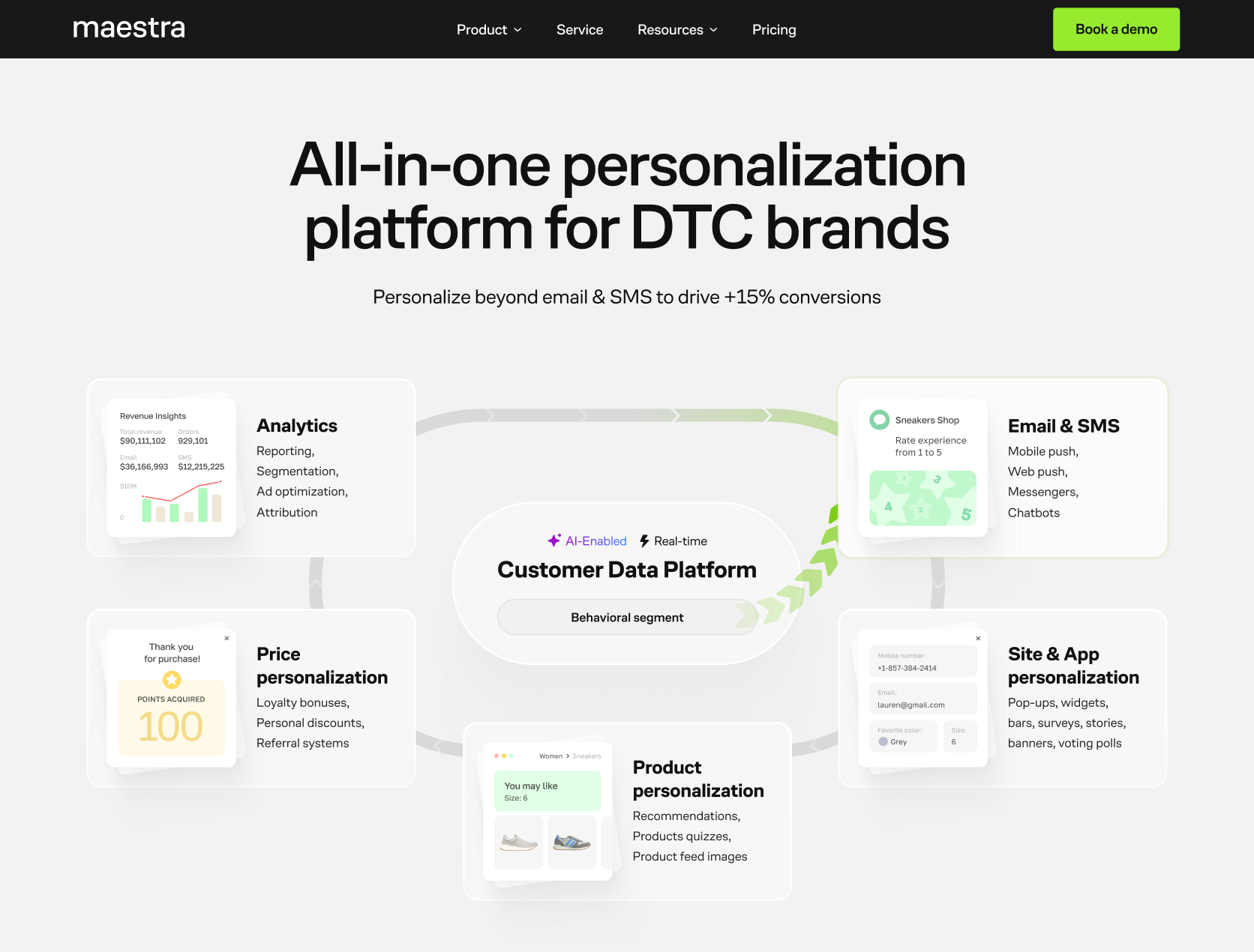
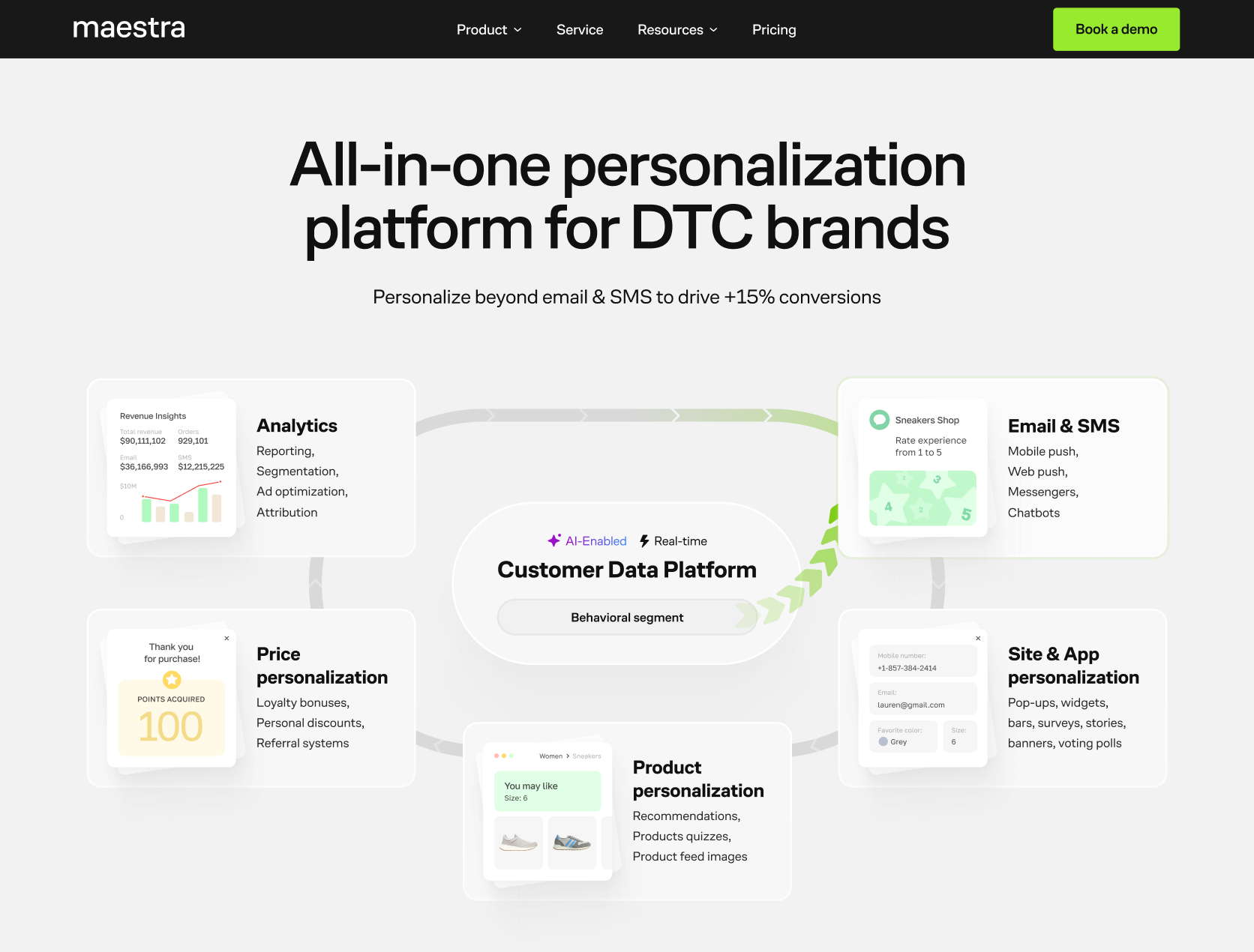
Maestra isn't a recommendation widget – it's an all-in-one marketing platform that happens to include a seriously capable recommendation engine. You get a real-time CDP, email, SMS, push notifications, site personalization, loyalty, and analytics alongside 14 AI-powered recommendation algorithms. All in one subscription.
For a Shopify merchant, the practical upside is that your product recommendations aren't siloed. The same customer data that powers your email flows drives your on-site suggestions. When someone buys through an email campaign, the website recommendations update instantly – no lag, no conflicting suggestions across channels.
Picture this: a customer browsing red bikini tops on your site sees the matching bottoms in her abandoned browse email – in their size, with the same material and cut. That's the kind of product intelligence most standalone recommendation apps simply can't deliver.
The recommendation engine itself offers real flexibility. You can let the AI run on autopilot – it handles "Frequently Bought Together," "Personal Recommendations," category bestsellers, post-purchase cross-sell, and more – or layer on business rules that filter by color, price, category, or any custom attribute. Furniture Fair had deep merchandising expertise in-store but no way to scale it online. They used Maestra's business rules to encode that knowledge into AI recommendations – +46% add-to-cart rate on-site, plus a hands-off post-purchase flow generating $26K/month.
The real power of an all-in-one platform is that your recommendations get smarter with every interaction across every channel – not just what happens on your storefront.
Maestra also handles automated bundles – grouping complementary products into a single offer at a combined price. You can let the AI generate bundles based on purchase patterns or build them manually around specific collections. Bundles show up on product pages, in cart, and inside email and SMS campaigns – same recommendation logic, same data, consistent across channels.
Maestra's product quizzes let you build guided discovery flows where the shopper answers a few questions and gets a tailored product selection based on their responses. Blossom Flower Delivery added a simple quiz and saw a 14% website conversion lift.
Here's a feature most recommendation apps don't touch: dynamic product cards for paid ads. Maestra auto-generates branded product visuals that update in real time with current prices, discounts, and "new arrival" badges – then pushes them directly to Meta and Google ad campaigns. No designer, no manual exports. Selkirk Sport, a pickleball brand on Shopify, saw a 2.6x ROAS increase and 17% CPC reduction on Meta ads after switching to Maestra's dynamic cards.
Maestra also supports Shopify Checkout Extensions for product recommendations at checkout and post-checkout, plus a Smart Upsell Bar that shows real-time progress toward free shipping or gift thresholds.
Maestra starts at $2,990/month for 150K active subscribers. It makes sense when you're ready to consolidate your stack, not just add a widget. JOLYN, a performance swimwear brand, replaced Klaviyo, Yotpo Rewards, Rebuy, and Amped with Maestra. Now 7% of their sales are influenced by recommendations – while repeat domestic revenue grew 22%.
Best for: Growing and established Shopify brands that want to consolidate their marketing stack and serve consistent recommendations across every customer touchpoint.
Rebuy: The Shopify-Native Checkout Upsell Powerhouse
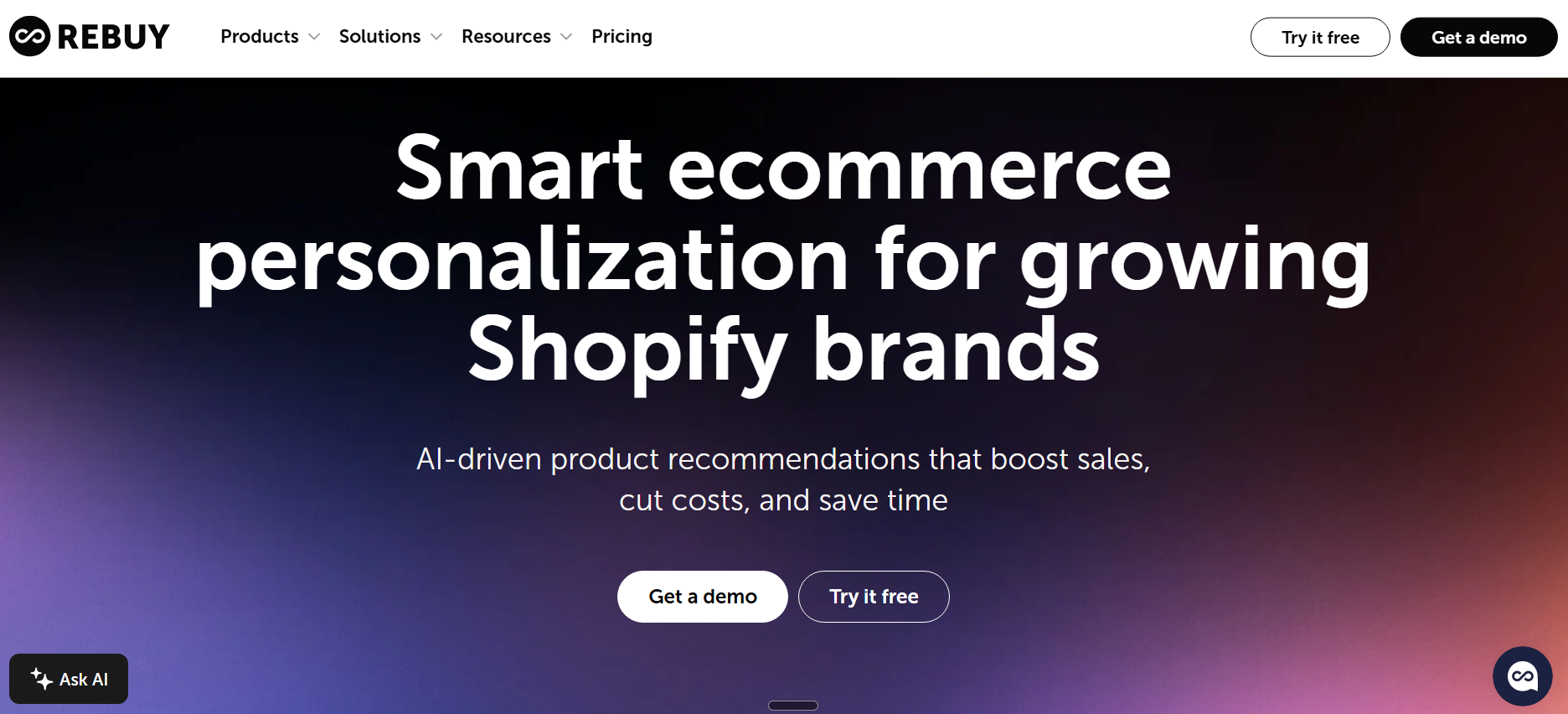
If you want a recommendation app that's built from the ground up for Shopify's architecture – cart, checkout, post-purchase, and everything in between – Rebuy is the default choice for a reason. It has 800+ reviews and a 4.7-star rating on the Shopify App Store, and it powers over 50,000 brands.
about it – every stage of the purchase journey becomes a merchandising opportunity. The Smart Cart transforms your cart drawer into a personalized experience, showing AI-powered recommendations, bundles, shipping protection, and gift options without redirecting to a new page. Native Shopify Checkout Extensions let you place offers directly on the checkout page. And post-purchase offers appear right after payment but before the thank-you page – that narrow window when the shopper has already committed and adding one more item feels effortless.
The visual rule builder makes it straightforward to set up conditional logic: "If cart value exceeds $100, show bundle A instead of bundle B." You can also run A/B tests across all recommendation placements to dial in what actually converts.
One unique feature is Rebuy Monetize – a free add-on that places post-purchase offers from partner brands on your thank-you page, earning you $0.20–$0.35+ per transaction. It's essentially a secondary revenue stream that costs you nothing. Free money, essentially.
Rebuy falls short is scope. Recommendation logic stays on your Shopify storefront – it doesn't extend to email, SMS, or any other channel. You'll need separate apps for those. And while the modular pricing (starting at $25/month per package) keeps the entry point low, some G2 reviewers note that costs scale with revenue. Advanced rule configurations also carry a learning curve.
Best for: Shopify merchants who want deep, native upsell and cross-sell functionality at checkout and post-purchase – without needing cross-channel recommendations.
Nosto: Enterprise-Grade AI for the Full Shopping Experience
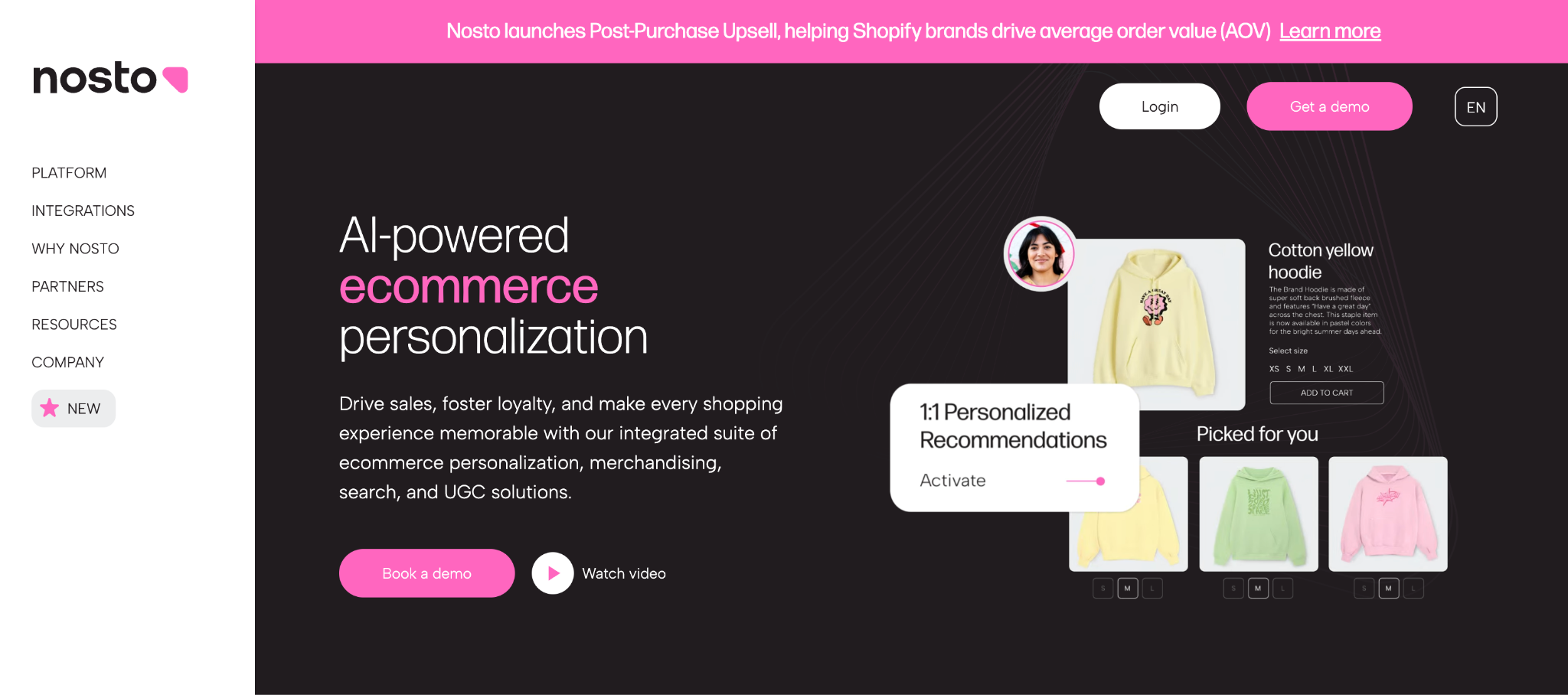
Nosto calls itself a Commerce Experience Platform – and the positioning is accurate. It goes beyond basic product recommendations into AI-powered site search, visual merchandising controls, content personalization, and user-generated content integration. Think of it as the recommendation app for merchants who want personalization across the entire shopping experience, not just a widget.
The recommendation engine uses 20+ self-learning algorithms that adapt in real time to individual shopper behavior. But what sets Nosto apart is the merchandising layer on top: a visual dashboard where you can pin products, boost or bury items based on margin or inventory levels, and set promotional priorities. If you want AI-driven recommendations with manual override for seasonal campaigns or clearance pushes – Nosto handles that well.
The platform also includes AI-driven search with autocomplete, spelling correction, and natural language understanding. Search results adapt to each shopper's behavior, which is a significant upgrade over Shopify's native search for stores with large catalogs.
Here's the catch: cost and transparency. Nosto doesn't publish pricing – you need to contact sales. The platform uses a commission-based model (typically 2.5–4% of Nosto-attributed sales), which means costs scale directly with revenue. Vendr data shows an average annual contract of $47.5K (~$3,966/month). Some Capterra reviewers find that expensive: "Fee paid for any sale that has a Nosto element to it, not always fair as other software could have been the clincher." The learning curve is also consistently mentioned in reviews – the platform is powerful, but it takes time and support to master.
Like Rebuy, Nosto doesn't include native email or SMS. It integrates with Klaviyo and other platforms, but product recommendations in those channels depend on the external tool.
Best for: Mid-market to enterprise Shopify stores ($3M+ revenue) that want AI-powered personalization across search, recommendations, and merchandising – and are comfortable with custom pricing.
Clerk.io: Cookieless Recommendations for Privacy-First Brands
Clerk.io takes a fundamentally different approach. It doesn't use third-party cookies or store personal identifiers. Instead, its AI analyzes transaction histories, click patterns, and product relationships using anonymous session data. In an era where browser cookie restrictions keep tightening and GDPR compliance keeps getting more complex – that's a meaningful differentiator.
The platform is modular: five separate products (Search, Recommendations, Email, Audience segmentation, and AI Chat) that you can buy individually. Recommendations start at €79/month for 50,000 monthly recommendations. The AI Chat module is particularly interesting – a catalog-aware chatbot that understands your products and guides shoppers to relevant items, essentially turning product discovery into a conversation.
That said, Clerk.io has some rough edges. Multiple G2 and Trustpilot reviewers report billing issues – charges continuing after cancellation requests, and a 30-day notice policy that catches merchants off guard. Customer support is hit-or-miss; some merchants describe it as "helpless" with low-level reps cycling through the same suggestions.
Integration with Shopify is done via JavaScript snippet and API rather than a native Shopify app, which adds a small layer of technical friction compared to app-store-based competitors.
Best for: European and privacy-conscious merchants who want cookieless personalization, modular pricing, and multi-platform support (Shopify, Magento, WooCommerce).
LimeSpot: Bundles and Upsells Without the Enterprise Price Tag
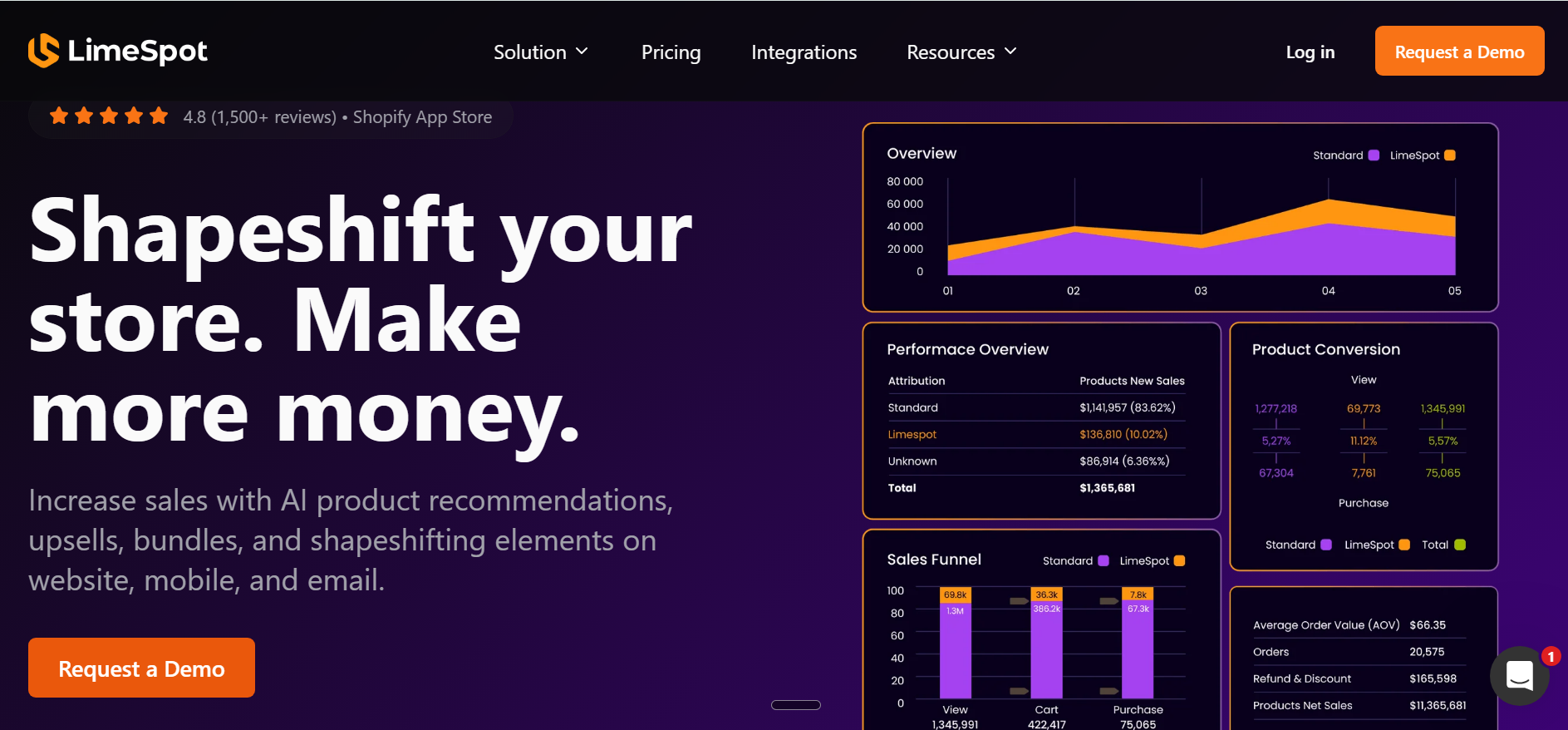
LimeSpot focuses on what drives AOV most directly: AI-powered bundles, "Frequently Bought Together" groupings, and checkout upsells. It carries a 4.6-star rating from 500+ Shopify reviews, and its "Complete the Look" feature makes it a strong pick for fashion and lifestyle brands.
commendation engine adapts in real time to customer behavior throughout the shopping journey. It places suggestions on homepage, product pages, checkout, and thank-you pages. The platform can also adjust pricing strategies based on customer segments – showing different offers to different shoppers based on intent signals.
LimeSpot reports 12–18% revenue uplift for merchants following their recommended setup, and the support team helps with widget customization during installation – a nice touch that speeds up time-to-value.
g starts low: the Turbo plan is free up to 10 monthly orders and scales from $9.99/month with order volume. The Max plan is $150/month for stores doing up to $50K in monthly revenue.
The concerns center around attribution and support. Some merchants report that LimeSpot "takes credit for selling things which have nothing to do with it" – a common frustration with recommendation apps that attribute broadly. Technical issues during peak traffic have also been flagged.
LimeSpot offers email and SMS personalization through integrations with Klaviyo, Mailchimp, HubSpot, and SendGrid – but it doesn’t send messages natively like an all-in-one platform would.
Best for: Small to mid-size Shopify merchants ($500K–$5M revenue) focused on bundles, "Complete the Look," and checkout upsells who want an affordable entry point.
Searchspring (Athos Commerce): The Discovery Engine for Massive Catalogs
Searchspring recently rebranded as Athos Commerce after merging with Klevu and Intelligent Reach – unifying three product discovery engines under one company. The combined platform focuses on the full discovery experience: search, merchandising, and contextual recommendations.
Here's the thing – if search is how most of your customers find products, and you're managing a catalog of 10,000+ SKUs, Searchspring's approach makes a lot of sense. The search engine adapts results in real time as shoppers type, with autocomplete, multi-language support, and natural language processing. The merchandising dashboard lets you boost, pin, or bury products based on margin, inventory, or promotional priorities across search results, collection pages, and recommendation widgets.
Contextual personalization adjusts recommendations based on where the shopper is in their session: new visitors see trending items; returning customers see products related to their history. A/B testing and conversion tracking are built in.
The company has deep experience in this space – Searchspring was founded in 2007. But the recent merger into Athos Commerce introduces uncertainty. Pricing historically started at $699/month and scaled with domains, sessions, and SKUs; after the rebrand, it's available only by request.
The platform focuses on search, browse, and recommendations – no native CDP. Email and SMS personalization is available through integrations with Klaviyo, Dotdigital, and Yotpo.
Best for: High-volume Shopify stores with large catalogs (10,000+ SKUs) where search and product discovery – not just recommendations – drive the majority of conversions.
Wiser: Real Recommendations on a Real Budget
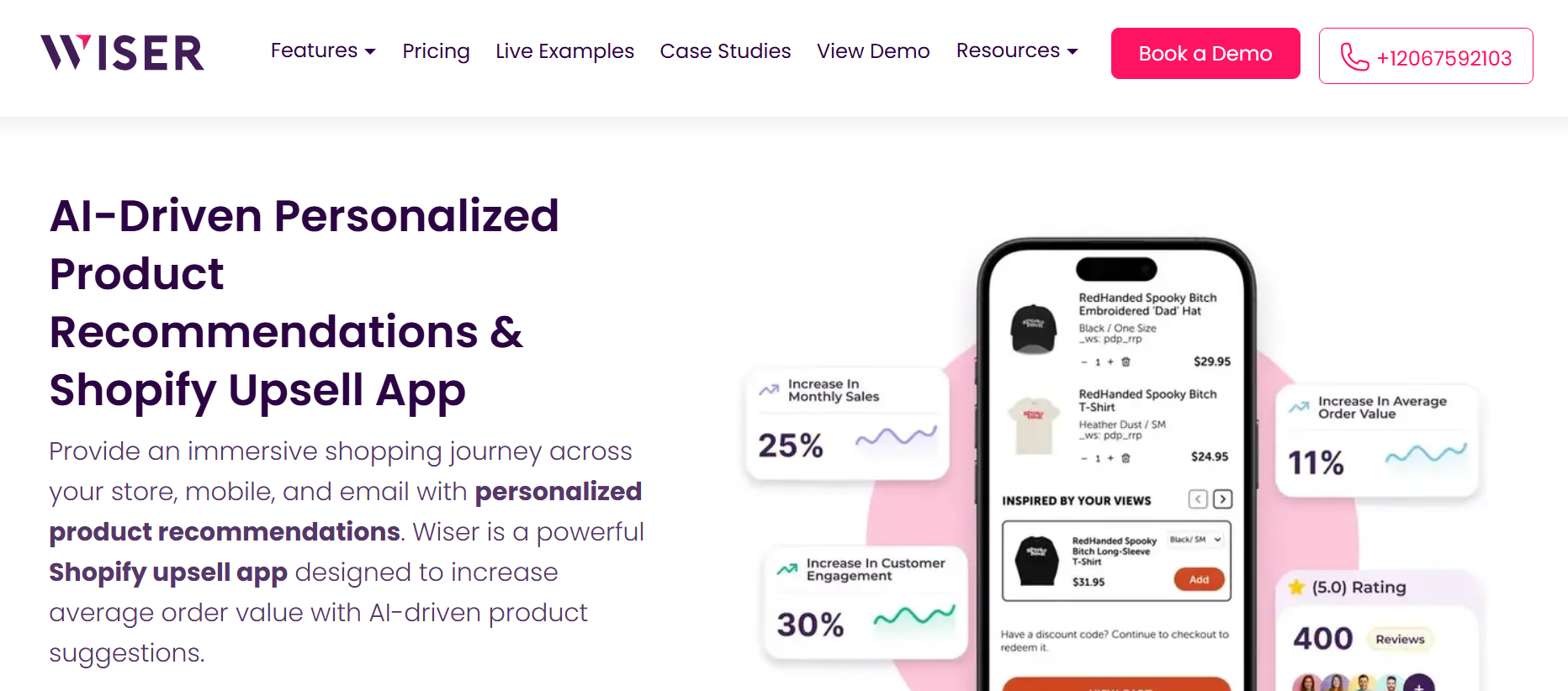
Not every store needs an enterprise recommendation engine. If you're doing a few hundred orders a month and want AI-powered product suggestions without a four-figure monthly bill – Wiser is hard to beat on value.
The numbers speak for themselves: 4.9 stars from 500+ Shopify reviews. That's one of the highest ratings in the entire category. The app covers more touchpoints than most budget apps – product pages, cart drawer, checkout, post-purchase, thank-you page, and email. Widget types include "Frequently Bought Together," related products, "Shop the Look," recently viewed, manual picks, and product bundles.
is straightforward. Long-term users describe it as working "even without much technical background," and support is consistently praised for speed – customization requests handled in under 20 minutes in some cases.
is free for stores with up to 50 monthly orders. Paid plans start at $9/month for 51–100 orders and scale incrementally: $19 (101–300 orders), $49 (301–500 orders), with higher tiers for larger stores.
The risk is in the billing model. A recent reviewer warned that Wiser charges "a percentage share of ALL sales on our site, not just attributed to what Wiser's recommendations were able to help sell." If that's accurate, the economics change fast as your revenue grows. The AI also isn't as sophisticated as platforms like Nosto or Maestra – Wiser handles "also bought" patterns well, but don't expect deep behavioral personalization or product-attribute matching across complex catalogs.
Best for: Smaller Shopify stores (under $1M revenue) that want meaningful product recommendations without a significant financial commitment.
Your Guide to Choosing the Right Recommendation App
The temptation is to look at feature lists and pick the app with the most checkboxes. Resist that. The right recommendation app depends entirely on where your business is right now and what problem you're actually trying to solve.
Don't chase features – chase the specific problem your store has with product discovery. The right app solves that problem cleanly, without adding operational complexity you don't need.
If your recommendations need to work across channels: You want the same product intelligence on-site, in email, SMS, push, ads, and your mobile app – not five separate tools guessing independently. Look at Maestra.
If you want native Shopify checkout upsells: Rebuy's integration depth with Shopify's cart and checkout is unmatched. If your primary goal is post-purchase revenue, start here.
If search is how customers find products: Large catalogs with thousands of SKUs need a discovery engine, not just a recommendation widget. Searchspring handles search, merchandising, and recommendations in one dashboard.
If you need enterprise-grade AI personalization: Nosto's 20+ algorithms and visual merchandising controls serve merchants who want real-time, behavior-driven personalization across the full shopping experience.
If privacy compliance is a priority: Clerk.io's cookieless approach means no dependency on third-party cookies or personal data storage – essential if your customer base is privacy-sensitive or you're selling heavily in the EU.
If you sell sets and matching products: You need recommendations that understand product relationships – color, size, material, compatibility. Maestra handles this; most apps don't.
If you're just getting started: Wiser gives you meaningful recommendations for free at low volumes, with a gradual pricing ramp as you scale.
- Building a Smarter Product Discovery Experience
A recommendation app does more than just suggest products – it shapes how customers navigate your store and how much they spend when they get to checkout. The right app turns a single-item browse into a multi-product order, reduces the friction of finding what you need in a big catalog, and makes every email and SMS feel relevant instead of generic.
The app you pick today doesn't have to be the one you use at $50M. Start with what fits your current reality, measure the impact with real A/B tests, and graduate to something bigger when the data tells you it's time. That compound effect – slightly higher AOV, slightly better conversion, slightly more repeat purchases – is where real growth comes from.
- Your Top Recommendation App Questions, Answered
- Will a Recommendation App Slow Down My Shopify Store?
Most modern apps load widgets asynchronously – they don't block your page from rendering. But any third-party script adds some weight. Run a before-and-after speed test with Google PageSpeed Insights during your free trial to measure the real impact on your specific store.
- Can I Use Product Recommendations in My Email Campaigns?
It depends on the app. Maestra includes cross-channel recommendations natively across email, SMS, push, and more. Clerk.io has a separate email module. For Rebuy, LimeSpot, and Wiser, email recommendations typically require integration with a platform like Klaviyo – the recommendation app itself doesn't send emails.
- What's the Difference Between Rule-Based and AI Recommendations?
Rule-based: you define the logic manually ("if someone buys A, show B"). AI-based: the engine analyzes behavioral patterns across all your shoppers and surfaces products automatically. Maestra, Rebuy, and Nosto let you combine both – AI handles the heavy lifting, business rules let you override when needed. LimeSpot and Wiser lean more heavily on AI with lighter manual controls.
- How Do I Measure Whether a Recommendation App Is Actually Working?
Track three things: (1) recommendation click-through rate – are shoppers actually engaging? (2) conversion rate lift – A/B test sessions with and without recommendations. (3) average order value – the most direct indicator of cross-sell and upsell success. Maestra, Rebuy, and Nosto all have built-in A/B testing for this.
Give any new app at least 30 days of data before drawing conclusions. Resist the urge to call it after three days – early spikes are noisy. Let the numbers stabilize before you decide.
- Is Shopify's Built-In Recommendation Engine Enough?
For stores with fewer than 100 products and simple product relationships – probably. But once your catalog grows, or you need personalization based on individual browsing behavior, purchase history, and real-time inventory – a dedicated app pays for itself through higher AOV and conversion rates. It's one of the fastest ways to improve your unit economics without touching your ad budget.