Master DHL Courier Rates: 2026 Guide

Your shipping quote looked fine when the order came in. Then the DHL invoice landed, and the margin on that order got thinner than expected.
That happens constantly in ecommerce operations. A merchant sees one number in a calculator, another number at label creation, and a third number after surcharges and billing adjustments settle. The problem usually isn't that DHL made up a fee. The problem is that many treat dhl courier rates like a single price, when they're really the output of a pricing formula.
For Shopify Plus brands, that gap shows up fast. It affects checkout rate accuracy, landed margin by SKU, support tickets after delivery, and even merchandising decisions when bulky products cost more to ship than is apparent. If you ship internationally, or even domestically with varied carton sizes, the difference between quote and invoice can become an ongoing leak.
Why Your DHL Invoice Is Higher Than the Quote
An order comes through with a shipping charge that looks acceptable at checkout. The label gets created, the parcel ships, and the DHL invoice arrives higher than expected. For a Shopify Plus brand, that difference is rarely random. It usually comes from inputs that were missing, estimated, or treated too loosely upstream.
A quote is only as good as the shipment data behind it. If your team entered a rough weight, skipped final carton dimensions, chose the wrong service, or added delivery options later, the quoted number and the billed number will drift apart. The invoice reflects what moved through the network and which billable conditions applied to that shipment.
The gap shows up in margin, not theory.
I see the same pattern in audits. Brands build rate logic around product weight and destination, then get hit later by dimensional billing, residential delivery fees, remote area charges, or shipment-level extras that were never modeled at checkout. Finance reads it as carrier inflation. In practice, it is often a data and packaging problem inside the operation.
If you ship cross-border, lane complexity makes the problem worse. A practical example is this guide to courier price from USA to India, which shows how route, service selection, and shipment profile change the final cost beyond the headline quote.
Practical rule: If your team cannot point to the exact invoice drivers, your checkout rates are probably missing billable inputs.
DHL pricing works as a stack of charges, not a single destination number. The final invoice can change because the box was larger than planned, the delivery address triggered an add-on, or the service level carried different surcharge exposure than the team expected. The quote was the starting point. The invoice is the operational reality.
What usually creates the mismatch
- Estimated weight instead of packed weight: The order was rated before pick and pack finalized the shipment.
- Missing carton dimensions: A lightweight order in an oversized box can bill at a higher weight than the scale shows.
- Service mismatch: The shipment moved on a faster or different DHL service than the rate logic assumed.
- Address-related fees: Residential, remote, or hard-to-serve destinations can add charges after the destination is validated.
- Optional extras: Signature, protection, pickup arrangements, and other accessorials increase the total invoice.
The practical question is not “What does DHL cost?” The useful question is “What will DHL bill for this exact parcel, on this lane, with this packaging and these service conditions?”
The Three Core Components of a DHL Rate
A Shopify Plus brand might quote one shipping cost at checkout, then see a different landed parcel cost after fulfillment closes the order. In my experience, that gap usually comes from one of three places: the linehaul price for the service, the billed weight DHL applies, or the extra fees attached to the shipment conditions.
That matters because each component is controlled by a different operational decision. Service selection sits with checkout logic or customer promise. Chargeable weight sits with packaging and pick-pack execution. Surcharges often sit with address quality, delivery requirements, and exception handling. If you want to protect margin, break the invoice apart before you try to negotiate rates.

Base rate
The base rate is the starting transport charge. It is mainly shaped by the service level and the destination lane.
A time-definite express shipment costs more than a slower option because you are buying tighter delivery performance and priority network capacity. Cross-border lanes also behave differently from domestic ones. Customs handling, lane density, and destination coverage all affect the starting price, even before the package size and extras come into play.
For operators, this is the first trade-off to audit. If your checkout promises speed that customers do not consistently value, the base rate gets inflated before the carton even reaches the pack bench.
Chargeable weight
The second component is the one that erodes margin. DHL may bill the shipment using the package's billed weight rather than the scale weight your warehouse sees.
For ecommerce brands, this is often where the actual invoice starts to drift from the quote. A light but bulky carton can move into a higher billed weight bracket because it takes up more network space. That hits brands selling apparel bundles, home products, subscription boxes, wellness kits, and gift packs especially hard.
The practical point is simple. Product weight is only part of the rating logic. Carton choice matters just as much.
Surcharges and accessorial fees
Surcharges are the cleanup crew on the invoice. They capture the shipment characteristics that the base rate does not cover.
Common examples include residential delivery, signature options, pickup-related charges, declared value protection, and other lane-specific fees. These charges are usually small in isolation and painful in aggregate. If your team ships thousands of parcels per month, a few avoidable add-ons can wipe out the margin gain from a headline carrier discount.
This is also where many rate reviews go wrong. Teams focus on the discount off the transportation charge and ignore the fees that sit outside it. The better approach is to ask which surcharges are showing up repeatedly, why they are being triggered, and whether the cause sits in packaging, checkout rules, address validation, or warehouse process.
The useful way to read a DHL invoice is line by line. Start with the service charge, verify the billed weight, then examine every extra fee that got layered on top.
A simple operating model for merchants
Use this framework when auditing any DHL shipment cost:
- Confirm the service that was used
- Check whether the billed weight matches the packed carton
- Review each surcharge and who triggered it
- Compare the invoice inputs against what checkout assumed
Teams that review invoices this way stop treating shipping variance as bad luck. They can trace the cost back to a specific decision and fix it.
Decoding Chargeable Weight Actual vs Dimensional
A common invoice surprise looks like this. The order weighs very little on the warehouse scale, the checkout estimate looked reasonable, and DHL still bills it at a higher weight. In many cases, the box size caused the increase.
Chargeable weight is the billed weight DHL uses to price the shipment. For ecommerce parcels, DHL eCommerce bills the greater of actual weight or dimensional weight. It also applies a domestic small-parcel exception in certain cases, which can materially change margin on low-weight orders.

Why dimensional weight exists
DHL prices shipments based on the space a parcel consumes in the network as well as what it weighs. A light carton with a lot of empty air still takes up room in vans, sortation equipment, and aircraft containers.
That is why soft goods and low-density bundles often disappoint finance teams. Apparel in oversized mailers, pillows, subscription kits, and gift sets can bill like heavier shipments even when the product itself is light.
If your team is comparing carrier behavior across similar parcels, this breakdown of DHL vs FedEx for ecommerce shipping is useful because dimensional policies and surcharge exposure can shift the true landed cost.
The formulas that matter
DHL publishes different calculation methods by shipment type:
- Parcels: divide cubic inches by 166
- Parcel metric version: divide cubic centimeters by 6,000
- Air freight: use a 1:6 density ratio, or length × width × height in cm divided by 6,000
- Road and rail: different density ratios can apply, including 1:3 for rail
Those methods are outlined in DHL's published explanation of chargeable and volumetric weight.
A practical comparison
Take two orders packed on the same day.
The first is dense hardware in a tight carton. The second is a larger box of lightweight apparel with void fill. The hardware order may show a higher scale weight, but the apparel order can produce the higher invoice if its carton dimensions drive up dimensional weight.
That is the part many teams miss during rate reviews. Product margin is tied to packed density, not just SKU weight in the catalog.
Evaluate shipping cost by packed shipment profile, not by SKU weight alone.
What operators can control
The biggest cost lever here is packaging discipline. If the warehouse defaults to one or two oversized cartons, dimensional charges will keep showing up no matter how good the negotiated transportation discount looks.
What works:
- Carton engineering: reduce unused air inside the shipper
- Pack-out rules by SKU group: assign tighter box options for soft goods, bundles, and kits
- Threshold control: keep qualifying domestic small parcels below the exemption trigger when operationally realistic
- Packed-dimension data: rate shop from actual packed dimensions, not catalog estimates
What does not work:
- One-box-fits-all fulfillment
- Relying on product-page dimensions instead of packed dimensions
- Assuming low actual weight means low DHL cost
For Shopify Plus brands, this is usually an operations problem before it is a carrier problem. Fix the carton, and the invoice often improves on its own.
Navigating DHL Service Levels and Shipping Zones
A merchant approves a shipping quote at noon, then sees a different margin picture at month end. The box size was already correct. The surprise came from a faster service than the order required, or from a destination lane that sits in a more expensive zone than the team expected.

Service level is a margin choice
DHL service selection should sit inside your order-routing rules, not in a picker's habit or a customer service shortcut.
For Shopify Plus brands, the true question is which orders qualify for premium transit. Replacement orders, time-sensitive international shipments, high-AOV purchases, and launch inventory often justify faster DHL options because a delay creates a larger commercial cost. Standard replenishment orders and lower-margin DTC parcels usually need a cheaper path, even if the delivery promise is a day slower.
If your team is reviewing carrier fit by lane, this comparison of DHL vs FedEx for ecommerce shipping is useful because it frames service trade-offs by operating model, not just by headline rate.
Zones change the invoice faster than many teams expect
Zones are part of the base transportation price. They are not a small adjustment.
Two shipments with the same contents, same carton, and same service can bill differently because DHL prices distance through zone tables. That matters in practice because many ecommerce teams report shipping cost by country, region, or fulfillment center, which is too broad to expose expensive lanes. A California to Nevada parcel and a California to East Coast parcel do not belong in the same cost bucket just because both are domestic.
This is one of the reasons quoted rates often look fine in isolation but weak in aggregate. The shipment-level estimate may be accurate. The routing mix is what changes the blended result.
How to use service levels and zones operationally
The useful move is to build shipping logic around order economics and lane behavior.
- Set service rules by order type: reserve premium DHL services for orders where late delivery creates refunds, replacements, or lost revenue
- Audit cost by lane, not just by carrier: review destination patterns to find zones that repeatedly erode margin
- Match inventory placement to repeat demand: if a region consistently lands in higher-cost zones, holding stock closer to that demand can lower transportation spend
- Separate CX exceptions from default routing: customer service upgrades should be tracked and approved, not absorbed without tracking into average shipping cost
I usually see the best results when finance, operations, and CX agree on where speed pays for itself. Without that alignment, teams overuse premium services, misread zone-driven cost increases as random variance, and end up negotiating rates before fixing the routing logic that created the problem.
Uncovering Hidden Costs Common DHL Surcharges
A shipment can clear your rate quote and still miss margin once the invoice lands. I see this a lot with Shopify Plus brands shipping cross-border. The base transportation charge looks reasonable, then accessorials stack up across hundreds of orders and subtly alter the economics of the channel.
Surcharges are where the final DHL bill starts to separate disciplined operations from expensive ones. Some fees are built into the way you ship. Others come from checkout settings, address quality, pickup habits, or destination mix. If your team only reviews the headline rate, you miss the part of the invoice that is easiest to control.
The charges that hit margins first
Domestic and international DHL invoices often pick up extra charges for residential delivery, signature requirements, non-standard pickup activity, declared value coverage, and remote delivery conditions. The exact fee level varies by market and service, as noted earlier. What matters operationally is that these are not edge-case exceptions for ecommerce brands. They show up repeatedly in the same order types and lanes.
Remote area fees deserve special attention. They are one of the fastest ways to underprice cross-border shipping because the destination qualifies for service, but at a materially different cost profile. A team may price France, Australia, or Singapore as a country-level lane while missing the postcode-level condition that drives the surcharge.
That is why I advise clients to audit invoice data at the order level, not just by country.
Common DHL surcharges and how to mitigate them
| Surcharge | What Triggers It | Pro Tip for Mitigation |
|---|---|---|
| Residential delivery | Shipping to a residential address where that fee applies | Validate address type before label creation: flag residential destinations early and show the right shipping options at checkout |
| Direct signature | Requiring recipient signature on delivery | Use it by exception: apply signature only to high-value, high-fraud, or replacement-sensitive orders |
| Non-standard pickup | Pickup requests outside your standard pickup setup | Tighten warehouse cutoff rules: consolidate collection windows and reduce ad hoc pickup requests |
| Shipment value protection | Adding declared value protection to eligible shipments | Set thresholds: use rules tied to product margin, replacement cost, and fraud risk |
| Remote area surcharge | Delivering to postal codes or service areas classified as remote in that market | Map remote postcodes: identify them in advance and adjust checkout pricing, routing, or shipping promises |
| Special handling and local service add-ons | Shipment characteristics or local product rules that require extra handling | Review by SKU and packaging type: repeated triggers usually point to a packaging or catalog setup problem |
Remote-area charges are especially hard on margin because they usually appear after the order has already been accepted at checkout.
What good operators do differently
Strong teams classify surcharges into three groups. Avoidable. Conditional. Accepted.
That sounds simple, but it changes behavior fast. Residential misclassification belongs in the avoidable bucket because better address validation can reduce it. Signature fees are conditional because the business may want them on certain orders. Remote area surcharges are often accepted, but they still need to be visible before the customer checks out and before finance signs off on contribution margin assumptions.
This is also where a multi-carrier shipping solution for ecommerce operations can help. If a lane or destination condition repeatedly triggers DHL accessorials, routing logic should test whether another service or carrier handles that order profile at a lower landed cost.
For operators building that review process, this expert guide to cutting shipping costs is a useful companion read.
The practical goal is not to eliminate every surcharge. It is to stop being surprised by them. Once invoice fees are tied back to checkout rules, packaging decisions, address quality, and routing policy, the final DHL bill becomes much easier to predict and defend.
Strategies for Reducing Your DHL Shipping Costs
DHL raised general average prices by about 5.9% effective January 1, 2026 for DHL Express and DHL eCommerce, and DHL had also announced a 7.9% general average shipment price increase in the U.S. effective January 1, 2023, according to this summary of major carrier rate changes. Annual increases are a recurring part of the shipping environment. If you're waiting for rates to become easier, you're waiting on the wrong lever.
The workable path is operational control.
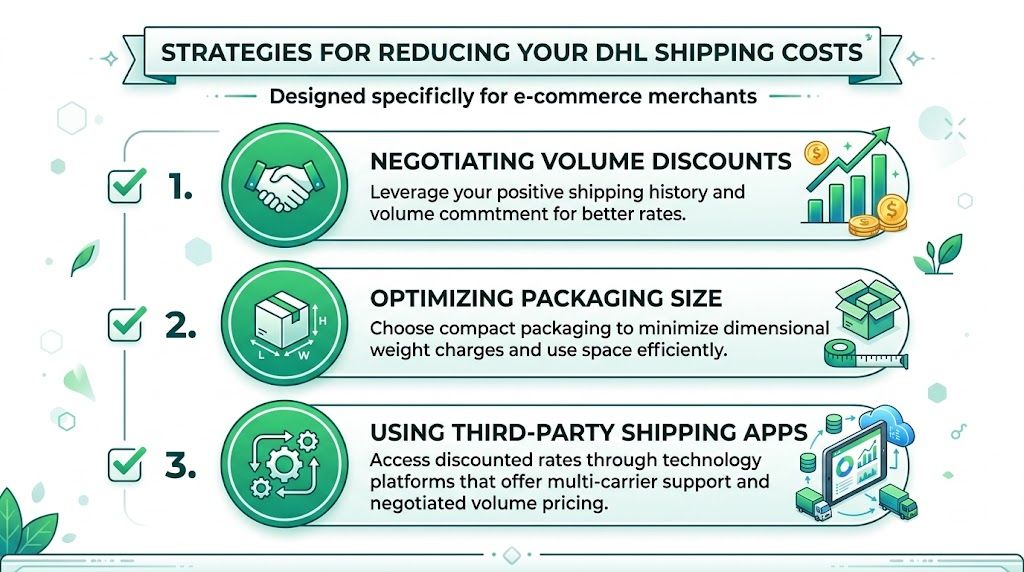
Optimize packaging before you negotiate anything
Negotiating with a carrier won't fix a bad carton profile. If your boxes are oversized, you're discounting the wrong number.
Start with packed dimensions, not product dimensions. Review your highest-volume SKUs, your worst margin orders, and any item family that ships light but bulky. If your team can reduce empty space, dimensional exposure drops immediately.
Use carrier mix instead of carrier loyalty
A lot of merchants overuse DHL because the network is reliable for cross-border. That doesn't mean every order belongs there.
For many brands, the best setup is a rules-based multi-carrier environment. Use DHL where speed, customs control, or service consistency matters. Use other carriers where the order is low urgency or low margin. This guide to choosing a multi-carrier shipping solution for ecommerce is useful if your current workflow still makes warehouse staff choose methods manually.
Audit invoices like a margin analyst
Most brands review freight totals. Fewer review billed weight changes, repeated surcharges by destination, or pickup and address-related leakage.
Create a regular invoice audit cadence. Focus on:
- Weight variance: compare quoted, manifested, and billed weight
- Surcharge clustering: find repeated fees by postal code, SKU family, or order type
- Service creep: identify where teams selected premium services without a clear reason
For a broader set of ideas outside DHL-specific tactics, this expert guide to cutting shipping costs is worth reading because it complements carrier-level analysis with process changes across fulfillment and checkout.
Later in the workflow, education helps too:
Charge the customer more accurately
If checkout uses flat rates while fulfillment uses real carrier logic, your margin is doing guesswork.
Live rate tools, address validation, and shipping rules help align customer-facing charges with actual shipment economics. They won't eliminate every variance, but they reduce the painful gap between what the shopper pays and what finance gets billed.
The brands that control shipping cost best don't chase a cheaper label. They build a better decision system.
Frequently Asked Questions About DHL Rates
How can I get live DHL courier rates in my Shopify checkout
Use a checkout setup that passes accurate shipment data, especially destination, packed weight, and packed dimensions. If dimensions are missing or estimated poorly, the returned rate won't reflect likely billed cost.
For Shopify Plus brands, the bigger issue is process discipline. Live rates only help if your warehouse packs to predictable carton rules and your checkout logic reflects the same assumptions.
Do DHL rates include customs duties and taxes
Not necessarily. The shipping charge and the total landed cost are different things.
Duties, taxes, customs support, and destination-specific charges can sit outside the base transportation quote. For international orders, merchants should decide whether they're showing a shipping price only or a fuller landed-cost view. If that distinction isn't clear, customers feel like they were undercharged at checkout or overcharged after purchase.
How often do DHL courier rates change
DHL pricing changes in more than one way. General average rate increases can happen on an annual cycle, while other components such as local surcharges and service-specific add-ons can change based on market rules and operational conditions.
That's why the right habit isn't checking the rate card once a year. It's maintaining an ongoing review process for packaging, service selection, and invoice variance.
If your team wants to reduce shipping-related support tickets while giving customers more control after checkout, SelfServe is worth a look. It lets Shopify brands enable customer self-service for address edits and order changes within rules you control, which helps prevent costly delivery issues before they turn into carrier fees, failed deliveries, or support backlog.