Boost with multi-carrier shipping solution: Cut costs and boost reliability
At its core, a multi-carrier shipping solution is a software platform that connects your ecommerce store to a whole network of different shipping companies. Think of it as a personal GPS for your packages—it automatically finds the best route for every single order, balancing speed and cost so you don't have to. It's the key to moving beyond relying on just one carrier for everything.
Your Shipping Mission Control Center
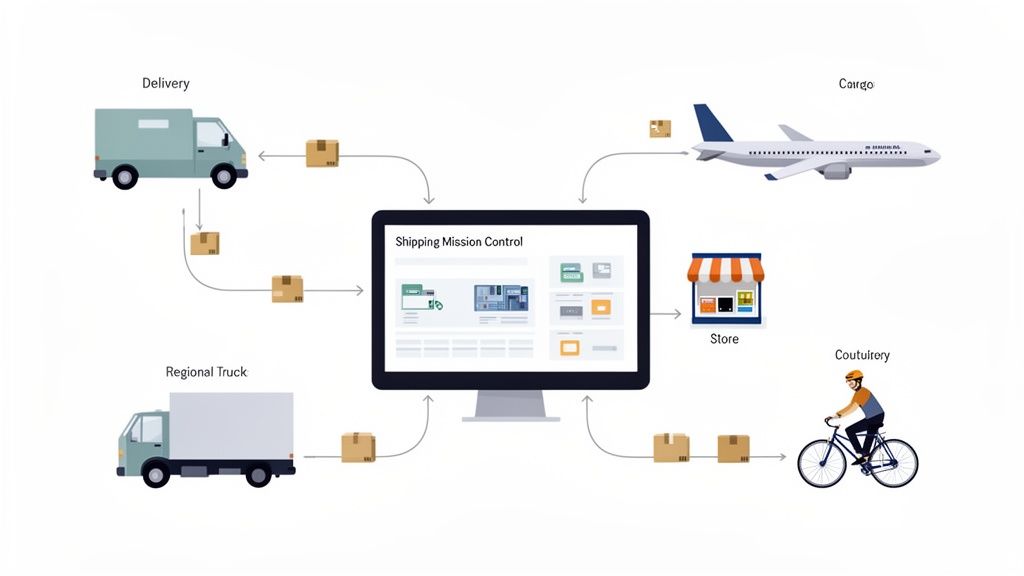
Imagine your entire fulfillment operation depends on a single highway. What happens when it gets jammed during the holidays or a surprise accident shuts it down? Everything grinds to a halt. For many high-volume Shopify merchants, relying on a single carrier is exactly like this.
A multi-carrier shipping solution gets you off that one-way street. It’s your shipping mission control—a command center giving you access to dozens of carriers, from global giants to nimble regional players, all managed through one dashboard. You're no longer stuck with one company's rates, rules, and limitations.
For a quick overview of how these two approaches stack up, here’s a simple comparison:
Single Carrier vs Multi-Carrier At a Glance
| Aspect | Single Carrier Strategy | Multi-Carrier Solution |
|---|---|---|
| Cost Control | Locked into one set of rates; limited negotiation power. | Shops for the best rate on every order across multiple carriers. |
| Delivery Speed | Dependent on one carrier's network and service levels. | Chooses the fastest option available for each specific destination. |
| Operational Risk | High vulnerability to delays, strikes, or capacity issues. | Builds resilience by providing instant backup carrier options. |
| Customer Experience | Fewer choices at checkout; potential for slow delivery. | Offers more delivery options (e.g., express, economy, local). |
| Flexibility | Rigid; one-size-fits-all approach to all shipments. | Highly adaptable; matches each package to the ideal carrier. |
This table makes it clear why so many growing brands are making the switch. The flexibility and control offered by a multi-carrier approach are just too significant to ignore.
Solving Critical Shipping Challenges
For brands that are scaling up, this isn’t a nice-to-have feature; it’s a core business strategy. A solid multi-carrier platform directly solves the nagging problems that eat into your margins and hurt your reputation.
It’s built to help you avoid:
- Overpaying for shipping by automatically finding the cheapest rate for every package.
- Getting sidelined by carrier disruptions, like labor strikes or bad weather, because you always have a Plan B (and C, and D).
- Losing customers to slow delivery estimates or a lack of shipping choices at checkout.
This strategic pivot is quickly becoming the industry standard. The global market for multi-carrier shipping software is on track to hit USD 2.5 billion by 2033, with a strong growth rate of 9.2% annually. More importantly, direct-to-consumer brands that optimize their shipping routes this way see customer satisfaction scores jump by an average of 25%.
A multi-carrier strategy fundamentally changes your approach. You stop trying to fit your shipments to one carrier's strengths and start fitting the right carriers to each shipment's unique needs.
By shifting from a reactive to a proactive shipping model, you can scale your business much more efficiently. Shipping is no longer just a cost center you have to manage; it becomes a powerful tool that gives you a real competitive edge. When you diversify your carrier mix, you build a more resilient, cost-effective, and customer-centric operation ready for whatever comes next.
Why Your Shopify Store Needs to Diversify Carriers
When your Shopify store starts to really take off, relying on a single shipping carrier feels a bit like trying to run a marathon in flip-flops. It might get you a little ways down the road, but eventually, it's going to hurt. The realities of high-volume sales, rising customer expectations, and supply chain surprises demand a smarter approach. That's where diversifying your carriers comes in.
This isn't just about having a Plan B. It's about fundamentally changing how you think about fulfillment. Adopting a multi-carrier shipping solution is the leap from a rigid, one-size-fits-all model to a nimble, optimized operation. Suddenly, you have the power to make the best, most cost-effective choice for every single package that leaves your warehouse.
Slash Your Shipping Costs
The most immediate win from carrier diversification is the power of real-time rate shopping. Instead of being handcuffed to one carrier's pricing and surcharge schedule, you can instantly compare all your options for every single order.
Think about it. You've got two identical packages. One is headed to a dense city just two states over. The other is going to a remote, rural address clear across the country. A single national carrier might tack on a hefty surcharge for that rural delivery, but a regional specialist could get it there for much less.
A multi-carrier platform finds those opportunities automatically, unlocking serious savings on a daily basis. We’re not talking about a few cents here and there; we're talking about a consistent drop in your cost-per-shipment that goes straight to your bottom line. Looking at the numbers in the US, the multicarrier shipping software market hit USD 229.55 million in 2023 and is projected to climb to USD 369.88 million by 2032. High-volume DTC Shopify brands are driving this trend, routinely pocketing savings of 15-25% per shipment by making the switch. You can explore more about these market trends and how they're shaping the DTC space.
Deliver Faster and More Reliably
Today's customers have been conditioned by Amazon to expect fast, predictable delivery. Not meeting that expectation is a fast pass to an abandoned cart or a one-star review. A multi-carrier strategy helps you turn this challenge into a real competitive edge.
By tapping into a whole network of carriers, you can:
- Pick the fastest horse for the course: The software can instantly pinpoint the carrier with the best transit time to any given ZIP code.
- Keep your promises: Confidently offer multiple delivery speeds at checkout (like Express, Standard, and Economy) because you know you can match the right carrier to each service level.
- Simplify tracking: A centralized dashboard gives both your team and your customers one place to look for updates, no matter who is carrying the package.
You stop trying to fit your shipments to a single carrier and start fitting carriers to your shipments. This simple mental shift is the secret to building a fulfillment operation that truly puts the customer first.
This strategic change means you're no longer hamstrung by one company's network limitations. You're free to choose the top performer for every single order, every time.
Build an Antifragile Operation
What happens if your only carrier goes on strike? Or if a major storm system shuts down their main hub? Or when they simply hit capacity during Black Friday and stop accepting new pickups? For most businesses, it means everything grinds to a halt. Orders get delayed, and your support team gets buried in tickets.
A multi-carrier strategy is your insurance policy against this kind of chaos.
Picture this: You’re in the middle of a huge flash sale, and your primary carrier suddenly announces a two-day backlog in your region.
- The Old Way: You're stuck. You can either wait it out and infuriate your customers, or you can frantically try to onboard a new carrier in the middle of a crisis.
- The Multi-Carrier Way: You just adjust your shipping rules. With a couple of clicks, you reroute all new orders to your secondary or tertiary carriers. The packages keep flowing out the door without a single hiccup.
This kind of resilience keeps your business running, protects the reputation you’ve worked so hard to build, and gives you the confidence to meet customer demand no matter what’s happening in the world. It transforms your shipping from a fragile point of failure into a flexible, powerful asset.
When you start looking for a multi-carrier shipping platform, the feature lists can feel endless. To avoid getting bogged down in marketing hype, you need to know which tools actually solve the real-world problems that high-volume Shopify merchants face every day.
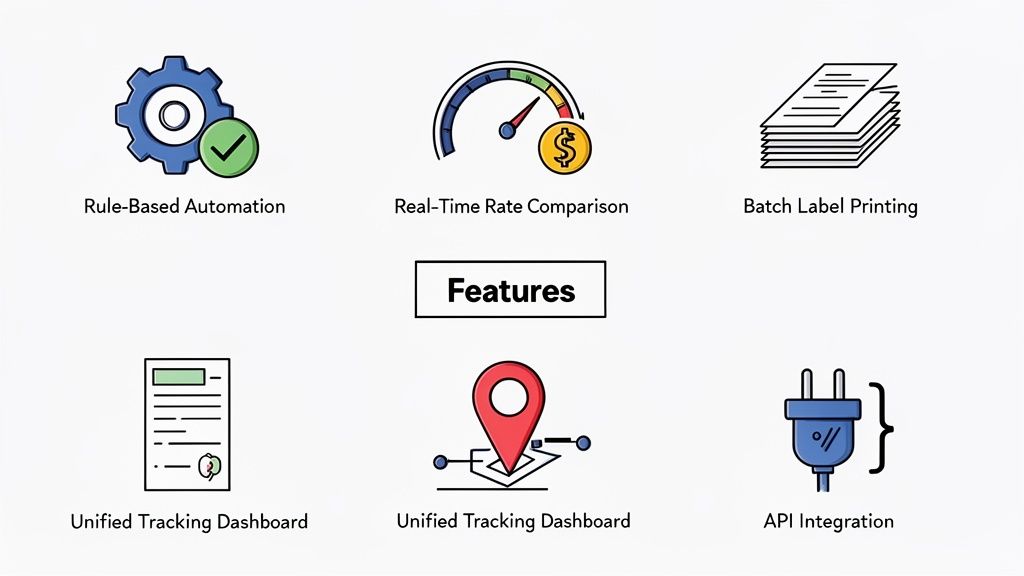
Let's cut through the noise. The goal isn't just to check off boxes on a feature list; it's to understand how each component directly impacts your bottom line. Ask yourself: How will this save my team time? How does it lower my shipping costs? Does it make my customers happier? That's how you find a tool that's a genuine investment, not just another subscription.
Rule-Based Automation: Your Fulfillment Autopilot
Imagine having an expert on your team who, in a fraction of a second, knows the cheapest and most reliable carrier for every single order that comes in. That’s precisely what rule-based automation delivers. It’s an autopilot for your shipping operations, making intelligent decisions based on criteria you define.
Instead of your team manually weighing options for each package, the system does the thinking for them. You can create "if-then" rules for almost anything, such as:
- Package Weight: If a package is under 1 lb, use USPS Ground Advantage. If it's over 50 lbs, automatically select UPS Ground.
- Destination: If the delivery is within a 50-mile radius, use a local carrier. If it's going cross-country, use a national one.
- Product SKU: If the order contains a specific fragile item, automatically assign it to a carrier with better insurance and handling.
- Delivery Promise: If a customer paid for "2-Day Express," the system will only show and select services that can meet that deadline.
This level of automation virtually eliminates human error and guarantees you’re always using the most cost-effective service that meets your standards. It frees up your team to handle exceptions, not the rule.
Core Features That Drive Efficiency
Beyond the "brains" of automation, a solid multi-carrier platform needs a few workhorse features to handle the daily grind of a busy warehouse. These tools are what turn a smart system into a high-velocity operation.
Must-Have Multi-Carrier Software Features
The table below highlights the features that form the backbone of any good platform. It breaks down what they do and, more importantly, how they directly affect your business's efficiency, costs, and customer experience.
| Feature | What It Does | Business Impact |
|---|---|---|
| Real-Time Rate Shopping | Connects to your carrier accounts to instantly pull all available rates for a specific shipment. | Cost Savings: Ensures you always see the cheapest option in real-time, including your negotiated discounts. |
| Batch Label Printing | Lets you select hundreds of orders at once and print all the shipping labels in a single job. | Time Savings: Drastically reduces a major fulfillment bottleneck, cutting down hours of manual work. |
| Unified Tracking Dashboard | Consolidates tracking information from all carriers into a single, centralized view for your team. | Customer Satisfaction: Reduces "Where is my order?" tickets by giving your team and customers one source of truth. |
| Robust API & Integrations | Connects seamlessly with your Shopify store, WMS, ERP, and other critical business software. | Operational Efficiency: Prevents data silos and manual data entry, ensuring information flows smoothly across your tech stack. |
Ultimately, a platform without these core functionalities will create more problems than it solves. They are the non-negotiables for any brand looking to scale its fulfillment operations effectively.
Tying It All Together: A Single Source of Truth
Using multiple carriers can get messy fast if you don't have the right system in place. A unified tracking dashboard is crucial. It gives both your team and your customers a single place to see the status of any order, no matter which carrier has the package. This visibility immediately cuts down on support queries and keeps everyone in the loop.
Equally important is how the software plays with your other tools. Strong API and integration capabilities are absolutely essential. Your shipping platform must talk to your:
- Shopify Store: To download orders and send back tracking data automatically.
- Warehouse Management System (WMS): To keep fulfillment status and inventory levels in sync.
- Enterprise Resource Planning (ERP): For accurate financial reporting and cost reconciliation.
Without deep integrations, you’re just creating more manual work for your team, which defeats the entire purpose. As you evaluate options, pay close attention to the platform's integration library and API documentation. It's also wise to see how other dedicated Shopify shipping apps might fit into and enhance your new, more powerful workflow.
How to Choose the Right Solution for Your Brand
Think of picking a multi-carrier shipping solution like buying a vehicle for your business. A small local shop might get by just fine with a reliable sedan. But if you're a high-volume enterprise, you need a whole fleet of logistics trucks. The goal is to find the right tool for the job—one that can handle today’s orders and scale with you tomorrow.
Before you even glance at a single software platform, you have to get your own house in order. A solid needs assessment is non-negotiable. This means digging into your metrics and processes to get a crystal-clear baseline of where you stand. This internal audit will be your compass as you navigate the market and find a partner that actually fits your brand.
Start with a Needs Assessment
First things first, pull your data. You need to answer a few simple but crucial questions about your shipping operations. Getting this clarity upfront stops you from getting distracted by flashy features you'll never actually use.
- Order Volume: What are your daily, weekly, and monthly shipping numbers? Be sure to look at your averages and your peak season spikes to understand the kind of scalability you’ll need to demand.
- Product Characteristics: What are you actually shipping? Consider the typical weight, dimensions, and fragility of your products. These details directly impact which carriers will be the most affordable and reliable for you.
- Shipping Destinations: Where are your customers located? If you have a high concentration of local or regional buyers, smaller, specialized carriers might be far more cost-effective than the national giants.
Once you have this data, you can build a profile of what your ideal shipping setup looks like. This profile will be your guide as you start sizing up different platforms.
Evaluate Your Potential Partners
With your needs clearly defined, you can start vetting solutions against a handful of make-or-break criteria. You have to look past the sales pitch and really dig into the details that will affect your daily operations and, ultimately, your bottom line.
1. Carrier Network Diversity: Does the platform integrate with the carriers you actually need? This isn't just about the big names like UPS and FedEx. Look for access to the regional carriers and international services that are essential for serving your specific customer base. A deep carrier library is a great sign of a mature, flexible platform.
2. Depth of Shopify Integration: How well does it really plug into your store? A shallow integration might just pull order data and call it a day. A deep one, however, will sync tracking info back to customers, update order statuses automatically, and play nicely with your existing Shopify apps and workflows.
3. Transparent Pricing Models: Is the cost structure easy to understand? Steer clear of any solution with a web of hidden fees or confusing pricing tiers. You want a partner who offers straightforward pricing that scales predictably as your business grows.
4. Quality of Customer Support: When your shipping system goes down during Black Friday, who are you going to call? Do your homework on the provider's support reputation. Do they offer dedicated account managers? Quick response times? Real expert guidance? A solid support team is an invaluable asset.
Choosing a shipping partner isn't just a software decision; it's a long-term strategic commitment. The right partner should empower your growth for the next five years, not just solve today’s immediate problems.
Ask the Right Questions During a Demo
A software demo is your chance to get under the hood and see if the platform lives up to the hype. Don't just sit back and watch. Come armed with specific, pointed questions that force them to show you, not just tell you, what the software can do.
Here are a few questions you should definitely ask:
- "Can you show me exactly how your rule-based automation would handle a shipment over 50 lbs going to a rural ZIP code?"
- "What is your average onboarding time for a Shopify merchant of our size?"
- "How does your platform handle international shipping compliance and customs documentation?"
- "Walk me through the real-world process of adding a new regional carrier to our account."
The answers to these kinds of questions will tell you everything. You'll quickly find out if the platform has the real-world functionality you need and if the company is truly equipped to be a partner in your success.
Implementing Your New Shipping Strategy
Making the switch to a new shipping strategy isn't as simple as flipping a switch. It’s a carefully staged process that, when done right, makes the whole transition feel seamless. A well-thought-out plan is your best defense against operational hiccups and the fastest way to start seeing the real benefits of a multi-carrier solution.
First things first, you’ll handle the technical setup. This just means plugging your carrier accounts—your UPS, FedEx, or USPS account numbers—into the new software. You’ll also want to load any special negotiated rates you have to make sure the system is always pulling the correct, real-time pricing for every order.
With the carriers connected, it's time to set up your first shipping rules. This is where you really start to unlock the power of automation. You’re essentially teaching the software your business logic by creating simple "if-then" commands it can run on its own. Getting this right is critical.
Launch with a Pilot Program
Instead of going all-in at once, take a page from experienced operations leaders and start small. A pilot program is the smartest way to test the waters, find any potential snags, and fix them before they can affect all of your customers. This approach takes the risk out of the transition and helps get your team on board.
Here’s a simple roadmap to get your pilot off the ground:
- Select a Limited Scope: Pick just one product line or a small group of SKUs to start with. If you can, choose items with consistent weights and dimensions to keep things simple for your first run.
- Configure Initial Rules: Build some basic automation rules just for this product set. Think simple, like, "If the package is under 1 lb, use Carrier A; if it's over 1 lb, use Carrier B."
- Train a Small Team: Get a core group from your fulfillment staff comfortable using the new system. They’ll become your internal experts who can help train everyone else later on.
- Monitor and Refine: Start processing real, live orders. Watch the results like a hawk, listen to feedback from your team, and don't be afraid to tweak the rules. For more tips on refining your fulfillment workflow, check out our guide on shipping and fulfillment best practices for Shopify merchants.
This controlled rollout gives you a safe space to learn and adapt. You can iron out all the wrinkles before you roll the new system out to every single order.
Track Key Performance Indicators from Day One
You can't improve what you don't measure. The moment your pilot program goes live, you need to be tracking a few key performance indicators (KPIs). These numbers are what will ultimately prove the ROI of your new multi-carrier software and point you toward your next optimization opportunities.
A successful implementation isn't just about getting the software up and running. It's about using data to confirm it's actually delivering on its promises of lower costs and better service.
Keep a close eye on these essential KPIs:
- Average Cost Per Shipment: This is your most direct measurement of cost savings. Compare this number to your old single-carrier data to see the immediate financial impact.
- On-Time Delivery Rate: Are your packages arriving when you said they would? This KPI tells you how well your carriers are performing and if the delivery estimates you show at checkout are accurate.
- Time to Ship: How quickly do you get an order out the door after a customer clicks "buy"? This helps you measure efficiency gains in the warehouse, especially from features like batch label printing.
- Shipping Cost as a Percentage of Revenue: This is a big-picture metric that shows how your shipping expenses are affecting your overall profitability.
By tracking these numbers, you replace guesswork with hard data. It takes the mystery out of the transition and gives you the objective proof you need to show just how valuable a smarter shipping operation can be.
Connecting Shipping to the Customer Experience
A perfectly tuned multi-carrier shipping solution is a beautiful thing. You’ve got the best rates, the fastest routes, and your warehouse is humming. But the customer's journey doesn't end when a package is scanned out the door.
What happens when a customer places an order and, five minutes later, realizes they misspelled their street name? That tiny moment of panic can completely undermine an otherwise perfect transaction.
This is where your shipping strategy needs to evolve beyond pure logistics. A great multi-carrier shipping solution handles the back-end, but what truly sets a brand apart is connecting that operational efficiency to a fantastic front-end experience. The post-purchase window is your final—and arguably most important—touchpoint.
This diagram shows how a shipping strategy matures from simply connecting carriers to actively tracking and improving the entire process.
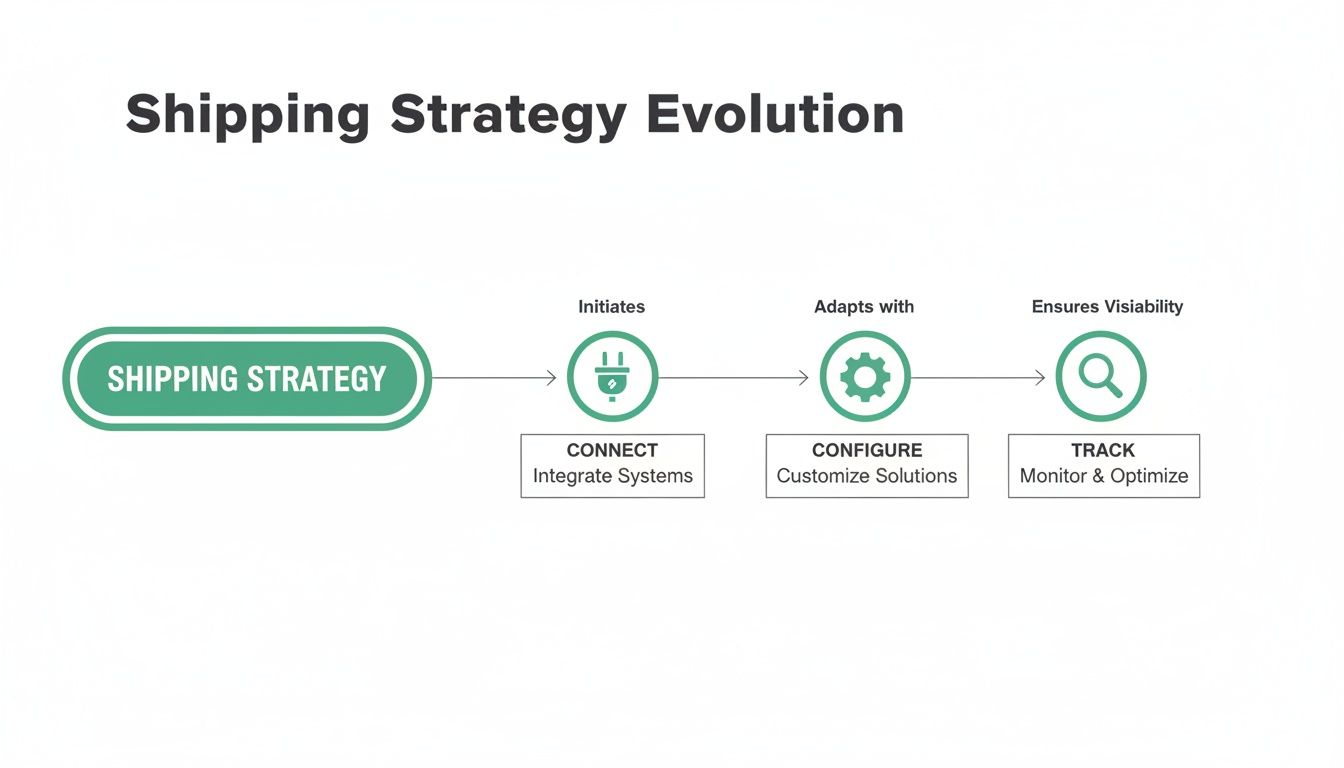
It’s not a one-and-done setup. A modern shipping strategy is a continuous cycle of connecting your systems, configuring the rules, and monitoring performance to get better over time.
Empowering Customers to Solve Their Own Problems
Imagine a world with fewer support tickets. Instead of emailing your team in a frenzy over a typo, your customer can just fix it themselves, right after checkout. This is the new frontier of customer experience, where post-purchase tools work hand-in-hand with your multi-carrier workflow.
By giving shoppers a brief, controlled window to make their own edits, you turn a potential headache into a moment of relief. This self-service capability is the perfect partner to your logistics operation because it ensures the data flowing into your multi-carrier system is accurate before you even think about printing a label.
The result is a direct hit to two major cost centers:
- Customer Support Overhead: Fewer "Where is my order?" (WISMO) tickets and frantic emails about address changes free up your support team to handle more complex customer needs.
- Mis-shipments and Returns: When customers can fix their own mistakes, packages actually arrive on the first try. This drastically cuts the costs tied to rerouting, returning, and reshipping orders.
Your shipping operation becomes more than just efficient; it becomes resilient. By adding a layer of customer-driven quality control, you prevent costly errors at the source and create a smoother experience for everyone.
Turning the Order Status Page into a Profit Center
The link between logistics and customer experience doesn't just stop at fixing problems. It also creates new opportunities for growth. Think about the order status page—it's one of the most visited, yet most underutilized, pages on your entire site.
Customers come back to this page over and over again to check on their delivery status. This high-engagement, high-intent moment is the perfect place to offer them more value. By integrating targeted upsell opportunities right on the order status page, you can generate more revenue from an already happy customer.
Think about these real-world scenarios:
- A customer who just bought a new camera sees a one-click offer to add a memory card to their order before it ships.
- Someone who purchased a set of skincare products gets a prompt to add the matching travel-size version.
These post-purchase upsells work so well because the customer is already in a buying mindset. They see a relevant, convenient offer and don't have to go through the whole checkout process again. Suddenly, your order tracking page transforms from a simple utility into a strategic revenue driver. You can also see how this connects to the very last step of the delivery by understanding what last mile tracking means for your brand.
Ultimately, when you connect your multi-carrier shipping solution to a smart post-purchase toolkit, shipping is no longer just a cost of doing business. It becomes a core part of a profitable, customer-focused strategy. You not only save money on operations but also build stronger loyalty and open up new income streams, all while delivering a fantastic experience from click to doorstep.
Frequently Asked Questions
It's natural to have questions when you're thinking about overhauling your shipping process. Let's tackle some of the most common ones we hear from merchants who are considering a multi-carrier shipping solution.
How Much Does a Multi-Carrier Solution Cost?
Pricing really runs the gamut. Some platforms offer a straightforward monthly subscription, while others might charge you based on the number of labels you print. The key is finding a provider with transparent pricing that grows with you, not one that hides essential features behind confusing paywalls.
But don't just look at the price tag; think about the return on your investment. While there's an upfront cost, the money you save from automatic rate shopping and fewer fulfillment errors often means the software more than pays for itself. For most high-volume brands, it’s a net financial win.
Will I Lose My Negotiated Carrier Rates?
Absolutely not. In fact, a good multi-carrier platform is built to amplify your existing carrier relationships, not get in their way. When you get set up, one of the first things you'll do is plug in your own accounts with carriers like UPS, FedEx, or others.
The system simply pulls your specific, negotiated rates into its dashboard. This means you're always comparing your best possible pricing against all other options, locking in maximum savings on every package that leaves your warehouse.
How Long Does Implementation Take?
This really depends on how complex your back-end operations are. If you're running a fairly standard Shopify store, you could be up and running in a few hours. The basics just involve connecting your carrier accounts and setting up some simple shipping rules.
For bigger brands with custom WMS or ERP integrations, the process is more involved and might take a few weeks. A smart approach is to run a pilot program—test the new system with just one product line or a specific warehouse first. This lets you iron out any kinks without disrupting your entire fulfillment operation.
Ready to connect your efficient shipping strategy to an unforgettable customer experience? SelfServe empowers your customers with post-purchase order editing, address validation, and one-click upsells, reducing support tickets and increasing your average order value. Start your 30-day free trial and see the difference.