DHL vs FedEx Choosing Your 2026 Ecommerce Shipping Partner
Choosing between DHL and FedEx isn't a simple "one is better than the other" decision. The right answer really depends on where you're shipping. If you’re a merchant with a global customer base, DHL is the undisputed king of international shipping. On the other hand, if your business is focused on the US market, FedEx has the upper hand for fast domestic deliveries.
For anyone managing logistics, understanding this core difference is the first step toward building a shipping strategy that actually works—for your bottom line and your customers.
DHL vs. FedEx: The Short Answer for Busy Merchants
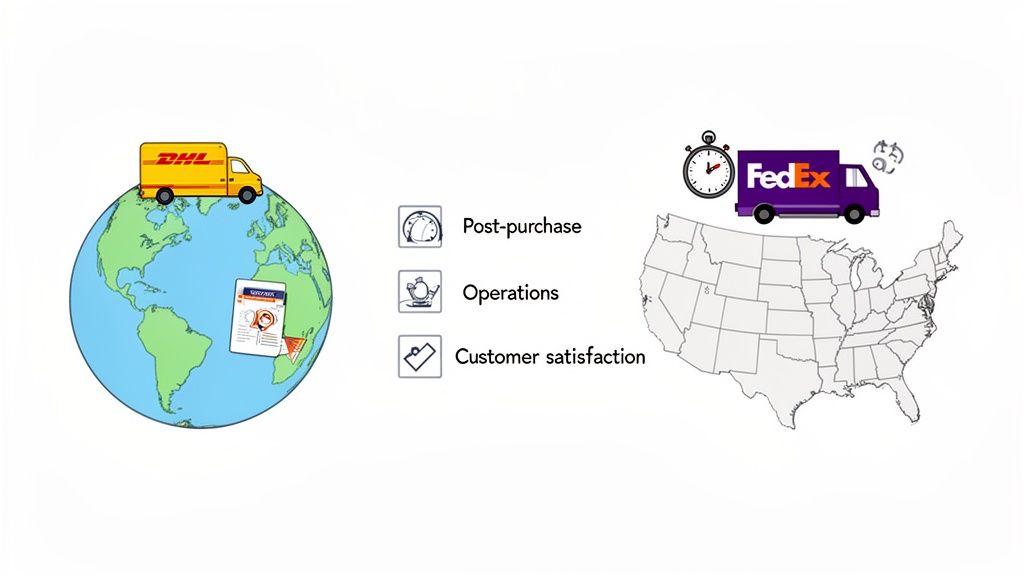
As an ecommerce operator, your carrier choice goes far beyond just comparing rates. It's about matching a carrier's strengths to your business model. DHL is the default choice for brands with a significant global footprint. Their massive network and deep expertise in customs brokerage are invaluable for navigating the messy reality of international sales, creating a much smoother post-purchase experience for customers around the world.
FedEx, in contrast, built its empire on the US market. Its dense ground network and reliably fast domestic services make it the more logical and cost-effective partner if your customers are primarily stateside. When speed and dependability within the US are your top priorities, FedEx is tough to beat.
Key Differentiators
The entire debate really boils down to one thing: global reach versus domestic dominance. DHL’s leadership in international express shipping is a huge advantage for any merchant selling across borders.
In the high-stakes world of global express shipping, DHL holds a commanding lead over FedEx in the premium time-definite international (TDI) segment, boasting over 43% of global TDI revenue market share as of 2023, compared to FedEx's 27%. You can read more about how this market dominance impacts shipping on redstagfulfillment.com.
This isn't just a number—it means DHL has more direct flight routes, fewer package handoffs, and faster customs clearance in more countries. FedEx is a giant in North America, but its international presence is smaller. For many businesses, the smartest path forward is a multi-carrier shipping solution that leverages the best of both worlds.
DHL vs. FedEx At-a-Glance Comparison
If you need a quick recommendation, this table breaks down the primary strengths and best use cases for each carrier.
| Feature | DHL Express | FedEx |
|---|---|---|
| Primary Strength | Unmatched international network and customs expertise. | Extensive US domestic ground and air network. |
| Ideal Use Case | Cross-border ecommerce, high-value international shipments. | Fast domestic US delivery, heavy freight within the US. |
| Global Reach | Leader in Europe and Asia-Pacific. | Strong in North America, more limited elsewhere. |
| Customer Experience | Smoother customs clearance reduces international delays. | Reliable tracking and varied speed options for US customers. |
This at-a-glance view helps clarify the core roles each carrier can play in your logistics stack. Most growing brands find they eventually need both to optimize for cost, speed, and customer experience across different markets.
International Speed and Network Coverage Compared
When you’re comparing shipping carriers, just looking at a list of countries they serve is a classic mistake. The real difference isn't if they can get a package to a destination, but how they do it. For any e-commerce business, that "how" is everything—it's the difference between a happy customer and a support ticket.
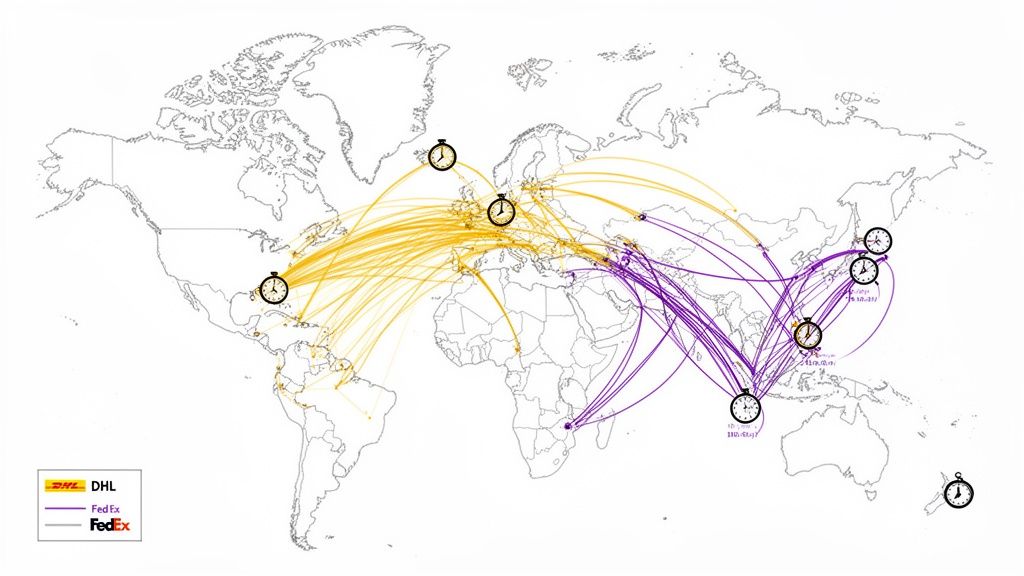
This is where DHL and FedEx show their true colors. Their entire networks were built on fundamentally different strategies. FedEx started by blanketing the United States, building an unmatched domestic machine. DHL, being German-owned, set its sights on the rest of the world from day one.
DHL's Global Stronghold
DHL's biggest advantage is its deeply integrated global network, especially across Europe and Asia. They didn't just partner with local carriers; in many regions, they built or acquired the entire infrastructure. This means DHL often controls the package from your warehouse all the way to the customer's front door.
That end-to-end ownership is a huge deal. It dramatically cuts down on the number of times a package is handed off between different companies.
Fewer handoffs directly lead to:
- Quicker Transit: Packages simply move faster when they aren't waiting to be processed by a third party.
- Fewer Delays: Every transfer point is a potential failure point. By minimizing them, DHL reduces the risk of your shipment getting stuck.
- Simpler Customs: DHL’s own teams on the ground are experts in local customs, often clearing packages before a problem even arises.
Imagine you're shipping a high-value item to a customer in France. With DHL, that package stays in one system the whole way. It’s a cleaner, more predictable journey, which is exactly what you need when your brand reputation is on the line.
The data confirms this. DHL commands a massive share of Europe's time-definite international market and has a formidable presence in the Asia-Pacific region. As you can see from their own business profile insights, their focus has paid off in markets outside of North America.
FedEx's North American Powerhouse
FedEx’s network, on the other hand, is an absolute juggernaut in North America. Its air and ground services across the United States are incredibly dense and fine-tuned for speed. If most of your customers are in the US, FedEx is often the undisputed champ for getting packages delivered quickly and reliably.
The game changes when FedEx goes abroad. In many international markets, it operates on a different model, often relying on local, third-party contractors to handle the final-mile delivery. While this extends their reach, it also introduces more variables.
Key Takeaway: The choice for international shipping comes down to where your customers are. For Europe and Asia, DHL's unified network often delivers superior speed and reliability. For anything domestic in the US, FedEx's network is built to win.
This operational difference has a real impact on your customer's experience. A minor delay caused by a handoff to a local delivery partner in another country can spiral into a major customer service headache, complete with confusing tracking updates and long waits for answers.
If you're making your first push into international sales, it pays to know these details. For example, our guide on using FedEx for international first-time shipments dives deeper into navigating its services. Ultimately, the right carrier depends entirely on the destination and the delivery promise you’ve made to your customers.
The Real Cost of Shipping: Base Rates vs. Hidden Fees
When you’re comparing DHL and FedEx, looking at the base rate is a rookie mistake. The number you’re quoted is just the starting point. The final bill you get is almost always inflated by a dizzying array of surcharges and complex pricing models that can eat into your margins if you aren’t paying attention.
Both carriers lean heavily on dimensional weight (DIM) pricing. It’s a simple concept: you’re billed for the amount of space a package takes up on a truck or plane, not just what it weighs on a scale. That’s why a big, puffy jacket can cost more to ship than a small, dense box of hardware.
It’s All About a Little Thing Called DIM Weight
The formula is pretty standard across the board: (Length x Width x Height) / DIM Divisor. The real kicker, though, is the DIM divisor. This single number can make a world of difference in your shipping costs. Both FedEx and DHL typically use a divisor around 139 for domestic and international shipments.
A lower divisor inflates the billable weight, which means a higher price tag. If you're selling bulky but lightweight items—think apparel, home decor, or even some electronics—this can be a silent profit killer. Always run the numbers for your most common package sizes using each carrier's divisor to see who comes out ahead for your specific products.
When you get to the negotiating table with your carrier rep, pushing for a higher DIM divisor is one of the smartest moves you can make. Getting them to bump it from 139 to 166, for instance, can slash your billable weight by nearly 20%. Over thousands of shipments, that adds up to serious savings.
Unpacking the Surcharges That Blindside You
On top of DIM weight, you have to contend with a long list of accessorial fees—charges for anything that isn't a standard A-to-B delivery. While both carriers have them, how and when they apply these fees can vary significantly.
The fuel surcharge is a perfect example. FedEx and DHL both adjust this weekly, but they peg it to different energy indexes. FedEx typically uses the U.S. Gulf Coast spot price for jet fuel, making it fairly predictable for U.S. merchants. DHL’s index, on the other hand, can shift based on global regions, introducing a bit more volatility.
Then there are the dreaded peak season surcharges. Both carriers roll these out during the busy holiday rush, but the dates, services impacted, and exact costs are never identical. FedEx often casts a wider net, applying these fees to more residential and oversized packages. DHL tends to focus its peak fees more narrowly on its international express services.
Common Surcharges to Compare
Here’s a quick rundown of other common fees and what to watch for with each carrier:
Residential Surcharge: With FedEx, this is a distinct line item for Ground and Home Delivery. DHL Express often bakes this cost into its international rates, which can look more expensive at first glance but is often simpler to forecast.
Delivery Area Surcharge: Both will charge you more to deliver to remote or rural zip codes. The catch is that their definitions of "remote" differ. You need to analyze your own customer address data to see whose network will hit you with fewer of these fees.
Oversize Package Fee: Both carriers have very strict definitions of "oversize," and the penalties are steep. As a rule of thumb, FedEx is better equipped for heavy domestic freight, whereas DHL’s international network is optimized for parcels under 70 kg.
Ultimately, just comparing rate cards isn't enough. A huge part of managing your shipping budget is implementing smart strategies to reduce shipping costs, like right-sizing your boxes to beat DIM weight and negotiating your contract from a position of knowledge. When you truly understand your shipping profile, you can pinpoint which surcharges hurt you the most and negotiate them away, turning a major expense into a real advantage.
Navigating International Customs and Duties
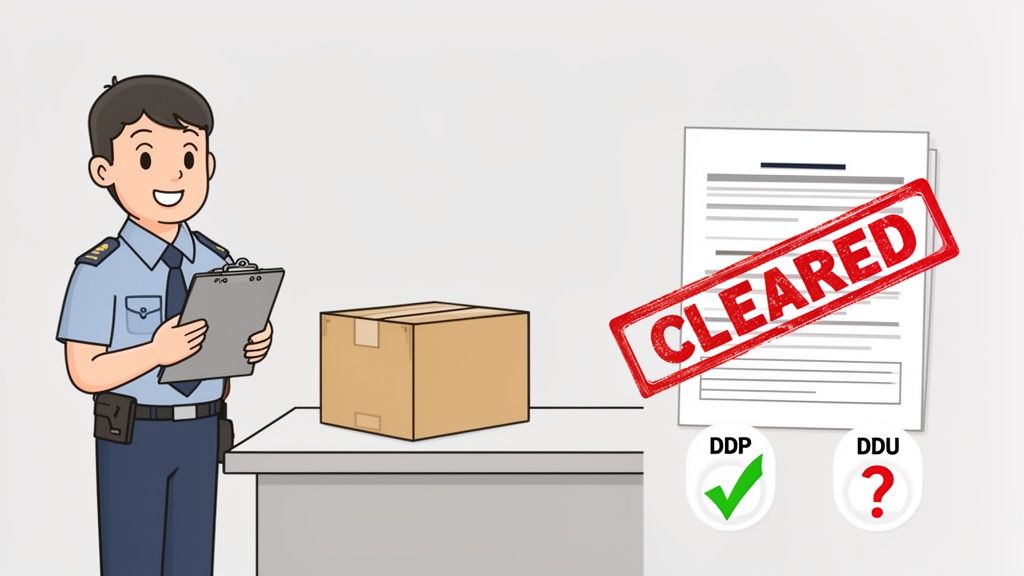
This is where the rubber meets the road. Customs clearance is the single biggest point of failure for international shipments, and your choice between DHL and FedEx can be the difference between a happy global customer and a support ticket nightmare. A package stuck at the border isn't just a delay—it’s a brand-damaging event that burns customer trust and ties up your support team.
DHL’s international identity is its greatest strength here. As a German-owned company, its entire network was built from the ground up to navigate a patchwork of global regulations. In most key markets, DHL doesn't just hand off packages to a local customs agent; they are the local customs agent. Their in-house brokerage teams manage the entire process, often spotting and fixing issues before you even know there’s a problem.
FedEx, on the other hand, offers very capable customs brokerage services, but its operational model can differ. In certain regions, they rely more on third-party partnerships, which introduces an extra handoff. While it works, it can add a layer of communication if a customs issue pops up, potentially slowing things down.
DDP vs. DDU: The Hidden Cost of a Bad Experience
How you handle duties and taxes is one of the most important decisions you'll make for your international business. This is the difference between DDP (Delivery Duty Paid) and DDU (Delivery Duty Unpaid), and the two carriers are not created equal in how they facilitate them.
DDP (Delivery Duty Paid): You, the merchant, cover all duties and taxes upfront. The package simply arrives at your customer's door with nothing more to pay. This is the gold standard for customer experience.
DDU (Delivery Duty Unpaid): Your customer gets a notification that their package has arrived, but they must first pay surprise import fees to get it. This often leads to confusion, frustration, and even package abandonment.
DHL’s global infrastructure is fundamentally built for DDP shipping. Their entire system, from billing to brokerage, is integrated to make calculating and prepaying duties a core part of the process. It's what their Express service was designed to do.
FedEx fully supports DDP as well, but the process can sometimes feel less seamless, particularly in markets where their direct footprint isn't as deep as DHL's. For DDU shipments, both carriers can get the job done, but the poor customer experience of a surprise bill remains the same, no matter whose logo is on the box.
For a premium brand, offering DDP is non-negotiable. A surprise customs bill is the fastest way to turn an excited customer into a one-star reviewer. DHL's infrastructure is arguably better optimized for making DDP a smooth, default part of your international strategy.
Proactive Brokerage and Documentation
The real value of a carrier’s customs service isn’t shown when everything goes smoothly—it's revealed when something goes wrong. A missing commercial invoice or a misclassified HS code can bring a shipment to a dead stop for days.
This is where DHL’s deep, native market presence really shines. With their own teams on the ground in virtually every country, they have an intimate, firsthand knowledge of local rules and quirks. This expertise means fewer documentation mistakes from the get-go and a faster resolution when problems do arise.
FedEx is also highly competent, especially for its core North American market. Their brokerage teams are excellent, but for shipments going to more remote or bureaucratic destinations, you might find DHL's native advantage gives you a smoother ride. The global courier market is incredibly competitive, with both DHL and FedEx vying for dominance. This rivalry directly impacts the post-purchase tools available, as services like real-time address validation and order editing become essential. Many merchants find DHL's international reliability helps them lower customer service costs. You can learn more about the courier market share and its impact on redstagfulfillment.com.
At the end of the day, a seamless customs process means fewer "Where is my order?" tickets. It eliminates the surprise fees that kill customer loyalty and helps you provide a predictable delivery window—the foundation of any great post-purchase experience. For merchants serious about global expansion, DHL often offers a clearer, more integrated path through the maze of international trade.
Improving Your Post-Purchase Experience
The moment a customer clicks "buy" isn't the end of their journey—it's the beginning of the post-purchase experience. Your choice between DHL and FedEx has a massive ripple effect here, directly impacting everything from customer happiness to the number of tickets your support team has to handle. This isn't just about moving a package; it's about managing expectations and building trust after the sale.
Think about a common headache for international merchants: a failed delivery because of a bad address. A carrier like DHL, with its deep roots in global logistics, often has superior local address intelligence. When you pair that inherent strength with real-time address validation software at checkout, you've created a powerful defense against undeliverable shipments before they even get a shipping label.
Aligning Operations with Carrier Strengths
The operational dance between your fulfillment center and your carrier becomes critical when you start offering post-purchase order edits. The time a customer has to change their address or add another item to their order isn't arbitrary—it's dictated by your carrier's pickup schedule and how fast your team can pack a box.
If you rely on FedEx for speedy domestic deliveries, your cutoff times for same-day processing are probably tight and early in the day. That means your customers get a much shorter window to make self-serve edits. On the other hand, if you're using DHL for international shipments that have a bit more lead time before being handed off, you can afford to offer a more generous editing window.
Key Insight: Your order editing window is not arbitrary. It's a direct function of your carrier's pickup schedule and your warehouse's processing speed. Matching these two realities is essential for offering post-purchase flexibility without creating operational chaos.
Turning Tracking into Revenue
A reliable delivery is table stakes for building customer trust. Once you’ve earned that trust, the post-purchase journey opens up opportunities that go far beyond a simple tracking update. When a customer feels confident their package is in good hands, they're much more open to what you have to say on your order status page.
This is where your carrier's performance directly connects to growing your Average Order Value (AOV). Both DHL and FedEx offer detailed tracking, but it’s the perceived reliability that truly influences customer behavior and their receptiveness to an upsell.
Here’s a practical look at how this plays out:
- High Confidence, High Conversion: A customer sees their international order with DHL has already cleared customs. They feel confident and engaged. Now is the perfect time to show them a compelling upsell right on the tracking page.
- Low Confidence, Lost Opportunity: A different customer is anxiously hitting refresh on a confusing FedEx tracking page for a delayed domestic package. An upsell offer at this moment would feel completely tone-deaf.
By capitalizing on the confidence a dependable carrier provides, you can transform your order status page from a simple utility into a revenue-driver. Beyond just shipping costs and speed, improving the overall post-purchase customer experience is a must for retention and follows established e-commerce best practices. Ultimately, your choice in the DHL vs. FedEx debate has a real, measurable impact on customer lifetime value.
Final Verdict: When to Choose DHL and When to Choose FedEx
So, who wins the DHL vs. FedEx showdown? The truth is, there’s no single "best" carrier. The smartest brands don't just pick one; they build a strategic, multi-carrier approach that aligns with what they're trying to achieve—whether that's dominating a new international market or offering blazing-fast domestic delivery.
Your choice should be situational. It all comes down to what you're promising your customers and how you plan to deliver on that promise.
A huge part of this strategy is matching your carrier choice to your post-purchase goals. Are you trying to bump up your average order value (AOV) with special offers, or are you focused on stamping out costly delivery failures? The right carrier can make or break these efforts.
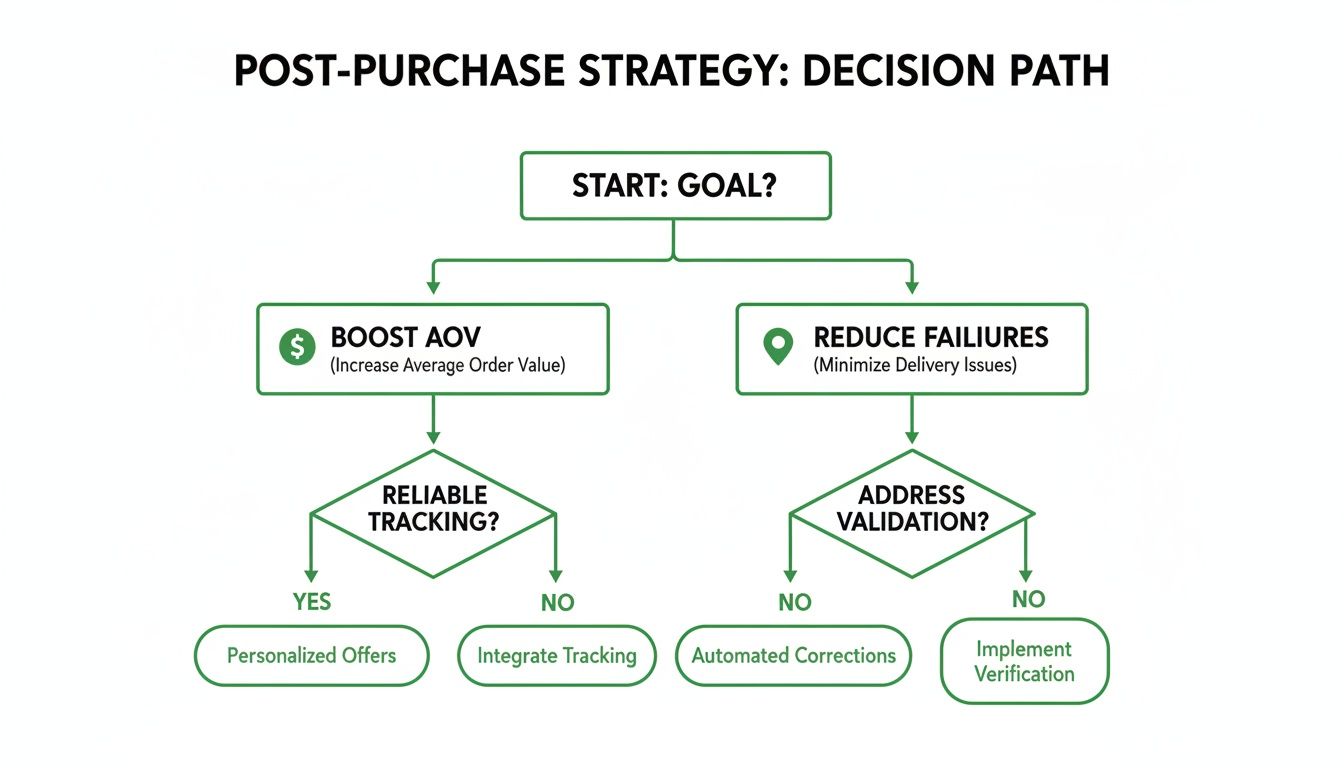
Think of it this way: your operational goals should be the starting point for your carrier selection. This decision path shows how objectives, like boosting AOV with rock-solid tracking or cutting down on failed deliveries with address validation, directly point to which carrier's strengths you need most.
When to Choose DHL Express
Simply put, DHL is your partner when your brand's reputation hinges on a perfect global customer experience. Their international network and customs expertise are second to none, making them the clear choice for merchants who can't afford any hiccups when shipping across borders.
Go with DHL in these situations:
- High-Value International Shipments: Selling luxury goods, high-end electronics, or anything where a smooth customs clearance is non-negotiable? DHL's integrated network is built to minimize risk and avoid those dreaded "stuck in customs" emails.
- European and Asian Market Expansion: If you're serious about growing in Europe or Asia, DHL is your ace in the hole. Their deep market penetration and in-house brokerage mean faster, more predictable deliveries compared to competitors that might hand off your package to a local third party.
- A True Premium DDP Experience: Want to offer a Delivery Duty Paid (DDP) service where your customer pays absolutely nothing extra upon arrival? DHL's infrastructure handles this seamlessly, preventing the surprise fees that completely ruin the customer experience and torpedo your brand loyalty.
DHL is the obvious winner for any brand that sees international shipping as a core competitive advantage. Their entire system is engineered for cross-border commerce, cutting out the friction that leads to customer complaints and a mountain of support tickets.
When to Choose FedEx
FedEx is the undisputed workhorse for the U.S. domestic market. With its incredible speed and dense ground network, it's the default choice for merchants whose business lives and dies by performance within North America.
You'll want FedEx in your corner for these scenarios:
- Fast and Free Domestic Shipping: Is your brand promise built around getting products to U.S. customers quickly and for free? FedEx Ground and Home Delivery give you the speed and reliability you need to compete, and their 7-day residential delivery is a huge plus.
- Heavy or Oversized Domestic Freight: If you're shipping bulky items like furniture or fitness equipment within the U.S., FedEx is often the only practical choice. Their Ground network can handle packages up to 150 lbs, making them far more capable and cost-effective than standard parcel carriers.
- Cost-Effective Zonal Shipping: Running a distributed inventory model with multiple warehouses? FedEx offers competitive pricing and predictable transit times that are perfect for optimizing shipments across different U.S. zones.
At the end of the day, the sharpest e-commerce brands don’t actually choose. They use both. They lean on FedEx for its domestic muscle and DHL for its global finesse. This creates a flexible and resilient shipping operation that’s ready for any customer, anywhere in the world.
Frequently Asked Questions
When it comes to DHL vs. FedEx, merchants are less concerned with corporate stats and more with real-world shipping problems. We get it. Choosing the right carrier isn't just about a logo; it's about building a shipping strategy that actually works for your business.
Let's dig into the questions we hear all the time from ecommerce operators, with some straight answers to help you pick the right tool for the job.
Is DHL or FedEx Better for US to Canada Shipping?
This is the classic speed versus cost dilemma. If your main goal is saving money on standard shipments across the border, FedEx Ground is almost always your most cost-effective option. Their massive North American ground network is built for this kind of volume, making them a default choice for many businesses.
But what if your customer needs it fast? That's where DHL shines. DHL Express typically blows past FedEx on transit times for cross-border express delivery. You'll pay a premium for that speed, of course, but it can be a huge competitive advantage if your customers demand quick turnarounds.
How Do DHL and FedEx Handle International Returns?
Both carriers can get a package back from an international customer, but the experience is worlds apart. DHL generally makes this process much smoother. They offer well-integrated, pre-paid return solutions that leverage their unified global network, creating a far simpler experience for both you and your customer.
A frictionless returns process is non-negotiable for building trust with international shoppers. DHL’s single network often translates to fewer logistical headaches and happier customers when a product needs to come back.
FedEx can handle international returns, too, but it can get complicated. The process often depends on local partnerships and the specific regulations of the destination country, which can sometimes lead to unexpected hurdles. Your decision here should mirror your return policy and how much convenience you want to offer your global customers.
Can I Use Both DHL and FedEx in My Shopify Store?
Yes, and you'd be crazy not to. Adopting a multi-carrier strategy is one of the smartest moves any growing ecommerce brand can make. By integrating both DHL and FedEx into your Shopify store, you can set up dynamic shipping rules that automatically choose the best carrier for each order.
You can create rules based on criteria like:
- The customer's location (is it a domestic, international, or remote address?)
- The package's weight and dimensions
- The delivery speed your customer chose at checkout
This isn't about picking one winner. It's about using the strengths of both carriers to optimize every single shipment for cost and customer happiness. This approach builds a more resilient and efficient fulfillment operation from the ground up.
Ready to give your customers control over their orders and slash your support tickets? With SelfServe, you can empower shoppers with post-purchase order editing, real-time address validation, and revenue-driving upsells. Start your 30-day free trial on getselfserve.com and transform your post-purchase experience.