Shopify Loyalty Program Integration Guide 2026
You're probably in one of two situations right now. Either your Shopify store already has a loyalty app installed, but it sits off to the side like a disconnected marketing widget. Or you're about to launch your first program and you're realizing this isn't really an app decision. It's a systems decision.
That distinction matters.
A weak loyalty setup gives customers a points balance and a coupon box. A strong loyalty program integration changes how your store recognizes customers, applies benefits, triggers post-purchase offers, coordinates with email and support, and measures whether any of it changed buying behavior. For Shopify Plus brands, the biggest missed opportunity usually isn't long-term retention strategy. It's what happens right after checkout, when customer attention is highest and your post-purchase experience can turn a one-time buyer into an enrolled member, a repeat buyer, or a higher-value order.
Going Beyond Points and Tiers
Many brands start loyalty with the wrong mental model. They think in terms of points, tiers, and a launcher in the corner of the site. Customers, meanwhile, think in terms of recognition. They want to know: Do I get anything better for buying again, buying more, or staying engaged?
That's why loyalty program integration belongs in your commerce stack, not just your retention stack.
By 2023, about 75% of all U.S. households were Amazon Prime members, according to McKinsey's analysis of loyalty and pricing. Prime matters here because it isn't a classic points program. It blends pricing, member benefits, promotions, fulfillment, and personalized experiences into one operating model. That's the standard merchants should learn from. Not “copy Prime,” obviously. But understand the architecture behind it.
What integrated loyalty actually looks like
A real integration changes decisions in places like these:
- Product and pricing experience where members see different offers or bundled value
- Checkout and post-purchase flows where earned value is surfaced immediately
- CRM and lifecycle marketing where loyalty status shapes segmentation and messaging
- Support and operations where agents can see benefit eligibility, reward issues, and exceptions
If your loyalty app can't influence those moments, it's not integrated. It's attached.
Practical rule: If a customer has to go hunting for loyalty value, the program will underperform.
That's especially true after the first purchase. Most stores thank the customer, send a receipt, and move on. A better setup uses the order confirmation moment to make the value concrete: points earned, member-only order add-ons, VIP progress, or a reason to create an account now instead of later.
The metric behind the strategy
Retention math matters. If you're setting targets around reactivation or repeat purchase, you need a shared way to define loss before you try to reduce it. A practical reference is this churn rate calculation formula guide, which helps teams align on what they're measuring before they start attributing outcomes to loyalty.
Loyalty also works best when it supports a broader customer value strategy instead of standing alone. If you're tightening that model, this piece on how to increase customer lifetime value is worth reviewing alongside your loyalty planning.
Planning Your Integration Strategy
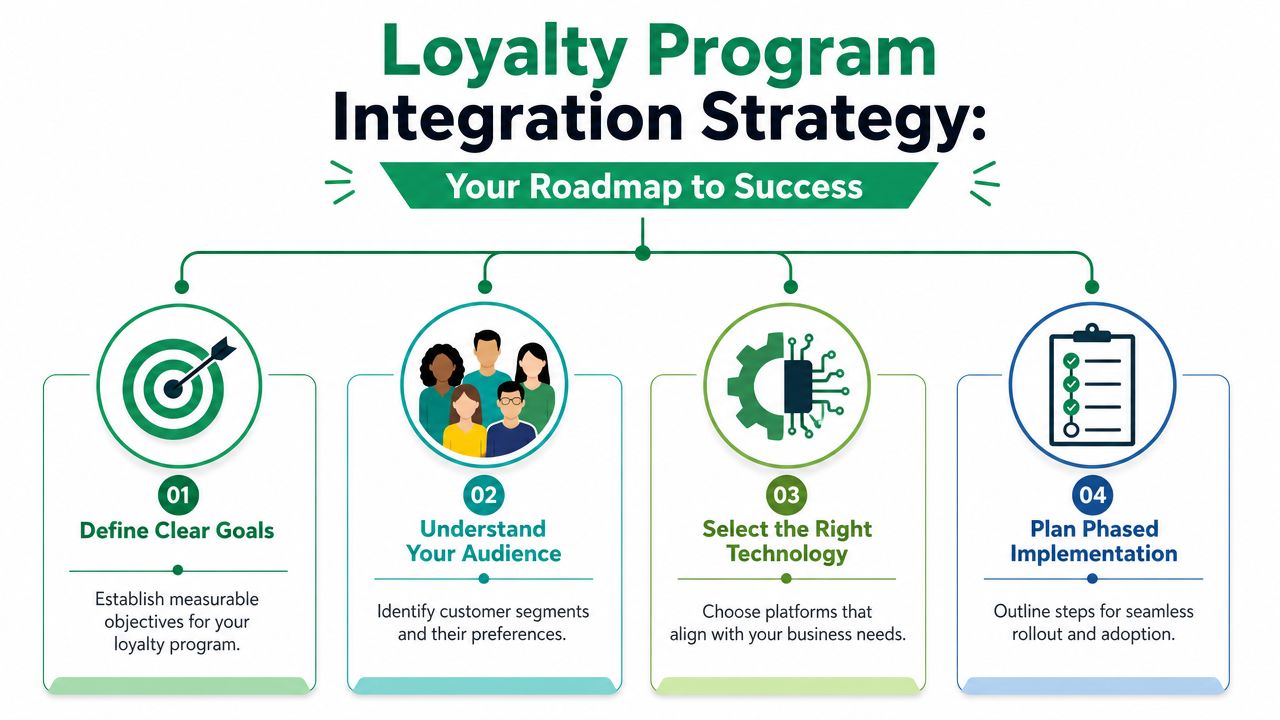
The most expensive loyalty mistake isn't picking the wrong vendor. It's launching without clear success conditions.
Before launch, it's critical to define KPIs such as engagement, conversion, revenue per customer, purchase frequency, and churn-reduction targets, then compare post-launch performance against baseline data to measure impact, as outlined in Data Axle's loyalty KPI guidance.
Start with business outcomes, not feature lists
Merchants often say they want “better retention” or “more repeat customers.” That's too vague to guide implementation. Your plan should answer concrete questions:
- Are you trying to increase second-order rate?
- Are you trying to raise revenue per customer among existing buyers?
- Are you trying to make post-purchase upsells more compelling for members?
- Are you trying to improve customer recognition across email, onsite, and support?
Those goals don't all lead to the same architecture. A brand that wants simple points and coupon redemption can live with a lighter setup. A brand that wants member-aware product offers, segmented lifecycle messaging, and loyalty-aware post-purchase merchandising needs a much tighter integration pattern.
Build your baseline before you install anything
At minimum, document the current state of:
- Purchase frequency among first-time and repeat customers
- Revenue per customer by cohort
- Conversion behavior on post-purchase pages
- Engagement signals such as account creation, reward redemption, and repeat session behavior
- Churn assumptions used by finance or retention teams
Then decide which actions will count as proof that the integration is working. For some brands, that's reward redemption plus repeat purchase. For others, it's member enrollment during or after checkout and stronger uptake on reorder or add-on offers.
A loyalty program with unclear success criteria usually turns into a monthly software cost with anecdotal reporting.
Plan around inactivity, not just signups
A large addressable market doesn't guarantee an effective program. The practical issue is activation. Many customers join programs and then ignore them. That means your strategy can't stop at enrollment mechanics.
Design for visibility from day one. Make rewards show up in the account area, in triggered messages, and in the post-purchase flow where intent is still high. If customers only encounter loyalty in a buried launcher or occasional campaign, the integration will stay technically “live” while commercially underused.
Choosing Your Loyalty Integration Pattern
There isn't one correct pattern for every Shopify brand. The right choice depends on how much control you need, how fast you need to launch, and whether loyalty will remain a marketing layer or become part of your store operations.
The three common patterns
Most Shopify merchants land in one of these buckets:
- Plug-and-play app setup for speed and lower implementation overhead
- Custom API integration for deeper control over data, rules, and customer experience
- Webhook-based workflows for event-driven updates without a full custom build
Each can work. Each can also fail when it's chosen for the wrong reason.
Loyalty Integration Pattern Comparison
| Pattern | Best For | Pros | Cons |
|---|---|---|---|
| Plug-and-play Shopify app | Brands launching their first program or teams without dedicated developers | Fast setup, native admin experience, lower operational complexity, easier support handoff | Limited control over edge cases, constrained UX, vendor-specific data model |
| Custom API integration | Shopify Plus brands with unique member logic, multiple systems, or advanced post-purchase flows | Full control over earn and redeem rules, better fit for custom customer journeys, easier alignment with internal systems | Longer implementation, more QA burden, ongoing maintenance, stronger dependency on technical resources |
| Webhook-based workflow | Teams that need lightweight event syncing between Shopify and a loyalty platform | Good for order events, account events, and triggered updates, flexible without rebuilding everything | Can become brittle if event handling is inconsistent, harder to manage when business logic expands |
What usually works best in practice
For a first major rollout, many brands do best with a hybrid approach. Use a proven loyalty platform for core program management, then extend it with APIs or webhooks in the places where differentiation matters.
That often means:
- The vendor handles points ledger, reward logic, and member account experience
- Shopify events trigger enrollment prompts, earned-value notifications, and post-purchase actions
- Your CRM or ESP receives loyalty status and reward events for segmentation
- Support tools get enough visibility to resolve reward issues without engineering involvement
This avoids the classic mistake of overbuilding too early. It also avoids the opposite mistake, which is forcing a generic app to do jobs it was never designed to do.
Decision criteria that matter more than the demo
Don't choose based on the prettiest rewards widget. Vet the pattern against your real operating needs.
Look closely at:
- Data ownership. Can you export customer, reward, and transaction history cleanly?
- Rule flexibility. Can you handle exclusions, refunds, delayed earning, and member-specific offers?
- Post-purchase extensibility. Can loyalty logic show up after checkout, not just in account pages?
- Support workflow fit. Can your CX team see enough context to solve issues quickly?
- Maintenance model. Who will own failures when a refund doesn't reverse points or an edited order changes eligibility?
The best pattern isn't the most sophisticated one. It's the one your team can operate without constant exceptions and manual cleanup.
Mapping Critical Data Flows
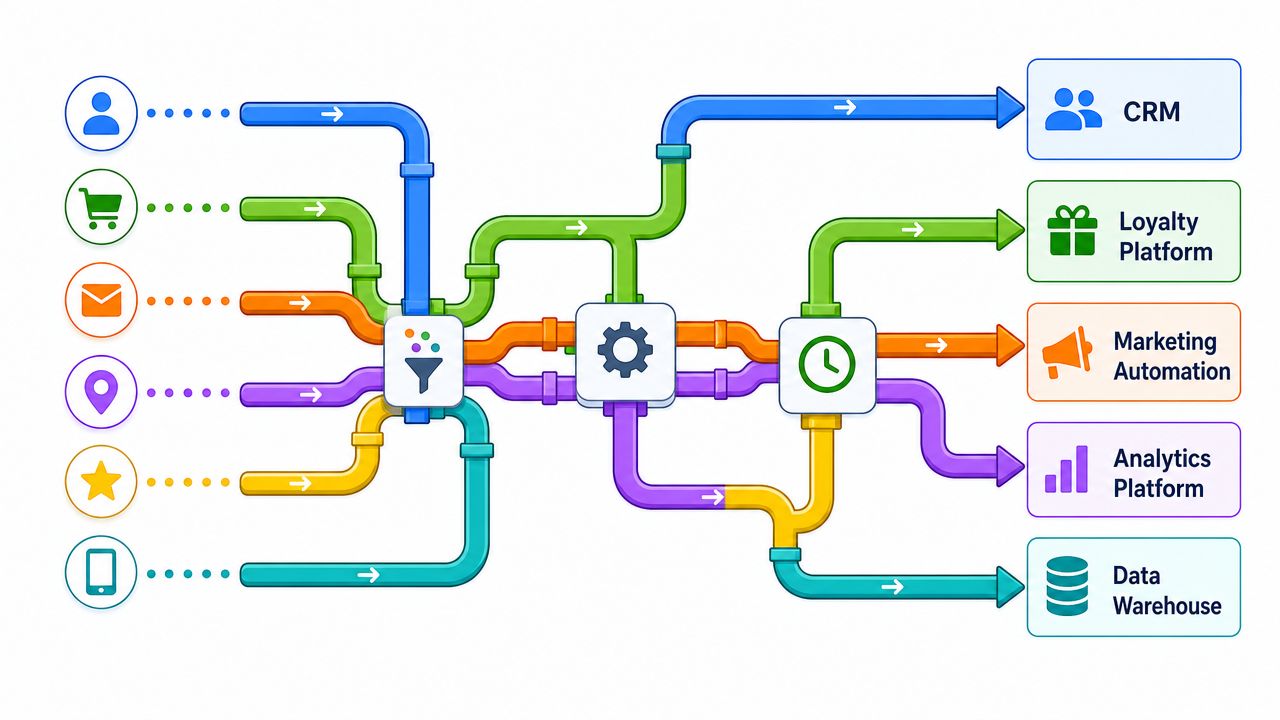
A loyalty program integration succeeds or fails in the data layer. If customer identity is messy, order events arrive late, or reward status doesn't sync back to the systems your team uses, the customer experience breaks fast.
The market size alone shows this category is established. The global loyalty management market was estimated at USD 10.67 billion in 2023, yet only 55% of loyalty program members were active in the programs they had joined in 2022, according to Open Loyalty's roundup of loyalty program statistics. That gap is exactly why clean integration matters. Customers don't stay active because a program exists. They stay active when the experience is timely, visible, and accurate.
The three records you need to map first
Start with these core objects:
- Customer profile including Shopify customer ID, email, account status, tags, and consent fields
- Order record including order ID, line items, discounts, returns, edited items, and net qualifying spend
- Reward state including points balance, tier or VIP status, redemption history, and pending rewards
If those aren't defined clearly, every downstream workflow gets harder.
A practical flow from order to loyalty action
A clean post-purchase flow usually looks like this:
- Customer places an order in Shopify.
- Shopify sends the order event to the loyalty system.
- Loyalty logic evaluates which items and discounts qualify.
- The customer's points ledger updates.
- Member status or tags sync back to Shopify and to your messaging tools.
- Post-purchase surfaces show earned value or member-only next actions.
That last step matters more than many might assume. If you also run lifecycle messaging in Klaviyo, your Klaviyo integration setup should receive loyalty status cleanly enough to trigger the right message without conflicting with order or refund logic.
The edge cases that create support tickets
The hard part isn't the happy path. It's the exceptions:
- Refunds and partial refunds that should reverse or adjust earned points
- Order edits that change net spend after the original purchase
- Duplicate customer records that fragment balances across profiles
- Historical backfills that accidentally trigger earning logic twice
- Discount stacking conflicts where customers receive a benefit they shouldn't
If the points ledger and the order ledger disagree, support inherits the problem.
For first rollouts, I prefer a conservative approach to historical imports. Migrate only what the program needs, define a clear source of truth for balances, and keep reversal logic explicit. Merchants get into trouble when they try to “sync everything” before they've defined what each system is responsible for.
Executing and Testing Your Integration
Many launches go sideways. The build gets treated like a frontend feature release when it should be treated like a cross-system operational deployment.
A robust loyalty integration needs a formal delivery plan, repeated test cycles, and explicit data-synchronization checks, with cross-system scenarios that simulate real customer journeys, as recommended in Omnivy's implementation guide.
Test journeys, not isolated functions
Don't stop at checking whether points can accrue or a reward can redeem. Test the complete customer journey across systems:
- Join flow from anonymous buyer to identified member
- Earn flow after a qualifying purchase
- Redeem flow with discount application and order completion
- Refund flow with points reversal or adjustment
- Support flow where a CX agent reviews and resolves an issue
That's how you catch the problems that look fine in isolated app testing but break in production. For example, the loyalty platform may record an earn event correctly while your ESP receives the wrong status because a webhook fired before the customer profile updated.
Use phased rollout logic
For larger Shopify Plus stores, don't release the full program to everyone on day one. Start with a limited audience, lower-risk rule set, or narrower reward catalog.
A practical rollout sequence often looks like this:
- Sandbox validation using test customers and sample orders
- Internal QA pass with real edge cases from support and ops
- Limited production launch to a controlled segment
- Bug-fix and re-test cycle before broad rollout
This keeps mistakes contained. It also gives your support team time to learn the workflow before reward disputes arrive at scale.
Synchronization checks you should not skip
Run explicit checks on:
- Customer identity matching between Shopify and the loyalty system
- Points balances after purchase, refund, and order edit events
- Transaction history to confirm no duplicate earn or redeem records
- Message triggers in email or SMS based on loyalty status
- Admin visibility so support and ecommerce teams can verify what happened
Launching without cross-system verification usually creates a hidden backlog. Customers see the symptom first. Your team finds the cause later.
Boosting Uptake with Post-Purchase Integration
The order confirmation moment is the most underused surface in loyalty.
A customer has already committed. They've just experienced your checkout. Their purchase intent is still active. That's when most stores should make loyalty visible, not weeks later in a generic campaign.
Pulse's guidance on retention makes the core point clearly: effective programs surface rewards at the moment of intent, turning passive memberships into active engagement. Their post-purchase loyalty playbook is useful because it pushes the conversation beyond backend connectivity and into behavior change.
What to show right after purchase
The post-purchase page shouldn't just say “thanks for your order.” It should give the customer a reason to care about the next action.
Good examples include:
- Points earned from the order so value feels immediate
- A simple member enrollment prompt if the shopper checked out as a guest
- Progress toward the next reward or tier so the next purchase has context
- Member-only add-ons or order edits that make enrollment useful now, not later
That last one is where a lot of Shopify brands can do better. If loyalty members can access exclusive post-purchase upsells, shipping upgrades, or curated add-ons within the order management window, you're no longer treating loyalty as delayed gratification. You're connecting it directly to current basket value.
For brands refining this area, this guide to post-purchase customer experience is a useful companion because it ties operational workflows to what the customer sees.
Why this changes AOV thinking
Many organizations think of loyalty as a retention lever and post-purchase upsells as a conversion lever. In practice, the best integrations combine them.
If a shopper sees that joining enables an immediate add-on opportunity or makes order changes easier, loyalty becomes part of the transaction experience. That's a different proposition from “earn points now, maybe redeem later.”
Here's a useful example of how merchants can think about the experience layer in motion:
The key is restraint. Don't overload the page with banners, reward math, and three offers at once. Show one clear benefit, one clear next action, and one loyalty-aware offer that fits the order that was just placed.
Frequently Asked Integration Questions
How long does a first serious integration usually take
It depends on the pattern you choose and how many systems are involved. A lightweight app setup can move quickly. A cross-system rollout that touches Shopify, your loyalty platform, lifecycle marketing, support workflows, and post-purchase merchandising takes longer because the testing surface is much bigger.
The better question is whether your team has defined scope tightly. Brands lose time when they mix launch-critical features with nice-to-have ideas.
What's the biggest mistake to avoid
Treating signup as success.
Enrollment is easy to celebrate and hard to monetize if the experience stays invisible. A loyalty program integration should make benefits show up in customer journeys that already exist: checkout completion, account creation, reorder behavior, support interactions, and triggered messaging. If customers join but never encounter usable value, the program becomes shelfware.
Ask one blunt question before launch: where will customers actually notice this program without being taught to look for it?
Should loyalty data go beyond Shopify
Yes, if another system influences customer experience or operational handling.
At minimum, think about your ESP, customer support platform, and any post-purchase tooling. In some businesses, your ERP or 3PL also needs limited awareness of loyalty-driven exceptions, especially if member perks affect fulfillment logic or service handling. Don't export everything everywhere, though. Share only the fields each system needs.
If you want a cleaner feedback loop after launch, collect direct voice-of-customer input instead of guessing why members aren't engaging. These customer loyalty survey tips are useful for shaping post-purchase and membership questions that give you something actionable.
If you want to turn post-purchase into a stronger part of your loyalty strategy, SelfServe is built for Shopify brands that want customers to manage order changes, access curated upsells, and get a cleaner post-purchase experience without piling more work onto support. It's a practical fit when you need loyalty-adjacent value to show up after checkout, where customer attention is still high.