How to Increase Customer Lifetime Value for Your Shopify Store
If you want to grow your Shopify store faster, you need to stop focusing so much on expensive acquisition and start maximizing the potential of the customers you already have. The secret lies in three core pillars: creating a seamless post-purchase experience, strategically expanding revenue from each customer, and using data for real personalization.
Why CLV Is Your Most Important Growth Metric
For a long time, the e-commerce playbook was all about one thing: acquiring new customers. But with ad costs constantly on the rise, smart Shopify merchants are catching on to a more sustainable truth. The most valuable asset you have isn't the next new shopper—it's the one who's already clicked "buy."
This is where Customer Lifetime Value (CLV) changes the game.
Simply put, CLV is the total revenue you can realistically expect from a single customer over the entire time they shop with you. It’s not about just one sale. It’s about every repeat purchase, every subscription, every single add-on. Thinking in terms of CLV fundamentally shifts your priorities from short-term wins to long-term relationships.
The Shift from Acquisition to Retention
The numbers behind this shift are hard to ignore. Get this: a small 5% increase in customer retention can boost your profitability by anywhere from 25% to 95%. That's not just marketing fluff; it’s a well-documented business principle.
In the DTC world, where customer acquisition costs have jumped a staggering 222% over the past eight years, it’s now about five times more expensive to get a new customer than to keep an existing one happy. If you want to dig deeper, you can find a ton of eye-opening customer lifetime value statistics that paint a clear picture.
This is especially critical for Shopify Plus brands juggling high support ticket volumes. Every bit of post-purchase friction is a leak in your revenue bucket. A focus on CLV encourages you to plug those leaks by investing in experiences that build real, lasting loyalty.
To make this crystal clear, we've broken down the core strategies into a simple framework. Think of these as the foundation for your entire CLV growth plan.
Three Pillars of CLV Growth for Shopify Brands
This table shows how each pillar contributes directly to a higher CLV. By mastering these three interconnected strategies, you're not just improving metrics; you're building a healthier, more resilient business. Each one addresses a different stage of the customer journey after the initial sale, turning one-time buyers into genuine brand fans.
By focusing on the post-purchase journey, you're not just solving problems—you're creating opportunities. A customer who effortlessly edits their own order is far more likely to return than one who has to wait 24 hours for a support response.
Calculating and Analyzing Your True CLV
Before you can start growing your customer lifetime value, you need to know where you stand right now. Guessing won't get you very far. What you need is a reliable, straightforward way to measure the current value of your customers without getting tangled up in overly academic formulas.
Let's break it down into a simple equation that any Shopify merchant can put to work immediately. This gives you a tangible number—a baseline you can start improving from day one.
The Simple CLV Formula
The most direct way to get a handle on your CLV is to multiply three core business metrics:
- Average Order Value (AOV): What’s the typical amount a customer spends in a single transaction?
- Purchase Frequency (F): In a given timeframe, how often does a customer come back to buy again?
- Customer Lifespan (L): How long does the average customer stick around and keep buying from you?
The formula is clean and simple: CLV = AOV x F x L
Let's say you run a specialty coffee subscription box. Your numbers might look something like this:
- Your AOV is $40.
- A typical customer buys 12 times a year (once a month).
- On average, a subscriber stays with you for 2 years.
Plugging those into the formula, you get: $40 x 12 x 2 = $960.
Just like that, you know that the average subscriber is worth about $960 in revenue over their entire relationship with your brand. That’s your benchmark.
Looking Beyond the Basic Calculation
Having a store-wide CLV is a great start, but it's only a starting point. The real magic happens when you segment your data. A single, blended number can be misleading because it averages out your best and worst customers, hiding the important details in the middle.
Think about it: customers you acquire from a steep "first purchase" discount might have a much lower CLV than those who find you organically through your blog. If you're only looking at the average, you'll never spot this crucial difference and might end up pouring money into the wrong channels.
Your goal isn't just to find one CLV number for your whole business. The real insight comes from comparing the CLV of different customer groups to see what actually drives long-term loyalty and value.
The Power of Cohort Analysis
This is where cohort analysis becomes your secret weapon for understanding customer behavior. A cohort is just a group of customers who share a common trait. For our purposes, the most useful way to group them is by the month they made their first purchase.
By tracking these monthly groups over time, you can start asking much smarter questions:
- Did the customers who joined in March spend more over their first six months than the ones who joined in April?
- Did that big marketing campaign we ran in July actually attract a higher-value cohort?
- Are our newest customers churning faster than the ones we acquired last year?
Suddenly, CLV isn't just a static number anymore; it’s a dynamic tool you can use to make real decisions. You can see precisely how changes to your products, marketing efforts, or post-purchase experience affect the long-term value you're building. If this is a new concept for you, our guide on how to track and understand Shopify analytics is a fantastic resource to get you up to speed.
Analyzing cohorts helps you pinpoint which acquisition channels, products, or campaigns are creating your most valuable, long-term relationships. This is the foundation you need to build a powerful strategy that systematically increases customer lifetime value.
Building Loyalty With a Flawless Post-Purchase Experience
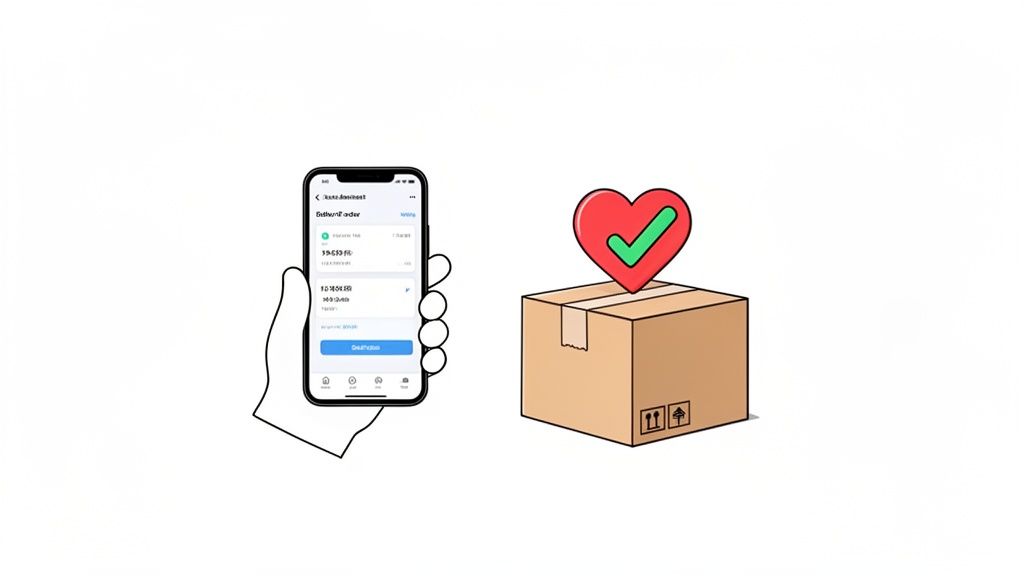
The moment a customer clicks "confirm purchase" isn't the finish line; it’s the start of the real relationship. This post-purchase window is your golden opportunity to either cement their trust or completely lose it. One small hiccup here can undo all the hard work you put into getting that customer in the first place.
Think about the most common pain points. A customer realizes they typed their apartment number wrong. Another notices they picked a size medium instead of a large. In a typical setup, these simple mistakes unleash a painful process: they have to find your contact info, open a support ticket, and then get stuck in an email chain, anxiously waiting for a fix. That's not an experience that makes anyone want to come back.
Today's shoppers expect to be in the driver's seat. Forcing them to contact support for a simple edit feels clunky and outdated. The quickest way to build loyalty—and boost your CLV—is to empower them to solve their own problems.
Reducing Churn by Empowering Your Customers
Every delayed shipment or unresolved issue is a reason for a customer to walk away for good. The data backs this up: a staggering 40% of customers admit they've stopped buying from a brand after a bad service experience. The post-purchase journey is your first, best chance to prove your marketing promises were real.
Let's imagine a customer, Sarah. She just bought a dress for a wedding this weekend. A few hours later, panic sets in—she realizes she sent it to her old address. If her only move is to email support and cross her fingers for a reply within 24-48 hours, she’s already stressed and likely regretting her purchase.
Now, let's flip the script. Sarah goes to her order confirmation page and sees a button: "Edit Shipping Address." She clicks it, fixes the typo in seconds, and gets an instant confirmation. Her problem is solved, and more importantly, she feels relieved and in control. You just turned a potential disaster into a moment that strengthens her trust in your brand.
The best post-purchase experiences are the ones customers barely notice. When self-service is intuitive and right there when they need it, you’re not just deflecting support tickets. You're actively building the confidence that turns one-time buyers into lifelong fans.
This self-service model is the foundation of a modern retention strategy. Give customers the tools to manage their orders, and you'll reduce their anxiety and boost their satisfaction, making them far more likely to shop with you again.
Preventing Errors Before They Happen
Of course, an even better strategy is stopping problems before they even start. How many of your support tickets are about failed deliveries due to a wrong address? Those aren't just costly in terms of reshipment fees; they create a terrible first impression that's hard to shake.
This is where real-time address validation is an absolute game-changer. By using a tool that checks and suggests verified addresses as the customer types, you can wipe out a huge chunk of human error right at the source.
Here’s how it works in practice:
- Auto-Complete Suggestions: As a customer starts typing, an integration like the Google Maps API suggests verified addresses, speeding up checkout and ensuring accuracy.
- Real-Time Validation: The system confirms the address is a real, deliverable location in the postal service database.
- Error Flagging: If someone enters an apartment number for a single-family house or a bogus zip code, the system can flag it before the order is ever placed.
Adding this one feature can dramatically cut down on failed deliveries. That means fewer support tickets, lower operational costs, and—most importantly—happier customers who get their packages on time, every time.
Catering to a Global Customer Base
As your Shopify store grows, you'll naturally start attracting customers from all over the world. A one-language-fits-all approach to your post-purchase experience is a huge source of friction for international shoppers. Confusion about order status or return policies can quickly lead to frustration and churn.
A multilingual support widget is a powerful way to create a seamless global experience. It can automatically detect a shopper's browser language and adapt. So when a customer from Germany lands on their order status page, all the self-service options—from editing their order to starting a return—should appear in German.
This is a small touch with a massive impact. It signals to your global customers that you value their business and have thought about their needs. It’s a simple way to build loyalty across borders and significantly increase customer lifetime value on an international scale by removing language as a barrier to great service.
Grow Revenue With Smart Post-Purchase Offers
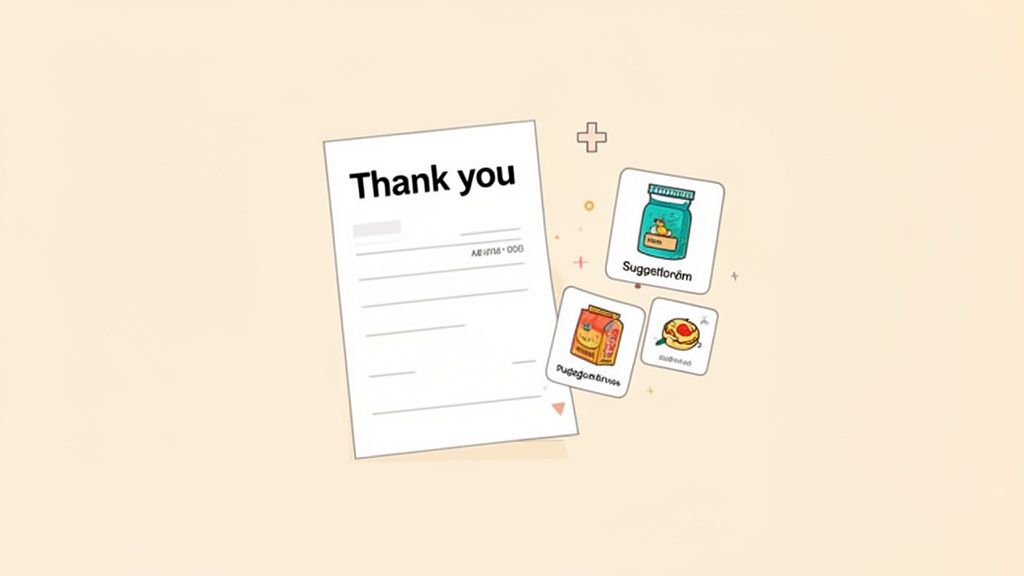
Sure, a great post-purchase experience keeps customers coming back, but what if you could also increase the value of their current order? That's where strategic post-purchase offers come in. It’s all about growing revenue without disrupting the initial checkout flow.
Think about the moment right after a customer clicks "Buy Now." It's a golden opportunity. Trust is high, their wallet is already out (metaphorically), and they're excited about what's coming. This is the absolute best time to present a relevant, complementary offer.
Trying to upsell someone before they've even finished buying is a risky game. It can cause decision fatigue and lead straight to an abandoned cart. A post-purchase offer, on the other hand, feels less like a pushy sales tactic and more like a helpful suggestion when it appears on the Thank You or Order Status page.
The Magic of the Post-Purchase Window
The psychology here is pretty straightforward. Once the main purchase is done, the customer has accomplished their goal. They're more relaxed and open to ideas that could make their original purchase even better. It’s a low-pressure moment to introduce them to other products they’ll genuinely appreciate.
Let's say a customer just bought a new pour-over coffee maker. They land on the confirmation page, happy with their choice. Right then, you show them a one-click offer for a bag of single-origin beans, perfectly ground for their new device. It’s not just a random upsell; it’s an add-on that completes the whole experience.
This is so much more effective than cluttering the main checkout. For a deeper look at this, our guide on building a Shopify upsell and cross-sell strategy has some great advanced tips. The real secret is making that extra purchase feel like a no-brainer.
Your Thank You and Order Status pages aren't just digital receipts—they're valuable real estate. Treat them like an extension of the shopping journey, and you can drive a surprising amount of extra revenue without hurting your initial conversion rate.
How to Craft Offers That Actually Work
The success of a post-purchase offer comes down to one thing: relevance. A generic, one-size-fits-all approach is doomed to fail. Your offer needs to feel like it was handpicked for that specific customer based on what they just bought.
Here are a few strategies I’ve seen work wonders:
- Offer a Perfect Companion: Suggest something that directly enhances their new purchase. If they bought a camera, offer a memory card. If they bought a plant, offer a decorative pot. Simple, logical, and effective.
- Encourage the "Complete Set": Did a customer buy a bottle of your best-selling shampoo? Offer the matching conditioner with a small bundle discount. It’s a powerful nudge to get the full experience.
- Turn a Trial into a Subscription: This is a goldmine for CLV. If someone buys a trial-size skincare product, present a post-purchase offer to subscribe to the full-size version, starting in 30 days.
- Create "Bought Together" Bundles: Dig into your sales data. What do people frequently buy together? Package those items as a post-purchase bundle.
You want the customer’s reaction to be, "Oh, I didn't even think of that, but I totally need it."
Putting It All Into Action
For this to work, the execution has to be completely seamless. Your customer just went through the checkout process; asking them to do it all over again for a small add-on is a dealbreaker.
Your implementation needs these key elements:
- One-Click Checkout: The offer must be accepted with a single click. No re-entering payment details, no re-entering shipping info. It should just get added to their existing order.
- Clear, Punchy Copy: Make the offer easy to grasp in a second. Use direct headlines like, "Complete Your Kit" or "A Perfect Match for Your New..." to instantly communicate the value.
- Clean, On-Brand Design: Use high-quality product photos. The offer itself should look like a natural part of your Thank You or Order Status page, not a cheap pop-up.
Using a tool like SelfServe with its built-in upsell features makes this incredibly easy. You can set up rules to show specific offers based on cart contents or order value, ensuring every offer is as relevant as possible. This turns a simple confirmation page into a powerful engine for boosting every customer's lifetime value.
Using Personalization to Drive Repeat Purchases
Let's be honest: in e-commerce, treating all your customers the same is a surefire way to get lost in the noise. The old one-size-fits-all approach is dead. If you really want to boost customer lifetime value, you have to show each shopper that you actually get them—their needs, their preferences, their history with your brand.
This is where personalization becomes your secret weapon for driving repeat business. And I'm not just talking about dropping their first name in an email. True personalization means digging into their purchase history to create experiences that feel curated and uniquely relevant. It’s the difference between a generic "New Arrivals" blast and an email showing off accessories that perfectly match the camera they bought last month. That kind of attention is what makes a customer feel seen, valued, and ready to come back for more.
Look to Purchase History for Targeted Campaigns
Your customer's past purchases are a goldmine. Seriously. This data tells you exactly what they like, what problems they're trying to solve, and what they'll probably need next. Instead of throwing spaghetti at the wall and hoping something sticks, you can use this insight to create marketing campaigns that actually hit the mark.
Here are a few practical ways this plays out:
- Replenishment Reminders: A customer buys a 30-day supply of your best-selling coffee beans. Sending an automated email around day 25 suggesting a re-order isn't pushy; it's helpful. And it works.
- Smart Cross-Sells: Someone just bought a new yoga mat. The next campaign they see from you should feature yoga blocks, straps, or mat cleaning spray—not running shoes. It just makes sense.
- Relevant Product Launches: You're launching a new flavor of protein powder. Who should be the first to know? The customers who have already bought other supplements from you, of course.
This isn't just a nice-to-have; it's a proven revenue driver. Here's a jaw-dropper: companies that master personalization generate 40% more revenue than their competitors. A staggering 80% of customers are far more likely to buy from brands that tailor the experience.
The numbers don't lie. Data shows 60% of shoppers become repeat buyers after a personalized experience, and they're willing to pay 16% more for it.
For Shopify brands using SelfServe, this means using features like real-time address validation to stop delivery failures before they happen, or multilingual upsells that automatically adapt to a customer's native language.
Automate Segmentation with Order Tagging
As your store grows, trying to manually segment your customers becomes a nightmare. This is where automated order tagging is a game-changer. You can set up simple rules to automatically tag orders and customers based on what they do, creating dynamic segments for your marketing without lifting a finger.
Think about it. A customer who uses a "NEW15" discount code gets tagged discount-buyer. Someone who purchases from your "Vegan Skincare" collection is tagged vegan-interest. A high-spender who crosses a certain AOV gets the coveted VIP tag.
These automated tags become the building blocks for hyper-relevant communication. You can effortlessly create email flows for your VIPs, announce new vegan products to the right audience, and think twice before sending another discount to your discount-buyer segment. Check out our article on other ways to increase repeat purchases without relying on discounts for more on that.
This simple strategy is a powerful way to increase customer lifetime value because it ensures every message you send feels relevant. When customers only get offers and content that align with their interests, they're far more likely to engage and buy again.
Personalize the Post-Purchase Journey
Personalization shouldn't stop at checkout. The post-purchase experience is a critical, and often overlooked, opportunity to make customers feel understood.
A simple but incredibly effective tool here is a multilingual widget on the order status page. For instance, SelfServe can automatically detect a customer’s browser language and present all self-service options—like editing an order or checking shipping status—in their native tongue.
This small detail shows your international customers that you’ve thought about their experience from end to end. When you combine this with personalized post-purchase upsells based on what’s already in their cart, you create a cohesive and deeply personal journey. That consistent, tailored experience is what gives them a compelling reason to return.
Your Actionable CLV Optimization Checklist
All this talk about CLV can feel a bit theoretical. Let's ground it in reality with a practical checklist. Think of this as your roadmap, broken down into the core stages of growing customer lifetime value. These are concrete actions you can start taking today.
Measurement and Analysis
You can't improve what you don't measure. Before you do anything else, you have to get a firm grip on your numbers. This is about moving from guesswork to informed decisions.
- Calculate Your Baseline CLV: First things first, figure out where you stand. Use the simple formula (AOV x Purchase Frequency x Lifespan) to get a clear store-wide CLV. This is your starting line.
- Implement Cohort Analysis: This is a game-changer. Group customers by the month they made their first purchase. Watching how these groups behave over time will show you which acquisition channels are actually bringing in the most valuable customers long-term.
- Identify High-Value Segments: Dig into your data to find the gold. Pinpoint the specific products, marketing channels, or even discount codes that attract customers who stick around and spend more.
Retention and Loyalty
Once you have a customer, the next job is to make them want to come back. The secret is creating a post-purchase experience that’s so smooth and effortless, they have no reason to look elsewhere. It's all about removing friction and building trust.
- Launch a Self-Service Portal: Give your customers control. Let them easily edit orders, update shipping addresses, and manage their own purchases without needing to wait for a support reply. This is a huge win for them and for your team.
- Enable Real-Time Address Validation: This one is a no-brainer. Catch address typos before an order ships to prevent failed deliveries and the support headaches that come with them. It’s a small tweak that saves a lot of money and frustration.
- Offer Multilingual Support: If you sell internationally, this is non-negotiable. Use a smart widget that automatically detects and displays in the customer's native language. A frictionless global experience is key.
The heart of a great retention strategy is empowerment. When customers can instantly solve their own problems, you're not just cutting support costs—you're building the kind of deep trust that creates lifelong fans.
This simple flow is a great visual for how to put this into practice, using customer actions to create offers they'll actually want.
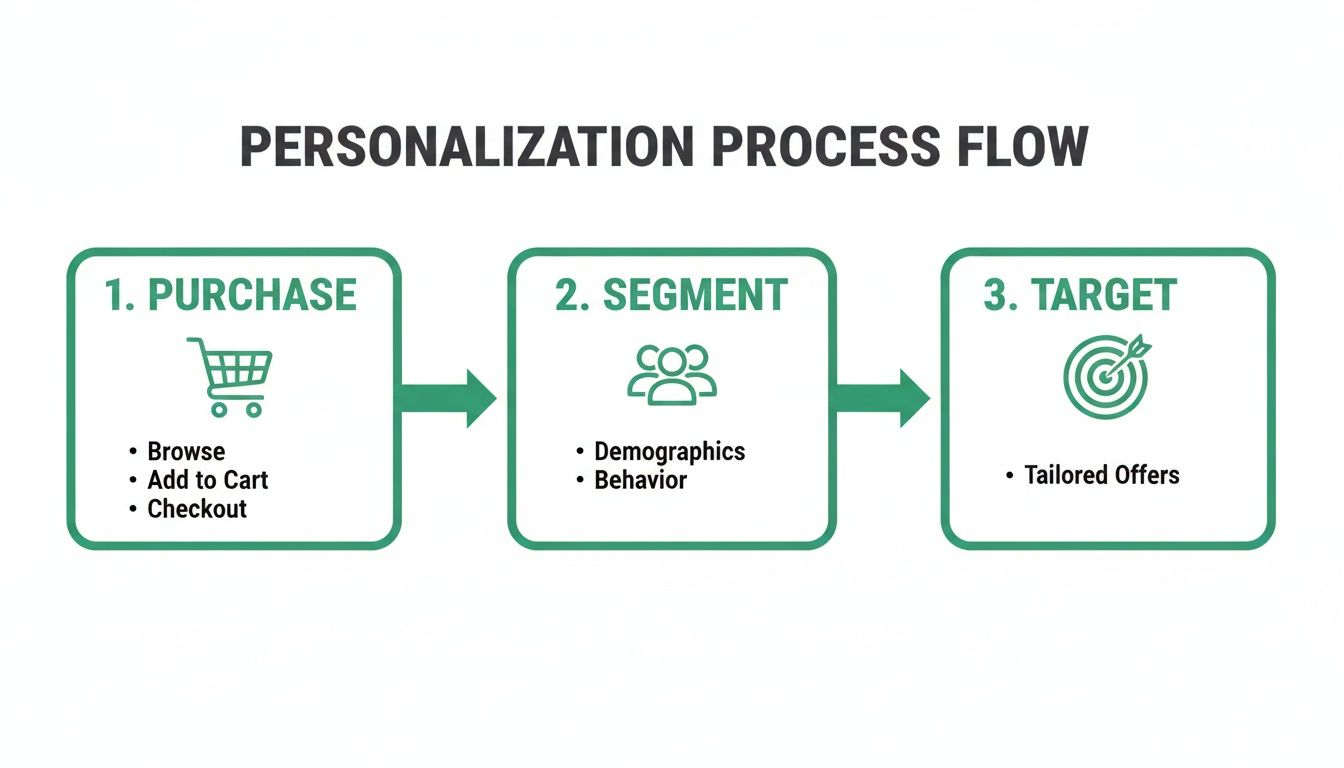
This is how you turn raw purchase data into smart, targeted marketing that keeps people coming back for more.
Your Top CLV Questions, Answered
As you start digging into customer lifetime value, a few common questions always pop up. It's totally normal. Let's clear up some of the most frequent ones we hear from Shopify merchants so you can move forward with confidence.
What’s a Good Customer Lifetime Value for a Shopify Store?
This is the million-dollar question, isn't it? But honestly, there's no single magic number. A "good" CLV for a store selling $20 t-shirts is going to be completely different from one selling $2,000 furniture.
Instead of hunting for a universal benchmark, focus on a much more important metric: the ratio of your CLV to your Customer Acquisition Cost (CAC). A healthy target to shoot for is a 3:1 ratio. This means for every dollar you spend to get a new customer, you're getting at least three dollars back over their lifetime.
Ultimately, what matters most is consistent, upward growth. Are your CLV numbers trending in the right direction month after month? That's the real sign of success.
How Can I Improve CLV With a Small Budget?
You don't need a huge marketing budget to make a real impact on your CLV. In fact, some of the highest-return activities cost next to nothing. The secret is often hiding in your post-purchase experience.
Think about it: simple, low-cost actions like sending a personal thank you email, offering proactive shipping updates, or just providing genuinely helpful customer service can work wonders for retention and, by extension, your CLV.
Another game-changer is setting up a customer self-service portal. It’s a low-cost way to give customers control over their orders, which they love. It also frees up your support team, creating a win-win that builds loyalty without a big investment.
How Long Does It Take to See an Increase in CLV?
Patience is key here. Since CLV is a long-haul metric, you won’t see a dramatic jump overnight. It's not like running a flash sale.
After you roll out new retention tactics or upsell offers, you'll start to see early positive signals within a few months. Keep an eye out for things like a better repeat purchase rate or a bump in your average order value.
But to see a real, measurable lift in your overall CLV, you need a bit more time. Plan on looking at your cohort data over a 6 to 12-month period. That's the timeframe you'll need to truly see how your changes have affected customer loyalty and their total spending with your brand.
Ready to turn post-purchase friction into revenue? SelfServe gives your customers the power to manage their own orders while you reduce support tickets and boost AOV with targeted upsells. Start your free 30-day trial and see the difference.