Online vs Store Shopping A Guide for Shopify Merchants

The old online vs. store shopping debate used to be simple: convenience versus experience. But that's not the world we live in anymore. Online shopping offers endless aisles and 24/7 access, while physical stores give customers that instant-gratification buzz and the chance to touch and feel a product. The real question for merchants today isn't which one to pick, but how to make them work together.
The Evolving Retail Landscape
It's no longer a battle of online versus in-store. The conversation has completely shifted to how these two worlds can—and must—coexist. While nothing can truly replace the hands-on experience of a brick-and-mortar shop, ecommerce has become an unstoppable force, fundamentally changing how people discover, buy, and interact with brands. Your digital storefront isn't just a "nice-to-have" anymore; it's a core part of your business.
The numbers don't lie. The growth in global ecommerce has been staggering. By 2025, online retail sales are projected to hit a massive $7.4 trillion, making up almost 24% of every retail dollar spent worldwide. To put that in perspective, that’s nearly one in every four dollars, a huge leap from just 13% back in 2020.
This data paints a clear picture of just how quickly online sales are scaling and grabbing market share.

These figures aren't just about growth; they show a permanent shift in how people prefer to shop. Building a strong digital strategy is critical for survival and success. If you're curious about what's behind this massive shift, our breakdown of Shopify ecommerce trends to watch in 2025 offers deeper insights.
Key Differences at a Glance Online Vs In-Store Shopping
Before we dive into the nitty-gritty, it helps to have a high-level view of how these two channels stack up. This table breaks down the core differences in a quick, scannable format.
As you can see, each model comes with its own set of advantages and challenges. The rest of this guide will unpack these points to help you figure out the best way to structure your operations and serve your customers.
Comparing the Customer Experience and Path to Purchase

The journey a customer takes from discovery to checkout couldn't be more different between online vs store shopping. Each channel has its own rhythm, its own psychology, and its own set of expectations. As a merchant, figuring out how to master both is where you win.
Nothing beats the in-store experience for pure sensory feedback. It’s where customers can feel the weight of a jacket, see how a color really looks away from a screen, and try something on for that perfect fit. This hands-on interaction removes a ton of guesswork and gives shoppers the confidence to buy right then and there.
Then you have the human element. A great sales associate can do more than just answer questions; they can offer styling advice, solve a problem on the spot, and build a genuine connection. That kind of personal touch is hard to bottle, and it's something ecommerce brands are constantly trying to figure out how to replicate.
The Digital Shopper's Journey
Online, the game changes completely. The shopper’s journey is all about convenience and an endless digital shelf. Someone can browse your entire collection from their couch at midnight, free from the pressure of a crowded store or a hovering salesperson.
While you lose the tactile experience, you gain the power of data. You can offer deep product information, showcase thousands of customer reviews, and use a shopper’s browsing history to serve up personalized recommendations. It's a different kind of discovery—one that can introduce customers to products they never would have stumbled upon in a physical store. It's a trade-off, for sure: you swap physical touch for 24/7 access and a nearly infinite inventory.
Think about the big shopping holidays. Convenience isn't just a perk; it's the main driver. A recent study found that a staggering 71% of people plan to do their Black Friday shopping online, mostly just to avoid the crowds.
Bridging the Experiential Gap
The smartest brands aren't picking a side. Instead, they’re blending the best of both worlds to create a cohesive experience that feels like a single, unified brand, no matter where the customer is.
Here’s how they’re pulling it off:
- Augmented Reality (AR) Try-Ons: Tools from brands like Warby Parker and IKEA are brilliant for this. They let customers use their phone to see how glasses will look on their face or how a couch will fit in their living room, closing that "what if" gap.
- Endless Aisle Kiosks: Placing kiosks in-store gives shoppers access to your full online catalog. If an item is out of stock in their size, they can order it right there. It saves the sale and merges the scale of digital with the immediacy of a physical visit.
- Buy Online, Pick-Up In-Store (BOPIS): This hybrid model is a massive win-win. Customers get the ease of online ordering combined with the instant gratification of grabbing their purchase the same day.
2. Fulfillment, Returns, and Post-Purchase Changes
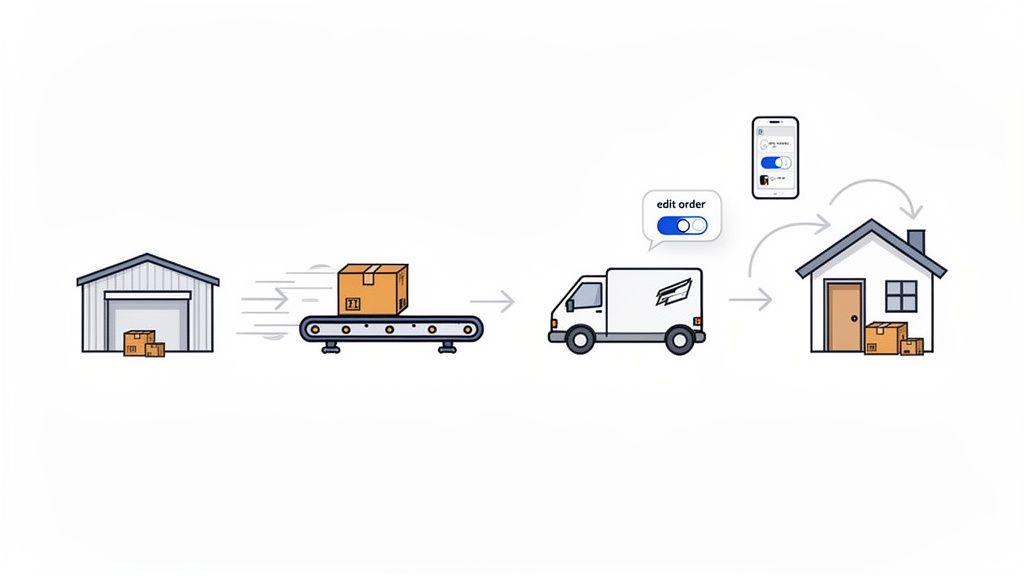
The moments after a customer pays are where the operational divide between online vs. store shopping really comes into focus. In a physical store, the deal is done. The customer has their product in hand and walks out the door. That immediate gratification is a huge psychological win that e-commerce, by its nature, can't quite match.
For an online store, a completed purchase is just the starting gun for a whole new race. An order triggers a complex chain of events: warehouse picking, careful packing, and the final hand-off for last-mile delivery. Even with impressive logistics like the Shopify Fulfillment Network making two-day shipping feel like the norm, there’s still a wait. And that wait changes everything.
The Post-Purchase Window: E-commerce's Hidden Advantage
That built-in delay, however, creates a window of opportunity that brick-and-mortar stores just don’t have. Once a customer leaves a physical shop, their purchase is locked in. If they spot a mistake or change their mind, their only option is to drive back, get in the returns line, and go through the whole process of an exchange or refund.
An online order, on the other hand, exists in a kind of limbo between payment and fulfillment. During this crucial time, a customer might realize they typoed their shipping address, picked the wrong size, or want to cancel the order entirely. In the past, fixing any of this meant a frantic email or call to customer support, creating a headache for both the customer and your team.
The ability for a customer to manage their own order after they've paid is no longer a nice-to-have; it's a core expectation. Giving them the power to make their own edits reduces support tickets and turns a moment of panic into a positive, empowering experience.
This is where modern tools completely flip the script. By letting customers help themselves, you can turn what used to be a major operational pain into a real competitive advantage.
For any Shopify merchant looking to tighten up their operations, getting this post-purchase phase right is essential. You can find more deep-dive strategies in our guide on shipping and fulfillment best practices.
Turning Problems into a Polished Experience
Instead of seeing post-purchase changes as a support burden, the smartest online brands view them as a chance to deliver a truly excellent customer experience. Self-service customer portals let shoppers take charge, which builds a surprising amount of trust and satisfaction.
Here's how this looks in the real world:
- Address Edits: A customer realizes they mixed up their street number moments after ordering. Instead of panicking, they log in, fix the typo themselves, and prevent a costly misdelivery without ever needing to contact an agent.
- Order Cancellations: A shopper has immediate buyer's remorse. They can request a cancellation through an automated system that routes it for approval, which is infinitely more efficient than handling it through a cluttered email inbox.
This level of control after the sale is something physical retail simply can’t offer. By using a solution like SelfServe, merchants give customers the autonomy to fix their own mistakes. This not only slashes your support team's workload but also creates a seamless, modern shopping journey that builds loyalty long after the "buy" button is clicked.
Maximizing Revenue: Conversion, AOV, and Lifetime Value
When it comes to generating revenue, the battle between online and in-store shopping isn't as clear-cut as you might think. Physical stores often have the upper hand with immediate conversions. After all, if someone takes the time to walk into your shop, they likely have a strong intent to buy something right then and there.
That focused, tangible environment is naturally geared for a single, successful sale. But that's where the story diverges. E-commerce is engineered from the ground up to maximize two other critical metrics: Average Order Value (AOV) and Customer Lifetime Value (LTV). The digital storefront provides an incredible number of touchpoints to grow each sale and foster relationships that last.
This all comes down to the power of data and automation, something that’s incredibly difficult for physical retail to replicate at scale. An in-store upsell depends entirely on a sales associate’s training, timing, and rapport—factors that can be brilliant one day and completely absent the next. Online, the process is built right into the system.
The Power of the Post-Purchase Upsell
One of the biggest opportunities for an online store happens after the initial "yes." Once a customer swipes their card and leaves a physical location, the chance to add another item to their bag is lost for good. Online, the order confirmation and thank you pages are prime real estate for boosting that AOV.
This is where one-click post-purchase upsells truly shine for Shopify merchants. By presenting a perfectly matched, complementary product right on the order status page, you can land an impulse buy without adding any friction to the original checkout. The customer’s payment information is already in the system, so adding the item is completely seamless.
A well-timed offer on the thank you page capitalizes on a customer's peak buying excitement. It turns a single purchase into a bigger, more profitable order—a window of opportunity that slams shut the moment a customer walks out of a physical store.
Building Long-Term Value Digitally
Beyond just one sale, the digital ecosystem is perfectly designed to cultivate long-term value. Every click, view, and purchase gives you valuable data. You can then use that information for incredibly personal marketing campaigns, loyalty programs, and product recommendations that keep people coming back. That's a level of personalization that's far more scalable than an associate trying to remember a customer's past purchases.
The continued growth of the e-commerce market highlights this massive potential. Projections show U.S. e-commerce revenue is on track to hit $1,381.74 billion by 2025, with an estimated 288.45 million shoppers driving that growth. With mobile commerce already accounting for 73% of all online sales, being able to send a timely, personalized offer directly to a customer's phone is a game-changer. You can dig deeper into these trends by checking out these 2025 ecommerce shopping statistics.
Tools like SelfServe are built to integrate these powerful upsell capabilities directly into your post-purchase flow. Merchants can set up automated upsell offers that show curated products on the thank you page, letting customers add items to their order with a single click. This doesn't just boost AOV; it transforms a static transaction into a dynamic and far more profitable customer interaction.
Managing Customer Support and Operational Load
When we talk about online vs. store shopping, the conversation usually sticks to sales and marketing. But behind the scenes, the real make-or-break difference lies in operations and customer support. How you handle customer inquiries in each channel reveals a massive gap in workload, which directly hits your scalability and profit margins.
In a physical store, issues are handled in the moment. A customer has a question about sizing? A team member answers it. A credit card won't swipe? You solve it right there at the counter. The interaction is immediate, personal, and once the customer walks out, it's done.
Online stores are a completely different beast. They don't just get occasional questions; they face a constant, 24/7 stream of remote inquiries that can easily swamp a support team. And we're not talking about deep, strategic conversations. We're talking about the same simple, repetitive tickets, over and over again.
The Grind of Repetitive Tickets
For most e-commerce brands, the support queue is choked by a handful of common questions. This relentless pressure of low-impact tickets is what drains resources, slows down operations, and makes it impossible to grow without just hiring more and more support agents.
What kind of tickets are we talking about?
- "Where Is My Order?" (WISMO) tickets: These are the undisputed champion of support requests. They create a never-ending cycle of looking up tracking numbers and sending updates.
- Address and contact detail changes: A simple typo in a shipping address is all it takes to create a support ticket. If it's not caught fast, it leads to a delayed shipment and often a costly redelivery fee.
- Order edits or cancellations: A customer changes their mind or realizes they ordered the wrong size, creating an urgent request that needs manual intervention before the warehouse packs the box.
Having your team manually field these high-volume, low-complexity tickets is a huge operational bottleneck. It stops your experts from focusing on the conversations that actually build loyalty and solve real problems, like helping a customer choose the right product.
Shifting the Burden with Self-Service
This is where smart automation can completely change the game for an online brand. By giving customers the tools to solve these problems themselves, you empower them to get instant answers and take control. This approach doesn't just cut down on support tickets—it makes your entire online operation leaner and more scalable. You can see exactly how to do this by exploring a self-service customer portal.
Imagine a world where customers can edit their own shipping address, check their order status in real-time, or request a cancellation through an automated workflow. The ticket never gets created. This frees up your team to become a strategic asset, not a cost center. By using technology to manage the operational load, the online model suddenly becomes far more efficient and scalable than its brick-and-mortar counterpart.
Global Reach and Multilingual Commerce
When comparing online and in-store, international expansion is where the two models really diverge. For a brick-and-mortar business, growing beyond its home country is a massive undertaking. It means wrestling with huge capital investments, navigating complex local laws, and building an entirely new team on the ground—often one that speaks a different language. It's a slow, expensive, and incredibly risky path.
An online store, on the other hand, is born global. From the moment you launch, a shopper in Tokyo has the same access to your brand as someone living down the street. But here’s the thing: just because they can find you doesn't mean they'll feel welcome. True international success comes from localization—making customers from anywhere in the world feel like they're buying from a local shop.
This is where the flexibility of an online model shines. You don't need to hire staff who are fluent in dozens of languages. Instead, you can lean on smart tools to create a seamless, native-feeling shopping experience for everyone.
Creating a Local Feel, Globally
Good localization is much more than a quick Google Translate job on your product pages. It's about designing a journey that feels intuitive and trustworthy to people from different cultures. Thankfully, modern e-commerce tools can handle most of the heavy lifting.
To do it right, you need to think like your international customer:
- Speak Their Language: The site should instantly recognize a visitor’s location and switch to their native language. This covers everything from the homepage welcome to the fine print at checkout.
- Show Their Currency: Forcing a customer in Europe to mentally convert prices from USD adds friction and doubt. Showing prices in their local currency is a non-negotiable for building trust.
- Offer Familiar Checkout Options: Seeing familiar payment methods and clear, local shipping information is often the final push a customer needs to complete their purchase.
The ability to cater to an international audience is a defining advantage of e-commerce. It transforms your store from a local shop into a global brand, capable of serving customers anywhere in the world with a consistent, high-quality experience.
The opportunity here is enormous. There are already 2.7 billion people buying online, a figure that's set to grow by 14.3% between 2024 and 2025. Even small businesses are seeing a 45% increase in online sales by tapping into this market. You can dig into the full global e-commerce growth trends to see the potential for yourself.
This localization even extends to what happens after the sale. For instance, a tool like SelfServe can automatically translate the entire post-purchase portal into the shopper’s language. This allows them to edit an order or check out an upsell offer in a way that feels completely natural. That kind of automated, scalable support is something a physical store just can’t replicate, making e-commerce the clear winner for ambitious international growth.
Building Your Hybrid Retail Strategy for 2026
The conversation about online vs. store shopping is no longer an "either/or" debate. The real winners in retail are building a smart, integrated approach. We've seen how both channels have distinct advantages, and the most powerful strategy combines them to create an experience that keeps customers coming back. It’s all about using technology to amplify the best of both worlds.
If you’re a pure-play ecommerce brand, your focus should be on bringing the best elements of an in-store visit to the digital space. This means going beyond basic product pages with rich information, building a community with genuine reviews, and offering instant, automated support. The goal is to eliminate friction at every turn, transforming potential headaches like order changes into empowering, positive interactions.
For retailers who also have a physical footprint, it’s time to start thinking of your stores as more than just points of sale. They are strategic assets that should work hand-in-hand with your online channel, serving as hubs for your brand experience.
Weaving Your Channels Together
A truly effective hybrid strategy feels completely natural to the customer. People don’t think in terms of channels—they just see your brand. Your operations need to mirror that unified perspective.
Here are a few proven strategies we see merchants use to create a connected retail ecosystem:
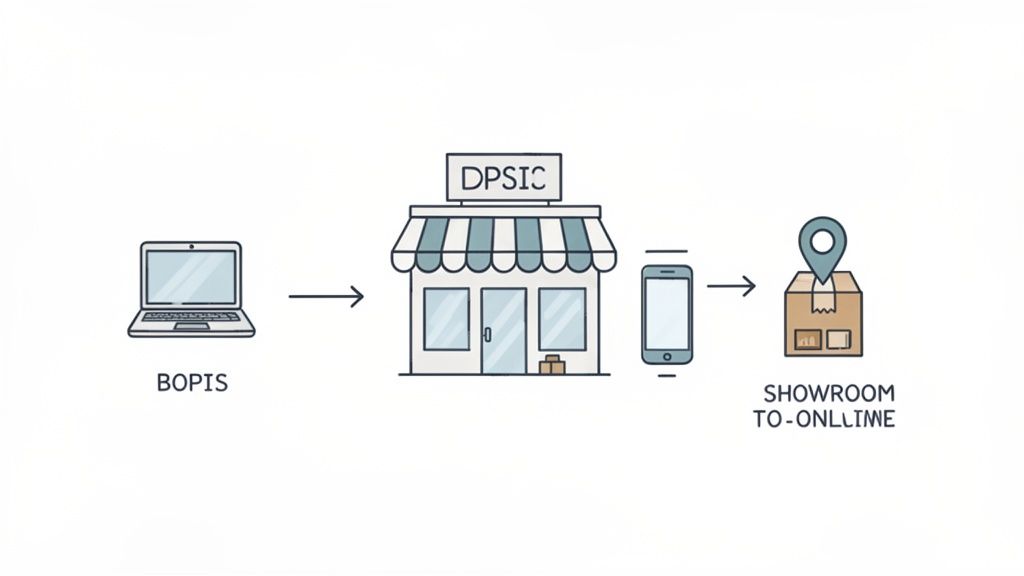
- Buy Online, Pick-Up In-Store (BOPIS): This is the classic hybrid model for a reason. It offers the ease of online shopping with the immediate satisfaction of getting the product the same day. It’s a win-win.
- Stores as Showrooms: Use your physical locations to let people touch and feel the products, then guide them to your website to make the final purchase. This works incredibly well for high-ticket items or products with lots of customizable options.
- In-Store Returns for Online Orders: Allowing customers to return online purchases at a physical store removes one of the biggest hesitations people have about buying online. Plus, it gets them back into your store, creating another chance to connect and make a sale.
The real takeaway is this: your online channel should be the efficiency engine for your entire business. When you automate post-purchase support and use data to drive intelligent upsells, you build a more profitable, scalable foundation that makes both your digital and physical operations stronger.
Ultimately, the argument is settled. The brands that thrive in 2026 and beyond will be the ones that nail a unified commerce strategy. They'll use their physical stores for hands-on experiences and community building, while their online stores become powerful machines for efficiency, personalization, and growth.
Ready to make your online channel more efficient and profitable? SelfServe empowers your customers with self-service order edits, slashes your support workload, and drives extra revenue with post-purchase upsells. Start your free trial today at https://getselfserve.com.