Master the Cost of Returns: Strategies for eCommerce
Returns look like a customer service workflow until you price them properly. Then they look like one of the largest margin leaks in ecommerce.
U.S. retailers anticipated $849.9 billion in returned merchandise in 2025, equal to 15.8% of total merchandise purchases, and online sales were expected to run at an even higher 19.3% return rate according to the NRF and Happy Returns reporting covered by Digital Commerce 360. For a Shopify Plus brand, that number matters because it changes how you evaluate returns. This isn't a support issue you delegate and forget. It's a P&L issue that touches acquisition efficiency, warehouse throughput, inventory health, and repeat purchase behavior.
Most operators still undercount the problem. They focus on the refund and the label. They miss the labor, the rework, the resale discount, the fraud exposure, the slower cash conversion cycle, and the support queue created by every order error that should have been fixed before fulfillment.
That’s why the cost of returns needs to be measured the same way you’d measure paid media efficiency or contribution margin. If you don’t know your actual cost per return, you can’t tell whether free returns are a growth lever, a retention tool, or an expensive habit you’re subsidizing without realizing it.
The Billion-Dollar Problem Hiding in Your Margins
A one-point increase in return rate can erase more profit than a meaningful lift in conversion, especially in categories with high shipping costs, tight gross margins, or heavy sizing-related returns.
That is why returns deserve the same level of scrutiny as paid media efficiency and contribution margin. On Shopify Plus, the problem is rarely the refund alone. The margin hit comes from the work that starts after the customer clicks “return item.” Someone has to issue or review a return label, answer status questions, receive the package, inspect the product, reconcile the refund, and decide whether that unit goes back into active inventory, into markdown, or into write-off.
The P&L impact gets missed because the costs sit in different places. Finance sees refunded revenue. Operations sees extra touches in the warehouse. CX sees more tickets. The merchandising team sees inventory quality drop when opened or damaged units come back. If those teams do not tie returns back to order-level economics, the margin loss stays hidden inside separate line items.
Shopify Plus brands feel this fastest when volume rises. During peak periods, returns compete with outbound fulfillment for labor, dock space, and system attention. A preventable return is not just a customer event. It is capacity taken away from shipping the next profitable order.
Why return rate alone is an incomplete metric
Return rate is a useful starting point, but it is not a decision metric by itself.
Two brands can both run a 20% return rate and have very different economics. One resells most returned units at full price within days. The other pays for expensive reverse shipping, handles high support volume, and discounts a large share of returned inventory before it moves. Looking at return rate without cost per return leads to bad policy decisions.
This is the operating view I recommend for Shopify Plus teams: measure returns at the order and reason-code level, then model the downstream cost of each return path. “Too small” behaves differently from “arrived damaged.” “Changed mind” behaves differently from “wrong item sent.” If you group all returns together, you lose the signal you need to fix the expensive ones first.
What strong operators do differently
Teams that protect margin do a few things consistently:
- Separate return reasons by controllable vs. non-controllable causes so sizing, product quality, fulfillment errors, and buyer remorse are not treated as the same problem
- Track cost per return by category or SKU group because apparel, beauty, electronics, and home goods recover very differently
- Measure warehouse and CX touches tied to returns instead of burying them in general operating expense
- Model policy changes against both savings and retention risk before changing free returns, exchange incentives, or refund timing
The goal is simple. Get from “returns are high” to “this return type costs us $X, and this fix saves $Y.”
That shift changes how teams prioritize work. Product content improvements, size-chart changes, exchange nudges, stricter exception handling, and better post-purchase flows stop looking like small optimizations. They become margin projects with clear ROI.
Deconstructing the Full Cost of a Single Return
A single ecommerce return behaves like a chain reaction. One customer action triggers work across multiple teams, and each step adds cost.
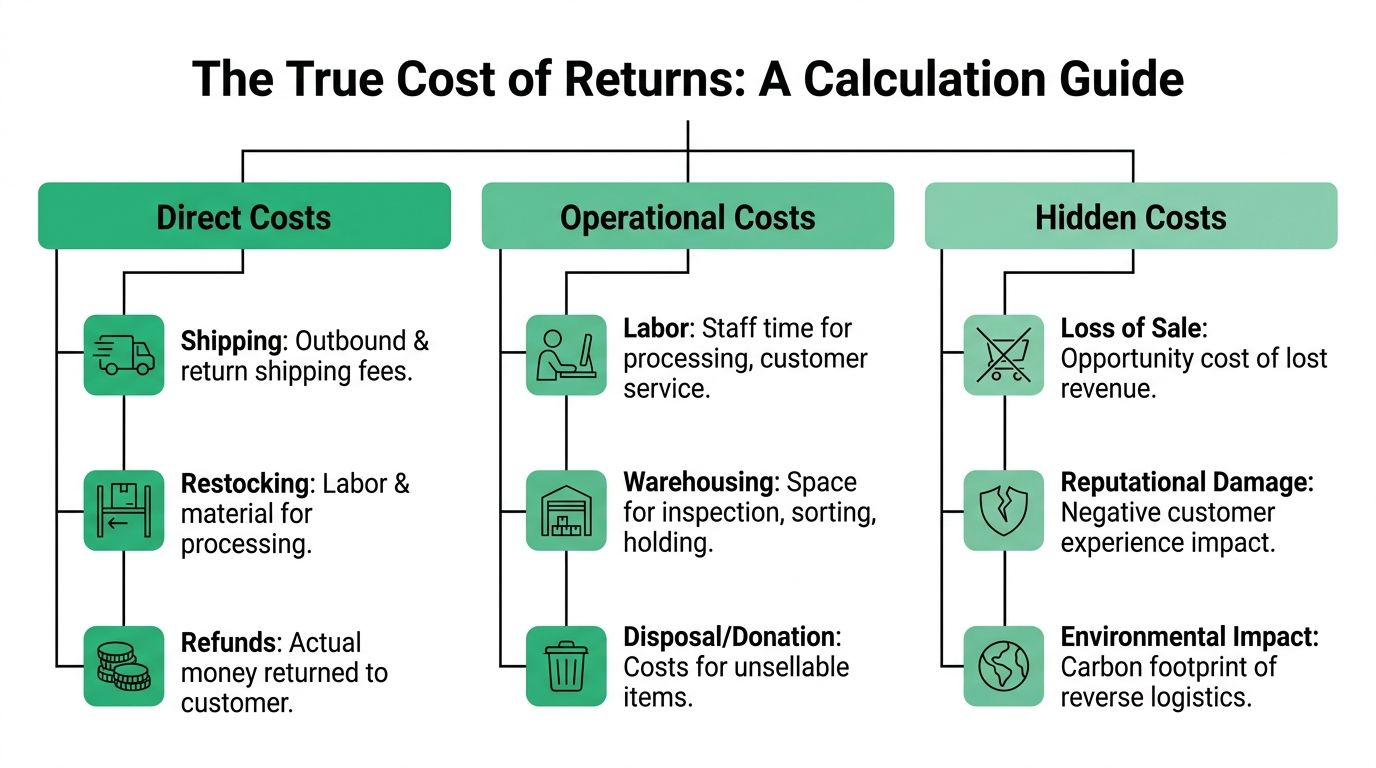
The easiest mistake is to count only the label and the refund. That’s the shallow version of return accounting. Cost of returns includes the labor to receive and inspect the item, the time support spends answering “where is my refund” tickets, the probability that the item has to be discounted, and the possibility that the customer never buys again if the experience is clumsy.
According to ClickPost’s analysis of ecommerce returns, online returns at a 19.3% rate create hidden costs beyond shipping and handling, and 71% of customers avoid repurchasing after a poor return experience. That last point matters more than many operators admit. The wrong return process doesn't just increase operational expense. It can also lower lifetime value.
Direct costs you can usually find in your systems
These are the charges most finance and operations teams can identify without much debate.
| Cost Category | Description | Example |
|---|---|---|
| Outbound shipping loss | The original shipment cost is often unrecovered once the order is returned | You paid to ship an order that produced no lasting revenue |
| Return shipping | The carrier cost to move the item back through reverse logistics | A prepaid label funded by the merchant |
| Receiving labor | Warehouse time spent unloading, scanning, and routing returned inventory | Staff opens, verifies, and logs the item |
| Inspection and restocking | Work required to determine if the item can be resold | Rebagging, refolding, retagging, or quality check |
| Refund processing | Administrative and systems work tied to issuing the refund | Payment reconciliation and order adjustments |
| Packaging and materials | Supplies used to reprocess inventory | New polybag, replacement insert, relabeling |
These line items are why even a “simple” return rarely stays simple. If your team wants a plain-language breakdown of the shipping side, this explanation of what a return label is is useful because it shows how the label is just one component inside a broader workflow.
Hidden costs that quietly widen the loss
Hidden costs are harder to isolate, but they’re often what separate a manageable return program from an expensive one.
- Support workload: Return requests, exchange questions, refund status follow-ups, and exception handling all create ticket volume.
- Inventory degradation: Some items come back in a condition that requires discounting or makes resale impractical.
- Fraud exposure: Reverse logistics creates openings for abuse, especially when inspection standards or policy rules are loose.
- Acquisition waste: If you paid to acquire the order and the sale doesn't stick, part of that spend produced no durable contribution.
- Lifetime value erosion: A poor return experience can push an otherwise viable customer out of the retention pool.
- Operational distraction: Returns consume warehouse attention that could have been allocated to shipping sellable orders.
A return should be treated as a mini workflow crossing commerce, support, warehouse, and finance. If you only assign the cost to one team, your numbers will be wrong.
Why category and condition matter
Not every return deserves the same treatment. A sealed replenishment product, a tried-on apparel item, and a damaged electronic accessory don't carry the same recovery profile. Operators who use one average assumption across all returns usually miss where significant losses occur.
In practice, the strongest teams sort returns into operational buckets such as:
- Resell immediately when the item returns in clean, unopened condition.
- Rework then restock when labor can recover the item for sale.
- Discount or liquidate when full-price recovery isn't realistic.
- Dispose or donate when the item can't return to stock.
That decision path is where margin is won or lost. If your systems can't show which bucket absorbs the most volume and labor, the cost of returns will keep looking smaller than it really is.
How to Calculate Your Store's True Cost of Returns
A return can erase the margin on an order fast. Cahoot’s analysis of return economics puts the average fully loaded cost of a return at $40.75 for a $100 item, and found that an order with a $17.88 profit margin can become a $54.68 loss once return costs are included. For a Shopify Plus brand, that is not a reporting detail. It is a margin model.
The useful metric is cost per return. Build it first at the store level, then break it down by category, reason code, and disposition. That gives finance a real loss figure, operations a control metric, and leadership a way to judge whether a reduction project will pay back.
Start with a practical formula
Use one primary formula for the period you manage, usually monthly:
Cost per Return =
(Total direct return costs + total operational return costs + allocated hidden return costs) / total number of returns
Then add a second metric to show scale:
Return Cost as a Share of Sales =
Total return-related cost / net sales for the same period
The first number tells you what one return costs. The second shows how much of your revenue base is being consumed by return activity.
Build the model from systems you already have
For Shopify Plus teams, the data usually sits across Shopify, your returns platform, help desk, WMS or 3PL reporting, and finance. Start with booked costs and measured labor. Add allocation logic only where the business can defend it.
Use three cost buckets.
Direct costs
- Return shipping paid by the merchant
- Original outbound shipping that produced no retained sale
- Packaging and processing materials
- Refund-related payment handling, if applicable
Operational costs
- Warehouse labor for receiving, inspecting, grading, and restocking
- Support labor tied to return, exchange, and refund tickets
- Exception handling for damaged, incomplete, or disputed returns
- Storage and handling for held inventory awaiting disposition
Hidden or allocated costs
- Markdown loss on inventory that cannot return to full-price stock
- Liquidation, donation, or disposal cost
- Customer acquisition spend tied to orders that did not stick
- Fraud write-offs and abuse-related loss
- Retention impact, if you can connect it to return friction with reasonable confidence
A step-by-step calculation framework
This is the version I recommend in practice because it is simple enough to maintain and detailed enough to use in decision-making.
Set the period and count returns consistently.
Decide whether you are measuring return requests, approved returns, or physically received returns. Do not mix them. For P&L work, received returns is usually the cleanest count.Export direct cash costs.
Pull label spend, carrier adjustments, outbound shipping on returned orders, and packaging costs for the same period.Convert labor into dollars.
Estimate hours spent by warehouse and CX teams on return-related work, then apply loaded hourly rates, not just base wages. If a 3PL handles returns, use their actual fee schedule instead.Measure inventory recovery loss.
Compare original sell price to actual recovery outcome. Full-price restock, discounted resale, liquidation, and disposal should not sit in one blended assumption if you can separate them.Add tracked write-offs.
Include fraud, missing-item disputes, and any refund issued without product recovery when those losses are booked separately.Divide by total returns.
That gives you store-level cost per return.Segment the result.
Recalculate by product type, return reason, warehouse, and disposition path. The useful patterns surface through this process.
Example: a workable Shopify Plus model
Take a store with a $100 AOV and 1,000 received returns in a month.
If the team spent $9,000 on return labels and related shipping, $6,000 on support and warehouse labor, $12,000 in markdown and liquidation loss, and $3,000 in write-offs, total return cost for the period would be $30,000. The cost per return would be $30.
That number is already useful, but the next cut matters more. If apparel returns are costing $24 each while footwear returns are costing $43 because grading is slower and recovery rates are lower, the operating priority changes. You stop treating returns as one blended problem and start fixing the expensive pockets first.
If your number comes in unusually low, check what is missing. In many audits, the gaps are labor, outbound shipping waste, and recovery loss on items that never make it back to full-price stock.
Practical rule: Version one should be honest, not perfect. A defendable estimate that gets reviewed monthly is better than a detailed model no one trusts or updates.
How to model the ROI of reduction strategies
Once cost per return is stable, you can model payback on return reduction projects with much more confidence.
Use this basic framework:
ROI of a return reduction initiative =
(Estimated returns avoided × current cost per return) + retained gross margin + recovered revenue from exchanges - cost of the initiative
A few examples make this concrete:
| Operational change | What cost it targets | What to measure |
|---|---|---|
| Better product content | Expectation-gap returns | Return reason mix by SKU |
| Address validation | Failed delivery and reship cost | Failed delivery rate |
| Order editing window | Preventable bad shipments and support load | Order-change ticket volume |
| Exchange-first workflow | Refund leakage and lost revenue | Exchange rate versus refund rate |
| Faster inspection routing | Labor cost and delayed inventory recovery | Time to disposition |
Use conservative assumptions. If a sizing improvement project is expected to reduce fit-related returns by 10%, apply that reduction only to the affected SKU group, not the whole catalog. If an exchange-first flow shifts refunds into exchanges, count the margin retained on those exchanges separately from the processing cost you avoid. Finance teams will trust the model more if the assumptions are narrow and traceable.
What experienced operators do differently
Experienced operators keep one headline metric for leadership and a tighter operating view underneath it.
They review cost per return by SKU family, reason code, and final disposition. They compare those numbers against contribution margin, not just topline revenue. They also use the same model to judge policy changes. A looser policy may improve conversion and customer satisfaction, but if it pushes high-loss categories into heavier return volume, the policy needs a different threshold or a different workflow.
That is the goal. Calculate return cost accurately enough to see where margin is leaking, then use the number to decide which fixes are worth funding.
Proactive Strategies to Lower Your Return Rate
The cheapest return is the one that never gets created.
That sounds obvious, but many brands still spend more energy making returns easier than making orders more accurate. Ease matters. Prevention matters more. If your category attracts trial behavior, especially bracketing, the financial pressure gets worse. The projected operational cost of processing retail returns reached $75 billion, and the problem is influenced by behaviors like bracketing, with people ages 18 to 30 averaging 7.7 online returns per year, according to the video reference provided in the verified data.
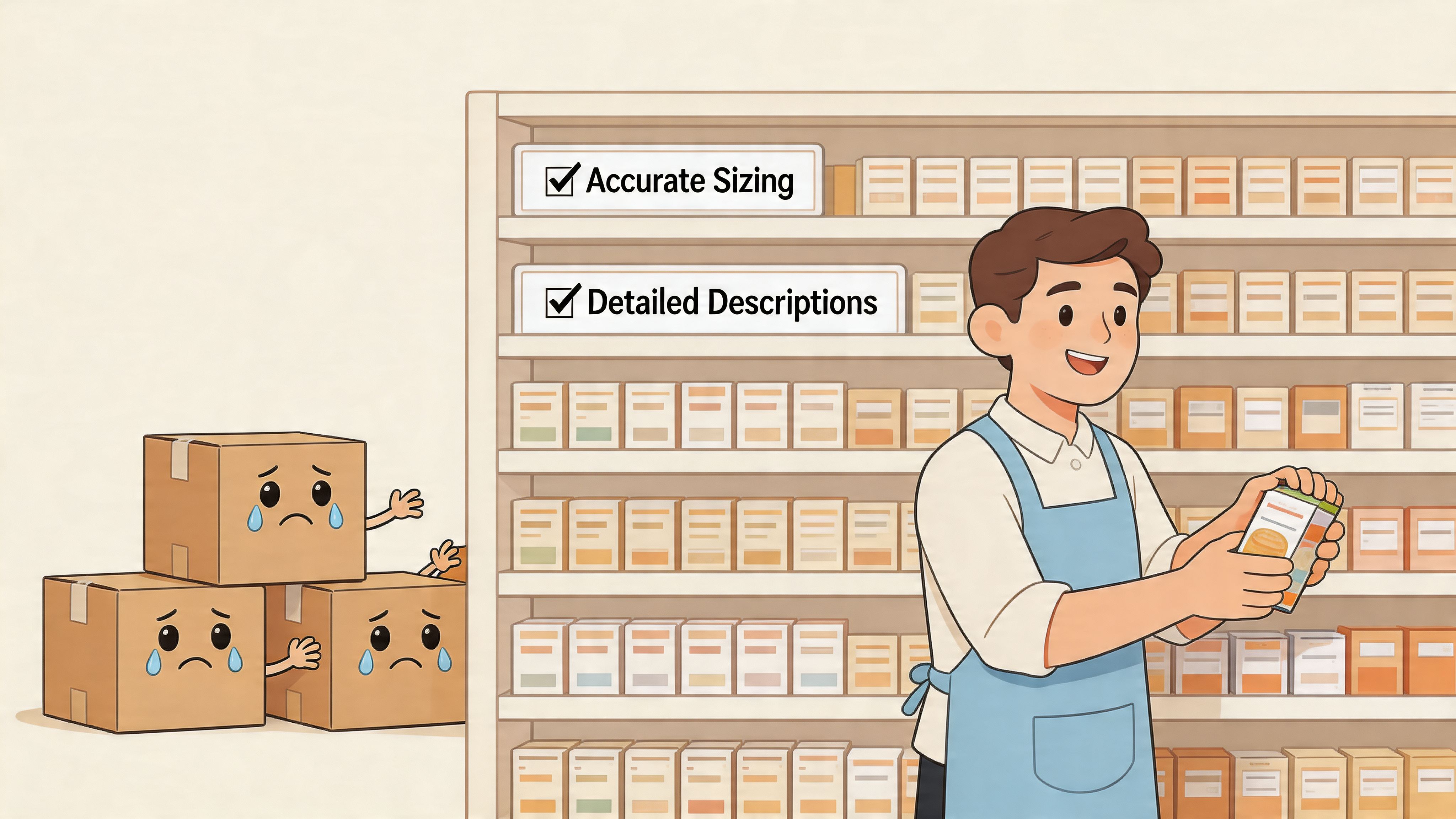
Fix product understanding before the order is placed
Most preventable returns start with expectation gaps. The customer thought the fit, finish, color, scale, or function would be one thing. The delivered product proved otherwise.
That puts pressure on merchandising, not just customer service.
Use a stricter standard for product pages:
- Show the product from useful angles. Front-on studio shots aren't enough if texture, drape, depth, or finish affect the buying decision.
- Write for decision-making, not branding. Customers need dimensions, material behavior, compatibility notes, care instructions, and limits.
- Add comparison guidance. Help shoppers distinguish between similar variants so they don't buy the wrong version.
- Surface fit and sizing context. Apparel brands especially need clear sizing frameworks that reduce guesswork.
If you're selling configurable or technical products, put compatibility and exclusion information near the buy box. If a shopper can make a wrong choice, many of them will.
Treat sizing and variant selection as an operations issue
Apparel brands often frame sizing as a merchandising challenge. It’s also an ops challenge because bad fit creates reverse logistics volume.
Practical fixes include:
- Use structured size guidance that maps customer inputs to recommended sizes.
- Standardize variant naming so customers aren't comparing ambiguous option labels.
- Audit return reasons by size curve to see whether the issue is product grading, customer expectation, or inconsistent manufacturing.
- Review photography and model context if customers routinely misread proportion.
The same logic applies beyond apparel. Bundles, shade variants, pack sizes, and accessory compatibility all need clearer selection cues.
If customers use the return process to learn what they should have known before purchase, your PDPs are carrying too little operational detail.
Tighten fulfillment and quality control
Some returns aren't demand problems. They're execution problems.
When the warehouse ships the wrong item, misses a component, or sends a damaged unit, the return wasn't caused by the shopper at all. It was created by internal process failure. That means return reduction work belongs inside fulfillment QA, pick accuracy, and pre-ship checks.
Focus on:
- Pick and pack verification for lookalike SKUs
- Damage prevention in packaging design and handoff
- Batch-level quality review when a production issue appears
- Clear escalation paths when support sees a repeated defect theme
Brands get into trouble when they lump all returns together. You need separate owners for preventable causes. Merchandising should own expectation gaps. Operations should own execution failures. Product teams should own repeat defects.
Use post-purchase edits to stop bad orders from shipping
A surprising number of returns begin as small customer errors that nobody catches in time. Wrong size, wrong color, wrong shipping detail, wrong apartment number. Once fulfillment starts, a simple correction becomes a shipment problem or a return.
That’s why post-purchase flexibility is underrated as a return reduction lever. If customers can correct mistakes quickly before the order leaves the warehouse, you avoid the cost of shipping the wrong thing and processing it on the way back.
For Shopify Plus brands, that means building a workflow that catches fixable mistakes early, instead of forcing support to handle them manually after the order is already in motion.
Optimizing Your Return Policies and Post-Purchase Flow
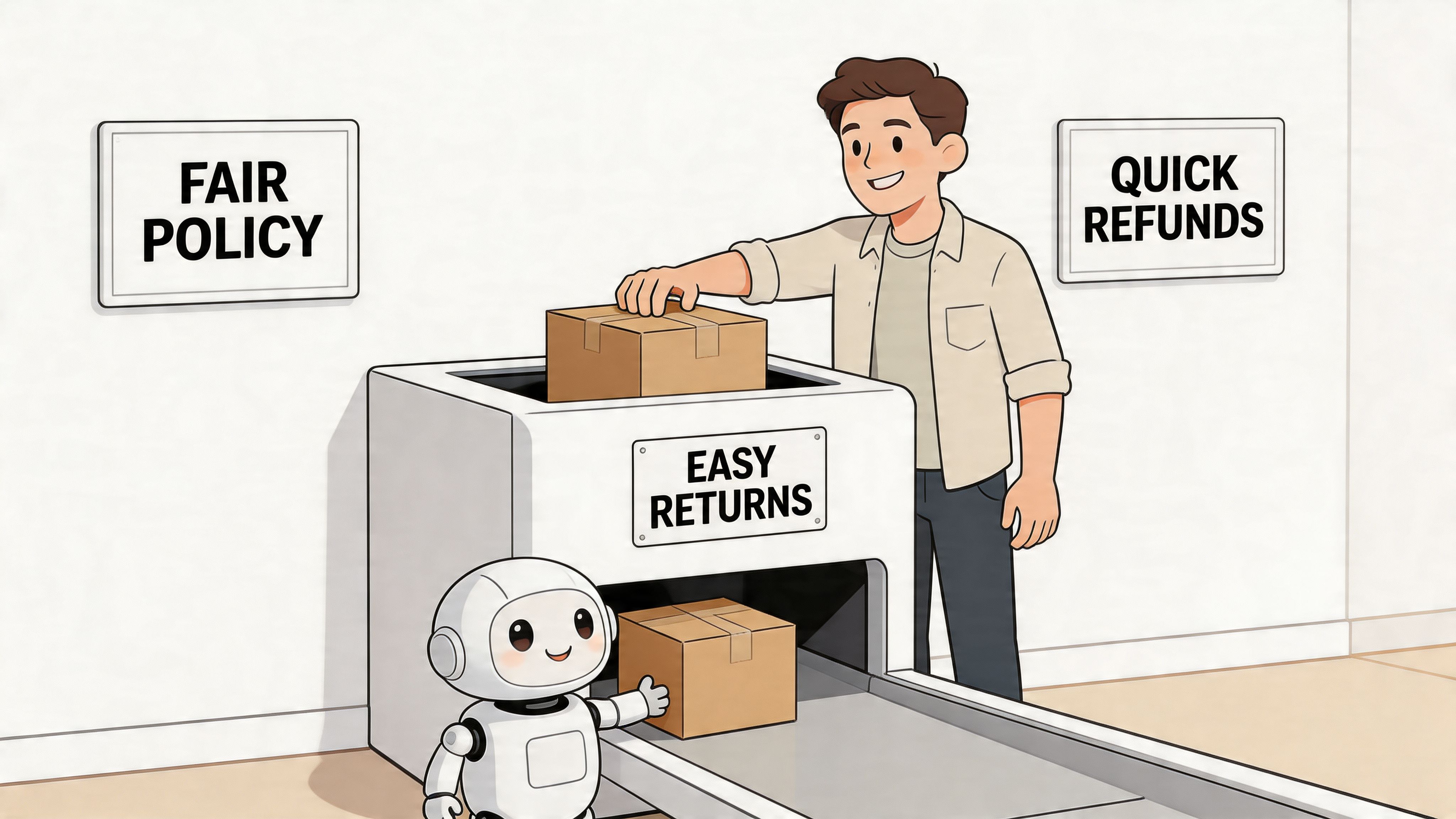
Charging for returns looks attractive on a spreadsheet. It can reduce direct shipping expense and discourage low-intent purchasing behavior. But operators who treat return fees as a simple win often create a second problem in retention.
The trade-off is real. Nearly 75% of retailers now charge return fees, yet 37% report losing customers and 24% see a sales decline as a direct result, according to the LateShipment analysis referenced in the verified data. That doesn’t mean fees are always wrong. It means they need to be designed carefully.
Why blunt return fees often backfire
A flat fee treats all customers and all return contexts the same. That’s operationally simple, but commercially clumsy.
It ignores differences between:
- loyal repeat buyers and one-time discount shoppers
- damaged-item complaints and discretionary returns
- low-risk categories and high-abuse categories
- domestic flows and more complex international flows
If you charge everyone the same way, you can end up protecting short-term shipping cost while making the brand feel harder to buy from.
Build a policy around behavior, not frustration
A smarter return policy separates business goals from emotional reactions. Don’t create fees because returns feel annoying. Create rules that match actual cost drivers and customer value.
A sound framework looks like this:
| Policy decision | Better approach | Why it works better |
|---|---|---|
| Return fee design | Segment by reason, category, or customer value | Reduces abuse without punishing good customers |
| Refund versus exchange | Encourage exchanges where appropriate | Preserves revenue and reduces reacquisition pressure |
| Return window | Match window length to product reality | Balances flexibility with inventory recovery |
| Exception handling | Make damage and merchant-error returns easy | Protects trust when the brand is at fault |
For teams reviewing policy language, examples of a clear refund and returns policy can help benchmark structure and clarity. The goal isn't to copy another business. It's to make your own policy easier for customers and support staff to interpret consistently.
Clean up the post-purchase flow
A good return policy can still fail if the workflow around it is confusing.
Customers should be able to answer basic questions without opening a ticket:
- Can I return this item?
- Is an exchange available?
- What happens if the item arrived damaged?
- When will my refund be issued?
- Can I fix an order mistake before it ships?
When those answers are buried, support volume rises and frustration follows. For Shopify brands, this guide to a return policy on Shopify is useful because it connects policy language with the actual post-purchase experience customers see.
A strong return policy doesn't just define rules. It reduces ambiguity at the moment customers are most likely to contact support.
Prefer exchange paths when they make sense
Refunds remove revenue. Exchanges preserve it. That doesn't mean forcing exchanges on people who want out. It means making the exchange path easier when the issue is fixable.
Good candidates include:
- size corrections
- color or variant swaps
- replacement for a damaged unit
- compatibility-based product change
This works best when the operational path is simple. If customers have to email support three times to switch a variant, they’ll choose the refund instead.
The strongest return programs feel fair, fast, and predictable. They lower cost without making the brand look defensive.
Using SelfServe to Cut Costs and Recover Revenue
Shopify Plus brands usually know where return costs come from. The harder part is operationalizing a fix without adding headcount or forcing support to become the traffic controller for every post-purchase issue.
That’s where self-service post-purchase workflows become valuable. They reduce avoidable mistakes before fulfillment, cut manual ticket handling, and create places to recover revenue that would otherwise be lost.

Map the feature to the cost driver
The best way to evaluate any tool is to connect it directly to a specific cost bucket.
Here’s the practical mapping for SelfServe:
| Cost driver | SelfServe capability | Operational effect |
|---|---|---|
| Wrong shipping details | Real-time address validation with Google Maps | Prevents deliverability problems before shipment |
| Order mistakes | Customer order editing within merchant-defined windows | Stops support tickets and bad shipments caused by simple errors |
| Excess manual review | Permission controls and approval flows | Keeps ops in control while reducing repetitive handling |
| International friction | Multilingual widget experience | Makes post-purchase edits easier for global customers |
| Revenue loss after checkout | Upsell modules on Thank You and Order Status pages | Creates incremental revenue that can offset unavoidable return cost |
This is the right lens for implementation. Don’t ask whether the app is “nice to have.” Ask which return costs or support costs it removes.
Where the operational savings usually show up
Support teams often absorb work that shouldn't exist in the first place. Customers email to fix an address typo, swap a variant, update contact details, or ask whether an order can still be changed. Each request costs time, and many arrive in volume during promotional periods.
When customers can make approved changes themselves, you remove the handoff. That matters because post-purchase mistakes can otherwise turn into failed deliveries, reships, cancellations, or returns.
A second gain shows up in warehouse execution. Cleaner order data means fewer exceptions. Fewer exceptions mean less manual coordination between support and fulfillment.
The cheapest support ticket is the one the customer resolves correctly on their own before your team touches it.
Revenue recovery matters too
Most return conversations focus on cost reduction. That’s only half the job.
SelfServe also gives brands a way to recover revenue through curated upsells on the Thank You and Order Status pages. That won't eliminate the cost of returns, but it can offset part of it by increasing order value after checkout without adding a separate acquisition cost.
For operators thinking more broadly about in-product guidance and self-service behavior, this piece on AI assistants that guide users inside the product is a useful parallel. The underlying idea is the same. Reduce friction at the exact moment a user needs help, instead of routing every issue through human intervention.
How to roll it out like an ops team, not a feature team
A strong rollout starts with the error types that generate the most unnecessary work.
Prioritize in this order:
- Address correction and validation if delivery issues are creating downstream cost.
- Order edits for common mistakes such as variants, contact details, or shipping fields.
- Rules and restrictions by product or order state so customers can self-serve safely.
- Upsell logic on post-purchase pages to recover margin where it fits your catalog.
- 3PL or ERP coordination if your process requires tighter downstream synchronization.
For a fuller view of how this type of workflow changes post-purchase operations, the overview of a self-service customer portal is worth reviewing.
The right ROI test
Judge SelfServe on three things:
- Are repetitive post-purchase tickets going down?
- Are fewer bad orders making it into fulfillment?
- Are post-purchase upsells offsetting part of your unavoidable return expense?
If the answer is yes on those three fronts, the tool is doing real operational work. That’s the standard that matters.
If your team is serious about lowering the cost of returns, reducing support load, and recovering margin after checkout, SelfServe is worth a close look. It gives Shopify and Shopify Plus brands practical control over post-purchase edits, address accuracy, multilingual self-service, and upsell opportunities without forcing every issue through support.