E Commerce Logistics Services A Complete Guide for 2026
The global e-commerce logistics market is projected to grow from USD 650.2 billion in 2025 to USD 3,221.6 billion by 2035, at a 18.9% CAGR, according to Future Market Insights. That number changes how fast-growing brands should think about logistics. This isn’t a back-office function anymore. It’s one of the main systems that determines whether growth feels controlled or chaotic.
Most DTC teams first feel logistics pain through symptoms. Shipping costs climb. Inventory gets stranded. Support tickets pile up after an address mistake or a late scan. Margins erode one operational exception at a time. The mistake is treating each symptom separately instead of seeing the full logistics stack for what it is: the operating system behind the customer promise.
E commerce logistics services sit between demand and delivery. They turn a paid order into a picked item, a printed label, a moving package, a delivered shipment, and if needed, a return that doesn’t destroy margin. When that system works, customers trust the brand more. When it breaks, support absorbs the damage first, then finance.
The brands that scale cleanly usually stop thinking of logistics as warehousing alone. They connect warehouse execution, carrier strategy, inventory placement, returns handling, and post-purchase customer experience into one flow. That’s where efficiency shows up. It’s also where profitability is protected.
The Unseen Engine of Your E-commerce Growth
Good logistics is invisible to the customer. That’s the point. The customer clicks buy, gets accurate updates, receives the order on time, and never thinks about your fulfillment process again. But inside the business, logistics decides whether growth creates strategic advantage or just more operational noise.
For a high-volume Shopify or Shopify Plus brand, e commerce logistics services are closer to a central nervous system than a cost line. Orders, inventory, warehouse tasks, carrier handoffs, tracking events, returns, and customer communications all pass through it. If one signal fails, the rest of the business feels it quickly.
Why growth exposes weak operations
A smaller store can absorb manual work for a while. A support rep can fix an address. An ops manager can catch a stock mismatch. A warehouse lead can patch a picking issue on the floor.
That stops working once order volume rises.
At scale, the expensive problems usually aren’t dramatic. They’re repetitive. Wrong suite numbers. Orders released before an edit is processed. Inventory counts that lag behind reality. Carriers selected without enough logic around zone, service level, or package profile. Each issue looks minor by itself. Together, they create margin leakage and support burden.
Operational truth: Most fulfillment problems show up first as customer experience problems, not warehouse problems.
What strong logistics actually does
Strong logistics doesn’t only move parcels faster. It creates control.
That control shows up in a few ways:
- Inventory is trustworthy. Teams know what’s available, where it sits, and whether it can ship on time.
- Fulfillment rules are consistent. Orders move through picking, packing, and handoff without constant manual review.
- Carrier choice is deliberate. Shipping isn’t based on habit. It’s based on cost, service fit, and destination.
- Returns are managed, not tolerated. Reverse logistics is designed to recover value and reduce friction.
- Post-purchase communication prevents escalation. Customers can see what’s happening before they contact support.
The brands that treat logistics as strategy, not overhead, usually make better decisions upstream too. They launch products more carefully, forecast more realistically, and avoid promising delivery experiences they can’t support.
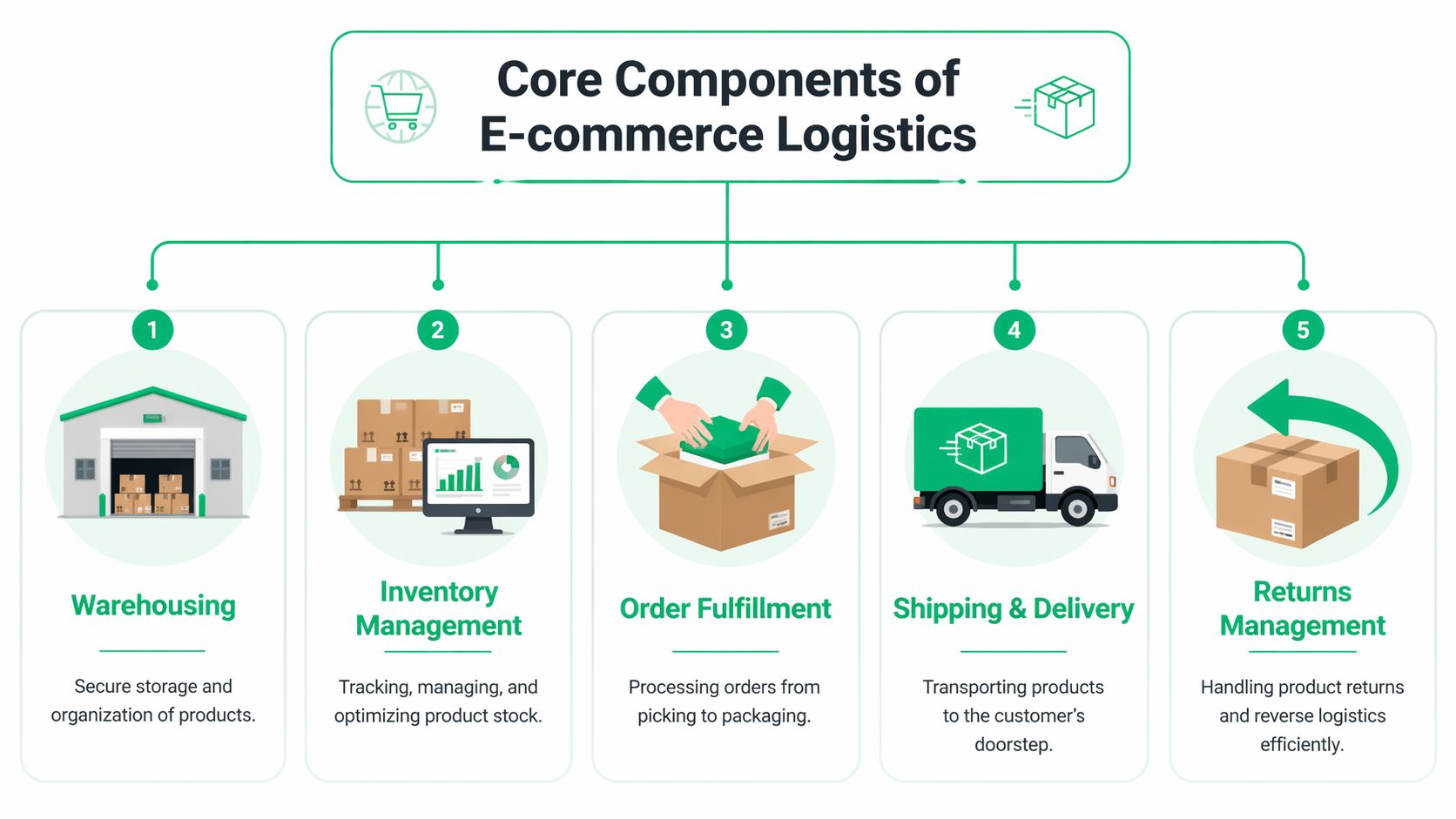
Understanding the Core Components of E-commerce Logistics
Most logistics failures happen at handoff points. Inventory is received but not stored correctly. An order imports but doesn’t route cleanly. A package leaves the building but tracking doesn’t sync. Returns come back but sit unprocessed. The fix is to understand the stack as connected parts, not isolated tasks.
Warehousing and inventory discipline
Warehousing is where physical control starts. It’s not just storage. It’s product organization, bin logic, receiving discipline, replenishment, and location accuracy.
Inventory management sits on top of that physical reality. If the system says stock is available but the shelf doesn’t, every downstream promise becomes fragile. That includes product availability on site, expected ship dates, and internal planning.
For a growing brand, the practical choices usually look like this:
- In-house fulfillment gives tighter control over process and presentation, but it adds hiring, training, space constraints, and management overhead.
- 3PL warehousing gives faster scalability, but only if the partner has reliable systems and strong exception handling.
- Distributed inventory improves delivery reach, but it increases transfer complexity and forecasting pressure.
Warehouse automation matters here because it directly affects cost and accuracy. Pitney Bowes notes that warehouse automation with robotics, AGVs, and smart picking systems can curb labor costs by 25-40% and boost order accuracy to 99.9%. That’s a meaningful operational shift. It changes whether growth requires proportional headcount growth.
If you’re evaluating warehouse software options before choosing a provider, this guide to best WMS systems is a useful place to compare what operational visibility should look like.
Order fulfillment on the floor
Fulfillment is the execution layer. An order enters the queue, stock is allocated, items are picked, packed, labeled, and handed to a carrier.
This sounds straightforward until volume increases.
On a busy operation, what matters isn’t whether you can fulfill orders. It’s whether you can fulfill them consistently under pressure. Batch picking, barcode verification, pack station controls, and exception flags matter more than motivational warehouse slogans.
A practical flow usually includes:
- Order release rules that hold risky or incomplete orders before they hit the floor.
- Picking logic that minimizes walking and prevents SKU confusion.
- Packing standards that protect margin by balancing packaging cost, presentation, and damage prevention.
- Label generation and manifesting that sync correctly with the selected carrier and promised service level.
Shipping and carrier management
Carrier management is where many brands overpay without realizing it. They keep a familiar carrier mix long after order profile, geography, and customer expectations have changed.
Good shipping operations rely on active decision-making. That includes service selection by destination, parcel characteristics, promised speed, and claim history. Some orders need speed. Others need cost control. Treating every shipment the same usually produces the wrong outcome for both.
For teams looking at fulfillment partners that combine shipping execution with operational tools, the Cargofit project is worth reviewing as an example of how providers package logistics workflows for modern e-commerce brands.
The cheapest shipping method on paper often becomes the most expensive option once delays, support tickets, and reships enter the picture.
Returns and reverse logistics
Returns are where weak processes become visible fast. If the forward path is clean but the reverse path is messy, customer trust still drops.
Reverse logistics includes return authorization, label generation, receiving, inspection, disposition, refund timing, and restocking logic. Each step affects cash flow and customer perception.
The brands that handle returns well usually make three decisions early:
- They define which items can be restocked quickly
- They separate damaged, resaleable, and non-resaleable inventory clearly
- They treat return reasons as operating data, not just customer service data
That’s the full lifecycle. Product comes in, is stored correctly, ships through a controlled process, reaches the customer through the right carrier setup, and if it comes back, re-enters the business through a system that protects both margin and experience.
Navigating Last-Mile and International Complexities
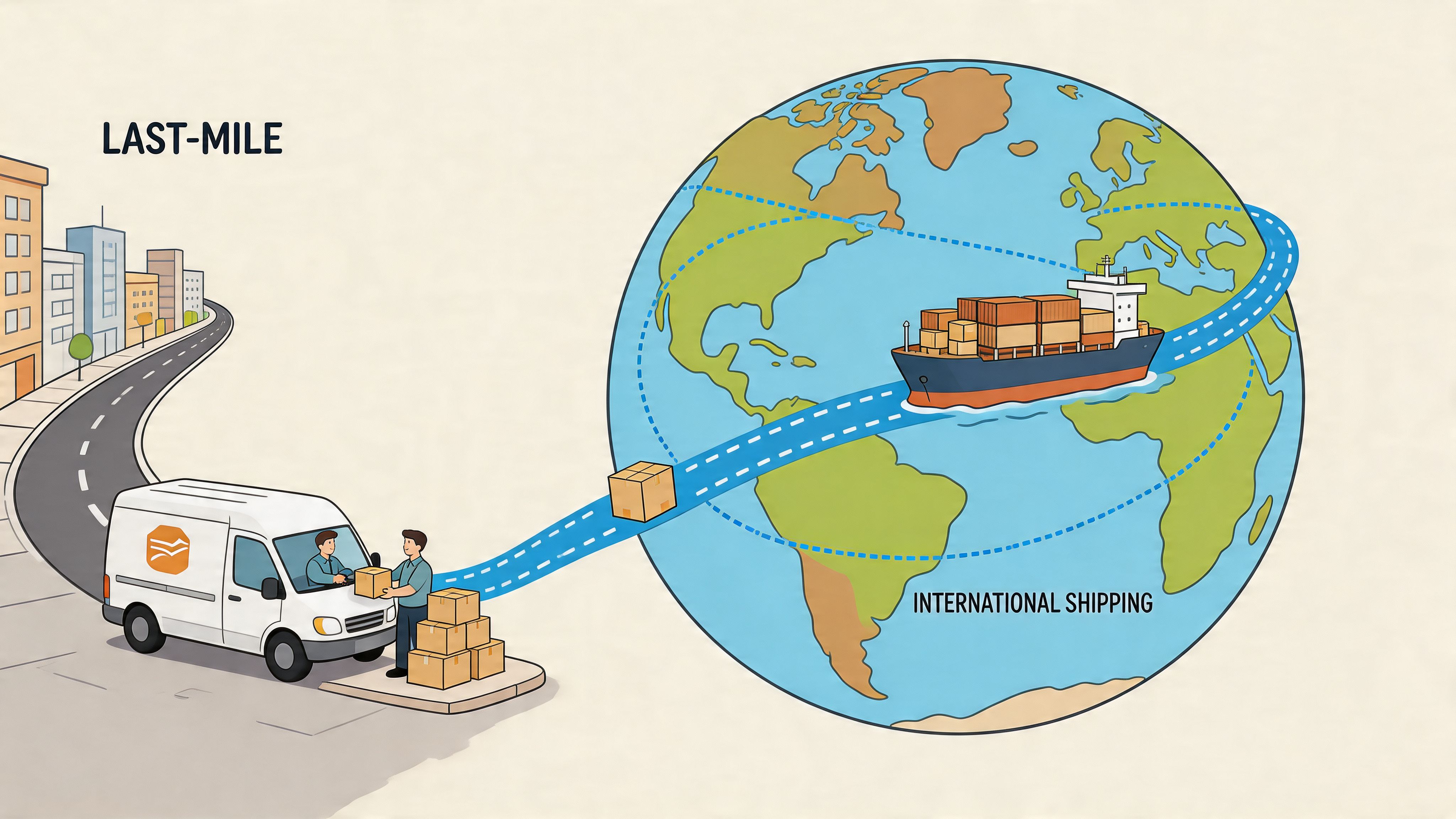
The warehouse is the part merchants control most directly. Last-mile delivery and international shipping are different. They involve external carriers, local delivery conditions, customs requirements, address quality, and region-specific exceptions. That’s where many operational plans look solid in a dashboard and messy in practice.
Why the last mile breaks otherwise good operations
The last mile is the customer’s only physical experience of your logistics system. They don’t see your pick path optimization or warehouse slotting logic. They see whether the parcel arrives where and when it should.
That’s why small upstream mistakes become expensive here. A missing apartment number, a mistyped postal code, or an outdated phone number can turn a simple delivery into a delay, reattempt, reroute, or return. The cost isn’t only shipping. It’s support time, refund pressure, replacement risk, and damaged trust.
Extensiv points out that existing logistics content gives minimal attention to address data quality as a preventative cost factor, even though inaccurate addresses create cascading costs from failed deliveries, especially for international orders where address formats and validation databases vary significantly.
That’s one of the biggest blind spots in e commerce logistics services. Teams spend time negotiating carrier rates, but not enough time preventing avoidable delivery failures before the label is printed.
International shipping adds complexity fast
Cross-border growth looks attractive because the top-line opportunity is obvious. The operational load is less obvious until orders start moving.
International shipping introduces variables that domestic teams often underestimate:
- Customs documentation has to match product reality, not just catalog language.
- Duties and taxes affect landed cost perception and delivery acceptance.
- Address formats vary by country and don’t always map neatly to a domestic checkout structure.
- Carrier handoffs become more complex when multiple networks touch the shipment.
- Customer communication has to bridge longer timelines and more uncertainty.
A lot of brands expand internationally before their post-purchase systems are ready for it. They translate storefront content but leave order communications, edit workflows, and delivery exception handling underbuilt.
For merchants comparing providers and operating models in this area, this roundup of cross-border logistics companies is a practical reference point.
What actually helps in the field
The fix isn’t a single carrier or a single app. It’s a combination of operating habits.
Teams that manage last-mile and international complexity well usually do the following:
- Validate addresses early instead of treating bad data as a warehouse problem
- Set country-specific fulfillment rules for documentation and service selection
- Separate premium-speed promises from standard service promises
- Use clear tracking communication so customers know what stage the shipment is in
- Review delivery exceptions by cause rather than bundling them into a generic delay bucket
A short explainer can help align internal teams on how these pieces fit together:
If international orders are growing, address quality and exception handling deserve the same attention as carrier pricing. Otherwise, volume just scales preventable errors.
Measuring Logistics Success with KPIs and Cost Drivers
Organizations often track logistics after finance complains or support volume spikes. That’s too late. Good operators monitor the system while it’s healthy so they can spot drift before it becomes a service problem.
The right KPI set does two jobs. It shows whether operations are stable, and it explains where money is leaking. A metric only matters if it leads to action.
The KPIs that actually matter
A practical scorecard for logistics should stay close to execution. If you want a broader planning model that links operations to company goals, a Balanced Scorecard Framework can help structure how logistics performance ties back to customer and financial outcomes.
For day-to-day operations, start with these:
- Order accuracy tracks whether customers receive the correct items in the correct quantities.
- On-time shipment rate shows whether the warehouse releases orders within the promised handling window.
- Delivery exception rate reveals how often shipments encounter avoidable friction after handoff.
- Inventory accuracy measures whether system counts match physical counts.
- Return reason mix helps separate product issues from fulfillment issues.
- Support contacts tied to fulfillment tells you whether the customer is paying for your process gaps with their time.
These aren’t just warehouse metrics. They connect directly to customer experience. If order accuracy drops, support will hear about it. If shipment timing slips, reviews will reflect it. If inventory accuracy is weak, marketing and merchandising start making bad decisions.
Cost drivers behind the dashboard
Shipping spend gets the most attention, but logistics cost usually comes from a combination of factors:
| Cost Driver | What raises it | What lowers it |
|---|---|---|
| Carrier spend | Poor rate selection, fragmented parcel profile, manual routing | Better carrier rules, stronger routing logic, negotiated fits by lane |
| Labor | Inefficient pick paths, rework, manual exception handling | Process design, scanning, automation, cleaner order inputs |
| Packaging | Oversized boxes, damage, inconsistent standards | Packaging rules by SKU profile, pack station controls |
| Storage | Slow-moving stock, poor slotting, excess safety stock | Better forecasting, faster replenishment decisions, SKU rationalization |
| Support overhead | Delivery confusion, address errors, order-change friction | Better tracking communication, customer self-service, exception prevention |
Where technology creates measurable savings
Transportation software is one of the clearest areas where tech can produce direct cost improvement. 42Signals reports that advanced TMS platforms use real-time data for dynamic route optimization and intelligent carrier selection, reducing shipping costs by up to 20-30%.
That matters because shipping isn’t just a negotiated rate problem. It’s a decision problem. If the system can choose carriers based on destination, package specs, and service reliability instead of habit, cost and service both improve.
Decision rule: Track KPIs that expose root causes. If a metric can’t tell you what to change on the floor, in your carrier mix, or in customer communications, it’s probably not helping enough.
The best reporting cadence is usually simple. Daily for execution issues. Weekly for trend shifts. Monthly for partner review and margin analysis. Once teams overbuild the reporting layer, they often spend more time formatting dashboards than fixing operations.
How to Choose and Evaluate Logistics Partners
Choosing a 3PL is one of the few operations decisions that can improve execution quickly or create long-lasting friction. Price matters, but cheap logistics often turns expensive when the partner can’t handle exceptions, integrations, or volume swings.
A strong evaluation process looks less like vendor shopping and more like risk assessment. You’re not buying storage and pick-pack labor. You’re choosing how much operational complexity your team will inherit later.
Start with your actual business model
A beauty brand with fast-moving SKUs, bundles, and influencer spikes needs a different fulfillment setup than a furniture brand shipping oversized items. The wrong comparison starts with a generic RFP and ends with a partner that looks fine in a spreadsheet but fails in live operations.
Use your own order profile first:
- Order composition asks whether shipments are mostly single-line or multi-line
- SKU complexity reveals whether products need special handling, kitting, or lot control
- Demand variability shows how exposed you are to launches, promos, and peak periods
- Returns behavior tells you whether reverse logistics needs to be a strength, not an add-on
- Geographic mix determines whether network footprint matters more than local specialization
If you’re early in that process, reviewing lists of 3rd-party fulfillment companies can help frame the market, but the shortlist should come from your own operational requirements, not brand familiarity.
Compare partners by trade-off, not by pitch
Every 3PL says they scale. Many do, but not in the way your brand needs. Some scale through process discipline. Others scale through volume aggregation but struggle with nuance. Some are excellent for standard parcel flow and weak at exception-heavy orders.
Use a decision table and force concrete answers.
| Evaluation Criterion | What to Look For | Red Flags to Watch For |
|---|---|---|
| Technology stack | Real-time inventory visibility, strong integrations, reliable reporting, clear exception workflows | Manual exports, delayed syncs, vague answers about system limitations |
| Network footprint | Facilities that align with customer concentration and shipping strategy | Warehouses in convenient locations for them, not for your service map |
| Operational specialization | Experience with your product type, packaging needs, bundle logic, and returns profile | “We handle everything” without specific process detail |
| Pricing model | Clear storage, pick-pack, receiving, packaging, return, and surcharge structure | Low headline rate with opaque accessorial fees |
| Service levels | Defined handling windows, escalation paths, inventory SLA, receiving timelines | Promises without documented SLAs or review cadence |
| Peak readiness | Staffing plan, overflow process, cut-off management, carrier contingency | Generic confidence with no peak playbook |
| Exception handling | How they manage address issues, stock mismatches, damaged inventory, and late scans | No named process owner for exceptions |
| Customer support alignment | Ability to provide timely status data your CX team can use | Black-box operations where your support team can’t get answers |
Questions that expose weak partners fast
Don’t ask whether they’re reliable. Ask what happens when things go wrong.
A better set of questions:
- What’s your process when inventory received doesn’t match the ASN or PO?
- How do you handle order edits that arrive near release cutoff?
- What causes most shipping exceptions in your network, and how do you prevent them?
- How are returns inspected, dispositioned, and restocked?
- What changes operationally during peak periods?
- Which parts of reporting are real-time versus delayed?
The quality of the answers matters more than the polish of the sales deck.
A capable 3PL can describe failure modes in detail. A weak one keeps the conversation at the feature level.
What works and what doesn’t
What works is alignment between your brand’s operating model and the partner’s real strengths. What doesn’t is choosing based on lowest pick fee, broadest marketing claims, or the assumption that problems can be solved later through account management.
A logistics partner should reduce complexity for your team. If the evaluation process already feels vague, the live relationship usually gets worse, not better.
Integrating Logistics with Your Shopify and Shopify Plus Store
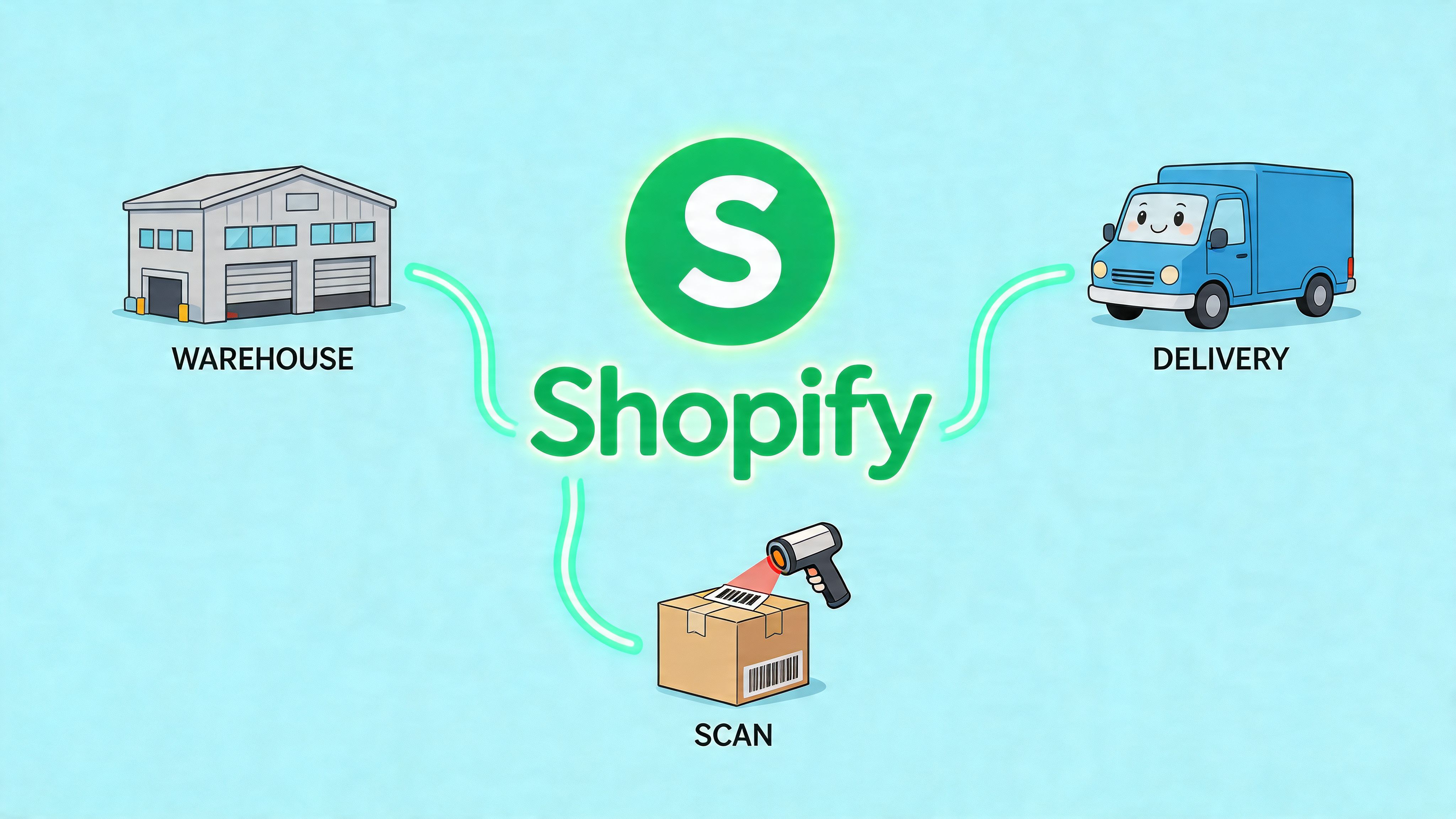
A logistics operation is only as good as its data flow. If Shopify, your warehouse system, carriers, and ERP aren’t aligned, the work gets done twice. Sometimes three times. That’s where oversells, wrong notifications, and fulfillment delays start.
What the integration actually needs to do
At minimum, the connection between Shopify and your logistics stack has to synchronize four things well:
- Orders need to flow into fulfillment without missing notes, tags, or routing rules
- Inventory needs to update back to the storefront reliably
- Tracking events need to return quickly and accurately
- Order status changes need to stay consistent across systems
This usually happens through APIs, middleware, native 3PL apps, or ERP connectors. The right choice depends on complexity. A simpler brand may be fine with a direct app integration. A larger Shopify Plus brand often needs custom logic because routing, editing windows, ERP sync, and international workflows aren’t standard.
Where poor integration hurts most
The common failure point isn’t connectivity. It’s timing and data consistency.
For example, if inventory sync lags, the storefront may continue selling units the warehouse can’t fulfill. If tracking pushes late, customers assume the order hasn’t moved. If order edits happen in one system but not another, the warehouse ships the wrong destination anyway.
These are operational issues, but the customer experiences them as service failure.
For teams still assessing the broader Shopify ecosystem itself, an Ecommerce Platform Comparison can be helpful for understanding where Shopify’s strengths fit against more customized platform options.
Shopify Plus raises the stakes
Higher-volume merchants usually need more than basic order forwarding. They need workflow control.
That often means:
- Tag-based routing for special handling or warehouse assignment
- ERP coordination for finance, inventory, and purchasing accuracy
- Localized post-purchase experiences for international customers
- Custom business rules around edits, approvals, holds, and order release
According to Precedence Research, for international Shopify merchants, trends like DHL’s new air cargo integrations and FedEx’s AI-powered workforce underscore the value of multilingual widgets, upsell modules, and ERP integrations in post-purchase workflows.
That point matters because logistics integration isn’t just about moving data into a warehouse. It’s also about keeping the customer-facing side of the order accurate after purchase. If the backend is synchronized but the customer can’t see or manage the order clearly, support still ends up doing manual cleanup.
A practical integration standard
A solid Shopify logistics integration should pass three tests:
- Can the operations team trust the data without manual verification?
- Can support explain order status without chasing multiple systems?
- Can the business change rules without rebuilding the whole workflow?
If the answer to any of those is no, the integration isn’t finished. It’s just connected.
Practical Ways to Reduce Support Load and Improve Fulfillment
Most logistics teams optimize the warehouse first. That makes sense. But there’s another layer that often gets ignored: what happens after the customer places the order and before the parcel is fully delivered.
That gap is where support volume grows.
Talking Logistics highlights that e-commerce logistics content heavily emphasizes carrier optimization and warehouse automation while overlooking customer-side friction in the post-purchase journey. It also notes that enabling customers to resolve post-purchase issues through self-service is an underexplored efficiency lever for high-volume merchants.
The support queue is often a process design issue
A surprising amount of support work isn’t really support. It’s manual order correction.
Customers write in because they entered the wrong apartment number, used an old phone number, want to change a shipping detail, or need clarity on what’s happening next. If your only answer is “contact support,” then your support team becomes a human middleware layer between checkout and fulfillment.
That’s expensive. It also introduces delay exactly when timing matters most.
What actually reduces ticket volume
The best improvements are preventative, not reactive.
A practical approach looks like this:
- Enable controlled order edits so customers can fix simple mistakes before the order is locked for fulfillment
- Validate address data in real time so bad inputs are caught before they create delivery exceptions
- Send clearer order-status communication so customers don’t need to ask where the package is
- Define fulfillment cutoffs clearly so customers and internal teams know when changes are still possible
- Use approval flows for risky changes instead of blocking all changes or allowing everything
Operations and customer experience cease to be separate functions. If a customer can correct a mistake early, the warehouse avoids rework, the carrier avoids a bad handoff, and support avoids a ticket.
Teams often search for savings in shipping rates while ignoring the labor cost of preventable order-change requests.
Better post-purchase design improves fulfillment too
There’s a direct operational benefit to giving customers limited control after checkout. It reduces hidden failure points.
When customers can verify or update shipping details inside a controlled workflow, the business avoids the messy version of the same request arriving through email, chat, or social DMs. Structured inputs are easier to approve, audit, and route than free-text support messages.
That changes fulfillment quality in practical ways:
- Warehouse teams work from cleaner order data
- Support teams spend less time triaging simple requests
- Customers feel informed instead of blocked
- Managers get fewer exceptions at the edge of release windows
The broader lesson is simple. E commerce logistics services don’t end when the order hits the WMS. The post-purchase experience is part of logistics performance. If it’s neglected, the rest of the stack carries more friction than it should.
Turning Logistics into Your Competitive Advantage
The best brands don’t win logistics by chasing a single silver bullet. They win by tightening the full system. Warehouse accuracy, carrier logic, partner selection, integration quality, and post-purchase experience all shape the same outcome: whether the customer gets a reliable, low-friction order experience.
That’s why e commerce logistics services deserve executive attention. They affect margin, retention, support load, and brand trust at the same time.
Teams usually get the biggest gains when they stop separating backend efficiency from customer experience. A bad address, a confusing tracking flow, or a delayed order edit isn’t just a service issue. It’s a logistics issue with customer-facing consequences.
Strong operations leaders build logistics for both scale and recovery. Orders move cleanly when everything goes right. The system also handles exceptions without creating chaos when something goes wrong.
That’s the advantage. Not just faster shipping. Better control.
If your Shopify team wants to reduce support tickets, give customers controlled post-purchase editing, validate addresses in real time, and create smoother global order workflows, SelfServe is built for that job. It helps high-volume brands connect fulfillment accuracy with a better customer experience, without giving up operational control.