7 Shopify Success Stories to Inspire Your Growth in 2026

Shopify now sits at a scale where its success stories are useful operating examples, not outliers. For merchants, that changes the value of studying them. The question is no longer whether the platform can support serious growth. The useful question is which decisions consistently improve conversion, retention, and margin.
That is the lens for this guide.
The best Shopify stories show how growth happened. A brand expanded through localization without breaking operations. A team improved retention with tighter lifecycle marketing. Another reduced support load and fulfillment mistakes by giving customers more control after checkout through tools such as a self-service customer portal for post-purchase order edits. Those are the patterns worth examining because they can be repeated.
I'm focusing on seven sources that are strong for different reasons. Some are better for founder context. Some are better for enterprise execution. Some are useful because they reveal the less glamorous work that protects revenue after the sale, including post-purchase workflows, support deflection, and operational controls.
Each example is broken down into tactics, trade-offs, and a replication playbook you can apply to your own store. The goal is to help you study Shopify success stories the way an operator would. Look at what changed, why it worked, what it likely cost, and which parts are realistic to implement next.
1. SelfServe
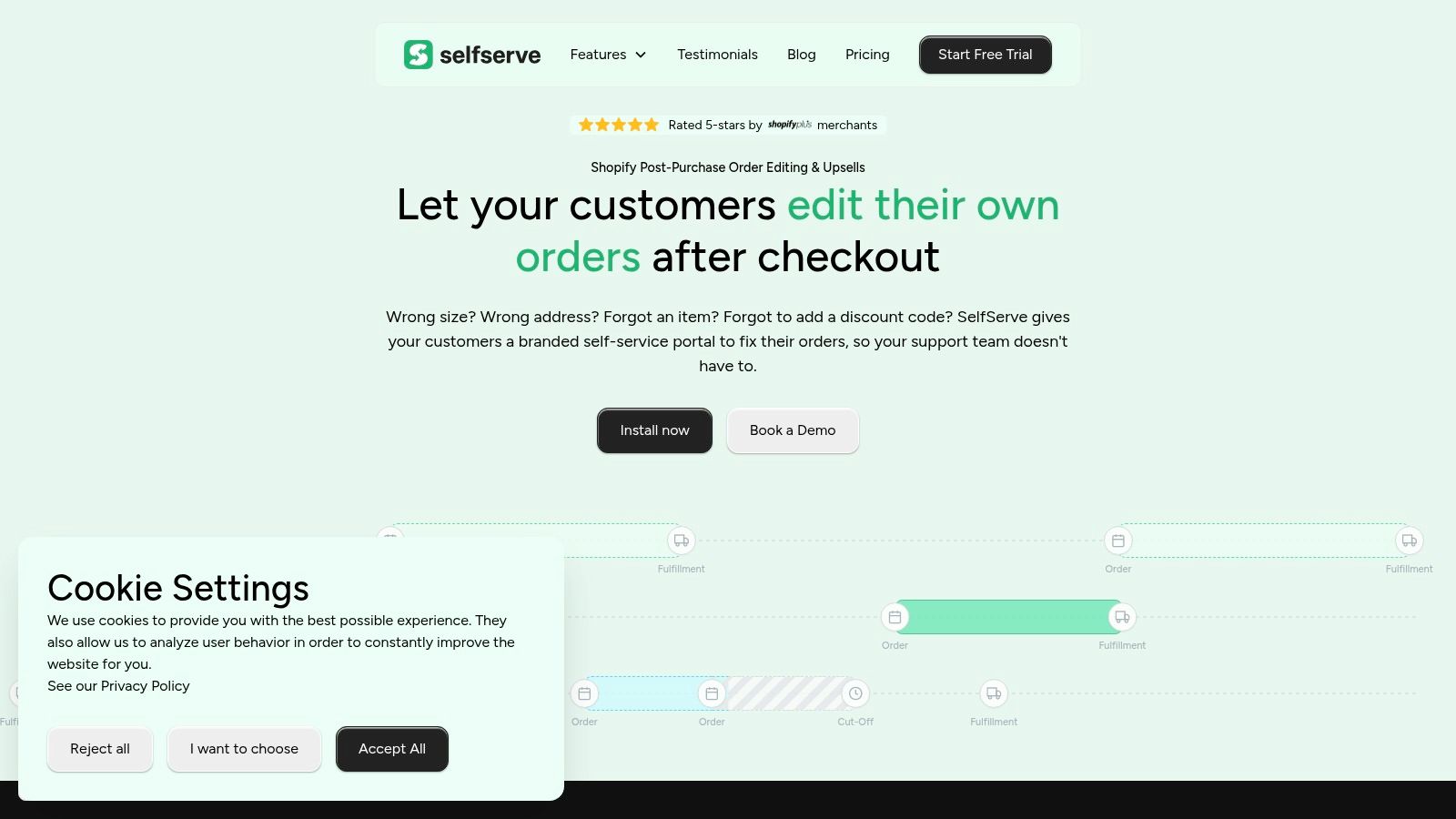
If you study enough Shopify success stories, one pattern shows up fast. Brands grow when they remove friction after the sale, not only before it. SelfServe is one of the clearest tools for that job because it gives shoppers a controlled way to fix their own orders on the Thank You and Order Status pages without forcing your support team to act as the middle layer.
The product is built around a branded, multilingual order-editing portal. Customers can update addresses, swap variants, change quantities, or cancel orders within rules you define. That matters for high-volume stores because the post-purchase window is where small mistakes turn into expensive support work, fulfillment errors, and refund friction.
A closer look at the platform helps: SelfServe's self-service customer portal explains how those edits happen inside merchant-defined permissions instead of opening up uncontrolled changes.
Why it stands out
SelfServe isn't just a convenience widget. It connects post-purchase edits to the systems merchants care about: Shopify sync, inventory accuracy, payment adjustments, order tagging, and fulfillment safety. Google Maps address validation and autocomplete are especially useful for stores dealing with shipping errors before a label gets created.
The revenue side is what makes it more than a support tool. Built-in post-purchase upsells let customers add to an existing order while they're already engaged. The company also cites customer results including 102 order edits with zero support emails, elimination of 91 tickets, 2,234 upsell conversions worth $3,991, and $17,308 in additional upsell revenue for other merchants. It also says merchants have reported cutting support tickets by about half. I'd treat those as directional proof, not a guaranteed outcome, but they're still the right metrics to care about.
Practical rule: If your team spends hours every week on address changes, item swaps, and cancellation requests, solve that workflow before buying another acquisition app.
What works and what doesn't
What works:
- Controlled customer autonomy: Shoppers solve simple issues themselves while your team keeps rule-based control over timing, products, and cancellation flow.
- Operational accuracy: Real-time sync and automated payment adjustments reduce the messy manual work that often causes inventory or refund mistakes.
- Incremental revenue: Upsells on the Thank You and Order Status pages monetize a moment most brands ignore.
- Global readiness: The multilingual experience is useful for stores selling across markets.
What doesn't:
- Pricing clarity: The provided material mentions a 30-day free trial, but advanced-plan pricing isn't listed here. You may need to review the app listing or contact the team.
- Edge-case complexity: Stores with custom 3PL or ERP logic should expect setup and testing before turning on every workflow.
Replication Playbook
Use SelfServe if your growth problem sits after checkout, not at the ad level.
- Start with one use case: Turn on address edits first if shipping corrections are your biggest ticket driver.
- Set tight rules: Limit the edit window and restrict products that create fulfillment risk.
- Add upsells second: Offer simple add-ons or replenishable products on the Thank You page before testing more complex bundles.
- Tag aggressively: Route edited or cancelled orders with tags so ops can monitor exceptions.
For Shopify Plus brands and high-volume DTC stores, this is one of the few tools in this list that directly converts post-purchase operations into both labor savings and added revenue. Visit SelfServe.
2. Shopify Case Studies Hub
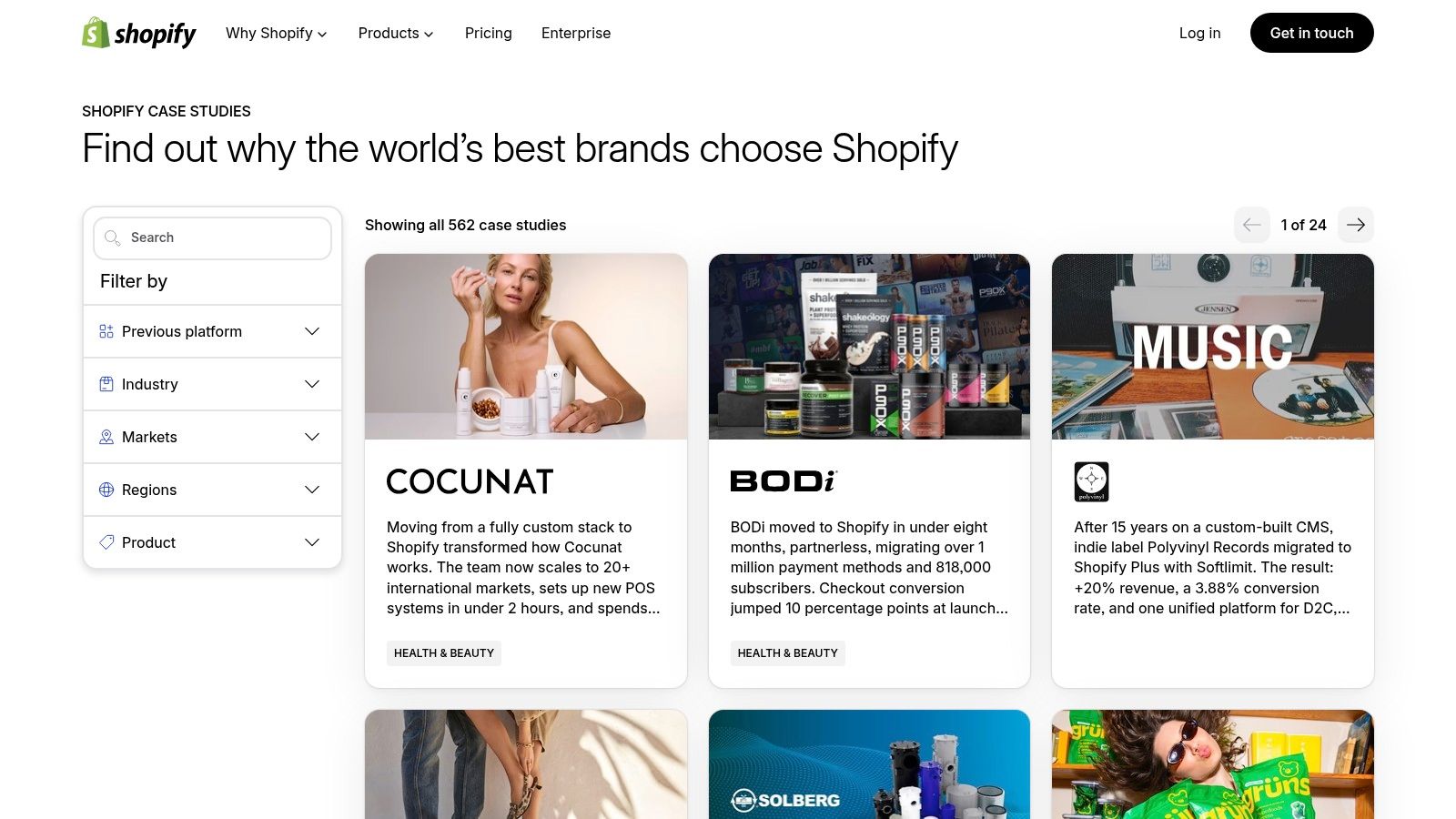
The official Shopify Case Studies hub is the best starting point when you need breadth. It has a large library of stories you can filter by industry, market, prior platform, and Shopify products such as Plus, POS, and B2B. That filtering matters because most merchants don't need abstract inspiration. They need examples from stores with similar complexity.
I like this hub most when a team needs internal alignment. If a COO is evaluating migration risk, a retail lead wants omnichannel examples, and ecommerce wants international examples, the filters make those conversations easier. You can build a short list of “brands like us” fast instead of circulating random success stories that don't map to your business model.
Where it helps most
The core value is pattern recognition. Shopify success stories often look different on the surface, but the repeated themes are familiar: tighter customer experience, faster launches, cleaner expansion paths, and smarter use of platform capabilities. The official library helps you spot those recurring plays across categories.
Vendor-produced case studies are useful for identifying proven plays. They're less useful for understanding what nearly broke during implementation.
That's the trade-off here. The content is polished. You'll usually get the win, the setup, and the result, but not always the operational compromises. Public case studies rarely show how many internal process changes were required after launch.
Replication Playbook
Use this hub as a discovery engine, not as your final decision-maker.
- Filter by prior platform: If you're leaving Magento, WooCommerce, or Salesforce Commerce Cloud, prioritize stories with the same migration path.
- Look beyond homepage redesigns: Save examples involving B2B, POS, or internationalization if those are actual priorities for your team.
- Extract the sequence: Note whether the brand fixed platform architecture first, retention next, and post-purchase later. The order often matters more than the tactic itself.
For merchants researching Shopify success stories at scale, this is the most efficient official database to mine. It's best for comparative research, weak for raw trade-off detail, and strong for building an executive-friendly shortlist.
3. Shopify Enterprise Plus Blog Case Studies
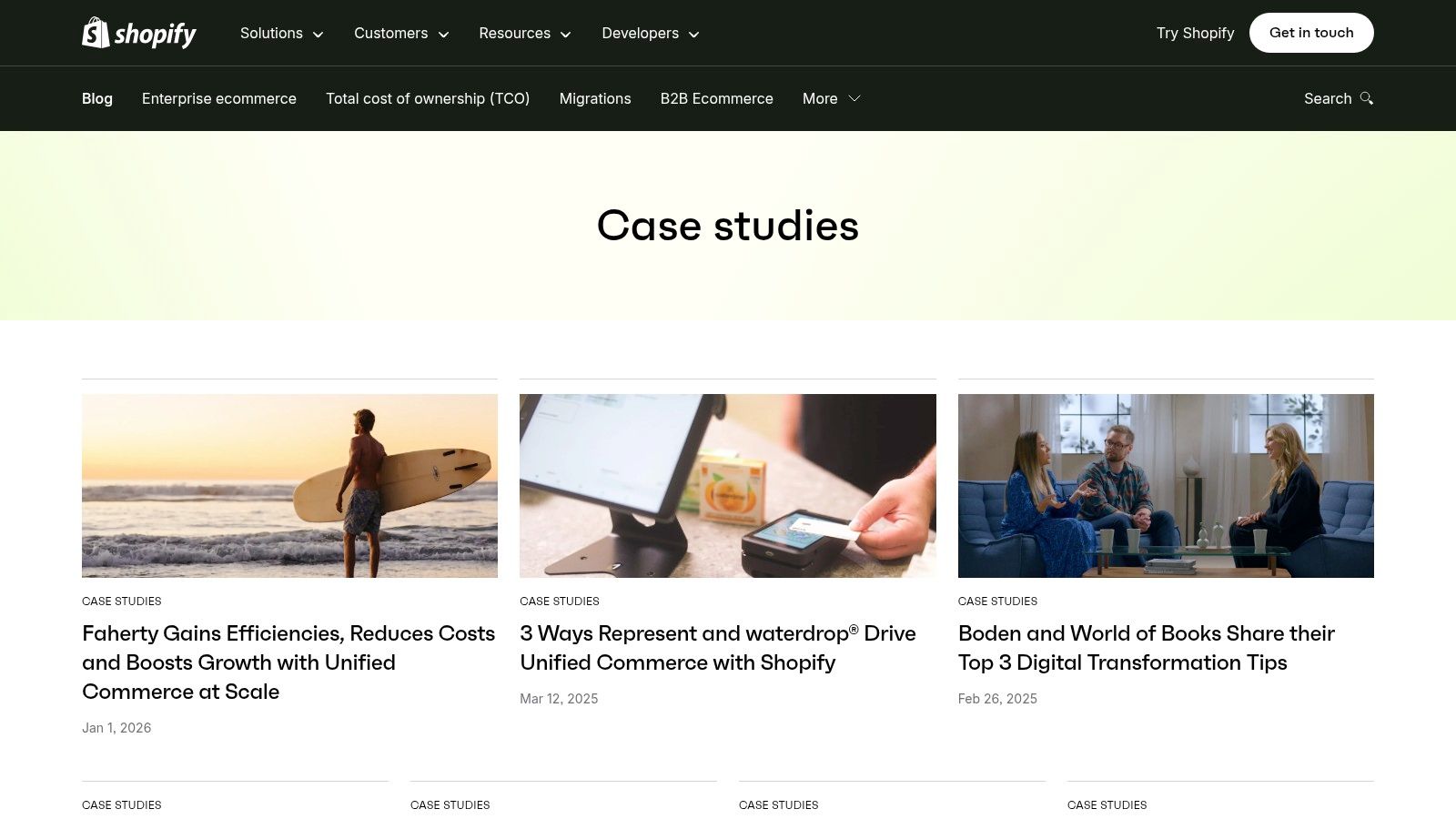
The Shopify Enterprise blog case studies are different from the main case study hub. They're slower, longer, and usually more useful for leadership teams than channel managers. If the central question is whether Shopify Plus can support your operating model, these articles usually give more substance around decision process, system complexity, and executive rationale.
That makes them useful for a specific kind of reader. Not the marketer hunting for one quick conversion tactic. The COO, CFO, head of ecommerce, or consultant trying to justify a replatforming project and explain what changes downstream.
The value is in the decision logic
These stories tend to spend more time on replatforming, cost structure, deployment timing, and integration realities. They also cover non-marketing topics that often decide whether a migration succeeds: data handling, ERP coordination, PIM relationships, and cross-functional rollout.
That's one reason they're more helpful than many surface-level Shopify success stories. They acknowledge that growth on Shopify often comes from operational simplification, not just prettier storefronts.
Replication Playbook
Read these when your business case needs executive language.
- Pull stakeholder talking points: Note how teams framed speed, operating flexibility, and platform simplification.
- Use the integration references: If your migration depends on ERP or PIM continuity, save the stories that mention stack coordination.
- Translate narratives into requirements: Turn each useful case into acceptance criteria for your own migration, agency brief, or internal roadmap.
The downside is obvious. This is still vendor content, so it won't dwell on dead ends or failed experiments. But if you need enterprise-weighted Shopify success stories with more operational framing, this is a stronger source than the general hub.
4. Shopify Masters
The Shopify Masters podcast is where polished case studies loosen up a bit. Founders and operators talk in first-person about channel bets, inventory mistakes, hiring problems, merchandising choices, and the messy parts of running a store. That makes it one of the best places to hear what successful operators prioritized before those choices got cleaned up into marketing copy.
Audio isn't the fastest format for extraction. You'll spend more time listening than skimming. But the payoff is context. That context is often missing from written Shopify success stories, especially around why a team chose one growth path over another.
The hidden lesson in the format
Podcasts surface sequencing better than static case studies. A founder might explain that paid social worked only after they fixed inventory planning. Or that email started performing once merchandising got sharper. Those aren't glamorous insights, but they're often the reason a strategy finally clicked.
Most growth advice fails because teams copy the tactic and ignore the setup that made it work.
That's why Shopify Masters is worth keeping in rotation. It gives your team a better feel for operator logic, not just output metrics.
Replication Playbook
Use Shopify Masters like a research feed.
- Assign episodes by role: Give retention-focused episodes to CRM, operations-focused episodes to support and ops, and brand-led episodes to merchandising.
- Summarize one lesson per episode: Don't try to capture everything. Pull the one decision, process, or channel shift that would matter for your store.
- Compare repeated themes: If multiple founders mention customer experience, channel discipline, or inventory control, treat that as a pattern.
If you're tired of Shopify success stories that sound too neat, this is the official channel that usually feels closest to real operator thinking.
5. Starter Story
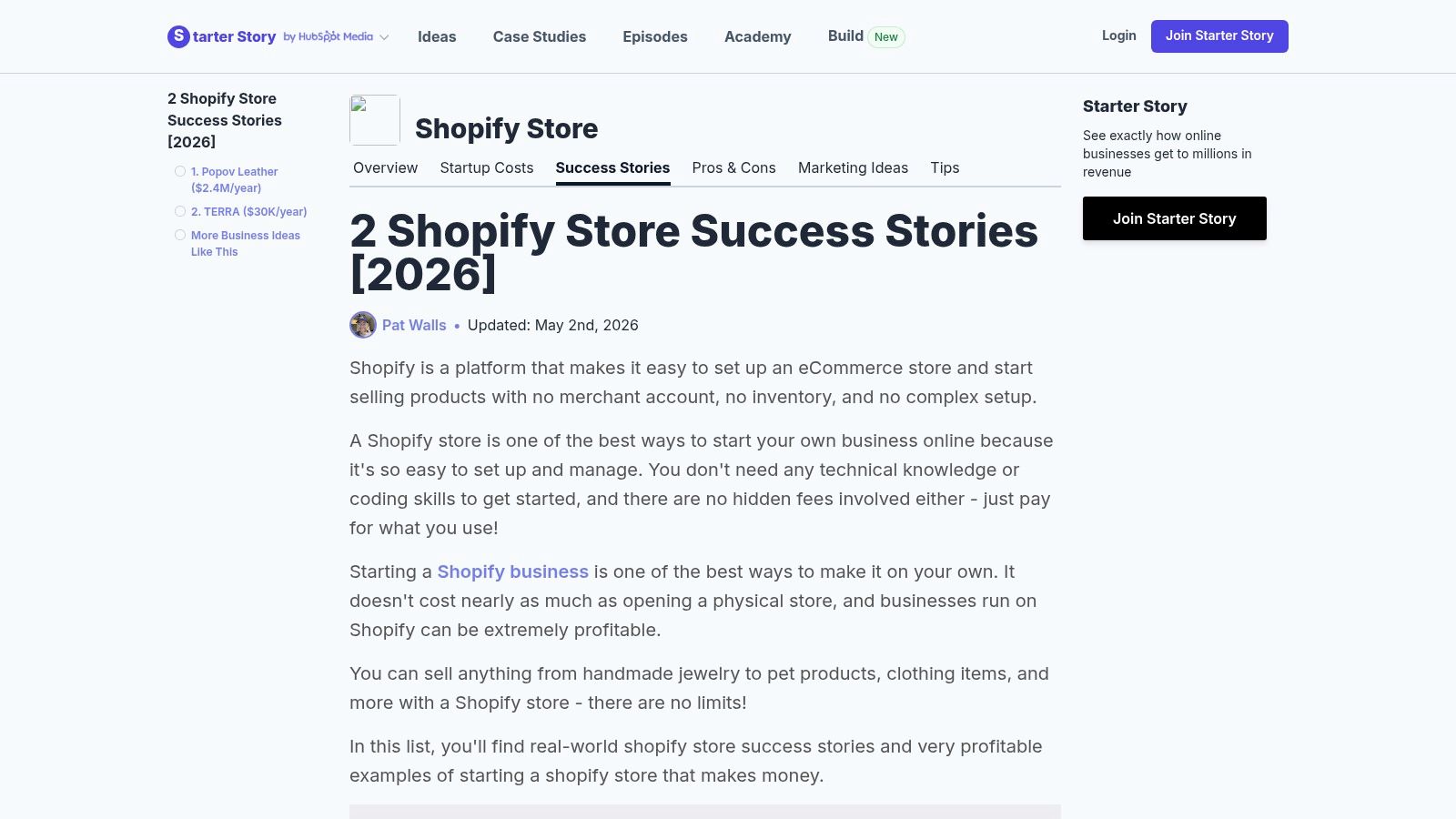
Starter Story's Shopify success stories collection is useful when you want scrappier examples and founder-level detail instead of polished enterprise narratives. The interviews often get into early traction, channel experiments, tool choices, and the mistakes people made before they found something repeatable.
That independence is the appeal. You're not only seeing stories selected by the platform itself. You're seeing founder interviews and business breakdowns with a wider range of ambition, polish, and operating maturity.
Why independent stories matter
Official Shopify success stories are strong for validation. Independent ones are better for ideation. You'll often find more practical details about how a founder tested a niche, built traction with content, or stitched together a tool stack while still operating lean.
The trade-off is uneven quality. Some stories are sharper than others, and the rigor depends on the submission and editorial treatment. Some deeper material also sits behind membership access, which may or may not fit your research budget.
Replication Playbook
Use Starter Story when you need ideas that feel closer to your current stage.
- Search by business model: Focus on stores or app founders with a growth path that resembles yours.
- Borrow tactics, not identity: A founder's niche or brand voice may not translate, but their testing method often will.
- Document stack mentions: If the same apps or workflows appear repeatedly, investigate why those operators rely on them.
For operators who want less corporate storytelling and more founder texture, Starter Story fills a gap that official Shopify resources usually don't.
6. Klaviyo Customer Stories
Retention is usually where profitable Shopify growth gets decided. Plenty of brands can buy first orders. Fewer build the email, SMS, and post-purchase systems that turn one-time buyers into repeat customers.
That makes Klaviyo customer stories useful for a different reason than platform-level Shopify success stories. They show how operators structure lifecycle revenue after the first conversion, including welcome flows, list growth, segmentation, campaign calendars, and retention offers. If you want to understand how a brand increased revenue per subscriber or improved repeat purchase performance, this library is often more useful than a broad founder profile.
What you actually get
Klaviyo's case studies are strongest at the CRM layer. You'll usually find concrete examples tied to email automations, SMS timing, pop-up strategy, audience splits, and promotional planning around launches or BFCM.
The trade-off is scope.
These stories rarely explain storefront UX, fulfillment constraints, merchandising decisions, or customer support workflows unless those issues directly affect messaging results. That limitation matters because retention performance does not come from flows alone. A strong post-purchase email series works better when shipping communication is clear, order edits are easy, and self-service options reduce support friction.
Email and SMS perform best when they follow the customer journey instead of operating as isolated calendar sends.
Replication Playbook
Use Klaviyo stories to improve the retention side of your operating model, not just your campaign ideas.
- Map flows to real customer moments: Build around welcome, browse abandonment, cart recovery, post-purchase, replenishment, and win-back. Skip any flow that does not match your buying cycle.
- Look for segmentation logic: Pay attention to how brands separate first-time buyers, VIPs, seasonal shoppers, or high-AOV customers. The segment usually matters as much as the creative.
- Study the timing around promotions: Launches, holiday pushes, and back-in-stock sequences often reveal better tactical detail than generic “always-on” examples.
- Connect retention to post-purchase operations: If a case study highlights repeat purchase growth, ask what happens after checkout too. Tools like SelfServe can support that by giving customers a cleaner way to manage orders without creating extra support load.
For teams with stable traffic but inconsistent repeat purchase rates, Klaviyo's customer stories are less about inspiration and more about diagnosis. They help you see which retention mechanics are missing, which segments deserve dedicated treatment, and where better post-purchase execution can make your lifecycle marketing work harder.
7. We Make Websites

Agency case studies can be self-congratulatory. They can also be extremely practical when you're scoping a large migration. We Make Websites is one of the more useful examples because its case-study material tends to focus on implementation depth: headless builds, visual CMS setups, multi-site architecture, and ERP or PIM integration work.
That makes it relevant for brands past the “how do I launch?” stage. If your questions are technical, organizational, and region-specific, agency material often gives a better sense of implementation scope than founder stories do.
Where agency case studies help
Agency-produced Shopify success stories are best for understanding complexity. You can use them to shape RFPs, technical acceptance criteria, and migration risk planning. They're especially useful if your store spans multiple markets or has non-trivial backend requirements.
The main limitation is predictable. Agencies highlight client wins. They're less likely to document every implementation hurdle, internal dependency, or post-launch cleanup issue.
Replication Playbook
Read agency case studies with a delivery lens.
- Extract scope assumptions: Identify what had to be rebuilt, integrated, or redesigned.
- Turn examples into requirements: Use architecture and workflow references to tighten your own project brief.
- Ask what isn't shown: For every polished outcome, list the internal dependencies your team would need to support the same move.
This is one of the stronger sources when your version of Shopify success is less about finding a winning ad and more about building a reliable commerce operating system.
Shopify Success Stories: 7-Source Comparison
| Solution | Implementation complexity 🔄 | Resource requirements ⚡ | Expected outcomes 📊 ⭐ | Ideal use cases 💡 | Key advantages |
|---|---|---|---|---|---|
| SelfServe | Low–Medium, installs in minutes; extra config for complex 3PL/ERP | Low for basic use; dev/ops for integrations or high tiers | Reduces support tickets (~50 reported), fewer mis‑ships, incremental upsell revenue | Shopify Plus, high‑volume DTC, ops/support teams reducing tickets & errors | Branded post‑purchase edits, real‑time Shopify sync, Google Maps validation, built‑in upsells |
| Shopify Case Studies hub (official) | Very low, searchable content portal | Time to filter and read; no implementation work | Broad benchmarking across 500+ stories; vendor‑curated wins 📊 | Research, vendor selection, stakeholder alignment | Large, filterable library covering sectors and platform migrations |
| Shopify Enterprise / Plus blog case studies (official) | Low, long‑form editorial reading | Time from executive stakeholders to extract insights | Executive‑level narratives on replatforming, cost and timelines ⭐ | Building Plus business cases for CFO/COO, replatform planning | Deep operational detail on migrations, integrations and ROI drivers |
| Shopify Masters (official podcast/video) | Low, episodic audio/video consumption | Time to listen/watch and extract learnings | First‑person operational context; qualitative tactics, variable metrics | Learning founder/operator perspectives; training and team sharing | Candid interviews with practical stories on ops, channels, hiring |
| Starter Story, independent | Low, article/interview reading | Time to read; some premium content behind paywall | Founder tactics and revenue/MRR snapshots for benchmarking 📊 | Early‑stage founders, niche idea validation, channel testing | Granular founder interviews with revenue breakdowns and lessons |
| Klaviyo Customer Stories (Shopify‑filtered) | Low, filtered case study content | Time to analyze; requires CRM context | Quantified email/SMS attribution and flow performance ⭐📊 | Lifecycle marketing, retention modeling, BFCM planning | Concrete retention metrics, seasonal playbooks and Plus examples |
| We Make Websites, agency case studies | Low to Medium, reading technical case studies | Time from technical teams; useful when planning agency work | Detailed implementation scopes, timelines and integration examples | Large migrations, headless builds, ERP/PIM integrations | Tactical technical detail for ops/engineering and RFP mapping |
Your Playbook for Shopify Success
The pattern shows up across the best Shopify success stories. Growth usually follows process, not hype.
Gymshark is a useful example because the operational lesson is clear. After moving to Shopify Plus, the brand expanded to more than 180 countries using multi-currency and international domain capabilities, and it generated over $15 million in sales in its first 18 months on Shopify. The takeaway is not the headline number. It is the stack behind it. International expansion worked because localization, payments, and storefront control were built into the operating model early enough to support scale.
That is the lens to use for every case study in this article. Do not just collect brand names. Examine what changed in operations, acquisition, retention, and post-purchase. Then copy the part that matches your current constraint.
Start with the problem that is costing the most money or time.
- Support queue growing too fast: Add controlled self-service for order edits and address changes so agents are not spending their day on preventable tickets.
- Retention underperforming: Review retention-heavy examples from Klaviyo and Shopify Masters, then rebuild flows around real customer moments like order confirmation, delivery, replenishment, and win-back.
- Migration or replatform under review: Use Shopify Plus and agency case studies to define scope, integration risk, ownership, and timeline before talking to partners.
- Team needs practical examples: Use the official Shopify case study libraries for benchmarking, then compare them with founder interviews from Starter Story to pressure-test what is realistic for your stage.
The replication angle becomes relevant. Strong operators reverse-engineer the mechanism. If a brand improved repeat purchase rate, ask what changed in email timing, offer structure, and post-purchase communication. If a brand scaled internationally, look at domains, currencies, fulfillment logic, and support coverage. If a brand reduced friction after checkout, measure fewer tickets, fewer fulfillment exceptions, and higher average order value from post-purchase offers.
As noted earlier, Shopify supports merchants worldwide. Durable success usually comes from fixing the boring but expensive issues first: operational mistakes, weak communication, post-purchase confusion, and revenue left on the table after checkout.
If SMS is part of your retention plan, it's also worth reviewing this Shopify SMS platform comparison alongside the resources above.
If post-purchase work is starting to create ticket volume, fulfillment risk, or missed upsell revenue, SelfServe is a practical place to start. It lets customers edit orders within rules your team controls, reduces support load, and gives you more chances to monetize the Thank You and Order Status pages.