Parcel Service Near Me: A Shopify Merchant's Guide

Another delayed package. Another customer asking where their order is. Another support agent checking tracking, emailing a carrier, and hoping the issue clears before the refund request lands.
That's usually the moment a merchant types parcel service near me into Google.
For a shopper, that search means “Where can I drop this box off?” For a Shopify brand, it means something much bigger. It's a shortcut into carrier selection, local coverage design, pickup discipline, delivery reliability, and post-purchase risk reduction. If you run meaningful order volume, local shipping decisions don't sit in the background. They show up in margin, customer satisfaction, and ticket volume.
The brands that handle this well rarely treat parcel operations as a commodity. They build a small system around it. They compare providers by actual service behavior, negotiate around workflow friction, connect the carrier cleanly to Shopify, and reduce preventable delivery failures before the label is printed.
Why Your 'Parcel Service Near Me' Search Is a Goldmine
A merchant searching parcel service near me is not really searching for a nearby storefront. The useful question is, “Which local carrier setup gives me the fewest delivery problems at the lowest total operating cost?”
That distinction matters because parcel delivery is not the same thing as regular mail. In the U.S. classification system, NAICS 492110 covers “Couriers and Express Delivery Services,” which includes establishments providing air, surface, or combined-mode courier and express parcel delivery without a universal service obligation. It's a commercial, time-sensitive network that typically runs between metropolitan areas, urban centers, or international destinations while relying on local pickup and delivery infrastructure at the edge of the network, as described in the NAICS 492110 courier and express delivery definition.
That's why two “local” options in the same city can behave very differently. One may have a late pickup and strong final-mile coverage. Another may look convenient on a map but hand off volume through a slower regional path or offer weak exception handling.
What merchants often miss
A local parcel decision affects more than transit.
- Cutoff discipline: Your warehouse team can only promise same-day dispatch if pickup timing matches your fulfillment rhythm.
- Coverage quality: A carrier may be strong in dense urban zones and inconsistent on rural edges or apartment-heavy neighborhoods.
- Support burden: Every failed attempt creates extra work across CX, operations, and finance.
- Returns and reroutes: The pain rarely starts with the shipment itself. It starts when something changes after checkout.
Practical rule: The best “parcel service near me” result is rarely the closest counter. It's the provider that fits your order profile, pickup schedule, and customer geography.
For high-growth brands, this search is useful because it exposes an advantage. Improve the local delivery layer and you don't just move boxes faster. You reduce preventable tickets, tighten promise accuracy, and make your shipping stack more resilient when volume spikes.
Assessing Local Parcel Providers Beyond Price
The cheapest rate card can become the most expensive carrier in your stack if it creates missed deliveries, repeat support contacts, and manual exception work.
The first filter I use is simple. Ignore the headline price until you've checked whether the carrier can deliver consistently in the zones that matter to you. A cheap parcel that fails on the first attempt costs more than a slightly higher-priced parcel that lands cleanly.

Start with delivery success, not the sales deck
A useful benchmark is first-attempt delivery success rate. In 2023 benchmark data from Parcel Perform, the U.S. was 97.2%, the U.K. 93.7%, Canada 92.5%, Malaysia 94.3%, Indonesia 95.9%, New Zealand 95.4%, and Australia 87.5%. The point is not that your local provider will match a national benchmark exactly. The point is that carrier performance varies materially by geography and network design.
If a provider can't speak clearly about failed attempts, address issues, route design, and exception workflows, that's a warning sign.
Build a scorecard your team can actually use
A good local carrier scorecard should cover operational fit, not just freight spend.
| Evaluation area | What to ask |
|---|---|
| Reliability | How do they define successful first-attempt delivery, and how do they handle failed attempts? |
| Coverage | Which ZIPs or neighborhoods are core service areas, and where do they rely on partner handoffs? |
| Pickup operations | What are the latest recurring pickup windows, and what happens if your dock misses cutoff? |
| Tracking quality | Are scan events frequent enough for customer-facing visibility and internal exception handling? |
| Claims and liability | What is covered, what is excluded, and how is proof collected? |
| Support model | Do you get a real account contact, or only a generic queue? |
Look at total risk, not only parcel spend
Liability language is where many otherwise solid negotiations go bad. If you ship fragile, seasonal, or high-consideration products, you need to know how the carrier treats loss and damage before you scale volume through them. For teams reviewing exposure, this guide to commercial trucking cargo insurance is a helpful reference point for understanding how cargo protection works outside the narrow wording in many carrier agreements.
If the carrier can't explain how they document damage, transfer custody, and resolve claims, assume your team will end up eating more of the problem than you want.
What works and what usually doesn't
What works:
- Testing by lane: Run a controlled slice of orders through a new provider before moving core volume.
- Address validation before label creation: Bad input data produces bad delivery outcomes.
- Multi-carrier logic: Keep a fallback option for zones where one provider underperforms.
- Territory awareness: Dense city blocks, gated communities, and rural edges behave differently.
What doesn't:
- Choosing by storefront proximity alone: The nearest counter tells you very little about network quality.
- Trusting advertised speed without operational proof: “Next day” on a page is not the same as clean, consistent execution.
- Ignoring support workflows: A strong carrier with weak exception handling can still overload your CX team.
A local parcel provider should make your operation quieter. If the relationship creates more customer contact and more internal chasing, it isn't cheaper in any meaningful sense.
Negotiating Rates and Finalizing Pickups
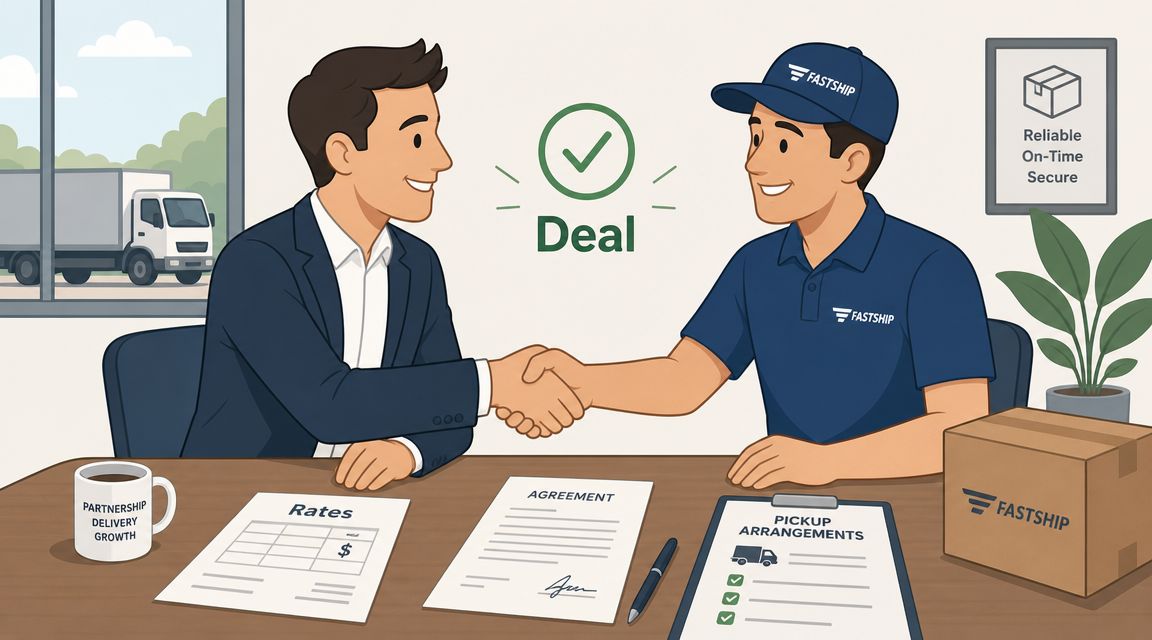
Once you've narrowed the field, the conversation should move away from generic discounts and toward operating terms. Rate matters, but pickup reliability, surcharge structure, claims handling, and exception rules usually create more long-term pain than the base price itself.
Ask for terms that support your warehouse reality
A useful negotiation starts with your own order profile. Know your average parcel shape, your common delivery zones, your seasonal spikes, your return flow, and the times your team can close pick-and-pack. If you don't bring that information, the carrier will shape the agreement around their convenience.
I push merchants to negotiate around these points:
- Recurring pickups: Lock in a pickup cadence that matches the latest realistic fulfillment cutoff, not the earliest convenient time for the depot.
- Accessorial clarity: Get written definitions for fuel-related charges, residential treatment, address correction handling, and redelivery rules.
- Service commitments: Ask how exceptions are escalated and who owns communication when a parcel goes off track.
- Returns handling: Confirm whether the same network supports outbound and reverse logistics cleanly.
Don't leave cross-border questions vague
Border-adjacent shipping creates a special kind of confusion because the location may be local while the operational risk is not. In places serving both U.S. and Canadian customers, some parcel pickup businesses explicitly market a U.S. mailing address for Canadians and mention use with major carriers, as shown by Port Huron Parcel's cross-border pickup offering. That setup can be useful, but it raises questions you need answered before signing anything.
Ask directly:
- Can the pickup address be used for ecommerce returns?
- Who handles customs documentation expectations?
- How are duties and taxes treated when the shipment is collected across the border?
- What happens if the customer needs a change after checkout but before final handoff?
A nearby parcel point can solve geography while still leaving policy, customs, and returns unresolved. Get those answers into the agreement, not into a support macro later.
The pickup schedule is part of the deal
A weak pickup process undermines good contracts. If the truck arrives before your late wave is packed, you've created same-day promise risk. If it arrives too late, dock operations drag and labor costs swell.
A solid pickup agreement should specify:
- Window ownership: Who to contact if the driver misses the scheduled window.
- Overflow procedure: What happens on high-volume days.
- Manifest expectations: Whether the carrier needs scan-ready documentation in a specific format.
- Holiday adjustments: How schedule changes are communicated.
The best negotiations feel boring on paper. That's a good sign. Boring terms reduce operational surprises.
Integrating Local Carriers Into Your Shopify Workflow
A carrier contract isn't useful until it works inside your daily order flow. At this stage, many teams lose momentum. They sign a promising local provider, then patch together rates, tags, labels, and handoffs with manual workarounds that create more friction than the old setup.
The right integration approach starts with order routing, not with label printing.

Configure shipping logic around real service areas
In Shopify, define shipping zones based on the carrier's actual local coverage, not the sales rep's broad verbal summary. If the provider is reliable in selected metros but inconsistent outside them, reflect that in your zones and rate logic.
At a minimum, your setup should distinguish between:
- Core local coverage where the carrier is your preferred option
- Adjacent zones where another provider may be safer
- Exception destinations such as remote addresses, border pickups, or special-handling orders
Multi-carrier routing becomes useful. Instead of forcing every order through a single local carrier, route by service fit. If you're weighing that model, this overview of a multi-carrier shipping solution for Shopify gives a practical look at how merchants structure carrier choice inside one workflow.
Keep your rate design simple enough to maintain
Merchants often overbuild shipping logic. They create too many conditions, too many edge-case rates, and too many manual overrides. Then nobody on the team trusts the setup.
A cleaner method is to align Shopify rates with a few operational truths:
| Shopify setup element | Good practice |
|---|---|
| Shipping zones | Match real carrier geography |
| Service names | Use customer-friendly names tied to expected delivery experience |
| Backup methods | Keep a fallback service for addresses your local carrier handles poorly |
| Order tags | Tag orders that need manual review before label creation |
Label creation should be boring
That's the standard. If your label process requires carrier-specific detective work every afternoon, the setup isn't finished.
Use a straightforward sequence:
- Order enters the correct shipping zone.
- Carrier or app selects the approved local service.
- Label is generated only after address quality checks pass.
- Manifest and pickup prep happen at a fixed time.
- Exceptions are tagged before the driver arrives.
That discipline matters because pickup errors are often self-inflicted. A late label batch, a mislabeled destination, or a bad service mapping can make a strong carrier look unreliable.
After the rate and routing logic is in place, train the team on the actual click path they'll use every day. This walkthrough is useful for teams standardizing that flow:
Treat carrier setup as an operations process, not an app install
I've seen brands focus on whether the integration technically “works” and ignore whether the warehouse can run it cleanly. Those are different questions.
A workable Shopify carrier setup should answer:
- Who reviews exception orders before labels print?
- Which team member owns failed label creation?
- How are missed pickups recorded?
- When does support get notified that an order moved into exception status?
If your team can answer those four questions without improvising, the integration is probably healthy. If not, the problem isn't Shopify. It's the workflow around it.
Reducing Delivery Errors with Customer Self-Service
Most delivery problems don't begin with the driver. They begin earlier, when a customer enters the wrong apartment number, uses an outdated address, forgets a gate code, or realizes after checkout that the parcel needs to go somewhere else.
That's why post-purchase self-service is not a cosmetic feature. It's an error-prevention layer.
Many carrier location pages are built for a narrow use case. They tell people where a parcel can be dropped off and what the hours are. They often don't help with the messier questions that create support contacts, such as returns, label issues, or what a customer can still change after an order is placed. You can see that limitation in the way a UPS Access Point location page focuses on pre-packaged, pre-labeled drop-off and pickup basics rather than broader exception handling.

Prevent the mistake before the label exists
The easiest failed delivery to solve is the one that never gets created.
Address validation before label generation removes a surprising amount of preventable noise from the system. When the checkout or post-purchase flow catches formatting errors, missing unit details, or clearly invalid destination data, operations doesn't have to discover the problem later through a failed scan or an angry customer email.
A good self-service flow usually includes:
- Address review: Let the customer confirm the destination while there's still time to act.
- Editable shipping details: Give controlled flexibility for corrections inside a defined window.
- Clear rules: Show what can be changed, what can't, and when the window closes.
- Notification support: Remind customers when action is still possible.
Operational insight: Every address correction completed by the customer is one less ticket for support and one less manual touch for operations.
Give customers a controlled path, not a support detour
Most brands already know customers want to change something after checkout. The fundamental choice is whether that change goes through a support queue or through a controlled workflow.
A merchant-controlled self-service portal is usually the cleaner answer. It lets the brand define permissions, timing, and exceptions while still giving the customer a fast resolution path. For teams evaluating that model, this guide to a self-service customer portal for post-purchase changes is a useful reference.
The best implementations don't allow unlimited edits. They allow the right edits at the right time.
Consider how that looks in practice:
| Customer request | Best handling approach |
|---|---|
| Minor address typo | Allow direct correction before fulfillment lock |
| Wrong contact detail | Allow update if notifications haven't failed downstream |
| Delivery note change | Route into a controlled editable field where supported |
| Full destination change | Allow only within defined rules and before carrier handoff |
Why this matters even with strong carriers
Carrier quality matters, but local proximity alone doesn't guarantee deliverability. Even a strong local provider can't rescue a shipment built on bad data. The more orders you ship, the more expensive that reality becomes.
Customer self-service works because it shifts correction work to the point where information is freshest. The customer knows they entered the wrong suite number. The customer knows they used their office instead of their home. If you give them a controlled way to fix it early, you lower the odds that the parcel becomes a downstream exception.
The best shipping stack doesn't just move parcels efficiently. It reduces the number of bad parcels entering the network in the first place.
Testing Service Levels and Optimizing Post-Purchase
Once a local carrier goes live, the work changes from setup to measurement. At this stage, disciplined teams separate carrier performance from internal process problems.
Don't judge the partnership by a few anecdotal wins or failures. Judge it by a repeatable review cycle that looks at delivery quality, exception patterns, and customer contact.
Track the metrics that expose friction
Price belongs on the dashboard, but it shouldn't dominate it. Better operating metrics usually include delivery times, successful delivery rate, return rate, complaint rate, and customer satisfaction or NPS, as noted in Kardinal's guidance on parcel service quality KPIs.
That same guidance notes that even premium next-day consignments should be expected to achieve about 98.5% successful first-time delivery, which means roughly 1.5% of parcels may still require exception handling. In other words, a strong carrier still needs a strong exception process behind it.
Use a simple review loop
I prefer a weekly operating review with a monthly contract-level review.
Weekly, check:
- Failed delivery patterns: Are they clustered around certain zones, buildings, or order types?
- WISMO volume: Are tracking events clear enough to prevent unnecessary customer contacts?
- Address-related exceptions: Are errors being caught before label creation, or only after dispatch?
Monthly, check:
- Whether the carrier is performing evenly across all local zones
- Whether pickup timing still matches warehouse output
- Whether customer complaints map to service issues or to expectation-setting issues
- Whether return flows are creating friction not visible in outbound reporting
A local carrier should be reviewed like any other operating partner. If performance drifts, act on it early. Don't wait until support volume makes the problem obvious.
Optimize post-purchase pages, not just delivery operations
The order status experience is where customers go when they feel uncertainty. That makes it a useful operating surface. If your tracking and post-purchase environment gives customers clear updates, delivery choices, and issue-prevention tools, you reduce support pressure. If it also presents relevant add-on offers cleanly, that page can do commercial work too.
That's why post-purchase optimization belongs in the same conversation as parcel service near me. Delivery transparency and revenue opportunities share the same customer moment. The brands that manage that moment well don't treat tracking as a dead-end page. They treat it as part of the customer experience stack.
From Local Search to a Scalable Shipping Strategy
A search for parcel service near me looks simple. For a merchant, it's one of the clearest windows into whether the shipping operation is built to scale.
The strongest approach is not complicated, but it is deliberate. Evaluate carriers beyond price. Negotiate around workflow, not just discounts. Build the right routing logic inside Shopify. Prevent bad deliveries before they enter the network. Then review performance continuously, because even strong service levels still produce exceptions.
As your operation grows, route visibility becomes more valuable too. Teams managing pickups, transfer points, or distributed local fleets often benefit from understanding the broader benefits of GPS fleet management, especially when service consistency starts depending on more than one warehouse or delivery partner.
If your business also touches international or border-adjacent fulfillment, it helps to think beyond domestic options and review how merchants evaluate international courier services near me when customs, returns, and address control become part of the operating model.
Local shipping isn't just a line item. It's part of your brand promise. Treat it that way, and the “near me” search becomes the start of a much better system.
If you want to reduce address-related delivery failures, give customers a controlled way to fix mistakes after checkout, and turn post-purchase pages into a better customer experience, take a look at SelfServe. It helps Shopify brands manage post-purchase changes without burying support teams in manual requests.