Delivery route optimization: A Practical Guide to Faster Deliveries
At its core, delivery route optimization is simply about finding the smartest way for a driver to get from A to B to C. But for a growing Shopify store, it’s much more than that. It's about using smart software to build delivery routes that slash fuel costs, eliminate unnecessary overtime, and guarantee on-time deliveries.
This isn't just about saving a few bucks; it's about turning a complex logistical puzzle into a serious competitive advantage.
Why Route Optimization Is Your New Competitive Edge
The final mile is where your brand's promise truly gets tested. For ambitious Shopify stores, moving past manual, "best-guess" routing isn't just a nice-to-have—it's a critical part of scaling your business. Sticking with manual planning means you’re essentially accepting wasted fuel, bloated driver paychecks, and the brand damage that comes with every missed delivery window.
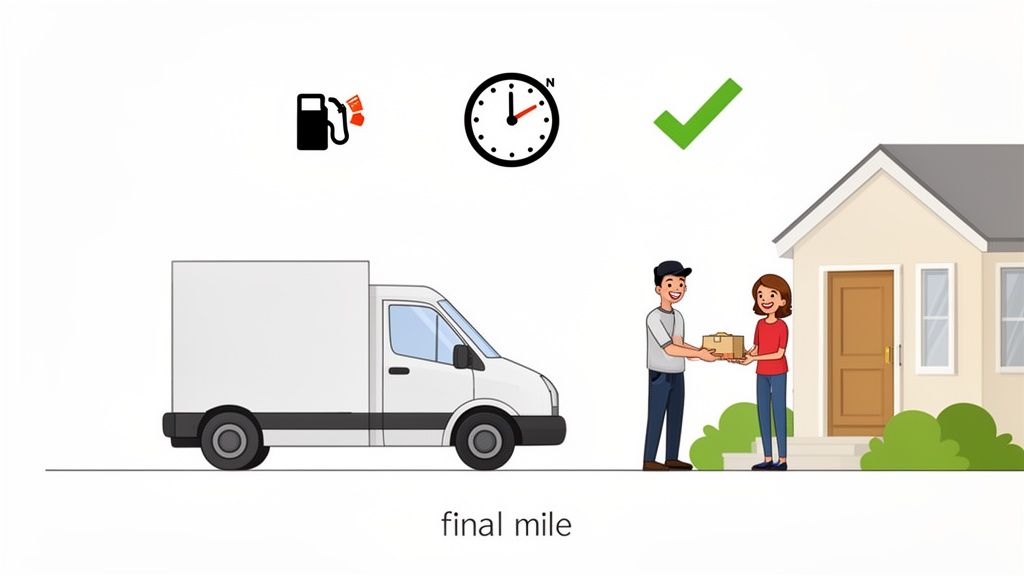
When you master logistics inside your Shopify ecosystem, you transform the entire post-purchase experience. It stops being a costly headache and becomes one of your most powerful assets for building a business that can grow sustainably.
The Real Cost of Inefficient Routes
Relying on manual routing is a deceptively expensive habit. A route that looks shortest on Google Maps rarely accounts for real-world chaos like rush-hour traffic, specific customer delivery windows, or the physical capacity of your vehicle.
Every poorly planned route quietly eats away at your profit margins through completely avoidable problems:
- Wasted Fuel and Time: Think of drivers backtracking across town for a forgotten stop or sitting in traffic you could have predicted, all while burning fuel and racking up hours.
- Failed Deliveries: Arriving outside a customer's requested time slot often means a redelivery attempt, instantly doubling your cost for that single order.
- Damaged Customer Trust: A late package is more than a simple inconvenience. It’s a broken promise that can easily convince a customer never to shop with you again.
The financial drain here is very real. The last mile can consume a staggering 41-53% of your total supply chain costs. This is precisely why savvy operations managers are obsessed with delivery route optimization.
Before we dive deeper, take a look at the tangible impact this strategy can have. The numbers speak for themselves.
The Impact of Route Optimization on Key Metrics
The shift from finding the "fastest" path to the "most efficient" one is a core strategy that top transportation professionals are using to fight rising expenses. You can read more about how these modern logistics trends and their impact are reshaping the industry.
By optimizing your routes, you’re not just saving money on gas. You’re building a more resilient, predictable, and customer-centric delivery machine that becomes a core part of your brand's value.
Turning Logistics into a Shopify Superpower
The good news? You no longer need an enterprise-level budget to access sophisticated delivery route optimization. For merchants on Shopify and Shopify Plus, modern tools can integrate directly into your workflow, automating the entire process from the moment an order is placed to the final delivery confirmation email.
This creates a seamless flow of accurate data, ensuring your routes are always based on reality, not guesswork. It gives you the power to handle a surge in order volume without a corresponding surge in operational chaos.
Ultimately, this integration turns your delivery operation from a reactive cost center into a proactive, strategic advantage that fuels growth and locks in customer loyalty for the long haul.
The Foundation of Flawless Deliveries
Let’s be honest: fancy delivery route optimization software means nothing if you’re feeding it bad information. The single most critical piece of data is the customer's delivery address. Get that wrong, and even the smartest routing engine is going to send your drivers on a wild goose chase.
Think about the real cost of a simple typo. An incorrect zip code or a misspelled street name doesn't just create a minor inconvenience. It causes a failed delivery. That means you’re paying for a driver’s wasted time and fuel, your support team is handling an unhappy customer, and you're covering the cost of a second delivery attempt. It’s a costly chain reaction, and it all starts with one bad address.
Your First Line of Defense is Address Validation
Before an order even hits your logistics queue, you absolutely must have a system in place to guarantee the address is 100% validated. The best way to do this is with real-time address validation, often powered by something like the Google Maps API, that checks the information as it’s being entered.
This isn't a "nice-to-have"—it's your first line of defense. Here’s what it looks like in practice, right in the customer's portal after they've placed an order:
A simple tool like this catches typos on the spot and suggests standardized, verified corrections. It turns a potential delivery failure into a non-issue before it ever has a chance to disrupt your operations.
This does more than just prevent errors. It gives your team back valuable time they would have spent manually checking addresses or calling customers to confirm details. Clean, accurate data flows straight from your Shopify store into your route planning software, setting the stage for truly efficient delivery route optimization. To get more insight on this, see these shipping and fulfillment best practices for Shopify merchants.
Empower Customers to Fix Their Own Mistakes
Even with powerful validation tools, people make mistakes. A customer might instinctively enter their old home address or realize after checkout that they need the package shipped to their office instead. Rather than letting this turn into another support ticket for your team, you can let the customer fix it themselves.
By providing a brief, controlled window for customers to edit their own shipping details post-purchase, you stop bad data at the source. This is a powerful way to reduce friction and improve the accuracy of your delivery data.
This self-service approach pays off in two major ways:
- It cuts down your support team's workload. When customers can resolve their own issues, it means fewer tickets and phone calls for your staff to manage.
- It protects your data integrity. The most accurate information will always come directly from the customer. Letting them make the correction ensures your routing software has the right destination from the very beginning.
Getting your data quality right is the unsung hero of logistics. It’s the foundational step that prevents chaos down the line and makes every delivery cheaper and more reliable.
Architecting Your Logistics Tech Stack
Great delivery doesn't happen by accident, and it certainly doesn't come from one "magic" app. From my experience working with countless merchants, the most successful delivery operations are built on a thoughtfully connected system—a logistics tech stack—where data flows smoothly from your Shopify checkout right to the customer's front door.
Think of your Shopify store as the command center. Every piece of order information originates there. The trick is getting that data, clean and accurate, to your route planning software so it can actually do its job. Building this architecture is all about creating a single source of truth, cutting out the manual data entry, and preventing the costly mistakes that kill your delivery route optimization efforts.
Your Essential Integration Blueprint
For any Shopify store doing serious volume, a modern logistics stack really boils down to three core pieces that need to talk to each other seamlessly.
- A Post-Purchase Experience Tool: This is your first line of defense against bad data. It's where customers can manage their own orders, and most importantly, fix that last-minute typo in their address before it ever becomes a problem for your drivers.
- Route Planning Software: This is the brain of your operation. It takes all that validated order data and crunches the numbers to map out the most efficient routes based on your unique constraints, like vehicle capacity or delivery windows.
- An ERP or 3PL System: This is where the rubber meets the road. Your final, confirmed order data gets pushed here for fulfillment and dispatch. Your third-party logistics software and partners depend on this data to actually execute the delivery.
Even a tiny hiccup in this data flow, like a customer mistyping "Avenue" as "Avunue," can create a massive headache. One wrong character can cascade into a failed delivery, a wasted trip for your driver, and an unhappy customer.
This is exactly what happens when you don't have a safety net in place.
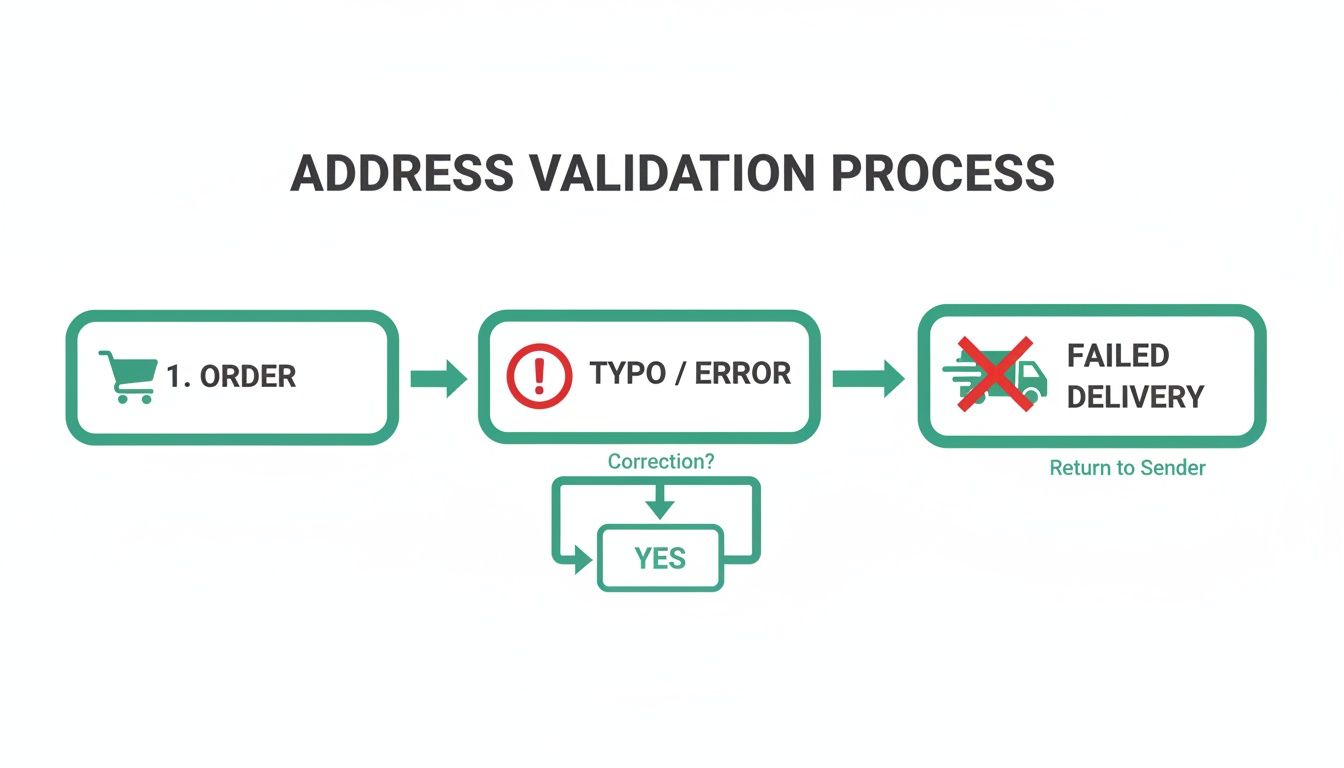
Without an automated check, that simple typo goes straight to your driver, leading directly to a failed attempt, higher fuel costs, and a support ticket you now have to deal with.
Using Automated Workflows to Connect the Dots
The real secret sauce is making these systems work together through automated workflows. For example, imagine a customer uses a post-purchase tool like SelfServe to correct their shipping address. The moment they hit save, an automation should trigger, instantly applying a tag like "Address_Updated" to their order in Shopify.
That simple tag is a powerful signal. It instantly flags the order for your logistics team, ensuring that when the data syncs to your route planner or 3PL, everyone is using the new, correct address—not the old, invalid one.
This kind of automation gets you out of the business of frantic emails and manually updating spreadsheets. It creates a reliable, error-proof process that just works. The impact is huge. Even giants like UPS, whose ORION system is a legend in delivery route optimization, save an incredible 10 million gallons of fuel annually with their planning.
On a more relatable scale, as more fleets adopt AI routing tools, businesses are consistently seeing cost savings of 15-30% from smarter, more efficient deliveries. You can see more on last-mile delivery trends and their financial impact to understand what’s at stake.
When you architect your stack correctly, you create a foundation of data integrity. Every system is on the same page, which is the key to building a delivery operation that's not just profitable, but scalable for the future.
Setting Smarter Rules for Real-World Routes
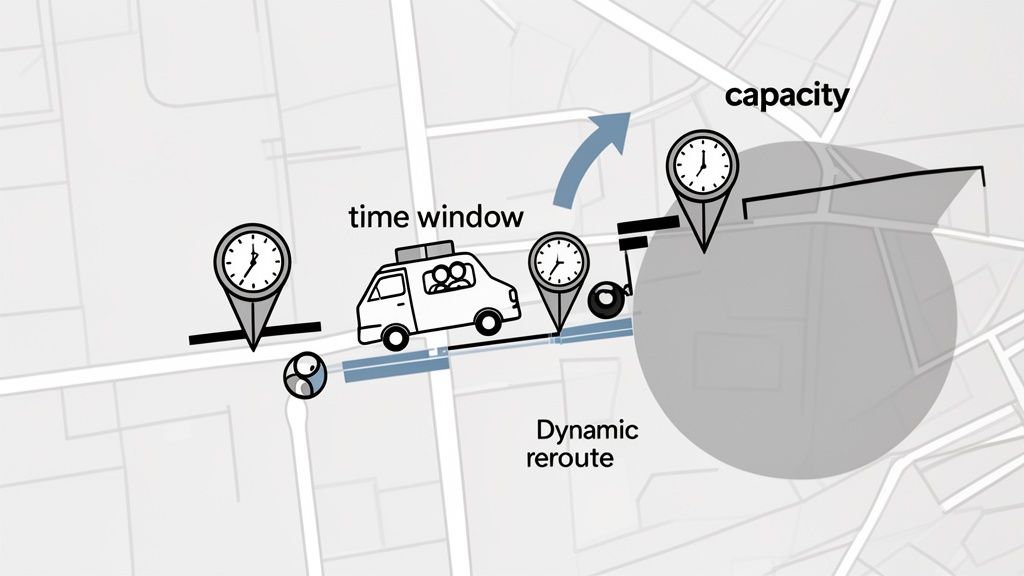
True delivery route optimization isn't just about finding the shortest path from A to B. It's about teaching your software how your business actually works on the ground. You have to translate all your operational quirks and customer promises into a set of rules the system can follow.
For example, your routing software must know that a customer paid for a premium "10 AM - 12 PM" delivery window. That stop isn't just another point on the map; it's a fixed appointment the entire route needs to be built around. This is where you graduate from simple mapping to genuine optimization.
The goal is to create routes that are not only efficient on paper but also intelligent in practice. It's about embedding your specific business logic—from vehicle capacities to driver skills—right into the planning process.
Defining Your Core Constraints
Every delivery operation has its own set of non-negotiables. The trick is to get these real-world limits defined as constraints inside your routing software. If you skip this, your "optimized" routes will fall apart the moment your drivers hit the road.
I've seen this happen countless times. Imagine a high-end furniture brand using its own fleet. A route plan might look perfect until you realize it sent a small van to deliver a king-size bed frame. It's an impossible task that leads to a failed delivery and a frustrated customer. This is exactly why constraints are so critical.
Here are a few you should be thinking about:
- Vehicle Capacity & Size: Does an order contain a bulky sofa that requires your largest truck? You need a rule that automatically matches oversized items to specific vehicles. This simple constraint prevents the wrong truck from ever being dispatched.
- Special Driver Skills: Maybe a delivery involves a complex installation or a two-person lift. By tagging orders with requirements like "Two-Person Job" or "Assembly_Required," you ensure the right crew is assigned every time.
- Customer Time Windows: Customers will gladly pay for the convenience of a guaranteed delivery slot. Your routing software has to treat these as priority appointments and sequence all other stops around them.
- Zone-Based Rules: Is there a part of town with terrible traffic between 4 PM and 6 PM? A smart rule can tell the software to avoid routing drivers through that zone during peak hours, saving everyone a massive headache.
These rules turn a generic map into a powerful operational playbook.
Adapting to Last-Minute Changes
Even the most carefully planned route is fragile if it's based on old information. The reality of ecommerce is that things change. A customer might use a post-purchase tool like SelfServe to add an extra chair to their order, suddenly making it too big for the assigned van.
This is where your system needs to be agile. When a customer edits an order, an automated tag—something like "Order_Updated"—should fire in Shopify. Your routing software must be set up to recognize this tag and immediately re-evaluate the delivery's constraints.
This triggers a re-optimization based on the new reality of the order, preventing a driver from showing up unprepared.
Ultimately, this level of detail is what separates a basic mapping tool from a robust delivery route optimization system. It’s how you build a reliable and customer-centric delivery operation that can handle the messiness of the real world without skipping a beat.
Measuring What Matters for Route Optimization
If you aren't measuring your delivery operation, you simply can't improve it. Sure, a well-executed delivery route optimization strategy feels good, but you need cold, hard data to prove its impact. It's time to move beyond gut feelings and focus on the key performance indicators (KPIs) that truly reveal the health of your logistics.
And these aren't just numbers for your operations manager to obsess over. They tie directly to your core business goals. A higher success rate on your first delivery attempt, for instance, means fewer customer support tickets and a lower cost per order. It's about drawing a straight line from your logistics performance right to your bottom line.
Core Logistics KPIs to Monitor
To get a clear picture of how you're doing, you need a dashboard that tracks the right metrics. For any high-volume Shopify store, I recommend starting with these essentials. They give you a balanced view of cost, efficiency, and—most importantly—customer happiness.
Cost Per Delivery: This is your north star for financial efficiency. It’s not just fuel and driver pay; it’s all the variable costs—wages, fuel, vehicle wear and tear—divided by your total number of successful deliveries. If this number is consistently dropping, your optimization efforts are paying off.
On-Time Delivery Rate: This is your reputation in a number. It’s the percentage of orders delivered within the promised time window, and it directly impacts customer loyalty. A high rate, ideally 98% or better, is what turns one-time buyers into repeat customers.
First-Attempt Success Rate: Failed deliveries are absolute profit killers. This metric shows the percentage of deliveries you get right on the first try. Every single percentage point you gain here means less money wasted on redelivery attempts and fewer headaches for your support team.
Tracking these numbers creates a data-driven feedback loop. You can spot negative trends before they become massive problems and double down on the strategies that are clearly working. A huge part of this is having great visibility, which we dive into in our guide on last-mile tracking for modern ecommerce.
The goal is to build a dashboard that tells a story. At a glance, you should be able to see if your routes are becoming more efficient, if customers are happier, and if your operational costs are trending in the right direction.
Your Go-To KPI Dashboard
Visualizing your data is the key to truly understanding it. Think of the table below as your starting point for a KPI dashboard. It breaks down the essential metrics, how to calculate them, and what they actually tell you about your delivery route optimization strategy.
Essential Route Optimization KPIs to Track
By keeping a close eye on these numbers, you get the insights needed to fine-tune your rules, adjust your tech, and make smarter decisions day in and day out. This is how you transform your delivery operation from a cost center into a data-backed asset that actively fuels business growth.
Common Questions About Delivery Route Optimization
Switching from manual delivery planning to an automated system brings up a lot of questions. It’s a big shift, but a necessary one for any growing Shopify store.
Let's dig into some of the most common things we hear from merchants as they navigate this process, with practical answers to give you clarity and confidence.
How Does Address Validation Directly Impact Route Optimization?
Think of your routing software as an incredibly smart GPS. It can do amazing things, but it's completely dependent on the quality of the coordinates you give it. Bad address data is the single biggest reason why optimized routes fail in the real world.
I've seen it happen time and again: a simple typo in a street name or an old zip code sends a driver 20 minutes in the wrong direction. That one mistake snowballs into a failed delivery, wasted fuel, driver overtime, and an unhappy customer calling your support team.
Using a tool with built-in Google Maps validation at the checkout or post-purchase stage is non-negotiable. It ensures the data entering your routing engine is 100% accurate from the start, stopping these costly errors before they ever become a problem for your drivers.
Can I Optimize Routes if I Use a 3PL?
Yes, absolutely. While you might not own the delivery van, you have significant influence over the final-mile process because you own the data. Your third-party logistics (3PL) partner’s performance is directly tied to the quality of the order information you provide.
Your job is to make their job easy. When you consistently send orders with validated addresses and clear customer details, you dramatically cut down on delivery exceptions and those frustrating surcharges that pop up on your invoices.
What’s more, by using integrations to automatically tag orders that a customer has edited post-purchase, you create a foolproof communication channel. This simple flag prevents your 3PL from shipping an order to the wrong, outdated address after a customer has already corrected it.
When your account is easy and profitable for your 3PL to handle, you become a valued partner. I've seen this lead to better service levels, more flexibility, and even better rates over time. Clean data is your leverage.
What Is the Difference Between Route Planning and Route Optimization?
This is a really important distinction that often gets missed. They sound similar, but the outcomes are worlds apart.
Route planning is simply about putting stops in order. It’s what Google Maps does when you ask for directions to a few different places—it finds the shortest path between A, B, and C. It's a linear, one-dimensional calculation.
Delivery route optimization, on the other hand, is a multi-dimensional puzzle. A sophisticated algorithm weighs dozens of real-world variables all at once to find the most efficient solution, not just the shortest one. These variables include:
- Customer-promised delivery time windows
- Vehicle capacity (weight and volume)
- Driver schedules and mandatory breaks
- Known traffic patterns for that time of day
- Business rules, like prioritizing VIP customers
Optimization finds the sweet spot that balances all these competing factors to lower your total costs, fit more deliveries into a day, and keep your promises to customers.
How Quickly Will I See ROI from This Process?
The return on investment from true delivery route optimization is one of the fastest you'll see from any operational change. The most immediate wins are in reduced fuel spend and driver overtime—savings you'll literally see on your next credit card statement or payroll run.
But the savings go deeper. Improving your first-attempt delivery rate means you're spending less on expensive redelivery attempts and your support team isn't buried under "Where is my order?" tickets.
For a Shopify store doing any kind of volume, preventing even a small fraction of failed deliveries can easily save thousands of dollars every month. The combined operational savings and the lift in customer loyalty from a reliable delivery experience mean the software often pays for itself in just a few months.
Ready to eliminate delivery errors and reduce support tickets? SelfServe empowers your customers to fix their own shipping details while giving you full control over your post-purchase workflow. With real-time address validation and seamless Shopify integration, you can ensure every route starts with perfect data. Start your 30-day free trial on getselfserve.com and see the difference today.