Online Shops In Ukraine: 2026 Launch Guide
Ukraine’s e-commerce market is already large enough to reward disciplined operators. The question for an international DTC brand is not whether demand exists, but whether your operating model can handle local expectations after the order is placed.
That is where many market-entry plans break down. Teams usually spend heavily on acquisition, storefront translation, and checkout, then underinvest in the post-purchase layer that Ukrainian customers use to judge reliability. Delivery updates, payment clarity, pickup coordination, failed-order recovery, and fast self-service support have a direct effect on repeat purchase rate and support volume.
Ukraine is a market where trust is built operationally. Buyers care about product and price, but they also care about whether the parcel arrives on time, whether the delivery option fits their routine, and whether they can fix a problem without waiting on an agent. Brands that treat post-purchase as a retention system, not a support cost, enter with a stronger position.
For high-growth DTC teams, the opportunity comes with specific execution demands. Payment and delivery choices need local fit. Fulfillment needs tighter control than a standard cross-border setup usually assumes. Self-service tools need to do real work, especially around tracking, order changes, and exception handling, because those are the moments that decide whether a customer becomes loyal or expensive to serve.
The Ukrainian E-commerce Market in 2026
Ukraine’s e-commerce market entered 2026 with one clear signal. Online buying is now routine behavior, not a temporary response to disruption.
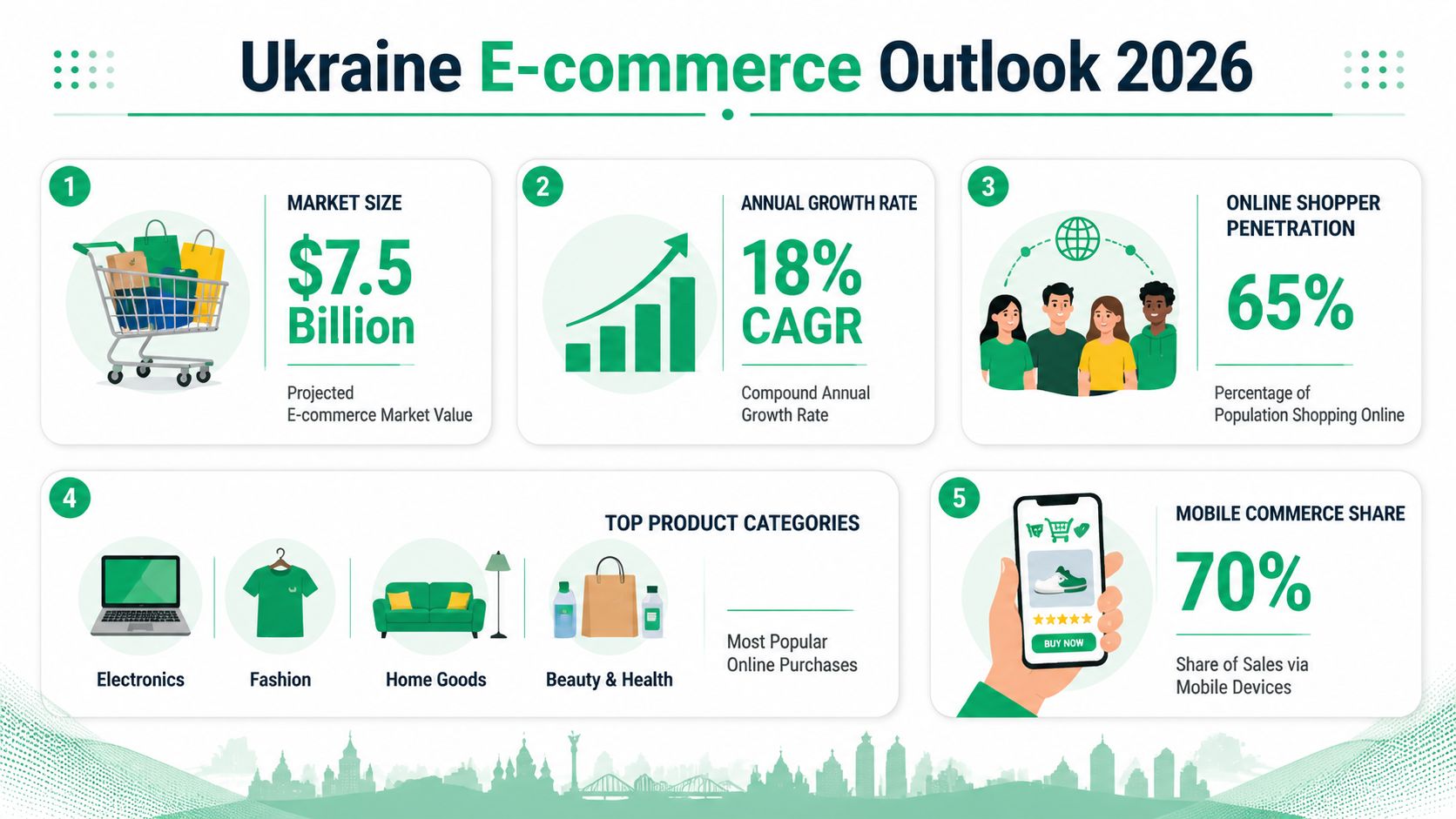
In 2025, online sales reached UAH 256 billion, or roughly $7 billion, with 7% year-on-year growth, and the number of online shoppers rose to 11.2 million. Shoppers also placed an average of 17.5 orders per year, according to UNN’s 2025 Ukraine online sales study.
This signals that demand not only held up under pressure. It became habitual.
Why the market still deserves attention
Ukraine still attracts serious DTC operators because customer behavior has matured faster than many international teams assume. Buyers adopted e-commerce under difficult conditions, then kept using it for repeat, practical purchases. That creates a stronger base than a market driven mainly by impulse browsing.
The category mix reinforces that point. Recent demand has been concentrated in areas tied to utility and everyday need, including car repair products, home and garden, appliances and electronics, cosmetics and perfumery, and clothing, footwear, and accessories, as noted earlier. For an entering brand, that changes the brief. The job is not to port a global bestseller list into a translated storefront. The job is to match real local demand with dependable stock, pricing, and fulfillment promises.
Practical rule: Build your Ukraine entry around purchase urgency and operational reliability, not broad regional assumptions.
There is also room to grow. Ukraine’s online share of total retail still trails more mature neighboring markets, which leaves space for brands that can build direct customer relationships and execute well after checkout.
What resilience means for a DTC operator
Resilience shows up in operations.
Ukrainian customers have spent years evaluating merchants on practical criteria. Can the store confirm payment clearly? Is the delivery promise believable? Will the parcel arrive where and when expected? Can an order issue be fixed without contacting support? Brands that answer those questions well gain trust faster than brands that rely on brand storytelling alone.
That is why I would read the market through an operating lens, not just a demand lens:
| Focus area | What the market indicates | What a merchant should do |
|---|---|---|
| Demand quality | Buyers order regularly, not occasionally | Design for repeat purchase, replenishment, and retention |
| Category fit | Utility-led categories perform well | Lead with practical value, clear availability, and relevant merchandising |
| Customer expectations | Shoppers judge merchants on execution | Set accurate delivery windows and communicate proactively after purchase |
| Growth potential | The market is active but still developing | Localize early and build a service advantage before slower competitors catch up |
The operating reality behind the opportunity
The strongest signal in this market is not growth alone. It is the kind of shopper growth produced. Constraint tends to create disciplined buying behavior. Customers compare prices carefully, watch delivery terms closely, and notice when post-purchase communication is vague or missing.
For online shops in Ukraine, trust is earned in the period after payment as much as at checkout. A translated site and competitive ads can generate first orders. Repeat revenue depends on whether customers can track a parcel, adjust delivery details, understand delays, and solve common issues through self-service instead of waiting for an agent.
That point is often missed in market-entry planning. Teams usually budget for acquisition and localization first, then treat post-purchase tooling as a later improvement. In Ukraine, that sequence is expensive. Weak tracking flows, poor exception handling, and unclear pickup communication increase support demand and reduce the chance of a second order.
Buyers under pressure value dependability over presentation.
Brands that combine local merchandising with disciplined post-purchase operations have a real opening here. The market has already shown that customers will buy online at scale. The harder question, and the one that decides margin, repeat rate, and support cost, is whether your operation can perform consistently once the order is placed.
What Ukrainian Shoppers Are Buying and Where
IWIS coverage of Ukraine e-commerce trends reports 36 million internet users, 27 million smartphone users, and a mobile commerce share of 45% of sales. That alone should change how a brand reads demand in Ukraine. Assortment, channel mix, and post-purchase design all need to reflect a phone-first buying path and a customer base that values practical outcomes over brand theater.
Misreading the Ukrainian market often starts with treating it like a generic Eastern European rollout. Demand is shaped by utility, affordability, and how quickly a shopper can judge whether an offer is worth the risk. Brands that lead with the wrong hero SKUs usually miss for a simple reason. They optimize for internal category priorities instead of local purchase triggers.
What sells well
The better lens is use case. Ask what problem the shopper is solving, how often that need repeats, and whether the product is easy to understand on a mobile screen.
Three demand patterns show up consistently:
- Practical replenishment. Consumables, health-adjacent products, and household-support items tend to fit well because they map to recurring demand.
- Problem-solving goods. Products that reduce inconvenience, improve comfort, or support day-to-day resilience usually outperform abstract lifestyle positioning.
- Mobile-friendly discovery items. Products with clear value in the first few scrolls convert more reliably than products that need long education.
That has direct merchandising implications. Dense PDPs, desktop-style bundle logic, and image galleries that bury key details often underperform. Ukrainian shoppers need fast comprehension, clear pricing, and delivery information that feels concrete. If your item requires too much interpretation, the marketplace listing or ad click will not carry it far.
Where shoppers buy
Channel strategy matters as much as product selection. Marketplace demand in Ukraine is strong because buyers can compare prices quickly, check seller credibility, and choose a fulfillment path they already understand. For many brands, a hybrid setup is the practical entry model. Use marketplaces to validate demand and use your DTC site to improve margin, retention, and service quality.
For brands still setting up operations, it helps to review how 3rd-party fulfillment companies for growing ecommerce brands affect channel choice. The fulfillment model shapes where you can compete well, especially if marketplace SLAs and direct-order service standards differ.
Here is the trade-off clearly:
| Channel | Best use case | Risk if used poorly |
|---|---|---|
| Marketplace presence | Fast validation, broad exposure, price benchmarking | Margin pressure and weak brand differentiation |
| Standalone DTC store | Brand control, retention, bundles, owned customer journey | Slower trust-building if localization and service flows are weak |
| Hybrid model | Marketplace for acquisition, DTC for repeat orders | Channel conflict if pricing, availability, or fulfillment standards drift apart |
Marketplace logic versus DTC logic
Prom, Shafa, and Bigl are different demand environments, not just different storefronts. Marketplace shoppers usually arrive ready to compare sellers on price, shipping terms, ratings, and total order confidence. That puts pressure on feed quality, titles, imagery, stock accuracy, and exception handling. Brand storytelling matters less at this stage.
Your DTC store has a different job. It needs to give the customer a reason to buy direct after first discovery. Better bundles help. So do clearer reorder flows, stronger support, and easier self-service after checkout. Operational excellence in these areas begins to affect revenue. If customers can track an order, solve common issues themselves, and trust your delivery communication, the direct channel becomes more credible.
A marketplace can validate demand. Your owned store has to prove service quality.
This also affects how teams allocate budget. Spending heavily on front-end design before fixing fulfillment visibility is usually the wrong sequence for Ukraine. Direct channels perform better when order updates, pickup instructions, returns communication, and delivery exception flows are already in place.
What usually underperforms
A few launch habits create avoidable drag:
- Porting your UK, German, or US assortment without local editing. The winning SKUs are often different.
- Leading with premium positioning before proving delivery reliability. Customers pay more after the service model earns trust.
- Treating mobile like a resized desktop experience. Cluttered navigation, long product explanations, and awkward checkout flows hurt conversion.
- Separating merchandising from service design. If a product needs explanation, support volume rises fast unless your post-purchase flow answers common questions clearly.
Payment expectations also shape channel performance, especially if a brand wants to move shoppers from marketplace discovery to direct repeat purchase. Suby's international payments guide is a useful planning reference because it frames payment acceptance as part of the operating model, not just a checkout plugin decision.
If I were testing a new category, I would launch with a narrower range, use marketplace data to identify the local winners, and keep the DTC site focused on repeat-order economics. That lowers the cost of a bad merchandising assumption and gives the brand time to build the post-purchase experience that supports retention in Ukraine.
Navigating Payments and Delivery Preferences
Checkout in Ukraine is where strategy becomes real. You can have demand, a strong catalog, and a clean acquisition plan, then lose the sale because your payment stack feels unfamiliar or your delivery promise feels vague.
The right way to think about this is as a last-mile bridge. Every choice at checkout either strengthens that bridge or weakens it. Payment methods create trust before the order is placed. Delivery options protect trust after the money is committed.

Build a payment mix customers recognize
Ukraine is a mobile-forward payments market, so your checkout should reflect that. Wallets, cards, and locally expected flows should feel native, not bolted on. If your international setup forces awkward redirects or unclear payment confirmation, conversion will suffer.
A useful reference point for structuring cross-border payment acceptance is Suby’s international payments guide. It’s a good planning resource because it frames payment acceptance as an operational system, not just a gateway decision.
In practice, merchants entering Ukraine should pressure-test four things before launch:
- Wallet visibility. If Apple Pay or Google Pay is available, it should be easy to spot, especially on mobile.
- Card flow clarity. Error states, currency display, and authentication steps need clean UX.
- Refund handling. Support teams need a defined process before the first delayed shipment or partial cancellation arrives.
- Order confirmation messaging. Customers should know immediately that payment was accepted and what happens next.
Delivery is often the deciding factor
The most important delivery lesson in Ukraine is simple. Customers don’t just evaluate shipping cost. They evaluate shipping confidence.
According to Ken Research’s Ukraine e-commerce market analysis, logistics inefficiencies are forecast to cost the sector $1.2B annually, and delivery issues contribute to 15% to 20% cart abandonment. The same analysis notes that Nova Poshta is integrated with over 518,400 POS terminals, which gives merchants a practical way to improve reliability through pickup options.
That should shape your offer architecture.
| Delivery choice | Why it works | Common failure |
|---|---|---|
| Pickup-oriented options | Familiar, flexible, lower missed-delivery risk | Poor branch selection UX |
| Home delivery | Convenient for certain segments and categories | Overpromising speed without local control |
| Mixed checkout model | Lets the customer choose based on urgency and location | Confusing rate logic or unclear ETA messaging |
Operational advice: If your carrier setup is still fragile, don’t promise fast delivery. Promise clear delivery.
Use 3PL decisions to reduce customer-service pain
A lot of support volume begins in fulfillment design. If your warehouse handoff, routing logic, and carrier communication are messy, your support inbox becomes the cleanup crew.
That’s why I’d review local and regional partner options before launch, not after your first spike in failed delivery questions. This overview of third-party fulfillment companies for scaling e-commerce operations is useful for comparing fulfillment models and understanding where outsourcing helps versus where it creates another layer to manage.
What works and what doesn’t
What works:
- Offering pickup alongside standard delivery
- Showing delivery choices early
- Using mobile-friendly checkout layouts
- Sending immediate, clear post-order communication
What doesn’t:
- A single international shipping method with weak local familiarity
- Generic ETAs that ignore local volatility
- Hidden delivery costs revealed too late
- Support scripts trying to compensate for a broken handoff to logistics
The strongest online shops in Ukraine usually feel predictable. Payments are familiar. Delivery choices are understandable. The customer doesn’t have to guess what will happen after checkout. That predictability is one of the biggest conversion levers available to an incoming DTC brand.
Mastering the Post-Purchase Experience
Many brands treat post-purchase as a support problem. In Ukraine, it’s a trust system.
That distinction matters. If customers worry about whether the parcel will arrive, whether the address is right, or whether they can fix an order after payment, silence becomes expensive. It creates tickets, cancellations, and repeat questions that your team then handles manually, one by one.

Why post-purchase matters more in this market
The usual launch advice for online shops in Ukraine focuses on traffic, marketplaces, payments, and shipping. Those matter. But the under-covered layer is what happens after the customer clicks buy.
That’s where anxiety shows up. A customer notices a typo in the address. Another wants to switch a phone number. Someone needs to change a delivery detail before the parcel is picked. If the only solution is to email support and wait, the customer experiences your operation as fragile.
According to National Sample’s report on Ukrainian online shopping behavior, 50% of Ukrainian shoppers prioritize price, while frequent buyers value delivery speed and free shipping. The same analysis notes that existing coverage largely misses how self-service tools can help customers edit shipping details and reduce support pressure in a market where delivery reliability is critical.
That’s the key point. Post-purchase flexibility isn’t a nice extra. It directly supports the delivery expectations frequent buyers already have.
Customers forgive a small issue faster when they can fix it themselves.
What self-service should actually cover
Most brands think “post-purchase” means sending a tracking email. That’s too narrow. The stronger model is controlled self-service, where the shopper can make limited, approved changes without turning every correction into a ticket.
Useful capabilities include:
- Address correction within a defined editing window
- Contact detail updates so carrier communication reaches the buyer
- Order-status visibility that reduces “where is my order” contacts
- Structured change rules so operations still controls what can and can’t be altered
Process design is essential. You don’t want unlimited edits that break fulfillment. You want controlled edits before operational cutoffs.
The revenue side of post-purchase
Post-purchase isn’t only defensive. It can also lift order value if the customer journey is designed well.
Thank You pages and Order Status pages are valuable because the customer is still engaged, but the main buying friction is already gone. Relevant add-ons, curated bundles, or complementary essentials can fit naturally there if they align with the original order.
The mistake is pushing generic upsells. In Ukraine, relevance matters more than aggressiveness. If a customer just bought a practical item, show the accessory, refill, or related utility product. Don’t interrupt the trust you just earned with something random.
For support leaders, this is also where staffing and tooling need to align. If you’re rebuilding service workflows around high order volume, this guide to scalable e-commerce customer care is worth reviewing because it frames support as a capacity and systems issue, not just a hiring issue.
How to operationalize it
A strong post-purchase setup usually includes these layers:
| Layer | What the customer sees | What your team gains |
|---|---|---|
| Editable order details | Faster fixes without waiting on support | Fewer manual requests |
| Address validation | More confidence that the order is deliverable | Lower risk of preventable delivery errors |
| Localized status communication | Clear updates in the right language | Fewer repetitive tracking contacts |
| Targeted post-order offers | Useful add-ons instead of hard selling | Better monetization of engaged traffic |
A helpful benchmark for thinking through these workflows is this article on post-purchase customer experience for Shopify brands. It’s useful because it treats the post-purchase stage as an operating system for retention, not an afterthought.
What breaks trust
Three habits consistently fail here:
- No edit path after checkout
- Unclear cutoff times for changes
- Support teams manually handling simple corrections that software should handle
Field note: In markets where delivery confidence is fragile, every preventable support ticket is really a design mistake upstream.
If I were auditing a Ukrainian launch, I’d inspect the post-purchase journey as closely as the checkout. Customers don’t separate those experiences in their minds. They remember one thing. Whether ordering from you felt easy and dependable.
Legal, Tax, and Localization Essentials
A lot of international brands overcomplicate market entry on the legal side, then underinvest in localization. The better approach is simpler. Treat compliance and localization as launch prerequisites, with clear owners and a written checklist.
Handle tax and customs before the first order
If you’re selling into Ukraine, your finance and operations teams need a clear view of how taxes, duties, invoicing, and import handling work for your specific setup. That includes physical goods, any digital components tied to the sale, and the way returns are processed.
The important part isn’t theoretical tax knowledge. It’s operational readiness.
Use a checklist like this:
- Tax configuration. Confirm how prices are displayed, how taxes are handled at checkout, and how records flow into reporting.
- Customs workflow. Define who owns documentation, declared values, and exception handling for cross-border shipments.
- Return path. Decide in advance how returned parcels, refusals, and undeliverable shipments are processed.
- Internal ownership. Name the person or team responsible for staying current on requirements.
For Shopify merchants, this guide to Shopify tax settings and compliance workflows is a practical starting point because it translates platform settings into day-to-day operational tasks.
Localization is more than translation
A translated storefront isn’t necessarily localized. Ukrainian customers notice whether the store feels built for them or merely available to them.
Good localization usually includes:
- Ukrainian language support across navigation, product content, transactional emails, and support flows
- UAH pricing display that removes conversion guesswork
- Delivery language that feels specific, not generic
- Customer-service messaging adapted to local expectations around clarity and responsiveness
What teams often miss
The legal team may think the job ends once the store can sell. It doesn’t. The brand still needs to make the customer comfortable enough to complete an order.
A few practical misses show up often:
| Miss | Why it hurts |
|---|---|
| Mixed-language checkout | Feels unpolished and lowers trust |
| Unclear final pricing | Creates hesitation right before payment |
| Generic shipping policies | Signals that the market isn’t fully supported |
| No localized support templates | Slows resolution when customers need help |
Localization should remove doubt. If a customer has to translate your process in their head, the store isn’t ready.
Keep the launch scope disciplined
You don’t need perfect localization on day one. You do need consistent localization. A narrower launch with clean language coverage, accurate pricing display, and support templates that match your fulfillment reality is better than a broad rollout full of small contradictions.
That discipline matters because Ukraine is a market where operational credibility shows up quickly. Customers can tell when a store has done the work. They can also tell when it hasn’t.
Your Action Plan for Launching in Ukraine
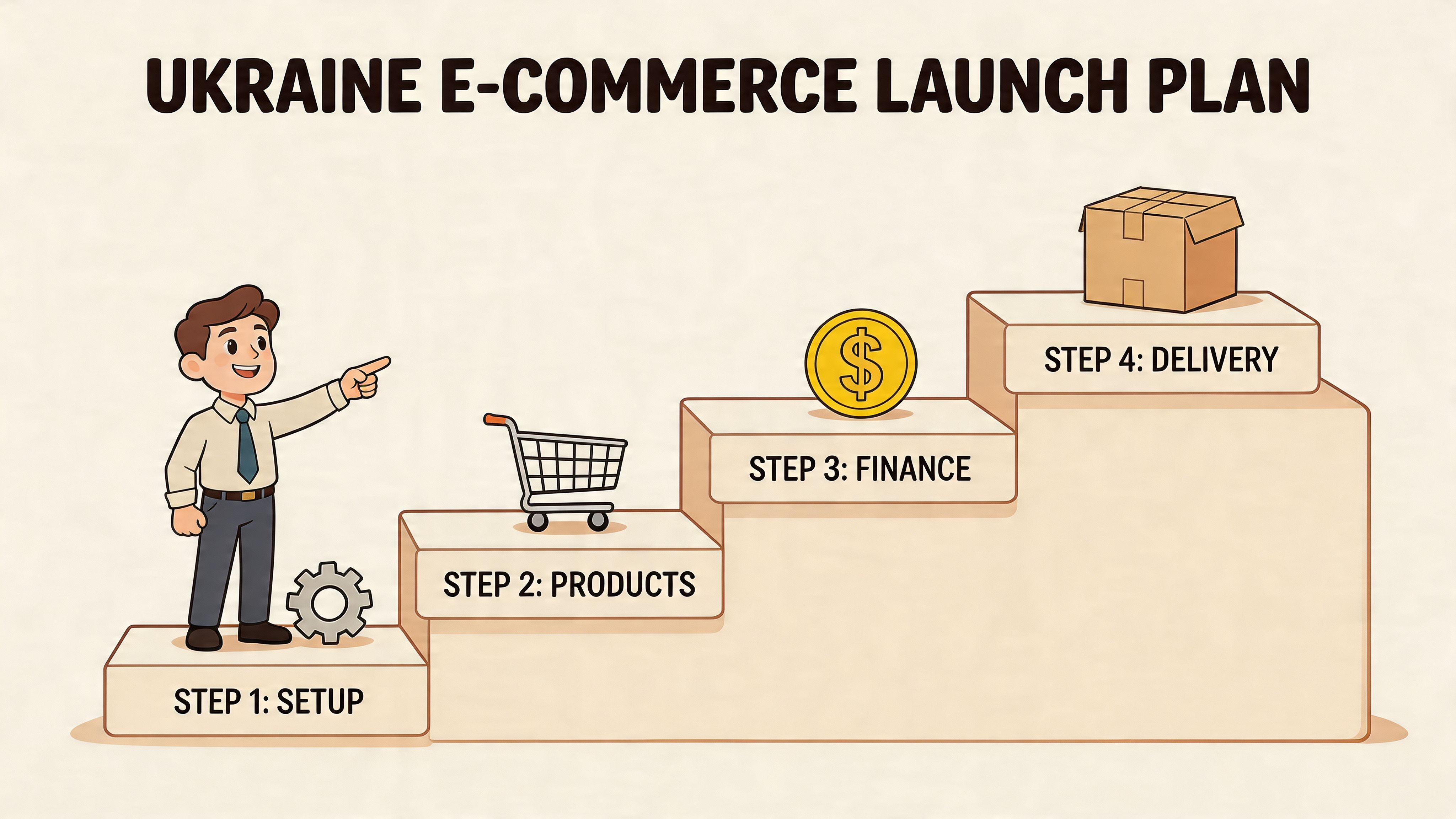
The brands that enter Ukraine well usually do three things before they scale spend. They control mobile conversion, tighten delivery execution, and reduce post-purchase support load with self-service tools from day one. That sequencing matters because early friction in this market shows up fast in support tickets, failed deliveries, and avoidable refund costs.
Phase one validate the market
Start with a narrower launch than the category team wants.
A focused assortment makes it easier to read demand signals, spot fulfillment exceptions, and fix weak product pages before complexity spreads across the catalog. Marketplaces can help you test interest, but the DTC site has to do a different job. It needs to convert branded demand, capture first-party data, and set customer expectations clearly enough that the support team is not cleaning up preventable confusion.
Audit your mobile experience first. In a market like Ukraine, weak mobile execution will distort every other result you measure.
Use phase one to answer a few practical questions:
- Which SKUs survive delivery reality with acceptable cost, damage risk, and return complexity
- Which acquisition channels bring buyers with repeat potential, not just cheap first orders
- Which checkout steps create hesitation on smaller screens or slower connections
Phase two build the operating layer
This phase decides whether growth will be efficient or expensive.
Payment setup has to cover familiar methods, but method coverage alone is not enough. The confirmation flow needs to be clear, failed payment recovery needs to be visible, and refunds need rules the support team can follow without escalating every edge case. Delivery setup works the same way. Offer fewer options if needed, but make each option understandable, reliable, and tied to what your carriers can do.
Assign owners before launch:
- Payments owner for authorization issues, refund rules, and reconciliation
- Logistics owner for carrier logic, exception handling, and service-level promises
- CX owner for macros, response standards, and post-purchase self-service rules
- Compliance owner for tax, customs, and returns governance
Teams often underestimate post-purchase operations here. That is expensive. If customers cannot update an address, check delivery status, or correct a simple order issue on their own, ticket volume rises quickly and resolution time slips.
Phase three localize and launch cleanly
Credibility comes from consistency under real operating conditions.
Run a release checklist that covers what the customer sees after the click, after the order, and after the shipment leaves the warehouse:
- Storefront and email language that match each other
- UAH pricing displayed where purchase decisions happen
- Product detail pages adapted for local buying context
- Shipping promises tied to actual carrier performance
- Self-service order management for address edits, status checks, and common support requests
That fifth point is where many international brands lose margin. Ukrainian customers do not judge the store only at checkout. They judge it when they need to make a correction, track a parcel, or understand a delay. If those moments force them into a slow support queue, trust drops and repeat purchase intent drops with it.
For teams refining their growth model after launch, this guide on how to scale your CRO strategy is a useful complement because it connects testing discipline to revenue expansion without treating conversion work as a set of isolated tricks.
A short visual walkthrough can also help align internal teams on sequencing and expectations:
Phase four optimize after the first orders
The first 30 to 60 days should produce an operating backlog, not just a marketing report.
Watch the patterns that create manual work. Repeated delivery questions usually mean the site or notification flow is too vague. Order change requests usually mean the customer has no controlled way to fix a mistake after payment. Support teams copying the same reply into dozens of tickets usually point to a self-service gap, not a staffing problem.
Focus reviews on these signals:
- Delivery-related contacts per 100 orders
- Manual address-change requests
- WISMO volume and resolution time
- Refunds tied to preventable fulfillment confusion
- Repeat purchase rate by channel
The goal is not a flashy launch. The goal is a store that stays reliable under volume, protects contribution margin, and gives customers enough control after purchase to keep support costs in check. That is how strong online retail execution in Ukraine compounds.
If your Shopify team wants to reduce manual order-change tickets, give customers controlled post-purchase flexibility, and monetize the Thank You and Order Status pages more effectively, SelfServe is built for exactly that. It helps brands offer multilingual self-service edits, real-time address validation, and post-purchase upsells without losing operational control.