Your Guide to Third Party Logistics Software
Third party logistics (3PL) software is the essential connective tissue linking your Shopify store to the warehouse that handles your fulfillment. It’s what makes the whole system work, automatically translating a customer’s click on "Buy Now" into a real-world package landing on their doorstep.
Think of it as the universal translator and traffic controller for your entire fulfillment operation. It ensures the order data from your online store is instantly understood and acted upon by your logistics partner.
What Exactly Is Third Party Logistics Software?
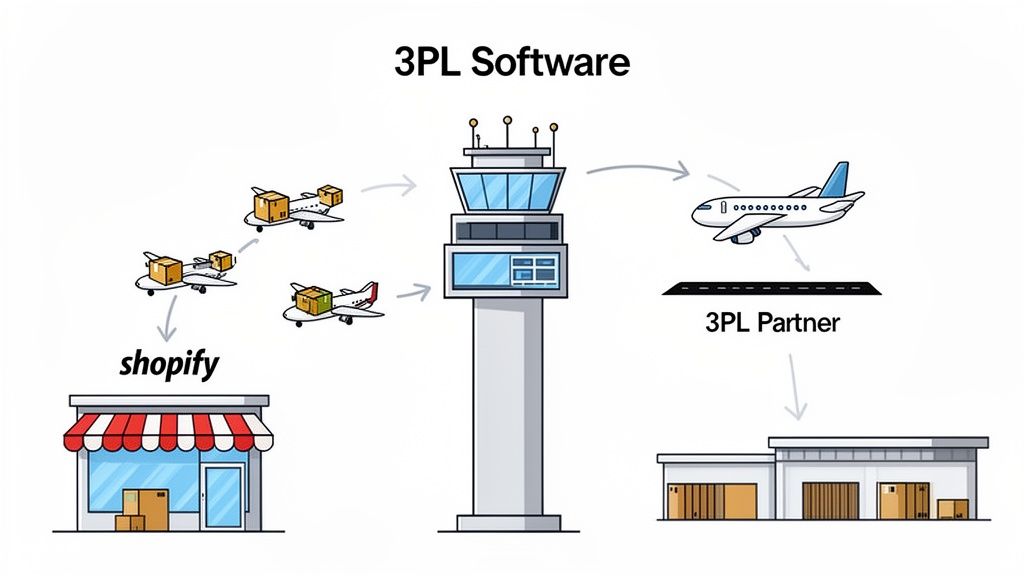
Let’s try a simple analogy. Your Shopify store is the restaurant's front-of-house, where customers browse the menu and place their orders. Your 3PL partner is the kitchen staff, responsible for preparing and sending out the food. Your inventory is the pantry full of ingredients.
The third party logistics software is the point-of-sale (POS) system that instantly zips the customer's order from the dining room right back to the kitchen's ticket printer.
Without it, you’re stuck running handwritten order slips back to the kitchen. It’s chaotic. Orders get lost, you run out of ingredients without realizing it, and customers get frustrated. This manual approach is slow, riddled with human error, and completely unsustainable for a growing brand.
The Core Mission of 3PL Software
At its core, 3PL software exists to automate everything that happens after a customer makes a purchase. It syncs up your brand and your fulfillment partner, creating a single, reliable source of information for orders, inventory, and shipping details. Everyone—from your marketing team to the warehouse floor manager—is looking at the same real-time data.
The real goal is to make your outsourced fulfillment feel completely in-house. It closes the communication gaps and smooths out the operational bumps that can make working with a 3PL feel disjointed.
This isn't just a "nice-to-have" anymore. The market for this technology is booming, expected to jump by USD 482.3 million between 2023 and 2028. With North America projected to account for 38% of that growth, it's clear that high-growth brands see this as a critical piece of their infrastructure. You can dig deeper into the data on 3PL software market growth to see what's driving this trend.
How It Connects Your Store to the Warehouse
The day-to-day job of 3PL software is to maintain a seamless flow of data between your platforms. When an order comes through on Shopify, the software immediately grabs it and sends it to your fulfillment center in a format they can use.
This automated communication loop is a summary of a few key functions.
Key Functions of 3PL Software at a Glance
This table breaks down the main jobs the software handles, connecting what happens on your Shopify store to what happens on the warehouse floor.
Essentially, the software ensures that every part of your fulfillment process is talking to the other parts, eliminating the need for manual work and drastically reducing the chance of errors.
What Features Should You Actually Look for in 3PL Software?
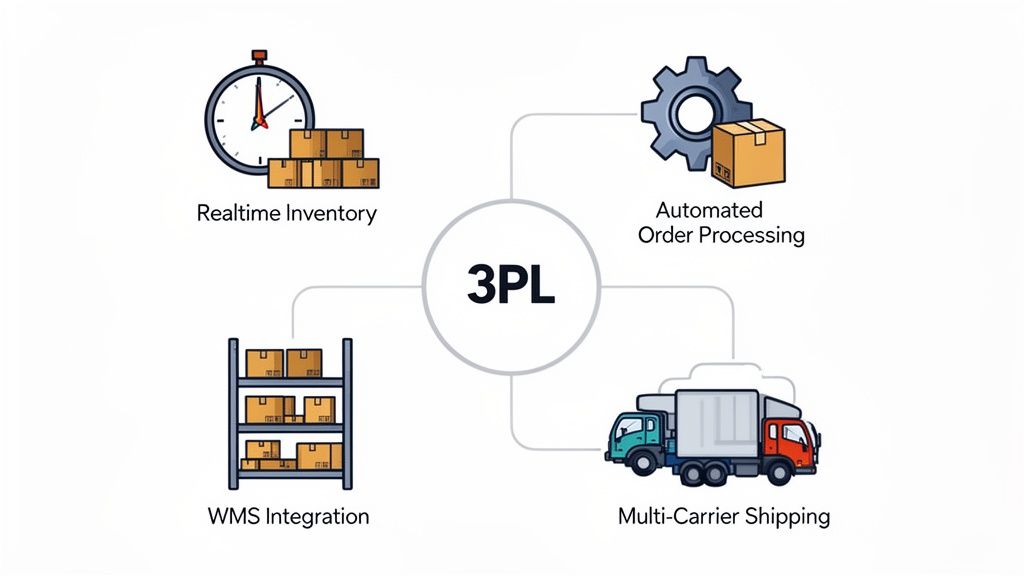
While every 3PL software platform comes with its own menu of options, a handful of core features truly make or break the system. These aren't just flashy bells and whistles; they're the engine that drives your entire fulfillment operation, protecting you from costly errors and preserving your profit margins.
If you understand what these non-negotiables are, you can cut through the sales pitches and judge a platform on its real-world ability to help your business. Let's dig into the capabilities that really count.
Real-Time Inventory Management
Ever run a huge flash sale only to realize you oversold your star product because your Shopify store wasn't talking to your warehouse? It’s a costly nightmare, and it's exactly what real-time inventory management prevents.
This is the bedrock feature. It means that the second a unit is sold, picked off a shelf, or received from a supplier, your stock levels are instantly updated everywhere. It creates a single source of truth for your inventory, so you can stop guessing and doing manual counts that lead to stockouts or overstocking.
Without it, you’re flying blind. With it, you can run promotions confidently and actually forecast demand with some precision.
Automated Order Processing
Manually entering orders into a system is a recipe for disaster. It’s slow, mind-numbingly tedious, and practically invites human error. One wrong SKU or a typo in an address can ruin a customer's entire experience.
Automation is the only way to go. The moment a customer hits "buy" in your store, the 3PL software should instantly grab all the order details and send them directly to the warehouse for picking and packing.
This hands-off approach changes everything:
- Orders get moving immediately, shrinking the time between purchase and shipment.
- Data entry mistakes disappear, meaning far fewer wrong shipments and returns.
- Your team gets their time back to focus on growing the business, not copy-pasting order info.
Multi-Carrier Shipping and Rate Shopping
Let's be honest, shipping is complex. The cheapest carrier for a small package going across town is almost never the best for a heavy box going overseas. Good 3PL software tackles this with built-in, multi-carrier shipping logic.
The software should automatically compare rates and delivery times from carriers like UPS, FedEx, and DHL for every single order. It then picks the best option based on rules you set—whether that’s cheapest, fastest, or a mix of both. This automated rate shopping can slash your shipping spend over time.
This is also critical for keeping customers in the loop. After an order ships, the software pulls the tracking number and pushes it back to your Shopify store, triggering those all-important shipping confirmation emails. If you want to dive deeper into that side of things, check out our guide on how to track Shopify orders.
Robust Reporting and Analytics
You can't fix what you can't see. Any worthwhile third party logistics software has to give you clear, actionable data on your fulfillment operations. And I mean more than just a simple report of how many orders you shipped last month.
The best platforms have dashboards that track key performance indicators (KPIs) like order accuracy, dock-to-stock times, on-time shipping rates, and average cost per order. This is the data that helps you spot bottlenecks and make smart decisions to improve your supply chain.
The entire logistics world is shifting to data-driven tools. By 2025, an estimated 78% of global logistics operators will be on cloud platforms with AI analytics. Why? Because it's been shown to cut delivery errors by 32% and provides unprecedented visibility. Good reporting isn't a "nice-to-have" anymore; it's a must. These features allow you to hold your 3PL accountable and work together to make things better.
3PL Software vs. WMS vs. Fulfillment Platforms: What's the Real Difference?
If you’re trying to get a handle on logistics tech, you’ve probably run into a wall of acronyms: 3PL, WMS, OMS. It's easy to get them mixed up, and frankly, a lot of brands make costly mistakes by choosing the wrong tool for the job. They all touch on fulfillment, but they solve very different problems.
Let's break it down with a simple analogy. Think of your entire fulfillment operation as a high-end restaurant trying to earn a Michelin star.
The Warehouse Management System (WMS) is the head chef. This person is a master of the kitchen—the warehouse floor. Their world is confined to what happens inside those four walls. The WMS tells the line cooks where to find every ingredient (inventory location), gives them the exact recipe for preparing a dish (picking and packing), and ensures it's plated perfectly before it goes out (quality control). It's all about internal efficiency.
What a Warehouse Management System (WMS) Actually Does
A WMS is, at its core, an operational tool for the warehouse. It's built to make every physical process inside a distribution center run like a well-oiled machine.
Its job is laser-focused on:
- Inventory Location: It knows the exact bin, on the exact shelf, in the exact aisle where every single one of your products lives.
- Picking Path Optimization: It maps out the most efficient walking routes for warehouse staff to grab all the items for an order. No wasted steps.
- Labor Management: It tracks how productive individual pickers and packers are, making sure the "kitchen" is running at peak performance.
- Physical Workflows: It directs all the hands-on tasks, like cycle counting, moving stock to forward-picking locations, and putting away new inventory.
Simply put, a WMS is the system your 3PL partner uses to run their building. As the brand, you’ll almost never log into it or interact with it directly.
Where Fulfillment Platforms Fit In
Back in our restaurant, a Fulfillment Platform is like a specialized line cook. Maybe they’re the grill master or the pasta expert. They get tickets for their specific station, execute them flawlessly, but they don’t really see what’s happening across the entire kitchen.
These platforms are similar. They are often brilliant at solving one specific part of the logistics puzzle, like connecting a single Shopify store to one fulfillment provider or automating shipping label printing. They’re a point solution, but that’s also their biggest limitation. As soon as you add another sales channel or a second 3PL, you’ve outgrown them.
The 3PL Software as the General Manager
This brings us to the 3PL software, which acts as the restaurant’s General Manager. The GM isn’t in the kitchen dicing onions. They are overseeing the entire guest experience. They take the customer’s order (from your e-commerce store), make sure the head chef (the WMS) gets it right, and confirms the finished dish is delivered to the correct table, on time.
The GM is the coordinator between the front-of-house (your brand) and the back-of-house (your 3PL). They have the big-picture view, managing communication, tracking every order’s progress, and stepping in to solve any problems. This is the key. While a WMS is internally focused, 3PL software is externally focused. It’s the connective tissue between you and your logistics partners.
A WMS manages the physical movement of goods inside a warehouse. 3PL software manages the flow of information and business rules between a brand and its external fulfillment partners.
This is a critical distinction to grasp. As your brand scales, you might need to use multiple warehouses or even work with several different 3PLs to get closer to your customers. A WMS can’t help you with that. A true 3PL software platform is built for exactly this scenario, giving you one central dashboard to see and control your entire outsourced operation. If you want to see how this fits into your overall tech stack, you can learn more about how a Shopify order management system works alongside these tools.
3PL Software vs WMS vs Fulfillment Platform Comparison
To make it even clearer, here’s a quick table that sums up the key differences between these three systems.
Knowing which system does what is the first step. A WMS is what your 3PL uses. A fulfillment platform is a simple starting point. 3PL software is what you, the brand, use to manage and scale your outsourced logistics network.
How to Seamlessly Integrate 3PL Software with Shopify
Connecting your third-party logistics software to Shopify isn't just a technical task; it's about building a digital supply chain that can withstand the pressure of a flash sale or the holiday rush. Get it wrong, and you're looking at a domino effect of shipping delays, inventory errors, and unhappy customers. Get it right, and you unlock serious scale.
The whole point is to create a hands-off, two-way street for data. An order hits your store, and the details shoot over to your 3PL instantly. The 3PL ships the package, and tracking info flows right back to Shopify and out to the customer. This isn't just about efficiency; it's about building a fulfillment machine that runs itself.
The Foundation: A Robust API Connection
At the core of this connection is the API (Application Programming Interface). Think of it as the universal translator allowing two different software systems—your Shopify store and your 3PL's platform—to speak the same language fluently. A powerful, modern API isn't a "nice-to-have," it's the absolute bedrock of a reliable integration.
Your best-case scenario is a native, pre-built integration. This means the 3PL software provider has already done the hard work of creating a plug-and-play connection specifically for Shopify. If that's not on the table, you'll be looking at a custom-built solution, which adds complexity, cost, and ongoing maintenance to your plate.
Pre-Implementation: Your Data Mapping Checklist
Before a single line of code is touched, you have to get your data in order. This is where most integrations stumble. If the product information in Shopify doesn't perfectly mirror what's in your 3PL's system, the whole process grinds to a halt.
Pay meticulous attention to these key data points:
- SKUs (Stock Keeping Units): They must be 100% identical in both systems. A stray dash, an extra space, or a capitalization difference is enough to cause an order to fail.
- Product Bundles: If you sell kits, make sure they are set up correctly. When a customer orders a bundle, the 3PL needs to know exactly which individual components to pick from the shelves.
- Order Statuses: You need to map your Shopify statuses (like "Paid" or "Fulfilled") to the equivalent terms in the 3PL's software. This ensures everyone is on the same page as an order moves through the fulfillment process.
A successful integration is 90% preparation and 10% execution. The time you spend cleaning up and auditing your product data upfront will save you from a world of hurt and troubleshooting down the road.
Testing: The Full Order Lifecycle
Once the connection is live, it’s time to put it through its paces. Don't just test one simple order and call it a day. You need to simulate every realistic scenario to find any potential breaking points before your customers do.
Run a full suite of test orders, including:
- A Standard Single-Item Order: The simple baseline.
- A Multi-Item Order: Checks if all SKUs are being pulled correctly.
- An Order with a Discount Code: Verifies financial data is passing through accurately.
- An Order Cancellation: Crucial for confirming the cancellation signal reaches the 3PL before the package is out the door.
This diagram helps visualize where 3PL software fits into the broader logistics tech stack—it's the brain that coordinates the different operational pieces.
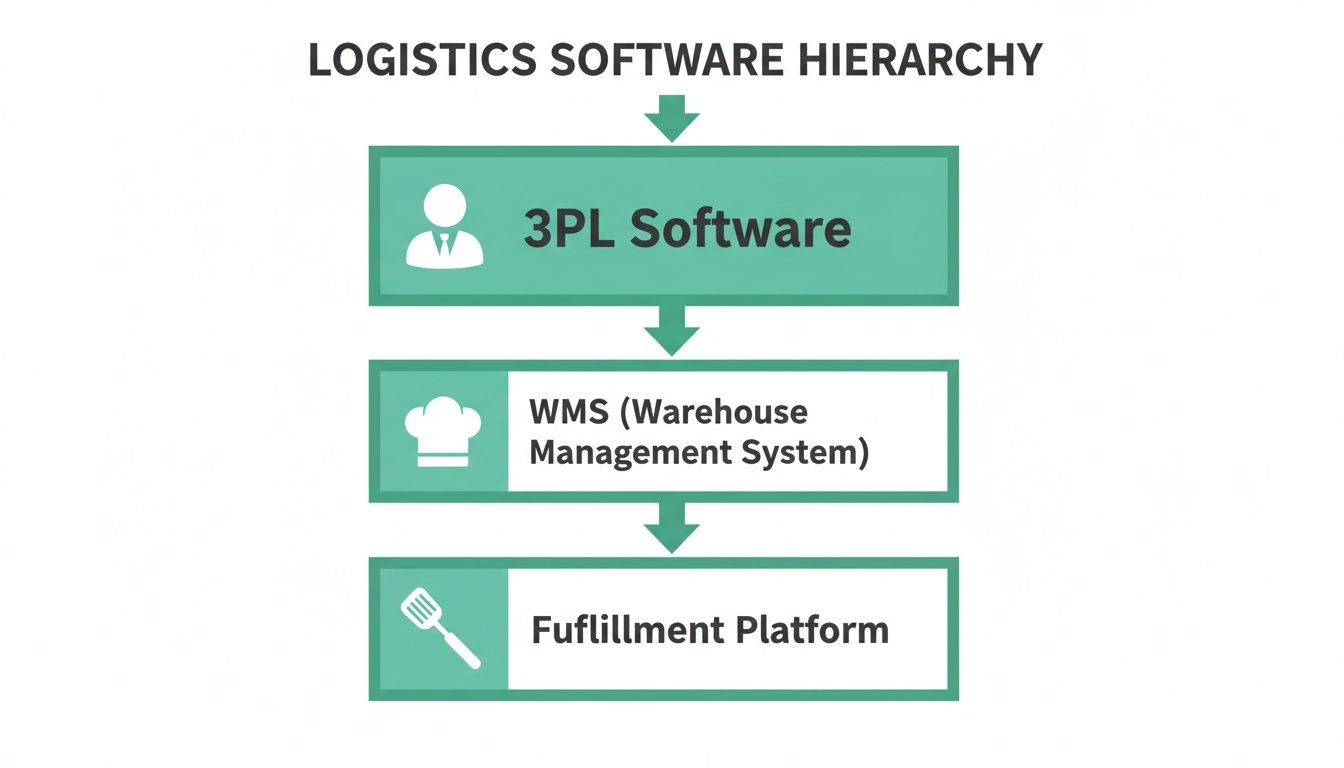
As you can see, 3PL software acts as a strategic layer, directing the on-the-ground functions that are typically handled by a Warehouse Management System (WMS).
A truly solid integration goes beyond just sending orders out the door. It enhances the entire post-purchase experience. For example, a customer could update their shipping address through their account, and that change would instantly sync with the 3PL. That one feature can save dozens of mis-shipments and support headaches. For more on this, check out our guide on shipping and fulfillment best practices for Shopify merchants.
Picking the Right 3PL Software and Partner
Let's be clear: choosing a third-party logistics software isn't like buying an app off the shelf. You're not just picking a product; you're selecting a long-term partner who will have a direct hand in your operations. The software you land on will dictate your shipping costs, your ability to grow, and ultimately, how happy your customers are.
This decision is a big deal. The right choice can be a powerful engine for growth. The wrong one? It becomes an anchor, a constant operational headache that holds your brand back. That’s why you need a solid, practical framework for evaluating both the technology and the people behind it. A little due diligence now saves you from getting stuck with a solution that can't keep pace with your vision.
Create Your Vendor Evaluation Checklist
To see past the slick sales pitches and marketing fluff, you need a structured checklist. This is your tool for comparing apples to apples, making sure you're focused on what actually matters for a high-growth ecommerce brand, especially if you're on Shopify or Shopify Plus.
I recommend building your checklist around four key pillars:
- Technology & Integration: How seamlessly does it talk to your existing tools, especially Shopify?
- Scalability & Performance: Can the platform handle your Black Friday traffic without buckling?
- Security & Compliance: Is your data—and your customers' data—genuinely safe?
- Partnership & Support: What happens after the contract is signed? Are they a true partner or just a vendor?
By framing your questions around these areas, you create a consistent scorecard to measure every potential 3PL.
Key Questions for Your Tech and Integration Deep Dive
A rock-solid, deep integration with your Shopify store is completely non-negotiable. If the connection is flimsy, you’re signing up for a future of failed orders, incorrect inventory counts, and endless support tickets. You have to be sure their API is robust and that they have real experience with brands like yours.
When you're talking to potential vendors, get granular with your questions:
- Is your Shopify integration native or a custom job? A native, pre-built connector is almost always going to be more stable and easier to deal with.
- How do you handle tricky order logic? Ask them to walk you through how they manage product bundles, subscription orders, and pre-orders.
- What’s your average API uptime? Don't settle for anything less than a proven 99.9% uptime. Ask for proof.
- Can you share case studies of Shopify Plus brands you currently work with? This is the best way to confirm they get the unique pressures of high-volume ecommerce.
Think of the integration as the foundation of a house. If it’s weak or cracked, it doesn’t matter how nice the rest of the features look—the whole structure is at risk of collapsing during a storm, like a Black Friday sales event.
Assessing Scalability and Pricing Models
Your fulfillment needs are going to change. A partner that works great when you're doing 1,000 orders a month might completely fall apart at 10,000. You need a solution that grows with you, backed by a pricing model that doesn't punish you for being successful.
The global 3PL market is projected to hit an incredible USD 4.3 trillion by 2035, a boom driven largely by technology that makes this kind of scaling possible. The best providers are already using AI and automation to manage huge volumes. This is a clear signal that you need to pick a platform built for the future. You can read more about the trends shaping the 3PL market to see where things are headed.
Here’s what to ask about their infrastructure and pricing:
- What is your exact process for handling sudden order surges?
- How does your pricing work? Is it based on order volume, a flat SaaS fee, or some kind of hybrid?
- Are there hidden fees for adding more users, warehouses, or sales channels?
- Can you show us your security certifications, like SOC 2 Type II?
A transparent partner will give you clear, straightforward answers. If you get vague responses or a pricing sheet that requires a PhD to understand, consider it a red flag. Your goal is to find a partner whose success is tied to yours, one that’s ready to support you at every stage of your growth.
Avoiding Common Pitfalls in Your 3PL Software Implementation
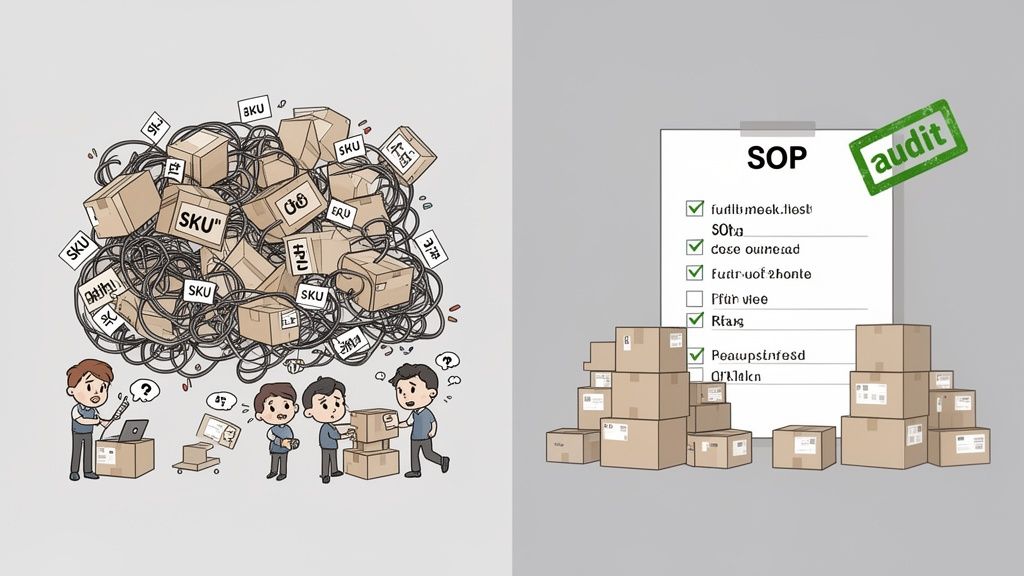
A successful third party logistics software implementation isn’t really about the day you flip the switch. It's about the prep work you do for weeks, or even months, beforehand. Too many brands get caught up in the shiny new features and completely miss the common, costly mistakes that can turn a smooth rollout into a total mess.
Getting ahead of these problems is what separates a successful transition from a chaotic one. By tackling potential issues before they start, you can sidestep operational nightmares, keep your customers happy, and build a solid relationship with your fulfillment partner right from the start.
Let's walk through the biggest hurdles I see brands face and, more importantly, how to clear them.
Overlooking Poor Data Hygiene
Garbage in, garbage out. It’s a cliché for a reason, and it's the single biggest threat to any new software project. Trying to implement a 3PL system with messy data is like building a house on a foundation of sand—it’s just not going to hold up.
We're talking about inconsistent SKUs, missing product dimensions, and inventory counts that are just plain wrong. If the data in your Shopify store doesn't perfectly mirror what your 3PL has, you're in for a world of hurt. Orders won't sync, inventory will be off, and your warehouse partner will be flying blind. This isn't a small hiccup; it's a full-blown operational failure waiting to happen.
Your best defense is a full data audit before you even think about integrating.
- Standardize Your SKUs: Every single product variant needs an identical SKU in both your ecommerce platform and the 3PL's system. No exceptions.
- Verify Product Information: Get out the measuring tape and scale. Double-check that all weights, dimensions, and barcodes are 100% accurate for every item.
- Do a Physical Count: Don't rely on old numbers. Start your partnership with a clean, verified inventory count so everyone is on the same page from day one.
Neglecting Team Training
The most advanced software in the world is completely useless if your team has no idea how to use it. A classic blunder is just assuming your operations or customer service folks will figure out the new system on their own. That assumption almost always leads to confusion, frustration, and a team that quietly ignores the very tool meant to help them.
When your people don't know the new rules of the game—like the cutoff time for changing an order or the exact process for a return—they can't give customers the right answers. This creates a terrible experience and torpedoes all the efficiency gains you were hoping for.
A new software system introduces new operational rules. Failing to document and train your team on these processes is like giving them a new car without explaining where the brakes are.
The solution is to create a shared Standard Operating Procedure (SOP) document that clearly maps out every workflow. This shouldn't be a dusty file that gets ignored; it needs to be a living document that both your internal team and your 3PL partner can access. Think of it as your shared playbook.
Hold regular training sessions before, during, and after the launch. This helps build good habits from the start and gives everyone a chance to ask questions as they pop up in real-world situations.
Your 3PL Software Questions, Answered
Jumping into the world of logistics tech always brings up a ton of practical questions. As you start looking at different systems and potential partners, you need straight answers to the most common concerns. Here’s a rundown of what we hear most often from Shopify merchants about third party logistics software.
How Is Third Party Logistics Software Priced?
Pricing for 3PL software is all over the map, and understanding the different models is the key to avoiding nasty surprises on your invoice. You'll usually run into one of these three common structures, or sometimes a mix of them.
- Monthly Subscription (SaaS): This is the most straightforward model—a flat, predictable fee you pay each month, just like your Shopify plan.
- Per-Order Fee: Some providers skip the big monthly fee and instead charge a small amount for every single order that flows through their system.
- Hybrid Model: This is a popular middle ground, combining a base subscription fee with usage-based charges that move up or down with your order volume.
One thing to watch out for is when 3PL partners bundle the software cost into their overall fulfillment fees. It might sound simpler, but you should always push for a fully transparent cost breakdown. Make sure you see any one-time setup fees, integration costs, or extra charges for adding more team members to the platform.
Can This Software Handle International Shipping and Returns?
Absolutely. In fact, solid support for global commerce is one of the biggest differentiators of a great platform. Modern third party logistics software is specifically designed to untangle the knots of cross-border selling, helping you get your products into the hands of customers anywhere in the world.
Good international features aren't just a "nice-to-have." Your software should have multi-carrier integrations that automatically shop for the best rates on international shipments. It also needs to generate customs documentation on its own—this is crucial for preventing your packages from getting held up at the border. On the flip side, the system should manage the entire returns process, from creating a return label for a customer in Germany to logging the item back into inventory when it hits the warehouse.
A smooth global operation lives or dies by its software. If your system can't manage the complexities of sending and receiving international orders, you simply can't deliver the kind of consistent experience that builds a global brand.
What Is a Realistic Implementation Timeline?
Getting your 3PL software up and running can take anywhere from a few weeks to a few months. The single biggest variable that dictates the timeline? The complexity of your current setup and how clean your product data is.
For a standard Shopify Plus store with a well-organized SKU system and a pretty direct integration, a 4-8 week timeline is a very realistic benchmark. That said, timelines can stretch out if you're trying to connect multiple systems (like an ERP) or if your product catalog is a mess that needs a major data cleanup project before you can even begin. Always, always insist on a detailed project plan from your vendor. It should spell out key milestones and deliverables so there are no surprises along the way.
Ready to stop post-purchase chaos and reduce customer support tickets? SelfServe empowers your customers to manage their own orders while giving you full control. Install the app today from the Shopify App Store and start your 30-day free trial.