A Shopify Merchant's Guide to international first fedex
When speed is non-negotiable for your international shipments, FedEx International First is the service you turn to. It’s FedEx’s top-tier, premium offering that gets your package door-to-door with customs cleared, often arriving as early as the next business day. This service is specifically built for your most urgent, time-critical deliveries to key global destinations.
Understanding FedEx International First
The easiest way to think about FedEx International First is to compare it to air travel. Standard international shipping is like flying economy—it's reliable and will get you there. International First, on the other hand, is the first-class seat for your package. It guarantees top priority every step of the way, from the moment it leaves your hands to its final destination.
For e-commerce brands, this isn't just about shipping faster. It's about creating an exceptional customer experience, hitting critical deadlines without fail, and building a brand reputation for absolute reliability. When timing is everything, this service becomes a strategic advantage.
When to Use This Premium Service
So, when does it make sense to invest in a premium service like this? It's not for every shipment, but it's indispensable for certain situations.
- High-Value Goods: If you're selling luxury watches, high-end electronics, or designer apparel, the delivery experience needs to match the product's prestige. A fast, white-glove service reinforces the value of the purchase.
- Urgent B2B Shipments: Think about sending crucial business documents, time-sensitive product samples to a potential partner, or critical replacement parts that absolutely must arrive before the business day begins.
- Time-Sensitive Deadlines: This is perfect for meeting product launch dates, getting materials to an event on time, or fulfilling contractual obligations that hinge on a package arriving by a specific morning.
The defining feature that sets International First apart is its commitment to an early-morning, time-definite delivery window. You can see the specific delivery commitments on the official FedEx page for International First. This makes it a fundamentally different option from other express services that might just promise delivery by the end of the day.
FedEx International First At a Glance
For Shopify merchants weighing their options, this table breaks down exactly what you get with FedEx International First and why it matters for your business.
| Feature | Description for Shopify Merchants |
|---|---|
| Delivery Speed | Get your products to customers in just 1-3 business days. Delivery is often by 8:00 or 8:30 AM to the U.S. and by 10:00 AM to major cities worldwide. |
| Customs Clearance | Includes expert brokerage to help your package sail through customs. This minimizes the delays that can sour an international customer's experience. |
| Tracking | You and your customer get complete end-to-end visibility. This transparency is key to building trust and reducing "where is my order?" inquiries. |
| Money-Back Guarantee | FedEx backs its delivery commitment with a money-back guarantee, giving you (and your customer) peace of mind for those high-stakes shipments. |
Ultimately, these features combine to create a powerful tool for delighting customers and protecting your brand's reputation when shipping your most important international orders.
Where and How Fast? A Look at Delivery Speed and Global Reach
When we talk about FedEx International First, the key isn't just speed—it's precision. This service isn't about a generic "1-3 day" window. It’s about a specific, time-definite promise that your package will arrive at the start of the business day, which can be a game-changer for high-value orders.
Think about it from your customer's perspective. A client in New York City needs a critical replacement part for their production line, and they need it now. With International First, you’re not just offering fast shipping; you’re offering a guarantee that the part will be on their loading dock by 8:00 AM or 8:30 AM the next business day. That's a promise that builds serious trust.
Where Exactly Is "International First" Available?
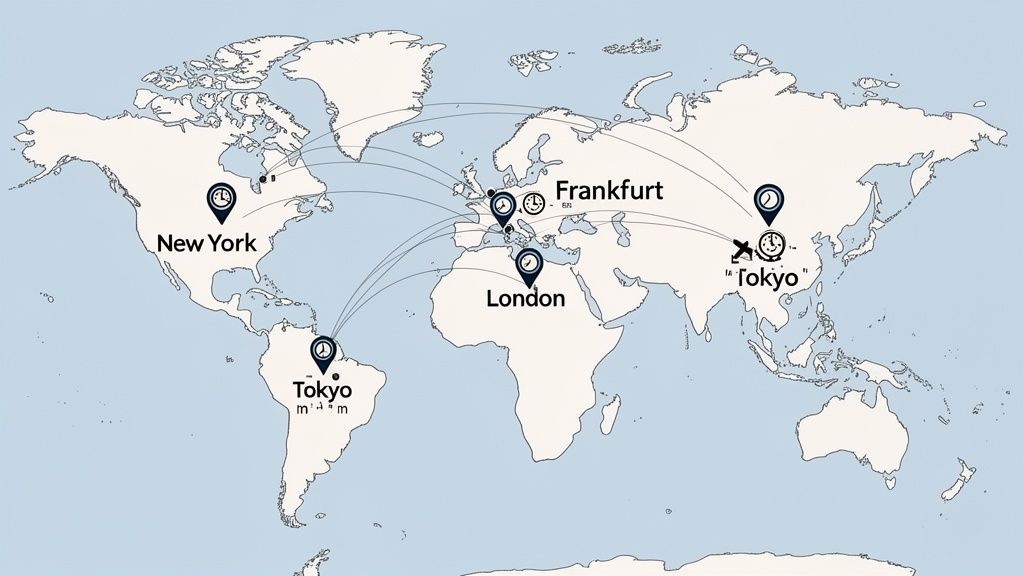
This premium service is surgical in its coverage. It's not meant for every corner of the globe. Instead, FedEx International First focuses on connecting the world's most active economic centers, so it's crucial to know exactly where you can offer it.
You can confidently promise this early-morning delivery to customers in:
- North America: Major metro areas throughout the United States and Canada, plus key cities in Mexico.
- Europe: The big commercial hubs you'd expect, like London, Paris, Frankfurt, Amsterdam, Brussels, and Milan.
- Asia Pacific: Key destinations including Tokyo, Singapore, Hong Kong, and certain major cities in China.
- Latin America: Service is available to primary business centers in countries like Brazil.
This targeted approach is what makes those tight deadlines possible. FedEx has built the infrastructure specifically to serve these high-traffic commerce lanes.
Cutting Through the Customs Red Tape
Every international shipper has felt the dread of a package getting stuck in the "customs black hole." You see the tracking stop, and the package just sits for days. This is where the integrated customs brokerage for International First really shines.
Instead of your shipment waiting in line for an independent broker, FedEx’s own team handles the entire clearance process. Often, the paperwork is pre-cleared while the package is still in the air. The result? It sails through customs on arrival with little to no delay.
For anyone running an e-commerce store, this is huge. Fast, predictable customs clearance means happier customers. You’ll spend less time answering "Where's my order?" support tickets and more time building your business.
This whole operation is powered by a truly massive global machine. The FedEx International First service is a flagship offering within a network that serves over 220 countries and territories. FedEx handles roughly 17 million packages every single day across more than 5,000 facilities. As detailed in their report on global economic impact and innovation on FedEx's newsroom, this scale allows you to offer precise delivery windows on your site, knowing there's a world-class system ready to back you up.
Understanding the Cost and When to Use It
No sugarcoating it: a premium, time-definite service like FedEx International First is going to cost more than your standard shipping options. But thinking of it purely as an expense misses the point entirely. This is a strategic tool, an investment you make in your customer's experience when speed and certainty are non-negotiable.
The higher price tag reflects the white-glove treatment your package receives—priority handling from end to end, dedicated customs clearance, and that rock-solid guarantee of early-morning delivery.
What Goes Into the Price?
The final cost isn't just one flat fee. FedEx calculates it for each specific shipment, and a few key variables will always be part of the equation.
- Package Size and Weight: This one's straightforward—bigger and heavier packages cost more. But don't forget about dimensional weight. A large, lightweight box can sometimes cost more to ship than a small, heavy one because of the space it takes up on the plane.
- Destination: Where is it going? Shipping from the US to a major hub in Europe is a different ballgame than sending a package to a business center in Asia or South America. Each route has its own cost structure.
- Surcharges: Keep an eye out for extra fees. Things like fuel surcharges, charges for delivering to a residential address, or handling for oversized items can be added to the base rate.
Getting a handle on these factors helps you predict your costs much better. The underlying principles are pretty similar across carriers; for another perspective, you can see a detailed breakdown of how UPS international shipping costs are calculated.
Strategic Use Cases for Shopify Merchants
Here’s the secret: you shouldn't offer FedEx International First on every single order. Its real power comes from offering it as a premium choice at checkout. You're giving customers the power to decide what they value most—saving money or saving time.
This approach lets you capture sales that might otherwise be lost, especially for certain products and time-sensitive situations.
For the right customer with the right need, a premium shipping option isn't a cost—it's a solution. Offering FedEx International First at checkout captures high-intent buyers who are willing to pay for speed and certainty, turning a potential lost sale into a loyal customer.
Think about these real-world scenarios where this service is a game-changer:
- High-Value Electronics and Jewelry: If someone just spent thousands on a luxury watch or a new camera, they want a delivery experience that feels just as premium. A secure, early-morning delivery minimizes the time the item is in transit and reassures them they made the right choice.
- Urgent B2B Sample Deliveries: You've got a potential wholesale partner on the hook, but they need product samples now to sign a major contract. Getting those samples on their desk by 10:00 AM the next business day can be the single factor that closes the deal.
- Critical Replacement Parts: A business customer's machine is down, and every hour of downtime is costing them money. Shipping a replacement part for early-morning delivery isn't just a nice-to-have; it's a lifeline that builds incredible brand loyalty.
Choosing Between International First and International Priority
When you're staring at FedEx's international shipping options, it’s easy to get stuck. You see FedEx International First and FedEx International Priority, and they both sound fast. So, what’s the real difference?
It really boils down to this: do you need it there fast, or do you need it there first thing in the morning?
Think of International Priority as the business-class ticket of shipping. It’s quick, dependable, and gets your package to its destination in 1-3 business days, usually by the end of the day. For most urgent e-commerce orders, it’s the perfect fit.
But FedEx International First? That’s the private jet. It’s for those times when "by the end of the day" just won't cut it. This service is all about hitting an early-morning delivery window, often by 8:00 AM in the U.S. or by 10:00 AM in major cities around the globe. This is the service you pick for critical B2B parts, time-sensitive legal documents, or luxury goods where the delivery experience matters just as much as the product itself.
Speed, Cost, and Coverage at a Glance
Let's break down how these two premium services stack up against each other. While both are backed by FedEx's money-back guarantee, they're built for slightly different definitions of "urgent."
FedEx International First vs International Priority Comparison
To really see the difference, it helps to put them side-by-side. One is laser-focused on the earliest possible delivery time, while the other offers a fantastic balance of speed and wider availability.
| Feature | FedEx International First | FedEx International Priority |
|---|---|---|
| Delivery Target | Early morning, time-definite (8:00 AM - 10:00 AM) | End of business day (1-3 business days) |
| Best For | Extreme time-sensitivity, B2B deadlines, luxury goods | General urgent shipments, e-commerce orders, documents |
| Global Reach | More targeted, focused on major economic hubs | Broader coverage, available to over 220 countries |
| Cost | Highest premium price point | Premium, but more cost-effective than International First |
This table makes it clear: International First is about precision timing, whereas International Priority is about reliable, all-around speed.
This simple flowchart can also help you decide when the extra investment for International First really makes sense.
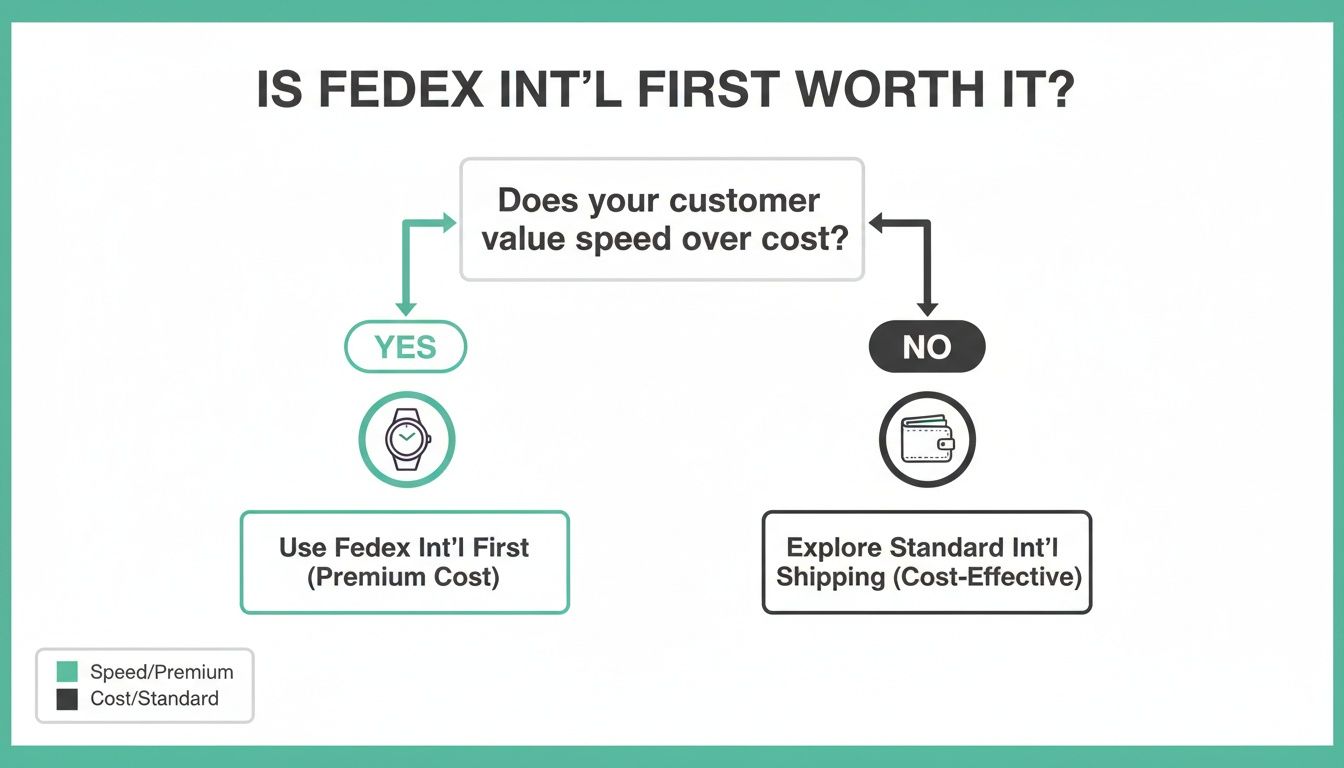
As you can see, if the customer's top priority is getting the item at the earliest possible hour, the premium service is the way to go. Otherwise, other options usually provide a better balance of cost and speed.
Making the Right Financial Choice
Let's be honest: price matters. And knowing when to opt for a more economical service is just good business. The market is showing a clear trend of customers balancing their need for speed with a desire for reasonable costs.
For example, in fiscal year 2025, FedEx saw its international economy services revenue jump to $5.9 billion from $3.3 billion the year before, while its priority services actually saw a decline. You can dive deeper into FedEx's market performance on RedStagFulfillment.com. This shift tells us that while speed is important, many shoppers are happy with "fast enough" if it saves them money. This makes International Priority a solid default for most e-commerce stores.
The smartest move is to offer both at checkout. Let your customers decide. Those who absolutely need the white-glove, first-light delivery can choose International First, while most others will appreciate the reliable speed and better price of International Priority. You end up catering to everyone's needs and budget.
Getting these small but crucial details right can make a huge difference in your shipping strategy. And as you grow, looking into how a multi-carrier shipping solution can further optimize your logistics by giving you more options is a great next step.
How to Streamline Your International Post-Purchase Experience
Choosing a premium service like FedEx International First is a great move, but the customer's journey is far from over once they click "buy." In fact, for international orders, the post-purchase experience is where you either win a customer for life or lose them for good. This is the delicate period where things can go wrong—from confusing address formats to customs delays and the nightmare of a failed delivery.
Getting this stage right means giving your customers more than just a tracking number. It's about giving them clarity and control when their expensive order is halfway around the world. A single typo in a foreign address can send a package on a costly round-trip back to your warehouse, completely wiping out your profit margin and leaving a bad taste in the customer's mouth.
Empower Customers and Slash Errors
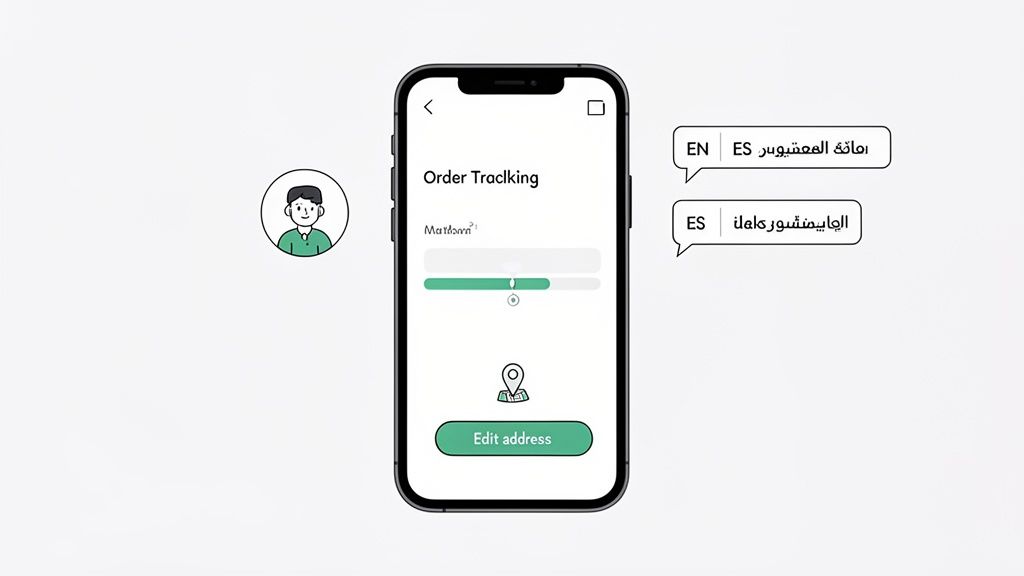
Think about this all-too-common situation: a customer in Germany types in their street name with a small typo. Normally, this mistake would trigger a delivery exception and a costly return. But what if, right after seeing their order confirmation, they spot the error and can fix it themselves?
With the right setup, they could click a link, edit the address within a time window you control, and have it instantly validated. This self-service approach turns a potential disaster into a smooth, positive interaction. Your customer feels empowered, your support team avoids another ticket, and the package gets delivered on the first try.
This isn't just about good customer service; it’s smart business, and it’s what modern logistics leaders are built on. FedEx's international network is a perfect example, forming a massive backbone for global commerce. In fiscal year 2025, FedEx brought in $87.9 billion in revenue. A staggering $75.3 billion of that—or 86% of the total—came from its express shipping division. You can read more about FedEx's impact on global trade in their newsroom.
Move Beyond Basic Order Tracking
A great post-purchase experience doesn't just prevent problems; it creates new opportunities. Your order status page can be so much more than a boring progress bar—it can be a branded, revenue-generating touchpoint.
Here’s how to completely transform that experience:
- Speak Their Language: An order management tool that automatically displays in your customer's native language shows you're thinking about their experience. It’s a simple touch that builds a huge amount of trust.
- Offer Smart Upsells: The order status page gets a lot of views. While your customer is excitedly checking their tracking, you can show them related products they can add to their unshipped order with one click.
- Communicate Proactively: Ditch the generic carrier updates. Send clear, branded messages that explain each step, from your warehouse to clearing customs and final delivery.
When you turn the post-purchase phase from a passive waiting game into an interactive and helpful journey, you’re not just cutting down on support tickets. You’re building real customer relationships and finding new ways to generate revenue from orders you've already won.
For any Shopify brand looking to scale internationally, this approach is non-negotiable. To see how these tools work in the real world, check out our guide on how to choose the right track package software. By giving customers the power to manage their own orders with a tool like SelfServe, you let your team get back to focusing on growth.
Common Questions About FedEx International First
Even when you've done all your homework, the practical, day-to-day questions about using a service like FedEx International First are what really matter. Getting these right is the key to managing your costs and keeping your customers happy. We’ve pulled together the most common questions we hear from Shopify merchants to give you the straight answers.
What Happens If a Shipment Is Delayed?
The biggest safety net with FedEx International First is its money-back guarantee. If FedEx misses that confirmed early-morning delivery window, you can typically request a full refund or credit for the shipping charges. This gives you some financial peace of mind on your most important deliveries.
Keep in mind, though, that this guarantee has its limits. It won’t cover delays caused by things totally out of FedEx's control, like a sudden blizzard, a natural disaster, or—the most common culprit—a package being held up by a customs agency.
Pro Tip for Merchants: It's always a good idea to add a quick note to your shipping policy about potential customs delays. This simple heads-up manages customer expectations from the start and can prevent a lot of frustration if their package gets flagged for inspection.
Are There Items I Cannot Ship?
Yes, and this is a big one. Every carrier has a list of things they won't carry, but international shipping adds another layer of rules from the destination country. You need to be aware of both.
Some items are an absolute no-go. This includes things like:
- Hazardous materials (think chemicals or anything flammable)
- Firearms and ammunition
- Perishable foods that need to be kept cold
- Live animals
- Certain electronics with lithium-ion batteries can also face tight restrictions
Before you even think about packing a box, you have to check the rules. Look at both the FedEx service guide and the specific import laws for the country you're shipping to. A mistake here can be costly—your package could be seized, destroyed, or sent back to you on your dime.
How Do I Handle Customs Paperwork?
Getting your customs paperwork right is the secret to a smooth international shipment. FedEx helps out a lot with its Electronic Trade Documents (ETD) system. It lets you upload everything digitally, like your commercial invoice, which can really speed things up at the border.
When you're filling out the forms, you need to be incredibly specific about what’s in the box, where it was made, and exactly how much it's worth. Accuracy is non-negotiable. A tiny mistake on the commercial invoice is all it takes to get your package flagged for a manual inspection, which can easily add days to the delivery time. Many Shopify apps can integrate with FedEx to help pull this information automatically, which is a great way to cut down on human error.
Can My Customers Track Their Package?
Absolutely. Comprehensive, real-time tracking is a core part of the FedEx International First service. The moment your package gets its first scan, both you and your customer can follow its journey every step of the way.
They’ll see all the key updates, from "in transit" to "cleared customs" and the final "out for delivery" scan. The best way to handle this on your Shopify store is to pull that tracking info onto your own branded order status page. It keeps customers on your site, reinforces your brand, and delivers the professional, transparent experience they expect when paying for a premium service.
Managing post-purchase changes for international orders doesn't have to be a headache. SelfServe empowers your customers to fix their own address typos, track their orders on a branded page, and even add upsells to their existing purchase. Reduce your support tickets and increase AOV with SelfServe.