Online Shopping in California: A Merchant's Guide for 2026

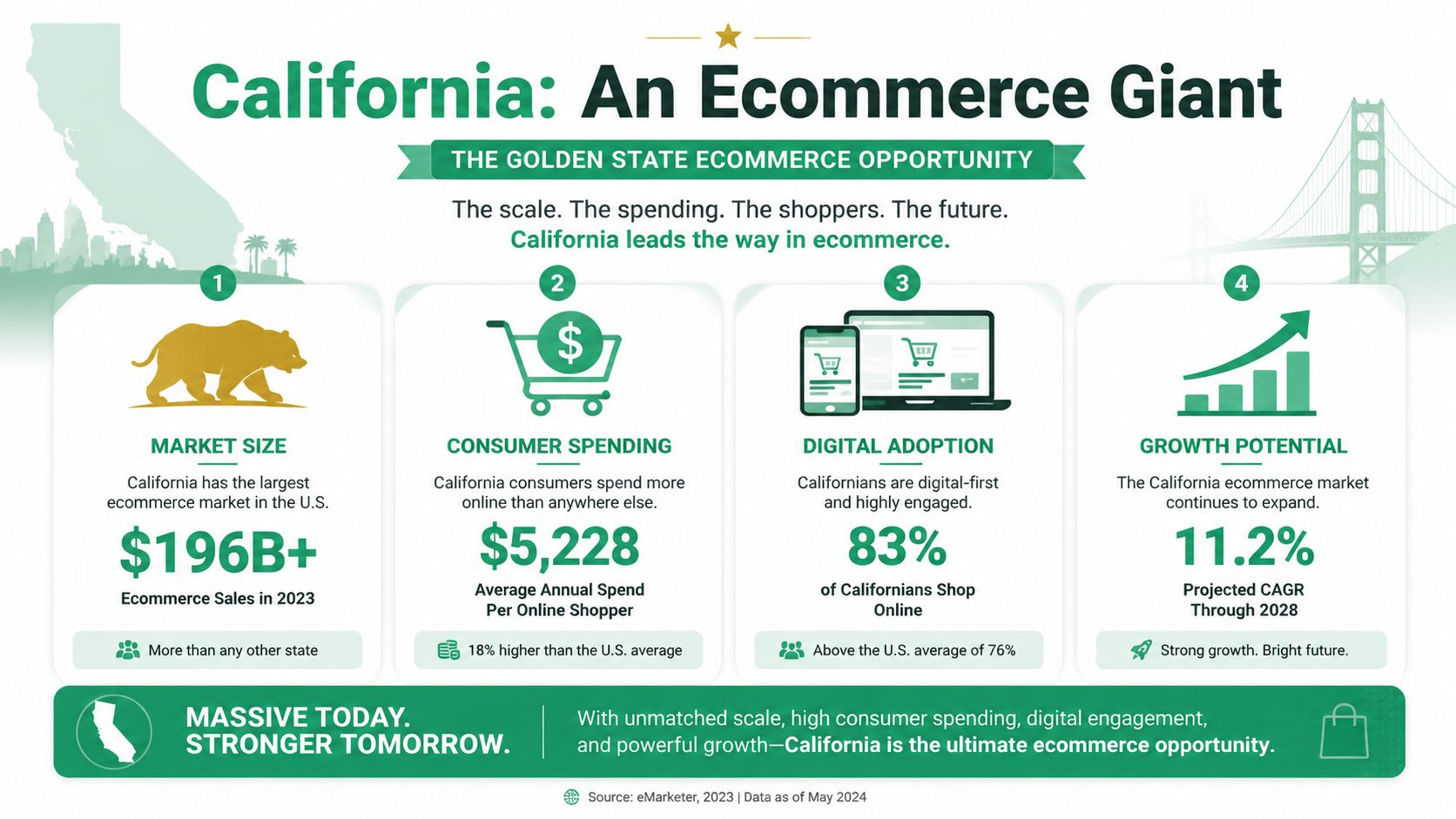
California is too often treated like a bigger version of every other ecommerce market. It isn't. The scale alone changes the playbook. In 2026, California online retail sales were estimated at $137.8 billion, or about $4,443 per adult, and shoppers in the state are 20.1% more likely than the average American to buy online weekly, according to Capital One Shopping's California ecommerce analysis.
That matters for Shopify operators because California exposes every weakness in an ecommerce system faster than smaller markets do. Tax setup mistakes get expensive. Privacy shortcuts become risky. Fulfillment exceptions multiply. Customer expectations rise quickly, especially after checkout when support, edits, tracking, returns, and communication all collide.
Most articles about online shopping in California are written for shoppers. This one is for merchants that need a cleaner operating model.
The Golden State Ecommerce Opportunity
California isn't just a large audience. It's a dense concentration of digitally active buyers. When a state combines very high ecommerce spending with frequent online purchase behavior, brands can't treat it as a side market or a generic West Coast region. It becomes a core operating environment.
The most useful way to think about online shopping in California is this. The opportunity isn't only at acquisition. It's in the system behind the order. Merchants that win here usually don't just run better ads. They reduce friction after the sale, protect conversion after checkout, and keep fulfillment errors from turning into support debt.
Why California changes the math
A high-growth Shopify brand usually feels California in three places first:
- Paid acquisition pressure: Competition is heavier because serious brands prioritize the state.
- Operational complexity: Shipping, address quality, and support workflows matter more because order volume compounds mistakes.
- Experience expectations: Customers are used to polished digital experiences and don't tolerate clunky post-purchase flows for long.
California also sits inside a broader ecommerce expansion cycle. If you're planning for the next phase of growth, it helps to align California execution with larger Shopify ecommerce trends to watch in 2025, especially the shift toward customer-controlled post-purchase experiences.
Practical rule: If your store only wins in California when everything goes perfectly, you don't have a California strategy. You have a fragile one.
What strong operators do differently
They treat checkout as the midpoint, not the finish line.
That means building for the messy realities that show up after conversion. Customers enter apartment numbers incorrectly. They use work addresses and then need them changed. They want shipping updates in their preferred language. They ask to add an item after purchasing. If your team handles all of that manually, California volume will expose it quickly.
The brands that scale cleanly here usually make a simple shift. They stop seeing post-purchase operations as support overhead and start treating them as margin protection.
Navigating California's Legal Labyrinth for Merchants
California has been shaping online commerce behavior for years. One analysis found that 56.5% of California residents had bought something online, ranking the state first among U.S. states in that measure, according to this summary of state ecommerce statistics. A market with that level of adoption tends to become a regulatory trendsetter, and merchants feel that in two places first: tax and privacy.

Sales tax is an operations issue, not just an accounting issue
A lot of Shopify brands treat tax setup like a one-time admin task. That's a mistake. California tax handling affects catalog configuration, shipping settings, exemptions, marketplace treatment, and how finance reconciles orders later.
If you're selling into California, start with a practical review:
- Confirm nexus exposure: Know whether your business has triggered California collection obligations.
- Check Shopify tax settings: Make sure products, shipping, and registrations reflect your actual setup.
- Separate direct and marketplace sales: If part of your volume flows through marketplaces, keep responsibility lines clear.
- Audit overrides and exceptions: Older stores often carry legacy settings that no one remembers changing.
For merchants that need a cleaner operational walkthrough, this guide on Shopify tax settings explained and how to stay compliant is useful because it focuses on implementation rather than abstract tax theory.
Privacy compliance has to show up in the storefront
California privacy rules aren't satisfied by dropping in a generic policy template and moving on. If your store uses tracking, retargeting, analytics, or customer data for marketing workflows, your public-facing experience needs to match your internal data practices.
At minimum, merchants should pressure-test these areas:
- Privacy policy accuracy: The policy should reflect what your store collects and how it's used.
- Consumer rights workflow: Someone on the team should know how requests are received, verified, and fulfilled.
- Tracking disclosures: Cookie and tracking choices need to align with the tools installed on the site.
- Vendor coordination: Your ad, email, support, and analytics stack all touch customer data differently.
California compliance breaks down when legal, growth, and retention teams each assume someone else owns the customer data flow.
What doesn't work
Three approaches fail repeatedly.
| Approach | Why it fails |
|---|---|
| Template-first compliance | The document may look polished while the storefront behavior says something else. |
| One-owner compliance | Legal, ops, marketing, and CX all affect the actual customer experience. |
| Annual review only | Apps, tracking scripts, and workflows change faster than yearly check-ins. |
A better merchant checklist
Use California as a forcing function to tighten your process.
- Assign ownership clearly: Finance should own tax operations. Someone in ecommerce or ops should own storefront privacy execution.
- Review apps quarterly: Old Shopify apps often leave behind scripts, tracking behavior, or data flows that no one documents.
- Train support teams: If customers ask about data access, deletion, or account changes, support needs a real process.
- Document exceptions: If you allow manual workarounds for orders or customer accounts, write them down.
Merchants don't need perfect legal fluency. They need a system that turns legal requirements into repeatable store operations.
Solving the California Shipping and Delivery Puzzle
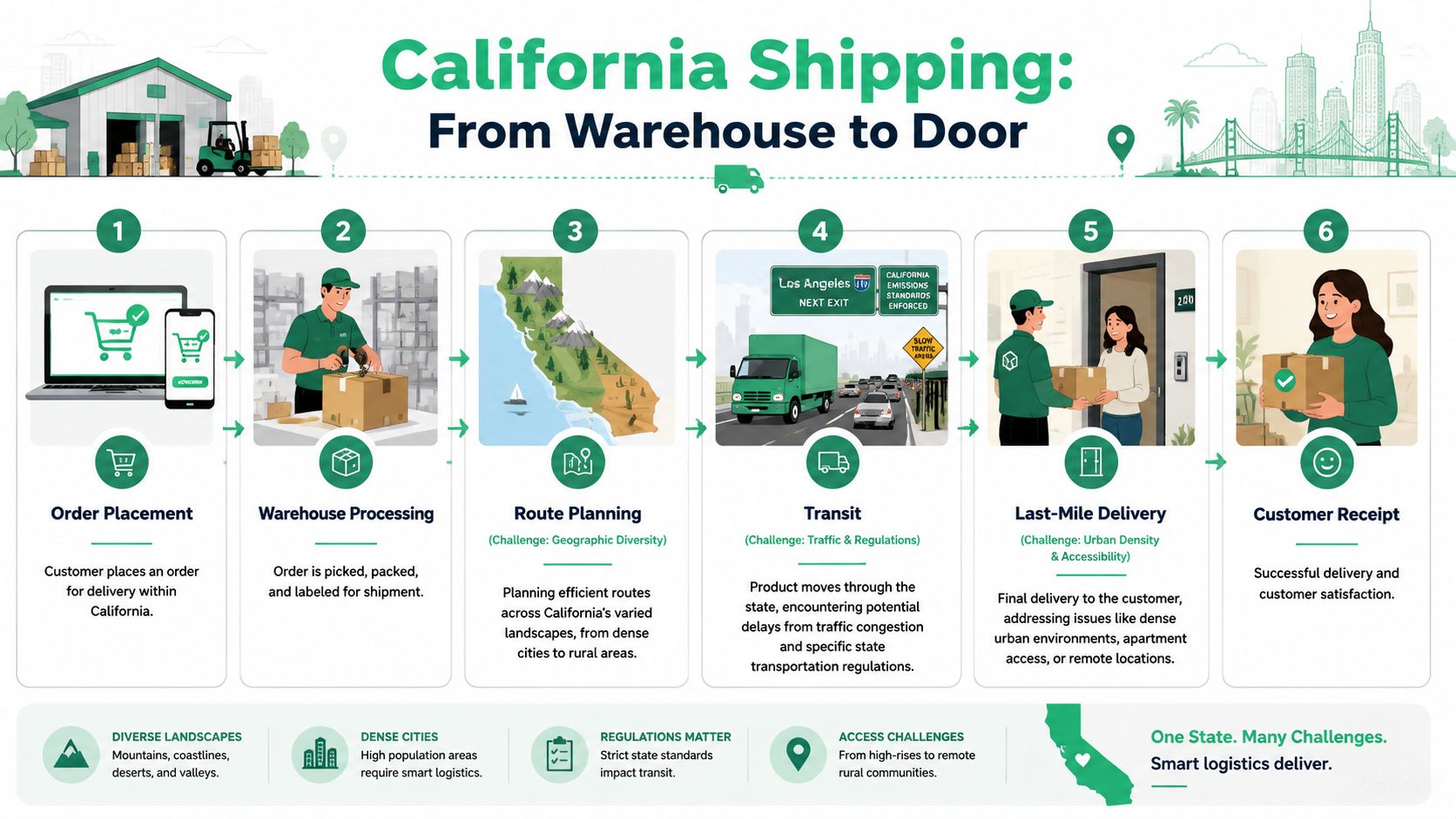
California rewards fast fulfillment, but it also punishes sloppy order data. The state's warehousing and distribution network has expanded significantly because of ecommerce demand, and that creates a tight connection between checkout accuracy and downstream cost, as noted in California transportation research on ecommerce logistics.
Why small mistakes get expensive fast
A bad address isn't just a typo. In California, it can trigger a cascade.
The order gets routed to a warehouse. A pick ticket is created. A label is printed. A carrier receives the package. Then the customer notices the missing unit number, or support finds out the street suffix was wrong, or a gated apartment delivery fails. At that point, one order can create warehouse rework, carrier exceptions, delayed delivery, and a service ticket.
This is why brands that promise speed also need disciplined edit windows. If you let customers request changes through email with no cutoff logic, your support team ends up negotiating against your fulfillment clock.
The real issue is exception cost
When merchants talk about shipping in California, they often focus on rates and speed. The bigger issue is exception cost. Not every exception is visible in the shipping invoice.
It also shows up in:
- Support load: Agents chase WISMO tickets, address changes, and delivery complaints.
- Warehouse friction: Teams stop normal flow to handle one-off edits or cancellations.
- Customer trust: Even when the package arrives, the experience can still feel unreliable.
- Refund pressure: Customers who hit friction earlier are less patient later.
The fastest way to lower shipping chaos is to prevent editable mistakes from entering the fulfillment pipeline in the first place.
What usually works better
A practical California shipping setup has a few traits in common:
- Real-time address validation: Catch incomplete or non-standard address entries before the order hardens.
- Short modification windows: Give customers a clear period to fix details without forcing staff into manual inbox triage.
- Fulfillment-aware rules: Once an order reaches a certain stage, edits should narrow or require approval.
- Carrier-friendly communication: Tracking messages should reduce uncertainty, not generate more questions.
If your brand competes on delivery promises, this is also the point where broader two-day shipping strategy on Shopify becomes relevant. Fast delivery only helps when the order data is clean enough to move without intervention.
Meeting California's High Customer Expectations
California customers don't just compare you with direct competitors. They compare your store with the best digital experiences they encounter anywhere. That changes the baseline for support, returns, communication, and localization.
The challenge isn't just speed. It's coherence. Customers expect the purchase, confirmation, shipping updates, edits, and returns process to feel connected. If the storefront feels premium but post-purchase feels manual, trust drops quickly.
Returns are part of the brand, not a back-office function
Many merchants still treat returns as a policy page problem. In practice, customers experience returns as a product experience. They want clear instructions, visible status, and minimal back-and-forth.
For California shoppers, that expectation is amplified by the variety of living situations and delivery contexts across the state. Apartment deliveries, gifting, travel-related shipping, and work addresses all create more opportunities for post-purchase changes and eventual returns. If your returns flow is confusing, support absorbs the cost.
A stronger approach usually includes:
- Plain-language return rules: Customers shouldn't need to decode legal wording.
- Consistent status communication: Once a return starts, updates should stay easy to follow.
- Operational alignment: Your support promises must match what warehouse teams can process.
Communication has to reflect the state's diversity
Localization in California isn't just translation. It's also message tone, channel fit, and customer confidence. A multilingual storefront with English-only post-purchase communication creates avoidable friction.
Merchants should review where communication breaks after checkout:
| Touchpoint | What customers expect | What weak setups do |
|---|---|---|
| Order confirmation | Clear next steps | Generic receipt language |
| Shipping updates | Useful, timely status | Carrier jargon with little context |
| Support contact | Fast path to resolution | Long forms and delayed replies |
| Returns communication | Visibility and certainty | Customers forced to ask for every update |
High expectations don't mean offering everything
A common mistake is overbuilding. More channels, more promises, more manual exceptions. That often creates slower service, not better service.
Field note: Customers usually forgive a narrow policy faster than a confusing one. They rarely forgive silence after they've paid.
The better model is controlled flexibility. Let customers solve common problems themselves. Reserve human intervention for exceptions where judgment is necessary. That keeps service quality high without training your support team to become a workaround department.
Actionable Post-Purchase Strategies for Shopify Stores
At the national level, ecommerce is still expanding quickly. U.S. retail ecommerce sales reached $326.7 billion in Q1 2026 and were up 9.7% year over year, according to the U.S. Census Bureau ecommerce report. For Shopify brands competing in California, that growth raises the value of every conversion you already paid to acquire. The easiest margin to lose is often after checkout.
Give customers controlled self-service
If your support queue is full of address edits, item swaps, contact updates, and cancellation requests, the problem isn't customer behavior. It's workflow design.
A well-structured post-purchase flow gives shoppers a controlled window to manage the changes that are safe to automate. That reduces ticket volume while improving order accuracy. On Shopify, the key isn't offering unlimited edit freedom. It's setting permissions that reflect fulfillment reality.
Start with the changes that create the most unnecessary support work:
- Shipping address corrections: Especially important for apartment, suite, and gate code issues.
- Contact detail updates: Customers often realize their email or phone entry is wrong only after ordering.
- Order cancellation requests: These need rules and queues, not inbox chaos.
- Add-on purchases: If a customer wants one more item right after checkout, that shouldn't always require a second order.
Use the post-purchase pages as revenue real estate
Many stores waste the Thank You page and Order Status page on passive confirmation copy. That's expensive in a market where acquisition costs are already high.
Those pages work better when they do one of two things well. They either reduce anxiety or create relevant next actions. Sometimes they do both. A customer who just converted is often still engaged enough to fix an address issue, opt into updates, or add a complementary product if the flow is clean.
For teams building retention beyond the first order, these ecommerce customer retention strategies are a useful complement to post-purchase workflow design because retention usually improves when the first fulfillment experience feels easy and controlled.
Design around operational guardrails
The strongest post-purchase systems aren't open-ended. They are specific.
Consider this simple framework:
| Workflow area | Best practice |
|---|---|
| Edit window | Keep it short and visible so customers know when they can act |
| Address quality | Validate in real time instead of fixing errors after routing |
| Product eligibility | Restrict edits for items that create inventory or compliance issues |
| Approvals | Route risky changes into manual review rather than blocking everything |
| Order tagging | Mark edited orders clearly so ops teams can act with context |
This matters more in California because operational variation is higher. A single store may ship to dense urban neighborhoods, suburban homes, campus housing, office towers, and remote addresses within the same state. One rigid post-purchase rule set often creates needless friction. One loose rule set creates fulfillment headaches.
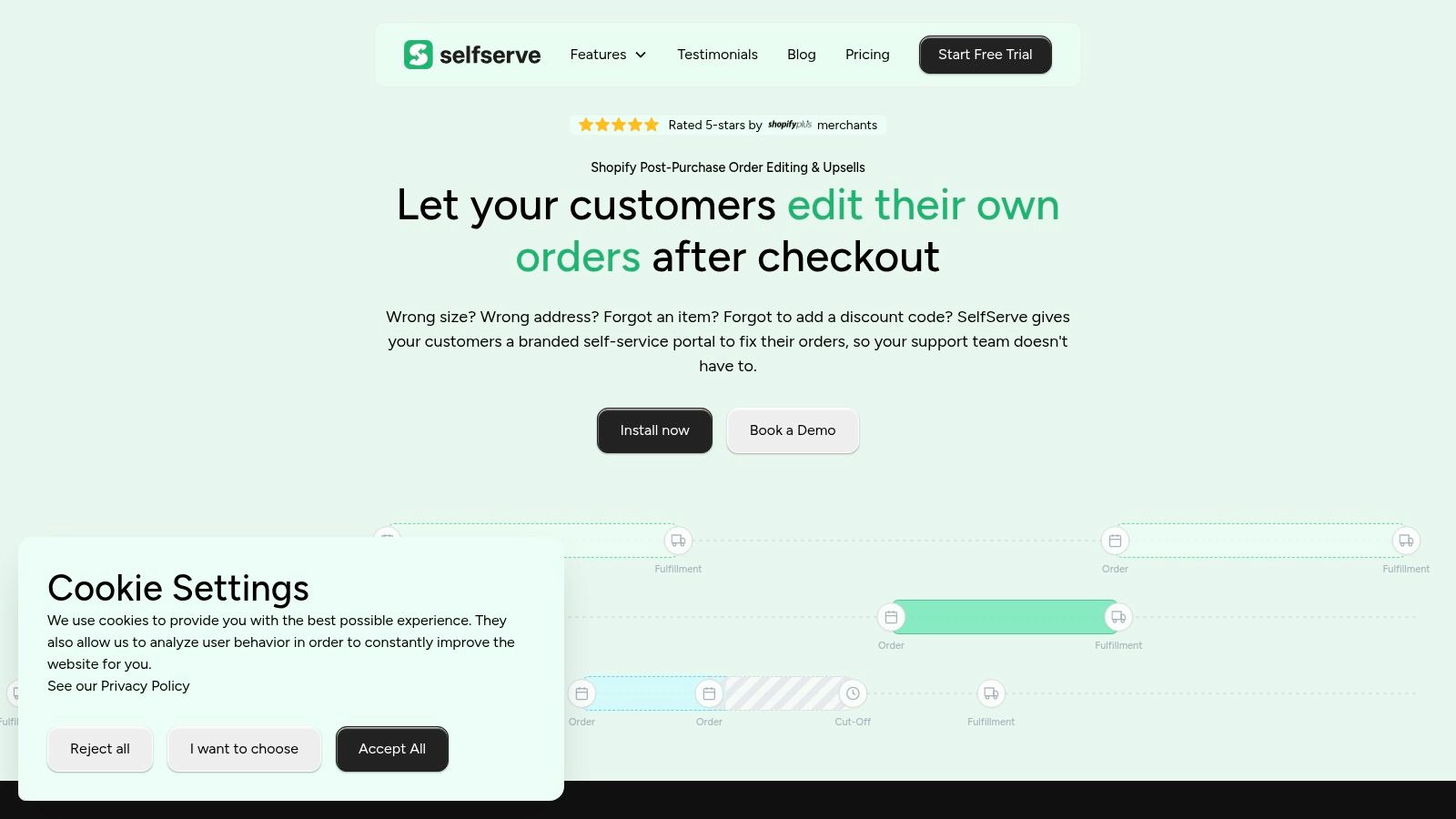
A quick visual example helps show how modern Shopify teams are handling this layer:
What to stop doing
A lot of brands still rely on shared inboxes and macros for post-purchase changes. That works at low volume. It breaks under California scale.
Stop relying on:
- Manual address edits through support
- Unclear cancellation promises
- Separate second orders for simple add-ons
- English-only post-purchase messaging for a diverse customer base
If the first order creates avoidable support labor, your team is paying acquisition costs twice. Once to win the customer, and again to rescue the order.
Smarter Marketing and Localization in California
California acquisition gets expensive when brands target the whole state as if it were one audience. It isn't. Messaging that works in Los Angeles may feel flat in the Bay Area, and messaging built for urban convenience won't necessarily resonate with customers who care more about local identity, product quality, or values alignment.
The fastest improvement usually comes from better segmentation, not broader reach.
Build campaigns around regional context
Use creative, landing pages, and offers that match how people shop in different parts of the state.
- Urban convenience segments: Emphasize clarity, speed, and polished mobile experiences.
- Local identity segments: Highlight founder story, sourcing decisions, or community relevance.
- Repeat-buyer segments: Focus on reorder ease and post-purchase reliability instead of first-order discounts.
Tell a credible Shop Small story
California shoppers actively look for ways to support local small businesses, and that creates an opening for brands that can tell that story authentically, as reflected in California's Shop Safe Shop Local initiative.
That doesn't mean vague copy about being "community-driven." It means showing specifics customers can evaluate:
- Where you operate: Be clear about your California roots if you have them.
- How you fulfill: Explain what customers can expect after ordering.
- Who you serve: Show relevance to the local communities you mention.
- Why your brand is different: If you're smaller than big-box competitors, make the service advantage visible.
Address values without turning them into slogans
Some California shoppers also have strong concerns regarding the local effects of ecommerce logistics, especially in warehouse-heavy regions. If your brand wants to speak to that concern, be careful. Empty environmental messaging is easy to spot.
A better approach is operational honesty. Tell customers what you do to reduce preventable shipments, avoid unnecessary resends, and make delivery communication clearer. In California, better operations often become better marketing.
California Ecommerce FAQ for Merchants
Do I need California sales tax registration if I don't have a physical location there
Maybe. Physical presence isn't the only trigger merchants watch. Remote sellers also evaluate economic nexus exposure and how different sales channels are handled. This is one of the first questions to confirm with your tax advisor because the answer depends on your selling footprint and order mix.
What's the most practical privacy priority for a Shopify brand selling into California
Make sure your storefront behavior matches your privacy disclosures. If your site uses tracking, retargeting, and app-based data flows, your notices, request handling process, and customer-facing choices should reflect that reality. The biggest risk isn't usually the policy page itself. It's the mismatch between what the page says and what the store does.
What's the single biggest operational mistake merchants make in California
Letting post-purchase order changes happen through unmanaged support channels. When edits, cancellations, and address fixes arrive by email with no timing rules, teams create avoidable warehouse disruption and customer confusion.
Should California strategy start with ads or operations
Operations. Ads can scale demand. They can't fix broken fulfillment logic, weak communication, or messy post-purchase workflows. In California, those problems show up quickly because order density and customer expectations are both high.
What kinds of systems should growing merchants evaluate first
Look at the stack that affects the customer after payment: tax settings, privacy workflows, address quality, tracking communication, returns handling, and post-purchase editing controls. For teams comparing broader categories of tools to sell online, prioritize systems that remove support friction instead of just adding more front-end features.
If your Shopify store is growing and post-purchase work is starting to crowd your support queue, SelfServe is worth a look. It helps brands give customers controlled order-editing power after checkout, reduce manual support work, improve address accuracy, and create upsell opportunities on the pages shoppers already visit after buying.