Master Two Day Shipping: Your 2026 Merchant Guide
69% of online customers may not become repeat buyers if an order arrives two days or more later than promised, and 38% abandon carts when delivery stretches beyond seven days, according to an ecommerce survey cited by WSI. That's the story behind two day shipping. It isn't a branding flourish. It's a promise with revenue attached.
Teams often frame the challenge as a carrier problem. It usually isn't. Carrier speed matters, but the larger failures happen earlier and later in the flow. Orders miss cutoff. Inventory sits in the wrong node. Addresses get entered badly. A warehouse clears the dock on time, then a missed delivery attempt breaks the customer promise anyway.
The operators who make two day shipping work consistently build around those failure points. They don't just buy a faster label. They design a system that can keep the promise under normal load, peak load, and the ugly middle where exceptions pile up.
The Business Case for Two-Day Shipping
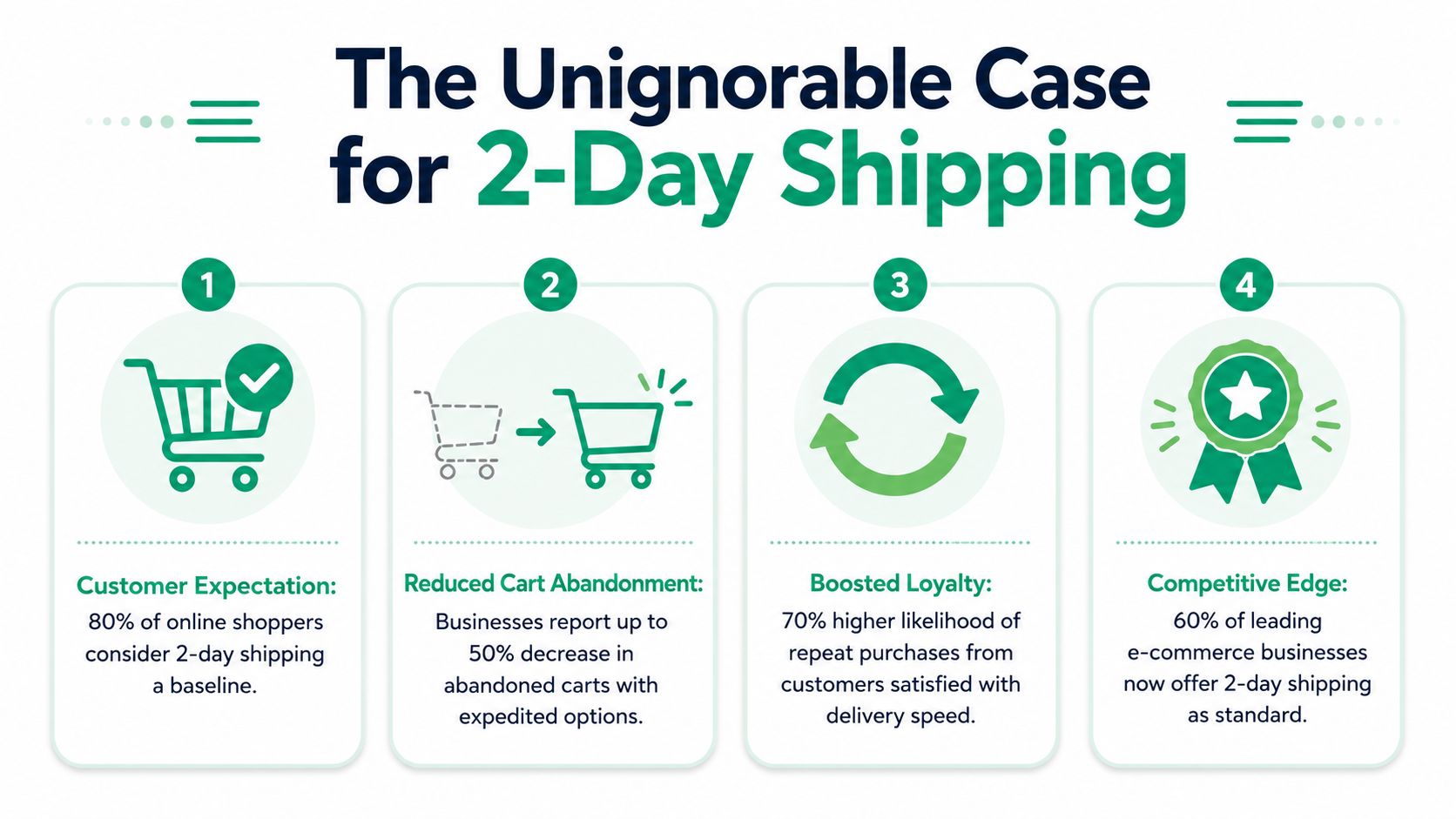
Two-day shipping changes the economics of an ecommerce business because customers judge the whole buying experience through the delivery promise. Once buyers expect an order in 48 hours, slow or vague delivery windows create friction at checkout, more WISMO tickets after purchase, and weaker repeat purchase rates. The revenue impact is real, but so is the operational cost of making that promise hold up on ordinary days and bad ones.
The expensive mistake is treating two-day shipping as a carrier upgrade. The carrier is only one part of the result. Missed cutoff times, bad address data, inventory in the wrong node, or an exception that sits unworked until the next morning will break the promise just as fast as a delayed linehaul. I have seen brands spend heavily on premium services while still missing delivery targets because the order released late, the address was incomplete, or no one had a clean process for handling holds and reships.
What speed changes in the P and L
Faster delivery can improve conversion and retention, but the bigger operational win is confidence. Customers buy more readily when the promise is clear, support teams spend less time calming anxious buyers, and merchandising teams can promote with fewer caveats. That only shows up in the P and L if execution is stable.
The hidden costs sit in the gaps between systems and teams. A storefront may promise two days based on a generic transit map while the warehouse is still working with a noon cutoff, manual address review, and no exception queue. That setup produces avoidable overnight upgrades, replacement shipments, refund requests, and margin erosion that never appears in a simple freight-rate comparison.
I evaluate the business case across four lines:
- Conversion lift: A faster, credible promise reduces hesitation at checkout.
- Repeat revenue: Customers return when the last order arrived when you said it would.
- Support cost: Fewer delivery surprises usually means fewer status tickets and fewer appeasements.
- Failure cost: Every missed promise creates labor, refund, reship, and trust costs that are easy to underestimate.
Why the investment pays back, and where it fails
Two-day shipping pays back when the program is designed as an operating system, not a marketing badge. That means inventory placement, order routing, cutoff logic, carrier selection, address validation, and exception handling all need to work together. If one of those pieces is weak, fast shipping becomes an expensive promise with inconsistent results.
This is also where technology choices matter. Brands usually need a storefront that can display realistic delivery dates, an OMS or 3PL workflow that can release orders fast, carrier software that can rate-shop and print on time, and a customer-facing layer to manage post-purchase questions without flooding support. Teams comparing 3rd-party fulfillment companies should evaluate more than footprint and pick fees. The partner has to support cutoff discipline, inventory accuracy, exception escalation, and delivery-date logic that matches the promise on site. SelfServe fits on the customer communication side by helping teams surface shipment status, reduce avoidable support contacts, and keep exception handling from turning into a blind spot.
In practice, the best business case usually appears in categories with repeat orders, time-sensitive purchases, or high checkout competition. The weakest case appears when margins are thin, average order value is low, and the operation still relies on manual fixes. Even then, the answer is not always to abandon fast shipping. It may be to narrow the offer by zone, SKU, order cutoff, or cart threshold until the economics work.
Choosing Your Fulfillment Model
The fulfillment model determines whether your two day shipping program is stable or fragile. Most brands start by asking who should pack the box. The better question is where inventory should sit and who can move it with the fewest handoff errors.
Good, better, best
Good: in-house fulfillment
This works when the operation is still concentrated, SKU counts are manageable, and the team wants full control over packing, cutoffs, and customer experience. It's often the best way to learn your order profile because you see every pain point firsthand.
The downside appears quickly. One warehouse means one origin point. That makes two day coverage expensive outside nearby zones, and it leaves little buffer when labor gets tight or volume spikes.
Better: 3PL fulfillment
A 3PL is usually the next move when order volume outgrows a single facility or when the internal team is spending too much time on pick-pack work instead of planning. A capable partner gives you reach, labor flexibility, and better access to carrier options. If you're evaluating that route, this overview of 3rd-party fulfillment companies is a useful starting point.
The trade-off is control. You need clean SOPs, clear escalation paths, and tight inventory discipline. A weak 3PL relationship creates a dangerous gap between the promise on your storefront and the reality inside the warehouse.
Where hybrid usually wins
Best: hybrid with distributed inventory
For most scaling brands, the strongest setup is a hybrid model. Keep strategic control in-house, place inventory across regional nodes, and use outside partners where they make the network better. That gives you more flexibility on high-priority SKUs without forcing every unit through one building.
A practical way to compare the options:
| Model | Best For | Pros | Cons | Typical Cost Structure |
|---|---|---|---|---|
| In-house | Brands with tighter SKU counts, specialized packing needs, or early-stage operational control goals | Full control, direct visibility, custom packaging, faster process changes | Limited geographic reach, staffing burden, harder to scale peaks | Fixed labor, rent, materials, software, parcel spend |
| 3PL | Brands expanding volume or looking for broader network coverage | Faster scale-up, regional reach, less warehouse overhead, carrier leverage | Less direct control, onboarding complexity, SLA dependency | Storage, pick-pack fees, receiving fees, parcel charges, accessorials |
| Hybrid distributed | Brands balancing margin, control, and national delivery goals | Better geographic coverage, selective redundancy, smart SKU placement | More planning complexity, inventory balancing risk, systems dependence | Mixed fixed and variable costs across owned and outsourced nodes |
Don't choose a model based on what looks sophisticated. Choose the one your team can operate cleanly every day.
The decision criteria that matter
Use three filters.
- Order profile: Fragile, oversized, regulated, or highly customized products often need more hands-on control.
- Geographic demand: If demand clusters regionally, distributed inventory pays off faster.
- Operational maturity: If your inventory accuracy and order routing are already shaky, adding more nodes will amplify mistakes, not solve them.
A bad network design can't be rescued by premium shipping services. A good one often lets you hit two day shipping with ordinary ground services in the right lanes.
Selecting Carriers and Managing Costs
Parcel cost decisions are usually won or lost before anyone prints a label. Carrier choice matters, but the bigger drivers are zone exposure, package dimensions, daily cutoff discipline, and how often your team has to fix bad addresses or stalled orders by hand.
Build the carrier mix around failure points
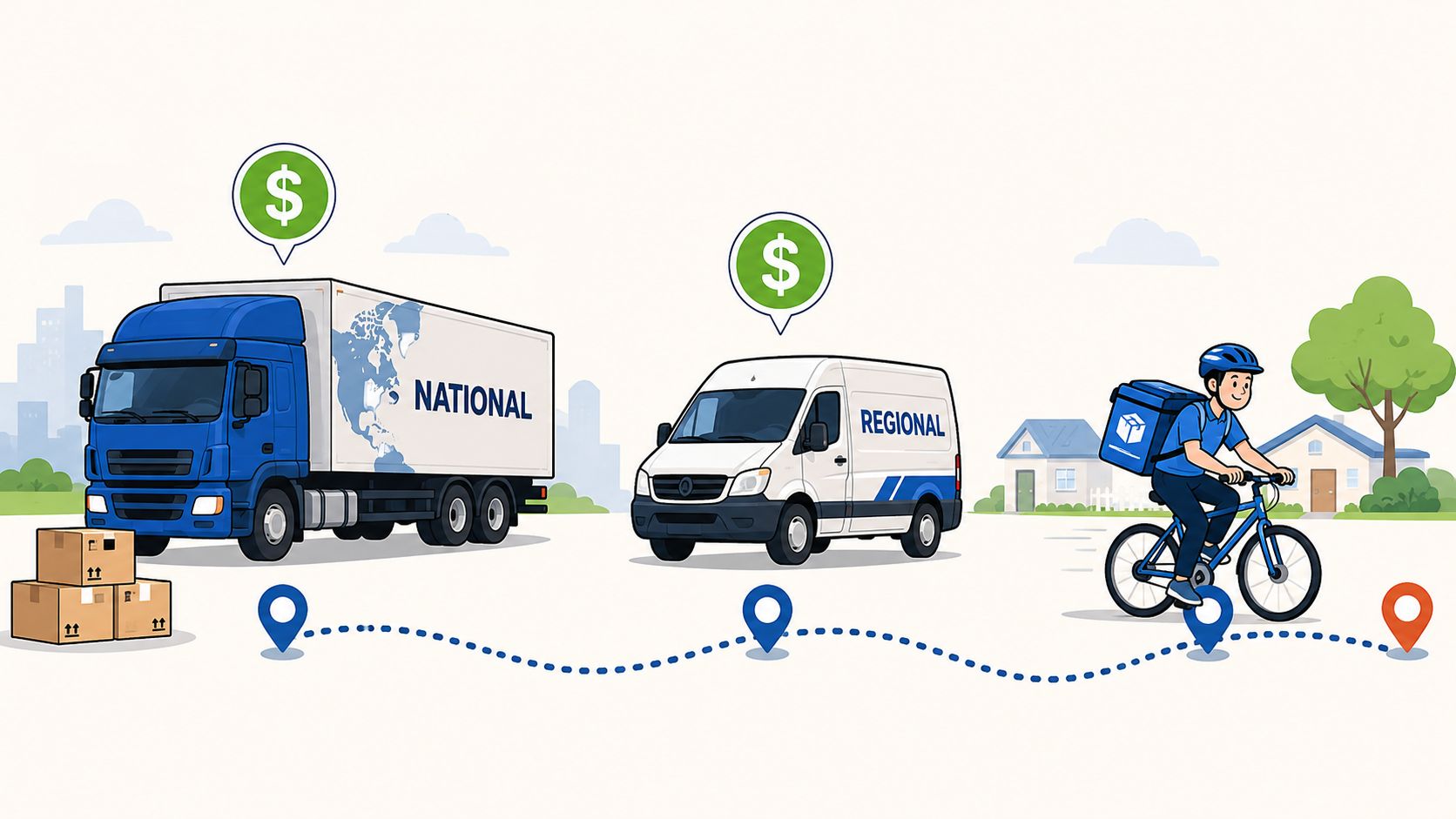
A two-day program should use more than one service strategy. National carriers usually anchor the network because they give you broad coverage, dependable pickup windows, and access to air products when ground will miss. Regional carriers can outperform them in dense markets. Consolidators can lower cost on selected lanes, but every extra handoff raises the chance of a late scan, a routing exception, or a customer asking where the package is.
The trade-off is simple. More carrier options can lower cost and improve coverage, but they also add routing rules, label logic, invoice complexity, and exception handling. If the team cannot maintain those rules accurately, the savings disappear in credits, reships, and support tickets.
Start with lane economics, not brand preference
Carrier selection should begin at the lane level. Review destination ZIPs, package weights, carton sizes, and actual order cutoff times. Then match service levels to the promise you can keep.
Use a practical matrix:
- National carriers: Best for broad geographic reach, consistent pickup operations, and service options that cover both ground and air.
- Regional carriers: Best where order density is high enough to justify setup work and where transit performance is consistently strong.
- Consolidators: Best for selected low-urgency or lower-value lanes where injection economics offset the extra operational complexity.
The hidden cost is often avoidable. A bad address, a missed same-day cutoff, or an order released to the floor too late can force an upgrade from ground to air. That is not a carrier problem. It is an operations problem.
Control costs where teams usually lose them
Three areas deserve constant review.
- Packaging discipline: Dimensional weight can erase margin fast. Right-size cartons, limit unnecessary void fill, and review packaging by SKU family instead of treating every order the same.
- Service assignment rules: Do not default to premium services where ground already meets the promise. Good routing logic protects margin.
- Accessorials and invoice accuracy: Residential surcharges, delivery area surcharges, address corrections, and Saturday fees add up quickly. This guide to calculating UPS charges is useful for training ops leads and finance teams to read the invoice line by line.
Weekend commitments need special care. If your promise logic ignores actual Saturday service availability by ZIP and product, you create preventable failures. Teams evaluating avoiding risky weekend deliveries should map weekend rules into checkout messaging and carrier selection, not leave them to customer support after the order is placed.
Use software to keep the rules from breaking at scale
Teams usually hit the wall. The issue is not picking a carrier once. The issue is maintaining thousands of daily decisions without relying on tribal knowledge.
A workable stack routes orders by destination, validates addresses before label creation, checks the warehouse cutoff in real time, and flags exceptions early enough to recover. SelfServe helps by centralizing shipping rules, service mapping, and operational controls so the team is not managing two-day promises across carrier portals, spreadsheets, and manual workarounds. Pair that with your WMS, rate shopping, and address verification tools, and you get a process the team can run every day.
The cheapest label is often the wrong decision if it creates a late delivery, a reship, and a support contact on the same order.
Designing Your Shipping Promise and SLAs
Most shipping pages make the same mistake. They present two day shipping as if every customer hears “48 hours” and every order moves on the same clock. That's not how operations work.
The phrase itself can mislead buyers. ShipBob notes that “two-day shipping” often means two business days, not 48 hours, and the clock may start at the order cutoff, checkout, or carrier handoff time, with constraints due to weekends, holidays, and weather.
Define the promise in operational terms
Your SLA should answer the buyer's actual questions.
- When does the clock start
- What is the order cutoff
- Do weekends count
- What happens before holidays
- Which locations and SKUs qualify
If your checkout says “2-day shipping” but your warehouse treats Friday evening orders as Monday processing, the customer experience is already off track.
A better promise sounds like this in practice: eligible items ordered before the posted cutoff ship the same business day, and delivery timing depends on destination and operating days. It's less flashy, but it's much harder to misread.
Don't advertise one universal promise
Availability is rarely uniform. Some programs only apply to certain products and locations. Nordstrom's terms state that free 2-business-day shipping is available only in select locations and on select merchandise. That kind of specificity is good operations, even if marketing teams hate how narrow it looks.
Here's what reliable merchants do instead of overpromising:
- Segment by geography: Urban ZIP codes and remote lanes shouldn't share the same message.
- Segment by inventory status: In-stock local inventory is different from backordered or cross-node inventory.
- Segment by calendar risk: Friday afternoons and holiday weeks need different estimated delivery messaging.
Clear promise language converts better over time than broad promise language followed by apology emails.
Handle weekends before customers ask
Weekend timing causes a disproportionate amount of confusion. If you sell products where timing matters, it's worth reviewing carrier-specific guidance on avoiding risky weekend deliveries so your customer-facing SLA matches how service behaves.
The practical rule is simple. If your team has to explain the promise after checkout, the promise wasn't clear enough at checkout.
The Tech Stack for Flawless Execution
A two day shipping program is usually won or lost before a package reaches the carrier scan. I've seen late deliveries traced back to bad apartment numbers, orders released five minutes after cutoff, and exception queues no one owned. Carrier speed matters. Execution discipline matters more.
The stack has to do four jobs well. It has to decide whether an order is eligible for the promise, route it to the right node, stop bad data before label creation, and surface exceptions early enough for someone to act.
For most brands, that means an OMS for routing logic, a WMS for pick-pack execution, a shipping platform for rates and labels, and a customer-facing layer that handles edits and status updates. The weak point is rarely the software category itself. It is the handoff logic between systems.
Bad address data will break a fast program
A mistyped unit number can turn a two day order into a support ticket, a reship, and a refund request. Address errors also create hidden labor cost because warehouse teams hold orders, CX teams chase corrections, and finance teams absorb avoidable carrier charges.
That is why address controls belong at checkout and again before fulfillment release.
A setup that holds up under volume usually includes:
- Address autocomplete at checkout: Reduce keystroke errors before the order is placed.
- Validation before label creation: Catch missing street numbers, invalid postal codes, and malformed apartment fields.
- Controlled customer edit windows: Let customers fix details before the order is locked into warehouse work.
- Order holds by reason code: Send risky orders into a review queue instead of forcing the floor team to guess.
Cutoff logic needs system enforcement
Many two day programs miss because the order should never have been promised in the first place. A checkout timer is only useful if the OMS, WMS, and shipping system all follow the same cutoff rules. If one system uses warehouse local time, another uses shopper local time, and the carrier schedule was updated last month without a config change, the SLA is already drifting.
I prefer rule sets that account for warehouse timezone, carrier pickup windows, SKU handling requirements, and destination risk. Friday afternoons, hazmat items, oversize parcels, and remote ZIP codes should not flow through the same promise logic.
For Shopify merchants comparing Shopify shipping solutions, that is the right evaluation standard. Label printing is table stakes. The better question is whether the app stack can suppress ineligible services, flag risky orders before release, and give operations clear exception states instead of vague failures.
Exception handling should be built into the stack
Support teams should not be the primary control layer for shipping errors. By the time a customer opens a ticket, the cheap fix is usually gone.
A mature setup includes automated holds for invalid addresses, delayed payment clears, missing inventory, and service mismatches. It also gives customers a way to correct problems without forcing an agent to intervene. A proper multi-carrier shipping solution helps by applying service rules by destination, parcel profile, and promised window, while SelfServe handles customer corrections and post-purchase updates inside guardrails your ops team controls.
The stack I'd put in place
Use this baseline:
- OMS: Route by inventory position, eligibility rules, and cutoff status.
- WMS: Release work by promise date and pickup schedule, not just order timestamp.
- Shipping software: Rate-shop across approved services and block bad-fit options.
- Exception monitoring: Alert on aging orders, failed label creation, and stuck holds.
- Customer self-service layer: Let buyers correct address details and other fixable mistakes before fulfillment starts.
That combination reduces manual touches, protects the delivery promise, and keeps two day shipping from turning into a daily exception management exercise.
Measuring Success and Handling Exceptions
A two day shipping program usually fails in the gaps between systems, not on the truck. If the team only watches delivered-on-time rate, those gaps stay hidden until refund requests, WISMO tickets, and margin erosion show up later.
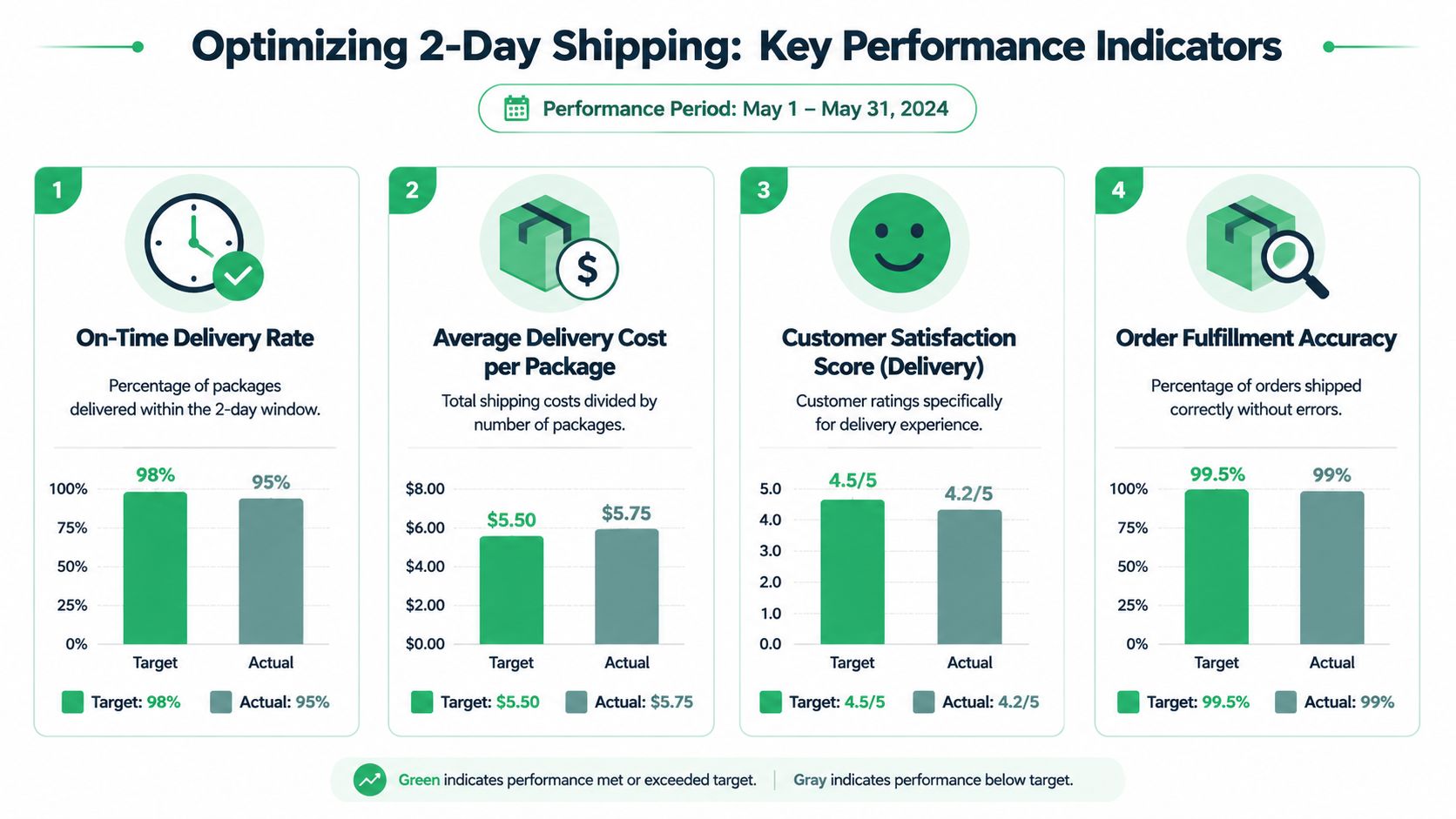
The scorecard has to separate promise quality from warehouse execution and carrier performance. Otherwise, operations ends up blaming the carrier for orders that were already late before the label printed. I track this at three levels: what we promised at checkout, what happened before carrier handoff, and what happened after the package entered the network.
Metrics worth watching every week
Track a short list, but make it diagnostic:
- Promise accuracy: Did checkout show a date the order could meet, given inventory position, cutoff time, and service availability?
- On-time release: Did the order leave the OMS and hit the floor in time for the planned pickup?
- Label exception rate: How often did label creation fail because of address problems, invalid service selection, or missing shipment data?
- First-attempt delivery success: Are packages reaching the customer on the first try, or are address quality and delivery conditions creating avoidable failures?
- Exception rate by reason code: Address issue, missed cutoff, payment hold, inventory split, carrier delay, weather, customer not available.
- WISMO contact rate: Are customers asking where their order is because the shipment is late, or because tracking events and promise messaging are weak?
One metric I would never skip is the share of orders that miss two day delivery before they ever leave the building. That number forces honest conversations about cutoff times, wave planning, and late inventory syncs.
Exceptions are operating data
Exceptions should run through one queue with clear ownership and timestamps. If address fixes sit in customer support, carrier delays sit in transportation, and inventory holds sit in the warehouse, nobody sees the full failure pattern.
A practical review rhythm is simple. Look at exceptions every day for aging risk. Review root causes every week. Change rules, staffing, or carrier assignments every month based on what keeps repeating.
| Exception type | What it usually reveals | Best response |
|---|---|---|
| Address corrections | Weak validation at checkout or bad customer-entered data | Validate earlier, hold risky orders automatically, and let customers correct errors before release |
| Missed cutoff orders | Cutoff rules are too aggressive, or release waves start too late | Reset published cutoffs by ship node and align pick waves to actual carrier pickup times |
| Carrier delays in specific lanes | The selected service is cheap but unreliable for that zone | Reassign those lanes to a better-fit service and review surcharge impact |
| Repeated SKU-specific delays | Inventory is in the wrong node, or the item needs special handling | Rebalance stock and remove ineligible SKUs from the two day promise |
| Stalled holds | The system caught the problem, but nobody resolved it fast enough | Set aging alerts and assign owners by exception code |
The tech stack's critical functions come into play. SelfServe should capture customer-fixable issues such as address corrections and post-purchase updates before fulfillment starts, while the OMS and shipping layer enforce cutoff rules, service eligibility, and hold logic. That keeps agents out of routine rescue work and gives ops a cleaner exception queue.
The goal is not to eliminate exceptions. That will not happen. The goal is to catch them early, route them to the right owner, and prevent the same failure from showing up again next week.
Pricing and Messaging Your Shipping Offer
Shipping cost is one of the last things a customer sees before placing the order, and it can still kill conversion even when the fulfillment plan behind it is solid. I have seen brands hit two day delivery targets operationally and still disappoint customers because the offer was priced in a way that felt arbitrary, or worded in a way that promised more than the operation could support.
As noted earlier, shoppers already compare your checkout against the standard set by large retailers. That does not mean you need to match a marketplace subsidy. It means your offer has to be easy to understand, credible, and consistent with what your network can deliver by cutoff time, destination, and SKU.
Three pricing models that work
Free above a threshold
This is usually the strongest option when contribution margin improves at a higher basket size. Set the threshold above current AOV with enough room to absorb zone mix, dimensional weight, and the orders that will need a more expensive service than planned. If the threshold is too low, two day shipping turns into a margin transfer from your business to the carrier.
Flat-rate expedited
This works well for brands that want simple merchandising and fewer checkout questions. The trade-off is that you will over-collect on some nearby orders and under-collect on distant zones. That can still be a good decision if the cleaner message improves conversion and keeps customer service contacts down.
Premium upgrade
This is the safest model when only part of the catalog, inventory pool, or customer base fits a two day promise. It gives urgent buyers a clear path without forcing you to subsidize speed on every order. It also pairs well with eligibility logic by SKU, zip code, and order time.
The right model depends on how often your operation misses promise windows, how wide your zone coverage is, and how much surcharge volatility you can absorb.
Messaging rules that prevent confusion
Good messaging starts with eligibility, not marketing copy. If a hazmat item, oversized SKU, PO box, or remote zip code cannot make the promise, say so before checkout. Do not let the customer discover that after payment.
Use plain language at each step:
- Product page: Show whether the item qualifies for two day shipping and note any location or order-time limits.
- Cart and checkout: Show an arrival date range tied to the shopper's address and the current cutoff time, not just a service label.
- Confirmation email: Repeat the delivery window in customer language and state whether weekends and holidays are excluded.
One line matters more than brands expect: the order cutoff. If your warehouse releases orders at 2 p.m. local time and the carrier picks up at 5 p.m., do not advertise "order by midnight" because the parcel may still move tomorrow. That gap creates preventable WISMO tickets, refund requests, and bad reviews.
The post-purchase flow matters too. Address fixes, apartment number additions, and customer-requested changes are common failure points in two day programs because they consume the few hours you have before release. If you run Shopify or Shopify Plus and want tighter control after checkout, SelfServe helps customers edit shipping details, correct mistakes, and manage post-purchase changes inside rules your team sets. It also supports multilingual experiences, real-time address validation powered by Google Maps, and upsell modules on the Thank You and Order Status pages so you can reduce support workload while capturing more revenue from the orders you already won.
If the offer needs an asterisk and a long footnote to stay profitable, the model needs rework.