Package at Customs: Resolve Delays Fast in 2026
You check tracking, see package at customs, and the order suddenly feels out of your hands. Customers assume the parcel is lost. Support teams assume the carrier will sort it out. Carriers often assume the recipient or merchant will provide whatever customs needs next. That gap is where delays stretch.
Most customs holds aren't mysterious. They're usually a paperwork problem, a classification problem, a payment problem, or a responsibility problem. The hard part isn't identifying the category. The hard part is knowing who has to act first.
That's the part merchants and customers need most. A package can sit in customs for perfectly routine reasons, then stay there longer because the wrong person is chasing the wrong party. A clear decision process cuts through that fast.
Understanding the 'Package at Customs' Status
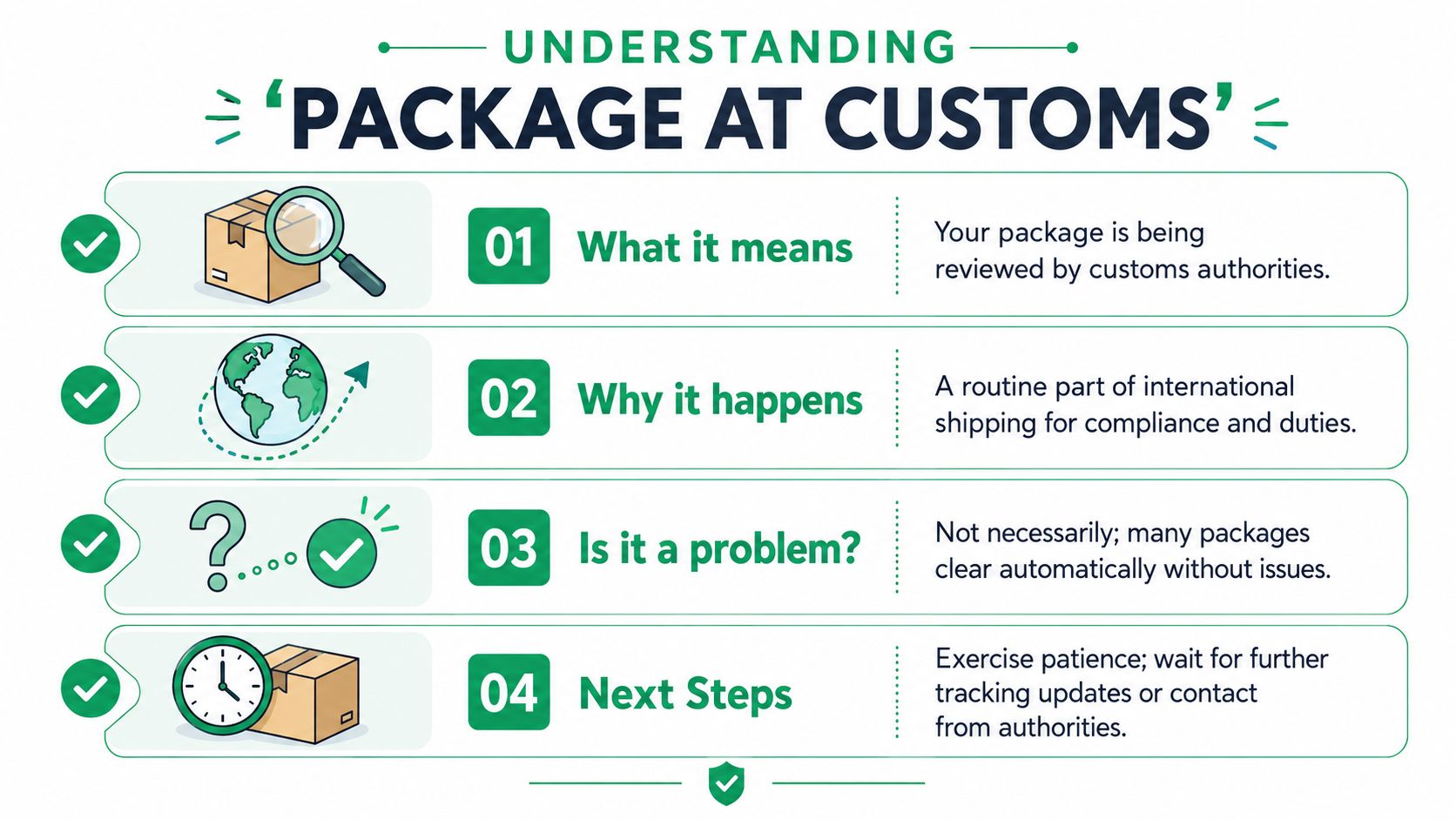
A customer checks tracking on day six, sees package at customs, and assumes the parcel is stuck for some unusual reason. In day-to-day shipping operations, that status usually means something more ordinary. Customs is reviewing the shipment data, the declared goods, and any duties or import requirements before release into the destination country.
That review is part of normal cross-border shipping. Many parcels clear quickly. Others pause because customs, the carrier, and the shipment paperwork do not line up cleanly. The key point is responsibility. A customs status tells you where the parcel is in the process, but it does not tell you who needs to act yet.
What customs is checking
Customs does not treat every parcel the same way. Low-risk shipments with clean data often pass with little friction. Parcels with weak descriptions, unusual values, restricted products, or missing documentation get more attention. In practice, customs clears the entry first and the box second.
The review usually comes down to four questions:
What is the product
Product descriptions need to be specific enough for customs to identify the goods. “Clothing accessory” creates more risk than “women's leather belt.”What is the declared value
If the value looks too low, too high, or inconsistent with the product type, customs may ask for more support before release.How is the item classified
HS code accuracy affects duty, tax treatment, and admissibility screening. A bad code can create delays even when everything else looks correct.Can the goods enter under normal parcel rules
Some goods need permits, testing records, product labeling, or extra declarations. Some cannot move through standard parcel channels at all.
Recent policy shifts have made this stricter for many merchants. Threshold changes, tighter data requirements, and more aggressive enforcement around product classification are creating delays that did not show up as often a few years ago. Merchants who still rely on vague catalog descriptions or copied invoice templates are seeing more holds.
The most common causes of holds
Misclassification is one of the repeat offenders. If the HS code does not match the item, customs may stop the shipment for review, reassess duties, or request corrected paperwork. I see this often with apparel, beauty products, electronics accessories, and bundled items where the merchant used a broad category instead of the correct product-level classification.
Invoice quality is another frequent problem. A commercial invoice should match the parcel contents and the shipment record in the carrier system. If quantities, values, buyer details, seller details, country of origin, or shipping terms conflict, customs has a reason to pause release.
Short internal naming conventions also create avoidable holds. Warehouse shorthand might make sense inside an operations team, but customs needs plain product language. SKU codes, abbreviations, and generic labels like “set,” “parts,” or “gift” slow down review because they do not explain what is entering the country.
For merchants, visibility matters here. Teams using package tracking operations software can spot customs-status clusters early, separate one-off inspections from broader paperwork issues, and decide whether the next action belongs with the carrier, the customer, or the merchant.
What this status does and does not mean
A package at customs status does not mean the parcel is lost. It also does not automatically mean customs has seized anything. It means the shipment is waiting for clearance, and the reason may be routine or may require action.
The operational mistake is treating every customs hold the same way. Some cases clear with time alone. Some require the recipient to pay duties or confirm identity. Some require the merchant to send a corrected invoice, product details, or proof of value. Some require the carrier or broker to update the entry they filed.
That is why the status itself is only the starting point. A complete diagnosis comes from the detailed tracking notes, the shipment documents, and knowing which party owns the next step.
A Recipient's Action Plan for Customs Holds
If your package is at customs, don't start by emailing five different companies at once. That usually creates more confusion, not less. Start with the party that can see the customs notes attached to your shipment.
First do nothing for a short window
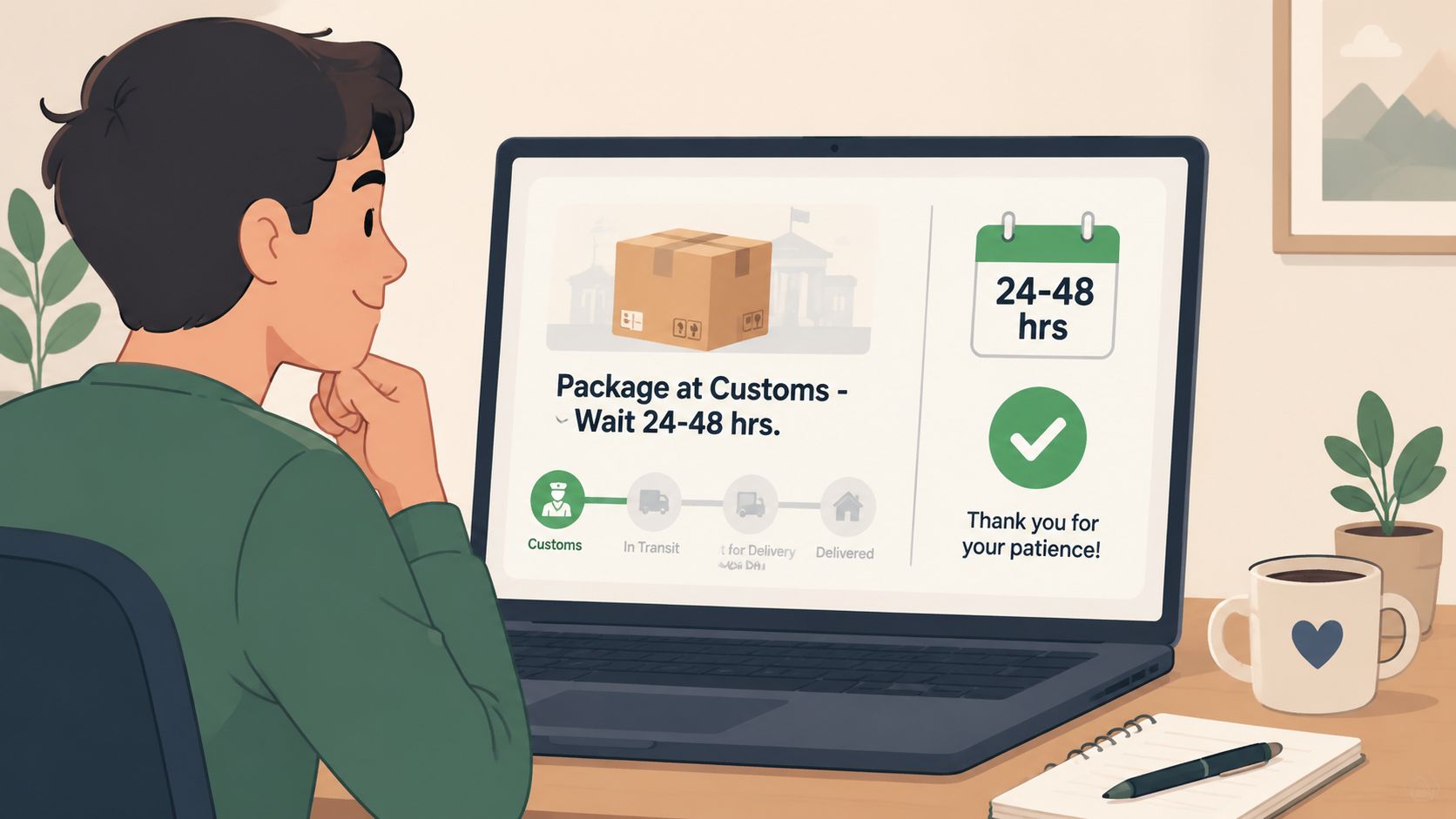
If the package only entered customs recently, wait a bit before escalating. Many parcels clear automatically after the first scan, and recipients often act too early.
A calm first check looks like this:
Review the tracking page carefully
Don't just read the headline status. Look for notes about duties, documents, address confirmation, or contact requested.Check your email and text messages
Couriers often send a payment link or a request for information outside the main tracking feed.Confirm your delivery details
If your phone number, email, or address was wrong on the order, the carrier may not be able to reach you. If you recently noticed an address issue, this guide on how to edit a shipping address after purchase is useful context.
Who to contact first
In most direct-to-consumer parcel shipments, the carrier is your first stop. That's usually DHL, FedEx, UPS, or the local delivery partner shown in tracking. In many cases, the carrier or its broker is the one coordinating customs release.
Ask direct questions:
- Is any action required from me
- Are duties or taxes waiting for payment
- Do you need ID, proof of purchase, or a confirmation of contents
- Is the package in routine review, or is it on a formal hold
- Who is the customs broker for this shipment
These questions matter because recipients often contact the merchant first when the carrier is waiting on recipient authorization or payment.
If the carrier says “we're awaiting consignee action,” the next step is usually yours, not the merchant's.
When the recipient is responsible
There are a few situations where you, as the recipient, are the only person who can unblock the shipment quickly.
| Situation | Who usually acts | What to do |
|---|---|---|
| Duty or tax payment request | Recipient | Pay through the carrier's official portal or approved channel |
| Identity or personal import verification | Recipient | Submit the requested ID or confirmation directly to the carrier/broker |
| Address or contact clarification | Recipient, sometimes merchant | Confirm details with the carrier and notify the seller if the order record is wrong |
| Proof of purchase request | Recipient and merchant | Send your order confirmation, then ask the merchant for invoice support if needed |
Don't send documents to random addresses from suspicious emails. Use the carrier's site, app, or official support channels.
When to contact the merchant
Contact the seller after you've checked tracking and spoken with the carrier, or if the carrier says the shipper must provide something. That gives the merchant something actionable instead of a vague “my package is stuck.”
Send a short message with:
- Your order number
- Tracking number
- The exact tracking note
- What the carrier told you
- Whether duties were requested or already paid
That helps the merchant decide whether they need to resend a commercial invoice, clarify the item description, or challenge incorrect shipment data.
What doesn't work
Recipients lose time when they:
- Call customs before checking the carrier. Customs often won't discuss parcel-level details directly with consumers.
- Assume the parcel is lost after one stagnant scan. Tracking can lag behind actual broker activity.
- Ask the merchant for answers the carrier already has. The merchant may not see the same customs notes.
- Ignore payment or document requests. Parcels can sit solely because the required authorization was never completed.
The fastest path is usually simple: check tracking details, contact the carrier, complete any required action, then update the merchant if shipper-side help is needed.
A Merchant's Guide to Resolving Customer Issues
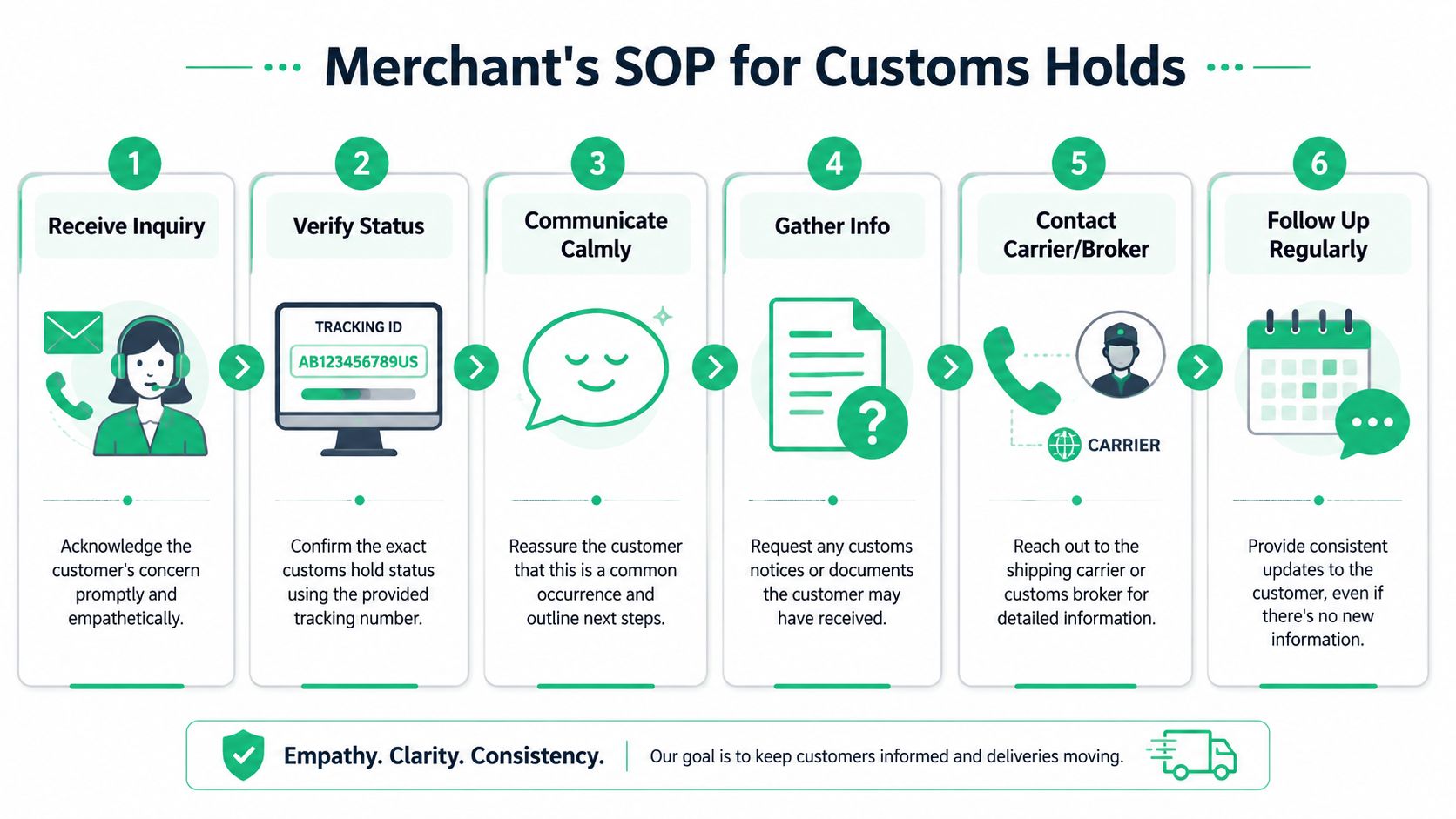
A customer opens a ticket saying, “Tracking hasn't moved for five days and the carrier says customs.” At that point, the job is not to debate fault. The job is to identify the blocker, assign the next action to the right party, and keep the customer from feeling abandoned while the shipment is worked.
That distinction matters because customs delays split into different owner paths. Some holds can only be cleared by the recipient. Some require the shipper to correct data. Others sit with the carrier or broker until they process the file. Merchants who treat every case the same create extra back-and-forth and longer delays.
Build a response workflow your team can actually follow
Support, ops, and your 3PL should all work from the same short process. If each team improvises, customers get conflicting answers and the carrier gets duplicate requests.
Use this sequence:
Confirm the exact hold reason
Pull the latest scan and any broker notes from the carrier portal. “Held for customs review,” “duties pending,” and “documentation required” each point to a different owner.Audit the shipment record
Check the commercial invoice, declared value, product description, HS code, incoterms, recipient name, phone number, and email. Small errors create long delays.Assign responsibility
Decide who acts next: recipient, merchant, carrier, broker, or 3PL. This is the step many teams skip.Send one useful update
Tell the customer what the hold is, who is handling it, and what you will do next. If the customer needs to act, give exact instructions.Escalate with evidence
If the shipper side needs to intervene, send the corrected documents through the carrier or broker channel they accept, then ask for confirmation that the file was attached to the shipment.
Use a responsibility framework, not guesswork
The fastest merchants do not ask, “Who caused this?” first. They ask, “Who can clear it today?”
| Hold scenario | Usually owns the next step | What the merchant should do |
|---|---|---|
| Duties or taxes requested | Recipient | Send the official payment path and confirm whether duties were prepaid or recipient-paid |
| Missing invoice or incomplete product detail | Merchant or 3PL | Submit corrected paperwork with clear, plain-language item descriptions |
| Declared value or contents mismatch | Merchant | Correct the customs data and check whether the same error affects other open shipments |
| Broker note is unclear | Carrier or broker | Ask for the hold code, missing field, and accepted submission method |
| Customer never received a notice | Carrier and merchant | Verify contact details, then request the carrier resend the notice |
One instruction saves time here: never tell a customer to “contact customs” unless the carrier specifically says customs will speak with them directly. In parcel shipping, that is uncommon. The carrier or its broker usually controls communication and document intake.
What merchants can do that customers usually cannot
On documentation holds, merchants have more control than customers. The shipper can correct invoice language, resend customs paperwork, and work through broker channels that the recipient may not even see.
Useful shipper-side actions include:
- Resend the commercial invoice with matching values, quantities, and descriptions
- Replace internal SKU language with product wording a customs officer can understand
- Confirm incoterms and duty setup so the carrier knows whether to bill the customer
- Check consignee contact data if the carrier says notices were sent but the customer saw nothing
- Coordinate with your 3PL or warehouse if they created the export file or label
- Decide on a service recovery option such as covering duties, refunding shipping, or reshipping if the delay is damaging the customer relationship
Policy changes have made this harder for unprepared merchants. Threshold rules, duty collection practices, and extra scrutiny on low-value cross-border parcels can shift with little warning. A workflow that worked six months ago may now fail if your invoices are vague, your HS codes are inconsistent, or your delivery duty setup is unclear.
For merchants choosing carriers, service model matters as much as transit time. Different international courier companies handle brokerage, recipient contact, and duty collection in different ways. That affects how quickly you can fix a hold.
The same principle applies to specialty shipments. Merchants selling high-scrutiny services or regulated goods need tighter documentation from the start. For example, pricing pages for international pet shipping costs show how fast cross-border logistics become document-heavy once health, import, and carrier rules overlap.
Communication that keeps the order from turning into a chargeback
Customers want clarity and ownership. They do not need a long explanation of customs procedure.
A useful update covers three points:
- What is causing the hold
- Who is responsible for the next action
- When you will update them again
Here is the standard I use: “Your shipment is currently with the carrier's customs broker. The file shows a documentation review, and our team has already sent the corrected invoice. No action is needed from you right now. We will check for a broker response and update you by tomorrow afternoon.”
That message does two things. It reduces repeat tickets, and it shows the customer that someone is managing the problem instead of waiting on the tracking page.
Customs Timelines and Troubleshooting Scenarios
A customer writes in on day four asking a fair question: “Is this normal, or is my package stuck?” The right answer depends on what customs is waiting for, and who has to act next.
Some shipments clear after a short review. Others sit because the broker needs a corrected invoice, the carrier is trying to collect duties, or customs has selected the parcel for inspection. Recent policy changes and stricter enforcement around valuation, product classification, and low-value import treatment have made these gaps more visible. Merchants who were fine with loose documentation a year ago are now seeing more holds that do not resolve on their own.
A practical timeline map
Use the tracking history, carrier messages, and shipment type to sort the order into the right bucket before anyone starts emailing random documents.
| Scenario | What is usually happening | Who acts next | What to do now |
|---|---|---|---|
| Routine customs review | The parcel has arrived and is in standard processing | Carrier or customs | Wait for the next scan and set a check-in time |
| Documentation hold | Invoice, description, value, or importer details need review | Merchant, broker, or carrier | Confirm the exact missing or mismatched field, then resend corrected documents |
| Duties or taxes pending | The shipment will not release until charges are paid | Recipient, sometimes carrier | Pay through the carrier's official payment flow and keep the receipt |
| Physical inspection | Customs has pulled the shipment for examination | Customs and carrier | Monitor status. Extra documents rarely speed up an exam unless specifically requested |
| No movement for several business days | The public tracking page is too vague, or the file is stalled internally | Merchant or recipient, depending on shipper terms | Ask for the internal hold reason, not a generic status |
That last column matters. I have seen customers send proof of payment for a shipment that was waiting on a corrected commodity description. I have also seen merchants resend invoices three times when the only blocker was unpaid import VAT. The fix starts with assigning the next action to the right party.
If tracking has not updated in a week
A week without a new scan is the point where “wait and see” stops being useful.
The recipient should ask the carrier one specific question: is the shipment waiting on recipient payment, merchant documents, broker review, or customs inspection? Broad questions usually get broad answers.
The merchant should ask for the internal exception code or broker note. If support cannot provide it, escalate through the shipping account, 3PL, or broker contact. Frontline carrier support often sees less detail than the brokerage team.
One rule saves time here. Ask for the hold reason in writing. That gives customer support, operations, and the consignee one version of the problem to work from.
If the carrier says they cannot help
That answer usually points to a handoff problem, not a dead end.
In practice, one of three things is happening. The shipment is with a partner carrier for final-mile delivery. The support agent cannot access brokerage notes. Or the carrier requires the shipper of record to open the case.
Recipients should send the merchant the exact wording from the carrier, including any case number or payment reference. Merchants should reopen the issue through the commercial channel tied to the shipment, not general chat support. If you ship internationally at any volume, account structure proves critical. A named account rep or broker contact can cut a day or two of back-and-forth compared with consumer support queues.
If the goods are unusual, regulated, or document-heavy
General parcel advice breaks down fast with products that trigger extra review. Live animals, food, supplements, medical items, cosmetics, and other regulated categories often require permits, health documents, or tighter product descriptions.
That is also why shipping timelines and total landed cost become harder to predict. Merchants dealing with specialized categories can see the same pattern in this overview of international pet shipping costs, where routing, paperwork, and compliance steps change both speed and price.
The broader lesson is simple. The more regulated the product, the less useful generic “customs takes a few days” guidance becomes.
If the package is no longer just delayed
At some point, the job shifts from clearance follow-up to claims management. That usually happens after repeated inquiries, no meaningful tracking updates, and no confirmation that the parcel is still under customs or carrier control.
Use this division of responsibility:
- Carrier: investigate the parcel location and confirm whether a loss claim can be opened
- Merchant: decide whether to replace, refund, or wait for the investigation result
- Recipient: provide any requested confirmation, but should not have to coordinate between companies
Customers judge this stage less by the original delay and more by how clearly the merchant takes control. State the decision rule. If you replace after carrier confirmation, say so. If you need the investigation to close first, say that clearly too. Clear ownership prevents customs confusion from turning into a trust problem.
How Merchants Can Prevent Customs Delays
The cleanest customs resolution is the one you never have to do. Prevention comes from better shipment data, tighter checkout controls, and a shipping model that matches the countries you serve.
For merchants shipping internationally at volume, customs performance is less about hustle after the hold and more about discipline before label creation.
Fix the data before the package moves
Most preventable customs delays start with data quality problems that were already present at checkout or in the product catalog.
Focus on four controls:
Product descriptions that a customs officer can understand
Replace shorthand with plain-language item names tied to the actual goods.Accurate HS code assignment
If your classification process is informal, expect delays. HS code errors create unnecessary reviews and secondary inspections.Value declarations that match the transaction
Trying to “help” the customer by understating value usually backfires.Reliable contact data
Carriers can't collect duties or request documents if the consignee email and phone number are missing or wrong.
One practical way to reduce bad consignee data is to let customers correct mistakes early in the post-purchase window. Tools such as SelfServe let Shopify merchants allow controlled edits to shipping and contact details after checkout, which can help align the delivery record before the shipment reaches a customs-triggering issue.
Choose a shipping model on purpose
A lot of customer frustration comes from merchants mixing up what they sell and how they ship. If you use recipient-paid duties, make that obvious before purchase. If you use delivered-duty-paid models, make sure the downstream carrier and broker setup supports that experience.
This is also where broader operations planning matters. Teams that are serious about mastering international logistics usually standardize lane rules, carrier selection, and documentation requirements instead of treating every international order as a one-off exception.
Policy changes are now part of customs risk
Customs delays aren't just about bad invoices anymore. Policy changes can turn formerly smooth lanes into problem lanes very quickly.
One major example is already set. Legislation effective August 29, 2025, will eliminate the de minimis duty-free exemption for goods from China and Hong Kong entering the U.S., and that affects a flow of more than 1 billion annual packages that will now require formal entry and duties, according to Red Stag Fulfillment's review of de minimis shipment volume. Merchants that built their process around low-value parcel assumptions need to rework customs data, duty handling, and customer communication before those shipments hit the border under the new rules.
That's not a niche change. It affects how you classify products, when you collect landed costs, what your carrier expects, and whether your support team can explain a hold without scrambling.
A second operational reality is sheer volume. The same source notes that approximately 4 million cross-border parcels enter the United States daily under Section 321, or roughly 1.36 billion annually in fiscal year 2024, which explains why low-friction, low-value flows have become a customs flashpoint. High volume and rule changes don't mix well when merchant data quality is poor.
Build a prevention checklist your team actually uses
Don't write a customs SOP that only logistics understands. Build a checklist support, operations, and merchandising can all follow.
A workable version includes:
- Review every international SKU for customs-friendly descriptions
- Validate HS codes before products are activated for cross-border sale
- Require destination phone and email for international orders
- Decide lane by lane whether duties are prepaid or recipient-paid
- Set escalation rules for customs holds by carrier and country
- Audit invoice output from your ERP, 3PL, or shipping app
A short walkthrough can help teams think through the post-purchase side of these controls:
The merchants that handle customs well usually aren't doing anything glamorous. They're sending cleaner data, choosing clearer terms, and removing ambiguity before the parcel leaves the warehouse.
Turning Customs Chaos into Customer Loyalty
A package at customs feels chaotic when nobody knows who owns the next step. Once that's clear, most delays become manageable.
For recipients, the playbook is simple. Check the detailed tracking notes, contact the carrier first, and act quickly if duties or documents are required. For merchants, the standard is higher. Verify the hold reason, guide the customer to the right party, send corrected paperwork fast when needed, and communicate before frustration turns into churn.
Customs delays won't disappear. Cross-border shipping is getting more regulated, not less. But a calm decision framework, better shipment data, and tighter post-purchase operations turn customs from a support fire into a predictable process.
If your team wants fewer address errors, cleaner contact data, and less post-purchase support friction before international orders run into customs trouble, SelfServe is worth a look. It gives Shopify merchants controlled post-purchase editing for shipping and contact details, which can reduce preventable mistakes before they turn into delivery or clearance issues.