The Ultimate Guide to Track Package Software for Shopify Stores
Let’s be honest. Just emailing a customer a carrier tracking link doesn't cut it anymore. What used to be a simple courtesy is now a massive missed opportunity. In fact, modern track package software has become a serious competitive advantage, turning the anxious wait for a delivery into a moment that builds real customer loyalty.
Why Track Package Software Is a Competitive Edge
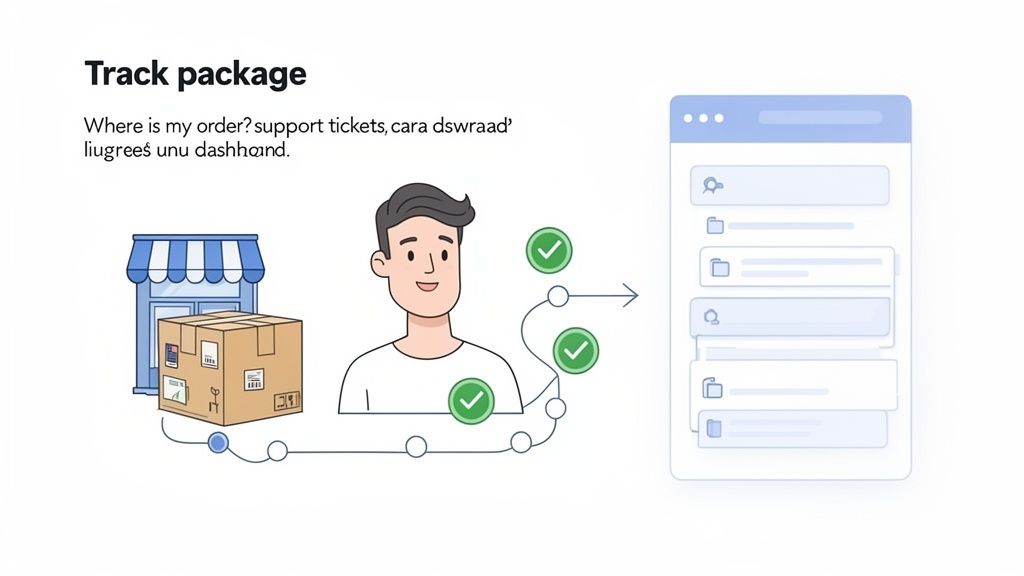
For any growing Shopify store, the constant stream of "Where Is My Order?" (WISMO) tickets is a drain on resources. Every single one of those inquiries costs your support team valuable time and, more importantly, represents a customer feeling anxious about their purchase.
When you send shoppers to a generic carrier website, you're not just breaking the brand experience you worked so hard to build; you're also throwing away a golden opportunity to engage with them. This is where dedicated track package software completely changes the game. It helps you reframe the entire post-purchase journey from a costly problem into a strategic asset.
Transforming Anxiety into Opportunity
Instead of leaving customers in the dark, you can offer them complete, real-time transparency into their shipment's journey. This isn't a "nice-to-have" anymore. Customers today expect clear ETAs and a seamless experience that feels like a natural extension of your store, not a hand-off to a third party.
This shift in expectations is fueling incredible market growth. The global package tracking software market was valued at $2 billion in 2025 and is on track to skyrocket to over $6 billion by 2033, growing at a blistering 15% compound annual growth rate (CAGR). That boom is being driven almost entirely by the explosive growth of ecommerce. For high-volume DTC brands, these tools are now essential for cutting down support tickets by giving customers the power to check their own order status. You can dive deeper into the numbers with this detailed report on package tracking software trends.
By transforming a point of customer anxiety into a positive, brand-building interaction, you create a powerful engine for loyalty and revenue.
The best tracking platforms do much more than just show a dot on a map. They give you the ability to:
- Create Branded Tracking Pages: Keep customers inside your brand's world with tracking pages that match your store's design. This is prime real estate for showing off new products or sharing content.
- Send Proactive Notifications: Automatically send updates at key delivery milestones, like "Out for Delivery" or "Delivered." You answer their questions before they even have a chance to ask.
- Empower Customers with Self-Service: Give shoppers the tools to find their own answers instantly. This frees up your support agents to focus on complex issues that actually need a human touch.
Ultimately, investing in the right track package software is about taking full control of the customer journey, from checkout to unboxing. It’s a strategic move to boost customer satisfaction, make your operations more efficient, and even open up new revenue streams in a place where most competitors only see a logistical chore.
What to Look For in Package Tracking Software
When you’re vetting package tracking software, it's easy to get lost in a sea of features. But here’s the secret: the best platform isn’t the one with the longest list of bells and whistles. It’s the one with the right features that actually solve problems for you and your customers.
Think about it. Sending a customer to a generic carrier site like UPS or FedEx to track their order is like putting a competitor’s ad right on your own storefront. It completely shatters the brand experience you’ve worked so hard to build and sends your customer away.
The real goal is to find software that keeps customers locked into your brand’s world, from the moment they click "buy" until that package lands safely on their doorstep.
Essential vs. Advanced Tracking Software Features
Not all features are created equal. Some are non-negotiable table stakes, while others are powerful additions for scaling brands looking to maximize their post-purchase ROI. This table breaks down the must-haves versus the nice-to-haves that really move the needle.
| Feature | What It Does | Why It's Critical |
|---|---|---|
| Branded Tracking Page | Replaces the generic carrier page with a customizable page that matches your store's branding. | (Essential) Keeps customers in your ecosystem, reinforces your brand, and creates a new marketing channel. |
| Real-Time Sync | Pulls the latest tracking data directly from carriers and displays it instantly. | (Essential) Provides the accuracy customers demand and drastically reduces "Where is my order?" (WISMO) support tickets. |
| Proactive Notifications | Automatically sends branded emails or SMS alerts for key delivery milestones (e.g., shipped, in transit). | (Essential) Keeps customers informed without them having to ask, building trust and reducing anxiety. |
| AI-Powered EDDs | Uses machine learning to provide more precise and reliable estimated delivery dates. | (Advanced) Sets better expectations than standard carrier estimates, leading to higher customer satisfaction. |
| Delivery Issue Detection | Proactively identifies and flags potential delays, exceptions, or stalled shipments. | (Advanced) Allows your support team to get ahead of problems and notify customers before they even notice a delay. |
| Analytics & Reporting | Tracks carrier performance, delivery times, and customer engagement on the tracking page. | (Advanced) Provides invaluable data to optimize your shipping strategy and improve the customer experience. |
While the essentials cover your bases, the advanced features are where you can truly differentiate your brand. They transform the post-purchase experience from a simple utility into a proactive, data-driven operation that boosts loyalty and efficiency.
The Core Features for Building Customer Trust
At a minimum, any tracking platform worth its salt needs to nail the fundamentals. These are the features that today’s shoppers simply expect. Get these wrong, and you'll spend more time answering support emails than growing your business.
Your software must offer:
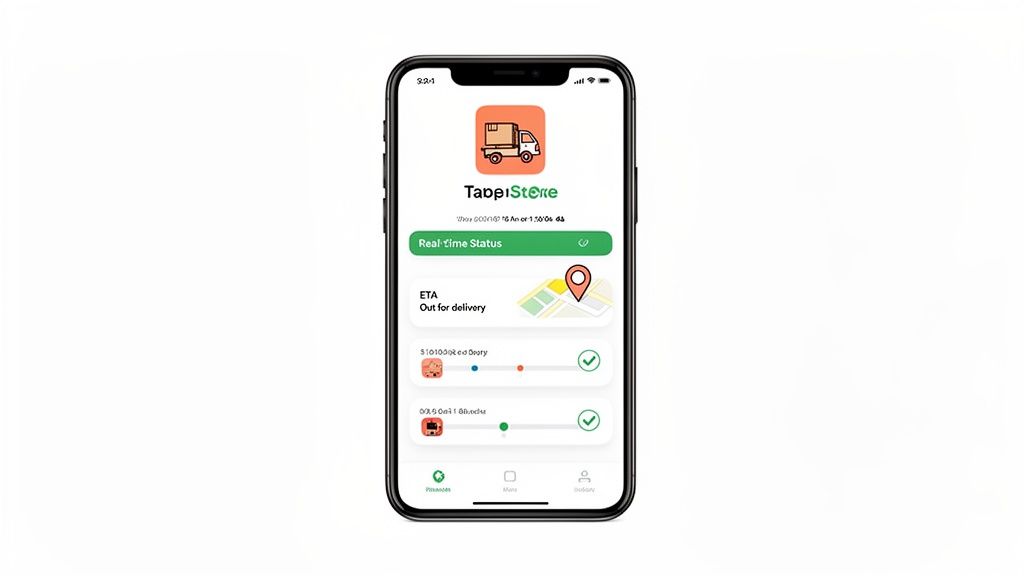
Real-Time Tracking Updates: Customers want to know where their order is right now, not where it was half a day ago. The system has to sync with carriers instantly to show live, accurate location data. This alone eliminates the guesswork and calms customer nerves.
Proactive Delivery Notifications: The best experience is one where the customer doesn't have to do any work. Your software should automatically push out branded emails or texts for key updates like “In Transit,” “Out for Delivery,” and “Delivered.” It keeps them in the loop every step of the way.
A branded tracking page isn't just a logistical tool; it's a marketing channel. It captures your customer’s attention when it's at its peak, giving you a golden opportunity to upsell, cross-sell, or simply reinforce your brand story.
- Accurate Estimated Delivery Dates (EDDs): Vague delivery windows like "5-7 business days" are a huge source of customer frustration. Modern tracking software needs to provide precise, dynamically updated EDDs based on actual carrier data. It’s all about setting clear expectations to build trust.
A Branded and Mobile-First Experience is Non-Negotiable
Beyond the data itself, how you present it is just as important. A clunky, generic tracking page can feel unprofessional and erode the confidence a customer has in your brand.
That’s why branded tracking pages are an absolute must. Your software should give you full control to customize the page with your logo, brand colors, and fonts. This creates a seamless journey and turns a boring status page into a prime spot for marketing banners, product recommendations, or helpful content.
Finally, with over 80% of post-purchase emails opened on mobile devices, a mobile-first design isn't just a nice-to-have; it's critical. The tracking experience has to be flawless on a smartphone—loading quickly, easy to read, and simple to navigate. Anything less, and you're providing a subpar experience for the majority of your customers.
The Business Case for Live Package Tracking
Standard tracking tells a customer their package has shipped. Live map tracking shows them exactly where it is on its way to their doorstep. That might sound like a minor difference, but for your business, it’s a game-changer. It’s the difference between a customer feeling anxious and a customer feeling excited and in control.
Providing a real-time, interactive map view is the single most effective way to solve the "Where Is My Order?" (WISMO) problem. When shoppers can literally see the delivery truck turning onto their street, the urge to contact your support team just melts away. This level of transparency doesn't just answer a question; it gets ahead of it, eliminating the anxiety that causes the customer to ask in the first place.
This move toward radical transparency is reshaping the entire logistics industry. Live package tracking isn't a novelty anymore—it's quickly becoming the standard for a modern delivery experience. The market is projected to hit $11.8 billion in 2025 and is expected to rocket toward $22.5 billion by 2032. This isn't just about fancy new tech; it's a direct response to customers demanding pinpoint accuracy. For high-volume stores, swapping vague delivery windows for live maps can cut WISMO inquiries by a staggering 40-50% as shoppers simply track their own orders. You can see more data on this rapidly growing market on metastatinsight.com.
Turning a Cost Center into a Loyalty Builder
Every single support ticket you prevent is money back in your pocket. For a high-volume Shopify Plus store, a 40% drop in WISMO tickets can easily translate into thousands of dollars saved on support agent hours each year. Think about what you could do with those resources—tackle more complex customer issues, invest in marketing, or improve your products.
But the benefits go way beyond just direct cost savings. Operationally, the impact is huge:
- Fewer Failed Deliveries: When customers know the exact arrival time, they’re far more likely to be home to receive the package. This dramatically cuts down on the costs of re-delivery attempts and packages getting lost or stolen.
- Improved On-Time Rates: Getting a clear view into the final leg of the journey—what we call last-mile tracking—helps you spot and solve carrier delays before they escalate into major customer complaints.
- Enhanced Customer Trust: Transparency is the bedrock of trust. By giving customers an honest, real-time look at their delivery, you’re showing them you respect their time and value their business.
Live tracking transforms a moment of potential anxiety—"Is my package actually going to show up today?"—into a delightful and engaging experience with your brand. It's a small feature that builds massive customer loyalty.
The Long-Term ROI of a Better Experience
Ultimately, the real business case for live tracking isn't just about cutting costs in the short term. A positive, reassuring post-purchase experience is one of the most powerful drivers of repeat business. Customers remember the brands that made them feel secure and kept them in the loop.
When a customer has a great tracking experience, they are far more likely to:
- Leave a Positive Review: A smooth, transparent delivery is something people love to mention in 5-star reviews.
- Purchase Again: Trust and satisfaction are the secret ingredients for customer retention.
- Recommend Your Brand: Word-of-mouth is priceless, and a cool, interactive tracking map is definitely something people will talk about with their friends.
By investing in live package tracking software, you’re not just buying another tool. You’re investing in your customer relationships. You’re turning the final, most stressful step of their purchase into a memorable and positive experience that reinforces your brand’s commitment to quality, encouraging them to come back for more.
Integrating Tracking into Your Post-Purchase Workflow
Having a standalone track package software is a good start, but its true power is unlocked when it’s connected to the rest of your operation. Think of your post-purchase experience as an orchestra. Your tracking software is just one instrument—say, the violin. It sounds nice on its own, but it only creates a real symphony when it plays in harmony with everything else.
When your tracking solution talks to your 3PL, ERP, and customer service tools, you build a single, automated system. This is about more than just showing a customer where their package is. It’s about using that information to make your entire operation smarter, faster, and more efficient. A deeply integrated system is what separates the good brands from the great ones.
Automating Your Operations with Tracking Data
The real magic happens when you start creating automated workflows based on real-time shipping events. Instead of your team manually checking tracking numbers and doing the same tasks over and over, the software can do the heavy lifting for you. This frees up countless hours for your team and cuts down on human error.
So, what does this look like in practice? When your systems can all talk to each other, you can:
- Automate Order Tagging: Your Shopify store can automatically tag orders with statuses like
Delivery_ExceptionorStalled_In_Transit. This gives your support team a quick, at-a-glance view of which orders need attention, without them having to dig through carrier websites. - Trigger Smart Communications: You can set up specific email or SMS messages based on what's happening with the delivery. For example, a "delivery delayed" scan can automatically trigger a message that proactively tells the customer, gives them a new ETA, and turns a potentially bad experience into a positive one.
- Streamline Your Helpdesk: When tracking data feeds directly into your helpdesk (like Gorgias or Zendesk), your agents see the complete shipping history right next to the customer's ticket. They can answer "Where is my order?" questions with a single click, cutting response times from minutes to seconds.
This visual shows how live tracking transforms the customer's journey from a state of anxiety to one of loyalty through simple, proactive transparency.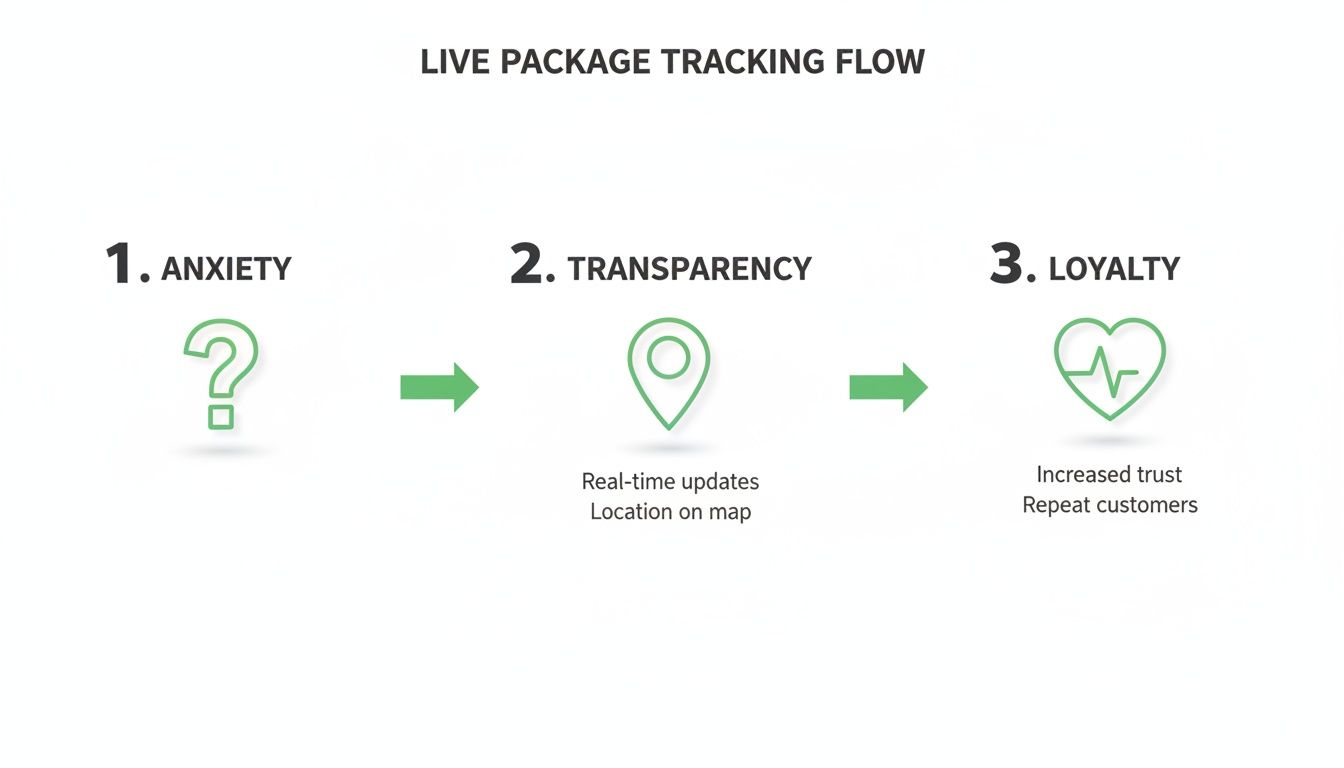
Moving customers from a confusing, disjointed process to a clear, predictable one is how you build the trust that leads to repeat business.
Creating a Unified Customer Journey
Integrating your tracking software isn't just about internal efficiency—it completely changes the customer experience for the better. When all your systems work from the same real-time data, the customer gets a consistent, coherent story from the moment they check out to the moment they unbox their order. For merchants on Shopify, knowing how to track Shopify orders within this connected system is a game-changer.
By weaving tracking data into every post-purchase touchpoint, you create a single source of truth. This eliminates confusion, builds immense customer confidence, and provides the scalable foundation you need to grow your brand without drowning in manual tasks.
Ultimately, this integrated approach is critical for scaling your business. As your order volume grows, you simply can't afford to have disconnected systems and manual processes. A connected post-purchase workflow ensures your operations stay smooth, your team stays efficient, and your customers stay happy and informed every step of the way.
Turning Tracking into a Revenue Channel
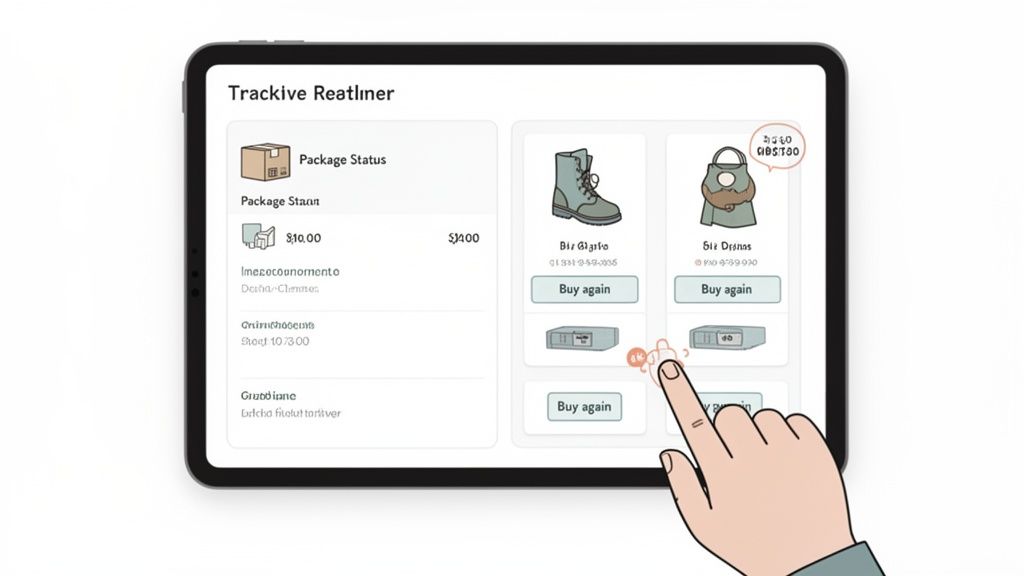
Most merchants treat package tracking as a simple utility—a way to answer the constant "Where is my order?" question. But if that's all you're doing, you're missing out on a huge opportunity. The post-purchase experience, especially the tracking page, is some of the most valuable, yet overlooked, digital space your brand owns.
With the right track package software, you can transform this touchpoint from a boring status update into a money-maker. It’s all about shifting from just passively sharing information to actively engaging customers when they are most excited about your brand.
Capitalizing on the Order Status Page
Think about it from your customer's perspective. After they hit "buy," what's the next thing they do? They start anticipating the delivery, often checking the tracking status several times a day. This makes your "Thank You" and "Order Status" pages prime real estate for engagement.
Instead of showing them a dry timeline of shipping events, imagine a page that also features smart product recommendations. A good tracking solution can showcase items that perfectly complement what they just bought, turning their excitement about the delivery into another potential sale. It's a natural, welcome way to upsell without being pushy.
When a customer is refreshing their tracking page, they are at peak engagement with your brand. This is the perfect moment to present relevant offers, transforming what was once a cost center into a new conversion opportunity.
There's a reason the "Tracking-as-a-Service" market is booming. It's projected to more than double from $4.19 billion in 2026 to a staggering $9.55 billion by 2031. This growth is fueled by cloud platforms that let merchants add these advanced features without the headache of custom development, which can save anywhere from $200K to $800K per project. For Shopify Plus brands, tools like SelfServe plug right in, instantly turning that tracking page into a revenue stream. You can dive deeper into the market analysis on Tracking-as-a-Service from Mordor Intelligence.
Protecting Revenue with Self-Service Features
It's not just about making more money, though. Modern tracking solutions also protect your bottom line by stopping expensive delivery problems before they even happen. Giving customers the power to solve their own issues not only makes them happier but also saves you a significant amount of money.
Key revenue-protection features to look for include:
- Real-Time Address Validation: By integrating with tools like the Google Maps API, you can make sure addresses are accurate and deliverable the second a customer types them in. This dramatically cuts down on returned packages and reshipment costs.
- Self-Service Order Edits: Letting customers fix a typo in their shipping address or update their contact info within a short window is a game-changer. It prevents simple mistakes from becoming costly headaches, especially for high-volume stores where even a small error rate adds up fast.
- Multilingual Support: If you sell internationally, a tracking widget that automatically displays in the shopper’s local language is a must. It removes friction, creates a smoother experience, and helps build a loyal global customer base.
When you combine revenue-generating upsells with these cost-saving self-service tools, your track package software becomes a core part of your growth strategy. It stops being just a tracking page and starts actively contributing to your store's profitability.
Choosing and Implementing Your Tracking Solution
Alright, you’re sold on the "why" of package tracking software. Now for the "how." Picking and plugging in a new tool can feel like a huge project, but it really just comes down to having a smart plan. The best tool in the world won't do you any good if it doesn't fit your business or if your team doesn't know how to use it.
Think of it less like buying software and more like finding the right partner. You're not just looking at a list of features; you need to see how it will mesh with your current operations, your budget, and most importantly, your team.
Evaluating Your Options
So where do you even start? When you're staring at a dozen different platforms, it’s easy to get overwhelmed. To cut through the noise, focus on a few non-negotiable criteria that matter most to your specific business.
What works for a massive enterprise won't be the right fit for a growing Shopify store. Here’s what I tell merchants to look for:
- Carrier Integrations: This is the big one. Does the platform play nicely with all the carriers you use? We’re talking domestic, international, and any regional players you rely on. If it can't track a package from one of your key shipping partners, it's a non-starter.
- Pricing Models: Look closely at the costs. Are you paying per shipment, or is it a flat monthly subscription? For stores with high order volumes, a tiered subscription can save a ton of money compared to a per-package fee. Do the math for your own store.
- Shopify Installation: How much technical heavy lifting is required? You want a tool that feels like it was built for Shopify. Ideally, you're looking for a simple one-click install from the App Store without needing a developer to get it running.
For a deeper dive, it’s always a good idea to see what other top-rated Shopify shipping apps are out there. Understanding the broader ecosystem helps you see how different tools approach the same challenges.
Your Implementation Roadmap
Once you’ve picked your winner, a solid rollout plan is what separates a quick win from a months-long headache. A phased approach is almost always the best way to go, letting you get everything dialed in before your customers even notice a change.
The real goal of implementation isn't just to "turn on" the software. It's about getting your people, your processes, and your new technology all working together to create a post-purchase experience that actually cuts costs and keeps customers coming back.
Here’s a simple, four-step roadmap for a smooth transition:
- Configure Branded Pages: First things first, make the tracking page your own. This is a prime piece of marketing real estate. Upload your logo, match your brand colors, and start thinking about adding marketing banners or product recommendations.
- Set Up Notification Triggers: Decide which moments in the delivery journey warrant an update. Don't go overboard. Start with the essentials that customers crave: “Shipped,” “Out for Delivery,” and “Delivered.” You can always add more later.
- Train Your Support Team: Your customer service crew needs to be comfortable with the new system from day one. Show them exactly how to find order information quickly and how to answer questions using the new dashboard. A little training goes a long way in preventing confusion.
- Measure and Optimize: How do you know if it's working? Data. Track the reduction in "Where is my order?" (WISMO) tickets. Keep an eye on the click-through rates from your tracking page offers. This is the information that proves the tool’s ROI to you and your team.
Frequently Asked Questions About Package Tracking Software
Even with a solid plan in place, a few questions always pop up when you're thinking about adding new software. Let's walk through some of the most common ones we hear from Shopify merchants about getting started with a package tracking tool.
Can It Really Reduce Support Tickets?
Without a doubt. In fact, it’s one of the biggest and fastest impacts you’ll see. The whole point of a great tracking platform is to get ahead of customer anxiety.
Think about it: a clear, on-brand tracking page and timely shipping updates answer the question, "Where is my order?" before your customer even thinks to ask. This directly slashes the number of WISMO tickets flooding your support inbox, letting your team focus on the tricky problems that actually need a human brain to solve.
Will It Integrate With My Shopify Store?
Yes, any tracking solution worth its salt is built to play nicely with Shopify. The best ones are simple, no-code apps you can grab right from the Shopify App Store. They're designed to install in a few clicks and have customizable pages that instantly adopt your store's look and feel.
The key is to look for tools with strong app connections. This lets you sync tracking data with your helpdesk, email marketing platform, and logistics partners, creating a single, connected workflow instead of a dozen separate ones.
How Much Does Package Tracking Cost?
The pricing really runs the gamut. Some providers will charge you per shipment, which can be a great, low-risk way to start if you're a smaller shop. Others use a tiered monthly subscription based on your order volume. These plans often make more financial sense as your brand grows and your shipment numbers climb.
When you're looking at the price tag, try to think beyond the monthly fee and consider the return you'll get. You have to factor in the money saved on support agent salaries, the long-term value of keeping customers happy and coming back, and any new sales you generate from upselling on the tracking page. It stops being a "cost" and starts becoming an investment in your customer experience.
Ready to turn your tracking page from a simple utility into a machine that drives revenue and cuts down on support? SelfServe gives your customers the power to manage their own orders while giving you the tools to build loyalty and increase your average order value. Give it a try and see the difference for yourself.