How to Request a Return: A Practical Guide for 2026

You've got the package open on the kitchen table, the size is wrong, the gadget doesn't match the listing, and the return window is already ticking. Stalling right there is common, because the merchant's help page feels like a maze of fine print, missing fields, and silent exclusions. A cleaner approach helps on both sides of the counter, and even basic fit advice, like clothes that fit every time, is easier to act on when you know how returns are handled.
Why Returning Something Feels Harder Than It Should
The hard part usually isn't the button. It's the uncertainty that comes before it, the moment when you're trying to figure out whether the item is eligible, whether the deadline has passed, and whether support is going to ask for proof you don't have handy. A lot of shoppers either write too much and bury the key details, or write too little and get sent back to square one.
That uncertainty exists because return requests have become a standard operating step, not an afterthought. In ecommerce, the request isn't just a note to support, it's the first gate in a process that decides whether an item becomes a refund, an exchange, or a denied claim. If you're building that mental model from scratch, a practical breakdown like costs and trade-offs in returns management helps explain why merchants care so much about getting the first message right.
What shoppers usually get wrong
The most common mistake is skipping policy review. People assume they can ask first and sort out the rules later, but many merchants won't do that for you. If the item is outside the return window, missing documentation, or covered by an exclusion, the request can fail before anyone looks at the reason.
Practical rule: Treat the return request like an evidence packet, not a complaint.
The second mistake is choosing the wrong channel. A support email, a portal submission, and a live chat message don't carry the same structure, and merchants route them differently. If you know what they need upfront, you save yourself a loop of follow-up questions.
What this guide gives you
You need two things at once. As a shopper, you need to know how to request a return in a way that gets approved. As a merchant, you need a workflow that turns those same requests into a low-touch, predictable operation instead of a pile of inbox messages.
The rest of this guide covers both sides. That means policy checks, proof requirements, portal flow, message templates, and the edge cases that trip up international or damaged-item claims. Once you see the shape of the process, it stops feeling like guesswork.
Why Return Volume Makes the Request Form Matter
Returns are big enough now that the request form matters operationally, not just administratively. U.S. retail returns reached $849.9 billion in 2025, equal to 15.8% of annual sales, and 2024 was even higher at $890 billion, or 16.9% of annual sales, according to the return statistics compiled by Ringly.io (return statistics and market context). Industry reporting also estimates the average ecommerce return rate at about 20.8% in 2026, which means roughly 1 in 5 online orders is sent back in that projection.
That scale changes how merchants design the intake step. A request that is missing the order number, reason code, or documentation doesn't just slow support down, it creates rework, manual exception handling, and avoidable back-and-forth across operations. Once the volume gets that large, the request form becomes a control point for fraud review, refund authorization, restock routing, and customer communication. A useful breakdown of costs and trade-offs in returns management helps show why merchants treat that first message as part of the workflow, not just a customer service note.
Why online needs tighter request data than store returns
Online and offline behavior are not close. Global ecommerce return rates are reported at about 30%, compared with 8.89% for brick-and-mortar sales, which means online retailers face returns at more than 3 times the rate of physical stores. Apparel is especially return-heavy, with average return rates in the 20 to 30% range, and footwear sits around 18%. Those categories need tighter request fields because fit, color, condition, and packaging matter more when the buyer can't touch the product before purchase.
The merchant takeaway is straightforward. If your request flow doesn't capture the reason, item, and order context cleanly, your team will ask for those details later anyway. The shopper takeaway is just as direct, structured submissions get processed faster because they reduce interpretation.
Why merchants standardize the flow
The modern return request exists because volume forced standardization. Instead of treating every case as a custom conversation, merchants use a consistent sequence, eligibility check, item selection, reason taxonomy, and resolution choice. That consistency lowers the chance that a weak request gets lost in the system or a valid request gets delayed by manual sorting.
A return form that looks simple on the surface is usually doing a lot of operational work underneath.
For shoppers, that means the best request is precise. For merchants, that means the best workflow is deterministic.
Preparing Your Return Request Before You Click Submit
A return request usually fails before anyone at support reads the message. The FTC advises consumers to check the return deadline, gather receipts or invoices, include order or transaction numbers, keep copies for their records, and confirm whether the merchant has exclusions or special conditions (FTC consumer guidance on returns and refunds). In practice, that prep work decides whether the request gets approved on the first pass or gets sent back for missing evidence.
Four checks that should happen first
- Find the return policy. Read the merchant's return window, condition rules, and exclusions. Some stores allow a straight refund, others only offer exchange or store credit for certain items.
- Confirm you're still inside the deadline. Merchants often enforce fixed timelines, and once that window closes, a clean request can still be denied.
- Gather the identifiers. Have the order number, receipt, invoice, or warranty details ready. The FTC recommends keeping originals for your records and sending copies with the request (FTC consumer guidance on returns and refunds).
- Prepare supporting evidence. Photos, packing slips, and documentation matter most when the item arrived damaged, was wrong, or arrived incomplete.
A lot of requests fail for simple reasons. The customer sends a screenshot with no order ID. They forget that the item was final sale. They submit one blurry photo when the merchant expects several. The failure is usually procedural, a missing field, the wrong attachment, or a claim that does not match the policy.
A screenshot-ready checklist
- Order number saved
- Receipt or invoice attached
- Return window verified
- Policy exclusions checked
- Photos prepared if needed
- Copy sent, originals kept
If you need to understand where the label comes from or who pays shipping, a plain explanation of what a return label is and how it works keeps the process grounded. The goal before submission is completeness first, then speed.
Send copies, keep originals, and don't assume the retailer will hunt for missing paperwork on your behalf.
That habit cuts down on back-and-forth, especially when support teams are working through a large queue and need clean information to approve a return quickly.
What a Modern Return Request Flow Looks Like
A good return portal feels boring in the best possible way. It asks for the order, the item, the reason, and the resolution in a fixed sequence, then shows the outcome before the customer confirms anything. That's the shape you see in major marketplace flows, including Amazon and eBay, where the customer locates the purchase, selects Return this item or Return or Replace Items, chooses a reason, and confirms the request through a controlled path tied to the order record (Amazon help flow).

The sequence that reduces support friction
The cleanest pattern is predictable:
- Order lookup, the customer finds the order and verifies the item.
- Item selection, the request is tied to one or more products, not a vague message.
- Reason selection, the customer chooses from a limited taxonomy.
- Resolution selection, refund, exchange, or store credit.
- Confirmation, the merchant shows the final outcome before submission.
That structure matters because it prevents support from having to decode a free-text story later. It also makes automation easier on the merchant side, because each choice can trigger the right routing rule, label workflow, or approval queue.
What should be visible before final submission
If the merchant charges restocking or return-label fees, the shopper should see those deductions before they click submit. Hiding the net refund until after submission creates disputes, and that's exactly the kind of thing that turns a routine return into a support ticket. The same is true for exchange paths, where inventory availability and shipping timing should be explicit instead of implied.
A simple refund preview helps too. If the order total is being reduced by a label fee or restocking deduction, the customer should see the expected result in the portal before the request is finalized. That keeps the request deterministic, which is what high-volume teams need.
Why free text should come late, not early
Free-text explanation has its place, but not as the first field. If you ask for a paragraph before you ask for order details and reason code, you make the request harder to route and harder to automate. The structured fields should come first, the explanation later if needed.
The best return UX gives the system enough data to decide what happens next without a manual read-through.
That's the standard merchants should aim for, and the standard shoppers should expect.
Email and Chat Templates That Get Return Requests Approved
A good request message is short, specific, and easy to verify against the order record. It should include the order ID, the item name, the reason, the evidence attached, and the remedy requested. That matches the FTC's guidance on including contact details, transaction numbers, a clear description of the problem, the requested remedy, and supporting documents (FTC guidance on solving return and refund problems).
Copy-paste email template
Subject, Return request for order [order number]
Hello,
I'd like to request a return for [item name] from order [order number]. The reason is [damage, wrong item, size issue, change of mind, or other clear reason].
I've attached [photos, invoice, packing slip, or other evidence]. Please confirm the approved return method, the return window, and whether the resolution will be a refund, exchange, or store credit.
Thank you,
[Your name]
[Email address]
[Phone number if needed]
Short chat version
Hi, I need to return [item name] from order [order number]. The reason is [short reason]. I've attached [evidence]. Can you confirm the return window, shipping cost, and refund method?
If the first request gets denied
Hi, thanks for reviewing my request. I'd like to understand which policy requirement wasn't met so I can correct it if possible. If the item can't be refunded, can you confirm whether an exchange or store credit is available?
That wording keeps the conversation calm and specific. It also gives the agent a path to respond without having to rewrite your case from scratch.
Evidence by request type
- Damage claims, use timestamped photos of the item, the packaging, and the defect, plus a short description of what failed.
- Wrong-item claims, show the received item next to the listing image or packing slip so the mismatch is obvious.
- Change-of-mind claims, keep it simple, the order ID, the original packaging, and a plain request are usually enough unless the merchant asks for more.
For a fast policy check in chat, use one line. Ask, “Can you confirm the return window, who pays return shipping, and whether I'll receive a refund, exchange, or store credit for order [order number]?”
That one question surfaces the details many overlook until it's too late.
Building an Automated Return Workflow on Shopify
A Shopify store loses time fast when every return starts with an email thread. A self-service return workflow on the order status page gives the customer a guided path and gives the merchant structured data to sort the request. Shopify-native return tools and apps fit into that post-purchase layer, where the customer already has the order context and does not need to dig through a help center.
The building blocks that matter
A workable flow needs a few parts, and each one serves a different purpose:
- Self-service portal, so the customer can open the request from the order record.
- Editable policy window, so approved items can be gated by the store's rules.
- Item selection, so the request is tied to a specific SKU or line item.
- Reason taxonomy, so support sees consistent return reasons instead of free text.
- Order tagging, so refunds, exchanges, and exceptions can be routed downstream.
- Manual cancellation queue, for edge cases that still need human review.
The workflow should be deterministic. If the customer chooses a reason that maps to a refund path, the system should know what happens next without waiting for a support agent to interpret the ticket.
Where merchants lose time
Ambiguity is the main drain. A customer writes “please help” in email, support has to find the order, ask for photos, check policy, and decide whether the item is returnable. A portal can collect that information once, up front, and hand over a complete record. Multilingual widgets and address validation also cut down on follow-up when the issue is really a data problem, not a policy problem.
SelfServe is one example of a Shopify app that lets customers submit post-purchase change requests from the order status page, while merchants keep control over permissions, tags, and approval flows (SelfServe). It also supports multilingual display and address validation, which matters when the request itself is simple but the shipping data is not.
What the process should look like
The flow should feel like a closed loop, not a thread that keeps drifting back to email. Order delivered, request submitted, confirmation sent, approval checked against policy, label generated if needed, return shipped, item scanned, refund processed, inventory updated.
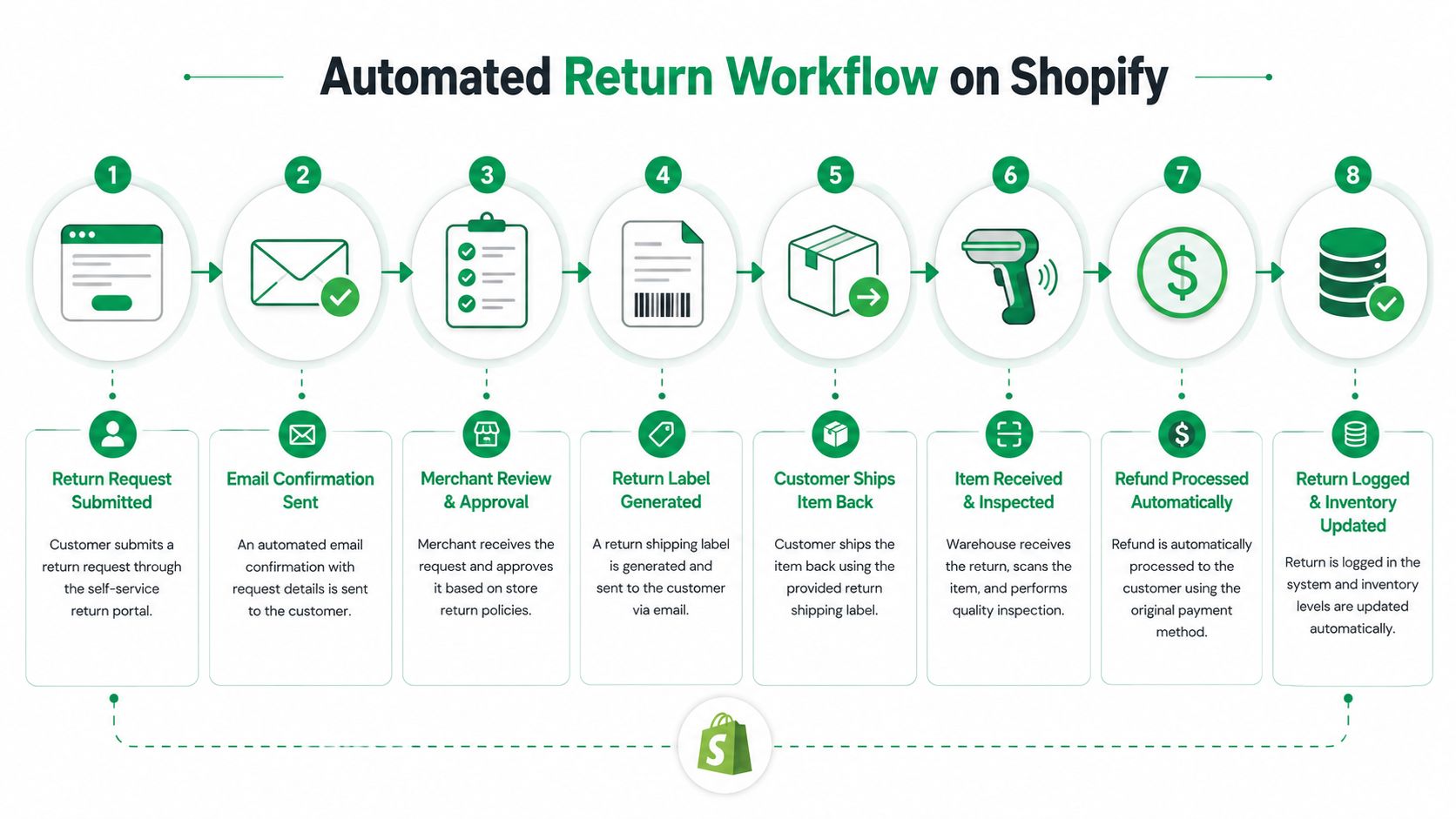
If you want to map your own stack to that flow, a practical overview of returns management systems gives a useful reference point. The goal is to let the software handle the repetitive parts so your team only touches exceptions.
Edge Cases That Trip Up Even Careful Return Requests
The requests that break down usually have one thing in common, they are not standard. Domestic returns inside the policy window are straightforward. The harder cases are international shipments, damaged goods, and items that fall outside the return window. Those are the situations where wording, evidence, and timing decide whether the request moves forward.
International requests need more than a return note
Cross-border returns often require customs paperwork, and some merchants ask for a Return Authorisation Number, a signed proforma invoice, and extra copies for non-EU shipments. As noted earlier, one merchant requires the courier to be contacted within 15 days of the RAN being created (Palm Angels return instructions). A basic “I want to return this” message can fail even when the buyer is otherwise eligible, because the request does not answer the operational questions that support still has to resolve.
If you are dealing with an international order, ask for the exact return method, the customs documents, and the carrier deadline in the same message. Do not assume the store uses the same label process it uses for domestic returns. It often does not, and the wrong assumption slows the request before it even reaches review.
Damaged items need proof, not just frustration
When something arrives broken or clearly mishandled, document it before you repack anything. Use time-stamped photos of the item, the box, the shipping label, and the damage itself. Then write one sentence that separates the product defect from the shipping condition, because support agents need to know whether they are handling a product issue or a transit issue.
If the package still looks like evidence, stop and photograph it before you touch it.
That habit matters because once the original condition is gone, the claim is harder to verify and the merchant has less to work with.
Outside-window and final-sale cases
If the return window has already closed, lead with a narrow ask. Ask whether store credit, an exchange, or a one-time exception is possible, and keep the tone factual. That will not guarantee approval, but it gives the merchant a lower-friction fallback than a blunt demand.
Final-sale and hygiene-restricted items are different. If the policy excludes them, quote the policy language back in your message and ask whether a warranty claim, replacement, or credit is available instead. That is a better path than arguing about a rule the store has already published.
Short FAQ
Can I request a return without a receipt? Usually not if the merchant needs transaction proof, so check the policy first.
Should I send the original item or just photos? Photos first when you are documenting damage, then follow the merchant's instructions.
What if support does not reply? Re-send the request through the official channel and include the order number, reason, and attachments again.
Can I ask for an exchange instead of a refund? Yes, and that can be the smarter fallback when the store will not approve a cash refund.
If you are trying to reduce the churn this process creates, build the request flow into the post-purchase experience instead of handling it one email at a time. That lets support collect the right fields up front, route approvals by policy, and keep exceptions visible without forcing shoppers to repeat themselves.