Parcel India to USA Shipping: Your 2026 Guide

A U.S. order lands in your Shopify dashboard and the feeling changes fast. First there's the win. Then the questions start. Which courier should you use, what do customs need, how much will the buyer pay, and what happens if the parcel gets stuck because one line on the invoice doesn't match the label?
That's the core problem with parcel India to USA shipping. It isn't just about printing a label and handing a box to DHL, FedEx, UPS, Aramex, or a postal operator. It's about protecting margin, avoiding customs friction, and making sure your customer doesn't regret buying from an overseas store.
New brands usually focus on the first visible number, the shipping charge at checkout. Experienced operators focus on landed cost, documentation accuracy, packaging discipline, and communication after dispatch. Those are the pieces that decide whether your first international order becomes repeat business or a support ticket.
Your First US Order Is In Now What
A common first order looks like this. A customer in California buys two lightweight products from your store. The order value looks healthy, your ad spend worked, and you're already thinking about scaling U.S. sales. Then you reach the fulfillment step and realize international shipping asks different questions than domestic shipping ever did.
You can't treat a parcel India to USA shipment like an Indian metro delivery with a longer route. Customs will inspect the data you submit. Carriers will charge based on service type and package profile. The customer will judge your brand on tracking clarity, delivery timing, and whether extra charges appear at the wrong moment.
The first operational mistake most new merchants make is choosing a carrier only by brand familiarity. The second is assuming the shipping label price equals the total delivered cost. The third is underestimating paperwork.
Your customer doesn't separate shipping, customs, and delivery experience into different departments. They see one brand. Yours.
If you're shipping your first U.S. parcel, your job is simple in principle and unforgiving in practice. You need to make four decisions correctly:
- Service choice: Pick speed and cost based on what the order needs, not on the flashiest courier option.
- Documentation: Make every shipment field agree across invoice, declarations, and label.
- Packaging: Protect the product without inflating billable weight.
- Post-dispatch communication: Give the customer useful tracking and clear expectations.
That's what turns cross-border shipping from a stressful one-off task into a repeatable workflow. Once you build that workflow, the U.S. stops feeling like a risky market and starts feeling like an address format your ops team knows how to handle.
Choosing a Carrier and Estimating True Costs
A new U.S. order lands, and the first quote you see looks manageable. Then the parcel gets billed at a higher weight than expected, the customer asks whether import charges are due on delivery, and your support team spends more time explaining the shipment than you earned on the order.
That is why carrier selection should start with total delivered cost, not just the label price.
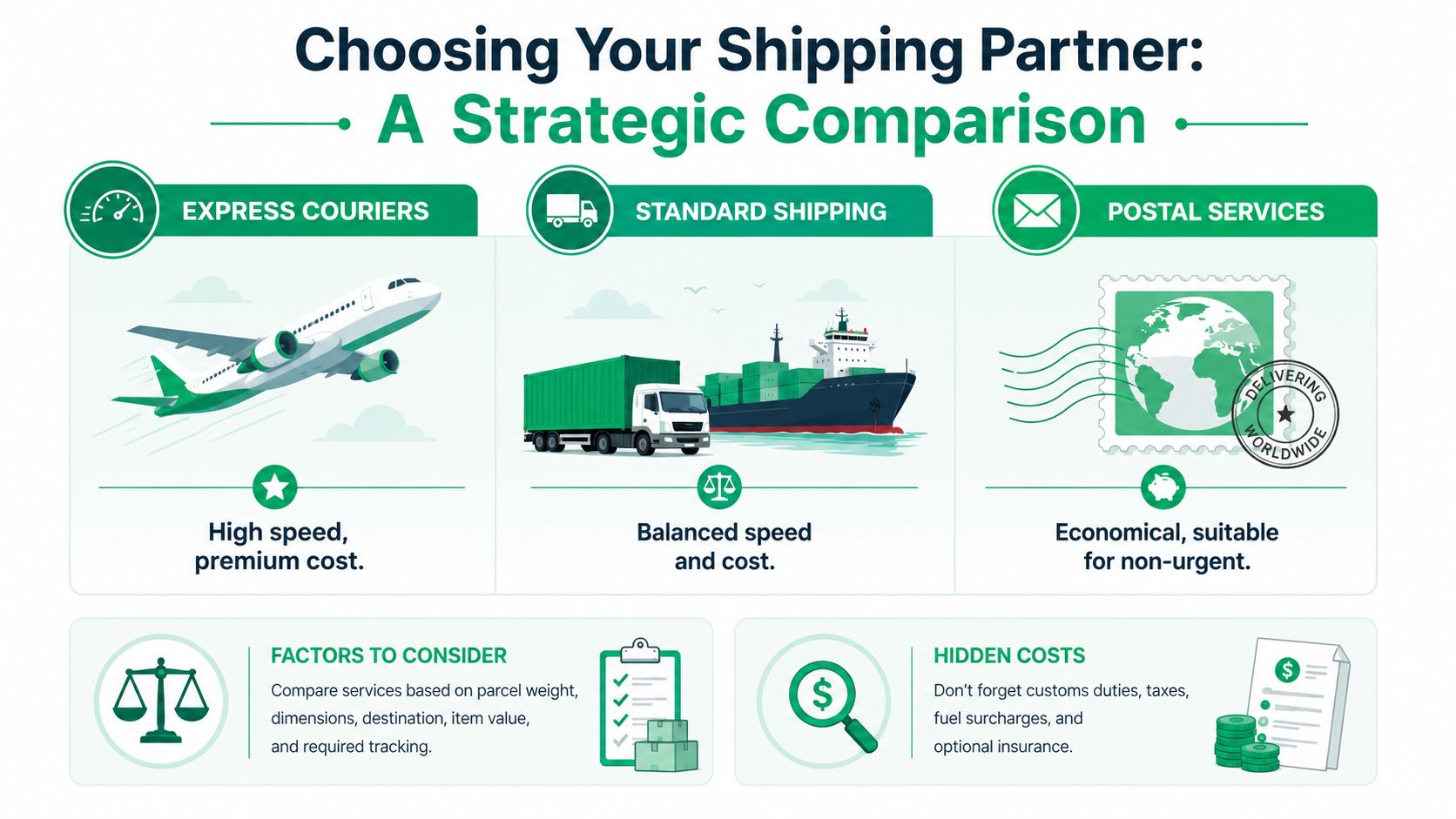
For parcel India to USA shipping, the decision is service fit. Express usually buys speed, tighter scans, and better intervention when something goes wrong. Standard air usually protects margin better if the promised delivery window leaves room. Shapiro's India to U.S. shipping rate overview gives a useful benchmark for how transit time and price move together on this lane.
Match the service to the order
An urgent replacement order and a low-risk catalog order should not travel the same way. High-value products, launches, gifts, and orders tied to a strict customer promise usually justify express. Routine e-commerce parcels with moderate order value often perform better on standard air if your checkout promise is realistic.
Use this table as an operating guide:
| Service type | Best use case | Main strength | Main risk |
|---|---|---|---|
| Express courier | Urgent orders, high-value items, premium customer promise | Faster delivery and tighter handling | Higher shipping cost |
| Standard air | Routine e-commerce parcels with flexible delivery window | Better balance of cost and speed | Less room for aggressive delivery promises |
| Postal service | Non-urgent, price-sensitive shipments | Lower entry cost in some cases | More complexity around customs and service consistency |
Carrier brand matters less than execution on your lane. Pickup discipline, customs support, scan quality, exception handling, and final-mile consistency affect both margin and customer trust. If you are comparing premium options, this DHL vs FedEx comparison for e-commerce shipping is useful for evaluating service fit in practical terms.
Label price is not landed cost
The shipping label is only one line in the full cost of delivery. The order can also absorb duties, taxes, brokerage, packaging cost, payment processing on shipping charges, and the internal cost of support tickets, failed delivery attempts, or refund pressure when expectations were set badly.
That last part gets ignored too often.
A cheaper linehaul rate can produce a more expensive order outcome if tracking is weak, customs communication is poor, or the buyer gets surprised by charges at delivery. For an e-commerce brand, landed cost includes what your team spends after dispatch to keep the customer calm and the order profitable.
Practical rule: Quote the order twice. Once for transport. Once for the full delivered outcome, including import-cost exposure and likely exception handling.
Dimensional weight changes your margin
Many first-time exporters focus on product weight and miss billable weight. Carriers often charge on the higher of actual weight and dimensional weight, so a light parcel in an oversized box can erase margin fast.
This is common with apparel packs, gifting boxes, and protective outer cartons that leave too much empty space. A bundle that looks efficient on the packing table can become expensive once the box dimensions are entered into the carrier system. The result is simple. Packaging decisions affect freight cost as much as carrier choice does.
A few patterns show up quickly:
- Oversized cartons raise billable weight: Empty space is expensive on international air services.
- Bundles need dimension checks before checkout goes live: Combining items can reduce cost, but only if the final box stays efficient.
- Premium packaging has a shipping penalty: Branded inserts, rigid boxes, and extra void fill can improve presentation while contributing to higher fulfillment cost.
Build an estimate you can actually use
Early on, you do not need a complex model. You need a repeatable method your ops team can trust before publishing shipping rates or delivery promises.
Include these inputs in every estimate:
- Service level
- Actual weight and parcel dimensions
- Expected import-cost exposure
- Packaging cost
- Tracking quality and carrier support
- Promised delivery window
This approach keeps the decision where it belongs. On profit per delivered order, not just on who offered the lowest pickup quote.
Mastering Customs Documentation to Avoid Delays
Your first U.S. order often feels straightforward until the parcel is packed, booked, and then stopped because the paperwork says one thing while the box says another. That delay is expensive in ways new brands tend to miss. Refund requests rise, support tickets pile up, and the customer remembers the wait more than the product.
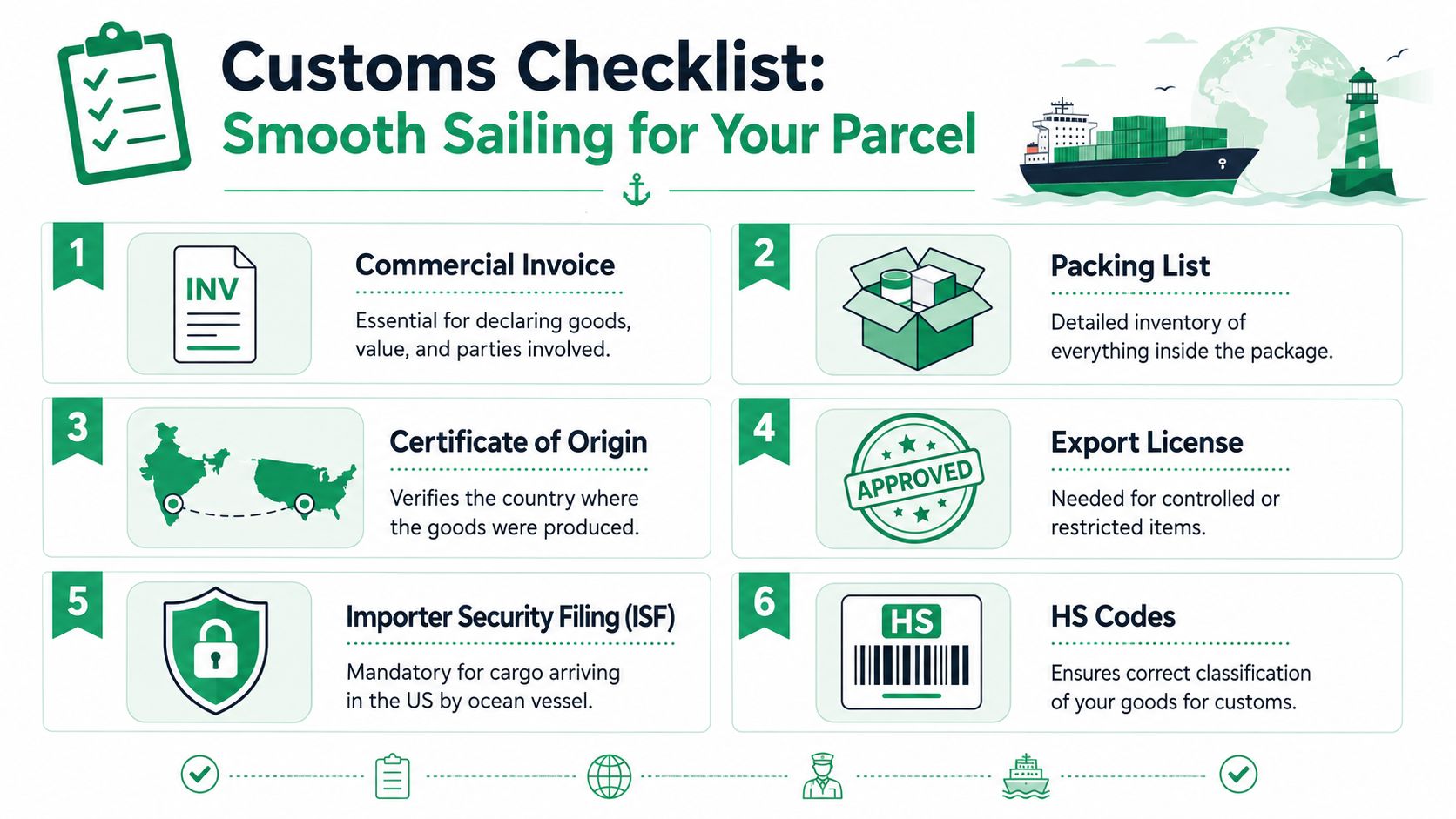
For parcel India to USA shipping, customs paperwork is part of the delivered cost, not just an admin task. A cheap shipment that sits for document review can cost more than a slightly higher courier rate that clears cleanly on the first pass. Atlantic Courier's India-to-USA shipping guidance outlines the core documents shippers need, including a commercial invoice, customs declarations, and supporting shipment details that match the parcel label.
What customs documents actually do
Customs teams and carrier compliance systems use your documents to answer three basic questions. What is the product, what is it worth, and does the shipment data line up across every record?
The commercial invoice carries the commercial facts. It should identify the seller, buyer, product, declared value, and country of origin in clear language. The packing list confirms what is physically inside the parcel. The declaration data and carrier shipment record support classification, screening, and admissibility checks. If one file says "garments," another says "gift items," and the label shows a different consignee name, the shipment gets attention for the wrong reason.
The easiest way to avoid that is to standardize the fields your team checks before label creation:
- Item description: Write what the item is in plain terms, such as "cotton T-shirt" or "stainless steel water bottle."
- HS code classification: Use the product code that fits the item you are exporting.
- Declared value: Keep the same value basis across invoice, declaration, and order record.
- Consignee details: Match the recipient name, phone number, and full delivery address exactly.
- Shipment reference: Make sure the order number or shipment ID ties the paperwork to the parcel label.
Gifts and personal effects still create customs work
New exporters often assume informal shipments get lighter scrutiny. They do not.
Atlantic Courier notes that gifts and personal effects still need supporting paperwork, including a pro forma invoice and an itemized inventory. That matters for small e-commerce brands too. If you replace an item for a customer, send a PR package, or ship a sample to a creator, the parcel still crosses a border and still needs to be described properly.
For brands comparing postal routes with private couriers, this guide to United States Post Office international shipping options and customs handling is useful because service design affects how visible delays become to your customer and support team.
The real cost of poor paperwork
A customs delay is rarely just a customs problem. It turns into a margin problem.
You may pay storage, correction, or return charges. Your customer may see a confusing tracking status for days. Your support team may spend more time explaining a preventable issue than the order was worth in contribution margin. For a growing brand, that is the operational trade-off that matters. Clean documents protect delivery speed and customer trust at the same time.
One policy issue to watch closely is low-value shipment treatment. Rules, thresholds, and enforcement practices can change, and small parcels are not automatically low-risk. The safe operating habit is simple. Document every order as if customs will review the product description, value, and consignee details line by line.
A useful explainer on customs workflows is below.
What works in practice
Teams that ship well use a repeatable review step before pickup is booked. It does not need to be complicated. It does need to be consistent.
Good habits include copying customer address data directly from the order system, using approved product descriptions for each SKU, and locking declared values to the same logic used in your store and ERP. Weak habits cause predictable problems:
- Typing addresses manually from screenshots
- Using vague descriptions like "accessories" or "samples"
- Updating value in one document but not the others
- Leaving out the recipient phone number when the carrier requires it
- Marking commercial goods as gifts to try to simplify clearance
Document discipline improves delivery performance more than new shippers expect. It reduces avoidable holds, protects margin on low-AOV orders, and gives customers a better post-purchase experience.
Packaging and Labeling for a Rough Journey
Your first U.S. order can be profitable on paper and still lose money in transit. A box that is too large pushes up dimensional weight. Weak cushioning turns a return into a replacement. A smeared label creates a support ticket before the parcel even reaches final delivery.
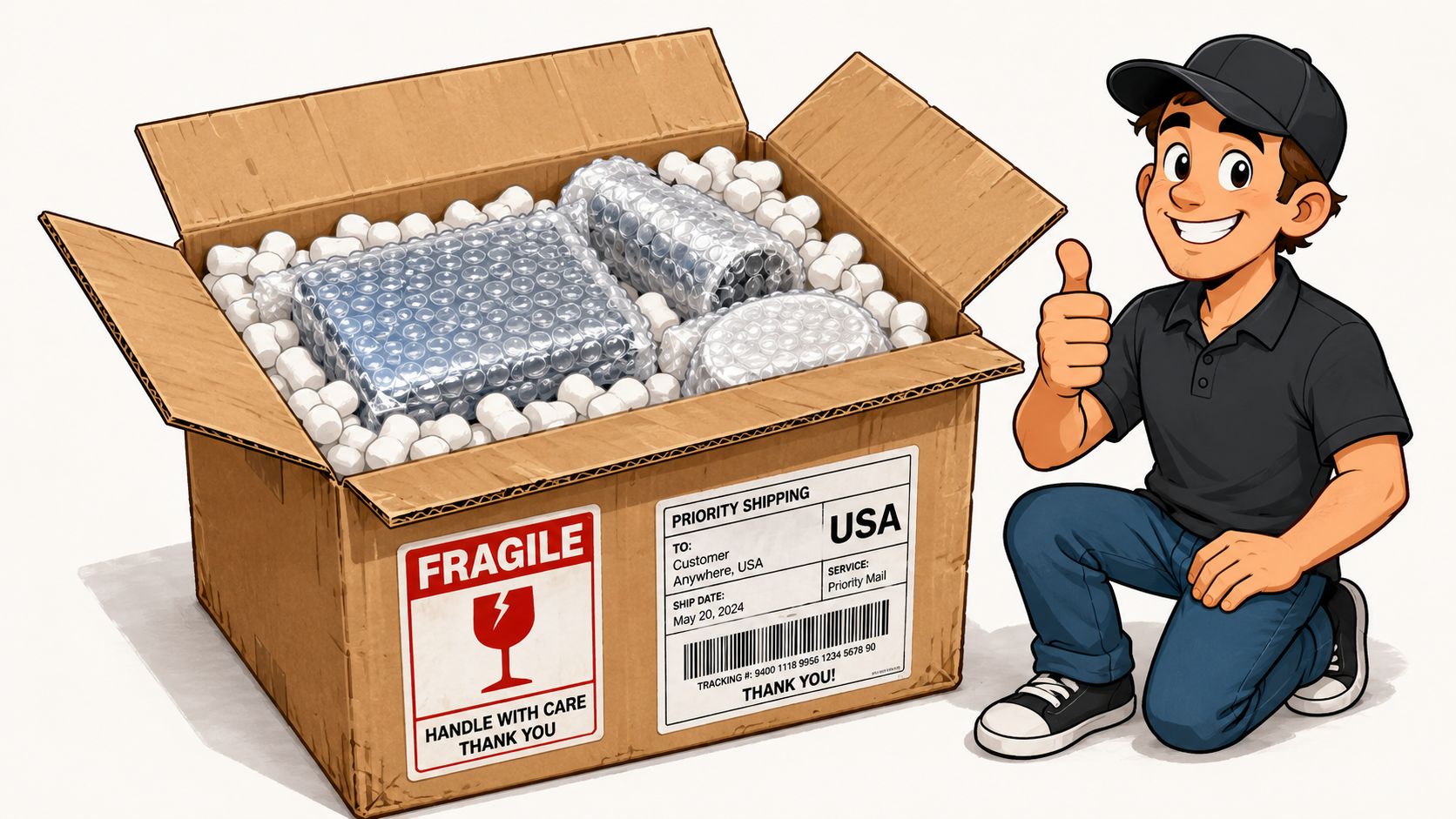
Cross-border parcels from India to the USA are handled repeatedly across export sorting, air movement, customs handoff, domestic processing, and final-mile delivery. Packaging has to protect the item and control cost at the same time. New brands often focus on courier rates and miss the fact that packaging decisions change the true landed cost of every order.
Pack for survival, with margin in mind
Good packaging protects the product without shipping air.
For heavier goods, use double-wall corrugated cartons and reinforce the bottom and side seams. For fragile goods, cushion the item so it cannot move inside the box when shaken. For multi-item orders, separate products inside the parcel so one unit does not scuff, crush, or leak onto another. Put a duplicate invoice or item summary inside the box in case the outer pouch is torn off during handling.
A practical packing standard looks like this:
- Heavy items: Use a stronger outer carton and tape all seams fully.
- Fragile items: Add enough internal protection to absorb drops and compression.
- Mixed orders: Use dividers, sleeves, or inner bags so items do not collide.
- Paperwork backup: Keep a duplicate invoice or packing summary inside the parcel.
Teams that want fewer damages and fewer re-shipments usually get better results by standardizing 4 to 6 carton sizes instead of forcing every order into one export box. That approach also speeds pack-out. If you're tightening your warehouse process, these shipping and fulfillment best practices for Shopify merchants are a useful benchmark.
Box size changes your shipping bill
Packaging is a rate decision.
Couriers bill on actual weight or dimensional weight, whichever is higher. If a lightweight product ships in an oversized carton, the box size can raise your freight cost enough to wipe out the margin on a low-AOV order. That is why pack stations need measuring discipline, not guesswork.
Measure length, width, and height after the parcel is fully packed. Use the actual carton dimensions. Do not rely on old box specs, rough estimates, or a warehouse shortcut where every order gets the same carton because it is close at hand.
Warehouse habit: Treat carton selection as cost control. Extra space inside the box often becomes extra cost on the invoice.
Labels should be plain, accurate, and easy to scan
A clean label does more for delivery performance than branded tape or fancy inserts.
Print the recipient name, full address, postal code, and phone number clearly. Apply the label to a flat surface. Keep barcodes visible and free of wrinkles, tape glare, or folds over an edge. If your team includes branded packing slips or internal SKU stickers, place them where they will not interfere with the carrier label.
It also helps to connect labeling and post-purchase visibility. unified tracking for eCommerce shipments helps support teams answer "where is my order" faster when the parcel moves between international and domestic carrier scans.
The parcel that arrives intact, on budget, and with readable tracking usually comes from ordinary execution done well. That is what customers remember.
Booking Pickup Tracking and Avoiding Pitfalls
Your first U.S. order can go wrong after the box is packed, not before. The label prints, the pickup is booked, and everyone assumes the hard part is over. Then the first scan is late, customs asks a question, the customer sees no movement, and support gets dragged into a problem that started with one missed check at dispatch.
That is why this stage needs process control. Good booking and tracking habits protect margin just as much as rate shopping does, because every avoidable exception adds cost through support time, rework, failed delivery attempts, or refunds.
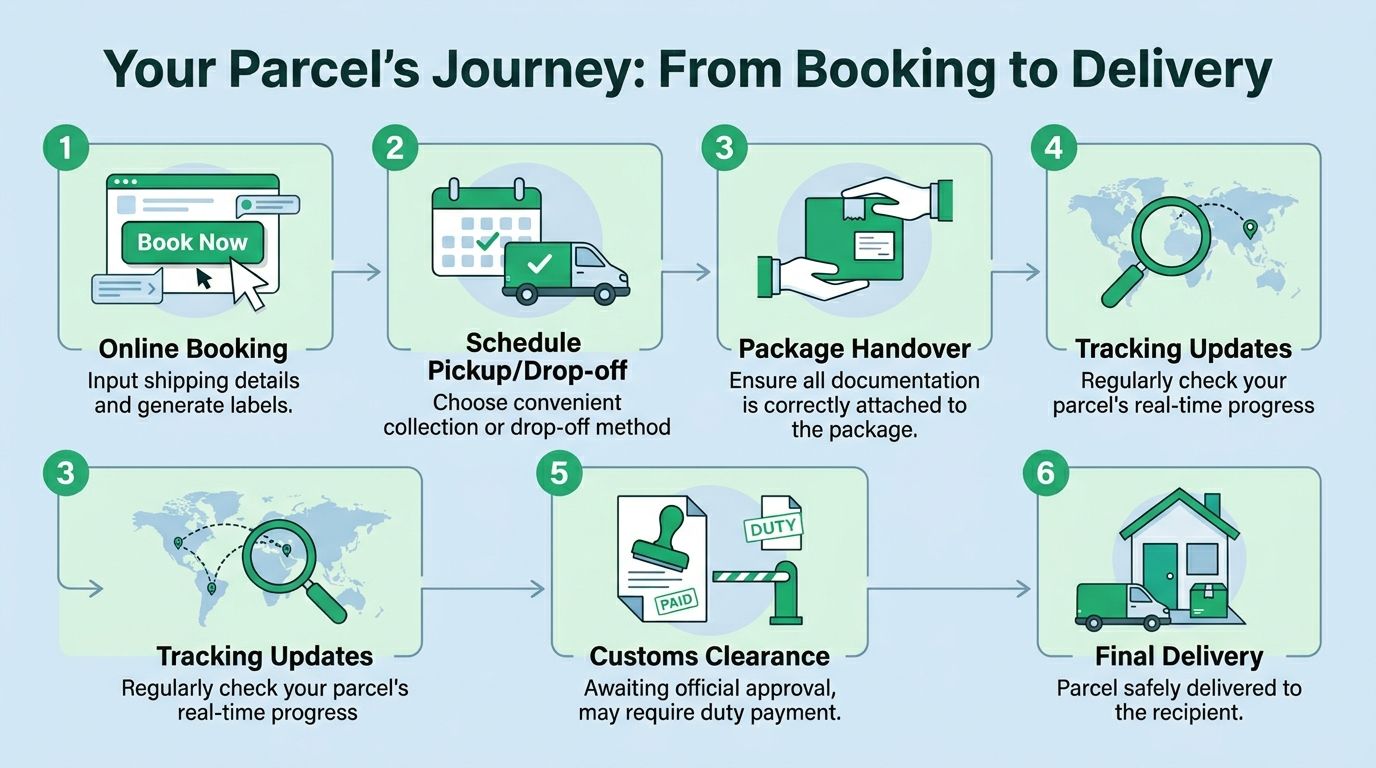
What to do at booking
Booking is where shipment data either stays clean or starts drifting.
The order record, carrier booking, shipping label, and customs submission need to match. If one system says "cotton t-shirt," another says "gift item," and the parcel profile shows the wrong weight, you have created a delay risk before pickup even happens. It also becomes harder to dispute carrier adjustments later.
Check four items before you confirm the booking:
- Recipient contact details: A working phone number helps with delivery coordination and customs contact.
- Service level: Match the service to the promise made at checkout, not to what someone clicks by mistake in the shipping dashboard.
- Parcel profile: Use the actual packed weight and dimensions, because billing corrections after dispatch eat into margin fast.
- Declared contents: Keep the description and value consistent with the paperwork already prepared.
If orders flow in from multiple stores or sales channels, visibility matters just as much as accuracy. Having unified tracking for eCommerce shipments helps support teams, operations staff, and customers work from the same shipment record instead of three conflicting ones.
What happens at pickup
Pickup is a control point.
The person handing parcels to the driver should confirm the label matches the box, the shipment count is correct, and any required document pouch is attached. This takes a minute and prevents the kind of errors that are expensive to fix later.
I have seen brands lose time over very ordinary mistakes here. Two cartons for the same pickup get switched. One package is left off the scan. A driver collects the parcel but the first event appears much later, so the buyer assumes nothing was shipped. None of these issues look serious inside the warehouse. All of them create customer-facing friction.
How to read tracking without overreacting
Tracking needs interpretation, not panic.
A status like "in transit" or "arrived at facility" usually means the parcel is moving through the expected network. "In customs" does not automatically mean there is a problem either. The primary question is whether the shipment is following a normal pattern for the service you bought and whether the consignee or shipper needs to act.
This matters for customer experience. If there is a customs hold, a payment request, or a request for more information, tell the buyer early. A short, clear update prevents the common situation where the customer blames the brand for "no delivery update" when the parcel is waiting on a routine customs step.
The low-value parcel trap
Low order value does not protect you from post-dispatch problems.
Brands often treat small parcels as low-risk because the product value is modest. Operationally, that is the wrong test. The right test is whether the shipment can still trigger customs questions, delivery contact issues, billing corrections, or customer confusion. As noted earlier, recent policy changes around low-value imports have made that assumption even less safe.
For e-commerce brands, the trade-off is simple. A cheap basket does not justify expensive support work, but poor communication after dispatch creates exactly that cost. If the buyer expects a domestic-style delivery and then gets contacted about customs or fees, the landed cost problem turns into a customer trust problem.
Customers do not judge the shipment when you print the label. They judge it when delivery feels harder than the checkout promise.
Common pitfalls that cost time and money
The same failure points show up again and again:
- Under-declaring value: This can trigger customs scrutiny and create claims issues if the parcel is lost or reviewed.
- Missing phone number: Last-mile teams and customs brokers have fewer ways to reach the consignee.
- Mismatched parcel data: Carrier systems, labels, and shipment records stop lining up, which leads to billing corrections or holds.
- Late tracking communication: Customers open support tickets because they assume the order has not shipped.
- No ownership of exceptions: A customs hold sits untouched because nobody on the team is watching it daily.
A better post-dispatch routine
Strong shipping operations use a simple review rhythm after handoff:
| Stage | What your team should do |
|---|---|
| Booking confirmation | Check service, parcel data, consignee details, and declared contents |
| Pickup day | Verify parcel-to-label match and confirm all cartons are handed over |
| First scan | Send tracking to the customer promptly and confirm the shipment entered the network |
| Customs phase | Watch exception statuses and contact the buyer fast if action or payment is needed |
| Delivery confirmation | Check completion, failed attempts, or return-to-sender risk |
That routine does more than keep operations tidy. It lowers support volume, helps you catch billing and customs issues sooner, and keeps the true cost of shipping from India to the USA closer to what you planned.
Your Final Pre-Shipment Checklist
Before a parcel leaves your hands, run one final quality check. At this point, strong international ops teams protect both margin and customer trust.
The reason is simple. The decision isn't just “Can I ship this?” It's “Do I understand the true landed cost and have I removed the obvious failure points?” Public shipping guides often focus on courier names and transit estimates, but they don't always address the full cost stack of customs duties, taxes, and brokerage fees, which is often the main concern for shoppers and merchants, as noted in Easyship's discussion of shipping from India to the USA.
The final go or no-go check
Use this before sealing the box:
- Carrier fit: The service matches the order value, urgency, and customer promise.
- Parcel size control: The box isn't oversized for the product, and measurements are exact.
- Document match: Product description, value, and consignee details agree across paperwork and label.
- Customs readiness: The shipment is being treated as customs-visible, not as an informal parcel.
- Packaging integrity: The carton, cushioning, and sealing are appropriate for international handling.
- Label clarity: Recipient address and phone number are complete and readable.
- Tracking plan: The customer will receive shipment visibility promptly after dispatch.
- Customer expectation: The buyer understands that international delivery includes customs processes, not just transit time.
What experienced teams do differently
They don't ask whether the label was purchased successfully. They ask whether the shipment is likely to arrive without intervention.
They don't treat support tickets as a customer service issue alone. They treat them as a shipping design issue. If customers repeatedly ask where the parcel is, whether they owe customs charges, or why delivery stalled, the workflow needs work.
A good parcel India to USA process should feel routine inside your business, even when it feels complex to a first-time buyer.
That's the standard to aim for. Not perfection. Predictability.
If you run a Shopify brand and want fewer address errors, fewer “please change my shipping details” tickets, and a smoother post-purchase experience for international customers, SelfServe is worth a look. It lets customers update shipping and contact details within rules you control, supports multilingual experiences, and helps operations teams reduce avoidable support workload before fulfillment begins.