Reverse Logistics Management: Shopify Playbook 2026
Reverse logistics management is no longer a side process you clean up after growth. It's a core operating system. The scale alone should change how you think about it. The global reverse logistics market was valued at USD 823.21 billion in 2024 and is projected to reach USD 3.18 trillion by 2033, growing at a 17.4% CAGR according to Grand View Research's reverse logistics market outlook.
For Shopify brands, that matters for one reason. Returns aren't just a customer service issue. They affect margin, inventory accuracy, warehouse flow, support workload, and how much trust a buyer has in your store before they ever place the order.
Many organizations start too late. They wait until return volume hurts, then they shop for a portal, write a policy, and ask the warehouse to “process faster.” The better approach is to design the whole loop upfront. Start with the policy. Build prevention into the post-purchase experience. Then create a warehouse and partner model that recovers as much value as possible from every unavoidable return.
The Foundation of Your Reverse Logistics Strategy
A reverse logistics system usually breaks first at the customer-facing layer. Not in the warehouse. Not in the ERP. At the moment a shopper tries to answer a simple question: “If this doesn't work, what happens next?”
That's why your returns and exchanges policy is the foundation of reverse logistics management. It isn't legal copy. It's a conversion asset, an operations document, and a cost-control mechanism all at once.
Write a policy your team can actually operate
Shoppers read policies for reassurance. Operators read them for edge cases. Finance reads them for exposure. If those three views don't match, you'll create friction immediately.
A strong policy should answer five operational questions in plain language:
- What can be returned: Spell out which products qualify, which don't, and what condition they must be in.
- What the customer receives: Refund, exchange, or store credit should be explicit, not implied.
- Who pays for shipping: If you hide this, support gets dragged into arguments that should've been prevented.
- How the return starts: A self-service workflow is easier to scale than inbox-based handling.
- What happens after receipt: Customers want to know when they'll hear back and what status updates to expect.
If you sell across multiple categories, don't force one policy onto every SKU. Apparel, consumables, final-sale products, and custom items often need different rules. Good reverse logistics management starts when policy matches product reality.
Practical rule: If your support team has to explain the same policy exception every day, the policy isn't finished.
Balance conversion and cost
Customer-friendly doesn't mean loose. Tight control doesn't mean punitive. The best policies give buyers clarity while protecting the business from avoidable loss.
Here's a simple way to think about policy design on Shopify:
| Policy lever | Good use case | Operational trade-off |
|---|---|---|
| Full refund | Standard products with broad resale potential | Higher refund exposure if intake and restocking are slow |
| Exchange first | Fit-sensitive categories | More process complexity, but often better retention |
| Store credit | Loyal repeat-purchase audiences | Stronger margin protection, but can create friction if forced too aggressively |
| Final sale exclusions | Clearance, hygiene, or customized items | Lowers loss, but requires very clear merchandising and checkout messaging |
Put the policy in the places customers look. Product page. Cart. FAQ. Order confirmation. Post-purchase account area. Hiding it in the footer creates doubt, and doubt lowers conversion.
Brands that care about enhancing supply chain sustainability should think of policy as the first sustainability control too. A clear exchange path, accurate expectations, and fewer preventable returns reduce waste before any package comes back through the network.
Make Shopify carry part of the load
Many merchants keep the policy in a static page and stop there. That's a miss. The policy should shape operational behavior inside your store.
Use your Shopify setup to reinforce it:
- Tag products by return class: This helps support, ops, and returns apps apply the right rules faster.
- Display exclusions near the buy button: Don't rely on legal pages to communicate product-specific terms.
- Separate exchange and refund paths: Customers often accept an exchange if the workflow is simple.
- Audit your logistics setup: If your current stack can't support the policy you want, review how modern e-commerce logistics services fit with your order flow, carrier mix, and warehouse model.
A policy should reduce interpretation. If it creates more exceptions than it resolves, it's not a foundation. It's a liability.
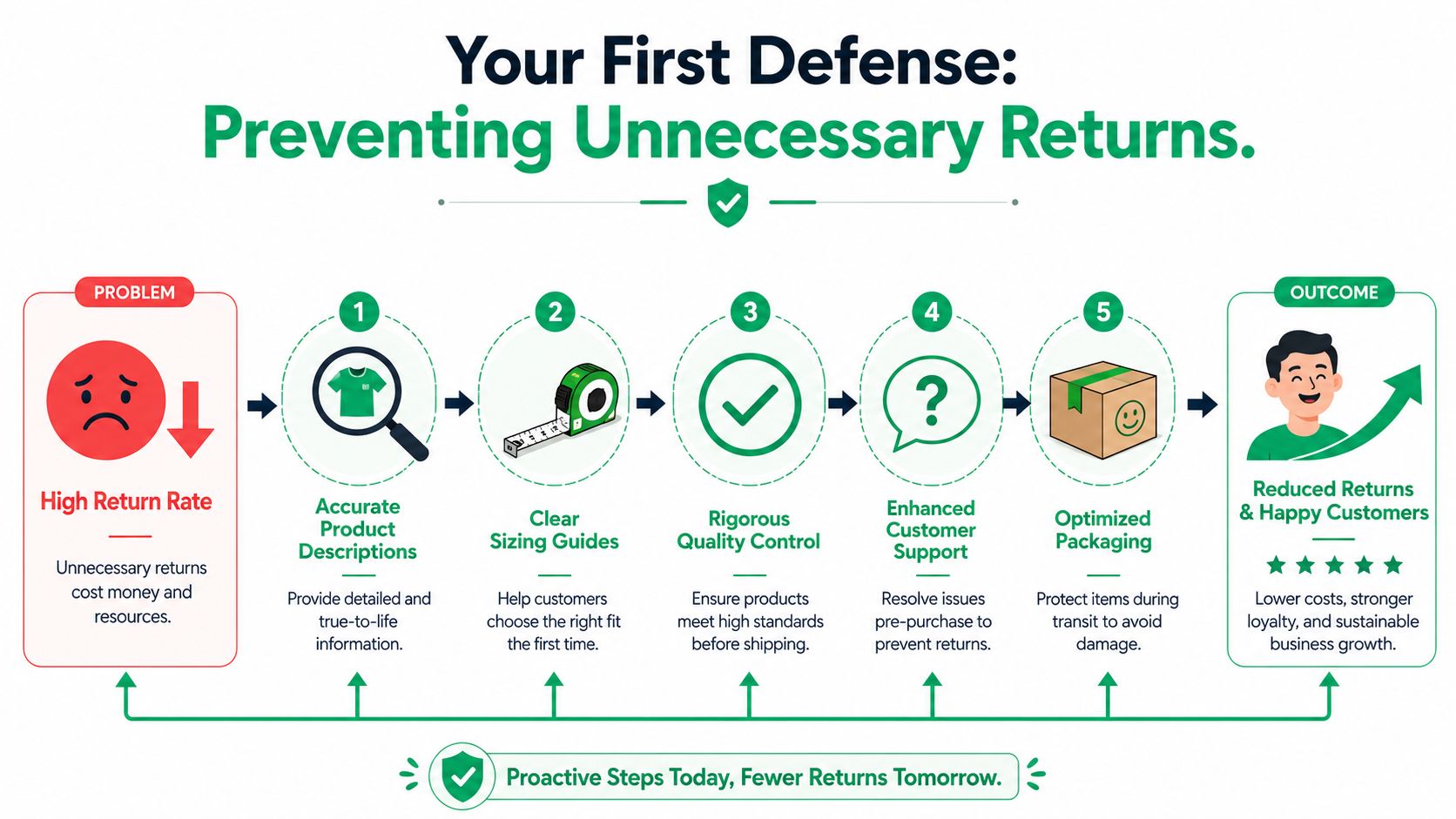
Your First Defense Preventing Unnecessary Returns
Most brands treat reverse logistics as a process that begins when a customer clicks “return item.” That's too late.
A meaningful share of return volume starts with preventable mistakes. As many as 30% of returns stem from address errors or customer confusion about order contents. By enabling proactive order modifications, brands can reduce return volume by 15–20%, with each prevented return saving an estimated $10–$15 in logistics and processing costs, based on American Public University's reverse logistics overview.
That's the operational shift many teams miss. Your first defense isn't the returns portal. It's the post-purchase edit window.
Fix errors before fulfillment locks them in
In fast-moving Shopify operations, there's usually a gap between order placement and pick-pack-ship. If customers can't fix mistakes during that window, your team inherits work that never needed to exist.
The highest-impact edits are usually simple:
Address corrections
Wrong apartment number, missing unit, typo in street name. These errors often become delivery failures, reships, or returns.Contact detail updates
Bad email or phone details make carrier communication harder and create support churn.Item changes
Wrong size, duplicate item, or mistaken variant selection often leads to an avoidable return if the order ships unchanged.Order clarification
Some buyers realize they misunderstood what they bought only after the order confirmation email lands.
A post-purchase editing process doesn't need to be wide open. It needs guardrails. Define what can be edited, which products are excluded, and how long the edit window stays open before the order moves into fulfillment.
What works and what breaks
The common failure mode is using support inboxes as the edit layer. Customers email. Agents triage. Ops checks whether the order was picked. Someone pings the warehouse. The customer waits. That process creates delay, inconsistency, and preventable labor.
The stronger model is rules-based self-service with merchant controls.
What works in practice:
- Short edit windows tied to fulfillment status
- Permissions by field, such as shipping address allowed, line-item changes restricted
- Automatic order tags so warehouse staff can spot changed orders
- Approval flows for higher-risk changes, like cancellations on limited-stock items
- Clear customer messaging about what can and can't be changed
What usually fails:
- Letting customers request edits with freeform email
- Offering edits without syncing fulfillment timing
- Allowing manual exception handling with no audit trail
- Treating prevention as “nice to have” instead of part of reverse logistics management
Prevented returns are worth more than efficiently processed returns because they protect margin before shipping, receiving, inspection, and refund work ever begin.
Put return prevention into your operating model
If you run a high-volume store, prevention should sit between checkout and warehouse release. Not in support. Not as an afterthought.
A practical setup looks like this:
| Stage | Operational move |
|---|---|
| Order placed | Customer gets immediate confirmation with a clear edit option |
| Edit window open | Approved fields can be changed without agent intervention |
| Risk review | Sensitive requests route to approval instead of auto-processing |
| Fulfillment release | Order locks when warehouse processing begins |
| Post-lock support | Team handles only true exceptions |
That structure does two things. It cuts avoidable reverse flow, and it improves customer confidence because buyers feel they still have a small degree of control after purchase.
Designing a Seamless Returns and Exchanges Workflow
Even with strong prevention, some returns are unavoidable. The difference between a manageable program and a chaotic one is whether the workflow is designed around speed, clarity, and controlled automation.
That matters because 79% of consumers check return policies before purchasing, and up to 30% of online purchases are returned, according to Wikipedia's reverse logistics summary. For a Shopify merchant, the return journey is part of the buying journey.
Build the workflow from the customer side first
Start with the experience the shopper sees. If the process begins with “email us to request a return,” you've already created delay and manual work.
A cleaner workflow looks like this:
- Customer opens a branded return portal from the order confirmation, account area, or help center.
- The portal recognizes the order and presents eligible items.
- The customer selects a reason and sees the available resolution path.
- If the request meets policy rules, the system approves it automatically.
- The label or instructions are generated immediately.
- The customer receives status updates without chasing support.
That sequence feels simple to the customer because the complexity sits in your rules. That's where it belongs.
Use automation where it removes repetitive work
Automation should handle routine decisions, not disguise a broken policy. If your rules are unclear, automation scales confusion.
The best candidates for automation are predictable, policy-based actions:
- Eligibility checks based on SKU, order age, and condition requirements
- Resolution routing to refund, exchange, or store credit
- Shipping label generation for approved returns
- Order tagging in Shopify so the team can segment return reasons and track downstream handling
- Customer notifications at each major step
Save human review for genuine exceptions. Damaged-item claims with unclear documentation. High-value orders. Suspected abuse. Items that fall outside standard policy but deserve a business judgment.
A smooth workflow doesn't remove the human touch. It protects your team's time so they can use judgment where judgment actually matters.
Exchanges deserve a separate design
Many brands treat exchanges as a variation of returns. Operationally, that's a mistake.
Exchanges touch inventory allocation, customer expectations, and timing in a different way. If you bury exchanges inside a refund-first process, customers often take the cash and leave. If you make exchanges faster and easier than refunds for eligible categories, you keep more revenue in the system.
A practical Shopify workflow often includes these layers:
| Workflow element | Why it matters |
|---|---|
| Branded self-service portal | Reduces support dependence and keeps the process consistent |
| Standardized reason codes | Gives ops clean data for product and merchandising decisions |
| Auto-approval rules | Speeds up low-risk requests |
| Exchange-specific flow | Preserves revenue and simplifies customer choice |
| Status messaging | Reduces “where is my refund?” tickets |
One more operational point gets overlooked. Return reasons are not just service data. They're merchandising data, product-quality data, and sometimes acquisition-quality data. If a campaign drives orders from buyers who repeatedly misunderstand the product, the issue may sit upstream in the offer, imagery, or landing page, not in returns.
Mastering In-Warehouse Operations and Disposition
The moment a return hits the dock, value starts leaking unless your warehouse knows exactly what to do next. At that point, reverse logistics management stops being a policy problem and becomes an execution problem.
Most margin loss in returns doesn't come from receiving the parcel. It comes from slow triage, inconsistent grading, weak routing logic, and items sitting in cages while teams decide what they are.
Centralize decisions, not confusion
According to NetSuite's guide to reverse logistics, organizations that centralize return centers and use cloud-based automation for asset recovery can achieve 20–30% higher value recovery. NetSuite also points to Recovery Rate as a key KPI. That's the percentage of value recovered from returned items.
The lesson is straightforward. If every location makes its own ad hoc decisions, recovery drops. One warehouse restocks aggressively. Another scraps too quickly. A third holds inventory too long waiting for inspection. Centralized disposition rules create consistency.
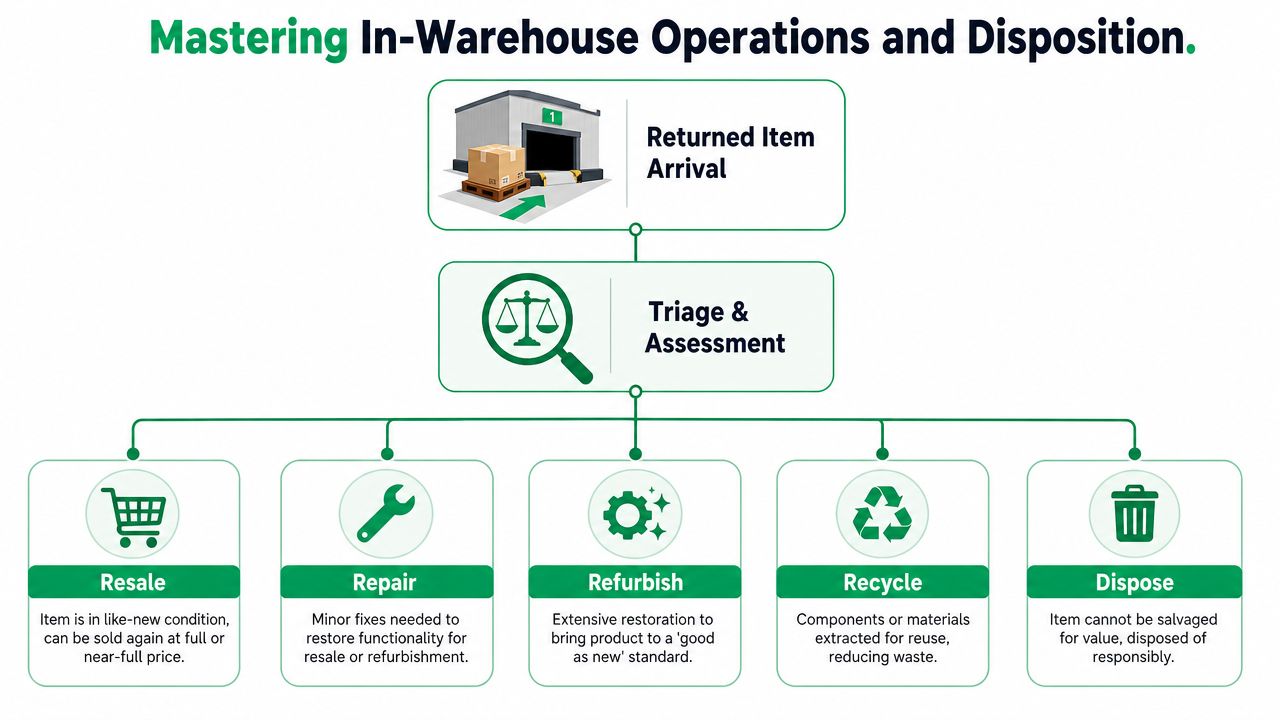
Build a disposition hierarchy
Every returned item should move through a clear hierarchy of possible outcomes. The hierarchy keeps your team focused on recovering the highest practical value first.
A useful order of operations is:
Restock for primary sale
Best outcome when packaging and product condition allow it.Refurbish or repair
Worth doing when labor and parts don't exceed likely resale value.Move to a secondary channel
Liquidation, off-price, marketplace, or bulk sale can recover value from imperfect goods.Recycle components or materials
Important when the item can't be sold but still has material value.Dispose responsibly
Last option, not the default shortcut.
Teams get into trouble when these decisions are made informally. “Put it in damages” is not a disposition strategy. It's an accounting bucket.
Standardize grading and routing
The best warehouse teams remove subjectivity wherever possible. That means defining condition grades, documenting inspection rules, and attaching clear actions to each result.
A practical triage sheet usually includes:
- Seal status: unopened, opened, missing packaging
- Product condition: new, sellable, repairable, unsellable
- Accessory completeness: manuals, cables, inserts, tags
- Reason-code check: does the returned condition match the customer's claim
- Final route: restock, repair, liquidate, recycle, dispose
Use Shopify order tags and your WMS status fields to reflect those decisions cleanly. If the item is restocked, inventory should update fast. If it's routed elsewhere, finance and merchandising need visibility into that outcome.
Returned products need a shorter decision cycle than outbound inventory. Every extra touch and every extra day reduce recoverable value.
One secondary channel many operators overlook is the bin-store ecosystem. If you're evaluating liquidation routes for low-value or mixed-condition goods, it helps to understand how buyers think about sourcing bin store inventory and why certain categories move better there than in traditional resale channels.
The core discipline is simple. Don't let the warehouse “figure it out later.” Disposition rules should exist before the first return lands.
Integrating with 3PLs and Leveraging Technology
At a certain scale, reverse logistics management starts competing with growth initiatives for attention. Your team can keep handling returns in-house, but that choice has a cost. Warehouse space, management time, software complexity, and process discipline all increase as return volume rises.
The right answer isn't always outsourcing. It depends on what kind of business you're running and where your operational bottlenecks sit.
In-house versus 3PL
Here's the practical comparison most Shopify operators need:
| Model | Strengths | Limits |
|---|---|---|
| In-house reverse logistics | Tight control over brand standards, direct access to inventory decisions, easier feedback loop with merchandising | Requires warehouse capacity, SOP discipline, staffing, and systems maturity |
| 3PL-managed reverse logistics | Frees internal team capacity, can add specialized process capability, useful when geography or volume becomes hard to manage internally | Less direct control, integration risk, and potential mismatch between provider workflow and customer experience |
In-house usually makes sense when your catalog is narrow, your team is operations-heavy, and returns need nuanced product knowledge. A 3PL becomes more attractive when return volume strains your internal operation or when you need distributed processing.
What to evaluate in a reverse-capable 3PL
Not every 3PL that handles outbound fulfillment is strong at returns. Many can receive a box. Fewer can inspect, grade, disposition, and report with enough precision to protect margin.
When assessing providers, focus on these areas:
Returns-specific SOPs
Ask how they inspect, grade, photo-document, and route goods.System integration depth
A decent provider syncs status. A strong one syncs reasons, approvals, inventory adjustments, and exception flows.Disposition flexibility
They should support more than refund-and-scrap logic.Geographic fit
The best network is the one that aligns with your customer base and product characteristics.Exception handling
Reverse logistics always produces edge cases. You need a partner that can escalate intelligently.
The software layer matters as much as the warehouse layer. If your Shopify data, returns platform, and 3PL system don't stay in sync, teams start working off conflicting records.
For operators comparing systems, it helps to understand what modern third-party logistics software should support across statuses, warehouse events, and inventory synchronization.
Integration determines whether outsourcing works
The handoff between your store and the 3PL should be as close to real time as your stack allows. Otherwise, avoidable problems show up fast. Refunds issued before inspection. Returned inventory not available for resale. Support agents telling customers one thing while the warehouse sees another.
A workable technology setup usually includes:
- Return authorization data from Shopify or your returns layer
- Receipt confirmation from the 3PL
- Inspection and grading outcome
- Inventory update by disposition result
- Customer status messaging tied to actual warehouse events
If a provider can't support that visibility, the apparent simplicity of outsourcing disappears. You'll still do the work. You'll just do it through email threads and reconciliation reports.
Measuring Success with KPIs Cost Control and Fraud Detection
If you don't measure returns at the unit-economics level, reverse logistics management turns into storytelling. Support says the process feels smoother. Warehouse says intake is under control. Finance says margins look worse. All three can be telling the truth because they're looking at different slices of the same problem.
You need a shared scoreboard.
Track the metrics that change decisions
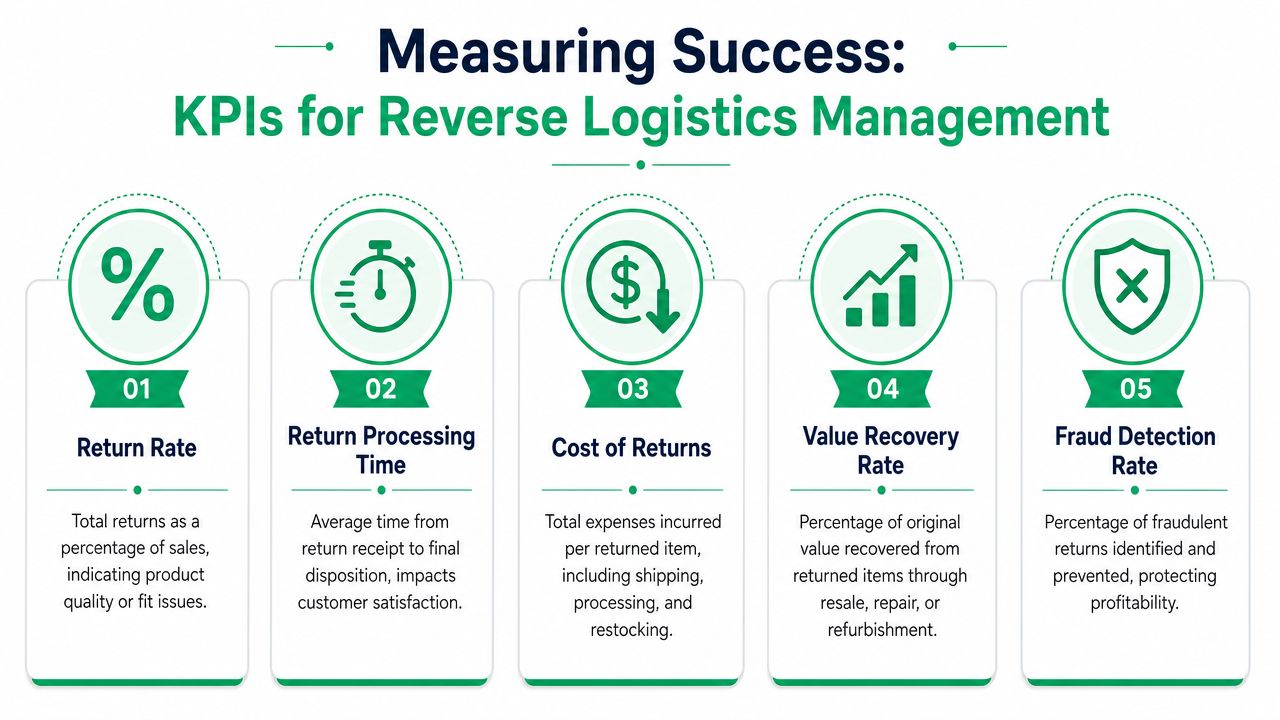
A useful reverse-logistics dashboard isn't huge. It's focused. Start with the KPIs that tell you where value is being lost or protected.
Return rate
This is the broad signal. Watch it by product, channel, campaign, and customer segment.Cost per return
This includes shipping, handling, inspection, relabeling, restocking, and disposal costs. If you want a deeper framework for the operational and margin impact, this guide on the cost of returns is a good reference point.Return-to-stock time
Slow restocking traps working capital and delays resale.Value recovery rate
This tells you whether warehouse disposition decisions are preserving margin.Exchange conversion
For categories where exchanges are viable, this shows whether your workflow keeps revenue in motion.
The biggest mistake is tracking only overall return rate. That metric tells you there's smoke. It rarely tells you where the fire is.
Cost control starts with segmentation
A strong dashboard slices returns into actionable cohorts. By SKU. By reason code. By warehouse. By fulfillment partner. By customer history. By acquisition source.
That level of segmentation helps you answer the questions that matter:
| Problem | Metric signal | Likely next step |
|---|---|---|
| Fit-related dissatisfaction | Return reasons cluster around size or expectations | Improve product page accuracy, imagery, and exchange flow |
| Warehouse bottleneck | Return-to-stock time rises | Redesign triage staffing and intake process |
| Low recovery value | Recovery rate drops by category | Tighten grading and disposition rules |
| Support overload | High ticket volume around return status | Improve automation and customer notifications |
| Abuse patterns | Returns cluster by customer behavior | Add review and policy controls |
Operator note: A metric is only useful if one owner can act on it. If a KPI sits on a dashboard with no clear decision-maker, it becomes decoration.
Fraud sits inside the data if you look for it
Returns fraud rarely announces itself cleanly. It shows up as patterns. Repeat high-frequency return behavior. Claims that don't match received condition. Products returned outside normal use expectations. Mismatches between reason code and actual item status.
You don't need a complicated fraud program to start. You need structured data and consistent review triggers.
Set flags for behavior such as:
- Repeated high-value return activity from the same customer record
- Frequent “item not as described” claims that don't match inspection results
- Disproportionate return behavior tied to specific products or campaigns
- Returns that repeatedly land just inside policy windows
- Unusual combinations of cancellations, edits, exchanges, and refunds
The key is balance. If you make the process hostile to honest customers, you'll create a new problem while solving another. Good fraud control is selective, evidence-based, and mostly invisible to legitimate buyers.
Optimizing for Profitability and True Sustainability
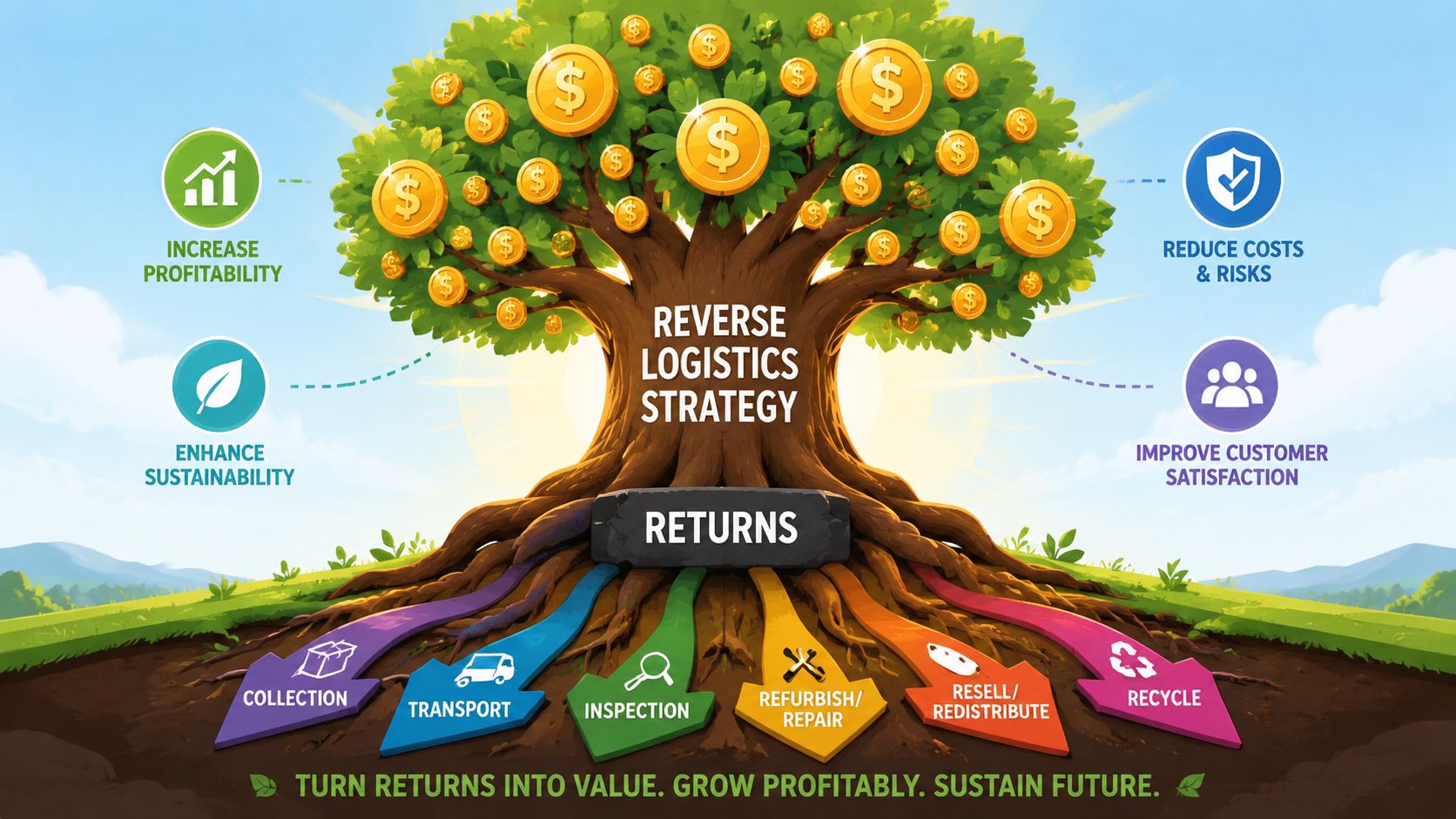
The best reverse logistics management systems don't just reduce loss. They create options. They help you hold revenue through exchanges, recover more value from returned goods, generate cleaner product feedback, and back sustainability claims with evidence instead of marketing language.
That's the shift from a defensive program to a strategic one.
Profit comes from preserving choices
When the returns process is rigid, every issue collapses into the same answer. Refund the order. Move the box. Accept the loss.
A more mature setup gives the business multiple profitable paths:
- Exchange instead of refund when the product mismatch is fixable
- Store credit when the customer still wants something from the catalog
- Secondary resale when the item can't go back to the main storefront
- Refurbishment or repair when labor creates recoverable value
- Recycling or responsible disposal when selling isn't realistic
The hidden benefit is better decision quality upstream. Returns data can influence buying depth, packaging changes, PDP content, quality-control priorities, and even promotional strategy. If the same return reasons keep appearing, reverse logistics is telling you where the forward operation is weak.
Sustainability needs proof, not slogans
Many brands get exposed. They describe their returns process as circular or eco-friendly, but they can't show what happens to the product after intake.
That gap matters because many retailers' sustainability claims are undermined by poor infrastructure, with up to 40% of returned items being destroyed, according to AsstrA's discussion of reverse logistics. If you can't track disposition outcomes with confidence, you can't prove waste reduction.
What real sustainability discipline looks like:
Capture return reason data accurately
Bad reason coding weakens every downstream decision.Track final disposition by item
Restocked, exchanged, refurbished, liquidated, recycled, disposed. Each path should be visible.Separate aspiration from evidence
Don't publish claims your systems can't support.Use infrastructure to improve outcomes
Faster triage, better sorting, and clearer routing rules are what make sustainability claims credible.
The brands that win here don't talk about circularity in the abstract. They can show where returned inventory went, why it went there, and what they changed to improve the next cycle.
The strategic payoff
A well-run reverse operation does four jobs at once. It protects margin. It improves customer trust. It reduces waste where possible. And it gives leadership better operating intelligence.
That's why the strongest Shopify teams stop treating returns as a narrow support workflow. They connect post-purchase editing, policy design, warehouse disposition, partner integration, and KPI discipline into one system.
When those pieces work together, reverse logistics stops acting like a tax on growth. It becomes part of how you grow without losing control.
If you run a Shopify store and want to prevent avoidable returns before they hit support or the warehouse, SelfServe is built for that exact post-purchase gap. It lets customers edit order details within your rules, supports multilingual experiences, validates addresses in real time, and helps teams reduce manual tickets while keeping tighter control over reverse logistics from the moment an order is placed.