What Is the Difference Between UPS and USPS for Ecommerce Shipping
For any ecommerce business owner, picking a shipping carrier isn't just a logistical step—it's a core part of your business strategy that directly impacts your bottom line and what your customers think of you. The choice often boils down to two giants: UPS and USPS.
At a glance, the trade-off seems simple. USPS is almost always the go-to for keeping costs down, especially on smaller, lighter packages heading to someone's home. On the other hand, UPS is the premium choice when speed is critical, you need a guaranteed delivery date, and you want top-notch tracking every step of the way.
UPS vs USPS: A Head-to-Head Carrier Comparison
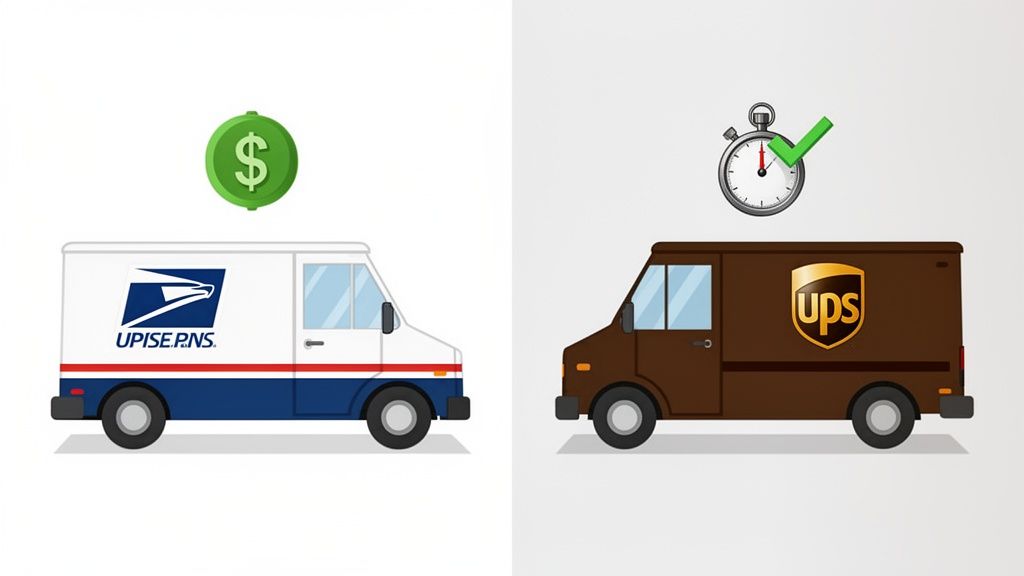
Choosing between these two isn't just about printing a label. It’s about creating a fulfillment strategy that works. The two operate on completely different models, and that trickles down to affect everything from your shipping rates to the final unboxing experience for your customer.
United Parcel Service (UPS) is a massive, publicly-traded logistics company. Their world revolves around profit and efficiency, which they achieve through an incredible network fine-tuned for business-to-business (B2B) shipments and time-sensitive deliveries.
United States Postal Service (USPS), in contrast, is an independent agency of the federal government. They have a universal service obligation, meaning their mission is to deliver to every single address in the country at an affordable price. This mandate puts widespread coverage and cost-effectiveness first.
This core difference in their mission is everything. It explains why USPS can offer such competitive rates for standard shipping, while UPS provides premium services with ironclad guarantees and much more detailed tracking.
Market Position and Strategy
You can see this difference play out in their market share. The data shows that while USPS delivered more packages—a staggering 6.9 billion parcels, making up 30.8% of the total volume—UPS actually brought in more money.
UPS captured 34.3% of the market's revenue compared to just 15.8% for USPS. This tells you everything you need to know about their strategies: UPS focuses on higher-value, premium services that businesses are willing to pay more for. You can explore a full breakdown in the latest Pitney Bowes Parcel Shipping Index, the industry standard for this data.
This guide will break down what these differences really mean for your shop and help you decide which carrier makes the most sense for each type of order you ship.
To get started, here’s a quick summary of the most important distinctions between UPS and USPS.
Quick Look: UPS vs USPS Key Differentiators
This table gives you a high-level view, but as you know, the devil is in the details. Now, let’s dig deeper into the specific service levels, pricing structures, and real-world scenarios you’ll face every day.
Comparing Pricing and Rate Structures
When you're comparing UPS and USPS, looking at the sticker price is just scratching the surface. The real cost differences are buried in their pricing models, which are fundamentally different. For any ecommerce merchant watching their margins, understanding this nuance is everything.
USPS has built its reputation on straightforward, often cheaper pricing, especially for smaller packages. If you ship a lot of items under five pounds, a service like USPS Ground Advantage is almost always your most cost-effective bet. A huge part of this is that USPS has far fewer surcharges—you won't get hit with extra fees for residential deliveries, which can be a massive hidden cost for D2C brands.
The best example of this simplicity is their Priority Mail Flat Rate service. If it fits, it ships for one flat price, no matter the destination or weight (up to 70 lbs). This takes all the guesswork out of the equation and lets you offer predictable shipping rates to your customers.
How UPS Pricing Differs
UPS, on the other hand, operates on a much more complex pricing structure. While their rates can be very competitive for heavier shipments, the final cost is a combination of a base rate and a whole menu of potential surcharges. Think fuel fees, residential delivery charges, peak season surcharges, and extra handling fees for oddly shaped boxes.
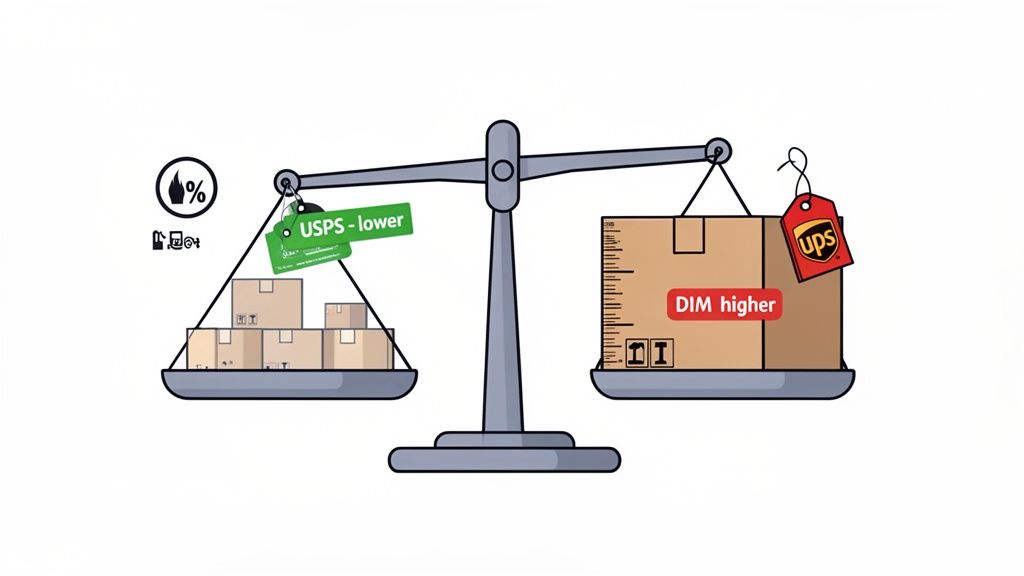
The biggest gotcha with UPS is dimensional (DIM) weight. They calculate a "volumetric" weight for every package based on its size. If that DIM weight is higher than the actual scale weight, you pay the higher price. This can make shipping large but lightweight items, like pillows or bulky apparel, surprisingly expensive.
This is where the real-world comparison comes into play. A small, 2lb package might be 30-40% cheaper to send with USPS. But once you get to a 15lb shipment, UPS Ground often becomes the more economical choice, particularly if you've negotiated business rates.
Let’s put this in practice. A Shopify store selling t-shirts and accessories would likely find USPS Ground Advantage unbeatable for the vast majority of its orders. But if that same store gets a bulk order for heavy winter coats or a customer needs an expedited delivery with a firm guarantee, a negotiated UPS rate could offer a better blend of cost and service. Smart businesses automate this decision-making with the best Shopify shipping apps, which can apply rules to pick the right carrier for every single order.
Ultimately, choosing between USPS and UPS isn't about picking one and sticking with it. It’s about building a hybrid shipping strategy. You set up your system so that smaller, standard orders default to USPS to maximize savings, while larger, heavier, or time-sensitive orders automatically route to UPS. That way, you’re never overpaying.
Delivery Speed and Reliability: Promises vs. Projections
When a customer clicks "buy," they're not just purchasing a product; they're buying the promise of its arrival. This is where delivery speed and reliability come into play, and it’s an area where UPS and USPS have fundamentally different philosophies.
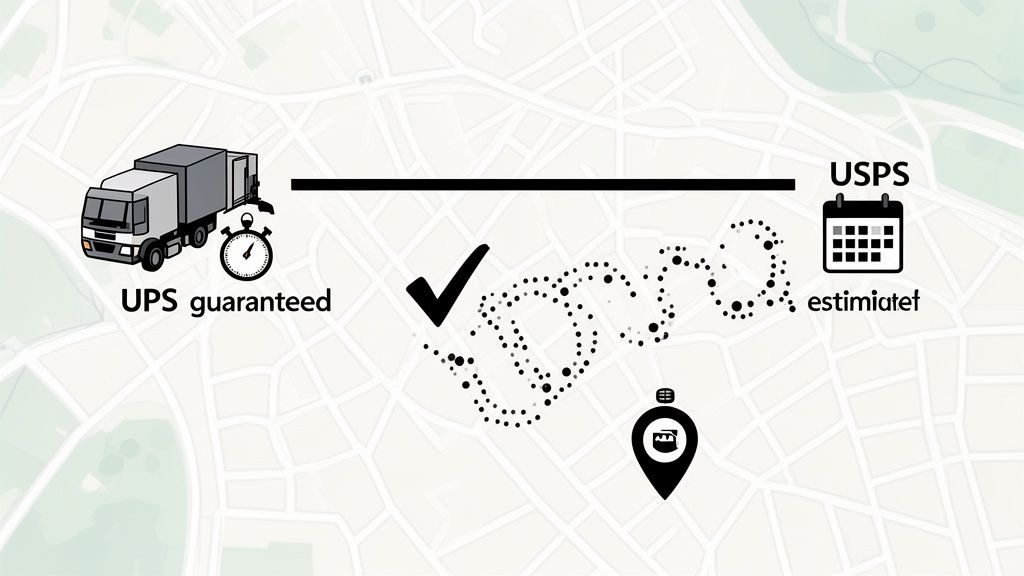
UPS built its entire brand on time-definite delivery. If you're using a service like UPS Next Day Air® or even the standard UPS Ground, you’re not getting a vague estimate—you're getting a money-back guarantee. If that package doesn't show up on time, you can often get a refund on your shipping costs.
How can they do this? It comes down to control. UPS owns and operates its entire network, from the truck that picks up the package to the one that drops it at the door. This tight integration is why their tracking updates are so granular, giving you and your customer a real-time view of the package's journey.
Where USPS Fits In on Speed
USPS has made huge strides in speed and reliability, but it plays by a different set of rules. Services like Priority Mail (1-3 business days) and the newer Ground Advantage (2-5 business days) come with delivery estimates, not guarantees.
While these services are dependable for the most part, the delivery windows are projections. A package arriving a day late won't trigger a refund. This distinction is everything for high-stakes shipments. For everyday orders where a day's delay isn't a disaster, USPS delivers incredible value. But for a critical B2B order or a special product launch, the certainty that UPS provides is often worth the extra cost.
The simplest way to think about it is that UPS sells certainty, while USPS sells cost-effective reach. Your choice really comes down to which one your customer needs for that specific order.
Performance Under Pressure: Holidays and International Shipping
The holiday season is the ultimate stress test for any shipping carrier. Year after year, performance data shows UPS has an edge, especially when time is of the essence. While USPS has improved its on-time performance, UPS's private network has proven more resilient, consistently hitting its targets for guaranteed 1- and 2-day services that cover over 95% of the U.S. population. You can see a detailed breakdown of carrier performance during peak season on FreightWaves.com.
This same logic applies to international shipping. UPS manages its own global air and ground fleet, giving you a seamless tracking experience from your warehouse to your customer's doorstep, no matter the country. USPS, on the other hand, hands off packages to the destination country's local postal service. This handoff can create tracking blackouts and introduces a new variable—the reliability of a foreign postal service you didn't choose.
For international orders where a predictable, controlled experience is a must, UPS is the clear winner.
Don't Get Blindsided by Surcharges and Package Rules
The rate you see upfront is rarely the rate you actually pay. The real cost of shipping is often buried in the fine print—the rules around package size, weight, and a laundry list of potential extra fees. This is where UPS and USPS play by very different rulebooks, and understanding them is key to protecting your profit margins.
If you’re moving big, bulky, or heavy products, UPS is often your only practical choice. They’ll take packages up to 150 lbs and 165 inches in combined length and girth. For furniture, equipment, or large wholesale orders, USPS simply can’t compete on these specs.
The Hidden World of Surcharges and Dimensional Weight
But here's the catch: that flexibility from UPS comes with a complex and sometimes maddening system of surcharges. They add fees for just about everything—delivering to a residential address, handling a package that isn't a standard cardboard box, and even hitting you with "demand" surcharges during the busy holiday season.
The most important concept you have to wrap your head around is dimensional (DIM) weight. UPS looks at the size of your box, not just its weight, to determine the shipping cost. If you have a large, lightweight item, they calculate a "billable weight" based on its dimensions. You pay for whichever is higher: the actual weight or the DIM weight.
A classic ecommerce mistake is ignoring DIM weight. Imagine you're shipping a big box of decorative pillows. The actual weight might be just 5 lbs, but because the box is large, UPS could bill you as if it were a 30 lb package. That's a costly surprise.
On the flip side, USPS is all about simplicity. Their weight limit is a stricter 70 lbs, but their pricing is far more predictable. Key services like Priority Mail and the newer Ground Advantage have no residential surcharges and no fuel surcharges. What you see is pretty much what you get.
This straightforward approach shines with USPS Priority Mail Flat Rate boxes. If your product fits, it ships for one set price, no matter how much it weighs (up to the 70 lb limit) or where it's going in the U.S. This is a game-changer for shipping dense, heavy items that can be squeezed into one of their standard-sized boxes.
To keep your shipping costs in check and avoid those nasty surprises, build this checklist into your process:
- Validate Every Address: Both carriers will hit you with address correction fees. Use an address validation tool in your shipping software to catch typos before they cost you money.
- Measure Everything: Don't guess. Get the exact weight and dimensions for every package. This is your only defense against unexpected DIM weight charges from UPS.
- Stick to Standard Boxes: Odd-shaped packages or things not fully encased in cardboard can trigger an "Additional Handling" surcharge with UPS. Keep it simple.
- Master the Flat Rate: If you have a heavy item that fits, a USPS Flat Rate box is almost always your cheapest bet. Know the box sizes and use them strategically.
By getting a handle on these details, you can stop reacting to high shipping bills and start proactively choosing the right carrier for each specific order.
Daily Workflows and Managing Returns
Beyond the numbers on a rate sheet, a carrier’s day-to-day operations have a huge impact on how smoothly your business runs. How you get packages out the door and how you handle them when they come back are where the differences between UPS and USPS really come into focus.
When you're shipping dozens or hundreds of orders a day, you can't just pile them by the door and hope for the best. This is where UPS shines. Their scheduled pickup services are built for business and are incredibly reliable—a must-have for any serious high-volume operation. Add to that a massive network of The UPS Store locations and other access points, and you’ve got great flexibility for dropping off packages, too.
USPS does offer free package pickups for services like Priority Mail, but it’s a different beast entirely. It’s designed for a mail carrier to grab a handful of packages during their normal route. If you have a cart full of orders, that system can quickly fall apart.
The Inevitable Returns Process
Returns are just part of the ecommerce game, and your returns process says a lot about your brand. Here again, the two carriers offer very different experiences for you and your customer.
At its core, the difference is simple: UPS is a private company built for business logistics, while USPS is a federal service mandated to serve everyone, everywhere. This one fact shapes everything from daily pickups to how your customers send a product back.
UPS gives you a more controlled, business-focused returns experience. You can easily generate return labels and give customers the option of dropping off a package or even scheduling a pickup. For your business, this means a clean, trackable reverse logistics flow.
But for your customer, nothing beats the convenience of USPS. With over 31,000 Post Offices and those iconic blue collection boxes on what feels like every corner, it's the easiest drop-off option for most people. This is why many merchants ship out with UPS but provide a USPS label for returns—it’s a simple way to improve the customer experience. For more on this, check out our guide on how to manage returns and refunds smoothly on Shopify.
These operational differences stem from their very foundations. UPS, founded in 1907, is a publicly-traded logistics giant that generated $88.7 billion in revenue in 2026 from moving 5.2 billion packages. Meanwhile, the government-run USPS is driven by a mission of universal service, not profit, and delivers roughly 7 billion parcels annually. Understanding this fundamental split is key to deciding when to pay for premium service and when to lean on everyday convenience. You can find more data on the North American postal services market on MordorIntelligence.com.
Choosing the Right Shipping Strategy for Your Store
When it comes to UPS vs. USPS, one of the most common mistakes I see merchants make is trying to find a single "best" carrier. The truth is, there isn't one. The smartest e-commerce brands don't pick a side; they build a flexible shipping strategy that uses both carriers for what they do best.
This hybrid approach is all about balancing cost, speed, and customer happiness. It means you stop guessing and start creating simple, automated rules that ensure every single package goes out the door using the most cost-effective method—without you having to think twice about it.
Building Your Rule-Based Shipping Logic
Think of this as creating a decision tree for your fulfillment team. You’re setting up the logic ahead of time so your shipping software can do the heavy lifting. This turns a complex decision into a simple, hands-off process that saves money and keeps customers happy.
Here are a few practical rules you can build on:
- Lightweight Orders: If a package weighs under 2 pounds and is going to a home address, make USPS Ground Advantage your default. For small, light items, its cost and reliability are just about impossible to beat.
- Heavier Shipments: For anything over 10 pounds or B2B orders shipping to a commercial address, your go-to should be UPS Ground. Their network is built for heavier parcels, and your negotiated rates will almost always make them the cheaper option here.
- Guaranteed Delivery: When a customer pays for expedited shipping or you're sending a high-value item, a guaranteed service is a must. Something like UPS 2nd Day Air® becomes non-negotiable. It protects your customer's expectations and the value of the product inside the box.
A hybrid strategy lets you use USPS for its incredible cost-efficiency on the majority of your orders, while calling on UPS for its speed, muscle, and reliability on the shipments that really count. It’s truly the best of both worlds.
This same logic applies perfectly to your returns process. The flowchart below shows how you can build a simple system that makes returns easy for customers while keeping your own operational costs in check.
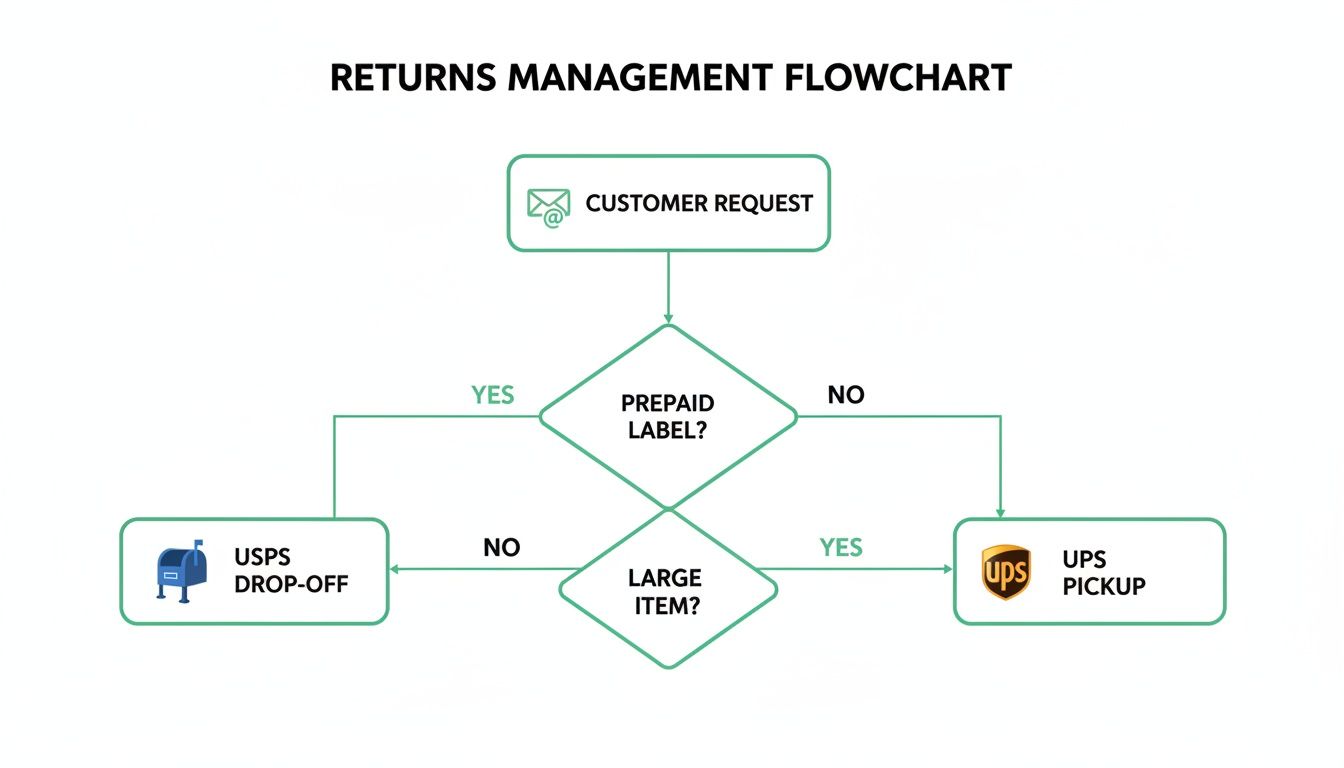
This workflow is a great example of balancing customer convenience (easy USPS drop-offs) with your team’s operational needs (scheduling a UPS pickup for that bulky return).
Automating Your Hybrid Strategy in Real-Time
The real magic happens when you let software automate these decisions. Modern shipping platforms can look at an order's weight, value, and destination in real-time and instantly pick the right carrier and service.
Imagine a customer adds a high-value item to their cart at the last minute. Your system could automatically upgrade the shipment from a standard USPS service to an insured UPS option, protecting the package without your team lifting a finger. You can explore more of these automation tactics in our guide to shipping and fulfillment best practices for Shopify merchants.
Frequently Asked Questions
Even after comparing UPS and USPS side-by-side, a few questions always pop up. Let's tackle some of the most common ones we hear from merchants trying to build a bulletproof shipping strategy.
Is UPS Always More Expensive Than USPS?
That's a common misconception. While USPS generally wins on price for small, light packages (think anything under 5 lbs), the script flips once you get into heavier items. For shipments over 10-15 lbs, you'll often find UPS Ground is more affordable, especially if you have a business account with negotiated rates.
But weight isn't the whole story. The real wild card is dimensional (DIM) weight. A large, lightweight box—say, one full of decorative pillows—can trigger surprisingly high costs with UPS because you're paying for the space it takes up on the truck. On the other hand, a heavy but compact item might be cheaper to ship with a USPS Priority Mail Flat Rate box, since the price is the same regardless of weight.
Which Carrier Is Better for High-Value Products?
When you’re shipping something expensive, peace of mind is paramount. For that, UPS is almost always the better choice. Their tracking system is more detailed and updates more frequently, giving both you and your customer a clear view of the package's journey.
UPS also includes $100 of insurance by default and lets you declare a value up to $50,000 for extra coverage. While USPS is plenty reliable for everyday shipments, the superior tracking and much higher insurance ceiling from UPS are critical for protecting high-value goods.
Can I Use Both UPS and USPS for My Store?
Not only can you, but you absolutely should. Relying on a single carrier is a surefire way to overspend on shipping. The smartest ecommerce brands use a hybrid strategy, leveraging both carriers for what they do best.
This is where shipping software really shines. You can set up simple rules to automate your decisions—for instance, a rule could automatically assign USPS for all packages under two pounds, and then switch to UPS for anything heavier or requiring a time-sensitive delivery. This way, you’re always getting the most cost-effective rate for every single order without having to think about it.
Ready to stop overpaying for shipping and reduce customer support tickets? SelfServe empowers your customers to edit their own orders post-purchase, validating addresses in real-time to prevent costly delivery errors. Explore how SelfServe can streamline your Shopify operations.