Subscription Box Shopify: Start & Grow Your Business

Analysts expect subscription commerce to keep expanding over the next decade, but growth alone does not make a subscription box Shopify business healthy. The brands that hold margin usually win after checkout, where retention, billing recovery, inventory planning, and customer account management decide whether recurring revenue stays recurring.
I've seen profitable boxes stall because the team treated subscriptions like a marketing offer instead of an operating model. A subscriber is not just a new order on a cadence. Each account creates ongoing work across renewals, skipped shipments, address edits, support policies, and warehouse timing.
That is why operators studying companies with successful subscription business models should pay as much attention to post-purchase systems as they do to product curation. Strong creative can get the first order. Stable processes keep months two through twelve from turning into avoidable churn.
A well-built subscription program on Shopify gives customers clear control over their recurring orders and gives your team fewer exceptions to clean up by hand. If those back-end mechanics are weak, a good launch can still turn into a support-heavy, margin-thin business. If they are well set up, even a modest offer can develop into a dependable recurring revenue stream.
The Real Opportunity in Subscription Commerce
Most subscription content overweights front-end tactics. Better landing pages. Better hooks. Better launch offers. Those matter, but they don't explain why some stores keep growing while others stall after an initial burst.
The primary opportunity sits in retention economics. If most subscription revenue comes from existing subscribers, then your first order is only the beginning. That's why a strong subscription box Shopify setup has to be designed around continuity, not novelty alone.
Revenue concentration changes the playbook
The market numbers are large enough to attract almost every DTC category now. But large markets also get crowded quickly. Competing on acquisition alone usually pushes merchants toward discounting, overpromising, or building a box experience they can't operationally support.
A better approach is to treat the subscription as a service operation.
That means asking questions most launch checklists ignore:
- Can customers skip a shipment easily when their pantry is full or they're traveling?
- Can your team manage billing exceptions without creating a support backlog?
- Can your fulfillment partner kit recurring orders accurately on the same cadence every cycle?
- Can customers update addresses before the next charge or shipment without opening a ticket?
Practical rule: If a subscriber has to contact support to make a simple recurring-order change, your retention system is already under strain.
Merchants that understand this early usually build healthier recurring revenue. They don't see post-purchase operations as an administrative layer. They see it as the engine that protects lifetime value.
Shopify is well suited to subscriptions, if you build beyond checkout
Shopify is a strong foundation because it gives merchants speed, app flexibility, and a familiar commerce environment. But the storefront is only part of the equation. Recurring businesses succeed when Shopify is connected to the right subscription logic, customer communications, and post-purchase controls.
If you want examples of how different recurring models work across industries, this roundup of companies with subscription models is useful because it shows how broad the category has become.
The takeaway is simple. The opportunity in subscription commerce is real, but the brands that capture it usually win after checkout, not just before it.
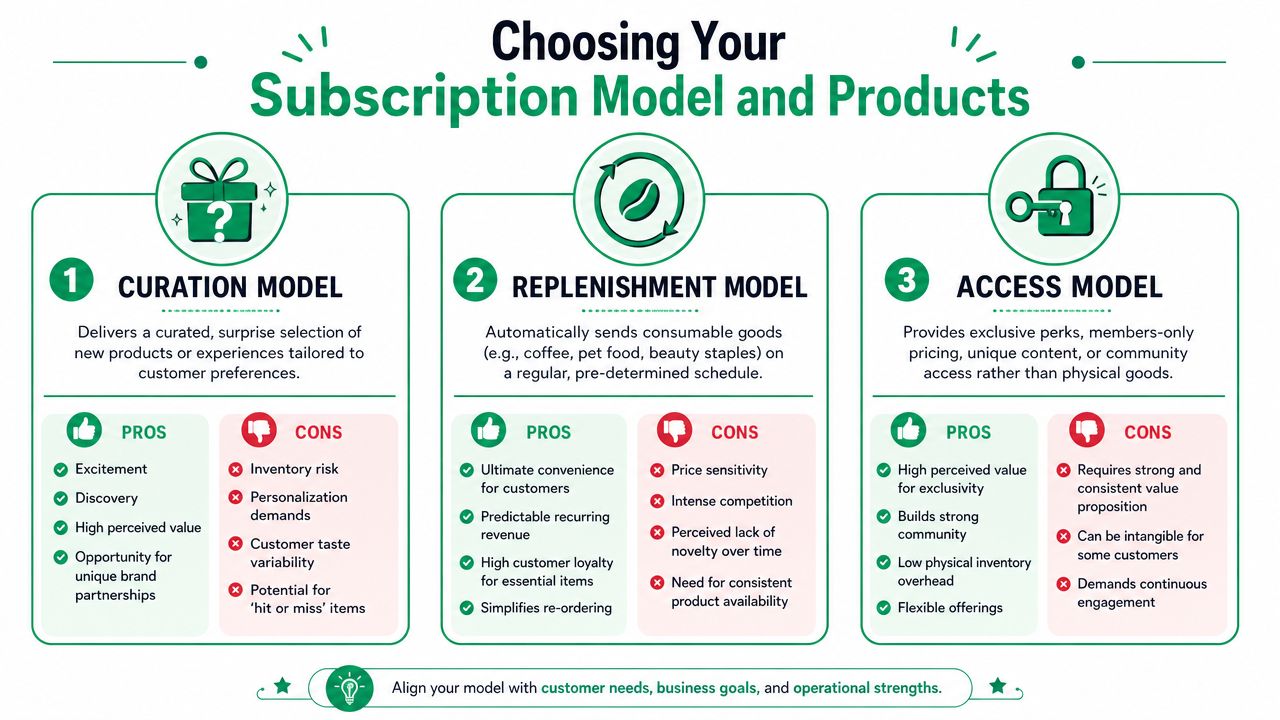
Choosing Your Subscription Model and Products
Before picking apps or writing product copy, choose a model that fits your product behavior and operational capacity. That decision shapes your inventory risk, support load, packaging flow, and retention strategy more than merchants expect.
On Shopify, subscription orders may carry an average order value 15% to 25% lower than one-time purchases, but longer customer lifespan can lift total value by 3x to 5x. The same industry guide reports average subscriber lifetime value at $350 to $800+ versus $168 for one-time buyers, as outlined in Easy Apps Ecommerce's Shopify subscription commerce statistics.
Curation works when surprise is part of the value
Curation boxes sell discovery. Beauty, snacks, hobby products, specialty food, and seasonal gifting all fit here. Customers subscribe because they want someone else to make smart selections for them.
This model can create strong perceived value, but it's operationally demanding. You need a content calendar, tight supplier coordination, and a clear plan for managing substitutions when featured items run short. Taste variability also creates churn risk. One weak box can do more damage than merchants expect.
If you're in a category where experience matters as much as convenience, curated alcohol and tasting programs can be a helpful reference point. Blind Barrels has a solid example of how premium discovery offers are framed in its guide to discover craft spirits subscriptions.
Replenishment is operationally cleaner, but less forgiving on price
Replenishment works best for consumables. Coffee, supplements, pet products, skincare basics, and household staples are classic fits. The customer promise is simple: don't run out.
This model is usually easier to forecast because repeat purchase behavior is more predictable. It also lends itself to cleaner SKU structures. In many cases, one core product can support multiple delivery cadences without forcing a large merchandising burden.
The trade-off is competition. If the product is easy to compare, buyers notice price quickly. Retention depends on convenience, product quality, and frictionless account management. Novelty won't carry you for long.
Access models remove physical complexity, but require stronger ongoing value
Access subscriptions sell membership rather than a monthly box. That could mean exclusive pricing, members-only drops, private community access, or premium educational content bundled with products.
For merchants, the upside is lower physical inventory pressure. The downside is that value can feel abstract if you don't refresh the offer consistently. Customers need a clear reason to keep paying after the initial sign-up.
How to choose the right fit
Use this decision filter before you build your catalog:
| Model | Best fit | Main risk | Catalog advice |
|---|---|---|---|
| Curation | Discovery-driven categories | Merchandising misses and inventory substitutions | Keep a tight core assortment and backup items ready |
| Replenishment | High-repeat consumables | Price comparison and routine fatigue | Build around a small number of repeatable hero SKUs |
| Access | Community, exclusivity, or education | Weak ongoing value perception | Define recurring benefits before launch |
Your model should match how customers already use the product. Don't force a subscription onto an item that doesn't naturally deserve repeat commitment.
In practice, most merchants should start narrower than they want to. One hero offer, a small set of variants, and a billing cadence customers immediately understand will outperform a complicated build-a-box experience launched too early.
Selecting Your Shopify Subscription App Stack
Subscription app decisions usually look simple during setup. The hard part starts after launch, when billing rules, customer edits, failed payments, and fulfillment timing all have to stay aligned across every cycle.
That is why I do not evaluate subscription apps as storefront add-ons. I evaluate them as operating infrastructure for recurring revenue. If the app cannot support clean renewals, subscriber self-service, and reliable data flow into your warehouse and support tools, the team ends up fixing preventable issues by hand.
Start with payment recovery and account management
A polished sign-up widget helps conversion, but retention usually breaks later. Failed renewals, expired cards, and clumsy account edits create avoidable churn long before a customer decides they no longer want the box.
Review dunning and account-management workflows first:
- Retry logic: Can you control retry timing and the number of attempts?
- Payment updates: Can subscribers update cards quickly from email or their account?
- Customer communication: Are failed payment messages editable and sent at the right intervals?
- Portal permissions: Can customers skip, pause, swap, delay, or cancel without opening a support ticket?
If those basics are weak, the team ends up spending too much time on recovery work that should be automated.
Evaluate the stack as an operations system
The right app depends on how your subscription program operates. A monthly curated box has different needs than a replenishment plan with rolling anniversaries. Prepaid plans, build-a-box logic, gift subscriptions, and mixed carts all create added complexity.
Here is the framework I use when reviewing Shopify subscription apps for growing brands:
| Criterion | Why It Matters | What to Look For |
|---|---|---|
| Billing logic | Renewal timing drives inventory planning, support volume, and cash flow | Flexible frequencies, prepaid options, renewal date controls, and clear plan rules |
| Dunning management | Recoverable failed payments should not become lost subscribers | Configurable retries, payment update flows, and editable recovery emails |
| Customer portal | Self-service reduces support load and gives customers more control | Skip, pause, swap, address edits, next-order visibility, and cancellation controls |
| API and integrations | Subscription data has to move cleanly into the rest of your stack | Reliable webhooks, API access, ERP compatibility, and 3PL integration support |
| Order creation controls | Billing and shipment timing need to match your warehouse schedule | Cutoff settings, batch processing options, hold logic, and renewal scheduling |
| Analytics visibility | Retention problems are hard to fix if you cannot isolate them | Cohort reporting, churn reasons, renewal reporting, and plan-level performance |
| Theme compatibility | Front-end friction still matters, especially on mobile | Stable widgets, clean cart behavior, and predictable theme support |
Pressure-test the app against your real workflow
App listings tend to emphasize front-end features. Operations teams live with the exceptions.
Test the stack against the scenarios your team will handle every week. Monthly batch shipping versus rolling renewals. Product swaps before charge date. Address changes after billing but before pick and pack. Order tags for warehouse routing. Gift messages, prepaid terms, and add-on products. These edge cases are where the wrong app starts creating friction across support, finance, and fulfillment.
For merchants mapping the payments side in more detail, this guide on recurring payments on Shopify is a useful reference point.
I also recommend checking whether your fulfillment partner can work with the subscription data the app produces. Clean order tagging, bundle logic, hold states, and renewal timing matter if you want to scale your brand with fulfillment.
Choose the stack your team can run accurately at month 12, not just the one that looks easiest during week one. Subscription growth puts stress on billing operations first. The app should reduce that stress, not pass it downstream to support and fulfillment.
Building Your Fulfillment and Retention Engine
A subscription box business is a fulfillment business with recurring revenue layered on top. Customers may buy because the concept is strong, but they stay because every shipment arrives when it should, in the condition they expect, with as little friction as possible.
That matters because the economics are back-loaded. A widely cited subscription box model estimates that an average 6-month customer tenure produces about $87 in profit, as discussed in this subscription box economics breakdown. If the experience falls apart before those renewals happen, acquisition spend doesn't get enough time to pay back.
Fulfillment is part of retention, not just logistics
Late boxes, damaged packaging, wrong inserts, and stock substitutions don't show up only as warehouse errors. They show up later as skips, cancellations, chargebacks, and support tickets.
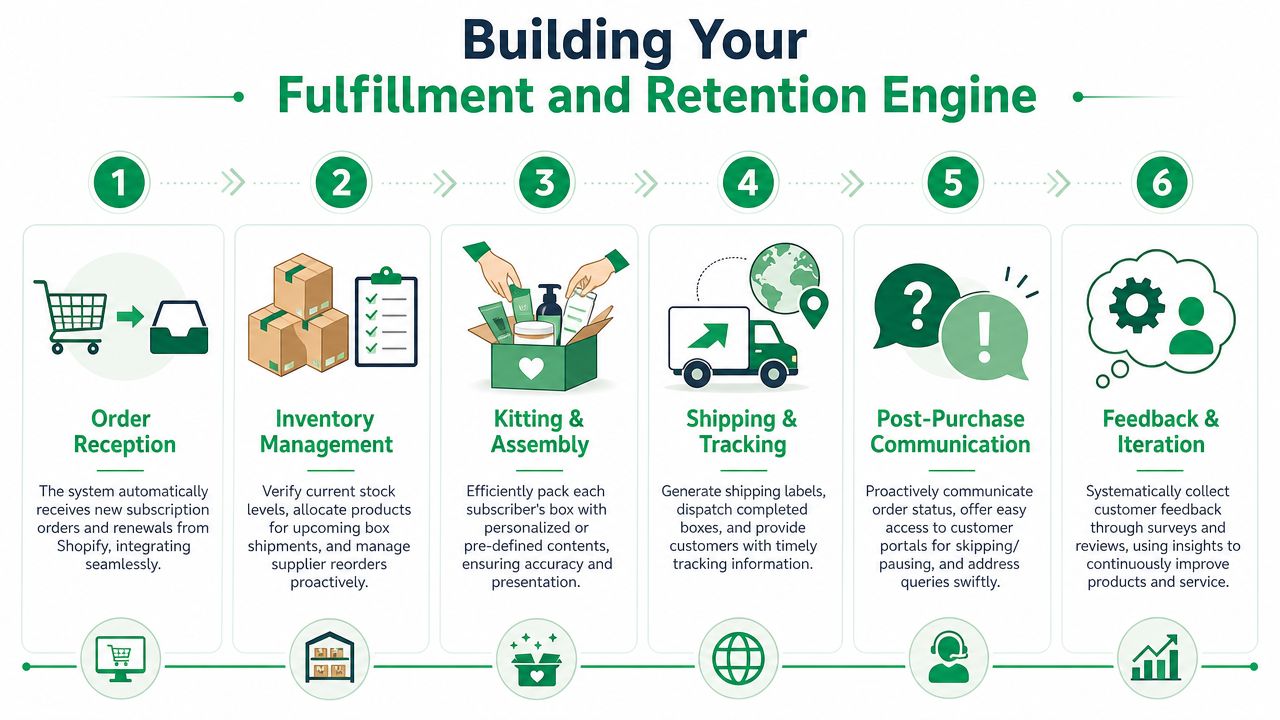
The operational goal is consistency. Subscribers don't grade you against one excellent shipment. They grade you against whether the second, third, and fourth cycle feel dependable.
The workflows that usually matter most
I've seen merchants overinvest in packaging details while underinvesting in shipment logic and replenishment planning. The sequence below matters more:
Lock your billing and ship windows
If renewals happen on one date and fulfillment teams need final counts on another, define those cutoffs clearly. Ambiguity creates customer confusion and internal scrambling.Forecast components, not just finished boxes
Kitted products hide inventory risk. One missing insert, flavor, or promo card can hold up an entire run.Design packaging for repeatability
The best subscription packaging isn't just attractive. It's fast to assemble, protects the product, and ships consistently without frequent exceptions.Build subscriber communication into the warehouse calendar
Charge emails, renewal reminders, shipment notifications, and delay notices should line up with actual operations, not idealized schedules.
When to outsource
Many brands hit a point where in-house packing stops making sense. The right fulfillment partner can help stabilize recurring shipping operations, especially once box assembly, storage, and batch release timing start consuming too much internal bandwidth. If you're evaluating that path, Snappycrate's overview on how to scale your brand with fulfillment is a practical reference.
For a broader look at outsourcing options, this breakdown of 3rd-party fulfillment companies is useful when you're comparing operational fit rather than just pick-and-pack pricing.
A subscriber rarely says, “I canceled because the warehouse missed a cutoff.” They cancel because the subscription stopped feeling reliable.
What strong operators do differently
Strong teams treat each shipment as both an order and a retention event. They watch for recurring failure points such as address issues, box damage, kit inaccuracies, and customer confusion around renewal timing. Then they fix the process, not just the incident.
That discipline is what turns recurring billing into recurring profit. Without it, subscription revenue looks smoother on a dashboard than it feels in the business.
Reducing Churn with Smart Post-Purchase Management
Manual post-purchase support is one of the least appreciated costs in subscription operations. It is often noticed only after growth creates a queue of “change my address,” “skip this month,” “swap this item,” and “cancel my next shipment” requests.
The problem isn't only labor. It's friction.
If a subscriber has to email support for a simple recurring-order change, you're creating a small moment of frustration inside a business model that depends on convenience. Existing guides tend to focus on acquisition, but the more durable lever is reducing friction in order edits, address validation, and account management, as argued in this discussion of post-purchase operational bottlenecks.
Why manual workflows push churn higher
A subscriber who wants to skip one month usually isn't asking to leave forever. They're asking for flexibility. If your process turns that request into a delay, a support exchange, or a forced cancellation path, you're teaching customers that staying subscribed is harder than leaving.
This is also where operations and finance overlap. The same subscriber who might have skipped and stayed can become a cancellation if your team can't resolve the request before the next charge or pick cycle.
The self-service functions that actually matter
Not every customer-facing feature reduces support load equally. These usually matter most:
Skip and pause controls
These protect retention when demand is temporary but commitment to the brand is still intact.Address editing within defined windows
Address changes are common in recurring commerce, especially around travel, gifting, and moving. Letting customers correct this themselves prevents shipment exceptions.Product swaps where appropriate
This matters more in curation and hybrid models, where taste fit can drift over time.Transparent cancellation paths
Hiding cancellation often creates more tickets and more frustration than it prevents.
The best churn reduction tactic is often giving customers a lower-friction alternative to canceling.
For operators who want a stronger grasp of churn mechanics before they redesign these flows, this guide from Million Dollar Sellers on customer churn is a helpful reference for thinking through the metric operationally.
Turn service moments into revenue moments
Post-purchase management doesn't have to be defensive. It can also increase order value when done carefully.
A subscriber updating an order is highly engaged. They've logged in, they care about the shipment, and they're already in a buying mindset. That's a good place to offer relevant add-ons, limited extras, or complementary products. The key is restraint. Add-ons should feel helpful, not like another obstacle between the customer and the change they came to make.
Here's a useful walkthrough on improving post-purchase flows and customer management:
Set rules, not open-ended exceptions
Merchants sometimes hear “self-service” and assume loss of control. The opposite is true when the system is configured correctly. Good post-purchase management lets you define exactly what customers can change, when they can change it, and which orders need manual review.
That structure protects your team from custom exception handling. It also gives customers a cleaner experience than back-and-forth email support ever will.
For a subscription box Shopify operation, that's one of the most practical retention upgrades you can make. It lowers avoidable support work, reduces frustration churn, and gives your recurring revenue model a better chance to stay recurring.
Scaling Internationally and Final Pre-Launch Checks
International subscription growth is where a lot of clean domestic setups start to break. What works in one market can create friction in another if billing expectations, payment preferences, shipping timelines, and customer messaging aren't localized.
Shopify's own guidance leaves this fairly broad, but one point is clear: local payment behavior matters. Insufficient payment options are a common cause of cart abandonment in many countries, which is why recurring checkout needs to be adapted to regional norms, as noted in Shopify's guide to subscription box ideas and global payment considerations.
What to localize before expanding
Don't treat international rollout as a translation project. It's an operations project.
Focus on these areas first:
Payment fit
Make sure recurring checkout aligns with how buyers in that market prefer to pay.Currency clarity
Customers should understand what they'll be charged and how renewals appear over time.Shipping expectations
Delivery promises need to reflect actual cross-border timelines, customs realities, and support coverage.Customer account messaging
Renewal notices, skip windows, and cancellation instructions should be easy to understand in the shopper's context.
Run a full renewal test before launch
A subscription box business shouldn't go live after only a successful first checkout test. You need to verify the whole lifecycle.
Run an end-to-end test that includes:
Initial purchase
Confirm plan selection, checkout flow, and confirmation messaging.Subscriber account actions
Test address changes, skips, pauses, swaps, and cancellations based on your rules.First renewal
Verify charge timing, renewal emails, and order creation behavior.Fulfillment handoff
Make sure the recurring order reaches your warehouse or 3PL correctly.Failed payment scenario
Check what the customer sees, what your team sees, and how recovery is triggered.
Launch only after you've tested the journey the customer will actually live through, not the one your storefront suggests.
A strong launch isn't about having every feature. It's about removing avoidable failure points before subscribers hit them. That's what makes a subscription box Shopify setup scalable instead of merely launchable.
If your team wants to cut support tickets, give customers controlled self-service options, and add post-purchase upsells without creating more operational chaos, take a look at SelfServe. It's built for Shopify merchants that need cleaner order edits, stronger customer experience, and a more scalable post-purchase workflow.