Subscription Box Service Business Model: Scale Your DTC
The number that should reset how you think about this category is USD 38.9 billion. That's the estimated size of the subscription box market in 2023, and it's projected to reach USD 139.2 billion by 2033 at a 13.6% CAGR, according to CatMan Global's subscription box market analysis.
That kind of growth doesn't happen because people enjoy cardboard boxes. It happens because the subscription box service business model solves three hard problems at once. It creates repeat purchasing behavior, gives operators better demand visibility than one-off retail, and turns customer experience into a measurable financial lever.
The mistake most founders make is treating a subscription box like a product bundle with billing attached. It isn't. It's an operating system. Pricing affects churn. Fulfillment choices affect retention. Packaging influences perceived value. Post-purchase flexibility can save a subscriber who would otherwise cancel. When these pieces work together, revenue becomes more stable and easier to forecast. When they don't, churn subtly undermines the model even while top-line sales look healthy.
The Recurring Revenue Revolution
Subscription commerce has moved far past novelty. A market that large, with that kind of projected growth, tells you something important. Customers have accepted recurring delivery as a normal way to buy across beauty, food, and lifestyle, not as a fringe behavior. The opportunity is real, but the value isn't in “having subscriptions.” It's in building a system that earns the next renewal.
Recurring revenue changes how an operator runs the business day to day. One-time retail forces constant reacquisition. A strong subscription business gives you another route. You still market aggressively, but you also improve what happens after the first order, because every retained subscriber raises the value of the customers you already paid to acquire.
Why operators love this model
The strategic appeal is simple:
- Revenue becomes easier to forecast: A base of active subscribers gives finance and operations a clearer planning horizon.
- Inventory planning gets less chaotic: Repeat cadence helps teams make better purchasing and kitting decisions.
- Customer relationships deepen over time: Each shipment becomes another chance to reinforce value, gather preferences, and reduce cancellation risk.
That last point matters most. In a healthy subscription business, growth doesn't come only from more customers. It also comes from better retention mechanics. Small improvements in save flows, box customization, billing options, and delivery experience can compound because they affect repeat orders, not just one checkout.
Subscription brands that win don't just acquire demand. They keep giving customers a reason to stay through the next billing cycle.
That's why the subscription box service business model deserves to be treated as a serious DTC discipline. It sits at the intersection of merchandising, logistics, finance, and customer experience. Operators who understand that interplay usually build something durable. Operators who don't often mistake early excitement for product-market fit.
The Three Pillars of Subscription Models
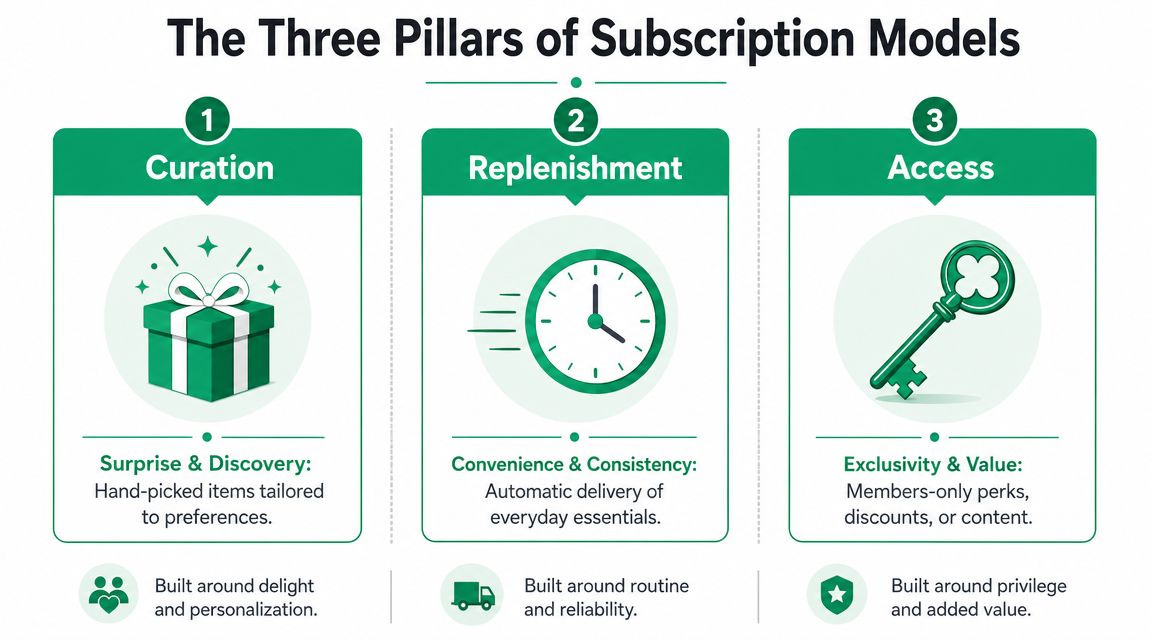
Every subscription box business sits on one of three models: curation, replenishment, or access. Stripe's overview of subscription box models makes the point clearly, and also notes that curated boxes usually require more complex forecasting and personalization systems than simpler replenishment offers, as explained in Stripe's guide to choosing a subscription box model.
Curation is discovery
Think of curation as a personal shopper. The customer pays for surprise, convenience, and taste. This works best when product discovery is part of the value proposition. Beauty, snacks, hobbies, and gifting are natural fits.
The upside is emotional engagement. The downside is complexity. You have to source broadly, maintain freshness in the assortment, and avoid repetition fatigue. If the box starts feeling predictable, churn follows. If the curation misses customer preferences too often, support tickets rise and renewal confidence drops.
Replenishment is convenience
Replenishment is the most operationally stable model. The customer subscribes because they already know what they need and don't want to reorder manually. Think coffee, supplements, pet consumables, skincare staples, and household basics.
This is usually easier to forecast because reorder logic is clearer. Marketing can also be more direct. You're not selling surprise. You're selling reliability, habit, and saved effort. The challenge is perceived replaceability. If your offer becomes a commodity, customers comparison-shop more aggressively and price sensitivity rises.
Access is membership
Access is different. The recurring payment provides benefits such as exclusive products, member pricing, early drops, or private content. Sometimes there's a box attached. Sometimes there isn't.
This model works well when the brand already has a strong identity or community. The retention question becomes: do customers feel they're part of something worth keeping? If the perks are thin, people leave fast. If the benefits are tangible and refreshed regularly, access can support strong loyalty without the same physical fulfillment burden as curation.
Subscription Model Comparison
| Attribute | Curation Model | Replenishment Model | Access Model |
|---|---|---|---|
| Core promise | Discovery and surprise | Convenience and continuity | Exclusivity and belonging |
| Best for | Broad assortments and exploratory buying | Repeat-use products | Strong brands with ongoing perks |
| Operational load | High | Moderate | Varies |
| Forecasting difficulty | Higher | Lower | Lower on inventory, higher on program design |
| Personalization need | High | Moderate | Moderate |
| Main churn risk | Repetition or poor fit | Price comparison or overstock | Weak member value |
One practical note. Operators often think they need to choose a pure model. In reality, many of the strongest businesses blend them. A replenishment core with curated add-ons is often easier to run than a fully curated offer. An access layer on top of a box can also improve stickiness by giving subscribers reasons to stay between shipments.
If you want a concrete example of how model choice changes the product experience, it helps to look at niche categories like safe and valuable kids subscription boxes, where curation and age-fit matter much more than they would in a simple replenishment program.
Decoding the Financial Engine Unit Economics
A subscription business can feel healthy while it's quietly losing money. That usually happens when the operator focuses on signups and ignores unit economics.
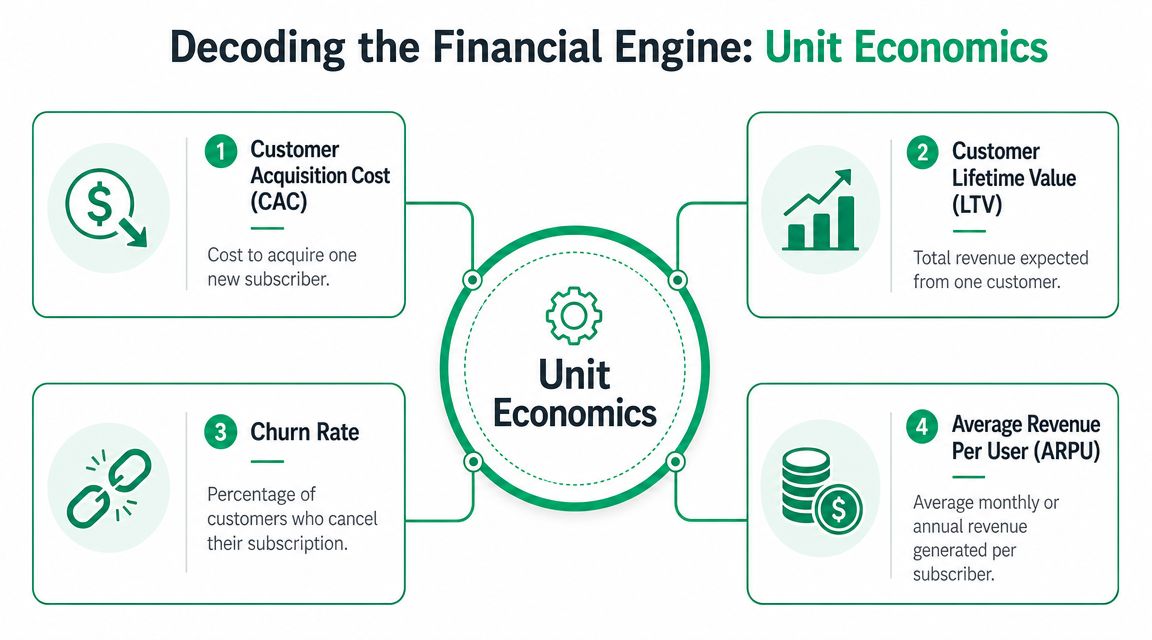
Chargebee highlights why this model gets so much attention from operators. Subscription box businesses are often benchmarked at 40% to 60% average profit margin, and the model is typically managed around metrics like MRR, LTV, CAC, and churn, as outlined in Chargebee's guide to subscription box economics.
The metrics that actually matter
The easiest way to understand this is to use a simple coffee subscription example.
You sell a monthly coffee box. A customer comes in through Meta ads, Google Shopping, influencer content, or email capture and eventually subscribes. The money you spent to bring that person in is CAC, or customer acquisition cost. What that customer is worth over the life of the relationship is LTV, or lifetime value. If they cancel sooner than expected, churn goes up and LTV drops. If they stay longer, skip instead of cancel, add extra items, or upgrade to a larger plan, LTV rises.
Here's the key: none of these metrics live alone.
- Higher CAC can still work if retention is strong.
- Lower pricing can hurt you if it attracts poor-fit customers who churn quickly.
- Premium packaging can pay off if it improves perceived value enough to reduce cancellations.
- Cheaper fulfillment can backfire if mistakes, delays, or damaged boxes push customers out early.
Read your business as a relationship, not a shipment
The strongest operators stop asking, “Did this box make money?” and start asking, “Did this subscriber become more valuable after this cycle?”
That shift changes decisions.
A damaged first shipment doesn't just create a refund issue. It can erase future renewals. A rigid billing policy doesn't just reduce edge-case support work. It can convert a temporary pause into a permanent cancellation. A poor unboxing experience doesn't just weaken brand feel. It lowers the customer's confidence that the ongoing charge is worth it.
For merchants tracking these patterns inside Shopify, a practical starting point is reviewing subscription business model metrics in one place and tying them back to real operational causes rather than reading them as isolated dashboard numbers.
The short explainer below is useful if your team needs a quick visual reset on recurring revenue mechanics.
What improves the engine
You don't fix unit economics with one big tactic. You improve them through a series of connected decisions:
- Acquire better-fit customers: Messaging should match the actual subscription experience. Overpromising creates fast churn.
- Protect the first two shipments: Early-cycle experience has outsized impact on retention.
- Give customers controlled flexibility: Skips, swaps, and timing changes often preserve revenue better than forcing an all-or-nothing decision.
- Use add-ons carefully: Extra revenue works when it feels relevant. It hurts when it complicates the promise of the core box.
- Watch failure reasons by cohort: Customers leaving for price, boredom, excess product, or delivery issues need different fixes.
Operator mindset: Churn is rarely just a pricing problem. It's often a product-value, logistics, and flexibility problem showing up in finance.
Pricing Packaging and Monetization Strategies
Pricing in a subscription business isn't just about margin. It tells the customer how to judge the offer. Price too low and the box can feel disposable. Price too high without enough clarity and customers start re-evaluating every renewal.
The best pricing strategy starts with a simple question. What commitment are you asking the customer to make? If the answer is ongoing discovery, you need strong perceived value every cycle. If the answer is convenience, price has to feel rational relative to buying on demand. If the answer is membership, the perks need to feel alive between billing dates.
Packaging shapes perceived value
Founders often underprice because they benchmark against product cost instead of customer perception. That's a mistake. Customers don't experience cost of goods. They experience the full offer. That includes product mix, shipping cadence, brand trust, packaging quality, editability, and how easy it is to manage the subscription.
A plain carton can work for a replenishment brand. It usually weakens a curated experience. A premium unboxing experience can justify stronger pricing, but only if the actual items support it. Fancy presentation can't carry a weak assortment for long.
Monetization works best in layers
A strong subscription monetization model usually includes more than one lever:
- Base plan pricing: The core monthly or recurring offer.
- Prepaid commitment options: Useful when customers want savings or gifting convenience.
- Tiered assortments: A standard box and a premium version can widen appeal without diluting the core.
- One-time add-ons: Good for increasing value when the add-on fits the shipment.
- Seasonal or limited drops: Effective when they feel special, not constant.
- Member-only store access: Helpful when subscribers want control over repeat favorites.
What works and what usually doesn't
What tends to work:
- Clear tier differences: Customers need to understand why one tier costs more.
- Billing flexibility: Different customers prefer different commitment levels.
- Optional upsells: These raise average revenue without forcing everyone into a higher base plan.
What usually fails:
- Overcomplicated menus: Too many variants create friction before the first conversion.
- Aggressive discounting: It can attract deal seekers who don't stay.
- Hidden shipping math: Subscription customers notice pricing inconsistency quickly.
The cleanest pricing model often wins. If a subscriber can't explain the value in one sentence, retention gets harder.
A practical rule is to price for the experience you can deliver consistently, not the one you hope to deliver after scale. Underpricing to buy growth usually creates pressure elsewhere. The box gets lighter, customer support gets slower, or fulfillment quality slips. Then churn rises and the price problem returns in a different form.
Mastering Operations Fulfillment and Inventory
Most subscription brands don't fail because the idea was bad. They fail because operations break the promise.
A subscription box is a recurring test of execution. Customers don't care that your receiving window slipped, a supplier changed case-pack logic, or your team had to hand-build kits late into the evening. They care that the box arrived on time, looked right, and matched the expectation set at checkout.
In-house vs 3PL is a strategic decision
Founders often frame fulfillment as a cost question. It's broader than that. It affects speed, error rates, packaging control, customer communication, and how quickly you can make exceptions when something goes wrong.
Running fulfillment in-house gives you:
- Direct control over kitting quality: Important for curated boxes with inserts, sequencing, or fragile items.
- Faster process changes: You can alter pack rules without waiting on a partner queue.
- Closer feedback loops: Issues surface faster when your own team handles the work.
Working with a 3PL gives you:
- Scalability: Better when order volume spikes beyond your physical capacity.
- Labor flexibility: You're not staffing every packing wave yourself.
- Shipping network advantages: Especially useful when customers are geographically dispersed.
If you're evaluating partners, this overview of 3rd-party fulfillment companies is a useful starting point because it forces the right questions around integration, control, and service fit.
Where the real trade-offs show up
The hard part isn't choosing in-house or outsourced. It's understanding your specific model.
A curated box usually needs stronger coordination. You're managing item availability, substitutions, insert updates, packaging presentation, and batch deadlines. A replenishment offer is often simpler to automate and easier for a 3PL to execute consistently. Access models may reduce physical complexity but raise expectations around speed and member treatment.
Here are the operational pressure points that matter most:
- Kitting discipline: Batch assembly looks efficient until one wrong SKU ends up across an entire wave.
- Packaging consistency: Damaged presentation weakens trust, especially in premium curation.
- Inventory buffers: Too little stock creates substitutions and disappointment. Too much stock traps cash and pressures future box design.
- Exception handling: Lost parcels, address errors, and partial shortages need a repeatable process.
Bad fulfillment doesn't just raise support volume. It lowers future LTV because customers stop trusting the next shipment.
Inventory planning is easier than retail, but less forgiving
Subscriptions do help with demand visibility. You have committed orders on a cadence. That's better than pure one-off commerce. But batch-based fulfillment introduces a different kind of risk. One delayed component can hold up the whole box.
That's why mature operators build inventory plans around dependency chains, not just SKU counts. If one hero item arrives late, do you delay the box, substitute, or split shipment? Each choice has margin implications and customer experience consequences.
For leaders thinking about operations as a scaling discipline, this operational roadmap for growth-stage companies is useful reading even outside SaaS because the underlying lesson is the same. Growth exposes weak systems before it rewards demand generation.
Fulfillment affects retention more than most teams admit
Shipping decisions feed finance directly. If delivery is slow, unreliable, or expensive to fix, subscribers reassess the value of staying. If the box arrives cleanly and predictably, customers feel safer renewing. That's why fulfillment isn't a back-office concern in a subscription box service business model. It's part of the retention engine.
The Tech Stack for Growth and Retention
A modern subscription brand usually starts with familiar foundations: Shopify for commerce, a subscription management layer for recurring billing, and lifecycle tools for email and SMS. That stack gets you launched. It doesn't automatically get you retained.
Retention often improves or falls apart after checkout. That's where a lot of teams leave money on the table. They optimize acquisition pages, then make the post-purchase experience rigid. Customers who want to swap an item, move a delivery date, or fix an address run into friction. Support queues grow. Some customers cancel instead of asking for help.
Core systems you actually need
The stack should support four jobs well:
Sell the subscription clearly
Product pages, landing pages, and recurring offer presentation need to remove confusion, not decorate it.Manage recurring payments reliably
Billing logic has to be predictable for both the merchant and the customer. If you're reviewing setup options in Shopify, this guide to recurring payments on Shopify is a practical reference.Automate lifecycle communication
Customers need timely reminders, shipment updates, and account prompts that reduce uncertainty.Enable post-purchase self-management
Many brands gain or lose long-term efficiency through post-purchase self-management.
Post-purchase flexibility is a retention lever
When customers can manage parts of the experience on their own, the business benefits in two ways. Support workload goes down, and the customer has an alternative to cancellation.
That matters most when intent is soft. A customer doesn't always want to quit. Sometimes they have too much product, need to change an address, want a different item, or need a later delivery date. If the only visible option is “cancel,” many will take it.
The best post-purchase flows do three things well:
- They offer guardrails, not chaos: Customers can make approved changes within rules.
- They surface save options before cancellation: Skip, swap, pause, or edit often preserves more value than forcing a support ticket.
- They make add-ons easy: Letting a shopper add something to an upcoming shipment is lower-friction than pushing a separate new order.
Retention tech should reduce effort for both sides
A lot of software claims to “improve customer experience,” but the practical question is narrower. Does it reduce operational friction without reducing control?
That means checking for capabilities such as address validation, multilingual customer-facing flows, permission-based editing windows, order tagging, and compatibility with the rest of your stack. If your team has to constantly override the tool with manual workarounds, the tech is adding complexity, not removing it.
Good retention tooling gives customers room to adjust without forcing your operations team to clean up avoidable messes later.
For subscription brands, that's especially important because a single change can ripple through picking, packing, inventory allocation, and customer support. The right stack doesn't just process recurring charges. It protects margin by keeping those downstream workflows clean.
Your Launch and Optimization Checklist
The cleanest launches usually come from boring discipline. Not hype. The operators who do well tend to make fewer assumptions, choose simpler models, and tighten the feedback loop quickly after launch.
Planning and setup
Before launch, get the structure right.
- Choose the right model: Don't pick curation because it looks exciting if your team can't support its complexity.
- Define the retention promise: Why should the customer stay after box one?
- Set contribution logic early: Know what has to be true operationally for the subscription to remain healthy.
- Design the cancellation alternative: Decide in advance how customers can skip, swap, pause, or edit.
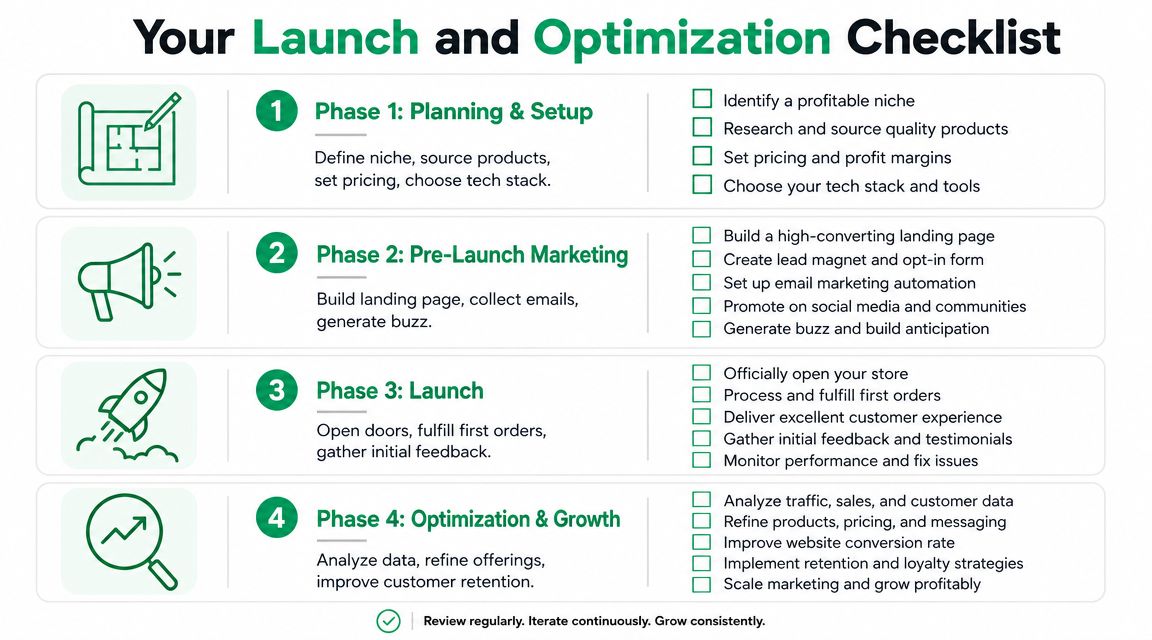
Pre-launch and launch
Then pressure-test the experience before you scale traffic.
| Phase | What to focus on |
|---|---|
| Pre-launch | Offer clarity, merchandising, packaging, fulfillment rules, support flows |
| Launch | First-order experience, billing communication, shipment accuracy, feedback capture |
| Early optimization | Cancellation reasons, repeat purchase behavior, support themes, add-on adoption |
A few practical checks matter more than people think:
- Run test orders end to end: Include address edits, failed payments, and customer-change requests.
- Script support responses: Early consistency helps you identify recurring friction faster.
- Protect the opening cohorts: Their feedback is more useful than broad acquisition volume.
Optimization and growth
After launch, stop looking only at gross sales. Watch the relationship between pricing, fulfillment performance, and customer flexibility. If customers are leaving, find the operational reason before changing creative or spending more on acquisition.
Ask:
- Are subscribers leaving because the box feels mispriced?
- Are fulfillment misses lowering confidence?
- Are customers canceling when they really wanted a temporary adjustment?
- Are add-ons increasing value without making the offer feel cluttered?
The strongest subscription box service business model is rarely the flashiest one. It's the one where merchandising, finance, logistics, and customer control reinforce each other month after month.
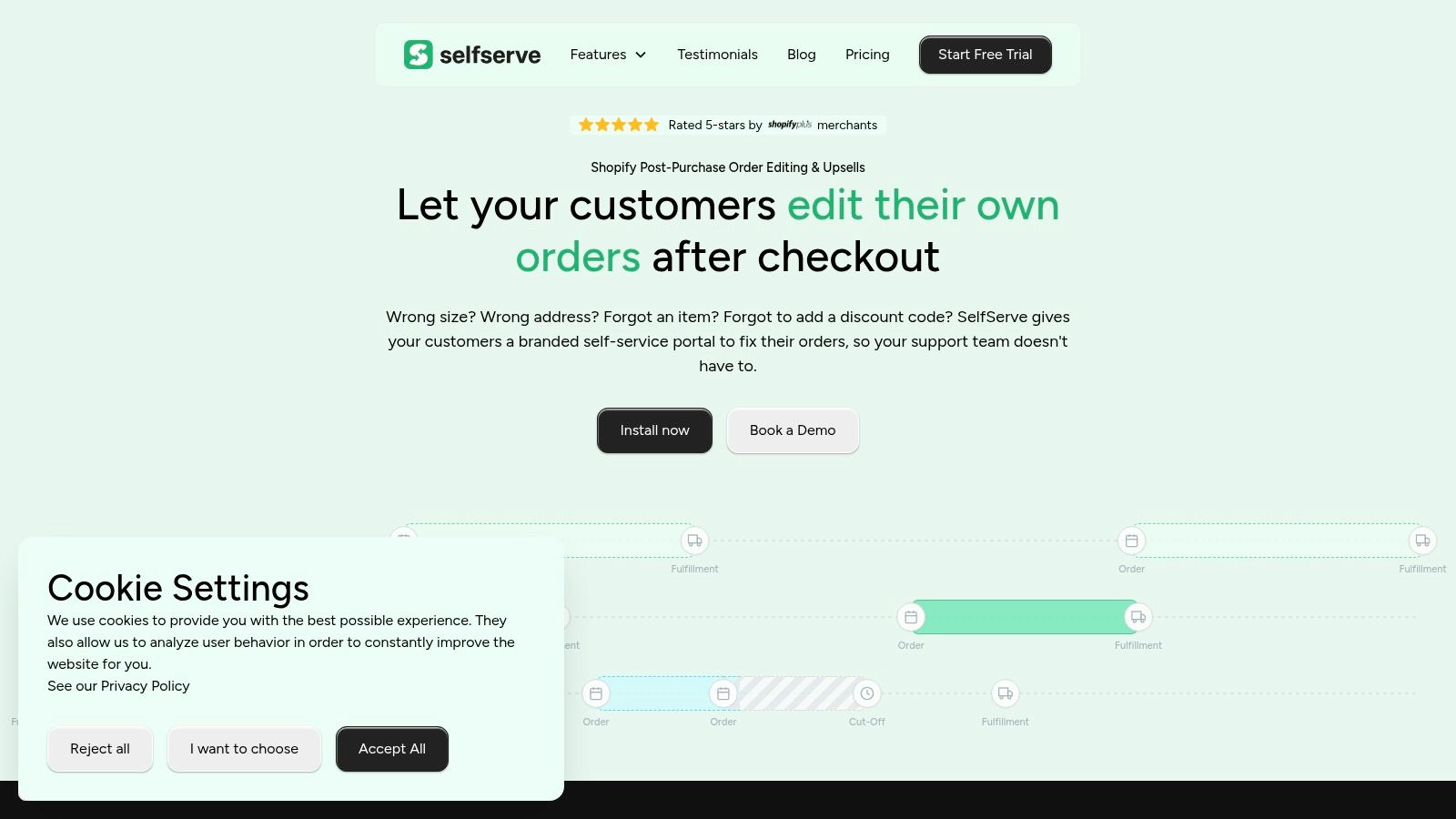
If you run subscriptions on Shopify, SelfServe helps turn post-purchase management into a retention and efficiency advantage. Customers can edit eligible order details, update addresses with validation, and add products to existing orders within merchant-defined rules, which helps reduce support load while improving the experience after checkout. For high-volume subscription brands, that kind of controlled flexibility often matters as much as acquisition.