What Sells Online in 2026 and How to Find It
Most product guides answer what sells online with a list of fashionable objects. That advice is incomplete. A product can have strong demand and still lose money through returns, damaged shipments, unclear product pages, support tickets, or a discovery channel that doesn't suit the buying decision.
The better question is: which product fits a specific demand environment and a low-friction operating model? Fashion may attract visual discovery, electronics may benefit from comparison search, and replenishable goods may support retention. Each category creates a different fulfillment and customer-service burden. In 2026, product selection should begin with channel fit, landed cost, post-purchase workflow, and the merchant's capacity to handle exceptions.
Why the Obvious Lists Miss the Point
A “top products to sell” list often sends merchants toward imitation. They spot a trending beauty item, phone accessory, or wellness product, copy the offer, and enter a crowded market without understanding the buying trigger or the work created after checkout. Popularity replaces strategy, while competitors with better sourcing, content, fulfillment, and retention capture the margin.
Demand isn't the same as commercial fit. A visual, low-cost accessory can suit short-form video and impulse discovery. A specialist tool may require long-tail search, detailed specifications, and educational content before purchase. A consumable depends on more than the first order. Customers must be able to reorder easily and trust the product enough to use it again.
Popularity creates pressure, not protection
Large categories generate major online revenue, and they also attract keen competitors. Fashion and electronics repeatedly rank among the largest online categories, as shown by global category rankings from ECDB and a broader category analysis of online purchasing. Their scale confirms online demand. It does not confirm that a new store can earn a healthy contribution margin.
Evaluate the operating fit before choosing the category label:
- Channel mix: Can you demonstrate, search, recommend, or replenish the product through channels your team can operate well?
- Support capacity: Will buyers need help with sizing, compatibility, installation, ingredients, or delivery changes?
- Fulfillment model: Can the supplier or warehouse pack each order consistently without damage, delays, or costly exceptions?
- Post-purchase flow: Can the order lead naturally to a refill, accessory, bundle, subscription, or useful order edit?
Operator's rule: Do not source a product until you can explain how the first customer discovers it and why that customer might buy again.
The offer also has to meet practical buying expectations. In a U.S. consumer survey, free shipping ranked as the top shopping factor at 57%, compared with 45% for the lowest price, 27% for brand trust, and 26% for discounts and promotions, according to Bizrate Insights' ecommerce optimization research.
That finding changes the research brief. Choose products that are easy to price, ship, explain, and support. In 2026, the right product is the one matched to a specific discovery channel and a low-friction post-purchase flow, not the item appearing most often on a trend list.
The Categories That Actually Carry Global Online Spend
The biggest online categories are not automatic opportunities. They show where consumers already spend, then force a harder question: can your team sell, support, ship, and follow up on those products without losing the margin?
Fashion remains a foundational ecommerce category. Estimates place global fashion and apparel sales at about US$771 billion in 2024 and project US$957.31 billion for 2026, depending on category definition and methodology, according to PushPull Agency's category overview. A separate ranking places apparel at US$695.5 billion in 2025, with an online share of 35–40%. Treat those figures as directional, not interchangeable. Fashion suits visual merchandising, creator content, and frequent wardrobe purchases. It also brings sizing exchanges, variant-heavy inventory, and a constant need for new content.
Consumer electronics competes with fashion for the largest pools of online spending. Reported 2024 online revenue estimates range from US$771 billion to US$988.4 billion, while a 2025 ranking places the category at US$690.3 billion with a 40–45% online share, as documented by ECDB's category data. Electronics can produce high order values and benefits from comparison-led buying. Compatibility questions, warranty expectations, software updates, and dense SKU catalogs create expensive support work.
Structural strength versus operating burden
| Category | Approx. share of online spend | Core strength | Key trade-off |
|---|---|---|---|
| Fashion and apparel | Varies by methodology, with apparel among the leading global categories | Visual appeal, repeat buying, broad customer base | Sizing, exchanges, returns, variant complexity |
| Consumer electronics | Varies by methodology, with electronics among the leading global categories | High order values, specifications, upgrade cycles | Compatibility, warranty, support, obsolescence |
| Home and garden | Major global category, behind the leading segments | Practical utility, project-based demand, bundling | Bulky shipping, damage risk, assembly |
| Food and grocery | Core recurring online category | Replenishment, routine purchases, frequency | Expiry, delivery timing, thin margins |
| Beauty and personal care | Major online category with strong discovery potential | Consumables, routines, bundles, creator content | Compliance, product claims, sensitivity and returns |
Home and garden wins when the product solves a visible household problem. Storage systems, lighting, and small furnishings can support demonstration-led discovery and sensible bundles. Large furniture belongs in a different operating model. Freight, damage claims, delivery coordination, and white-glove service can erase an attractive product margin.
Food and grocery have the clearest replenishment logic. Buyers already understand the routine, so subscriptions and repeat orders can fit naturally. The trade-off is unforgiving: expiry control, reliable delivery, and price-sensitive competition leave little room for fulfillment mistakes.
Beauty and personal care combine routine use with visual discovery. Serums, body care, hair products, and tools can sell through demonstrations, creators, and bundles. Operators still need accurate ingredient information, disciplined product claims, and clear guidance for different routines. Poor expectations turn quickly into support requests and returns.
UN trade metadata groups online sales across clothing, footwear, fashion accessories, cosmetics, food and beverages, electronics, and household goods. The taxonomy supports a practical conclusion: what sells online is concentrated in recurring, broadly useful consumer goods. Use category size to choose a demand environment, then choose the product that fits your discovery channel and gives the customer an easy reason to complete the next order.
Traits That Separate Winners From Also-Rans
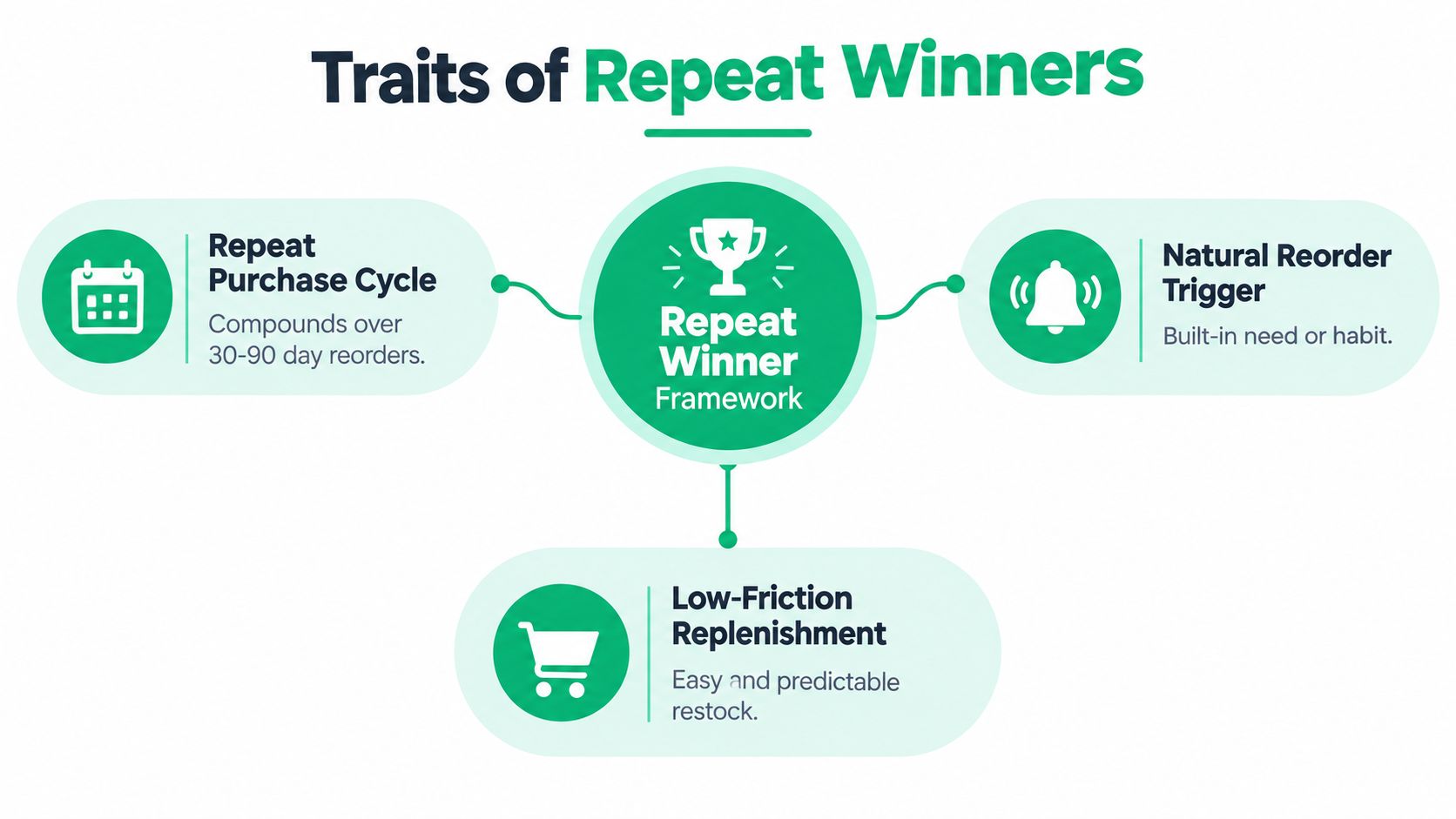
Winning products usually share a small set of operational traits. They don't need every trait, but a strong candidate should offer a clear advantage in repeat purchase, margin, shipping, differentiation, or customer understanding.
Start with the reorder cycle
Consumables deserve priority because they create a natural reason to return. A beard oil brand can build its retention plan around a 45-day reorder cycle, then offer reminders, multipacks, and a subscription that matches actual usage. The product's value isn't limited to the first transaction. It creates a repeatable customer relationship.
A product doesn't need to be consumed quickly to support repeat buying. A non-consumable can earn another order through accessories, replacement parts, refills, or adjacent use cases. The question is whether the customer has a credible reason to return, not whether the catalog looks broad.
Specificity protects margin
Niche products often beat generic products because customers compare them against fewer identical listings. A monogrammed leather goods store can make personalization part of the product, then add engraving or gift packaging as an upsell. The buyer isn't choosing only on base price because the offer carries personal meaning.
Lightweight, durable goods create another advantage. A small home fragrance line that ships under 200g can design its assortment around predictable packaging and free-shipping thresholds. The exact weight isn't the strategy by itself. The strategy is choosing products whose physical profile supports a dependable landed-cost model.
Use this filter before placing an order:
- Repeatable use: The buyer consumes, replaces, or expands the product.
- Distinctive value: The offer solves a narrow problem or carries customization.
- Shipping resilience: The item is lightweight, compact, and unlikely to break.
- Simple choice: The buyer doesn't need complex sizing, assembly, or compatibility help.
- Post-purchase potential: The order can lead naturally to a refill, accessory, bundle, or subscription.
Practical test: If the product needs a discount to beat identical listings, heavy education to explain its use, and manual support to fix ordinary orders, it's a poor first product for a lean store.
The best candidates reduce work after the sale. That means fewer address problems, fewer fit questions, fewer breakage claims, and fewer reasons for a customer to contact support before placing a second order.
Validating Demand Before You Source a Single Unit
Validation should use independent signals, not one attractive chart. Search data tells you what people seek, marketplaces show how many sellers already serve the need, and social platforms reveal how people discuss emerging use cases. Each source has blind spots, so the decision should come from triangulation.
Use three signals, then look for conflict
Search and keyword analysis is the first pass. Build a seed list around the problem, product, material, use case, and alternative. Compare Google Trends with Amazon search behavior and keyword tools. Rising queries matter, but flat demand isn't automatically bad if the niche has strong commercial intent and weak competition.
Marketplace density tells you whether demand is already captured. Review Amazon Best Sellers, category results, review quality, product variations, and Etsy top tags. A crowded result page isn't a guaranteed no. It does mean you'll need a sharper promise, better creative, stronger service, or a defensible product detail.
Social momentum helps identify language customers use before it becomes obvious in search tools. Watch TikTok demonstrations, Reddit problem threads, creator comments, and recurring questions. Engagement can be noisy, so look for repeated conversations and clear evidence that people want a solution, not merely entertainment.
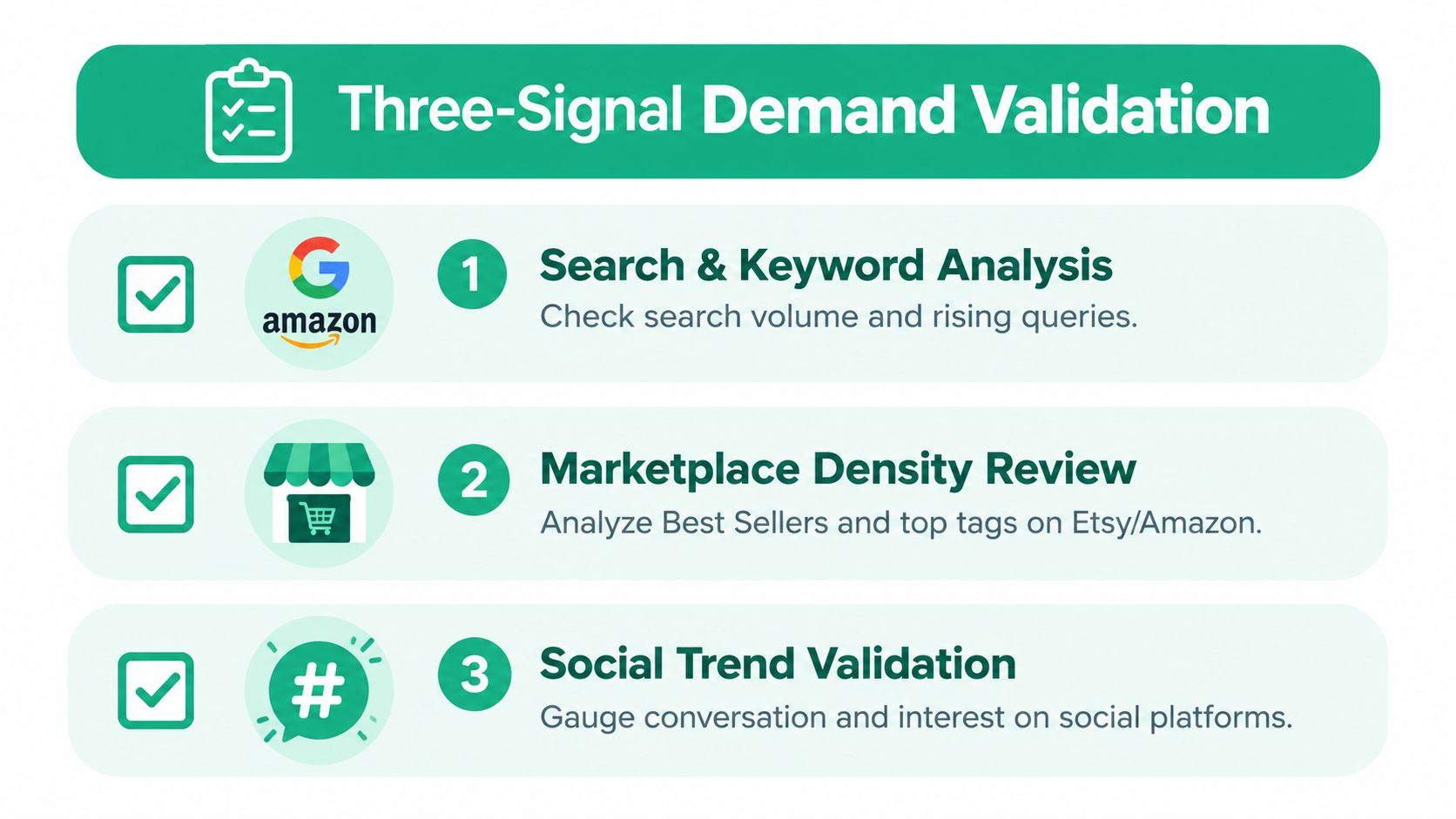
A pet supplement merchant might compare “calming chews” across Helium 10, Amazon listings, TikTok creative, and Reddit discussions. A jewelry seller validating engraved name necklaces could compare Etsy listing activity with Pinterest saves and search interest. For structured brainstorming before validation, AI ideas from Genpire can help generate product angles, but generated ideas are hypotheses, not proof.
Run an afternoon screening process
Create a short worksheet with these fields:
- Keyword seed list: Record problem-led and product-led phrases.
- Competitor density: Count meaningful competitors and identify their dominant promise.
- Price spread: Check whether the market supports a credible position above the cheapest listing.
- Review velocity proxy: Look for recent review activity and signs of ongoing demand.
- Creative test: Run a small paid test only after the offer, page, and fulfillment promise are clear.
- Operational red flags: Note sizing, ingredients, fragile components, delivery restrictions, and likely support questions.
A product should have at least two of the three demand signals working before you consider sourcing. This isn't a promise of success. It's a refusal to mistake one viral post or one keyword spike for a business.
For the strategic choice between a focused catalog and a broad assortment, compare whether to start a niche store or a general store before you build your navigation and buying plan.
Margins Fulfillment and the Hidden Cost of Returns
A product's gross margin is only the opening line. Fulfillment, exchanges, address corrections, damage, refunds, and support can turn a promising SKU into a recurring operational loss. Compare product types by the work they create, not only by their supplier price.
| Product type | Gross margin | Average return rate | Shipping profile | Support burden |
|---|---|---|---|---|
| Apparel | Can be attractive, but varies widely by material and brand position | Structurally return-sensitive because of fit and style | Light to moderate, with many variants | High, sizing and exchanges |
| Supplements | Often suited to repeat purchasing | Usually lower fit-related exposure, but product expectations matter | Efficient when compact and non-fragile | Moderate, ingredients and usage |
| Beauty | Strong bundling and replenishment potential | Product sensitivity and expectation issues can create exceptions | Usually compact, packaging quality matters | Moderate to high, routines and claims |
| Electronics accessories | Can support focused bundles and compatibility-led offers | Compatibility can trigger returns | Often lightweight and economical | Moderate, device fit and troubleshooting |
| Home goods | Broad utility and cross-sell potential | Damage and preference-related returns vary | Bulky or fragile items raise costs | Moderate to high, delivery and assembly |
| Print-on-demand | Low inventory exposure | Quality, personalization, and expectation issues still matter | Made-to-order, with variable package profiles | Moderate, production and replacement issues |
The lean-operations winners are usually compact consumables, non-apparel products without sizing, and goods that arrive ready to use. That doesn't make every small item profitable. It gives the operator fewer variables to control.
Put the hidden costs into the model
Merchants routinely underestimate return restocking, sizing exchanges, hazmat surcharges, address validation problems, replacement shipments, and carrying costs for slow-moving inventory. A product that looks profitable before these lines may fail after them.
Use a simple contribution calculation:
Net contribution = selling price + post-purchase revenue, minus product cost, payment fees, fulfillment, shipping subsidy, acquisition cost, expected returns, replacement cost, and support cost.
Baymard's benchmark found only 48% of leading U.S. and European desktop ecommerce sites achieved a “decent” or “good” product-page UX score, and none reached “perfect.” Its research also attributes 20% of purchase abandonments to insufficient or unclear product information, as summarized by product-page best-practice research. Clear specifications, imagery, delivery promises, and return information protect both conversion and support capacity.
For a practical breakdown of the expense categories that returns create, use this guide to understand the cost of returns. Don't approve a product until the model still works after a realistic return and replacement allowance.
Where Demand Is Forming Now and What That Means for Your Catalog
Trend reports are useful only when they change a buying decision. Adding every popular category creates a confused store, weak merchandising, and operational sprawl. A trend belongs in your catalog when it matches an existing buyer, a known channel, and a manageable post-purchase flow.
Health and wellness demand is moving toward functional, specific use cases, including products adjacent to GLP-1-led routines. The merchant response shouldn't be a random supplement expansion. Bundle or substitute around the buyer's existing routine, with careful attention to claims, ingredients, education, and replenishment timing.
Home demand favors modular organization over isolated storage objects. Customers often need a system, not one container. Bundle complementary pieces around small-space use cases, then make the order easy to expand as the customer organizes another room.
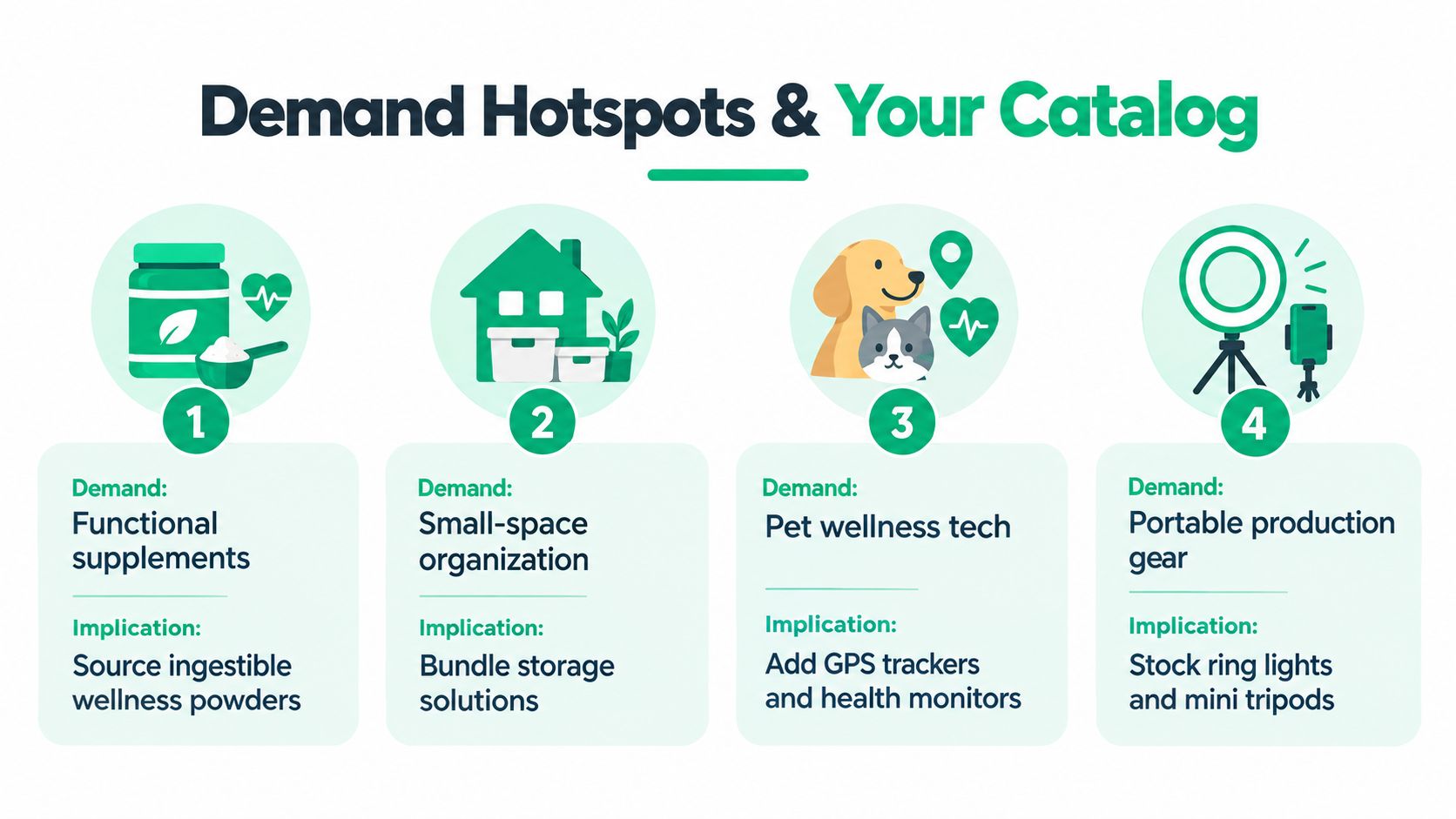
Pet humanization creates room for premium treats, wellness products, and monitoring tools. The strongest move is usually to enter narrowly, with a clear pet profile or use case, rather than building a generic pet superstore. Consumables can support replenishment, while devices need compatibility content and after-sale help.
Creator-economy products, such as portable production gear, benefit from demonstration-led discovery. A ring light, mini tripod, or compact audio accessory can be shown in use, compared quickly, and bundled with related equipment. The catalog implication is simple: choose products that look useful within seconds and don't create a complex installation burden.
The 2026 ecommerce trend analysis from BigCommerce highlights how social commerce, livestreaming, and AI-assisted discovery are changing product discovery. Its cited industry figures include US$585.9 billion in global social commerce revenue and a projection of US$14.64 billion for U.S. livestream ecommerce sales. These channel differences matter. A visual product needs creative proof, while a specification-heavy product may need structured data and comparison content.
DHL's 2026 ecommerce trends report also emphasizes logistics and price as major purchase motivators and reports that mobile wallets account for 56% of online payment transactions. The implication is operational, not cosmetic: catalog expansion should improve convenience, not add products your warehouse and support team can't reliably deliver.
Turning First-Time Buyers Into Repeat Orders
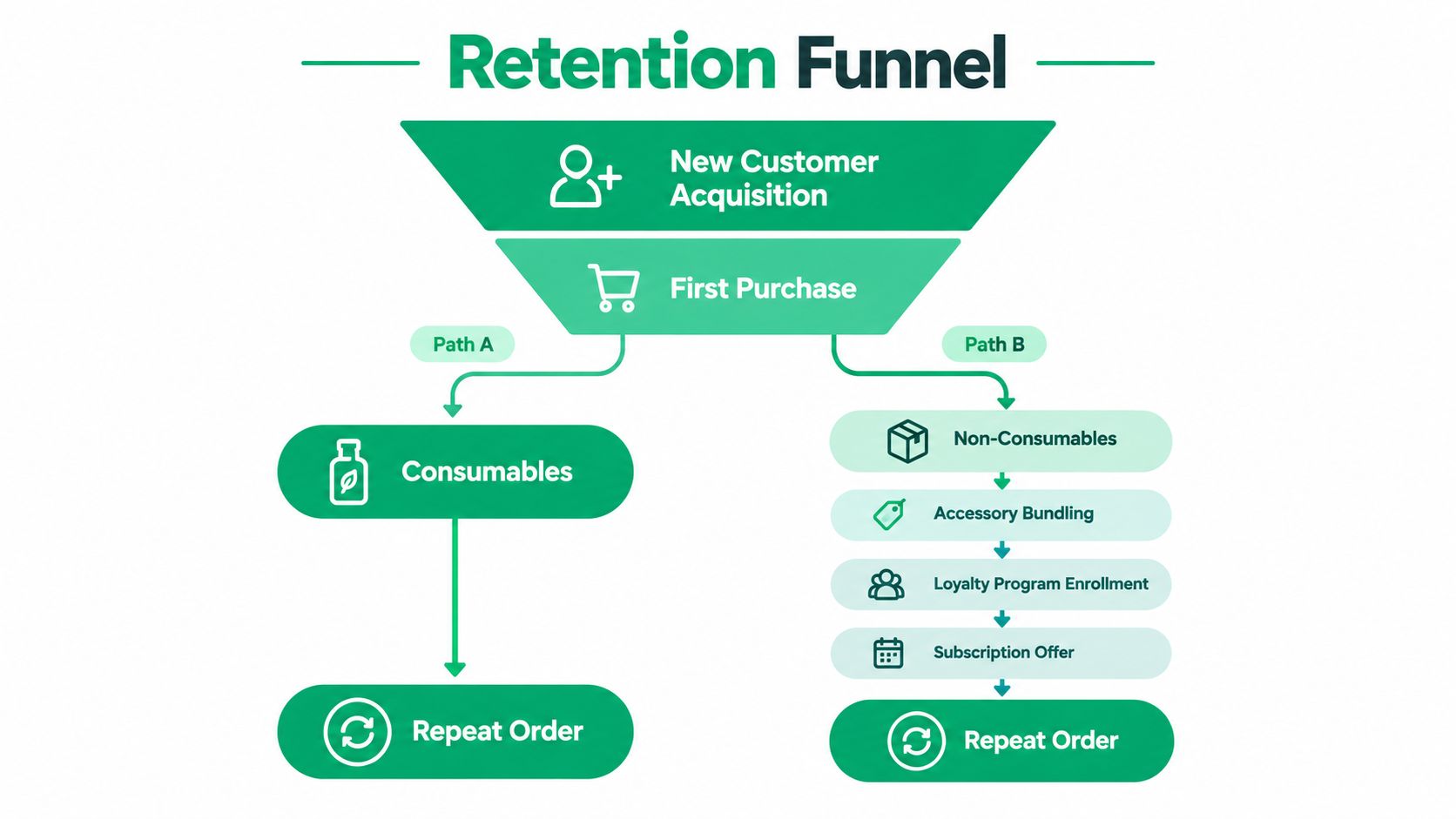
A product doesn't sustainably sell online until the second order has a credible path. Consumables have an advantage because the customer already knows what to replenish. Non-consumables need a designed retention route through accessories, refills, upgrades, education, or loyalty.
A candle brand can recommend scent refills or complementary vessels after checkout. A technology accessory store can offer a protective case or spare cable while the original order is still being prepared. A pet supplies shop can turn regularly used chews into a replenishment offer that matches the buyer's routine.
Match the retention mechanism to the product
- Consumables: Use replenishment reminders, multipacks, and subscriptions.
- Accessories: Recommend the next practical item, such as protection, storage, or compatibility.
- Personalized goods: Offer gift occasions, engraving upgrades, and related recipients.
- Home products: Build room-by-room bundles and expansion paths.
- Digital or educational products: Add relevant templates, instruction, or premium access.
Post-purchase timing matters because the buyer has just confirmed a need and completed payment. Use Shopify thank-you-page recommendations, order-status offers, subscription tools, and controlled order-edit windows. A merchant should make the next purchase feel like a useful continuation, not an unrelated promotion.
Before launch, run this short go or no-go sequence:
- Identify the first discovery channel.
- Confirm at least two independent demand signals.
- Calculate contribution after shipping, support, and expected returns.
- Define the first post-purchase offer.
- Test whether the product can be reordered, expanded, or replaced without friction.
If you need more retention mechanics that don't rely on blanket discounts, review these ways to increase repeat purchases without discounting. A post-purchase order-management option such as SelfServe lets Shopify customers edit permitted order details and add curated products through thank-you and order-status experiences, giving merchants another way to connect operational control with repeat-order opportunities.
SelfServe helps Shopify and Shopify Plus brands let customers manage permitted post-purchase changes while merchants control order windows, address validation, and upsell rules. Visit SelfServe to see how a lower-friction post-purchase flow can support the products you choose to sell online.