Size of UPS Boxes Complete Dimensions and Use Guide
You're at the pack station with a small electronics order, a stack of cartons, and a customer promise that the shipment will leave today. The product fits inside a compact box, but the available carton is much larger. If you use it, the item may move during transit and the package may be priced by its dimensional size. If you force the product into a smaller carton, protective cushioning disappears and damage risk rises.
That's why the size of UPS boxes should be treated as a decision system, not a list of measurements. The right carton depends on the product's shape, density, protection needs, shipping service, and the relationship between outer dimensions and billed weight. A Shopify merchant shipping a jewelry order has a different packaging problem from a DTC brand sending apparel or a household-goods seller handling a long framed item.
Introduction to UPS Box Sizing for Ecommerce Merchants
A small electronics order is ready at the pack station, but the only available carton is much larger than the product. The extra space can let the item shift and may increase billed weight through dimensional pricing. A smaller carton creates the opposite risk if it leaves too little room for cushioning. Box selection therefore starts with product fit, protection, and the package's final dimensions.
UPS packaging offers a structured range of Express branded cartons, standard cube formats, international weight-rated boxes, and specialty packaging. UPS's flat-rate packaging guidance connects carton formats with intended uses and service rules. The choice affects packing speed, material use, and shipping cost.
Use three checks before choosing a carton:
- Will the product fit with enough protective space?
- Will the packed carton remain within the applicable weight and size limits?
- Will the carton use its cube efficiently, or will empty volume raise billed weight?
A paperback book, compact charger, or small cosmetics bundle may fit a shallow Express carton because each is dense and relatively compact. Folded garments need a shape that matches their volume. A fragile ceramic item may require a larger carton for cushioning, even when the product itself is small. The box should match the product's form, not just its measured length and width.
Practical rule: Choose the smallest carton that holds the product, required cushioning, and a secure closure. “Smallest” does not mean tight. It means avoiding unnecessary empty volume.
The guide supports two workflows. New operations staff can follow the category explanations and product examples to learn the selection logic. Experienced packers can use the later lookup table at the station, then check the detailed entry for a specific carton.
This decision method also fits broader fulfillment planning. Merchants reviewing packaging, warehouse workflows, and order handling can consult Peak Transport ecommerce logistics for related fulfillment context.
Choose the packaging tier first, then verify dimensions, weight, product fit, and dimensional-weight exposure. That sequence helps prevent selecting a familiar carton before measuring the order.
How UPS Organizes Box Categories and Size Tiers
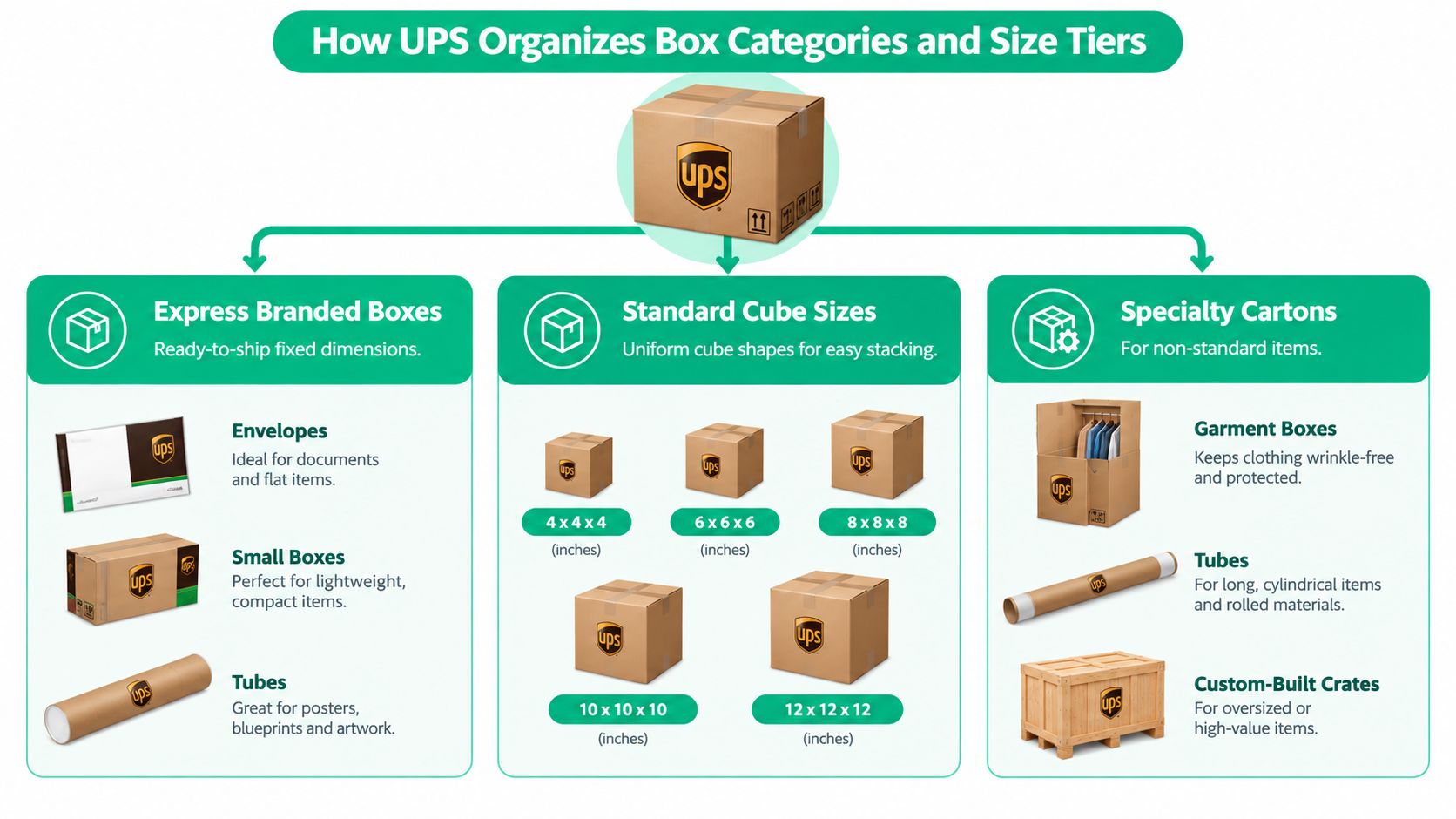
UPS packaging becomes easier to work with when you sort it into three practical groups. Each group solves a different packing problem, and each one has a different relationship with service rules.
Express branded boxes
Express boxes use fixed, recognizable dimensions and are designed around UPS Express services. They're useful when a merchant wants a ready-to-ship carton with a known footprint rather than creating a box specification for every order. The core range runs from shallow document-style packs to larger cartons intended for bulkier merchandise.
A small Express carton can work for books, jewelry, electronics, or other compact products. A larger Express carton gives the packer more horizontal or vertical room for merchandise that cannot fit efficiently in a shallow format. The key is to check the specific box's weight rating and the service associated with it, rather than assuming every branded carton carries the same load.
Standard cube sizes
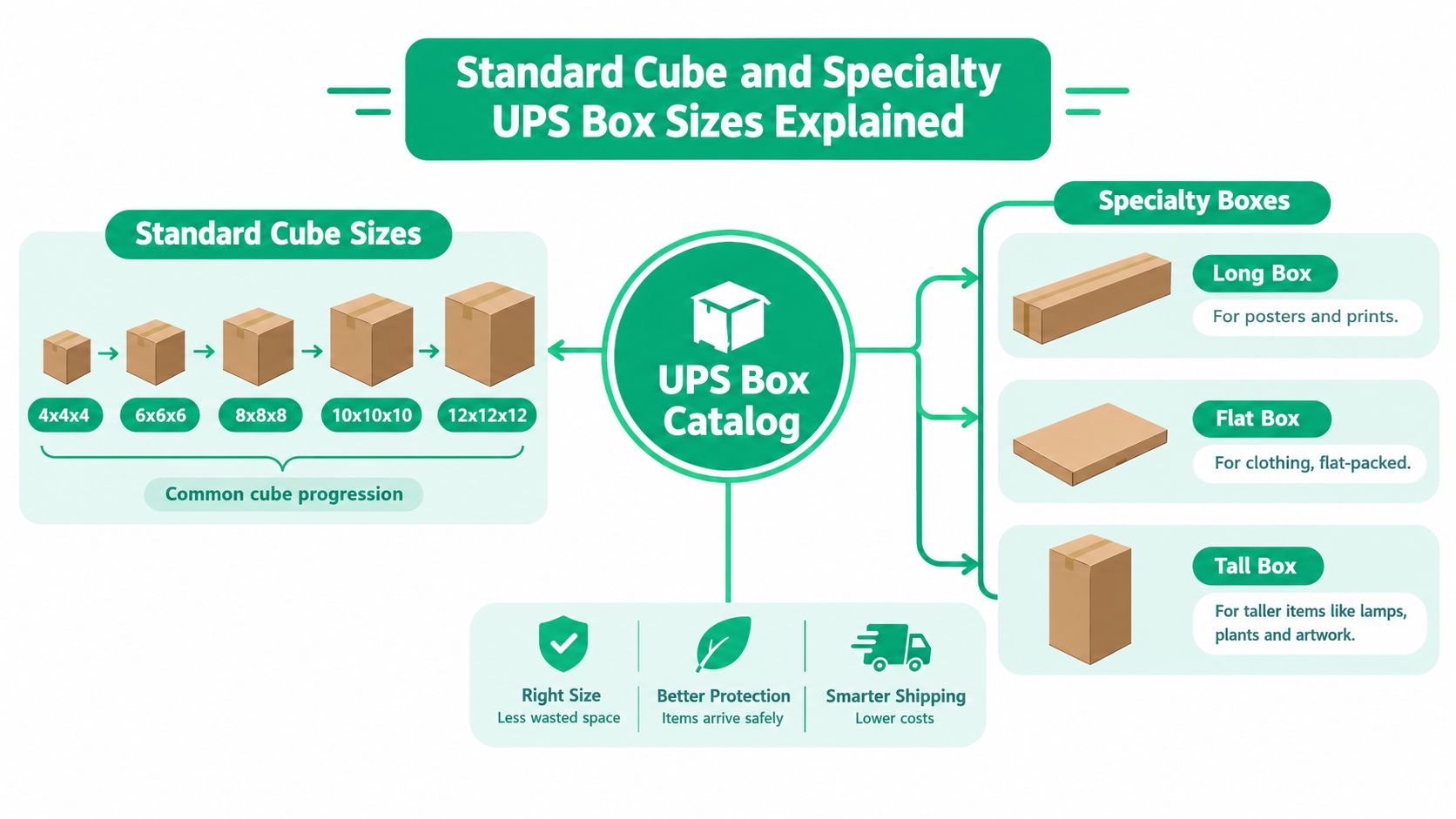
Standard cube cartons follow predictable dimensions such as 4 x 4 x 4 inches, 6 x 6 x 6 inches, 8 x 8 x 8 inches, 10 x 10 x 10 inches, and 12 x 12 x 12 inches, as documented in UPS package-type information and summarized in published UPS box catalog guidance. Cubes are simple to stock, stack, label, and assign to product families.
A cube is often a sensible choice for products with similar length, width, and height. It can also make warehouse replenishment easier because staff can identify the next size tier quickly. However, a cube isn't automatically efficient. A flat product in a tall cube may create more empty volume than a shallow rectangular carton.
Specialty cartons
Specialty cartons handle products that don't belong in a standard rectangle. Long tubes or mirror and picture boxes suit posters, prints, and similarly shaped items. Flat cartons can protect framed or flat-packed merchandise without forcing it into a deep box. Larger specialty formats support household goods or irregular products that need a different orientation.
UPS packaging history shows how broad the catalog can become. One published moving-supplies list included 21 named box sizes, ranging from a 6 x 6 x 6 inch cube to a 6 x 6 x 48 inch mirror/picture box and a 30 x 24 x 6 inch box. That range illustrates the difference between a basic Express lineup and a wider packaging catalog built around product categories.
Use the hierarchy as a search shortcut. Select Express when service and fixed branded dimensions matter, a standard cube when repeatable product packing benefits from uniform cartons, and a specialty format when the product's geometry makes either option wasteful or unsafe.
UPS Express Boxes Dimensions Weight Limits and Best Uses
A fulfillment team should select an Express carton by matching the product's shape, the space needed for protection, and the carton's rated capacity. Dimensions alone are not enough. A shallow box may fit a flat item efficiently, while the same box can crush or bulge around a thicker product. Confirm the current rating and service eligibility for the exact carton before adding it to a packaging matrix.
Core Express carton reference
| Box Name | Dimensions Inches | Weight Limit | Best For |
|---|---|---|---|
| Small Express Box | 13 x 11 x 2 | Up to 10 lb | Documents, books, jewelry, compact electronics |
| Medium Express Box | 15 x 11 x 3 | Up to 20 lb | Small merchandise, accessories, denser products needing more depth |
| Large Express Box | 18 x 13 x 3 | Up to 30 lb | Bulkier flat merchandise, multiple compact items |
| Common shallow format | 15 x 11 x 3 | Service and carton rating should be confirmed | Electronics, accessories, small merchandise |
| International 10 kg Box | 16 x 13 x 10 | Up to 22 lb | Denser international shipments with more three-dimensional volume |
| International 25 kg Box | 19 x 17 x 14 | Up to 55 lb | Bulkier or heavier international merchandise |
UPS packaging references list commonly used formats such as a 13 x 11 x 2 inch Small Express Box, a 16 x 11 x 3 inch Medium Express Box, an 18 x 13 x 3 inch Large Express Box, another 15 x 11 x 3 inch format, and a 19.75 x 17.75 x 13.25 inch 25 kg box. Published descriptions can differ slightly from the dimensions printed on a carton. Check the box label and current service rules before assigning a permanent SKU-to-carton rule.
Small Express Box
The 13 x 11 x 2 inch Small Express Box has a shallow profile and works like a protective folder with walls. It suits a paperback book, a small jewelry order, a compact calculator, or a low-profile electronics accessory. Place the product flat, add only the cushioning it needs, and check that the lid closes without pressure.
Its published limit is up to 10 lb, but capacity does not override fit. A product that requires thick padding around every side may need a deeper carton. Forcing that item into this box can compress the cushioning, bulge the panels, or leave the package difficult to close.
Medium and Large Express Boxes
The 15 x 11 x 3 inch Medium Express Box adds depth and has a published limit of up to 20 lb. Use it for a compact device wrapped with protective material, a small bundle of charging accessories, or a dense order that no longer lies comfortably in the Small box. Keep the contents centered so the extra depth supports protection rather than creating an empty cavity.
The 18 x 13 x 3 inch Large Express Box has a published limit of up to 30 lb. Its broader face suits several thin products packed together, such as folded merchandise or flat accessories. A gaming console, appliance component, or similarly deep item should not be squeezed into this shallow profile because its length and width fit. Choose a deeper carton when the product's height or cushioning requirement controls the pack.
International weight-rated cartons
The international 10 kg box, listed at 16 x 13 x 10 inches and up to 22 lb, provides meaningful three-dimensional space. It can hold a compact device surrounded by protective material, a dense assortment of small products, or merchandise whose height makes an Express flat carton unsuitable.
The 25 kg box, listed at 19 x 17 x 14 inches and up to 55 lb, is intended for heavier or larger international shipments. It fits a substantial product bundle or dense equipment order when the shipment uses much of the available cube. A light item placed in this carton with large empty areas may cost more to move because the package occupies space without using it efficiently.
Select by product profile first, then check the weight rating, service eligibility, and outer dimensions. The smallest viable carton should protect the order without bulging, crushing the product, or leaving avoidable empty volume.
Standard Cube and Specialty UPS Box Sizes Explained
Standard cubes are useful because they make packaging selection repeatable. The common progression includes 4 x 4 x 4 inches, 6 x 6 x 6 inches, 8 x 8 x 8 inches, 10 x 10 x 10 inches, and 12 x 12 x 12 inches. These formats give a fulfillment team recognizable steps, but the correct choice still depends on the product's actual shape.
Comparing the cube progression
A 4 x 4 x 4 inch cube is suitable for a very compact accessory, a small cosmetic item, or a tightly grouped component. It won't work for a product that needs broad cushioning or a long orientation.
A 6 x 6 x 6 inch cube can handle a small cosmetics bundle, a compact smart-home accessory, or a similarly proportioned product. Its balanced shape is helpful when the contents don't have a dominant length or width.
An 8 x 8 x 8 inch cube gives more room for a small device with protective material, a compact gift set, or several small items packed together. The 10 x 10 x 10 inch and 12 x 12 x 12 inch tiers support progressively larger bundles, but packers should reject the larger size when it merely adds empty volume.
For a flat shirt, a shallow rectangular mailer may outperform a cube. For a compact but fragile device, a cube may provide room for cushioning on every side. Merchants should compare the cube with an Express carton rather than assigning every order to the next larger cube.
Specialty formats for unusual geometry
Specialty cartons solve shape problems that cubes can't. A 6 x 6 x 48 inch mirror or picture box is appropriate for long, narrow, flat items such as framed prints or mirror components. A 30 x 24 x 6 inch carton is better suited to large flat merchandise, posters, prints, or flat-packed household items.
The broader catalog also includes packaging for apparel, electronics, household goods, and oversized flat items. Stocking every listed SKU may be unnecessary for a smaller operation. A merchant can often build a practical set around a few cube sizes, one or two shallow cartons, and specialty packaging for products that cannot safely fit elsewhere.
For moving-related packing comparisons, taxi box dimensions for movers offers useful context on how box geometry affects the handling of larger household items. The operational lesson is the same: match the carton shape to the contents instead of treating volume alone as the selection rule.
Dimensional Weight and UPS Carrier Limits You Must Know
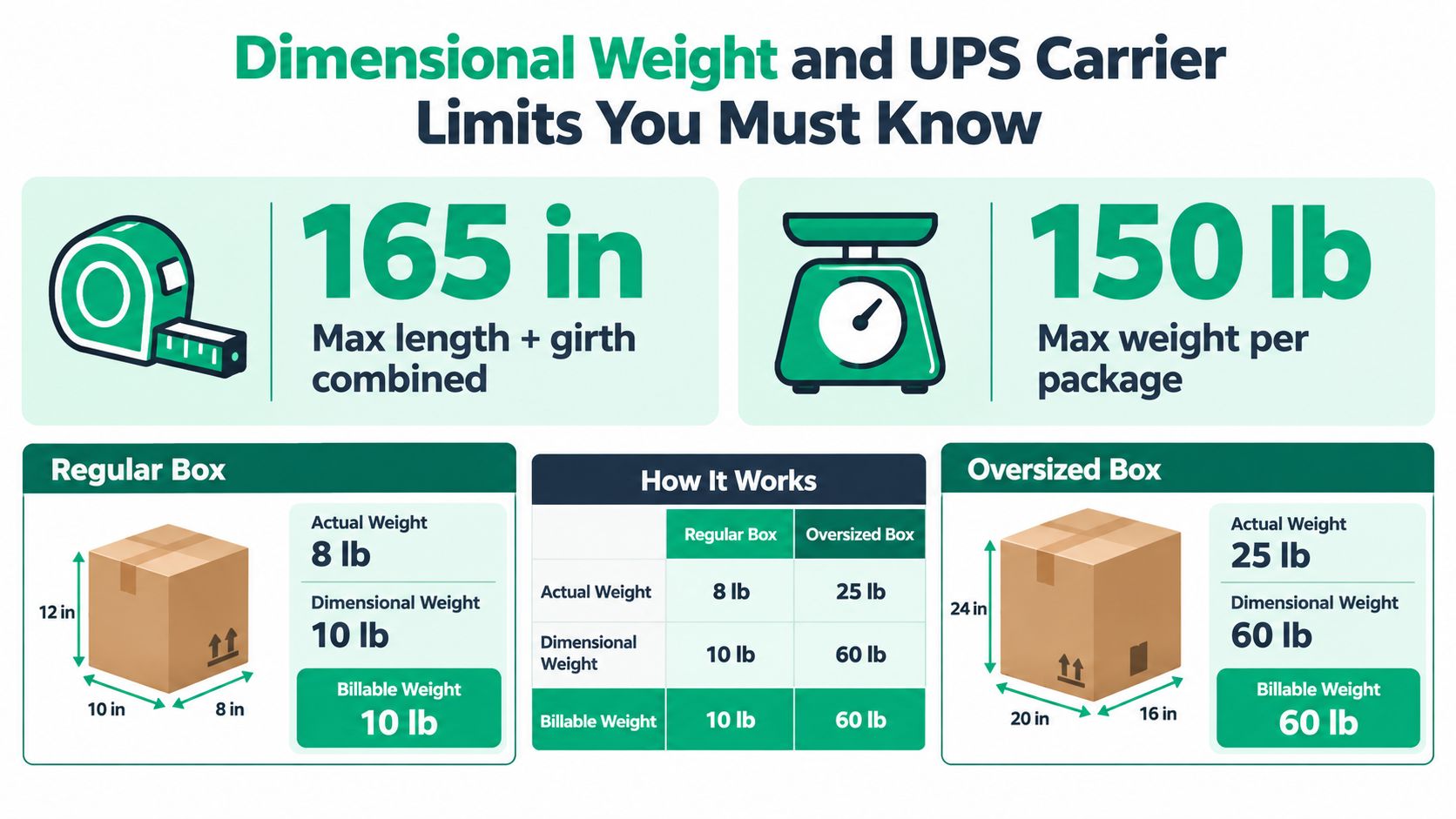
A box can be light on a scale and still be expensive to ship if it occupies too much carrier space. UPS uses package dimensions and weight to apply its rating rules. The two limits every fulfillment lead should keep visible are the maximum 165 inches for length plus girth combined and the maximum 150 lb package weight for domestic shipments, both stated in UPS's dimensions and weight guidance.
The carrier limits
Length plus girth is calculated as the longest side plus the distance around the package. For a rectangular carton, girth uses the two shorter dimensions around the box. A shipment that exceeds the combined limit may require a different handling or service decision, so packers shouldn't rely on length alone.
UPS also states that packages over one cubic foot, or 1,728 cubic inches, or over 50 lb are rated using standard UPS dimensional-weight pricing rather than flat-rate pricing. That threshold makes cube utilization a daily fulfillment concern, not a theoretical pricing detail.
A calculation your team can repeat
Take a carton measuring 12 x 12 x 12 inches. Its cubic volume is:
12 × 12 × 12 = 1,728 cubic inches
That package is exactly one cubic foot. If the carton becomes larger because of an unnecessary outer carton or excess void space, its cubic volume rises. If the product fits in a smaller, protective carton, the dimensional exposure can fall.
The exact dimensional-weight divisor depends on the applicable UPS rate type, so don't invent a divisor in a warehouse worksheet. Record the ship-ready outer dimensions, calculate the cubic volume, and use the divisor shown by your UPS rate agreement or shipping software. SelfServe's guide to calculating UPS charges also emphasizes measuring the final packed carton and calculating cubic volume from length, width, and height.
Audit habit: Measure the sealed carton, not the product and not the empty box. Tape, cushioning, bulges, and the final orientation all belong in the ship-ready measurement.
A smaller carton can lower dimensional weight only when it still protects the contents. Cutting space that the product needs can create damage, returns, and repacking work. The target is efficient cube utilization, not the lowest possible box dimensions at any cost.
Matching Products to the Right UPS Box Size
Product category provides a fast starting point, but density and protection determine the final carton. A compact, heavy item may need a small box with reinforcement. A light, soft item may occupy more volume while needing little structural protection. A fragile product needs controlled empty space for cushioning, not the smallest available carton.
Dense small items
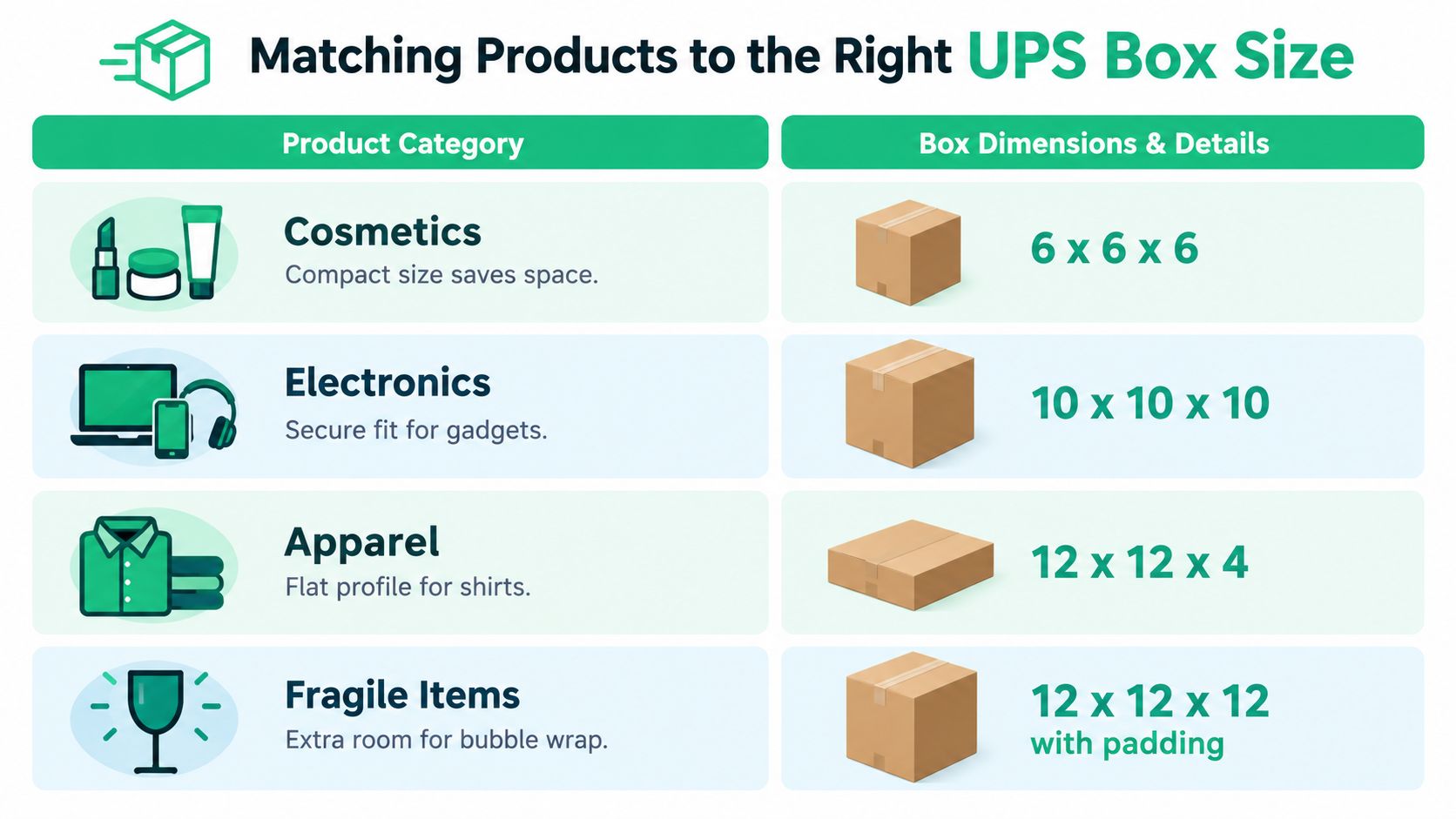
Cosmetics, jewelry, cables, and compact accessories usually benefit from a small cube or shallow Express carton. A cosmetics bundle can fit a 6 x 6 x 6 inch cube when the products are grouped and protected against movement. A jewelry order may suit the 13 x 11 x 2 inch Small Express Box if the presentation packaging remains low profile.
Sizing up creates empty volume and can allow small products to shift. Sizing down too aggressively can crush retail packaging or leave no room for protective wrap. Use dividers, tissue, or a controlled void-fill layer rather than filling the carton with loose material.
Electronics
A small electronic device often fits a 10 x 10 x 10 inch cube when the product box and cushioning require balanced space. A shallow Express carton may be better for a thin keyboard accessory, tablet accessory, or cable kit. The decision depends on the packed product, not the product name.
Measure the retail box, add the protection needed around it, and compare the resulting profile with both a cube and a shallow carton. Postal boxes for eCommerce can provide additional packaging context for merchants comparing mailing-box formats and product presentation requirements.
Apparel
Folded shirts and other soft goods usually need a flat, shallow carton rather than a deep cube. A 12 x 12 x 4 inch style of carton can preserve a neat fold while limiting unused height. For larger apparel orders, the 12 x 12 x 12 inch cube may work when the garments fill the space without compression.
A larger carton won't automatically protect clothing better. It may let garments spread, wrinkle, or move, while increasing the parcel's outer volume. For operational guidance on apparel fulfillment, use this practical guide to shipping clothing.
Fragile and bulky low-density goods
Fragile ceramics, glassware, and framed products need room for cushioning and separation. A 12 x 12 x 12 inch carton can be appropriate when the item requires protective material on every side, but the packer should still test whether a shallower or specialty carton provides a safer fit.
Bulky, low-density products often belong in a larger carton only when their shape demands it. A long print should use a long specialty format, while a broad flat item may suit a 30 x 24 x 6 inch carton. The right answer follows geometry and protection, not a default “large box” rule.
Packing Tips to Optimize Fit Protection and Cost
Good carton selection can fail at the pack station if the product is measured incorrectly or the final package gains unnecessary volume. Build the packing process around the ship-ready carton, because that is what the carrier measures and what the customer receives.
Measure the complete packed order
Measure the product in its retail packaging first. Then account for the protective material required around it, including corner protection, wrap, inserts, and any inner box. The final carton needs enough room to close without pressure, but it shouldn't contain large pockets of unused space.
Use this sequence:
- Measure the packed product: Record its longest, widest, and deepest points.
- Add protection deliberately: Select cushioning based on fragility and movement risk.
- Compare carton profiles: Check a shallow Express box, standard cube, and specialty alternative where relevant.
- Confirm closure: Reject any carton that bulges, crushes the product, or leaves the flaps under tension.
- Measure the sealed package: Capture the outside dimensions after taping.
A compact charger may need only a shallow carton and a small protective layer. A glass bottle needs separation and cushioning even if the bottle itself is narrow. The carton should support the product's weak points rather than distribute void fill randomly.
Control movement and reinforce closure
Place the product so it can't slide from one end of the carton to the other. Use fitted inserts, folded corrugate, paper, or another suitable void-fill method. Don't use loose fill as a substitute for a correctly sized box when the contents can still move.
Seal the carton across the main seam and reinforce weak points when the product is dense or the box is handling a heavier load. A secure closure protects the contents and prevents the carton from opening during normal handling.
Pack-station check: The product should be protected, the carton should close naturally, and the final dimensions should reflect the actual sealed package.
For Shopify teams standardizing these steps across multiple staff members, shipping and fulfillment best practices for Shopify merchants can complement a carton-sizing SOP. The operational goal is consistency. Every packer should make the same decision when presented with the same product profile.
Split an order only when one carton creates excessive empty volume, exceeds a weight or service constraint, or makes safe protection impractical. Don't split automatically. Compare the combined packing effort and carrier treatment with the single-carton alternative.
Quick Reference Lookup and Cross References for Fast Selection
At the packing station, use this matrix to choose a starting carton by product shape, protection requirement, and cube utilization. The dimensions identify the available profile. The added decision fields help staff reject a carton that is either too tight or mostly air before sealing it.
| Box Profile | Best Product Pattern | Minimum Practical Cube Use | Dimensional-Weight Risk | First Check |
|---|---|---|---|---|
| Small Express | Flat, dense items such as books, jewelry, and compact electronics | 70% | Low when contents fill the footprint | Confirm depth for cushioning |
| Medium Express | Dense small merchandise with moderate depth | 65% | Low to moderate | Keep the product centered |
| Large Express | Grouped thin products or bulky flat merchandise | 60% | Moderate | Compare with a smaller split |
| International 10 kg | Three-dimensional international shipments | 65% | Moderate | Check service and packed weight |
| International 25 kg | Heavier or bulkier international merchandise | 60% | High if underfilled | Review cube before adding void fill |
| Small or medium cube | Compact accessories, cosmetics, devices, and small components | 70% | Usually low | Select the smallest cube with controlled cushioning |
| Large cube | Bundles, protected electronics, and fragile goods | 60% | Moderate to high | Measure the sealed carton |
| Long specialty carton | Mirrors, pictures, posters, and other long products | 75% along the product length | Depends on unused width and height | Keep the product straight |
| Flat specialty carton | Prints, framed goods, and oversized flat items | 70% across the footprint | Moderate to high | Protect corners without adding excess height |
The cube-use figures are operating thresholds, not UPS service limits. A carton below the threshold deserves a second review. Reduce the carton size, add a planned split, or confirm that the protection method justifies the unused volume. A carton above the threshold can still fail if the product contacts the walls or cannot close without compression.
Use product geometry to make the first choice:
- Flat and dense: start with an Express profile, then verify that the depth accommodates cushioning and closure.
- Roughly cube-shaped: select the smallest standard cube that leaves controlled space around the product.
- Long and narrow: use a specialty carton. Bending the product or placing it diagonally in a cube creates wasted space and weak protection.
- Fragile: choose the carton that supports measured cushioning on every vulnerable side, not the carton with the largest internal volume.
- Mostly empty after packing: compare the next smaller carton before accepting a dimensional-weight risk.
- Large or heavy shipment: check the earlier UPS dimensional-weight and carrier-limit rules before finalizing service.
For example, a compact device that occupies most of a medium cube may be a better fit than a larger cube filled with loose paper. A framed print needs a flat carton sized around its face and corner protection, while a long poster should stay straight in a specialty carton. The right choice is the smallest viable carton, not the carton with the most room.
Store these rules in the warehouse system with packed dimensions, weight, fragility requirements, and preferred carton profile. A product name such as “wireless speaker” does not give a packer enough information to choose consistently. The rule should identify the product's packed shape and the condition that triggers a smaller carton, a split shipment, or a service review.
Audit the matrix when packaging changes, a new carton enters inventory, or UPS requirements change. Review actual packed orders for recurring wall contact, damage, low cube use, and dimensional-weight exceptions. Remove carton options that repeatedly create those problems.
SelfServe helps Shopify and Shopify Plus teams manage post-purchase order edits, address validation, cancellations, and order upsells within merchant-defined rules. Visit SelfServe to see how those workflows can support cleaner fulfillment operations alongside a more disciplined UPS box-sizing process.