Best 3rd Party Fulfillment Companies for Shopify 2026

Orders start as a win and turn into an operational problem faster than most founders expect.
At first, fulfillment feels manageable. A few shelves. A label printer. Late-night packing sessions. Then Shopify volume climbs, customers expect faster delivery, support tickets pile up, and a simple address change suddenly means someone has to stop the warehouse flow, find a box, update a label, and hope nothing ships wrong.
That’s usually the moment brands start looking at 3rd party fulfillment companies.
The move is bigger than outsourcing boxes and postage. You’re handing a piece of your customer experience to another operator. You’re also choosing the system that will carry your brand through launches, promotions, and messy post-purchase requests that most 3PL sales decks barely mention.
That shift is happening at scale. The global 3PL market reached USD 1,260.98 billion in 2025 and is projected to reach USD 2,502.22 billion by 2033, growing at a 9.1% CAGR, according to Grand View Research’s third-party logistics market analysis. That tells you two things. First, outsourcing fulfillment is no longer a niche move. Second, brands that treat 3PL selection like a quick procurement task usually regret it.
When Your Shopify Growth Outpaces Your Garage
A common pattern looks like this.
A Shopify brand gets traction with paid social, creator partnerships, or a product launch. The team can still keep up for a while by throwing labor at the problem. Someone’s packing orders at night. Someone else is reconciling stock in a spreadsheet. Customer support keeps Slack-pinging ops to catch last-minute edits before the carrier pickup.
Then the cracks show.
A customer enters the wrong apartment number. Another wants to add one item after checkout. A wholesale order lands on the same day as a DTC promo. Suddenly your “warehouse” is a bottleneck, not an advantage.
That’s where a 3PL becomes infrastructure, not just convenience. A solid provider takes over receiving, storage, pick-pack-ship, and carrier handoff, so your team can stop improvising logistics and start managing it. If you want a plain-language baseline on the mechanics before you outsource, this guide on how to fulfill orders on Shopify is a useful reference point.
What changes when fulfillment leaves your building
Once inventory moves into a partner warehouse, your business starts running on process quality.
That includes the building itself. If you’ve ever toured a facility, you know little details matter. Dock flow, trailer access, and inbound handling discipline affect how quickly inventory gets received and made available for sale. This breakdown of a modern warehouse loading dock is worth skimming if you want to understand why some operations absorb inbound inventory smoothly and others create delays before a single order is picked.
A lot of founders think the biggest risk is shipping speed. It usually isn’t.
The bigger risk is choosing a 3PL that handles standard fulfillment well but falls apart when real-world commerce gets messy. That includes order edits, address corrections, bundled add-ons, returns routing, and support handoffs between your CX team and the warehouse.
The first 3PL decision isn’t “Who can ship my orders?” It’s “Who can handle my exceptions without creating more work for my team?”
Understanding 3PL Services and Cost Models
A 3PL quote makes more sense when you stop thinking about it as one service.
It’s a stack of warehouse activities, each with its own labor, storage, system, and exception costs. If you don’t break that apart, you’ll compare vendors on headline pricing and miss the charges that move your margin.
What a 3PL is really doing every day
At a practical level, most 3rd party fulfillment companies handle four operating motions.
Receiving inventory
Your supplier sends cartons or pallets to the warehouse. The 3PL unloads them, counts them, checks for discrepancies, and books units into inventory.
This step sounds routine, but it’s where a lot of problems start. If receiving is sloppy, inventory goes live late, counts drift, and your storefront can oversell stock that isn’t available.
Ask how the provider handles:
- Appointment scheduling: Can inbound freight sit for days before anyone touches it?
- Exception handling: What happens when the PO count is wrong or labels don’t match?
- Dock-to-stock workflow: How quickly does inventory become sellable after arrival?
Warehousing and storage
After receiving, product gets put away into reserve or pick locations. You’re paying for physical space, but also for location control, replenishment, inventory audits, and the software that tells the team where everything lives.
Storage sounds cheap until your catalog gets weird. Odd-sized cartons, fragile units, expiry-sensitive products, and bundles all create complexity.
What works:
- Clean SKU setup
- Consistent carton labeling
- Packaging standards defined before go-live
What doesn’t:
- Sending mixed cartons with poor labeling
- Frequent SKU changes with no notice
- Launching bundles without warehouse instructions
Picking and packing
This is the labor-heavy core. Orders drop into the system. Pickers pull items. Packers confirm contents, add dunnage or inserts, print labels, and hand off to the carrier.
The fee structure here is often where merchants get confused. Some providers quote a base fee per order, then additional charges per item, per pick, per insert, per custom box, or per special handling instruction.
If your brand runs subscriptions, sets, gifts, influencer mailers, or lot-controlled inventory, picking logic matters as much as speed.
Shipping and carrier management
The 3PL buys or manages parcel labels, injects shipments into carrier networks, pushes tracking back to Shopify, and may help with claims or delivery exceptions.
Providers often promise savings in this area. Sometimes that’s real. Sometimes the shipping discount gets offset by packaging markups, residential surcharges, or fees attached to special routing.
How to read a 3PL quote without getting trapped
Most quotes include some version of the fee types below.
| Fee Type | What It Covers | Common Structure |
|---|---|---|
| Receiving fees | Unloading, counting, checking in inbound inventory | Per carton, per pallet, per hour, or per unit received |
| Storage fees | Shelf, bin, pallet, or warehouse space used | Monthly fee by bin, pallet, cubic space, or square footage |
| Pick and pack fees | Pulling items and packing outbound orders | Per order plus per item, or flat bundled fee |
| Packaging fees | Boxes, mailers, dunnage, branded inserts, special materials | Per shipment or per packaging component |
| Shipping management fees | Label generation, carrier selection, dispatch handling | Built into shipping cost or added as admin fee |
| Returns fees | Receiving returns, inspection, restock, disposal, or routing | Per return, per item, per action, or hourly |
| Setup and onboarding fees | Account configuration, system mapping, implementation work | One-time project fee |
| Value-added service fees | Kitting, relabeling, bundling, quality checks, custom requests | Per unit, per bundle, or hourly |
Where merchants usually underestimate cost
The invoice rarely gets ugly because of the obvious line items. It gets ugly because of activity you assumed was included.
Watch for these:
- Minimums: Low-volume months may trigger monthly minimum billing.
- Peak surcharges: Promo periods can change labor pricing.
- Storage creep: Slow movers inflate monthly carrying costs.
- Exception fees: Split shipments, relabels, manual holds, and order changes can all become billable.
- Returns handling: Especially painful if your category has a heavy reverse flow.
If you sell apparel or another return-heavy category, returns economics need a separate review. Don’t let them hide inside a general fulfillment quote.
Practical rule: Ask every vendor to price one normal order, one multi-line order, one return, and one exception scenario in writing. If they resist, assume invoice surprises are coming.
What to compare beyond price
The cheapest quote is often the most expensive operating model.
A better comparison uses three lenses:
Workflow fit
Can they handle your catalog, packaging rules, and support processes without manual workarounds?Billing clarity
Can your finance or ops lead trace each invoice line back to a warehouse activity?Exception discipline
What happens when a customer changes an address, a bundle component goes out of stock, or inbound inventory arrives wrong?
That last point is often overlooked. Standard fulfillment is easy to demo. Exceptions reveal whether the provider is built for e-commerce operations or just warehouse throughput.
The Strategic Trade-Offs of Outsourcing Fulfillment
Outsourcing fulfillment provides an advantage. It also removes direct control.
That’s the trade. If you ignore either side, you’ll make the wrong decision.

What gets better fast
For a growing Shopify brand, the upside is usually operational breathing room.
You stop staffing a warehouse function inside a retail business. You stop buying supplies in panic mode. You stop tying leadership attention to daily shipment volume. Peak periods become more survivable because the warehouse labor pool, carrier relationships, and physical footprint are already there.
A 3PL also helps when growth stops being geographically neat. If orders are spreading across regions, a distributed network can improve delivery consistency in ways a single in-house location often can’t.
There’s a less obvious gain too. Internal teams get time back.
Marketing can launch faster without asking whether the back room can absorb the order spike. CX can focus on customer resolution instead of walking downstairs to find a package. Ops can work on planning, not label printing.
What gets harder the day you sign
The hard part starts after onboarding.
You’re no longer standing next to inventory. You can’t fix a packaging issue by walking to the line. You can’t casually change an insert, a box style, or a warehouse rule and expect instant execution.
That loss of control is familiar in many outsourced functions, not just logistics. Some of the broader critical disadvantages of outsourcing apply here too. Communication lag, process drift, and accountability gaps all show up if roles aren’t defined tightly.
Here’s where brands get burned:
- Brand presentation slips: Custom packaging or fragile presentation standards get inconsistently applied.
- Inventory visibility weakens: Your system says one thing, the floor says another.
- Exception handling slows down: Order holds, special requests, and replacements get routed through too many people.
- Priority conflicts emerge: You are not the only client in the building.
The decision usually comes down to this
If your in-house operation is still a strategic advantage, keep it.
If your in-house operation has become a distraction, outsource it. But do it with eyes open. You need operating discipline, escalation paths, and measurable standards from day one.
A weak 3PL relationship doesn’t remove complexity. It relocates complexity to email, support queues, and invoice disputes.
The best partnerships don’t feel magical. They feel boring. Orders move. Inventory stays accurate. Exceptions have rules. Your team doesn’t spend all day asking the warehouse what happened.
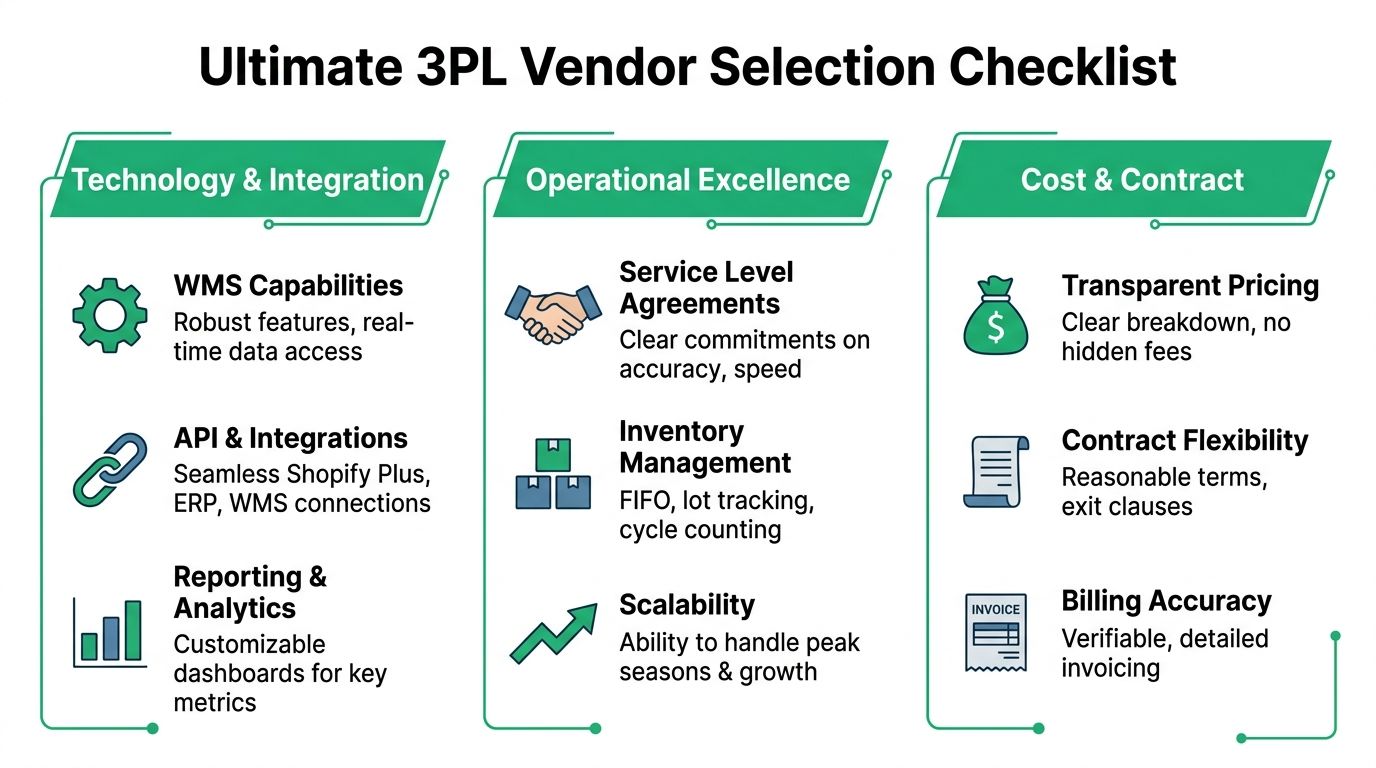
Your Ultimate Vendor Selection Checklist
A 3PL sales process usually breaks down the same way. Your team asks about shipping speed, storage rates, and Shopify compatibility. The vendor says yes to all of it. Sixty days after launch, your support queue is full of order edit requests the warehouse cannot catch, inventory is out of sync after a promo, and finance is disputing fees tied to “manual exceptions.”
That is why vendor selection has to test operating fit, not sales polish. For a fast-growing Shopify brand, the hard part is rarely basic pick and pack. The hard part is whether the 3PL can support the messy post-purchase workflows that show up once volume rises. Address changes. item swaps. fraud holds. delayed release logic. upsells added after checkout. If those workflows break, the warehouse becomes a customer experience problem.
Technology and integration
Start with the system behavior you need after the order is placed, then work backward into warehouse capability.
Shopify connection quality
“Do you integrate with Shopify?” is too vague to be useful. Plenty of providers can pull orders and push tracking numbers. That does not tell you whether they can handle the operational reality of a high-volume store.
Ask questions that expose how the integration behaves under pressure:
- Order sync depth: Do they ingest tags, notes, fraud flags, routing rules, and hold statuses, or only the basic order record?
- Edit window support: What happens if a customer changes size, address, or quantity after import but before pick release?
- Post-purchase offers: Can the system accept item additions or order merges without forcing your team into manual work?
- Inventory sync timing: How often does available inventory update back to Shopify, and what events trigger an update?
- Error handling: Who sees failed syncs, duplicate orders, or inventory mismatches, and how fast can someone act on them?
If normal daily operations depend on CSV files, inbox threads, or “our team checks that manually,” treat that as a warning.
WMS maturity
A weak WMS does not stay contained inside the warehouse. It spills into customer support, merchandising, and finance.
Ask for a live walkthrough of warehouse actions, not just dashboards. If you are comparing providers, it helps to know what strong warehouse systems look like. This breakdown of best WMS systems for modern fulfillment teams is a useful reference point before demos.
Review these areas closely:
- Location control: Bin, shelf, pallet, and overflow visibility
- Cycle counts: How stock discrepancies are found, approved, and corrected
- Lot or batch tracking: Required for products with expiration, compliance, or recall risk
- Rules engine: FIFO, replenishment, order priority, and hold logic
- Scan discipline: Where barcode scans happen and where the process still depends on human memory
If the rep cannot show how an order moves from import to pick release to ship confirmation, you still do not know how the operation works.
Reporting and data access
Your team should not need to open a ticket to answer basic questions. Daily visibility should be self-serve.
Check whether the 3PL gives you access to:
- Order-level event history
- Inventory adjustment logs
- Return status by order and SKU
- Billing detail tied to warehouse activity
- Exception queues for holds, errors, and failed releases
Good reporting shortens problem resolution. Weak reporting turns every issue into a scavenger hunt.
Operational excellence
Warehouse tours and polished SOPs matter less than repeatable execution. The right questions here are specific, a little uncomfortable, and tied to how they measure themselves.
SLA discipline
A serious provider puts service levels in writing and defines exactly how they are measured. Industry groups such as MHI’s warehousing and fulfillment resources describe the core metrics operators track, including order accuracy, inventory accuracy, and on-time shipment performance.
Do not stop at headline targets. Ask for the measurement logic behind them.
You want clarity on:
- What counts as an error
- When the clock starts and stops for same-day or next-day shipping
- How inventory accuracy is audited
- How often performance is reviewed
- What escalation path applies when service drops
- Whether service credits or other remedies are written into the contract
A vendor can advertise strong SLAs and still exclude half the failure cases in the fine print.
Returns and reverse logistics
Returns expose the difference between a warehouse that ships boxes and one that can support commerce operations.
For categories with frequent exchanges, fit issues, or bundle complexity, ask practical questions:
- How are returned items inspected and graded?
- What disposition codes do they use?
- How fast can sellable units go back into available inventory?
- Can they separate exchange inventory from resale inventory?
- Can their process feed refund approvals or exception queues back to your systems?
- Are reverse logistics fees fixed, variable, or tied to handling steps?
Symbia’s comparison of internal warehouses and 3PL fulfillment services notes how quickly reverse logistics becomes a margin issue when process design is weak. That matches what operators see every day. Slow returns processing ties up cash, delays refunds, and leaves support answering questions the warehouse should have resolved already.
Scalability under stress
Average-week performance is easy to sell. Peak-week performance is what you are buying.
Ask for specifics on:
- Promo and product launch readiness
- Holiday labor planning
- Order cut-off rules during volume spikes
- Overflow capacity
- Receiving turnaround during peak periods
- How fast new SKUs, bundles, or inserts can be added when the floor is busy
I always ask for an example from their last peak season. A provider that answers in generalities usually has not pressure-tested the process.
Cost and contract
Margin leaks start here. The goal is not to get the cheapest rate card. The goal is to understand exactly how your operating model turns into charges.
Transparent pricing
Ask each finalist to build a sample invoice from your real order mix. Include standard orders, multi-line orders, returns, kitting, and exception handling.
Look for detail on:
- Receiving
- Storage
- Pick and pack
- Packaging
- Returns
- Special projects
- Minimums
- Peak surcharges
- Account management or tech fees
Watch for vague phrases such as “custom handling,” “special projects,” or “manual processing.” Those labels often become catch-all charges once your business gets more complex.
Contract flexibility
Long terms do not create alignment on their own. They can also trap a brand in a partnership that looked fine in the pitch stage and failed in live operations.
Review:
- Termination rights
- Notice periods
- Fee increase language
- Implementation milestones
- Data access rights
- Liability for lost or damaged inventory
- Responsibility for integration fixes after go-live
The hidden contract issue for Shopify brands is workflow ownership. If post-purchase edits fail, who fixes the process? Your app partner, your 3PL, your agency, or your team? If that is not defined upfront, every issue turns into finger-pointing.
Billing accuracy
Invoice disputes are usually a systems problem disguised as a finance problem.
Ask how the 3PL ties charges back to operational records. They should be able to trace fees to receiving logs, storage snapshots, return scans, special project approvals, and order events. If they cannot do that cleanly, your ops team will end up auditing warehouse bills line by line.
A short scorecard for final-round vendors
Use a weighted scorecard before you choose a partner. Give extra weight to the workflows that break customer experience when they fail.
| Area | What to verify |
|---|---|
| Integration | Real-time Shopify sync, hold logic, order edit support, post-purchase changes |
| Warehouse execution | Receiving accuracy, scan discipline, pick performance, returns handling |
| Visibility | Event history, inventory logs, exception reporting, billing traceability |
| Cost control | Clear fee schedule, sample invoices, surcharge rules, project pricing |
| Risk | SLA definitions, liability terms, escalation paths, termination options |
Selection mistakes rarely happen because a provider lied outright. They happen because the brand bought capacity and basic shipping competence, when what it needed was a 3PL that could keep up with dynamic order workflows after the checkout button is clicked.
The Tech Stack That Powers Modern Fulfillment
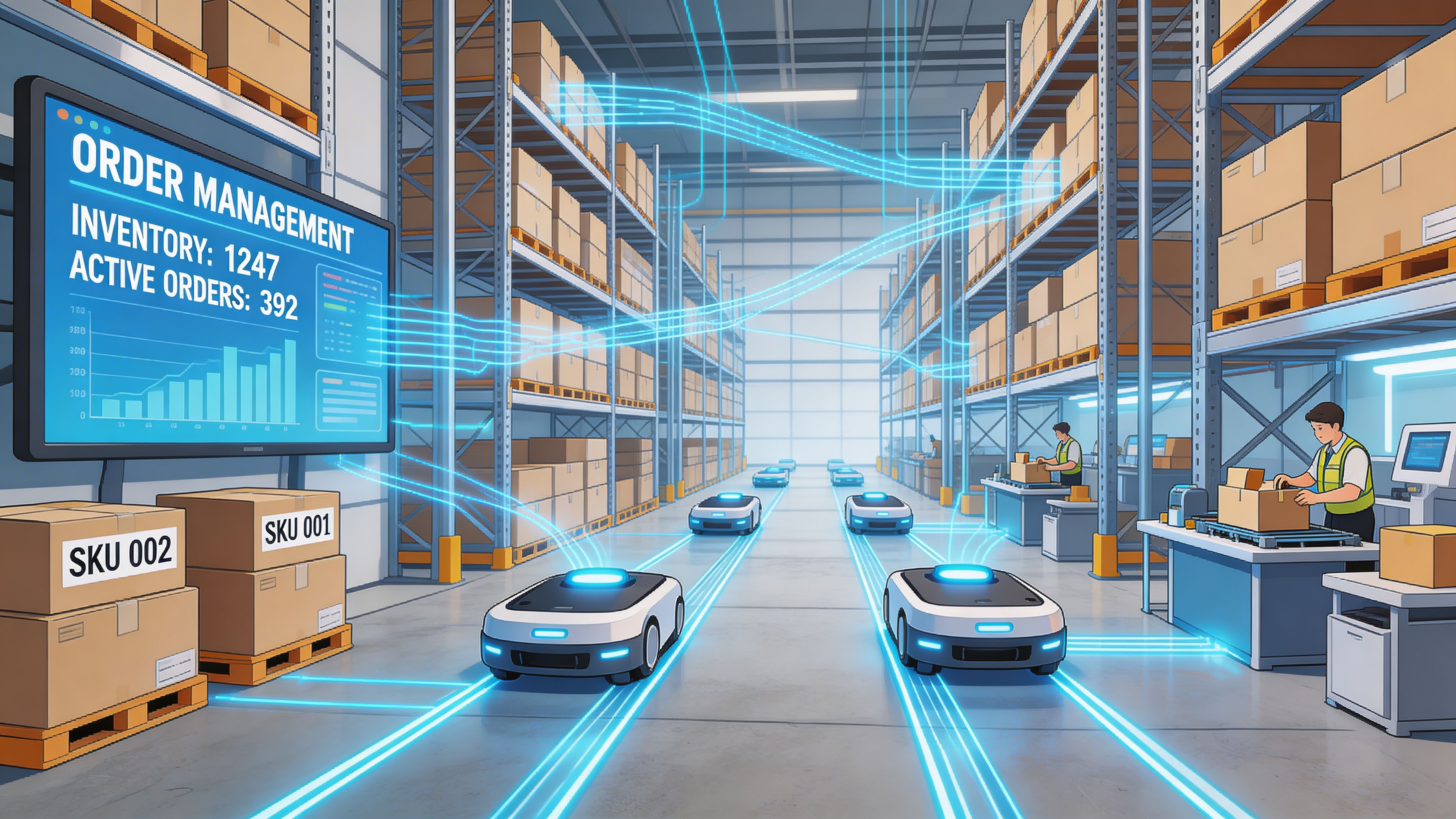
A 3PL in 2026 isn’t just a warehouse operator. It’s a software environment attached to physical labor.
That distinction matters because your team experiences the partner through systems first. Inventory syncs. Order status events. Exception flags. API limits. If that layer is weak, even a well-run warehouse feels unreliable.
Why WMS quality matters more than the sales demo
The Warehouse Management System controls receiving, putaway, picking, replenishment, cycle counts, and inventory location logic. It also determines whether your support and ops teams see clean data or spend their day reconciling mismatches.
Technology is a major performance driver. 38% of 3PLs use their WMS to scale order volumes by more than 25%, with real-time inventory tracking cited by 82% and accuracy improvements by 75% as top adoption drivers, according to Extensiv’s guide to 3PL statistics.
That lines up with what operators see in practice. A mature WMS reduces warehouse ambiguity. A weak one exports that ambiguity to your storefront, CX queue, and finance team.
If you’re comparing platforms from the merchant side, this roundup of best WMS systems gives helpful context on what stronger warehouse software tends to do well.
APIs decide whether your process is scalable
A lot of 3PL relationships fail because the tech stack only supports the happy path.
Orders import. Labels print. Tracking syncs back. Fine.
But what about:
- an order on hold because fraud review isn’t complete
- a customer who fixes a shipping typo before pick release
- a bundle that needs order tags to trigger custom handling
- a replacement shipment tied to a support case
Those aren’t edge cases in DTC. They’re daily operations. If the API can’t handle them cleanly, your team builds manual patches.
Don’t ask whether the 3PL has an API. Ask whether your actual exception flows can run through it without human re-entry.
A useful way to pressure-test this is to ask the vendor for a live walkthrough of an exception, not a standard order. Make them show the system behavior.
Here’s a useful overview for teams evaluating warehouse automation and operations tech in context:
The signals of a tech-forward 3PL
You don’t need a provider with the flashiest UI. You need one with operationally useful software.
Look for:
- Documented APIs: Clear endpoints, event behavior, and support ownership
- Real-time status visibility: Not delayed exports
- Warehouse exception workflows: Holds, edits, cancellations, and returns states
- Role-based reporting: Ops, CX, and finance should each get usable visibility
- Change control discipline: System changes shouldn’t surprise your storefront or ERP
Warehouse location still matters. But if the tech layer is brittle, a well-placed building won’t save the relationship.
Solving Post-Purchase Chaos with Your 3PL
Most content about 3PLs gets shallow at this point.
Pick, pack, and ship are important, but they aren’t what overloads a fast-growing Shopify support team. Friction usually starts after the customer has already checked out.
An address is wrong. A buyer wants to add one item. Someone entered the right street with the wrong unit number. A cancellation request lands while the order is already sitting in a pick queue.
Those requests expose the gap between storefront flexibility and warehouse rigidity.
Standard integrations don’t solve dynamic order changes
Most 3PL integrations are designed for one-way execution. Import the order. Fulfill it. Return tracking.
That works until the customer wants to change something.
A commonly overlooked problem in 3PL content is post-purchase order management. An estimated 30% to 50% of customer support volume stems from address edits and returns, yet many integration guides don’t address the API gaps around self-service changes, according to Built In’s article on 3PL companies.
That gap creates real operating pain:
- CX agents scramble to intercept orders before release
- warehouse teams get ad hoc requests outside normal flow
- customers receive packages at bad addresses
- simple add-on opportunities turn into support tickets instead of revenue
Where the workflow usually breaks
The failure points are predictable.
Address edits after order import
A customer spots a typo after checkout. Shopify has one version of the order. The 3PL has already imported another. If the order is released quickly, there may be no safe window to update it.
If your process depends on an agent emailing the warehouse, you don’t have a system. You have a race.
Upsells after checkout
Post-purchase offers sound easy until fulfillment gets involved. Adding an item to an existing order affects pick lists, package dimensions, labels, and sometimes tax or inventory allocation.
Many 3PLs can handle this operationally if the order is still editable. The problem is the merchant often has no clean logic connecting the storefront event to the warehouse state.
Returns and order change overlap
A customer who can’t edit an order in time often becomes a return later. That means one bad post-purchase process creates extra outbound cost, inbound returns labor, and more support handling.
For teams reviewing the broader systems around this, these notes on returns management systems help frame how post-purchase operations and reverse logistics connect.
A lot of “returns problems” are actually “we failed to manage the order before it shipped” problems.
What a workable model looks like
The cleanest setup has three rules.
Define an edit window
Not every order should be editable forever. The safe window has to reflect your 3PL’s release timing.Validate changes before they hit the warehouse
Address updates need deliverability checks. Product add-ons need inventory and order-state checks.Sync only approved changes into the fulfillment flow
The warehouse should receive clean instructions, not support-team improvisation.
That’s the missing middle in many 3PL partnerships. The warehouse doesn’t want messy exceptions. Your customers don’t want to open a ticket for every typo. Your CX team doesn’t want to play traffic controller between Shopify and a WMS.
A strong post-purchase layer solves that by controlling what can change, when it can change, and how the approved change reaches operations.
What does not work at scale
These patterns usually collapse as volume rises:
- Manual inbox triage: Support forwarding order edits to ops
- CSV corrections: Batch fixes for live orders
- No lock rules: Customers can request changes, but nobody knows which orders are still safe to modify
- Warehouse-side improvisation: Staff changing labels without system alignment
- Disconnected upsell logic: Marketing launches offers ops can’t fulfill cleanly
If you’re evaluating 3rd party fulfillment companies, this should be part of the core assessment, not an afterthought. A provider that handles standard outbound volume but can’t support post-purchase control will shift cost into CX, returns, and re-shipments.
Migration Planning KPIs and Contract Negotiation
The contract usually gets signed right as order volume is climbing, the team is tired, and leadership wants the move done before the next promotion. That is exactly when brands agree to vague timelines, soft service levels, and integration assumptions nobody has tested.
A 3PL migration is an operations project, but for Shopify brands with active post-purchase flows, it is also a systems-control project. If customers can edit addresses, cancel, swap items, or accept post-purchase offers, the question is not just whether the warehouse can ship on time. The question is whether every downstream system knows when an order is still editable, when it is locked, and who has authority to change it.
How to move without breaking fulfillment
The highest-risk mistake is stacking too much change into the same week. New warehouse, new carrier rules, new inventory counts, new order-routing logic, and a half-finished Shopify integration is how brands end up with support queues full of "where is my order?" and ops teams doing damage control in spreadsheets.
A safer migration plan usually follows this sequence:
Clean the catalog before inventory moves
Fix SKU naming, pack-out rules, bundle components, case packs, and product dimensions while you still control the current environment. Bad master data survives every warehouse move.Document every system handoff
Map how orders, inventory states, tracking events, cancellations, returns, and replacement orders move between Shopify, the 3PL, your ERP, and CX tools. Include the post-purchase layer if customers can modify orders after checkout.Define order lock timing in writing
This is one of the most missed integration requirements. If your site offers address edits or upsells for a period after purchase, the 3PL needs a clear release trigger. "Near real time" is not a rule. "Orders release 30 minutes after payment unless fraud review is open" is a rule.Phase inbound if you can
Sending all inventory at once leaves no room to catch receiving or putaway errors before they affect live orders. A phased ramp lets both sides test the operation under controlled volume.Test exceptions, not just happy-path orders
Standard single-line orders rarely expose problems. Test partial shipments, split shipments, address corrections, customer cancellations, post-purchase add-ons, returns intake, and replacement orders.Set one decision-maker on each side
One merchant owner. One 3PL owner. Daily issue review during launch. Problems get fixed faster when escalation paths are already clear.
The strongest migrations remove ambiguity before the first inbound carton is checked in.
The KPIs worth putting in writing
A 3PL should be managed against clear service levels and clear definitions. Otherwise the reporting looks fine while your team is still eating reship costs and support volume.
Start with the basics:
- Order accuracy: Right item, right quantity, right packaging, right insert
- Inventory accuracy: WMS quantities match physical stock and Shopify availability
- On-time shipment: Orders leave within the agreed cutoff and service window
- Return processing time: Returned units are received, inspected, and dispositioned fast enough to protect resale inventory and customer refunds
- Exception rate: Orders that need manual intervention before shipment
- Cost per order: Total fulfillment cost after storage, pick fees, packaging, special projects, and exception handling
Then add metrics that reflect how your business runs after checkout.
For a high-volume Shopify store, I would also track:
- Order edit success rate: Approved customer changes that reach the 3PL correctly before release
- Order release latency: Time between order creation, customer edit window, and warehouse release
- Post-purchase upsell fulfillment accuracy: Added items that ship correctly with the original order
- Cancellation containment rate: Orders canceled before pick, instead of after labels print or parcels move
These are the KPIs that expose whether your integration is helping operations or creating manual work. Industry guidance from the Warehousing Education and Research Council stresses that warehouse KPIs only matter if definitions, calculation methods, and review cadence are agreed upfront, which is the part many first-time 3PL buyers skip (WERC warehouse KPI guidance).
One warning here. "On time" needs a shared definition. Some 3PLs mean same-day label creation. Merchants usually mean the order was packed, manifested, and handed off within the promised window. Write the definition into the SLA.
Contract points merchants under-negotiate
First-time 3PL contracts often look detailed because the fee tables are long. The risk usually sits in the sections that are still vague.
Push for precision on these points:
- Liability for lost or damaged goods: Reimbursement method, claim timing, and whether value is based on cost or retail
- Rate-change terms: How often pricing can change, what notice is required, and which triggers are valid
- Implementation scope: What is included in onboarding, integration setup, testing support, and training, and what becomes a billable project
- Service failures and remedies: What happens if they miss agreed service levels for accuracy, ship times, or inventory control
- Exit terms: Notice period, inventory withdrawal process, data export access, and who pays for offboarding labor
- Exception billing: What counts as standard workflow versus custom work, especially for order edits, partial cancels, and special handling
- Data ownership: Your right to access order history, inventory history, tracking events, and operational logs if you switch providers
The post-purchase piece belongs in the contract too. If your brand allows customer edits after checkout, the agreement should state whether the 3PL supports delayed release, order holds, revised pick instructions, merged shipments, or partial cancellations. If they do support those workflows, define the turnaround time and any added fees. If they do not, that limitation needs to be explicit before launch, not discovered during your first campaign spike.
A contract will not make a weak operator strong. It will make failure easier to identify, escalate, and exit.