Master Returns Management Systems for E-commerce Growth & Profit
Let’s be honest: for many growing brands, returns feel like a necessary evil. A returns management system changes that. It's not just a fancy tool for printing return labels. Think of it as the central nervous system for your reverse logistics, bringing order and intelligence to what is often a chaotic process.
Why Returns Management Systems Are a Strategic Asset
Too many merchants see returns as nothing more than a line item on the expense sheet—a hit to the bottom line that you just have to swallow. This mindset forces you into a reactive corner, scrambling to handle returns with manual processes, endless email chains, and messy piles of products in the warehouse. But this approach creates hidden costs that are far more dangerous than the price of a single returned item.
A disorganized returns process is like an anchor dragging on your business. It slows everything down. Each manual return eats up precious time from your team, from answering customer emails to inspecting and restocking products. These little tasks compound, stealing focus from the activities that actually grow your business.
The True Cost of Manual Returns
The damage isn't just about labor costs. A clunky, confusing return experience can poison your brand reputation. When a customer has to fight to send something back, that frustration quickly turns into a bad review or a vow to never shop with you again. In today's market, a bad post-purchase experience is a gift you hand directly to your competitors.
Does any of this sound painfully familiar?
- Wasted Staff Hours: Your support team is buried in "Where's my refund?" tickets and spends hours manually creating return labels for customers.
- Lost Inventory Value: Without a clear system, returned items get lost, damaged, or sit in a warehouse "death pile" for so long they become worthless.
- Damaged Brand Reputation: A slow, opaque, or difficult return process leaves customers feeling angry and unheard, ensuring they won't be back.
- Lack of Actionable Data: You're flying blind. You have no real insight into why items are coming back, missing out on crucial feedback that could fix product descriptions, sizing charts, or even manufacturing flaws.
By shifting returns from a chaotic cost center to an automated, data-driven operation, a returns management system unlocks incredible strategic value. It’s not about just plugging a leak; it's about turning a potential loss into an opportunity to build customer loyalty and operational muscle.
To really grasp the power of an RMS, you need to see its impact on your bottom line. You can calculate return on investment to measure the success of your new system. Understanding how closely shipping and returns are linked also shows how a unified logistics strategy can create a much better customer journey.
At the end of the day, high-volume merchants simply can't afford the compounding costs of handling returns by hand anymore. A solid returns management system isn't a "nice-to-have"—it's an essential piece of a scalable and sustainable e-commerce business. It gives you the structure to not only survive returns but actually use them as an engine for growth.
To really get a handle on how a returns management system (RMS) can shift returns from a logistical nightmare to a strategic asset, you need to look under the hood. It’s not just one piece of software; it’s a set of connected components that work together to create a smooth, intelligent process for both your team and your customers.
Think of it as the central nervous system for your brand's post-purchase experience. It connects what a customer does on your website with what your warehouse team does with the physical product, making sure every step is coordinated and smart.
The Customer-Facing Returns Portal
The part your customers will actually see and interact with is the branded returns portal. This is your brand's digital welcome mat for returns. Instead of forcing customers to dig for a support email and wait in a queue, a good portal lets them start a return on their own, right from your site.
It should look and feel just like your store, reinforcing your brand identity even when a purchase didn't work out. Customers can log in, pick the items they want to send back, and give a reason why—all without ever needing to contact your team. This self-service approach is exactly what modern shoppers expect, and it drastically cuts down on the constant "Where's my refund?" tickets that can overwhelm a support desk.
Automated RMA and Smart Workflows
Once a customer initiates a return, the system's brain kicks in. The first thing it does is generate a Return Merchandise Authorization (RMA). This is essentially a unique tracking number for that specific return, ensuring that when a box shows up at your warehouse, your team knows exactly what’s inside, who it came from, and what to do with it.
But the real magic happens with automated workflow rules. These are the "if-then" recipes that apply logic to the entire process, allowing you to create customized experiences at scale.
For example, you can set up rules to:
- Reward your best customers: If a return is from a VIP customer, you could automatically issue them an instant refund or store credit, even before they ship the item back.
- Protect high-value products: For any item over $500, a workflow could automatically flag it for a mandatory manual inspection upon arrival.
- Incentivize exchanges over refunds: If a customer chooses "wrong size" as the reason for return, the system can offer a free shipping label for an exchange but charge a small fee for a refund.
This is how you move returns from a pure cost center toward becoming a powerful tool for your business.
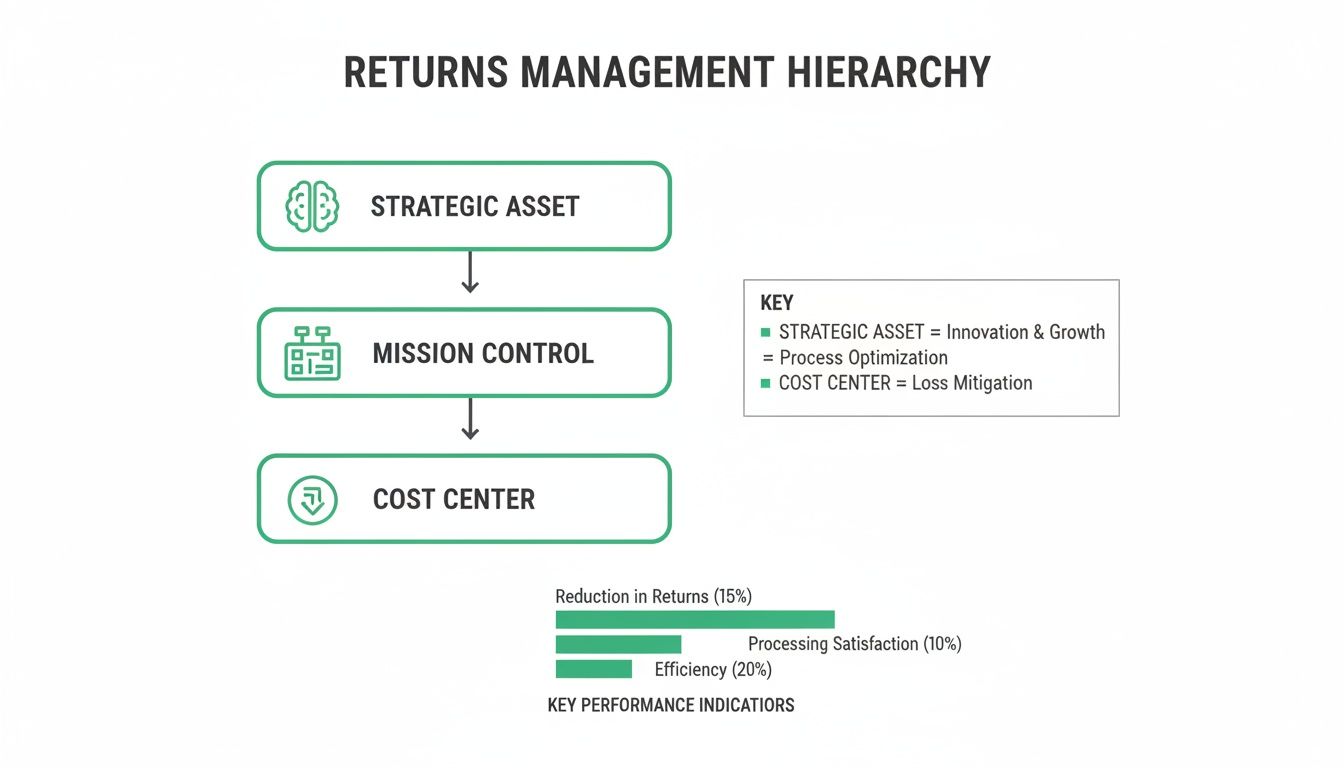
As you can see, the most sophisticated brands don't just see their RMS as a way to process returns. They see it as mission control for improving products, understanding customer behavior, and driving retention.
To help you distinguish between the must-haves and the nice-to-haves, here's a look at the features that define a modern RMS.
Key Features of Returns Management Systems
| Feature Category | Essential Functionality | Advanced Capability (for high-volume stores) |
|---|---|---|
| Returns Initiation | Branded, self-service returns portal for customers to start returns. | Order lookup via email, phone number, or ZIP code; QR code-based, box-less returns. |
| Rules & Workflows | Basic automation based on return reason (e.g., refund vs. exchange). | Dynamic rules based on customer LTV, product value, inventory levels, or return history. |
| Outcomes | Standard refunds to the original payment method and basic exchanges. | Instant exchanges, store credit bonuses, and "keep the item" rules for low-cost products. |
| Logistics | Generation of printable return labels for a single carrier. | Multi-carrier rate shopping, automatic label generation, and international returns management. |
| Integrations | Core connection to your ecommerce platform (e.g., Shopify). | Deep integrations with 3PLs, WMS, helpdesks (like Gorgias), and marketing platforms. |
| Analytics | Basic reports on return volume and top return reasons. | In-depth analytics on return reasons by SKU, exchange conversion rates, and financial impact. |
While the essential features get the job done, high-volume merchants quickly find that advanced capabilities are what unlock true efficiency and turn returns into a competitive advantage.
Critical System Integrations
A returns platform is only as good as its connections. To be truly effective, it has to communicate seamlessly with the other tools in your tech stack. Crucial integrations with your inventory system, warehouse management system (WMS), and third-party logistics (3PL) partners are absolutely non-negotiable.
When your RMS is properly plugged into your operations, it creates a perfect loop of information. A return approved in the portal instantly pings your 3PL with an inbound shipping notice, letting them know what product is coming and how to process it.
This connectivity is what allows a returned item, once inspected and approved, to be added right back to your available inventory count in Shopify. This simple action prevents stockouts and ensures you never miss a potential sale. All these components are designed to work in concert, and a big part of that is understanding what a return label is and the role it plays in tying the physical and digital journey together.
How a Returns Management System Actually Helps Your Business
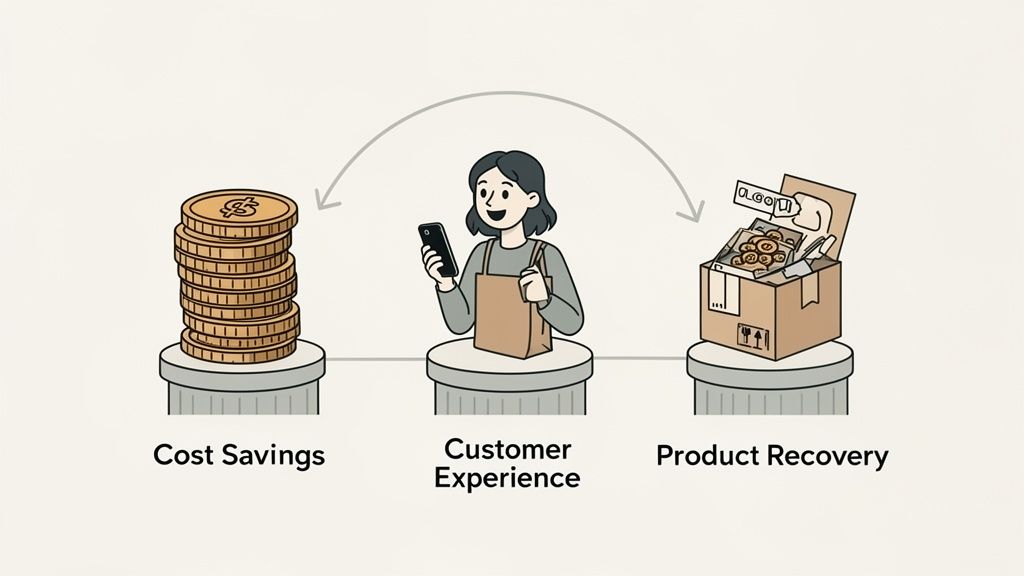
While the specific features of a returns management system are great on paper, what really matters are the concrete results you'll see in your day-to-day operations. Bringing in a modern RMS isn't just about shuffling boxes more efficiently; it’s about making a fundamental shift in how you run your business—making it more profitable, more efficient, and far more focused on the customer. It turns what was once a pure cost center into a surprising source of growth.
This change really comes down to three key wins: cutting your operational costs, dramatically improving the customer experience, and finding new ways to make money from returned products. By automating the entire returns journey, an RMS gets rid of the manual, repetitive tasks that bog down your team and leave customers feeling frustrated.
Cut Down on Operational Costs
The first and most obvious benefit you'll notice is a big drop in what it costs to handle returns. Processing returns by hand is a notorious time-drain. It forces your support team to spend hours on repetitive, low-value work instead of helping customers with more complex problems.
A good RMS automates everything from the moment a customer requests a return to the final refund confirmation. Your team no longer has to manually generate labels or send status updates. This automation cuts down on returns-related support tickets, freeing up your agents to focus on mastering customer support for ecommerce and building real relationships.
Think about it this way: a self-service returns portal acts like your best support agent. It works 24/7, never gets tired, and handles all the routine questions so your human team doesn't have to.
Make the Customer Experience Memorable (in a Good Way)
These days, a simple and clear returns process isn't a "nice-to-have"—it's a baseline expectation. An RMS can turn a moment of potential disappointment into an experience that actually builds customer loyalty. Instead of navigating a confusing maze of emails and instructions, customers get a straightforward, branded portal that puts them in control.
This simple shift has a huge impact. When a shopper knows they can easily send something back if it’s not right, they feel more confident hitting that "buy" button. A hassle-free return can even convince an unhappy customer to come back and shop with you again. In today's competitive market, you can't afford to get this wrong; poor return policies lead 79% of shoppers to abandon their carts.
Find the Hidden Revenue in Your Returns Pile
Maybe the most overlooked advantage of an RMS is its power to turn your pile of returned goods into a genuine revenue stream. Without a proper system, returns often end up in a "death pile" in the corner of a warehouse, losing value every day until they’re eventually written off as a total loss.
A returns management system acts as a product recovery engine. It gives you the clear visibility and workflow you need to inspect returned items quickly and get them back into your sellable inventory.
Here’s how it works:
- Speedy Restocking: The system gives your warehouse a heads-up on what's coming back. This allows them to inspect items and immediately restock products that are in perfect condition, making them available for the next sale.
- Smart Grading and Resale: For products with slight damage or opened packaging, you can grade them and sell them through a dedicated "open-box" or "imperfect" section on your store, recovering a huge chunk of their original value.
- Data for Better Decisions: The system tracks why items are being returned. This data is gold. You can use it to identify product defects, improve your product descriptions, or work with suppliers to fix quality issues, which reduces future returns.
With these workflows in place, you’re no longer just managing a loss. You're actively recovering assets. This is exactly what the best reverse logistics companies do. Instead of seeing a returned box as a problem, an RMS helps you see it as an opportunity.
Choosing the Right System for Your Shopify Store
Picking a returns management system for your Shopify or Shopify Plus store is a high-stakes decision. And it should feel that way. This tool becomes the foundation of your entire post-purchase experience and a critical hub for operational data. The right one can boost efficiency and build incredible customer loyalty, but the wrong one will just create data silos and massive operational headaches.
Instead of just listing software brands, let's focus on the questions you need to ask during your evaluation. Think of this as your buyer's checklist—designed to help you find a real partner for growth, not just another software subscription. Your goal is to find a system that fits into your current workflow like a missing puzzle piece, rather than one that forces you to change the entire picture.
Evaluating Seamless Shopify Integration
The absolute first thing to look at is how deeply the system integrates with Shopify. A shallow integration, one that just pulls order numbers, is a recipe for disaster. It creates disconnected data streams that force your team to constantly jump between platforms just to get a complete view of a customer or an order.
You need a solution that feels like it was born inside the Shopify ecosystem. This means it should sync customer data, order history, inventory levels, and product information in real time, without any hiccups.
Ask any potential provider these direct questions:
- Data Synchronization: How does your system actually sync data with Shopify? Is it instant, or is there a frustrating delay?
- Order and Product Data: Can your system access and use all product and order data—including important details like tags and metafields—to power our automation rules?
- Inventory Management: When a return is processed and restocked, does it automatically update our inventory levels inside Shopify so the item is immediately available for sale?
A truly native integration is the only way to prevent data silos and ensure your returns process works with your e-commerce platform, not against it.
Assessing Scalability and Performance
Your business isn't static, and your returns system can't be either. It needs to handle the quiet days in July with the same rock-solid reliability as the absolute chaos of Black Friday. For any high-volume merchant, proven scalability isn't a nice-to-have; it's a fundamental requirement.
A system that crashes or even just slows down during peak season will cost you sales and do serious damage to your brand's reputation. The RMS you choose must have the infrastructure to manage a flood of return requests, label generations, and status updates without breaking a sweat.
The global market for returns management software is exploding for this very reason. Its value shot up from $12.38 billion in 2024 to $13.26 billion in 2025, with projections showing it could hit $26.38 billion by 2035. This growth is fueled by the need for scalable, cloud-based solutions that offer real-time data access, multilingual widgets, and instant address validation. As you can read in the full research about these market trends, this highlights a major shift where brands now see returns as a huge opportunity, not just a cost center.
Demanding Deep Customization and Brand Control
Your returns experience is a direct, unfiltered reflection of your brand. A generic, third-party portal can feel jarring to a customer, breaking the trust you've worked so hard to build. Having the ability to completely customize the look, feel, and language of your customer-facing returns portal is non-negotiable.
Look for a system that lets you:
- Incorporate your brand’s own logos, colors, and fonts.
- Customize all email notifications to match your unique brand voice.
- Tailor the entire returns journey to keep customers within your brand's world, never making them feel like they've been offloaded to some other company.
This level of control ensures a consistent and seamless brand experience, from the moment they buy to the moment they get support. It reinforces customer confidence, even when a product is being sent back. Choosing a platform with a flexible rules engine and robust analytics will give you the business intelligence you need to keep growing.
Implementing and Optimizing Your Returns Strategy
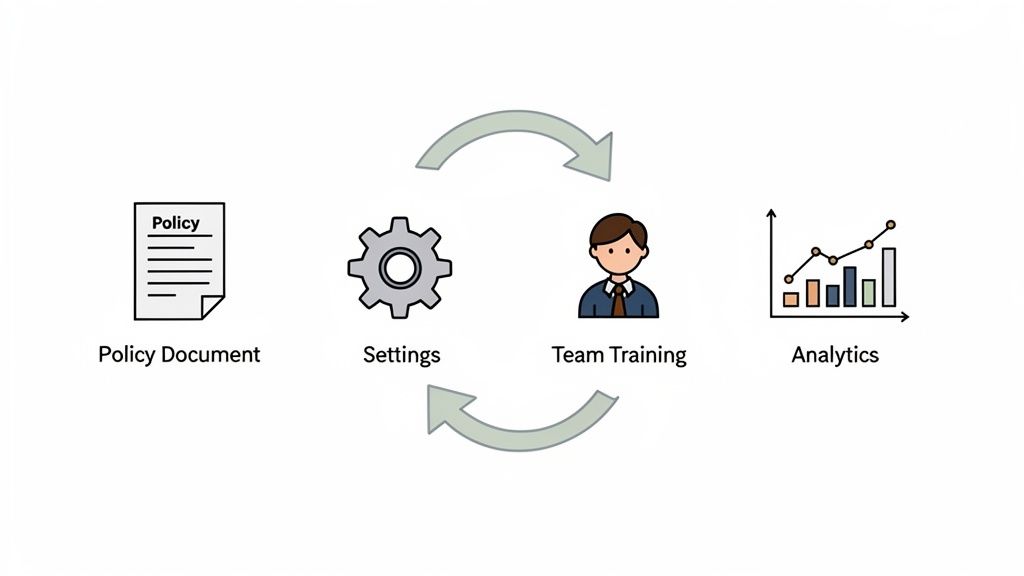
So, you’ve picked out a returns management system. That’s a big win, but the real work—and the real payoff—starts now. Getting the system up and running is one thing; weaving it into the fabric of your business is another. This is where you go from just having a new tool to having a data-driven engine that powers your entire post-purchase experience.
The initial rollout is your chance to get things right from the start. It’s less about flipping a switch and more about carefully translating your returns philosophy into a set of rules and workflows that your team and your customers can actually follow. A smooth launch prevents headaches later and paves the way for a truly efficient operation.
Configuring Your Foundation
First things first: you need to build your return policies directly into the system. Think of your policies as the constitution for your returns process. They need to be airtight, easy to find, and written in plain English so there’s absolutely no confusion.
With your policies documented, you can start programming them into automation rules. This is where the magic really happens. These simple "if-then" scenarios will handle the bulk of your return requests automatically, giving every customer a consistent experience without tying up your team.
For instance, you could set up rules like these:
- Item Condition: If a customer returns a shirt for "wrong size," your system can automatically offer an exchange and generate a free shipping label.
- Customer Value: If a return comes from a loyal customer with a lifetime spend over $1,000, you might automatically issue their refund as instant store credit.
- Product Type: If the item is marked as final sale, the system can automatically deny the request and politely point the customer to the relevant policy.
This setup takes some deliberate planning, but once it’s done, your system acts as a 24/7 gatekeeper, enforcing your rules perfectly every time.
Training and Empowering Your Team
Once your rules are set, it’s time to bring your support team into the fold. They’re on the front lines every day, so they need to know this new system like the back of their hand. This isn't just about a quick tutorial on how to look up an RMA number.
Great training helps your team understand the why behind the change. Explain how automation frees them from repetitive tasks so they can focus on solving tougher customer problems. Show them how to navigate the new dashboard to handle edge cases, like manually overriding a rule for a VIP or guiding a frustrated customer through the portal.
By equipping your team with a deep understanding of the system, you turn them from reactive ticket-solvers into proactive problem-solvers. They become true champions of the new, improved customer experience you’re building.
Driving Continuous Optimization with Data
With your system humming along, you can shift your focus to optimization. Your returns platform is now a goldmine of feedback, collecting data that can help you make smarter decisions across the business. The goal is to stop just processing returns and start learning from them.
Dive into your analytics dashboard to hunt for trends. Do you see a particular product with a sky-high return rate? Maybe customers are constantly sending back a certain t-shirt because the online color doesn't match reality. That’s your cue to reshoot your product photos. Or perhaps a new style of boots is always returned for being "too narrow." That’s a clear signal to add more detailed fit notes to your product page.
Refining your return reasons is another powerful tactic. Generic reasons like "not what I expected" tell you nothing. Get more specific with your dropdown options to gather actionable intelligence. Try using reasons like:
- "Color was different than photos"
- "Fit was smaller than size chart"
- "Arrived with minor damage"
This kind of detail transforms every return into a valuable piece of customer insight. By constantly analyzing this data and making small, informed tweaks, you can systematically lower your return rate, enhance your products, and build a more resilient, profitable brand.
Even with a solid plan, it's natural to have questions when you start digging into returns management systems. Let's clear up some of the most common ones we hear from Shopify merchants so you can move forward with confidence.
What Is the Difference Between a Returns Management System and a 3PL?
This question gets right to the heart of a modern ecommerce operation. The easiest way to think about it is this: your returns management system (RMS) is the brain, and your third-party logistics (3PL) partner is the muscle.
The RMS is the software platform where the entire return process is kicked off and managed. It’s the customer-facing portal, the rule-setter for refunds and exchanges, and the data hub. It’s the command center for your entire returns strategy.
The 3PL, on the other hand, is the team on the ground. They run the warehouse that physically receives the package, inspects the item inside, and then restocks, recycles, or sets it aside based on the instructions it gets from the RMS.
The real power comes when your returns system integrates directly with your 3PL. An approved return in your software automatically pings the warehouse, telling them what's coming and what to do with it once it arrives. For any brand that wants to scale, you need both: the software to manage the flow and the logistics partner to handle the physical product.
Can a Returns Management System Help Reduce My Return Rate?
It can, but not in the way you might think. While an RMS is built to manage incoming returns, its secret weapon is the data it collects. Those insights are your roadmap to actually reducing how many returns you get in the first place.
A good system doesn't just process returns; it tells you why they're happening with incredible detail. You stop guessing and start seeing clear patterns.
- A specific dress is constantly being returned for being "not as described"? That's your cue to reshoot the product photos or add more detailed measurements to the description.
- Seeing a lot of returns for a particular t-shirt in size Medium because it's "too small"? Now you have the data to adjust your sizing chart or discuss fit with your manufacturer.
By spotting these trends, you can fix the root cause of your returns—whether it's a product issue, a misleading description, or even a packing error. This turns your returns process from a cost center into a powerful feedback loop that improves your entire business.
How Does a Native Shopify Returns Solution Improve Customer Experience?
A native Shopify solution creates a smooth, trustworthy experience because it lives inside the ecosystem your customer already knows. This is a huge deal for brand perception.
Think about it. Instead of being booted to a clunky, third-party site with weird branding, your customer starts their return right from their order history page or a portal that looks and feels just like your store. That consistency alone removes a ton of friction and makes the customer feel like you've got their back.
On top of that, a native integration unlocks smarter, more personal options. For instance:
- The system can immediately see a customer is a VIP and automatically offer a perk like an instant refund or free return shipping.
- It can pull product data in real time, making it simple for a customer to request a one-click exchange for a different size or color of the same item.
This keeps the entire journey under your brand's umbrella. You end up reinforcing loyalty during a make-or-break moment, rather than creating a confusing experience that could push them away for good.
When Do I Need a Dedicated Returns Management System?
There isn't a magic number of orders that signals it's time, but there are definitely clear signs that your manual process is holding you back. If any of these sound familiar, you're ready for a dedicated system.
First, your support team is drowning in returns-related tickets. If a big chunk of their day is spent answering "Where's my refund?" or manually emailing return labels, you're paying people to do work that software can automate completely.
Second, your process is slow and full of mistakes. This doesn't just frustrate customers; it leads to lost inventory. If you can't confidently say whether a returned item has been inspected and put back into sellable stock, you're losing money every day.
And third, you have zero data on why returns are happening. If someone asks, "What's our most-returned product and why?" and your answer is a shrug, you're flying blind. You're missing a massive opportunity to improve your products and protect your profit margin.
For most high-volume Shopify merchants, the tipping point is when returns stop being an occasional task and become a chaotic, expensive problem. That's when a dedicated system goes from a "nice-to-have" to a "need-to-have."
Ready to reduce support tickets and give customers the post-purchase control they crave? Discover how SelfServe can transform your Shopify store's order management. Explore SelfServe on the Shopify App Store and start your 30-day free trial today.