Flat Rate Shipping International

International checkout gets messy fast. You set up calculated rates, a customer in Germany sees one number, a customer in Australia sees another, and your support inbox fills with the same questions: Why is shipping so high? Why did it change at checkout? Why can't I get a simple answer before I add everything to cart?
That's why so many Shopify teams look at flat rate shipping international as the clean fix. A single published price feels easier to merchandise, easier to explain, and easier to operationalize. But the part most guides skip is that international flat rate shipping isn't a universal carrier feature, and it definitely isn't a “set it once and forget it” tactic.
What works is a narrower, more deliberate approach. You use flat rates where your catalog, destination mix, and fulfillment workflow can support them. Then you pair that setup with tight Shopify shipping profiles, clear customs messaging, and post-purchase controls that prevent expensive mistakes after the order is placed.
The Reality of International Flat Rate Shipping
Merchants usually assume international flat rate shipping works like domestic flat rate shipping. Pick a carrier, choose a box, publish a price, done. That assumption breaks down quickly once you move beyond the US market.
Authoritative guidance shows that true international flat-rate options are much more limited than domestic ones. USPS offers it internationally, while carriers like FedEx and UPS do not offer true international flat-rate pricing in the same way, and the “flat” promise only applies within specific packaging rules rather than any parcel shape or size, as explained in Quadient's overview of whether international flat-rate shipping really exists.
What merchants usually get wrong
A lot of stores treat flat rate as a pricing philosophy. Carriers treat it as a packaging program.
That difference matters. If your products don't fit the approved packaging well, or your order mix swings from light to heavy, the model starts leaking margin. You also can't assume the same operational logic applies to parcel shipping, freight, and larger cross-border movements. If your catalog includes oversized items, pallets, or wholesale replenishment orders, it helps to understand the broader mechanics of navigating international freight before you promise anything “flat” to customers.
Practical rule: Flat rate works best when your products behave predictably. If your orders don't, your shipping margin won't either.
What the phrase really means in practice
For Shopify merchants, “flat rate shipping international” usually means one of two things:
- Carrier flat rate: You're using a specific service with predefined packaging rules.
- Store-created flat rate: You publish your own fixed checkout rate by market, product set, or order condition.
The second option is more common in real stores. It gives you flexibility, but it also moves pricing risk from the carrier to you. That's why setup matters so much. The checkout rate is only the visible layer. Underlying work sits underneath it in packaging discipline, zone logic, and customer communication.
When to Offer Flat Rate Shipping to Global Customers
Flat rate is a good fit for some international stores and a bad fit for others. The decision usually comes down to three things: your product profile, your margin structure, and your destination mix.
Industry guidance recommends testing package profiles against destination zone pricing instead of using one “average” shipment. Flat rate stays constant, while standard international shipping changes by destination, size, and weight. That's also why flat rate tends to work better on heavier or long-haul parcels, while standard shipping can be cheaper for lighter or low-volume shipments, according to DHL's guidance on flat rate shipping versus standard shipping.

Start with your package profile
Look at what leaves your warehouse, not what your catalog says in theory.
If most international orders contain compact items that pack cleanly into a small number of repeatable carton types, flat rate is easier to control. If your store sells mixed bundles, awkward shapes, or items that trigger frequent box-size changes, fixed pricing gets much harder to defend.
Use a simple review process:
- Check repeatability: Are most international orders packed in the same few box formats?
- Check weight clustering: Do your typical shipments fall into a narrow range, or do they swing wildly?
- Check dimensional efficiency: Are you filling cartons well, or shipping a lot of air?
The hidden killer is underfilled packaging. Flat rate only works when the box is used efficiently. If customers buy one small item and pay the same published rate as a denser order, they may feel overcharged. If they buy a dense order that pushes your cost higher than expected, you absorb the difference.
Then look at contribution margin
Some merchants price flat rates too aggressively because they want the checkout to “feel easy.” Easy isn't the goal. Sustainable is.
You need enough product margin to absorb the spread between your cheapest international shipments and your most expensive ones. If your products have thin margins, every remote delivery, address issue, or failed first attempt hurts more. In those cases, standard or carrier-calculated rates are often safer.
Flat rate isn't just a shipping decision. It's a margin allocation decision.
A useful test is to review your best-selling SKUs and identify which ones can carry a fixed shipping subsidy without eroding profitability. If the answer is “only a handful,” don't publish one international rate across the full catalog.
Finally, map the destinations that matter
International stores rarely need a global flat rate. They need a workable rate for the markets that drive most cross-border demand.
That usually means you segment by destination groups and ask practical questions:
- Where are orders concentrated? Focus on repeat markets first.
- Which lanes create the most pricing volatility? Don't hide high-risk destinations inside a broad “rest of world” promise.
- Where do customers expect simpler pricing? In some markets, checkout clarity matters as much as transit speed.
If you can answer those three questions with confidence, flat rate becomes a strategic tool. If you can't, start with calculated rates and graduate into selective flat rates later.
Designing Your International Flat Rate Pricing
The strongest international flat rate setups don't use one price worldwide. They use a pricing structure that mirrors how orders move through fulfillment.
USPS gives a useful model for thinking about constraints. Its Priority Mail International service reaches about 180 countries with estimated delivery in 6 to 10 business days, and many shipments include tracking and insurance. It also shows that international flat rate is built around explicit packaging limits: Flat Rate Envelopes and Small Flat Rate Boxes max out at 4 lbs, while Medium and Large Flat Rate Boxes max out at 20 lbs. USPS also publishes a starting flat-rate price of $32.65 for Priority Mail International, while a weight-based option starts at $43.55 for packages up to 70 lbs, as listed on USPS Priority Mail International.
Use zones, not one worldwide number
Most Shopify stores should price international flat rate by shipping zone, not by planet.
A practical structure looks like this:
| Shipping Zone | Countries | Order Value < $100 | Order Value $100+ |
|---|---|---|---|
| Zone 1 | Canada, Mexico | Flat rate | Lower flat rate or free-shipping threshold |
| Zone 2 | UK, EU core markets | Flat rate | Reduced flat rate |
| Zone 3 | Australia, New Zealand, selected Asia markets | Flat rate | Reduced flat rate |
| Zone 4 | Rest of world | Higher flat rate | Reduced but not free |
The exact numbers should come from your own shipment history and current carrier quotes. What matters is the structure. Nearby and predictable markets get simpler rates. High-variance markets get more protection.
If you ship into trade lanes with volatile landed costs, it helps to model them separately. For example, merchants working through South Asia into Europe often need a reality check on route-specific economics, and a tool for estimating shipping costs for India-EU trade can help pressure-test whether a broad zone price is too optimistic.
Build conditions into the offer
A flat rate doesn't have to mean unconditional.
Three conditional models usually hold up better than a blanket promise:
- Order value tiers: Charge one flat rate below a threshold, then reduce it for higher-value carts.
- Product-specific profiles: Keep bulky or fragile products out of your standard international flat-rate program.
- Market exclusions: Publish flat rate only in the countries where your landed shipping cost is stable enough to support it.
Merchants often overcomplicate the logic. Don't create a maze of rules nobody on support can explain. Use just enough segmentation to protect margin.
Price around operational behavior
The right price is one your warehouse can fulfill consistently and your support team can defend clearly.
If your boxing process is disciplined, you can be more aggressive. If pick-and-pack teams substitute carton sizes often, your shipping promise needs more cushion. International shipping costs aren't just about the linehaul. They're shaped by packing decisions, routing exceptions, and what happens when a parcel doesn't move cleanly.
For stores comparing fixed-rate logic against carrier-driven pricing, this breakdown of UPS international shipping cost is useful for thinking through when a published merchant rate is simpler than exposing every variable to the customer.
A good flat rate price is not the lowest number you can advertise. It's the number you can survive at when the order mix gets weird.
Configuring Shipping Zones and Profiles in Shopify
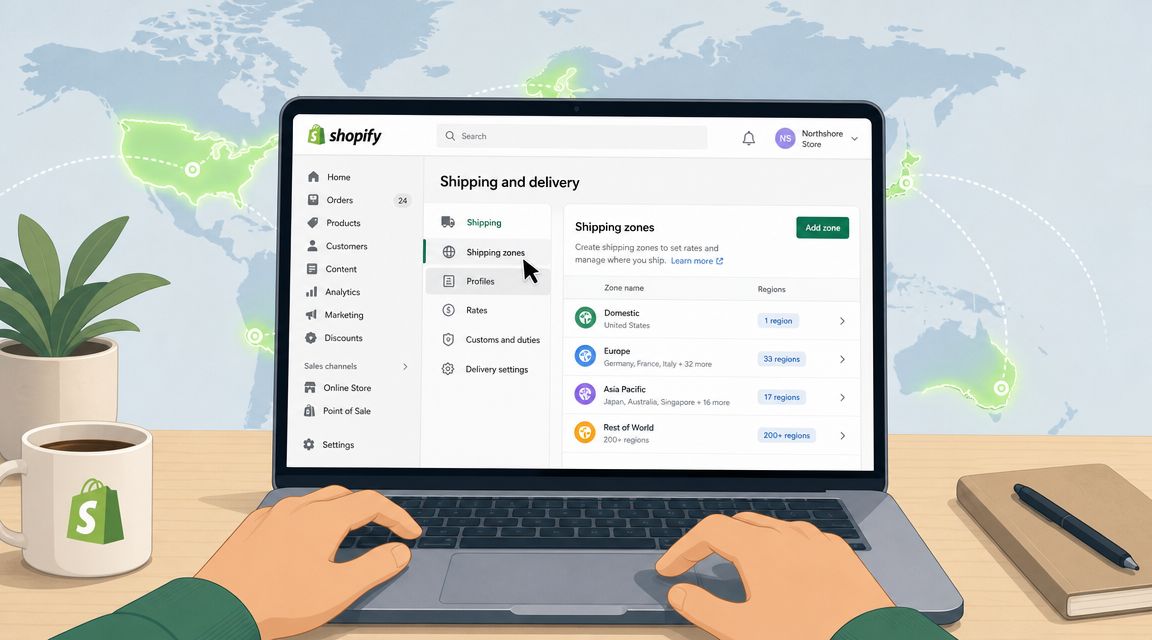
The strategy only matters if the Shopify setup reflects it cleanly. Most flat rate problems show up because merchants try to force one shipping profile across products that behave differently.
Split products before you set rates
In Shopify, start by separating products into shipping profiles based on fulfillment reality, not merchandising categories.
A useful split might look like this:
- Standard shippable products: Items that fit your normal international flat-rate logic
- Oversized or fragile products: Items that need different handling or should use calculated rates
- Restricted market products: Items that can't ship to every country you sell into
This step prevents one common failure mode. A merchant adds a flat rate for “international,” then a bulky SKU slips into the same profile and wrecks the economics.
Build shipping zones around markets you actually serve
Inside each profile, create shipping zones that reflect your commercial priorities. Don't create dozens of micro-zones unless you have the order volume to justify them.
A clean zone structure usually works better:
- Core neighboring markets
- Core overseas markets
- Higher-cost remote markets
- Excluded destinations you don't want to serve with flat rate
Within each zone, assign a manual flat rate that matches the pricing design you settled on earlier. If you want to reward larger carts, add conditional rates by order value so customers see a better option as basket size increases.
If you're evaluating apps to extend Shopify's native shipping logic, this overview of Shopify shipping apps is a helpful starting point for deciding when the default admin is enough and when you need more control.
Handle duties and taxes before support asks
International flat rate often falls short of customer expectations. The checkout says “flat rate,” but the shipment still triggers import charges. Customers then assume the store hid part of the cost.
You need a clear policy on duties and taxes:
- DDP: Duties are handled upfront by the seller or included in the purchase flow.
- DDU: Duties are collected from the customer on import.
Neither model is automatically better. DDP reduces surprise and usually creates a smoother customer experience. DDU is simpler to launch operationally, but it requires much clearer messaging.
If duties aren't included, say it in three places: shipping policy, checkout-facing copy, and order confirmation.
A short explainer near shipping information does more than most merchants think. It reduces “why do I owe customs?” tickets and lowers the chance that customers refuse delivery.
This walkthrough is worth watching if your team is building out shipping settings and wants a visual reference for how the Shopify admin behaves in practice:
Test the checkout like a customer
Before you publish anything, run test carts across your main markets.
Check these points closely:
- Rate display: Does the right flat rate appear in the right countries?
- Profile logic: Do excluded products trigger the intended fallback?
- Message clarity: Can a customer understand duties, timelines, and restrictions without contacting support?
If any of those are unclear, the problem won't stay in shipping. It will move into customer service, refunds, and failed delivery costs.
Reducing Errors with Post-Purchase Workflows
A lot of merchants treat shipping setup as the finish line. It isn't. For international orders, the biggest cost spikes often happen after checkout.
Addresses are entered with the wrong building number, the wrong province, or a missing phone number. Customers notice the mistake after payment, then email support. Your team scrambles to catch the order before it's packed, relabeled, or exported with the wrong customs details.
Give customers a controlled edit window
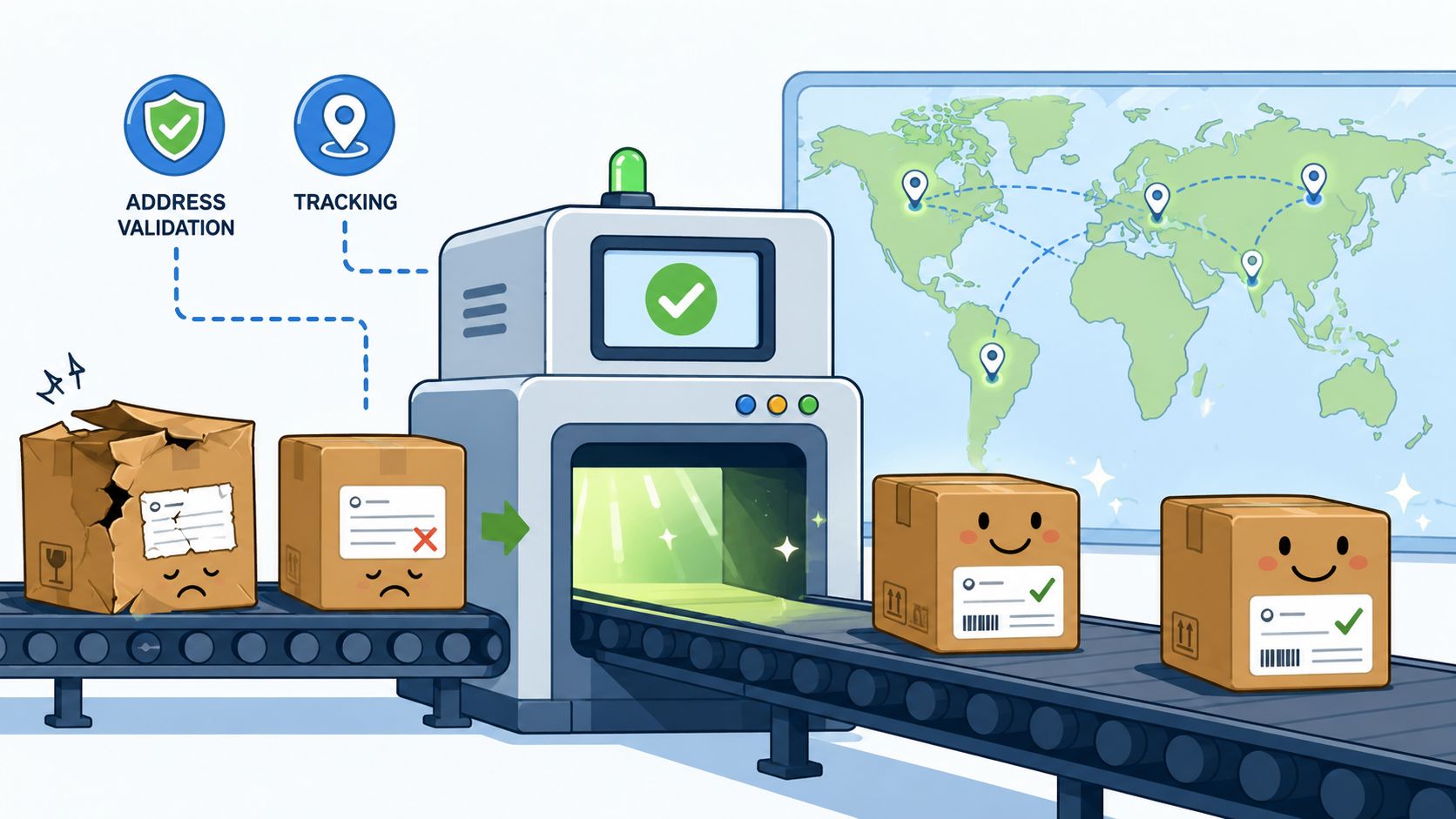
The simplest way to reduce avoidable shipping errors is to let customers fix obvious mistakes themselves within a defined window after purchase.
That works especially well for international orders because formatting conventions vary by country, and customers often notice issues only when they review the confirmation page. A controlled self-service flow is usually better than a support-driven inbox process because it removes lag and reduces the chance that warehouse staff fulfill stale order data.
For teams trying to tighten this process, using an address validation tool is one of the most practical upgrades. It helps catch bad address inputs earlier and standardize deliverable formats before the label is created.
Don't let edits break operations
Self-service only works if it's governed. The right model gives customers flexibility without letting them rewrite the order after fulfillment starts.
The controls that matter most are operational, not flashy:
- Time windows: Allow edits only before picking or label creation
- Field permissions: Let customers correct address lines or phone numbers without changing fulfillment-sensitive details you can't support
- Approval logic: Route edge cases into a review queue instead of auto-applying every change
This keeps the workflow from turning into a second source of errors. International shipping has enough failure points already. You don't need a post-purchase tool creating new ones.
The best post-purchase experience removes support work without removing merchant control.
Use the post-purchase moment to improve order economics
There's another benefit here. International shipping is expensive enough that many brands need stronger order economics to make the channel worthwhile.
The post-purchase window can help if you use it thoughtfully. A customer who has already committed to an overseas order is often more open to adding a small complementary item than they would have been during initial checkout, especially if it fits the same parcel profile. That can improve the value of a shipment you're already paying to move internationally.
The key is restraint. Keep additions curated and operationally easy to merge into the existing order. If the upsell introduces a new packaging requirement, hazardous restriction, or customs complexity, it can erase the benefit.
Why this lowers support volume
Most shipping-related tickets aren't strategic. They're preventable.
They come from issues like:
- Wrong address details
- Confusion about editability after checkout
- Questions about whether an item can still be added
- Customers trying to intervene before dispatch
When customers can handle simple changes through a structured post-purchase flow, support teams spend less time on repetitive requests and more time on exceptions that require human review.
Common Pitfalls and How to Avoid Them
Most international flat rate failures aren't caused by bad intent. They're caused by oversimplification. A merchant wants fewer checkout variables, so they compress too many realities into one published price.

Pitfall one: one global rate for every country
This is the classic mistake. It looks elegant in the Shopify admin and chaotic everywhere else.
A single worldwide rate usually overcharges nearby markets, underprices remote ones, and creates arguments with both finance and customers. The fix is simple: use regional zones and only offer flat rate where you understand the shipping behavior well enough to stand behind it.
Pitfall two: ignoring box fit and packaging discipline
Flat rate models break when the warehouse can't reproduce the assumptions behind them.
If packers regularly change carton sizes, add void fill unpredictably, or split orders into multiple parcels, your published rate stops matching your actual process. Solve this by narrowing the SKUs eligible for international flat rate and documenting standard packouts for the products that remain in the program.
Pitfall three: vague duties messaging
Customers don't care that shipping is “flat” if customs charges feel like a surprise.
Make the policy plain. If duties or taxes may be collected on import, say so before checkout is complete and repeat it after purchase. If you absorb them, make sure your pricing model accounts for that decision.
Pitfall four: no post-purchase controls
Even a well-priced flat rate can become unprofitable when bad address data, last-minute changes, and avoidable service tickets pile up.
Use a controlled edit process, validation checks, and clear cutoffs for when changes are still allowed. That keeps mistakes from rolling downhill into relabeling, failed deliveries, and preventable refunds.
Pitfall five: treating shipping as separate from support
International shipping isn't just a logistics setting. It's a customer experience system.
If your shipping rate is simple but your policies are hard to understand, customers will still contact you. If your checkout promise is clear but your post-purchase workflow is rigid, they'll still contact you. The stores that make flat rate shipping international work are the ones that connect pricing, fulfillment, and support into one operating model.
Flat rate succeeds when the promise at checkout matches what your ops team can deliver without improvising.
If your team wants fewer address-change tickets, tighter control over post-purchase edits, and a better way to increase order value after checkout, SelfServe is worth a look. It gives Shopify merchants a controlled self-service layer for order changes, real-time address validation, and post-purchase upsells, so international orders create less manual work and fewer preventable errors.