The Cheapest Way to Ship From US to UK in 2026

Let's be honest: finding the cheapest way to ship from the US to the UK often feels like a moving target. For a standard package, an economy service like FedEx International Economy is usually a safe bet. With a typical 5 lb parcel, you can strike a solid balance between a reasonable 4-10 day delivery window and a price that won't destroy your margins. It's a go-to for many e-commerce merchants for good reason.
Your Guide to the Cheapest US to UK Shipping
Figuring out the most affordable shipping for your UK-bound orders is about more than just grabbing the lowest price you see on a carrier's website. It’s a delicate dance between package size, your customers' expectations for delivery speed, and having a firm grasp on the total landed cost.
If you get this wrong, you're setting yourself up for surprise fees and frustrated customers. That "cheap" option can quickly become a very expensive mistake. This guide will help you cut through the noise and make smarter shipping choices from the get-go.
Understanding the Key Players
For the vast majority of e-commerce shipments, you'll be looking at the big three: FedEx, UPS, and DHL. While postal carriers like USPS can be great for very lightweight items, these major couriers are built for business shipping and offer competitive economy services that are hard to beat.
When you start comparing, you'll see a pattern emerge. For common parcel weights, FedEx International Economy frequently comes out on top as one of the cheapest ways to ship from the US to the UK.
For example, a standard 5 lb package might cost as little as $42.82 with FedEx. This often beats out UPS Worldwide Expedited, which can be around $48.67, and DHL, which might be closer to $53.38 for a similar delivery timeline. Exploring international shipping comparisons shows you just how these rates stack up in real-time.
A Quick Look at Your Options
To give you a clearer picture, here’s a snapshot of what you can expect when shipping a standard 5 lb package from the US to the UK.
US to UK Shipping Options at a Glance
This table shows why starting your search with economy courier services is often the smartest move for your bottom line.
Critical Factors Beyond the Rate
While the shipping rate is a huge piece of the puzzle, it's not the only one. For a smooth and profitable international operation, you need to think about these three factors with every single shipment.
Delivery Speed vs. Cost: Economy services are affordable because they aren't express. Does that 4-10 business day window work for your brand and your customers? Make sure you set clear expectations on your product and checkout pages.
Customs and VAT: The UK charges a 20% VAT on most imported goods. You have a crucial decision to make: charge this at checkout (DDP - Delivery Duty Paid) or let the customer get a surprise bill upon arrival (DDU - Delivery Duty Unpaid).
Pro Tip: Always go with DDP. It creates a far superior customer experience and prevents the angry emails and abandoned packages that come with unexpected fees.
- Post-Purchase Flexibility: Typos happen. An incorrect address can trigger a costly return-to-sender fee that completely erases your profit on an order. By giving customers a short window to fix their own address details right after a purchase, you can save hundreds, if not thousands, of dollars a year. To get this right, it's essential to follow shipping and fulfillment best practices for Shopify merchants.
Choosing the Right Carrier for Your Parcel Size
Finding the cheapest way to ship from the US to the UK isn't about picking one single "best" carrier and sticking with it. That's a classic rookie mistake that leads to overspending. The real secret is building a flexible shipping strategy that matches your package's specific size and weight to the most economical service for that particular shipment.
Think of it as a decision tree. You have to weigh cost, speed, and size for every single order.

As you can see, the right choice changes depending on whether you're prioritizing rock-bottom cost, lightning-fast delivery, or accommodating a bulky item. It's a constant balancing act.
The Sweet Spot for Small, Light Packages
For those small, lightweight items, don't sleep on the United States Postal Service (USPS). Many merchants assume they need a big-name courier for international shipping, but for smaller parcels, USPS is often the undisputed champ.
Specifically, USPS Priority Mail International is fantastic for anything under 4 lbs. We're talking rates between $69.10 and $83.95 to get a package to the UK in a respectable 6-10 days. It's the go-to service for roughly 70% of personal and small e-commerce shipments for a reason.
Even better, USPS offers flat-rate boxes. These are a lifesaver, helping you sidestep those pesky dimensional weight charges. A 5 lb parcel in a 13x11x3 inch box, for example, can ship for just $72.60.
Here's a real-world scenario: Let's say you sell handcrafted leather wallets. They’re small, light, and slide perfectly into a USPS Priority Mail International Small Flat Rate Box. By using this service for all your wallet orders, you lock in a predictable, low shipping cost. If you used a courier instead, you might get hit with variable pricing and unexpected residential delivery surcharges.
When to Switch to Economy Couriers
Once your packages start tipping the scales past the 4-5 lb mark, the cost advantage of USPS begins to fade. This is where the big couriers like FedEx and UPS re-enter the picture with their economy services.
For these more standard e-commerce shipments—think clothing, books, or small electronics—a service like FedEx International Economy hits the perfect balance of affordability and reliable, end-to-end tracking.
- Best for: Packages weighing between 5-20 lbs.
- Common Products: Apparel, shoes, home goods, and boxed consumer electronics.
- Key Advantage: You get far superior tracking and customer support compared to postal services, which is a must-have for providing peace of mind on higher-value orders.
The most successful merchants automate this entire process. By integrating the right Shopify shipping apps, your system can automatically comparison shop in real time, ensuring every single order goes out the door via the cheapest possible method.
Segmenting your shipping this way—USPS for the light stuff, couriers for the heavier items—creates a powerful system that protects your profit margins without ever letting your customers down.
Navigating Customs Duties and UK VAT
A fantastic shipping rate can evaporate in a flash if your UK customer gets a surprise bill for customs fees. I’ve seen it happen time and again. Finding the truly cheapest way to ship from the US to the UK means looking beyond the carrier's sticker price and getting a handle on the total landed cost. This is the only way you'll protect your margins and—just as importantly—keep your customers happy.

Get this wrong, and you're staring down the barrel of refused packages, expensive return shipping, and a string of one-star reviews. The secret is being completely transparent about every single charge before your customer ever clicks "buy."
Understanding UK VAT and Duties
For any US merchant, the biggest extra line item is the UK's Value Added Tax (VAT), a standard 20% tax on most goods. The game changed significantly after Brexit. Now, if you're sending a package valued at £135 or less, the responsibility falls on you, the seller. You must register for a UK VAT number and remit that VAT directly to their tax authority, HM Revenue and Customs (HMRC).
What about shipments over £135? In those cases, the import VAT and any customs duties are collected when the package hits the UK border. This presents you with a critical choice for your business and your customers.
DDP vs. DDU: The Critical Choice
You have two ways to handle these cross-border fees, and your decision will make or break the customer experience.
DDU (Delivery Duty Unpaid): This is the old-school way. You charge for the product and shipping, and that's it. The problem? When the parcel arrives in the UK, the carrier contacts your customer to collect the VAT, duties, and a surprisingly high administrative fee for their trouble. It’s a recipe for frustration and surprise costs.
DDP (Delivery Duty Paid): This is the gold standard for modern international e-commerce. You calculate and collect all the duties and taxes right at your checkout. The customer pays one clear, all-inclusive price. Their package sails through customs without delays or unexpected bills showing up at their door.
From my experience, offering a DDP shipping option is one of the most powerful moves you can make to boost your UK conversion rates. UK shoppers expect price transparency. Countless studies—and my own observations—confirm that unexpected fees are the number one reason for abandoned carts and refused deliveries.
Calculating the Total Landed Cost
To offer DDP shipping, you first have to accurately calculate the landed cost. The formula isn't as intimidating as it sounds, and mastering it is the key to figuring out the actual cheapest way to ship.
Total Landed Cost = Product Cost + Shipping Cost + UK VAT + Customs Duty
Let’s walk through a real-world example: a $150 designer t-shirt (well over the £135 threshold) heading to London.
- Item and Shipping: The product costs $150 and you’ve found a $30 shipping rate. That’s $180.
- Customs Duty: You'll need to look up the UK commodity code for t-shirts, which reveals a duty rate of 12%. So, the duty is 12% of the $180 value, which comes out to $21.60.
- UK VAT: Here’s where many get tripped up. The 20% VAT is charged on everything—the product, the shipping, and the duty. So, that's ($180 + $21.60) * 0.20 = $40.32.
- Total Price for Customer: Add it all up: $180 + $21.60 + $40.32 = $241.92.
By displaying this final, all-in price at checkout, you’re not just making a sale. You're providing a seamless, professional experience that builds trust and brings those UK customers back for more.
Advanced Strategies for High-Volume Shipping
Once your UK orders grow from a few scattered packages to a steady, predictable stream, your old shipping methods just won't cut it. Finding the cheapest individual rate for a single parcel is no longer the name of the game. Now, you need to think bigger—about consolidated shipping and freight.
At this point, you're moving beyond the standard carrier websites. Your growing volume is a powerful asset, unlocking new tiers of pricing and service that simply aren't offered to the public. It's time to cash in on that scale.
Partnering with Consolidators and 3PLs
For any business shipping in bulk, consolidators and third-party logistics providers (3PLs) become your closest allies. These companies are masters of volume. They bundle shipments from thousands of businesses like yours, creating enormous leverage to negotiate with major carriers like DHL, FedEx, and UPS.
They get access to rock-bottom rates based on their collective volume and pass those savings down to you. Suddenly, you're getting discounts that would typically require you to ship tens of thousands of parcels a month on your own. For a growing brand, this is a game-changer. If you're ready to scale, exploring third-party logistics software and solutions is your next logical step.
The real power of a 3PL isn't just discounted rates. It's the operational efficiency. They handle the warehousing, picking, packing, and carrier management, freeing you up to focus on growing your business instead of managing logistics.
Shifting from Parcels to Freight
There’s a tipping point where shipping individual packages one by one stops making any financial sense. As your total shipment weight climbs, palletizing your orders and sending them via air or sea freight becomes dramatically cheaper per kilo.
Knowing these weight thresholds is crucial for controlling your costs. Once your shipments start hitting the 150+ kg mark, you'll find that express air freight can be as low as $5 per kilo, often undercutting standard air services by 20-30%. To give you a real-world example, a service like DHL eCommerce Parcel Direct is great for smaller packages, but its bulk rate comes out to around $750 for 150 kg. This is where freight really shows its value. As you can see from detailed freight market analysis, once you exceed 500 kg, sea freight is the undisputed champion, potentially slashing your costs by another 50-70%.
Negotiating Your Own Rates and Automating the Savings
With consistent volume, don't be shy. Go directly to the carriers and negotiate a custom pricing agreement. Come prepared with your shipping data—show them your monthly volume, average package weight, and most common destinations. Use that data as leverage.
To truly lock in those savings, integrate a rate-shopping tool into your fulfillment process. These tools automatically ping all your carriers for every single order, comparing your negotiated rates in real-time and selecting the absolute cheapest option without anyone lifting a finger.
If you're a Shopify Plus merchant, you can get even smarter. By using native features like order tagging and holding queues for palletized DTC orders, you can manage bulk changes effortlessly. This cuts down on the manual labor and costly errors that come with high-volume fulfillment. This powerful combination—negotiated rates and smart automation—is the endgame for any serious high-volume shipper.
A Smarter Post-Purchase Flow Can Slash Your UK Shipping Costs
Finding the cheapest way to ship from the US to the UK doesn’t end when your customer clicks "buy." In reality, some of your best cost-saving moves happen in the minutes and hours after an order is placed. This post-purchase window is a goldmine—a crucial, yet often overlooked, place to catch expensive errors before they happen.
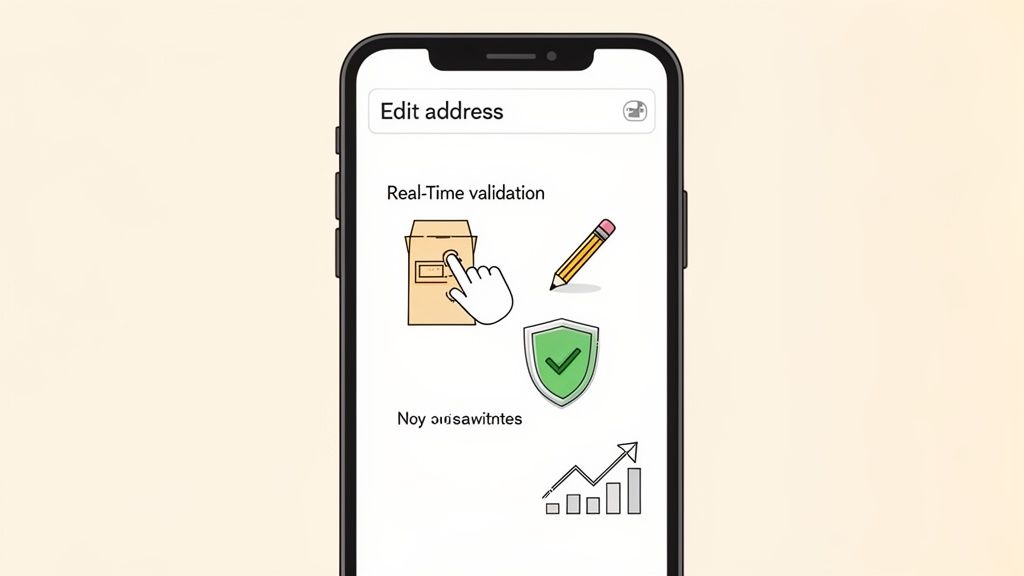
Think of it less like damage control and more like a strategic play that protects your profits while giving customers a better experience. A well-designed post-purchase flow is your secret weapon against the hidden fees of international logistics.
Nip Address Errors in the Bud
Nothing tanks your profit margin on a UK shipment faster than a bad address. A simple typo in a postal code or street name can send a parcel on a costly round trip back to your warehouse. Now you're on the hook for return shipping and the cost to send it out a second time. It’s a completely avoidable expense.
The solution is to be proactive, not reactive. For any merchant serious about selling to the UK, real-time address validation at checkout is an absolute must-have.
- How it works: Tools that tap into APIs, like the Google Maps Platform, can instantly verify and even auto-complete UK addresses as the customer types them in.
- The payoff: This one simple feature catches errors before the order is confirmed, dramatically cutting down on undeliverable packages.
This isn't a small thing. Implementing this can save you hundreds, if not thousands, of dollars a year in wasted postage and lost inventory.
Let Customers Fix Their Own Mistakes
Even with the best validation tools, mistakes happen. A customer might accidentally choose an old saved address or realize last-minute they need the package sent to their office instead of home. When that happens, your support team gets flooded with urgent, "change my address!" emails, which is a huge drain on their time.
There’s a much better way: empower customers to fix their own orders within a short, controlled window.
Giving customers a 30-minute window to edit their own shipping address through a self-service portal is a game-changer. It catches those last-minute human errors, slashes support tickets, and creates a modern, flexible experience that builds serious customer trust.
This small convenience for your customer translates into big operational savings for you. It frees up your support staff to focus on complex problems instead of spending their day doing manual data entry.
Make Each Box More Profitable with Post-Purchase Upsells
One of the sneakiest ways to make international shipping more cost-effective is to increase the value of what's inside the box. The cost to ship a $200 order is often the same as shipping a $150 order, so the higher-value shipment is far more profitable.
The order confirmation page is the perfect real estate for this. Your customer just committed to buying from you and is at peak engagement. This is the ideal moment to show them a compelling, one-click offer to add a related item to their order.
For example, if someone just bought a leather jacket, you could offer a bottle of leather conditioner. This tactic not only boosts your average order value (AOV) but also makes the fixed cost of shipping to the UK a smaller slice of the total revenue. It’s a brilliant way to find the "cheapest" shipping by making every single shipment work harder for you.
Answering Your Top Questions About Shipping from the US to the UK
When you're figuring out how to ship to the UK without breaking the bank, a lot of questions come up. Getting good, straight-from-experience answers is the only way to build a shipping strategy that actually works and saves you money. Let's dig into the questions I hear most often from fellow merchants.
What’s the Single Biggest Lever I Can Pull to Lower My UK Shipping Costs?
Hands down, it's your package's weight and dimensions. Forget looking for one "cheapest" carrier—the right choice changes completely depending on what you're sending.
I see this all the time:
- For small, light stuff (under 4 lbs): A postal service like USPS Priority Mail International is almost always your best bet. Their rates are practically built for this weight class, especially with their flat-rate boxes. It’s a no-brainer.
- For the mid-range (5 to 20 lbs): This is where the whole equation flips. Suddenly, economy services from couriers like FedEx International Economy start looking much better. They often hit the sweet spot of decent cost, speed, and reliable tracking. But you have to watch out for dimensional weight—a big, light box can get you a shockingly high bill. Always get real-time rates.
My Two Cents: The most powerful thing you can do is obsess over your packaging. Make every single box as small and light as humanly possible. This one change will give you bigger savings than anything else, no matter which carrier you end up using.
Should I Really Ship DDP to the UK? Won't That Cost Me More?
Yes, you absolutely should be shipping DDP (Delivery Duty Paid). It might feel like an extra cost because you're pre-paying the UK's 20% VAT and any duties for your customer, but it's one of the smartest business decisions you can make. It's a huge conversion booster.
Put yourself in your UK customer's shoes. They expect the price they see at checkout to be the final price, period. Getting hit with a surprise customs bill from the postman is the fastest way to get a refused package, a chargeback, and a nasty one-star review. The fallout from that is way more expensive than simply being transparent upfront.
In reality, it's not an "increase" in your costs. It's a cost you collect transparently from the customer at checkout, turning a potential disaster into a moment of trust.
How Do I Stop Losing Money on Incorrect UK Addresses?
The only winning move here is to prevent the mistake from ever happening in the first place. For any serious international seller, integrating a real-time address validation tool into your checkout is non-negotiable.
Tools that use the Google Maps API, like the address verification feature in apps such as SelfServe, are incredibly effective. They can auto-complete a UK address and flag errors while the customer is still typing. This is your first and best line of defense.
As a backup, I also recommend giving customers a short, automated window—maybe 30 minutes after they place their order—to edit their own shipping address through a self-service portal. This simple step catches those last-minute typos that even a validation tool might miss, saving you from the headache and high cost of an international return.
Is It Cheaper to Use a Shipping Consolidator or Go Directly to a Carrier?
This really boils down to your shipping volume.
If you're just starting out and sending a few packages a week to the UK, going direct is fine. Using a carrier's own website or a native platform like Shopify Shipping is straightforward and simple.
But once your volume starts to pick up, the math changes completely. When you find yourself shipping dozens of packages to the UK every week, a shipping consolidator or a 3PL becomes your best friend. They negotiate incredible volume discounts with carriers—rates you could never get on your own as a small business.
The general rule of thumb is when you hit around 50+ international shipments per month, it’s time to start getting quotes. See what a consolidator can offer and compare it directly to what you’re paying now. You might be surprised.
Juggling all of this—from last-minute address changes to order edits—can absolutely bury your support team. That’s exactly why we built SelfServe. Our Shopify app empowers your customers to fix their own shipping address, add an upsell, or make other changes post-purchase, all within a time window you set. You'll slash support tickets, prevent expensive mistakes, and even boost your average order value. Find out more and start your free trial.