Shopify vs Shopify Plus The Ultimate 2026 Comparison Guide
The real question isn't just "Shopify or Shopify Plus?" It’s about figuring out where your business is today and, more importantly, where you're heading. At its core, the difference is simple: standard Shopify plans offer a fantastic, ready-to-go platform for most businesses. Shopify Plus, on the other hand, is a whole different beast—an enterprise-level infrastructure built for high-volume brands that demand serious customization, automation, and power.
Your decision really boils down to whether you need a powerful, out-of-the-box solution or a flexible, high-growth engine you can build on.
Understanding the Core Differences
Shopify's standard plans, from Basic all the way to Advanced, provide a solid runway for launching and growing a store. They're perfect for new brands finding their footing and established businesses with steady, predictable sales. But as a company scales—as order volume spikes, operations get more complex, and traffic surges—it's common to hit a ceiling. The standard features just can't keep up anymore.
This is exactly where Shopify Plus steps in. It's not just another tier; it’s an entirely different service designed to solve the challenges of scale. Think of it less as an upgrade and more as a re-platforming to enterprise-grade tools.
The jump to Plus unlocks some game-changing capabilities:
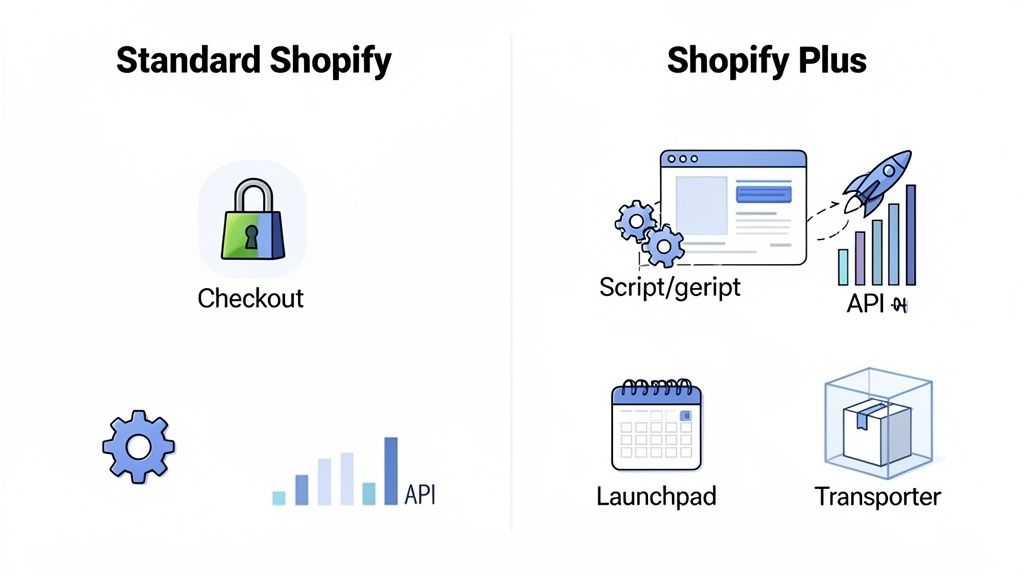
- Checkout Customization: You get full control over your checkout, letting you fine-tune the experience for maximum conversions.
- Automation Tools: Exclusive apps like Shopify Flow and Launchpad let you automate complex business logic and schedule major sales events without breaking a sweat.
- Higher API Limits: Integrate with your ERP, 3PL, and other critical systems without worrying about hitting performance walls.
- Dedicated Support: You're not just another customer. You get priority support and a dedicated Launch Engineer to help you navigate your growth.
This decision tree gives a great visual of the main factors to consider.
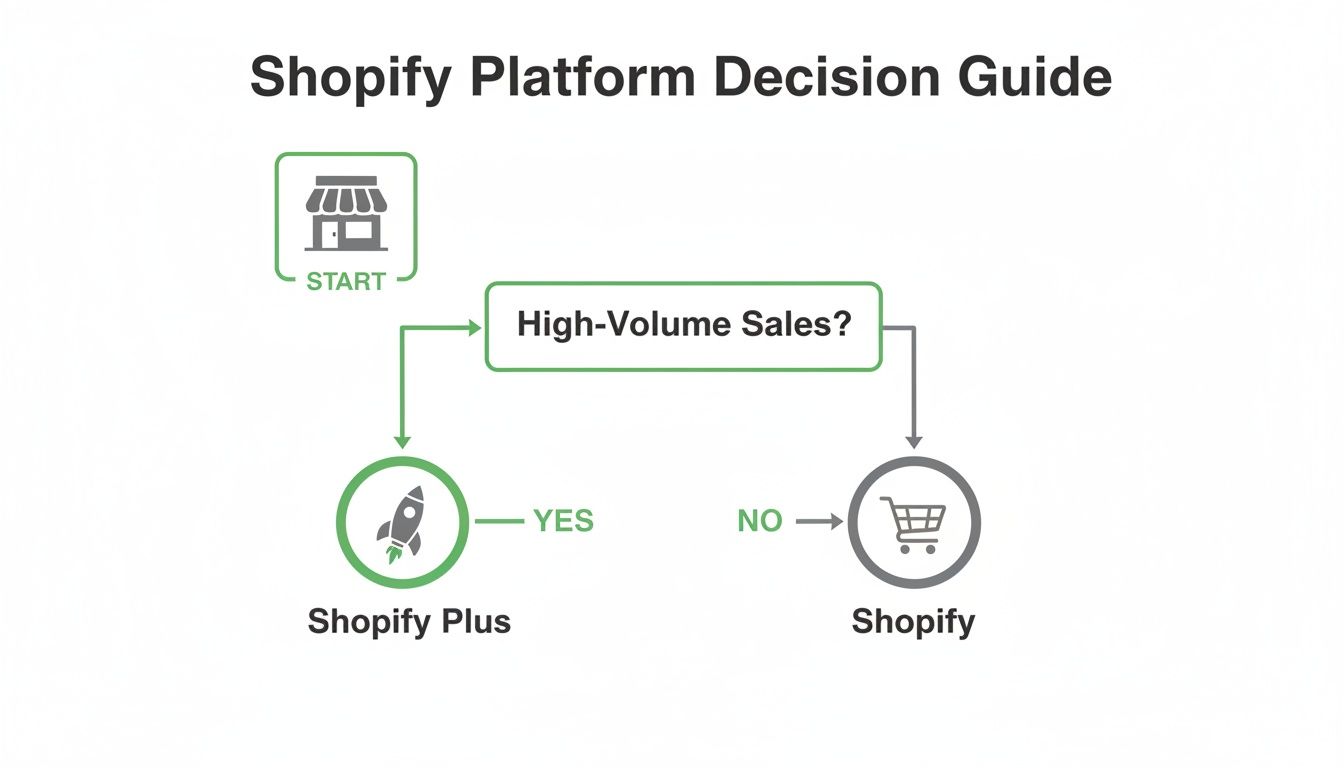
As you can see, the path often leads to Shopify Plus as sales volume and operational needs grow, making it a natural next step for ambitious brands.
Shopify vs Shopify Plus Key Differences at a Glance
To put things in perspective, let's look at a side-by-side comparison of the top-tier standard plan (Advanced) and Shopify Plus. This table breaks down the key distinctions that usually push a successful brand to make the leap.
Ultimately, this isn't just about paying for more features. It's an investment in an infrastructure that removes limitations and supports your brand's most ambitious goals.
Core Feature Differences and Customization Capabilities
While standard Shopify plans give most businesses a fantastic starting point, Shopify Plus is where the platform transforms from a powerful template into a truly custom commerce machine. The differences aren't just minor bells and whistles; they represent a fundamental shift in control, allowing high-volume brands to mold the platform to their exact operational needs.
This becomes crystal clear the moment your brand needs to finely tune every customer touchpoint or integrate with complex backend systems. The "vs" in "Shopify vs Shopify Plus" stops being about features and starts being about architecture.
Unlocking the Checkout Experience
For many brands, the single biggest game-changer with Plus is getting access to the checkout.liquid file. On standard plans, your checkout customization is pretty much limited to branding and whatever your apps can add. With Shopify Plus, you get direct, code-level access to the entire checkout process.
This opens up a world of strategic possibilities that can have a real impact on your conversion rates and AOV. Imagine embedding custom trust seals exactly where you want them, adding unique fields for delivery instructions, or building a completely branded checkout flow that feels seamless with the rest of your site. To dig deeper, check out our guide on how to modify the Shopify checkout page for more ideas.
With
checkout.liquid, the checkout stops being a generic Shopify page and becomes an integral, optimized part of your brand's unique sales funnel.
Exclusive Automation and Logic Tools
Shopify Plus also comes with a suite of exclusive apps built to handle the headaches that come with scaling up. These aren't just your average App Store downloads; they're integrated at the platform's core, giving them capabilities that third-party apps just can't match.
- Shopify Scripts: This is where you can get really granular. It lets you write custom Ruby code to run complex logic for things like pricing, shipping, and payments. Think tiered wholesale pricing, "buy one, get one" deals that are too complex for standard discounts, or even hiding certain payment options based on what's in the cart.
- Shopify Flow: A powerful workflow builder that lets you automate all those repetitive, time-sucking tasks. You can set up triggers for just about anything—tagging high-value customers, sending a Slack notification when inventory runs low, or automatically segmenting users based on what they buy.
- Launchpad: This is your command center for big sales events like Black Friday. Launchpad lets you schedule and automate everything from theme changes and product releases to price drops. No more scrambling to make manual updates in the middle of your biggest sales day.
API Limits and System Integrations
If your business relies on a web of other software—like an ERP, a 3PL partner, or a custom inventory tool—you've probably felt the pain of API call limits. The rate limits on standard Shopify plans can get hit pretty quickly when you're trying to keep all that data in sync.
Shopify Plus blows those limits out of the water with 10x higher API rate limits. This is a massive deal for operational stability. It means your whole tech stack can talk to each other without getting throttled or lagging behind. Your inventory levels stay accurate, orders get to the fulfillment center instantly, and customer data syncs with your CRM in real time. This robust API is the backbone that keeps complex operations running smoothly at scale.
Comparing Total Cost of Ownership and ROI
It’s tempting to just look at the monthly subscription fee when comparing Shopify and Shopify Plus, but that sticker price is deceptive. It barely scratches the surface. To really understand the financial impact, you have to look at the Total Cost of Ownership (TCO)—a figure that bundles platform fees, transaction fees, app costs, and the hard-to-quantify value of Plus-exclusive features.
For any brand on a steep growth curve, the most immediate and dramatic change is the sharp drop in transaction fees. This is where the ROI for Shopify Plus really starts to take shape, and you can pinpoint the exact moment the upgrade not only makes sense but actively starts saving you money.
Breaking Down the Fee Structures
The pricing between standard Shopify plans and Shopify Plus isn't just a simple step-up; it's a completely different model. A plan like Shopify Advanced runs a predictable $399/month. Shopify Plus, on the other hand, starts at $2,300/month (on a three-year term), but it's better to think of this as a platform fee that gets cheaper the more you sell.
This is exactly why Plus is a powerhouse for scaling DTC brands. It delivers enterprise-level ROI by slashing variable costs and throwing in exclusive tools. While the monthly fee seems high, for a store hitting $1 million in monthly sales, the platform fee is capped at a mere 0.25% ($2,500). Even better, your transaction fees plummet from something like 2.9% + 30¢ to custom-negotiated rates, while third-party gateway fees drop from 0.5% on Advanced down to just 0.2% on Plus. If you're processing millions in revenue, those savings add up to tens of thousands of dollars a year. You can dig into more of these numbers over at ecommercetrix.com.
That fee reduction alone is often enough to justify the move. It creates a simple, powerful equation: the more you sell, the more you save.
Pinpointing the Profitability Crossover Point
So, when does Shopify Plus actually become cheaper? It’s not a single magic number; it depends on your revenue, which payment gateways you use, and how much you're spending on third-party apps. But a good rule of thumb I've seen over the years is that the upgrade becomes a no-brainer once you're consistently hitting around $80,000 in monthly sales.
Let’s walk through a real-world example:
- A store on Shopify Advanced doing $1.5M in annual revenue: This merchant pays $4,788 a year in platform fees. If they use a third-party gateway, they're also paying around $7,500 in transaction fees (at 0.5%). That's a total of $12,288 before you even touch credit card processing.
- The same store on Shopify Plus: The platform fee jumps to $27,600 annually. But their third-party transaction fees are slashed to just $3,000 (at 0.2%). That’s an instant $4,500 savings on transaction fees alone.
While the Plus subscription is higher upfront, the savings on transaction fees start to close that gap immediately. The true ROI clicks into place when you start factoring in the tools that are now included, letting you cut other software costs.
For instance, Plus comes with Shopify Flow for automation and Launchpad for managing sales events. These can easily replace paid apps that cost you hundreds of dollars every month. Smaller perks, like unlimited staff accounts (versus just 15 on Advanced), also add operational value without tacking on extra fees.
As your revenue climbs, the math gets even more convincing. For a business pushing $5 million a year, the TCO for Plus is almost always lower than Advanced once you account for fee reductions and the apps you no longer need. At that point, the upgrade isn't about affording a higher monthly bill—it's a strategic move to lower your variable costs and run a more efficient operation at scale.
Scalability and Performance Under Pressure
When your brand starts to take off, your website’s infrastructure gets put to the test. This is never truer than during a flash sale or the Black Friday rush. It’s in these high-stakes moments that the real architectural differences between standard Shopify plans and Shopify Plus come into sharp focus.
While the standard Shopify plans are more than capable for most businesses, Shopify Plus is built from the ground up to handle extreme traffic spikes without even blinking.
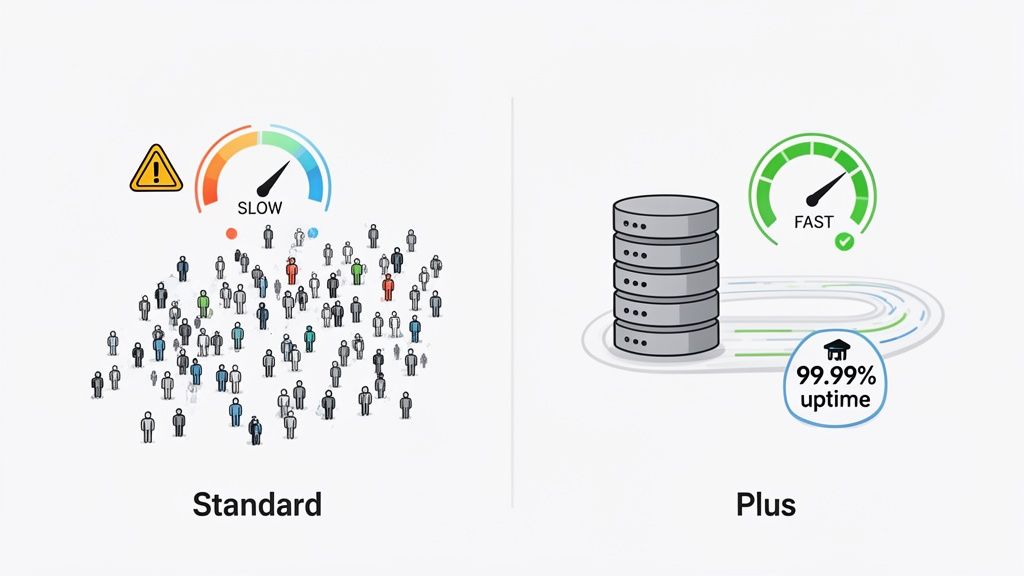
Think of it this way: standard Shopify is a reliable, multi-lane highway that gets the job done for millions of people every day. But during rush hour, you might hit some traffic. Shopify Plus is your own private express lane, engineered for pure speed and volume, ensuring your customers always get through.
Infrastructure Built for Peak Demand
The secret sauce for Shopify Plus is its beefed-up infrastructure, which comes with unlimited bandwidth and a rock-solid 99.99% uptime Service Level Agreement (SLA). That's not just marketing fluff; it's a contractual promise that your store will be there when you need it most.
For example, Plus can handle over 10,000 checkouts per minute. This is the kind of power that prevents the catastrophic site crashes and checkout errors that can absolutely tank a major sales event. A slow or broken site during a launch doesn't just lose you sales—it erodes customer trust. With Plus, that risk is pretty much off the table.
For a high-growth brand, uptime isn't a feature—it's the foundation of revenue. Shopify Plus guarantees that your busiest day won't be your last.
The Impact of Blazing-Fast Speeds
Everyone knows site speed is crucial for conversions and SEO, but Plus merchants often experience performance gains that directly fatten their bottom line. According to ROI analyses looking ahead to 2026, the average store sees a staggering 126% increase in conversion rates after upgrading from a standard Shopify plan.
A huge part of that comes from an 18% average drop in page load times, which is a massive advantage when most of your customers are shopping on their phones. If you want to dig deeper into optimizing your site, our guide on how to speed up your Shopify store and boost conversions is a great place to start.
Scaling Complex Operations Globally
But scalability isn't just about handling a flood of traffic. It's also about managing growing operational complexity. Shopify Plus supports up to 200 store locations, a huge jump from the 10 available on the Advanced plan.
This is a game-changer for any brand juggling a complex inventory network, multiple warehouses, or expanding internationally. You can accurately track stock across dozens of locations, making sure customers see the right inventory levels and get their orders shipped from the closest, most efficient fulfillment center. For any brand with global ambitions, this isn't a nice-to-have; it's essential.
B2B and Wholesale: A Tale of Two Platforms
If your business is juggling both direct-to-consumer (DTC) and wholesale channels, this is where the Shopify vs. Shopify Plus conversation gets really interesting. While you can absolutely run a wholesale business on a standard Shopify plan, it usually means duct-taping together a solution with third-party apps or spinning up an entirely separate, password-protected storefront. It works, but it can quickly become an operational mess—clunky, inefficient, and surprisingly expensive.
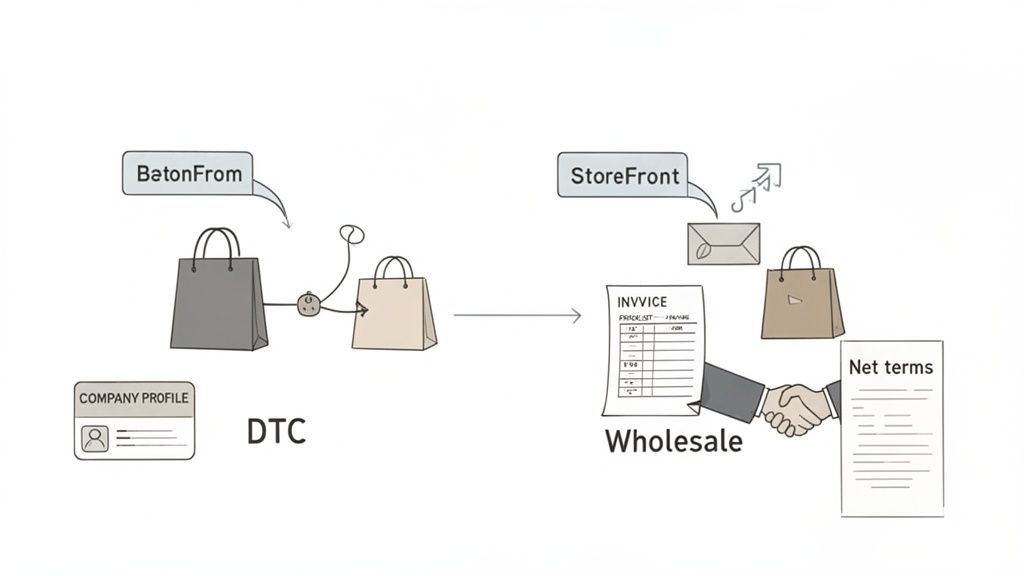
Shopify Plus blows this entire problem up with its built-in B2B on Shopify features. This isn't just another app; it’s a fundamental part of the platform designed to let you manage a hybrid DTC and B2B model from one place. This single-backend approach is a game-changer for efficiency. No more wrestling with duplicate product catalogs, trying to sync inventory across two different stores, or merging separate customer lists.
A Polished and Unified Wholesale Experience
The B2B toolkit in Shopify Plus lets you build a self-serve portal for your wholesale clients that feels just as slick as your DTC site but comes packed with the features they actually need. Forget about emailing spreadsheets back and forth or taking complicated orders over the phone. Your B2B partners get a professional, easy-to-use buying experience.
A few key features exclusive to Plus make this possible:
- Company Profiles: You can set up unique profiles for each wholesale business, then assign multiple buyers to that single account, each with their own permissions.
- Custom Price Lists: Effortlessly create and assign different pricing rules to different wholesale customers. You can set up fixed-price catalogs or apply percentage-based discounts across your entire product line.
- Net Payment Terms: Let your trusted partners buy now and pay later with terms like Net 30, Net 60, or Net 90. Invoices are automatically created and tracked right in the customer’s profile, making life easier for your accounting team.
- Wholesale Self-Serve Portal: Buyers can log in anytime, see their specific pricing, place new orders, and manage their own account details without ever needing to contact your team.
The native B2B toolkit on Plus shifts wholesale from a manual, high-effort process into an automated, scalable revenue stream. It gives your wholesale partners the power they want and frees up your team to hunt for the next big opportunity.
Comparing the B2B Playbook
To really grasp the difference, let’s look at how B2B works on each platform side-by-side.
For any brand with a serious wholesale operation—or plans for one—this comparison makes the decision pretty clear. While the workarounds on standard plans can get the job done for a while, Shopify Plus offers a truly professional, scalable, and integrated solution that drastically improves both your team's workflow and your wholesale customer's experience.
Enhancing the Post-Purchase Experience
The real difference between Shopify and Shopify Plus often shows up after a customer clicks "buy." A great post-purchase experience is your secret weapon for cutting down on support tickets, building real customer loyalty, and ultimately boosting lifetime value. While any Shopify store can use apps to smooth out this part of the journey, Shopify Plus gives you the raw power to truly perfect it.
The main advantage comes down to how deeply you can weave your systems together and automate everything. Merchants on Shopify Plus get much higher API rate limits, which means their whole tech stack—from their ERP to their 3PL partner—can talk to each other without hitting a wall. This opens the door for complex, real-time automation that standard plans just can't handle.
Supercharging Post-Purchase Workflows
Think about a common headache for a growing brand: a wave of customers needing to change their shipping address moments after placing an order. On a standard plan, that usually means a support agent has to step in and fix it manually, causing delays and eating up time.
With Shopify Plus, you can automate that entire process. The higher API limits allow a post-purchase app, like SelfServe, to connect directly and reliably with your 3PL’s system. When a customer updates their address, the change is instantly validated and sent to the fulfillment center, stopping shipping mistakes before they even have a chance to happen.
This kind of operational muscle is why so many enterprise brands choose the platform. The numbers speak for themselves: as of 2026, there are 55,964 live Shopify Plus stores around the world, with the US alone accounting for over 25,413 of them. These aren't just small operations; many are juggling massive catalogs of over 1,000 SKUs across up to 200 inventory locations. That’s a scale that absolutely demands the robust framework Plus delivers.
Custom Checkout and Upsell Opportunities
This is where Shopify Plus really leaves the other plans behind. Getting access to the checkout.liquid file and Shopify Scripts gives you complete control over the final steps of the sale and what happens right after.
For a Plus merchant, the thank you page isn't just an endpoint; it's the beginning of the next customer journey. It becomes a dynamic, revenue-generating asset.
Imagine building a custom upsell offer directly into your branded checkout. A customer who just bought a new tent could instantly see an offer for a sleeping bag with a simple one-click "add to order" button—no need to re-enter their card details. This kind of frictionless experience, made possible by Plus-exclusive tools, can have a huge impact on your average order value. For more ideas on this, check out our guide on the Shopify post-purchase upsell for some practical strategies.
This deep level of customization shows how Shopify Plus provides the foundation for a truly seamless and profitable post-purchase workflow. It’s about moving beyond simply managing orders to actively improving the customer experience and driving more revenue long after that first sale is done.
Your Shopify Plus Questions, Answered
Deciding whether to move from Shopify to Shopify Plus is a big step, and it usually comes with a lot of practical questions. Getting straight answers is the only way to know if the investment makes sense for where your brand is headed. This section cuts through the noise to answer the most common questions we hear from merchants at this exact growth stage.
We'll give you direct, clear information to help you look at the upgrade from all sides, so you can make a final, confident decision.
What Is the Main Difference Between Shopify and Shopify Plus?
The biggest difference boils down to scalability, customization, and automation. Standard Shopify plans are fantastic, offering a powerful, out-of-the-box platform that’s perfect for most businesses getting started and scaling up. Shopify Plus, on the other hand, is an enterprise-level platform built specifically for high-volume merchants who need granular control over their entire operation.
With Plus, you get unlimited bandwidth, complete checkout customization via checkout.liquid access, much higher API call limits, and a dedicated support team. You also unlock a suite of exclusive tools like Shopify Scripts for running complex promotions, Shopify Flow for automating workflows, and Launchpad for managing massive sales events like Black Friday. In short, you go from a great ready-made solution to a highly adaptable platform designed for enormous scale and complex business logic.
The real shift is from fitting your business into a platform to shaping the platform around your business. Standard Shopify gives you a powerful storefront; Shopify Plus gives you an enterprise-grade commerce engine.
At What Revenue Should I Consider Upgrading?
There’s no single magic number, but the general rule of thumb is to start seriously looking at Shopify Plus when you're approaching or surpassing $1 million in annual revenue. Once you hit that scale, the operational and financial perks usually deliver a clear, compelling ROI.
Most brands find their unique tipping point somewhere between $800,000 and $2 million a year. The right time to upgrade really depends on your specific pain points. For example, if the savings on transaction fees alone would cover a big chunk of the monthly cost, it's a smart financial move. Or, if operational headaches and a lack of checkout customization are actively stunting your growth, you might need to make the switch even sooner.
How Difficult Is the Migration from Shopify to Shopify Plus?
The migration from a standard Shopify plan to Shopify Plus is surprisingly straightforward. Because you’re staying inside the Shopify ecosystem, there’s no messy, high-risk data migration to deal with. All your critical data—products, customers, orders—stays exactly where it is.
The upgrade simply "unlocks" the new Plus-specific features and dashboard in your existing admin panel. A dedicated Shopify Plus Launch Engineer is assigned to you to make sure the transition is seamless. They’ll walk you through configuring the new features, setting up any expansion stores, and ensuring there is absolutely zero downtime for your customers. It’s one of the smoothest re-platforming experiences you'll find at the enterprise level.
Do I Need a Developer to Use Shopify Plus?
While you can absolutely run a Shopify Plus store without a developer for day-to-day tasks, you’ll need one to truly harness its most powerful capabilities. The platform is built to be deeply customized, and unlocking that potential requires technical skill.
Here are a few things that almost always require a developer:
- Checkout Customization: Editing the
checkout.liquidfile to build a fully branded and optimized checkout experience. - Shopify Scripts: Writing custom Ruby scripts to implement complex promotions, tiered pricing, or dynamic shipping rules.
- API Integrations: Building custom apps or connections between your store and third-party systems like an ERP or a 3PL.
Most merchants on Shopify Plus either work with a development agency or have an in-house developer to unlock the platform’s full power and build a truly unique, high-converting customer experience.
Ready to cut down on support tickets and boost your AOV? SelfServe empowers your customers with post-purchase order editing, while our smart upsell modules turn your thank you page into a revenue driver. Install in minutes and see the difference. Start your 30-day free trial on getselfserve.com