Shipping to India From US Your 2026 Shopify Guide

Shipping to India from the US means getting a handle on customs, picking the right carrier like FedEx or DHL, and understanding how import duties will affect your final price. Nail the paperwork and be upfront with your customers about everything—from potential 3-25 business day transit times to the final landed cost—and you’ll be set up for success.
Why India Is a Key Market for US Brands
For US-based Shopify merchants, India isn't just another pin on the world map. It’s a colossal, rapidly expanding ecommerce market that you simply can't ignore. The story you've heard about a rising consumer class hungry for American products isn't just talk; it's backed by real, hard economic trends. Making a strategic move into this market now could be a game-changer for your brand’s growth plans.
While the thought of international shipping might feel overwhelming, the key is to see the challenges as a series of manageable steps, not insurmountable barriers. Mastering the logistics of shipping to India from US ports is really about learning a clear, repeatable process.
The Growing Demand for US Products
The bond between US brands and Indian shoppers gets stronger every year. In 2024, US goods exports to India hit a staggering $41.5 billion, which was a $1.2 billion jump from the year before. This isn't just a number; it's proof of a massive appetite for American quality and innovation in one of the world's most vibrant economies.
This trade boom isn't all about heavy industrial equipment, either. It reflects a growing demand for the very things American brands do best: consumer goods, electronics, apparel, and lifestyle products.
For Shopify merchants, the business case is crystal clear. There’s a huge, ready-made market of Indian consumers actively looking for the products you sell. The real hurdle isn't a lack of interest—it's getting the product into their hands.
Shipping to India at a Glance: Key Considerations
Before diving in, it helps to see the big picture. Navigating the Indian market means balancing opportunity with operational readiness. Here's a quick summary of the most critical factors to keep on your radar.
Mastering these five areas is the foundation of a successful shipping strategy for India. It turns logistical headaches into a competitive advantage, creating a smooth and predictable experience for your customers.
Your Roadmap to Success
To really crack the Indian market, you need a solid game plan built on a few core pillars. This guide is your high-level roadmap, breaking down the essentials you need to turn India from a potential market into a profitable one.
We’ll cover:
- Customs and Paperwork: Finally making sense of the documents and duties needed for a shipment to fly through customs.
- Carriers and Costs: Comparing the major players to help you find that sweet spot between speed, reliability, and price.
- Customer Experience: Smart strategies to cut down on errors, manage expectations, and earn repeat customers.
By zeroing in on these areas, you'll build an efficient and reliable shipping operation. Getting this right is vital for staying competitive, and you can learn even more about adapting to what's next by checking out the top ecommerce trends to watch in 2025. This kind of prep work ensures that the moment an Indian customer hits "buy," you have a system in place ready to deliver an outstanding experience.
Decoding Indian Customs, Duties, and Paperwork
Shipping to India from the US can feel daunting, especially when you hit the customs part. But think of it less like a bureaucratic maze and more like a detailed checklist. Once you understand the rules of the game and get your paperwork in order, you can turn a potential headache into a smooth, predictable part of your business.
At the heart of it all is one simple concept: Indian customs needs to know exactly what you're sending. This is where the Harmonized System (HS) code comes into play. It’s essentially a universal passport for your product—a standardized numeric code that tells officials whether you’re shipping a cotton t-shirt or a sophisticated piece of electronics.
Getting the HS code right is non-negotiable. A wrong code can get your package stuck, re-assessed at a much higher duty rate, or even sent back. It’s the very first domino that needs to fall correctly for a seamless delivery.
The whole process fits together in a logical sequence, with customs being the first major gatekeeper.
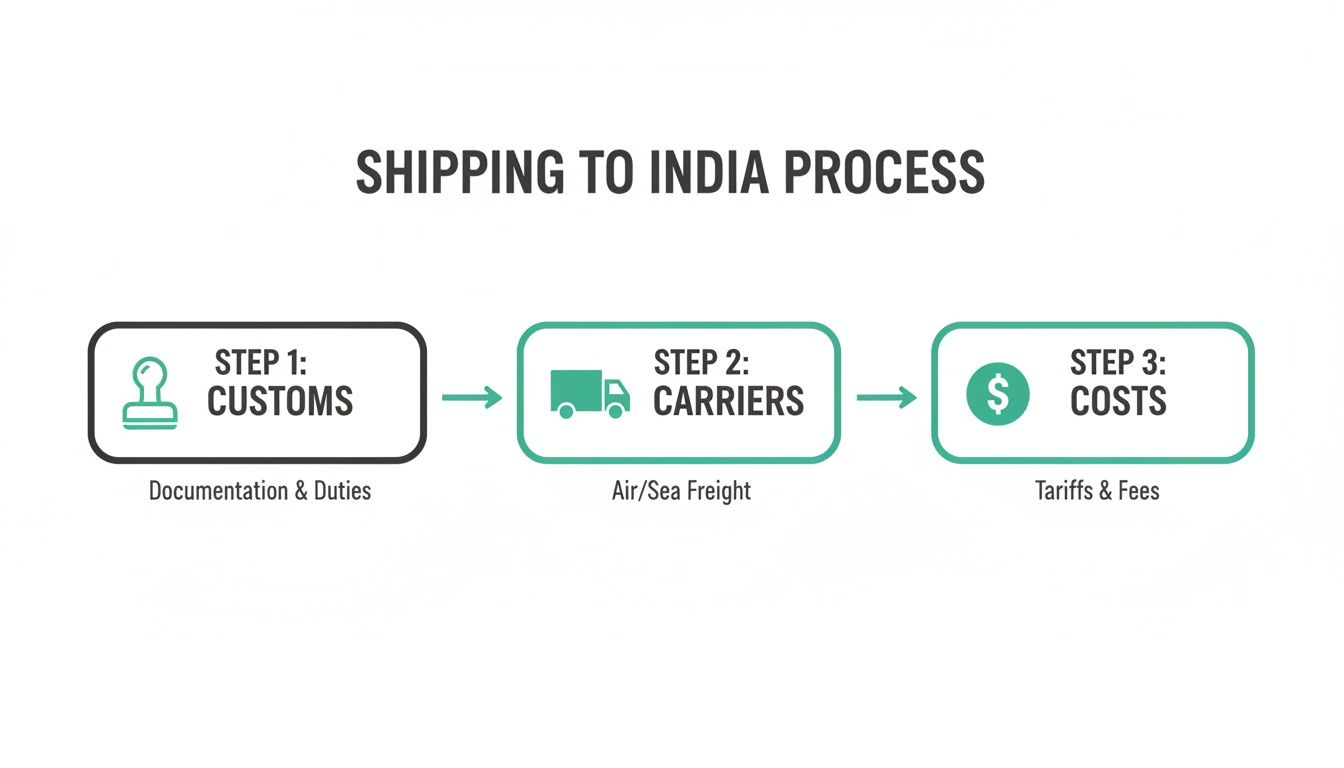
As you can see, nailing customs clearance is the first hurdle. Get it right, and you’re well on your way to a happy customer.
Understanding Duties and Taxes
After your product is properly classified with its HS code, Indian customs calculates the duties and taxes. These fees are how the government manages imports, and they primarily come in two forms: Basic Customs Duty (BCD) and Integrated Goods and Services Tax (IGST).
The BCD is a percentage figured out from the "assessable value" of your shipment, which is the total of the product cost, insurance, and freight (often called the CIF value). Then, the IGST is applied on top of that new total (assessable value + BCD).
Think of it like a layered tax. First, the import duty (BCD) is applied to the shipment's value. Then, the national sales tax (IGST) is calculated on that new, higher total. This compounding effect is why the final landed cost for your customer can be quite a bit more than just the price of your product.
Getting this right matters on a massive scale. In 2024 alone, India's imports from the United States hit a staggering $38.99 billion. While a huge chunk of that (over 31%) was mineral fuels and oils, consumer and industrial goods like aircraft ($757.69 million) and vehicles ($575.39 million) also made up a huge volume—all requiring perfect customs processing. You can dig into more of this data on the U.S. exports to India page on tradingeconomics.com.
Essential Shipping Documents for India Explained
Clean, accurate paperwork is the lifeblood of international shipping. A missing signature or an incorrect value is the number one reason packages get stuck in customs. Your goal is to give officials a clear, transparent story of the transaction.
Here’s a look at the essential documents you’ll need to prepare for a smooth customs clearance process in India.
Beyond these shipper-provided documents, there’s one more crucial piece. Indian customs requires the recipient to complete a Know Your Customer (KYC) verification, which usually involves providing a government-issued ID and proof of address.
It’s a fantastic idea to let your customer know about this requirement right after they place their order. A quick heads-up can prevent major delays when the package arrives in India and is waiting for their documentation.
Choosing the Right Carrier for Your Business
Picking a partner for shipping to India from US warehouses is a whole lot more than just comparing prices. This is a strategic decision that directly impacts your customer's experience, your brand's reputation, and ultimately, your bottom line. The right carrier is like a trusted team member; the wrong one can mean lost packages, angry customers, and costs that spiral out of control.
Think of it like choosing the right vehicle for a road trip. A zippy, fuel-efficient car is perfect for getting around the city. But for a long-haul journey across rugged country? You'd want a tough, reliable truck. In the same way, the best carrier for sending lightweight t-shirts to Mumbai is probably not the best choice for shipping expensive electronics to Bangalore.
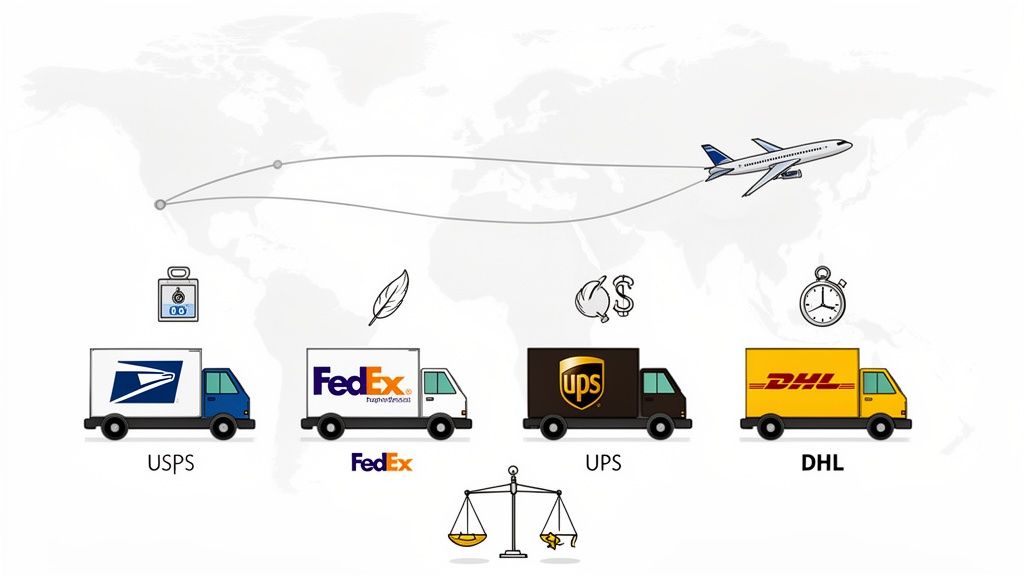
It all comes down to finding the right balance between three critical factors: speed, cost, and reliability. Let's break down the major players and see how they really stack up for Shopify merchants.
Comparing the Major Carriers
Every carrier brings something different to the table, especially on the popular US-to-India route. The best fit for you will depend on what you're selling, what your customers expect, and how much you're willing to spend.
- USPS (United States Postal Service): Usually the most affordable option, USPS is a go-to for small, lightweight, and lower-value items. It works by handing off packages to India Post for the final leg of the journey. While it's great for keeping costs down, be aware that tracking can get a bit spotty once it enters the Indian postal system, and delivery times are often the longest.
- FedEx and UPS: These global logistics giants offer a fantastic mix of speed, detailed tracking, and dependable service. They're a smart choice for higher-value goods where you and your customer want to see every step of the journey. Their express services can get a package to a major Indian city in as little as 3-5 business days, and they have solid systems in place for handling customs clearance.
- DHL: As a specialist in all things international, DHL really excels on the US-to-India lane. They're known for a massive global network and real expertise in navigating tricky customs situations. If you're looking for top-tier reliability and speed, DHL is a premium option. Their process for managing duties and taxes is incredibly smooth, which is why many merchants choose them to provide the best possible customer experience.
Look Beyond the Shipping Quote to the Total Landed Cost
Here’s a classic mistake: focusing only on the carrier’s shipping rate. Your customer in India doesn't just pay for shipping; they pay the total landed cost. This is the complete price of getting the item to their door, which includes the product price, shipping fees, customs duties, and taxes (like IGST).
Showing your customers this total landed cost upfront at checkout is a game-changer. It gets rid of that awful "surprise fee" when the package arrives—a moment that can instantly destroy trust and ensure they never buy from you again.
This is where shipping Delivered Duty Paid (DDP) is so powerful. When you choose a carrier service that supports DDP, you prepay all duties and taxes for your customer. They see one final price when they check out, and the package arrives at their door with nothing else to pay. It’s the closest you can get to giving them a familiar, domestic-like shopping experience.
Match Your Products to the Right Service
There's no single "best" carrier for everyone. A smart shipping strategy means adapting your choice based on what you sell.
- For Lightweight Apparel or Accessories: The cost-savings from USPS First-Class Package International Service often make it the winner. The lower product value makes a longer transit time a fair trade-off for a much cheaper shipping fee.
- For High-Value Electronics or Jewelry: The peace of mind that comes with security, end-to-end tracking, and insurance from FedEx, UPS, or DHL is non-negotiable. The higher cost is an investment in protecting your product and your customer relationship.
- For Time-Sensitive or Perishable Goods: You absolutely need an express service like DHL Express Worldwide or FedEx International Priority. The speed is critical to ensuring the product arrives in perfect shape, and customers are usually willing to pay for that premium experience.
Your carrier choice is a key piece of your international growth strategy. Just as you use different software for marketing and finance, you might need a mix of carriers and services to hit the sweet spot between cost, speed, and customer happiness. You can also explore powerful integrations to simplify this process—learn more about the top Shopify shipping apps that can help with rate calculation and carrier management.
The Post-Purchase Experience: Your Secret Weapon for Winning Indian Customers
The moment a customer in India clicks "buy" isn't the end of the sale—it's the beginning of the most important part of their journey with your brand. A smooth, transparent, and flexible experience after checkout is what separates a one-time buyer from a lifelong fan. When you're shipping to India from US warehouses, this is where you either build incredible trust or create a whole lot of frustration.
Let's be honest, for customers in India, a few common problems can quickly kill the excitement of a new purchase. They're often anxious about long transit times, confused by non-standard address formats, and find it impossible to make a small change to their order when your support team is on the other side of the world. A rigid, hands-off approach after the sale is just asking for failed deliveries and angry support tickets.
But what if you could turn this potential minefield into your biggest advantage? The secret is giving your customers clarity and control.
Stop Failed Deliveries Before They Start with Address Validation
One of the most persistent headaches of shipping to India is dealing with address errors. Indian addresses can be long and complex, and they don't always follow the neat, standardized formats we're used to in the US. Even a tiny typo can send a package on a very expensive round trip back to your warehouse, costing you money, inventory, and a customer's goodwill.
The best fix is to catch these mistakes before a shipping label is even printed. When you give customers a clear window to review and edit their own shipping details, you empower them to get it right.
Think of real-time address validation as a safety net for your entire shipping process. By using tools that tap into Google Maps, customers can literally see their address pinpointed on a map. It becomes instantly obvious if something’s off.
This isn't just about catching typos. It's about confirming that an address actually exists and is deliverable by global carrier standards, which will slash your return-to-sender rate.
Give Customers Control with Self-Service Edits
Picture this: a customer in Delhi realizes they typed in the wrong apartment number just after placing an order. With a 10.5-hour timezone difference, waiting for your US-based support team to wake up and see their email just isn't going to work. This is a classic friction point that turns a happy customer into a stressed-out one.
This is exactly where a tool like SelfServe can be a game-changer by letting merchants create a custom, self-service portal.
This screenshot shows how you can give customers a specific time frame—maybe two hours after purchase—to fix their own address, update a phone number, or even cancel the order themselves.
By offering a localized widget that can be translated, you meet your Indian customers on their terms. This simple act of trusting them with their own order builds massive brand confidence.
Turn Your "Thank You" Page into a Profit Center
A customer's excitement is never higher than in the moments right after they've made a purchase. They're feeling good about their decision and are highly engaged. For most brands, the "Thank You" page is a total dead end, but it has the potential to be so much more. In fact, it's the perfect place to increase your average order value.
By embedding an upsell module directly on the order confirmation and status pages, you can show customers curated products that perfectly match what they just bought. For instance:
- Offer Complementary Items: If someone just bought a leather handbag, why not offer them a matching wallet or a leather care kit?
- Suggest Low-Cost Add-ons: Small, high-margin items like funky socks, accessories, or travel-sized versions of popular products are easy impulse buys.
- Create Exclusive Deals: Present a time-sensitive offer that's only available right then and there. It creates a feeling of urgency and exclusivity.
This strategy works because it taps into the customer's existing buying momentum without being pushy. They've already entered their payment and shipping info, so adding another item is a frictionless, one-click affair. Suddenly, the post-purchase flow goes from being a simple receipt to an active part of your sales funnel. You can dig deeper into this strategy in our complete guide to building a great post-purchase customer experience.
Best Practices for Packaging and Insurance
Getting your products safely across the world is a physical challenge long before it’s a logistical one. When you’re shipping to India from US warehouses, your package is embarking on a journey of thousands of miles, handled by dozens of people and machines. Smart preparation is your first line of defense against damage, delays, and lost revenue.
Think of your packaging as a suit of armor for your product. Its only job is to absorb the bumps, drops, and pressures of a long trip so the item inside arrives in perfect condition. Skimping here is a classic mistake that often costs far more in replacements and unhappy customers than you’d save on materials.
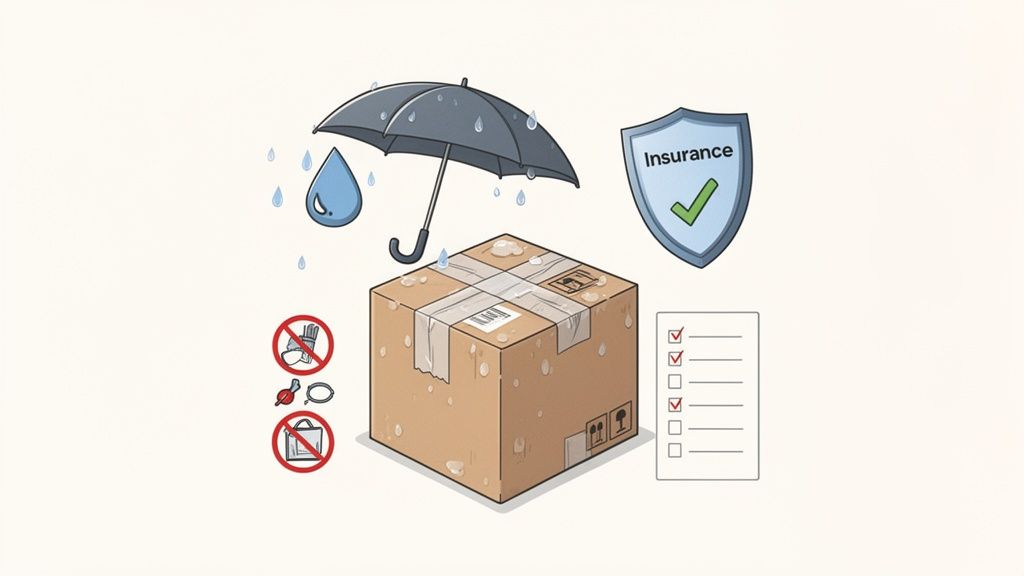
Building a Fortress for Your Products
Proper packaging is a science. You need to protect against impact from the outside and movement on the inside. Start with a sturdy, double-walled corrugated box—it’s worth the small extra cost over a standard thin-walled box. It’s the foundation of a safe journey.
Once you have the right box, follow these essential steps:
- Wrap Each Item Individually: Use at least two inches of cushioning like bubble wrap or foam around every product. If you're shipping multiple items, wrap each one separately before placing them in the box. Don’t let them rattle against each other.
- Fill All Empty Space: Any void inside the box is an invitation for items to shift and collide. Use packing peanuts, air pillows, or crumpled paper to ensure a snug fit. Your goal is zero movement when you shake the sealed box.
- Use the H-Tape Method: Secure your box with high-quality packing tape. Seal the center seam and then tape along all the edge seams on both the top and bottom. This forms a letter "H" and dramatically reinforces the box's weak points.
Weatherproofing for Indian Climates
India’s climate, especially during the monsoon season from June to September, introduces another major risk: moisture. A cardboard box left on a damp loading dock can quickly weaken and fall apart, exposing what’s inside.
To counter this, place your products inside a sealed plastic bag before you put them in the box. This simple, inexpensive step provides a crucial waterproof barrier. It ensures that even if the outer box gets soaked, your product stays dry and safe.
Shipping insurance isn't an expense; it's a vital safety net. Without it, you're accepting 100% of the financial risk if a package is lost, stolen, or damaged. For high-value goods, shipping without insurance is a gamble you can't afford to take.
Securing the Right Shipping Insurance
Insurance protects your investment. Most carriers offer basic declared value coverage, but it’s often limited and might not cover the full retail value of your product. Always read the fine print to understand what’s covered and, more importantly, what’s not.
When purchasing insurance, be prepared to:
- Declare the Accurate Value: Always declare the replacement cost of the item, not the sale price. Under-declaring to save a few cents on fees can completely void your coverage if you need to make a claim.
- Document Everything: Take clear photos of your product and the packaging before you seal the box. This visual proof is invaluable if you ever need to file a claim.
- Understand Policy Exclusions: Most policies won't cover damage from poor packaging or losses related to prohibited items. This is exactly why following the steps above is so critical—it’s part of holding up your end of the insurance agreement.
By combining robust packaging with comprehensive insurance, you create a powerful defense system. This ensures that the beautiful product you sent from the US is the same one your customer excitedly unboxes in India, creating the kind of positive experience that builds a loyal global brand.
How to Handle International Returns and Support
Let's be realistic: even with the best shipping strategy in the world, returns happen. It’s a standard part of running an ecommerce store. But when an order is international, a return isn't just a minor headache—it can quickly spiral into a logistical and financial mess. The cost of shipping to India from US is already high; paying for a return label can completely erase your profit on that sale.
The best way to protect your bottom line is to get ahead of the problem. Your first line of defense is a crystal-clear international returns policy that customers can't possibly miss. Many successful brands take a firm stance: all international sales are final. It might sound harsh, but it sets a clear expectation from the get-go. A more flexible approach could be offering store credit or a partial refund without asking the customer to ship the item back. In many cases, this is actually cheaper than dealing with the complexities of reverse logistics.
Shifting from Reactive to Proactive
A good returns policy is your safety net, but the real win is preventing the need for it in the first place. The truth is, most shipping problems and angry support tickets trace back to simple, preventable mistakes made moments after a customer clicks "buy." This is your chance to shift your support from a reactive, fire-fighting mode to a proactive, problem-solving one.
The culprits are almost always the same:
- Address Errors: One tiny typo in a long, complex Indian address can send a package into a black hole.
- Incorrect Contact Info: A wrong phone number means the local courier can't call the customer for delivery instructions or KYC updates.
- Buyer's Remorse: The customer has a change of heart but can't cancel before it ships because your team is asleep in a different timezone.
Trying to fix these issues after the package is already in transit is a costly, time-sucking nightmare. The smarter play is to give customers the power to fix these mistakes themselves before they become your problem.
Using Self-Service to Cut Down Support Tickets
This is where giving customers a small window of post-purchase control makes a huge difference. A self-service portal like SelfServe attacks the root causes of returns and support tickets by letting customers manage their own orders within a time limit you set.
Think about it: who is more motivated to double-check that their shipping address is perfect than the person eagerly waiting for the package? When you give them the tool to make their own edits, you're handing off the most critical data-check to the expert—the customer.
When a customer in Mumbai realizes they typed the wrong apartment number, they can fix it instantly on the order confirmation page. They don't have to wait for your US-based support team to wake up and respond. Just like that, you've avoided a future support ticket and a potential "return-to-sender" nightmare.
This kind of system doesn't mean you lose control. You can set up workflows to define exactly what customers can change and for how long. For example, you might allow address edits for two hours post-purchase but have all cancellation requests go into a queue for your team to review manually. This automation gives you the best of both worlds: it empowers your customers while keeping you in the driver's seat. By validating addresses and letting customers make their own edits, you’re not just reducing returns—you’re building a much more resilient and efficient operation for the Indian market.
Your Top Questions Answered
When you're sorting out the logistics of shipping to India from your US warehouse, a few key questions always pop up. Let's tackle the most common ones we hear from Shopify merchants.
How Much Does It Cost to Ship a Package to India From the US?
This is the big one, and the honest answer is: it depends. The price tag can swing wildly based on the package's size and weight, which carrier you use, and how fast you want it to get there. A small 1kg package could cost as little as $30 with a postal carrier or jump to over $100 with an express service.
But remember, the shipping rate is just one piece of the puzzle. The number you really need to focus on is the total landed cost. This includes the customs duties and taxes your customer will have to pay, which can easily add another 30-50% on top of your product's price.
How Long Does Shipping to India Usually Take?
Again, this comes down to the service level you pick. If speed is your priority, express options from carriers like DHL or FedEx are your best bet. They can often get a package to major Indian cities in just 3-5 business days and offer fantastic, detailed tracking along the way.
If you’re looking to save some money, economy or postal services are much more budget-friendly. The trade-off is time, with deliveries taking anywhere from 10-25 business days. And for either option, always build in a buffer for customs clearance, which can add a few extra days to the timeline.
What Is the Best Way to Handle Customs Duties for My Indian Customers?
Transparency is everything here. The simplest method for you is to ship DDU (Delivered Duty Unpaid), which means your customer is on the hook for paying any import fees when the package arrives. It's easy on your end, but it can lead to some serious sticker shock and an unhappy customer.
A much better approach for customer experience is shipping DDP (Delivered Duty Paid). With DDP, you calculate and collect all the duties and taxes at checkout. It takes a bit more setup, but it means no surprise bills for your customer. Whichever route you take, make sure your policy is spelled out clearly on your website.
How Can I Prevent Shipping Errors Before an Order Leaves My Warehouse?
The best defense is a good offense. Instead of fixing errors, prevent them from happening in the first place by empowering your customers. Using an app that has Google Maps address validation built-in is a game-changer, catching typos and flagging undeliverable addresses right at the source.
Even better, give your customers a short, automated window right after they place their order to edit their own shipping details. This simple step catches so many human errors, saving you a ton of time, money, and headaches from failed deliveries.
Tired of dealing with costly shipping errors and endless support tickets? SelfServe gives your customers a simple portal to validate their own addresses and make post-purchase edits, giving you full control and complete peace of mind. Start your 30-day free trial and see the difference.