What Is The Return Label: An Essential Ecommerce Guide
At its core, a return label is a simple concept, but it's one of the most powerful tools in an ecommerce merchant's arsenal. Think of it as the digital evolution of the old self-addressed stamped envelope you’d find in a mail-order catalog package.
It's essentially a shipping label that's been pre-filled with all the necessary information—your warehouse address, the customer's details, and tracking information—to get a product back to you.
The Return Label Explained for Modern Merchants
A return label isn't just about logistics; it’s a direct message to your customers about what it’s like to do business with you. Getting it right turns a moment of potential disappointment into an opportunity to build serious trust and loyalty.
When you make the return process effortless, you're showing customers you stand behind your product, no matter what. That confidence is contagious. In fact, research shows a staggering 72% of online shoppers "love" it when a prepaid return label is included right in the box. It removes the financial risk and mental friction from their purchase decision, making them far more likely to buy in the first place and come back again.
Prepaid vs. Customer-Paid Labels
Every merchant has to make a fundamental choice that directly shapes their customer experience and their budget: who pays for the return shipping? There are really only two ways this can go.
Prepaid Return Labels: With this approach, the merchant covers the cost of return shipping. It's the gold standard for customer experience, creating a smooth, no-hassle process that customers genuinely appreciate. The big advantage for you is control—you choose the carrier and the shipping service, which helps you manage and predict your costs.
Customer-Paid Return Labels: Here, the customer is responsible for buying their own postage to send an item back. While this obviously saves your business money on shipping fees, it introduces a significant amount of work and uncertainty for the customer. That friction can be enough to stop them from ever shopping with you again.
For any brand dealing with a significant number of orders, the costs associated with returns can add up quickly. Getting your label strategy right from the start isn't just a small operational detail; it’s a critical part of protecting your profit margins. A clunky, confusing return system will inevitably lead to frustrated customers and a buried support team. A great one, however, can become a reason customers choose you over the competition.
A return label might seem like just another sticker, but think of it more like a GPS-enabled ticket for your package. Every single detail printed on it has a specific, vital job to do, guiding that item from the customer's hands right back to your warehouse without a single wrong turn.
If just one detail is off, you risk a lost package and a customer service headache. But when everything is right, the whole process is remarkably smooth. Let's break down what makes these labels work.
The Barcode: Your Package's Passport
The first thing you’ll notice on any return label is the barcode. This isn’t just a random set of black and white lines—it’s the package’s unique passport. This is what allows it to be scanned and tracked at every checkpoint on its journey home.
When a carrier like USPS, UPS, or FedEx scans this barcode, the package's location gets updated in their system instantly. This gives both you and your customer total visibility, answering that all-too-common question, "Where's my return?" before they even have to ask. It’s the simple tech that powers the entire tracking experience.
How a customer gets this label can vary, but the label's job remains the same.
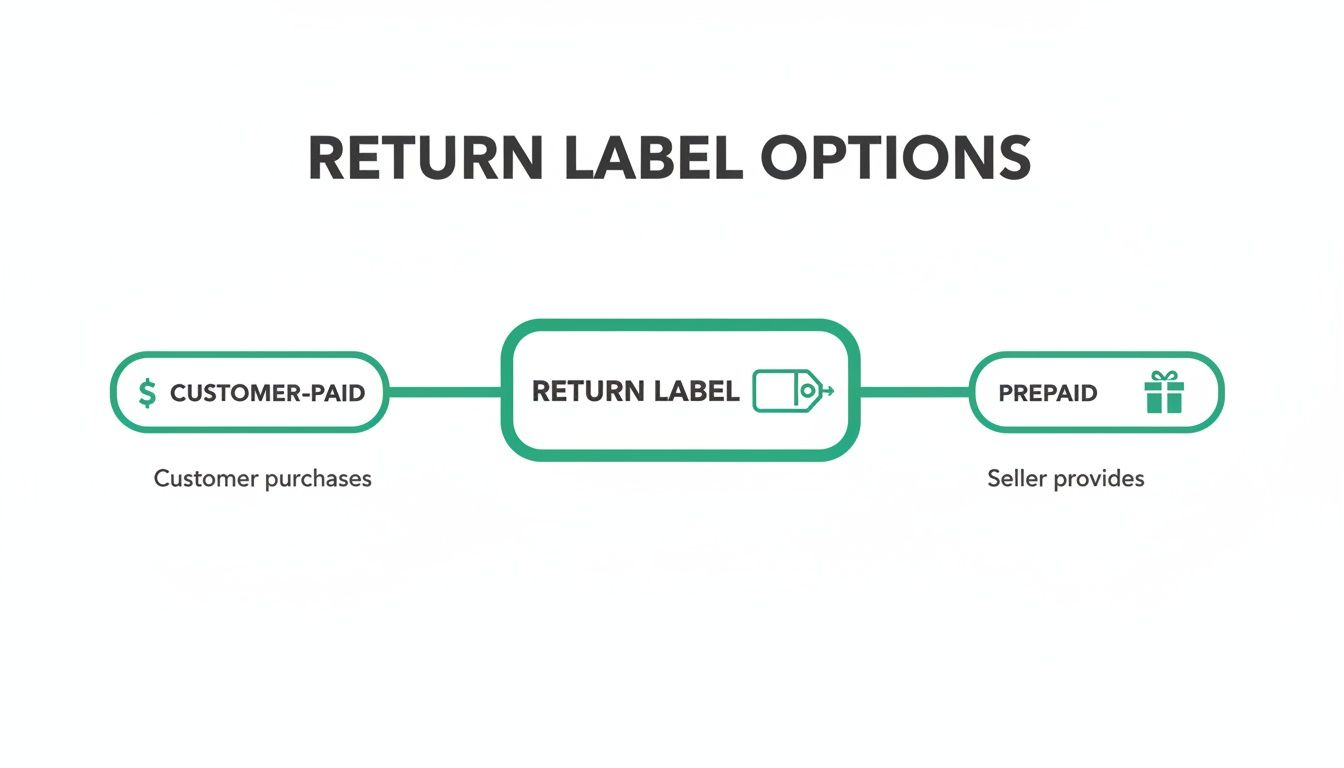
As you can see, whether the customer pays for shipping or you provide a prepaid label, the core components are what make a successful return possible.
Core Data Components
Beyond the barcode, a few other key pieces of information are working behind the scenes. Each one plays a part in getting the package to the right place and connecting it to the right order.
Return Merchandise Authorization (RMA) Number: Think of this as the confirmation number for the return. You assign this unique code when a customer starts a return request. When the package shows up at your facility, your team can use the RMA number to instantly pull up the customer's order, what they're returning, and why. This is absolutely critical for processing refunds quickly and preventing return fraud.
Carrier Routing and Service Level: The label also contains specific codes that act as instructions for the carrier. This tells them exactly which warehouse or facility to send the package to—not your corporate office—and what shipping speed to use. This ensures the package follows the route you’ve chosen and paid for.
A return label is the operational engine of your returns process. Without accurate data on that label, even the most generous return policy will break down, leading to lost inventory, delayed refunds, and unhappy customers.
When you look at a return label, you're seeing a system in action. The addresses provide the destination, the barcode provides the tracking, and the RMA number connects the physical product to its digital record. It’s a perfect example of logistics made simple.
How to Create and Distribute Return Labels
Alright, so you've got the concept of a return label down. The next big question is: how do you actually get that label into your customer’s hands? This isn't just a tiny operational detail; the method you choose has a massive impact on your costs, your team's workload, and whether a customer ever shops with you again.
Getting this right is about building a smart returns strategy that makes sense for your business and doesn't frustrate your shoppers. Let’s break down the three main ways merchants handle this.
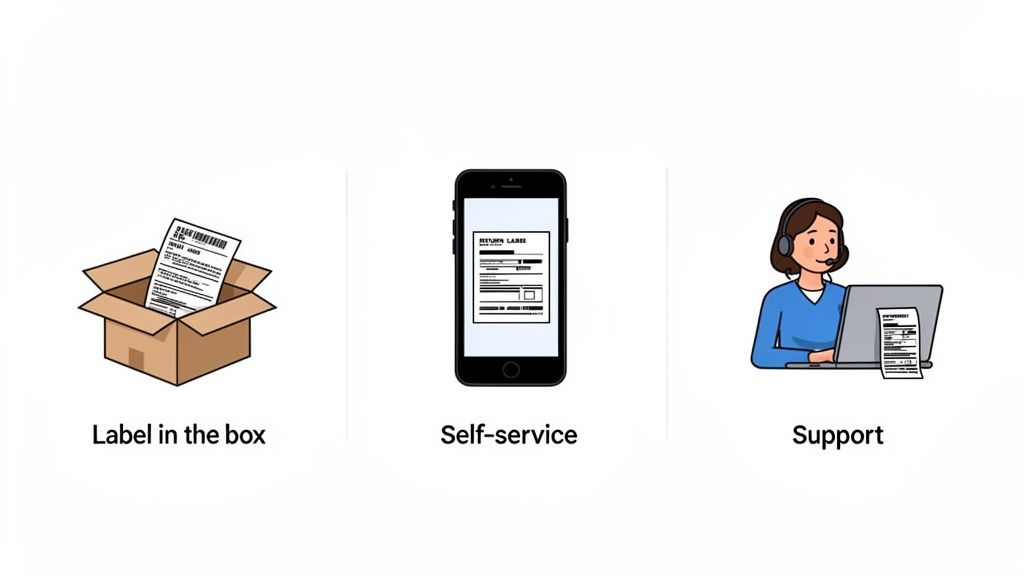
Common Label Distribution Methods
The best approach really depends on your business model, how often you get returns, and the kind of experience you want to offer.
Include a Label in Every Box: This is the old-school, proactive approach. You simply slip a physical return label into every single package you ship out. For the customer, it’s incredibly convenient—they have what they need right from the start. The big downside? It's wasteful. Most of those labels get thrown away, and every single one costs you money to print. For brands shipping a lot of orders, a dedicated thermal label printer for shipping labels becomes essential just to keep up.
Generate Labels Manually Through Support: In this model, customers have to reach out to your support team to kick off a return. An agent then has to create the label by hand and email it over. While this gives you total control over every return, it's also incredibly slow and inefficient. It creates a huge bottleneck, burying your support team in repetitive tasks.
Offer Self-Service Label Generation: The modern, and frankly, the best approach. You empower customers to generate their own labels instantly through a digital return portal on your website. This is by far the most efficient option, automating the whole process and giving your support team their time back.
Shopify's native tools offer a starting point for creating labels. But for a truly automated system that can scale with your brand, specialized apps that plug right into your order status page are a different league. If you're curious about the specifics, our guide on creating a FedEx return label dives into the details for one of the major carriers.
Why Self-Service Is Winning
The industry-wide move toward self-service isn't just a trend; it's a response to clear customer demands and practical business needs. Today’s shoppers expect instant answers. Forcing them to wait on an email from support just to get a simple label is a fast way to lose their business.
Convenience is everything. A whopping 82% of consumers say free and easy returns are a major factor in their buying decisions. What's more, research shows 46% of shoppers will ditch their cart if they think the return process looks like a hassle.
With the total value of returned goods projected to hit $849.9 billion by 2026, it's no surprise that 64% of retailers are actively working to improve their systems. For high-volume Shopify brands, automating this flow with a self-service tool is a no-brainer. It eliminates endless support tickets and creates a smooth, professional experience for customers everywhere.
The True Financial Impact of Your Returns Process
When a return comes through, it's tempting to just glance at the cost of the return label and move on. But that single postage fee is just the tip of the iceberg. The reality is, a return kicks off a whole new, expensive journey for that product—a reverse supply chain where every stop costs you money.
Think about what actually happens when that package lands back in your warehouse. A team member has to physically receive it, open the box, and inspect the item. Is it damaged? Was it even the right product? If it's in pristine condition, it still needs to be re-tagged, repackaged, and meticulously added back into your inventory system. Every one of those steps takes labor, and that labor has a real cost.
Beyond the Shipping Fee: The Hidden Costs
The expenses don't stop once the item is inspected. Every returned product carries a story, and that story often involves lost value. An item that's been opened, tried on, or even just handled by a customer is rarely considered "brand new" anymore.
Here’s where the costs start to compound:
- Restocking & Repackaging: This covers the physical labor and new materials (like poly bags or tags) needed to get an item back on the virtual shelf.
- Product Devaluation: Many returns, especially in categories like apparel or consumer electronics, can't be sold at full price again. They're often moved to a clearance section or sold to liquidators, directly chipping away at your profit margin.
- Damaged & Unsellable Goods: A frustratingly high percentage of returns come back damaged, used, or otherwise unsellable. In these cases, you lose the entire cost of the goods.
This isn't just a small-scale problem. By 2026, U.S. retailers are on track to handle an incredible $849.9 billion in returned merchandise. That’s 15.8% of all sales, with the online return rate soaring to 19.3%. With figures this staggering, it's clear why 64% of retailers are making plans to overhaul their returns process. A clumsy, manual approach to return labels just multiplies these already massive costs.
To put this in perspective, let's break down what processing a single returned item can really cost.
Cost of a Single Return Breakdown
The table below gives an example of the various costs that can be associated with just one returned product. While your exact numbers will vary, it illustrates how quickly the expenses add up.
| Cost Component | Example Cost (USD) | Impact on Margin |
|---|---|---|
| Return Shipping Label | $8.00 | Direct cost, reduces net revenue |
| Receiving & Inspection Labor | $3.50 | Operational cost, increases overhead |
| Repackaging Materials | $0.75 | Direct cost, eats into profit |
| Product Devaluation (15%) | $7.50 | Reduces potential resale value |
| Inventory Carrying Cost | $0.50 | Hidden cost of holding unsellable stock |
| Total Hidden Cost | $20.25 | Significant erosion of profit margin |
As you can see, the initial $8.00 shipping fee is only a fraction of the total financial hit. The hidden operational and devaluation costs can easily double or triple the initial expense.
The Debate Over Charging for Returns
With all these expenses piling up, it's completely understandable why many merchants are tempted to charge customers for return labels. It seems like a simple way to recoup some of the cost and maybe even discourage casual or "wardrobing" returns.
However, this decision comes with a major trade-off: friction. Today's shoppers expect a smooth, easy experience, and adding a fee can be all it takes to send them straight to a competitor next time. A key part of building a sustainable ecommerce brand involves understanding refunds not just as a cost center, but as a part of the overall customer experience.
The most profitable long-term strategy often involves making returns as seamless as possible. An efficient, automated return label system reduces your internal costs while preserving customer loyalty—a combination that directly protects your bottom line.
Investing in a better returns process isn't just about managing an expense; it's a strategic move to protect your profitability and build a stronger brand. For a closer look at implementation, check out our guide on how to manage returns and refunds smoothly on Shopify.
Using Return Labels to Prevent Fraud and Abuse
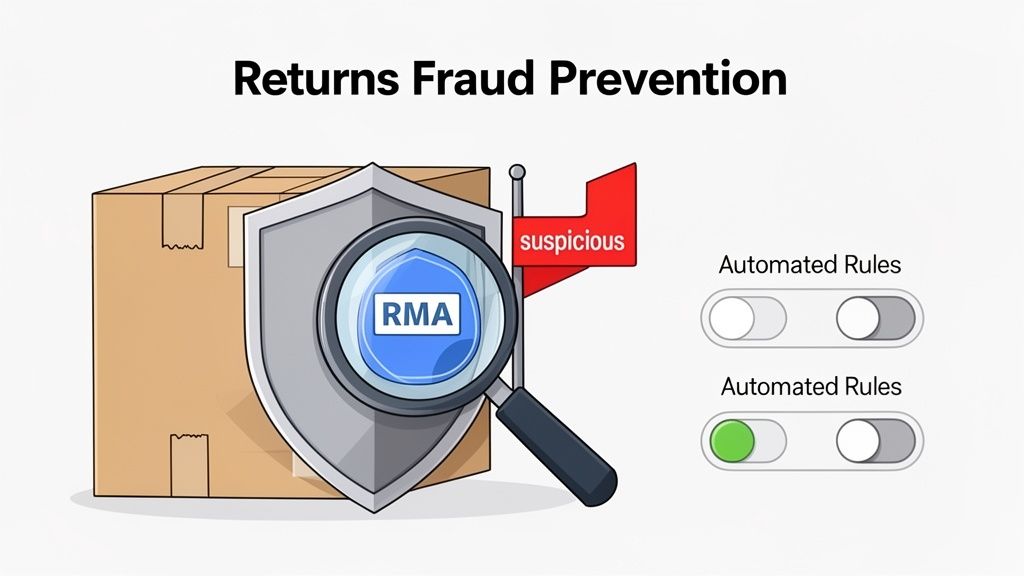
While a flexible, customer-friendly return process is a cornerstone of building trust, it can also swing open the door to fraud if you’re not careful. Without the right controls in place, your generous policy can be easily exploited, eating directly into your profits and tying up your team's valuable time.
For any high-volume store, a few common scams crop up again and again, all enabled by poorly managed return label systems.
- Wardrobing: This is the classic "buy, wear, and return" scheme. A customer orders an item, uses it for a weekend or an event, and then sends it back for a full refund. Your store essentially becomes their free rental service.
- Incorrect Item Returns: In this scenario, a customer uses your prepaid label to ship back something completely different—an old, broken version of the product, or sometimes a totally unrelated item. You're out the product, the shipping cost, and you're left holding worthless inventory.
- Empty Box Fraud: It’s as brazen as it sounds. The customer initiates a return and sends back an empty box, banking on the hope that your warehouse team is too busy to notice and will process the refund on faith.
The Alarming Scale of Return Fraud
These aren't just isolated incidents from a few bad actors; they're part of a massive, industry-wide problem. Return fraud now accounts for nearly 9% of all returns, a figure that represents billions of dollars in losses for retailers. With total returns projected to rocket to $849.9 billion by 2026, the financial stakes are getting higher every year.
For Shopify merchants, who often see online return rates climb as high as 19.3%, this is a serious threat to the bottom line.
Worse yet, this kind of behavior is becoming surprisingly normalized. Recent surveys found that 47% of shoppers admit to taking tags off an item before returning it, 32% have sent back worn merchandise, and 25% have shipped back a different product than the one they claimed to be returning. As you can dig into in the full NRF report on the 2025 retail returns landscape, this fraud epidemic forces support teams to spend countless hours just trying to verify which claims are legitimate.
"Every fraudulent return represents not just a lost sale, but also wasted shipping costs, processing labor, and devalued inventory. Proactive prevention is the only way to protect your margins without punishing your honest customers."
Proactive Strategies to Stop Fraud
So, how do you fight back? The answer isn't to make your return policy stricter for everyone. That just punishes your loyal, honest customers. The key is to implement smarter systems that can spot trouble before it starts.
Modern return management software, like SelfServe, gives you a powerful security layer. You can set up customizable return windows that automatically prevent someone from trying to return an item they bought six months ago. More importantly, you can create automated rules to flag suspicious activity. Think of it like a digital security guard.
For example, you can automatically flag customers with an unusually high return rate or orders that contain high-value, high-risk items. Instead of getting a label instantly, these flagged returns are sent to a manual approval queue. Your team can then take a quick look at the request before a return label is ever issued.
This targeted approach lets you scrutinize the handful of questionable returns without adding any friction for the vast majority of your customers. It's the perfect balance between tight security and great service.
How To Turn Returns Into a Competitive Advantage
Let’s be honest: most businesses see returns as a pure cost center—a necessary evil. But that’s a huge missed opportunity. A well-oiled returns process, with an easy-to-use return label system at its core, is one of the most powerful tools you have for building customer loyalty.
Think about it. When a product doesn't work out, the customer is already a little disappointed. A confusing or difficult return process just pours salt on the wound. But if you make it incredibly simple and stress-free, you turn that negative moment into a surprisingly positive experience, building trust that lasts.
Building a Modern, Customer-First Workflow
A modern returns strategy is about more than just slapping a prepaid label in the box. It’s about rethinking the entire experience from the customer's point of view. It starts with a crystal-clear return policy that's easy to find and even easier to understand.
From there, it’s all about empowering your customers. The best workflows today include:
- Flexible Return Options: Not everyone has a printer. Offering both a traditional print-at-home label and a printerless QR code option is now the standard for a reason. It accommodates everyone.
- Automated Updates: Keep your customers informed at every step. Automatic emails or texts that confirm their return request, track the package, and announce their refund eliminate anxiety and drastically cut down on "Where's my refund?" support tickets.
- A Seamless Digital Portal: The cornerstone of a low-friction process is a self-service returns portal. It lets customers generate their own labels whenever they want, 24/7, turning a manual, time-consuming task for your team into an efficient, automated flow.
An effortless, automated workflow doesn't just make customers happy—it's a game-changer for your ops team. By automating label generation and communication, you free your people from endless copy-and-paste tasks so they can focus on solving real problems and growing the business.
Ultimately, the goal is to make the return feel so smooth and professional that it reinforces the customer’s decision to shop with you in the first place. A great return experience proves you stand behind your products and value your customers, even when a sale doesn't stick. It’s a critical moment that can turn a one-time buyer into a lifelong fan.
By putting these strategies into action, you can build a modern returns system that saves you time and money while making your brand stronger. For merchants looking to optimize this entire post-purchase journey, learning more about the role of reverse logistics companies can provide a broader strategic perspective on managing the flow of goods back into your business.
Common Questions We Hear About Return Labels
As you start to dial in your returns process, a few key questions always seem to pop up. Let's walk through the most common ones we hear from merchants just like you.
How Much Does a Prepaid Return Label Actually Cost?
The short answer is: it depends. You only get charged when a customer actually uses the label, but the final price is a mix of carrier rates, service type, package weight, and dimensions. For a standard small package shipped domestically, you're likely looking at a cost between $5 and $12.
But that's just the tip of the iceberg. The sticker price of the label doesn't account for the "soft costs" that eat into your margins. Think about the non-refundable payment processing fees from the original sale, plus the labor hours your team spends receiving, inspecting, and restocking that item. The true cost of a single return can easily be double the shipping fee.
Can I Set Rules for Who Gets a Free Return Label?
This is where you can get really strategic. A blanket, one-size-fits-all free returns policy is rarely the most profitable approach. Instead, you should absolutely set rules to control who qualifies for a prepaid label.
It’s smart to build policies based on a few different factors:
- The why behind the return: It makes sense to provide a free label for a damaged item or a fulfillment error. But for a simple case of "changed my mind," it's perfectly fair to ask the customer to cover the shipping.
- Who the customer is: You might offer free, no-questions-asked returns to your VIPs or customers with a high lifetime value. It's a great way to build loyalty.
- What's being returned: It's common practice to exclude certain categories, like final sale items or products prone to fraud, from your free returns policy.
What Is the Difference Between an RMA and a Tracking Number?
It’s easy to get these two mixed up, but they serve completely different functions.
Think of the RMA (Return Merchandise Authorization) number as your internal file number for the return. It’s a unique code you generate to connect the physical item coming back to the original order in your system. Without it, you’d just have a random box showing up at your warehouse.
A tracking number, on the other hand, is created by the shipping carrier (like UPS or FedEx). Its only job is to provide visibility into the package’s journey through their network.
So, to put it simply: the RMA number tells you what the return is, while the tracking number tells you where the package is.
Empower your customers and slash support tickets with SelfServe. Let shoppers manage their own orders with automated, multilingual, and fraud-prevention tools built for Shopify. Start your free 30-day trial of SelfServe today.