Your Guide to an Effective Return Policy Shopify Strategy
It's easy to think of your Shopify return policy as just another legal page you have to create. A box to tick. But that’s a huge missed opportunity. A well-thought-out policy is one of the most powerful tools you have for building trust, lowering cart abandonment, and ultimately, making more sales. It's a critical marketing asset, not just a boring legal document.
Your Return Policy Is a Powerful Conversion Tool
Let's reframe how we think about returns. Too many store owners view them purely as a cost center—a necessary evil that chips away at profit margins. What if your return policy was actually one of your best marketing tools? For today’s shopper, a clear and fair return policy is a massive signal of trust.
Remember, your customers can't touch, feel, or try on your products. They're taking a leap of faith. Your policy is their safety net, assuring them they won’t get stuck with something that doesn't fit, doesn't work, or just isn't what they expected.
The Psychology of a Risk-Free Purchase
A great Shopify return policy answers the biggest question looming in a customer's mind: "What if I don't like it?" By removing that risk, you make the decision to click "Buy Now" so much easier. In fact, a staggering 92% of shoppers report they will buy again from a store that offers an easy return process.
A generous return policy isn't about bracing for losses; it's about investing in customer loyalty. It shows you stand behind your products and you respect your customers, which is how you turn a one-time buyer into a lifelong fan.
Think about common shopping behaviors like "bracketing," where a customer buys a shirt in both medium and large, knowing they'll return one. While this might sound like a headache, it often leads to a higher initial sale and a happier customer who found their perfect fit. The trick is having an efficient backend process so the benefits easily outweigh the logistical costs.
Understanding the True Cost of Returns
Returns are simply a part of doing business in e-commerce, but their financial bite is real. The industry average return rate for online stores sits between 17-20%, which is more than double the 8-10% seen in physical retail. For some product categories, the numbers are even higher.
Return Rate Benchmarks by Product Category (2026 Data)
Knowing the typical return rates for your industry can help you see where you stand. While every store is different, these benchmarks provide a useful starting point for evaluating your own performance.
| Product Category | Average Return Rate | Primary Reason for Return |
|---|---|---|
| Apparel & Fashion | 25-40% | Sizing issues, "wrong fit" |
| Electronics | 15-20% | Product not as described, defective |
| Home Goods & Furniture | 10-18% | Damaged in transit, color mismatch |
| Beauty & Cosmetics | 5-15% | Allergic reaction, wrong shade |
| Footwear | 20-35% | Sizing and comfort issues |
These figures show that returns aren't just an occasional inconvenience; they're a significant operational hurdle. A single return isn't just a refunded sale—it comes with a cascade of hidden costs.
We're talking about expenses that can range from $10 to $45 per item, covering everything from return shipping labels and payment processing fees to the labor costs for inspecting, repackaging, and restocking the product. For growing brands, these costs multiply quickly. This is precisely why having an optimized process is mission-critical for your profitability.
You can dive deeper into a full breakdown of these Shopify return costs and reduction strategies to get a better handle on this crucial part of your business. Getting this workflow right is essential for sustainable growth.
Crafting the Core Components of Your Return Policy
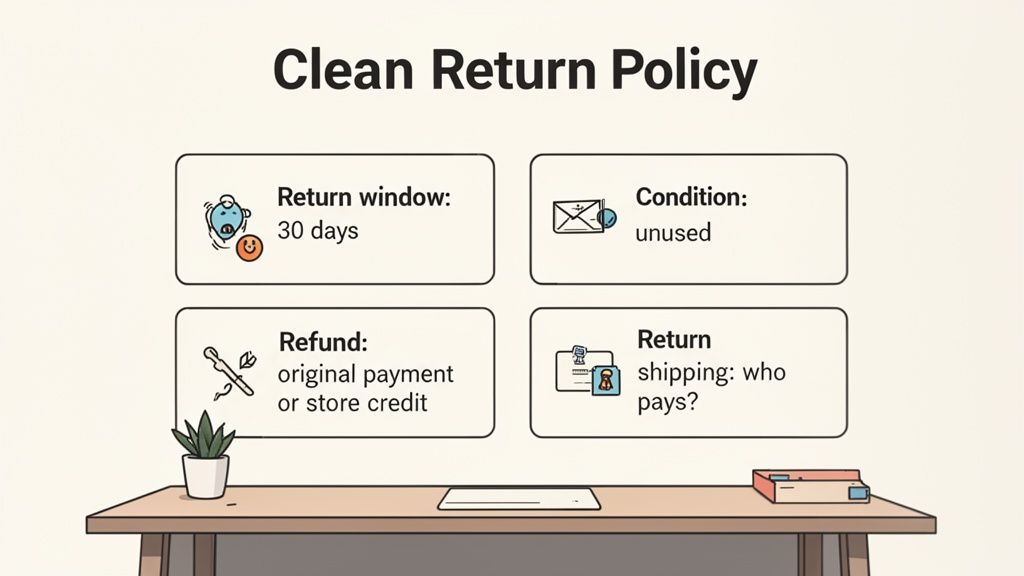
It’s time to move past the generic templates. A truly effective return policy does more than just cover you legally—it’s a communication tool that builds trust and gives customers the confidence to click "buy." The goal here is simple: write a policy that is dead simple to understand.
Every solid return policy for Shopify hinges on a few essential elements. Think of these as the "who, what, when, and how" that will shape your entire post-purchase experience. Getting these right is non-negotiable.
Define Your Return Window
The first thing a customer looks for is the return window. How long do they have to send something back? While 30 days is a common industry benchmark, it’s definitely not the only answer.
Your return window should be a strategic decision based on a few factors:
- Your Products: Selling clothes? A shorter, 14-day window can help curb "wardrobing," where people wear an item once and return it. For expensive electronics or furniture, a longer 60 or 90-day window can be a powerful selling point, especially around the holidays.
- Your Operations: Can your team and inventory system realistically handle returns coming back 90 days later? A longer window often means you need a bigger buffer in your stock.
- Your Competition: Take a look at what your direct competitors are doing. If they offer 30 days, maybe you can stand out by offering 45.
For instance, a high-end camera store might hold firm at 30 days because of how quickly technology depreciates. On the flip side, a mattress brand can build its entire marketing strategy around a 100-night trial, turning the return policy into its biggest advantage.
Specify the Condition of Returned Items
This is where you protect your business from damaged or used returns. You have to be crystal clear about the condition an item must be in to qualify for a refund or exchange. Don't use vague language like "good condition." It just invites trouble.
Get specific. I’m talking about language like this:
To be eligible for a return, your item must be unused, in the same condition that you received it, and in its original packaging. All original tags must be attached.
That leaves very little room for argument. It sets a clear expectation that the product needs to be in a resellable state. If you sell items like swimwear or cosmetics, you absolutely must add clauses about hygiene seals being intact. Spelling this out gives you a firm leg to stand on if you need to reject a return that doesn't meet the bar.
Clarify Refund Types and Shipping Responsibility
Next, you need to tell customers exactly what they'll get back and who's paying for the shipping. These two points have a huge impact on both your profit margins and the customer's perception of your brand.
For refunds, you have a few routes you can take:
- Refund to Original Payment Method: This is what most customers expect, but it means cash is walking out the door.
- Store Credit: A fantastic way to keep the revenue in your business. Many brands sweeten the deal by offering a little extra, like a 10% bonus on top of the credit amount.
- Exchanges: Perfect for when a customer just needs a different size or color. You save the sale and keep a happy customer.
Deciding who pays for return shipping is a big one. Free returns are a massive conversion booster, but those shipping costs can eat into your profits fast. A great middle-ground I’ve seen work well is offering a free return label only when the customer chooses an exchange or store credit. This frames the choice in a positive way while protecting your cash flow. For international orders, it's pretty standard to have the customer cover the higher shipping costs.
Handling Exceptions and Special Cases
No policy is complete without outlining the exceptions. These are the items and situations that don't follow your standard rules. Being upfront about these from the start saves a lot of headaches and angry customer emails down the line.
Here are the most common exceptions to spell out:
- Final Sale Items: Clearly label any products that are non-returnable. This usually applies to clearance goods, personalized items, or perishables.
- Damaged or Defective Goods: This needs its own separate, frictionless process. Reassure the customer that you'll make it right at no cost to them, which means you provide a prepaid label and a fast replacement or full refund.
- Exchanges: If you offer them, explain how they work. Can they swap for a different size? A completely different product? Be clear about how you'll handle any price differences.
As you put all these pieces together, using a tool like an AI Contract Generator can be helpful to make sure your language is not only clear to customers but also legally sound. This gives you a strong foundation to build on.
Setting Up Your Return Policy in Shopify Admin
Alright, you've hammered out the details of your return policy. Now it's time to make it an official, living part of your Shopify store. This isn't just a matter of copy-pasting; it’s about weaving your policy into the fabric of your site so it’s both legally sound and easy for customers to find.
Let's head into your Shopify admin. You’ll want to go to Settings (the gear icon in the bottom-left) and then click on the Legal section. This is Shopify’s dedicated home for all your store's foundational policies, and it's designed to automatically link them to key areas like your checkout.
Once you’re in the Legal area, you’ll see fields for your Refund policy, Privacy policy, and more. We're obviously focusing on the Refund policy field.
Using Shopify's Policy Generator
If you're staring at a blank page, don't panic. Shopify has a built-in policy generator that can give you a running start. Right there on the Legal page, you'll see a small link that says "Create from template."
Clicking this will populate the field with a standard return policy. But here's the catch: it's incredibly generic. It won’t mention your specific return window, list your non-returnable items, or reflect your brand's unique voice.
My Personal Insight: I always tell merchants to think of Shopify's template as rough scaffolding, not the finished building. Use it to get the basic legal language down, but immediately start editing. Infuse it with your brand's personality and the specific rules you just spent time creating. A generic policy doesn't build confidence—it creates confusion.
After you’ve pasted in your own policy or customized the template, hit that Save button. This officially creates the policy and gives it a dedicated page on your site. But your job isn't done yet.
Making Your Policy Visible and Accessible
A return policy that no one can find is a customer service headache waiting to happen. You need to place it where shoppers instinctively look: the footer of your website. It's an e-commerce standard, and having it there builds instant trust.
Here’s how to add it to your footer menu:
- From your admin, navigate to Online Store > Navigation.
- Select your Footer menu.
- Click Add menu item.
- In the "Link" box, start typing "Policies." You'll see an option to select your Refund Policy.
- Shopify will name the link "Refund Policy," but I'd suggest changing it to something more customer-friendly, like "Returns & Exchanges" or "Start a Return."
Placing this link makes your policy a core part of your store's navigation. As you're dialing in these settings, it's a good moment to think about your site as a whole. Reviewing the dos and don'ts of building your Shopify store can help ensure every piece of your setup, from policies to product pages, feels professional and cohesive.
Activating Shopify's Native Return Requests
Beyond just posting the text, Shopify offers a native feature that lets customers initiate returns right from their account page. This is a huge step up from messy email chains.
To turn this on, head to Settings > Customer accounts. You'll need to be using the new customer accounts for this feature to be available. In the Returns section of those settings, just flip the switch to enable self-serve returns.
Once activated, customers will see a "Request return" button next to their eligible orders. It’s a clean, simple system.
Now, this built-in tool is fairly basic—it won't automatically generate shipping labels or handle complex exchanges. That's where dedicated return apps really shine. But for a new store, enabling this feature is a no-brainer. It provides a structured workflow right from day one. For those ready to explore more powerful refund workflows, our guide on handling a refund on Shopify offers a much deeper dive.
How to Automate and Streamline Your Returns Workflow
If you're still managing returns through a maze of email threads and spreadsheets, you know the pain. It’s a huge drain on your team's time, creates a frustrating experience for your customers, and sooner or later, becomes a serious bottleneck for any growing store. At some point, you have to move away from manual processing. It's not a luxury; it's a necessity for scaling.
The solution is to give your customers a branded, self-service returns portal. This is a dedicated space on your site where they can start a return or exchange entirely on their own, whenever they want—24/7. The impact is immediate. You’ll see a massive drop in those "How do I make a return?" support tickets almost overnight.
The Power of a Self-Service Returns Portal
Think about it from the customer's perspective. It's 11 PM on a Friday, and they just realized they ordered the wrong size. Instead of firing off an email and waiting until Monday for a reply, they can go straight to your portal, pick the item they want to return, and select the correct size for an exchange. The system checks if they're within your policy window, generates a return label, and creates the new exchange order—all in about two minutes.
This is about more than just convenience. It’s a powerful tool for retaining revenue. When the exchange process is that easy, customers are far more likely to stick with your brand instead of just asking for their money back.
A self-service portal transforms your return policy for Shopify from a reactive, manual chore into a proactive, automated asset. It meets modern customer expectations for speed and autonomy while freeing up your team to focus on more complex issues.
The difference between a manual and automated workflow is night and day. It affects everything from your team's workload to your bottom line.
Manual vs Automated Returns Workflow
Let’s get specific. Seeing the two approaches side-by-side really highlights how much operational drag you can eliminate. What used to take hours of back-and-forth can now happen automatically in the background.
| Process Step | Manual Workflow (Email/Spreadsheets) | Automated Workflow (Using Apps) |
|---|---|---|
| Return Initiation | Customer emails support; support team finds order manually. | Customer initiates return via a branded, self-service portal. |
| Eligibility Check | Support agent manually checks policy rules and order date. | System automatically verifies eligibility based on preset rules. |
| Resolution | Back-and-forth emails to confirm refund vs. exchange. | Customer chooses refund, store credit, or exchange in the portal. |
| Label Generation | Agent manually creates and emails a shipping label. | System auto-generates a prepaid label and provides instructions. |
| Inventory Update | Team manually adjusts stock levels in Shopify. | App automatically updates inventory upon return processing. |
As you can see, automation doesn't just speed things up—it removes the potential for human error at nearly every stage of the process.
Preventing Returns Before They Happen
But what if you could stop some returns from ever happening? The best return is the one that’s avoided entirely. This is where the really smart returns apps shine. Tools like SelfServe can integrate into your post-purchase experience to let customers fix common mistakes themselves.
For example, a customer might enter the wrong apartment number during a rushed checkout. Instead of the package getting lost and sent back to you, they can log into a self-service widget on your Order Status page and correct the address before it even ships. You just set the time window.
The same idea works for order edits. A customer might realize they wanted a different color or forgot to add an accessory. By letting them modify their own order post-purchase, you prevent those "ordered by mistake" returns before you've even packed the box. You can even use this as a chance to show them relevant upsells.
Look for preventative features that empower your customers, such as:
- Self-Service Order Edits: Let customers fix their own shipping address or contact info, which drastically cuts down on failed deliveries.
- Post-Purchase Upsells: Allow customers to add items to a confirmed order, preventing them from placing a messy second order they might need to return.
- Real-Time Address Validation: Tools that use Google Maps API to autocomplete and verify addresses are a simple way to reduce undeliverable shipments.
Choosing the Right Returns Management App
The Shopify App Store has a ton of great tools for automating returns. While Shopify’s own native returns feature is a decent start, dedicated apps offer far more power and flexibility. When you’re evaluating your options, think bigger than just the return itself. For a deep dive, check out a comprehensive breakdown of the different returns management systems available.
A top-tier app won’t just give you a customer portal; it will also streamline your backend operations. Look for features like smart exchange suggestions, which can offer alternative products or even let a customer apply their credit to anything in your store—turning a potential refund into a brand new sale.
Beyond that, things like automatic label generation, direct integrations with your 3PL, and detailed analytics are what give you the control and insight to truly master your returns process at scale.
Proactive Communication to Prevent Unnecessary Returns
Having a solid return policy for Shopify is a great start, but it’s only half the story. If a customer only finds your policy when they’re already upset, you’ve missed a huge opportunity. The real goal is to get proactive—using clear communication to stop returns before they even become a thought.
This means putting your policy front and center to build trust before the sale. Don't just bury it in your website's footer. A simple link near the "Add to Cart" button or a quick note in the cart like, "Easy 30-day returns," can make a world of difference in a customer's confidence.
And don't stop there. Once the purchase is made, use your Thank You page and order confirmation emails to gently remind customers of your policy and set clear expectations. It's all about making your policy a visible, reassuring partner throughout their entire journey with you.
Improve Product Details to Reduce Mismatched Expectations
Honestly, the best way to cut down on returns is to make sure customers know exactly what they’re getting. The number one reason for returns? The product that showed up just wasn't what they pictured. This makes your product pages your first line of defense.
You need to go deeper than just a basic description. If you're selling a t-shirt, don't just write "cotton." Is it a "100% pre-shrunk heavyweight cotton" or a "lightweight cotton-poly blend"? Get specific with measurements, materials, weight, and clear care instructions.
Here are a few things you can do right away:
- Ultra-Specific Descriptions: Selling a backpack? List its exact dimensions, the size of the laptop sleeve, and its capacity in liters.
- High-Quality Visuals: Show the product from every angle with high-resolution photos. Even better, add a video of someone using it to give a true sense of scale and function.
- User-Generated Content: Feature photos from actual customers. This kind of social proof is invaluable because it shows your product in a real-world setting, not just a sterile photo studio.
Whenever a customer returns an item because "it wasn't what I expected," take it as a sign. It’s feedback telling you that your product page could be working harder. Every little detail you add is a potential return you just prevented.
Implement Clear Sizing and Fit Guides
For any store selling apparel or footwear, getting sizing wrong is a killer. It can account for over 40% of all returns. We’ve all been burned by a generic "S, M, L" chart that means nothing. You have to do better.
Create a detailed size guide that’s genuinely easy to understand. Include specific measurements for the garment itself, not just body measurements. A great trick is to add a reference point, like "Our model is 6'1" and is wearing a size Medium." You can even find apps that recommend a size based on a customer's height and weight, which cuts out the guesswork entirely.
Automating the returns process itself also simplifies things immensely for both you and your customer. This flow shows just how smooth it can be.
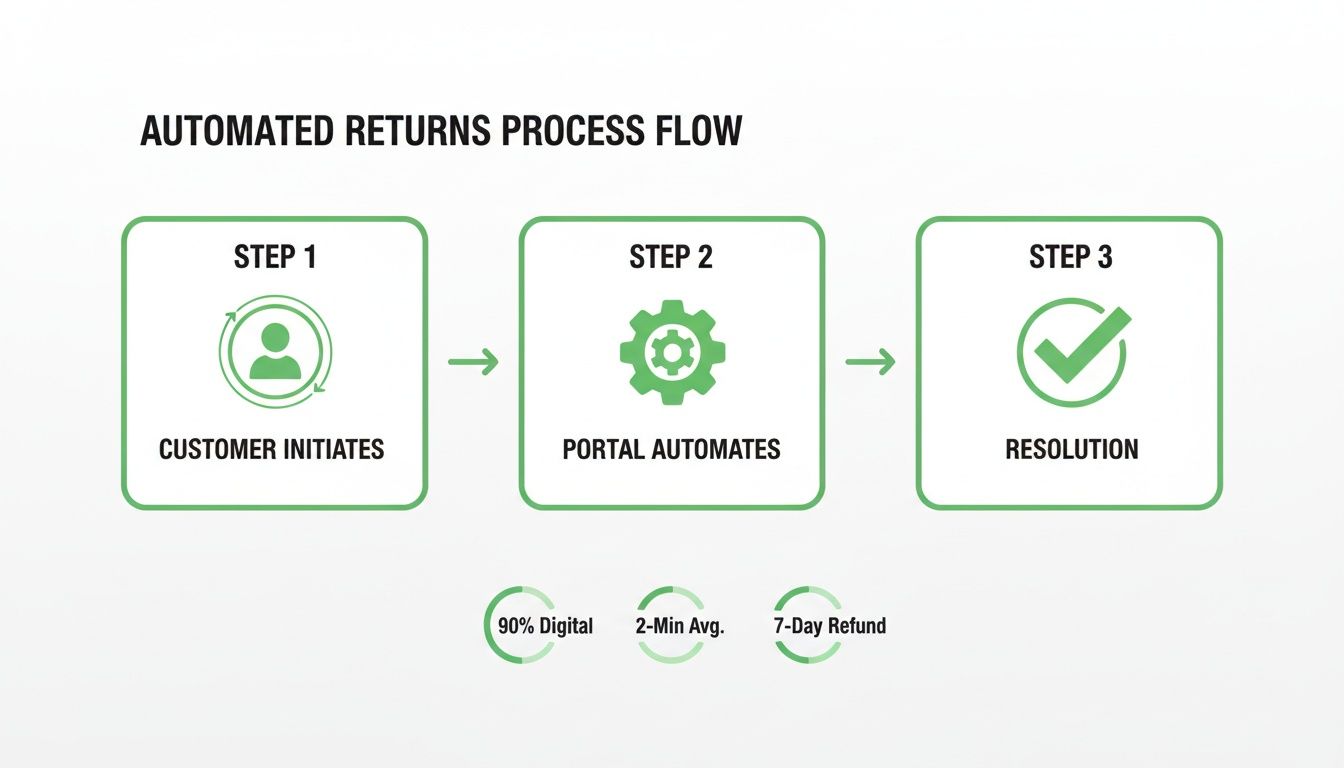
Moving away from a clunky, manual process of back-and-forth emails to an automated portal makes everything faster and less prone to error.
Enhance Your Post-Purchase Experience
The moments right after a customer clicks "buy" are absolutely critical. Your Thank You page and order confirmation emails are prime real estate. Use them to not only celebrate the order but also to give your customer more control.
This is the perfect time to offer self-service options. Did they accidentally type in the wrong address or pick the wrong color? By giving them a small window to edit their own order, you can prevent a simple typo from becoming a costly return. It’s also the ideal spot to remind them about tracking. You can dive deeper into this with our guide on how to track Shopify orders.
When you combine all these strategies, you create a system that doesn't just react to returns but actively works to reduce them. The result is less money wasted, less time spent on logistics, and a much happier, more loyal customer base.
Answering Your Top Return Policy Questions
No matter how airtight your return policy seems on paper, you're going to run into tricky situations. Customers will always find the gray areas. Knowing how to handle these common sticking points with confidence is what separates a smooth-running store from one bogged down in support tickets.
Let's walk through some of the most frequent questions I see Shopify merchants grapple with. Having a ready-made game plan for these scenarios will protect your business and show customers you’ve got their back.
What Is a Fair Return Window for a Shopify Store?
This is probably the number one question, and the truth is, there's no magic number. While 30 days has become the unofficial industry standard that shoppers expect, the "right" window is a strategic decision for your store.
Think about what you sell and who you sell to.
- Fashion and Apparel: A shorter 14-day window can be a smart move. It does a great job of discouraging "wardrobing"—when someone buys an outfit, wears it once, and sends it back.
- Holiday Shopping: This is the time to be generous. Extending your window to 60 or even 90 days for purchases made between November 1st and December 25th is a huge conversion booster. It gives gift-givers peace of mind and removes all purchasing risk.
- High-Value Goods: For expensive electronics or custom furniture, you might need a much stricter policy to protect the item's value. On the flip side, for low-cost, high-margin items, a super flexible policy can encourage that initial, risk-free purchase.
Ultimately, you're looking for a balance. You need to give customers enough time to make a thoughtful decision without creating an inventory headache for yourself.
Should I Offer Free Returns on My Shopify Store?
The words "free returns" are incredibly powerful. It's a proven way to get more people to click "buy." But those shipping costs can be a silent killer for your profit margins, especially if you're a small or growing business. A blanket "free for all" approach is rarely sustainable.
A much smarter strategy is to offer free returns conditionally. You can still use it as a marketing tool without giving away the farm.
Here's the best compromise I've found: offer a free return shipping label only when the customer chooses store credit or an exchange. This simple move keeps the cash in your business and rewards customers for giving your brand a second chance.
Here are a few other popular and effective strategies:
- Free Returns for Exchanges Only: This is a direct path to saving a sale. The customer gets a different size or color, and you don't lose the revenue.
- Customer Pays for Refund Shipping: It is perfectly acceptable and common to require the customer to cover the shipping cost if they want a cash refund to their original payment method.
- No Free International Returns: Don't even think about it. The high carrier fees and customs paperwork make this a non-starter. It's standard practice to have international customers pay for their own return shipping.
How Can I Stop Customers From Returning Used Items?
This one is infuriating and expensive. Your first line of defense is crystal-clear wording in your return policy on Shopify. You have to be explicit. Vague terms like "good condition" won't cut it.
Your policy must state that items must be in "new, unused, and unworn condition with all original tags and packaging intact." If you sell things like swimwear or cosmetics, you absolutely need to add a line that "all hygiene seals must be unbroken."
Words are great, but technology can be your best friend here:
- Photo Uploads: If you use a returns portal app, make it a required step for customers to upload a photo of the item they want to return. This creates a time-stamped record of its condition before it ever gets to a mailbox.
- Tamper-Evident Tags: For high-value apparel, look into special security tags. Once they're removed, they can't be reattached, making it obvious if an item has been worn out.
When a used item inevitably lands on your doorstep, you have to stand your ground and enforce your policy. That could mean issuing a partial refund by charging a restocking fee, or in clear cases of abuse, refusing the refund entirely. Consistency is the only thing that will deter this behavior over time.
What Is the Best Way to Handle International Returns?
International returns are a beast of their own—they're complex, they're expensive, and they're slow. Your policy needs a dedicated section that spells out the process for anyone ordering from outside your home country. Transparency about costs is non-negotiable.
The standard and most sensible approach is to require the international customer to pay for their own return shipping. Trying to generate prepaid labels across different carriers and countries is a logistical and financial nightmare.
Offering store credit as the main refund option is often the cleanest solution. It sidesteps currency conversion issues and fees for both you and the customer. Most importantly, try to prevent these returns from happening in the first place. You'd be surprised how many international returns are simply due to a small data entry error on a customs form.
Empower your customers and reduce your support workload with SelfServe. Let shoppers edit their own orders post-purchase, fix shipping errors in real-time, and even add upsells—all within a framework you control. Start your free trial at https://getselfserve.com.