Shipping from Philippines to USA: Your 2026 Guide
Your Shopify store is finally getting U.S. orders. That's the good news. The bad news is that international fulfillment exposes every weak spot in your operation at once.
A customer in California wants fast delivery. Another customer in New York enters the wrong ZIP code. Your warehouse team packs a lightweight product in a box that's too large and gets billed on volumetric weight. One order clears customs smoothly, another stalls because the item description was too vague. None of this is unusual. It's what happens when a domestic workflow gets stretched across the Pacific.
Shipping from the Philippines to the USA works well when you treat it as an operating system, not a one-time shipping task. Carrier choice matters, but so do customs data, package dimensions, address quality, and what happens after checkout if a buyer needs to fix something. The brands that handle this lane well usually aren't doing anything flashy. They're doing the basics with discipline.
Navigating Your First Shipment from the Philippines to the USA
The first U.S. order often creates the wrong instinct. Merchants rush to compare courier rates before they've defined the service promise they can keep.
A better starting point is to look at the lane itself. This is not an obscure route. DHL notes that the Philippines' major U.S.-bound export categories include electrical goods, machinery, articles of leather, optical items, and food preparations. It also cites US$6.40 billion in electrical machinery exports from the Philippines to the USA in 2024, along with US$1.56 billion in machinery and US$559.99 million in animal products, which shows how established this corridor already is in both industrial and consumer goods flows (DHL shipping guide for the Philippines to the U.S.).
That matters for a growing Shopify brand because you're not building on an untested route. You're entering a lane with mature carrier coverage, known gateways, and established customs processes. The challenge isn't whether shipping from the Philippines to the USA is possible. The challenge is whether your workflow is structured well enough to use that network without creating avoidable delays and support headaches.
What new merchants usually get wrong
The most common mistake is making each shipment manually. Someone checks the order. Someone else types product details into customs fields. The packing team grabs whatever box is nearby. Support handles address changes through email. That setup can limp through a handful of international orders, but it breaks as volume rises.
The stronger approach is to define four operating rules early:
- Match service to margin: Don't offer premium speed on products that can't support the shipping cost.
- Standardize shipment data: Product descriptions, declared values, and classifications should come from a controlled source, not free typing at the shipping station.
- Pack to a rule set: Box selection should follow product dimensions and protection requirements, not habit.
- Control exceptions after checkout: Address edits and order changes need a process, not inbox chaos.
Practical rule: Your first international workflow should be designed for your fiftieth order, not your fifth.
The mental model that actually helps
Think of this operation in three layers.
First, there's the physical move. That's the carrier, route, transit mode, and final delivery.
Second, there's the data layer. That's customs classification, item descriptions, values, and labels.
Third, there's the customer layer. That's tracking, address accuracy, and post-purchase changes.
If one layer is weak, the others won't save you. A fast courier can't fix a bad HTS code. Clean paperwork won't protect a fragile item packed in an oversized carton. And even a well-routed shipment can still become expensive if support has to manually correct customer mistakes every day.
Choosing the Right Carrier Speed and Cost
Most merchants start by asking which carrier is cheapest. The better question is which shipping method fits the promise on your product page and the margin on the order.
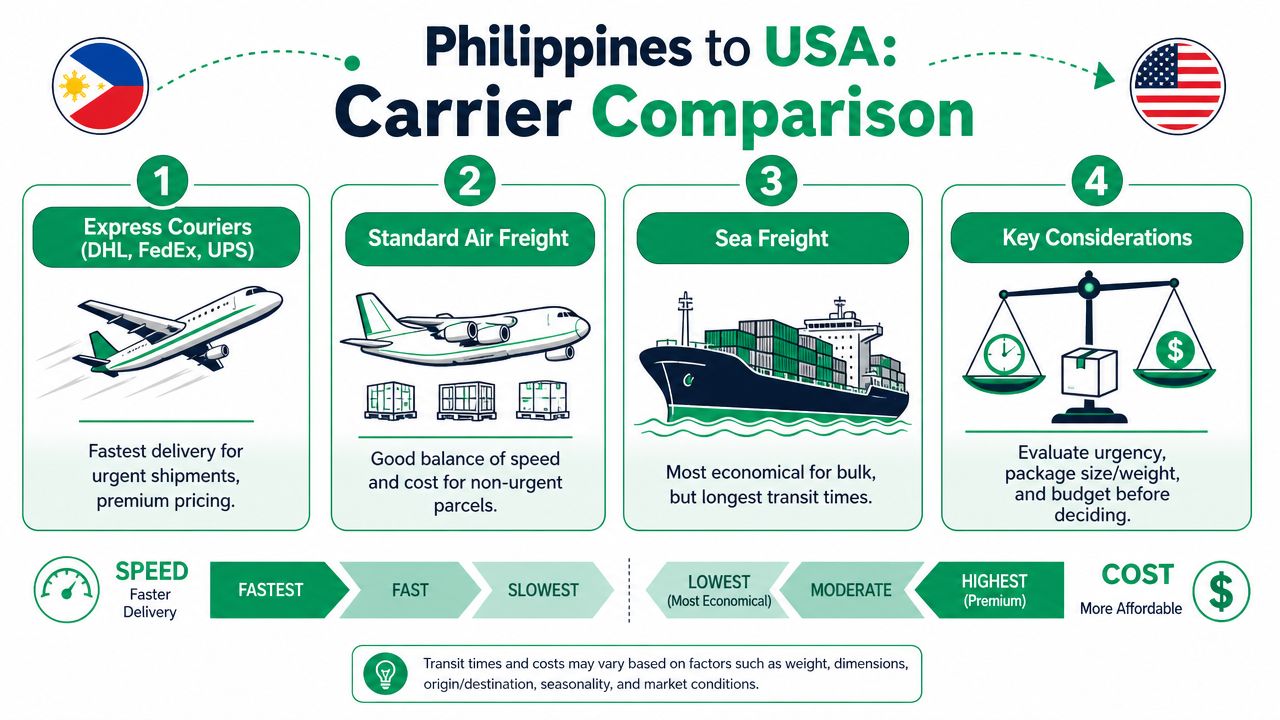
The trade-offs on this lane are wide. Ocean freight from the Philippines to the U.S. West Coast typically takes 21 to 35 days, while East Coast moves typically take 28 to 45 days. Air freight typically takes 2 to 5 days airport-to-airport and around 5 to 8 days door-to-door, while express courier service is commonly cited at US$25 to US$60+ per kg (GortoFreight lane guide).
How to think about the options
Express couriers such as DHL, FedEx, and UPS are usually the simplest option for smaller, urgent, or higher-value shipments. They bundle pickup, customs handling, and final delivery into one operational flow. That simplicity is valuable when your internal team is lean.
Standard air freight makes sense when you need speed but want more control over the shipment design, broker choice, or fulfillment structure. It usually fits merchants who are shipping in larger batches, replenishing U.S. inventory, or coordinating with a 3PL on the destination side.
Ocean freight belongs in a different discussion. It's not a parcel decision. It's an inventory planning decision. If you're shipping bulk stock, can forecast demand with confidence, and can absorb longer transit windows, sea freight usually gives you the best landed-cost profile.
Carrier comparison Philippines to USA
| Carrier Type | Typical Speed | Best For | Cost Profile |
|---|---|---|---|
| Express Couriers | Fastest door-to-door option | Urgent orders, samples, high-value parcels | Highest per-kg cost |
| Standard Air Freight | Faster than sea, slower than express in full door flow | Replenishment, non-urgent but time-sensitive cargo | Mid-range |
| Sea Freight | Longest transit window | Bulk inventory, lower urgency cargo | Most economical at scale |
One useful habit is to split orders into service bands instead of trying to force one carrier across every use case. A merchant selling accessories, electronics, and giftable items to U.S. buyers rarely benefits from a single-mode setup.
- Urgent replacement orders: Put these on express and protect the customer experience.
- Routine direct-to-consumer orders: Use the fastest service your margin can comfortably support.
- Inventory transfers to a U.S. warehouse: Evaluate standard air or sea based on stockout risk and reorder discipline.
If your finance team and customer support team would choose different shipping methods for the same order, your service policy isn't defined tightly enough.
A similar logic shows up in adjacent cross-border categories. If you've ever reviewed essential car importation costs, the pattern is familiar. The visible transport charge is only one part of the landed-cost equation. Timing, handling complexity, documentation, and exceptions can easily matter as much as the headline rate.
The gateway decision inside the Philippines
At this stage, many merchants leave money and time on the table. They compare air versus ocean, then stop. In practice, the origin gateway can shape the result almost as much as the transport mode.
Dimerco notes that direct U.S. West Coast air capacity from the Philippines is limited and that much of the freight is routed through third-country hubs such as Singapore, Taipei, Hong Kong, and Seoul. It also highlights the practical importance of choosing among Philippine origins such as Manila, Subic, Batangas, Cebu, and Clark based on final U.S. destination and network fit (Dimerco's Philippines-to-U.S. routing analysis).
That means your real decision is often:
- Which origin gateway should handle the shipment
- Which hub or transshipment path introduces the least risk
- Which U.S. coast best aligns with your final delivery footprint
For broader context on provider models, this overview of cross-border logistics companies is useful if you're deciding between integrators, freight forwarders, and more specialized international partners.
A short explainer can help your team align on the basics before you lock policy.
What tends to work in practice
Merchants usually get better results when they stop optimizing for the cheapest quote and start optimizing for predictable execution.
That often means:
- using express for customer-facing urgency,
- using air freight for controlled replenishment,
- using sea freight for planned inventory moves,
- and choosing origin gateways based on actual route behavior, not habit.
What doesn't work is promising U.S. shoppers one service level while operating with another behind the scenes. The gap between those two things is where refunds, complaints, and margin erosion begin.
How to Prepare Flawless Customs Paperwork
Customs problems rarely start at customs. They start when the shipment data is created.
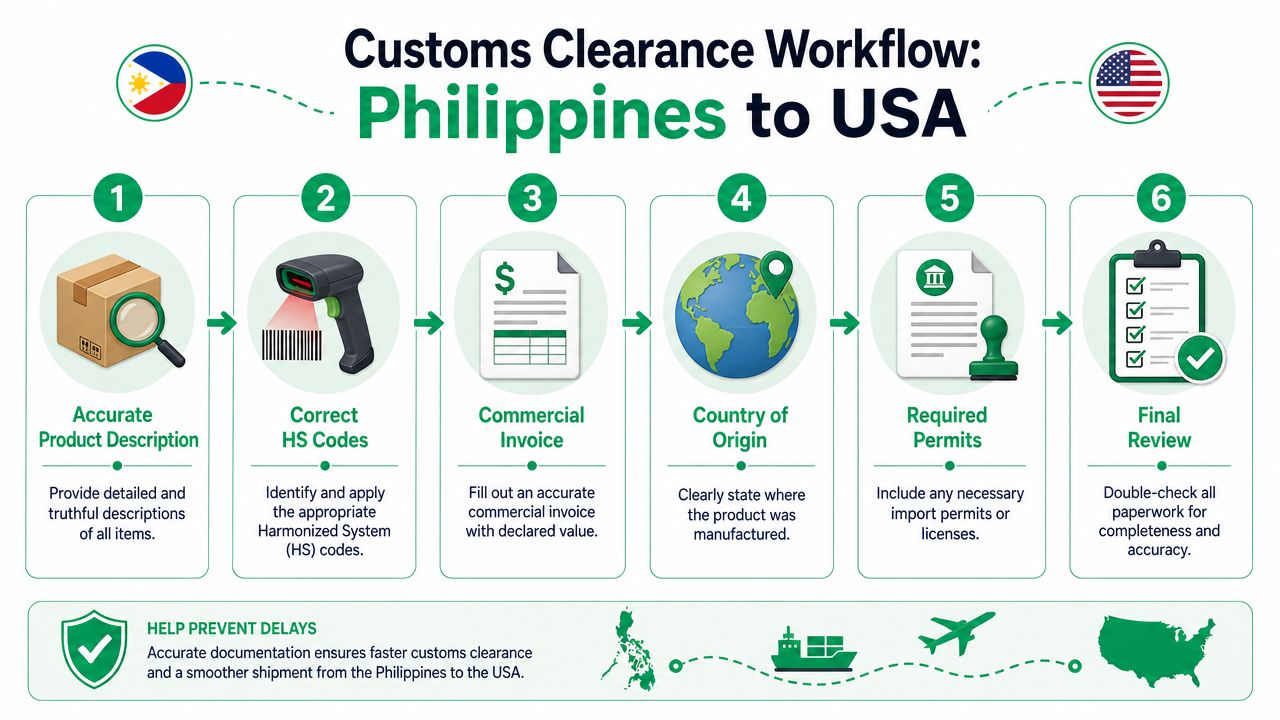
For shipping from the Philippines to the USA, UPS advises shippers to classify each item with the correct HTS code before preparing the commercial invoice, and warns that incorrect tariff classification can cause customs delays or fines. USPS also requires each item's weight and value on customs forms and states that international customs forms must be computer-generated (UPS international shipping guide).
That's the operational takeaway: customs accuracy is not a paperwork problem. It's a data-governance problem.
Build the commercial invoice from the SKU level
A good commercial invoice starts with product truth, not shipping convenience. Every line item should reflect what the product is, not how your team casually refers to it internally.
If your SKU says “Summer Drop 03,” that's useless for customs. If the actual item is a leather card holder, phone accessory, or optical frame, the invoice needs to say that clearly and specifically.
A practical invoice workflow usually includes:
Itemize each product line
Don't bundle unlike items into one vague description.Assign the HTS or HS code
Classification comes before label generation, not after.Verify declared value
Use a consistent internal rule for how values are recorded.Confirm country of origin
This needs to match the product record and supporting documentation.Generate the paperwork by computer
That reduces formatting inconsistency and manual legibility issues.
What the invoice should communicate
A commercial invoice should allow a customs officer or broker to answer basic questions quickly:
- What is the item?
- Why is it being shipped?
- Where was it made?
- How many units are included?
- What is the declared value?
- How was it packed?
The best invoices are boring. They're specific, consistent, and easy to audit against the parcel itself.
The shipment description that works in your storefront usually isn't the description that works in customs.
The workflow that reduces mistakes
The cleanest shipping teams usually separate product data creation from label creation. That's important because warehouse staff are often under speed pressure, and classification mistakes happen when pack-out becomes the moment where all information gaps must be solved.
Use a sequence like this:
| Step | What your team does | Why it matters |
|---|---|---|
| Product review | Confirm SKU, item description, and origin | Prevents vague or mismatched shipment data |
| Classification | Assign HTS or HS code | Reduces delay and penalty risk |
| Value check | Validate declared value and item quantity | Keeps forms aligned with order data |
| Documentation | Generate commercial invoice and customs forms | Creates a consistent audit trail |
| Release to shipping | Print labels and hand off to carrier | Keeps booking downstream of data verification |
If your team also ships lighter parcels through postal flows, this guide to United States Post Office international shipping is a useful reference point for how postal documentation expectations differ from courier workflows.
Common failure points
The errors that cause trouble are usually small:
- Overly broad descriptions: “Accessory,” “gift,” or “sample” invites scrutiny.
- Mismatched values: Store order value, declared value, and invoice lines should not conflict.
- Late classification: If the HTS code is chosen after packing, people guess.
- Manual form handling: Re-typing data creates avoidable mistakes.
One practical fix is to create a product master file that stores the customs-ready description, code, and origin for every SKU you sell into the U.S. market. Then your shipping software pulls from that file instead of asking staff to improvise.
That's how customs paperwork becomes reliable. Not by reminding people to “be careful,” but by removing decisions from the last minute.
Best Practices for Packaging and Labeling
Bad packaging creates two costs at once. You pay more to move the shipment, and you increase the chance that the customer receives it damaged.
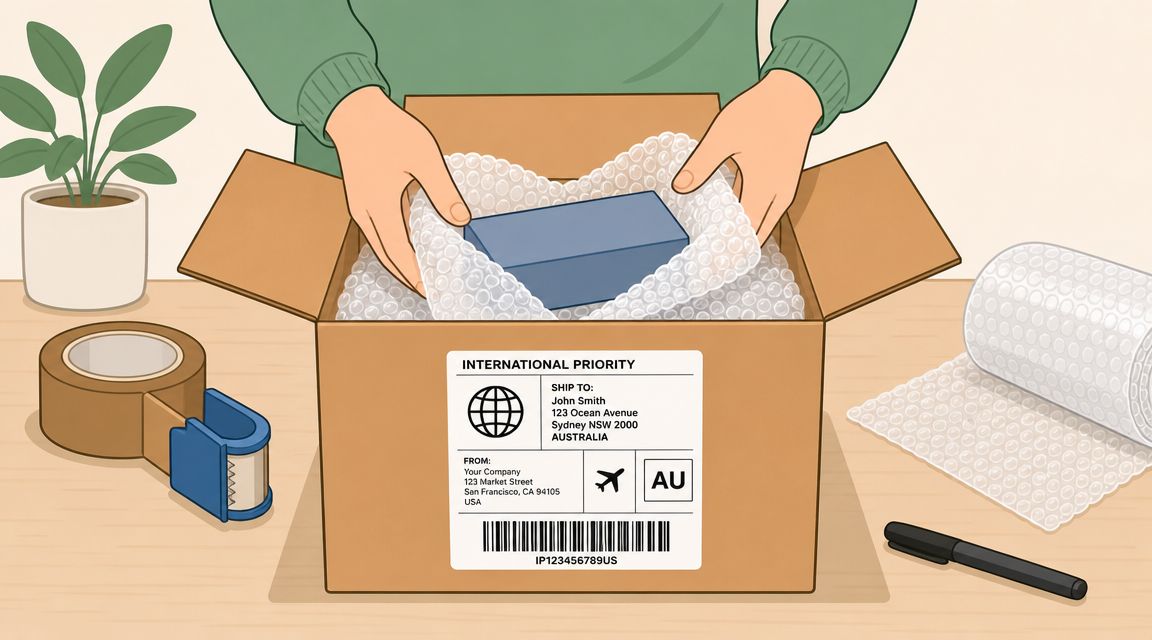
DHL explains that volumetric weight is calculated as length × width × height in centimeters divided by 5,000, and notes that it may re-weigh and re-measure shipments to confirm billing accuracy. It also warns that inaccurate dimensions or weight can lead to delays or extra fees (DHL international shipping packaging guide).
Packaging discipline saves money
For many Shopify brands, the packaging problem isn't protection. It's overprotection. A lightweight item goes into a box that's far larger than necessary, filler gets added, and the shipment is rated on volume instead of actual weight.
That doesn't mean pack tightly at all costs. It means build a packaging library around your product catalog.
- Standardize carton sizes: Give your team a controlled set of box options, not unlimited choice.
- Capture dimensions at pack-out: Measure the actual parcel before label creation.
- Compare rated versus actual outcomes: If certain SKUs repeatedly trigger remeasurement, redesign the packaging.
- Use product-specific protection: Electronics, glassware, and handcrafted goods need different internal support.
Warehouse note: If your packers choose boxes by eye, your carrier bill will eventually tell you.
Labeling that prevents avoidable exceptions
The label is part of operations, not just presentation. Poor placement, incomplete addressing, or mixed formatting can create manual handling problems.
DHL advises that shipments may be re-measured, and USPS advises writing the delivery address in English and ensuring the address and postage fit on the same side of the package, which helps reduce sorting exceptions as noted in the earlier DHL guidance.
A few practical habits help:
- Put the shipping label on the largest flat face of the carton.
- Keep customs documents and carrier labels clean, flat, and fully readable.
- Avoid placing seams, tape wrinkles, or corners through scannable areas.
- Make sure the address format is standardized before the label is printed.
If address quality is still inconsistent before fulfillment, an address validation tool for Shopify workflows can help catch formatting errors before the order hits the packing queue.
What works for long-haul movement
Transpacific shipping exposes weak packaging fast. The parcel gets sorted, stacked, transferred, and delivered through multiple handling points. A box that survives a short domestic route may fail on an international one.
What works is boring and repeatable: right-size carton, clear dimensions, secure void fill, durable outer labeling, and a pack station process that doesn't rely on memory.
Streamlining Post-Purchase Workflows for US Customers
A shipment can be perfectly packed and properly documented, then still turn into a customer problem after checkout.
That usually happens when the buyer notices a wrong apartment number, wants to update a contact detail, or realizes they used an old shipping address. If your only process is “email support and hope we catch it before fulfillment,” your U.S. expansion will create ticket volume faster than your team expects.
Why post-purchase operations matter more on international orders
Domestic orders leave less room for error, but international orders are less forgiving. The shipment travels farther, costs more to intercept, and takes more coordination to correct once it enters the carrier network.
That's why post-purchase operations should be treated as part of your shipping strategy, not a support afterthought.
When merchants clean this up, a few things usually improve at once:
- support agents spend less time on manual edits,
- warehouse teams get fewer last-minute exceptions,
- customers feel more confident ordering from abroad,
- and address errors get caught before they become delivery failures.
Give customers a controlled way to fix mistakes
The most practical setup is to allow limited, rules-based edits inside a defined post-purchase window. That keeps control with the merchant while removing unnecessary back-and-forth.
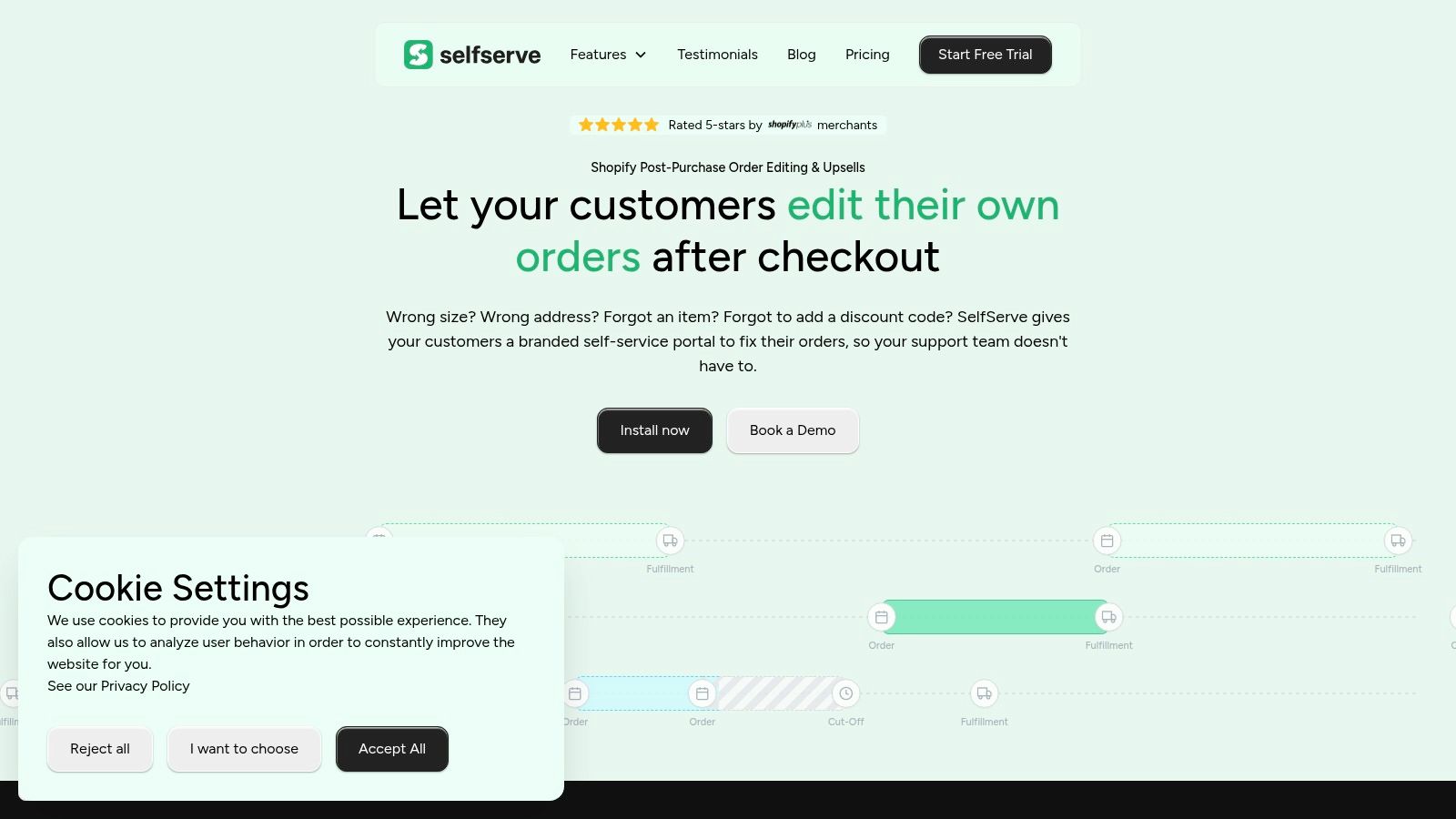
For Shopify teams, one option is SelfServe, which lets customers edit shipping and contact details within merchant-defined windows and uses Google Maps-powered address validation to improve address quality at the point of change. For this specific lane, that matters because small address errors are much more expensive to resolve after dispatch than before label generation.
You don't need to let buyers change everything. In fact, you shouldn't. The strongest setups are constrained.
The rules that usually work
A customer-friendly workflow is still an operations workflow. It needs clear permissions.
Consider controls like these:
- Allow address edits before fulfillment release: Once the shipment has been manifested or handed over, the edit window should close.
- Separate low-risk and high-risk changes: Contact detail corrections are different from destination changes.
- Route exceptions by rule: If an order includes restricted products or special handling, send changes for review instead of auto-accepting them.
- Show customers what's possible: A visible order-edit option reduces “Can you change this?” tickets.
Customers don't expect perfection. They expect a clear path to fix simple mistakes before those mistakes become expensive.
Build around fewer manual touches
Every manual touch increases the chance of delay. Support copies an address from chat into Shopify. Ops updates it in another system. The warehouse prints a label from stale order data. That chain breaks constantly.
The better model is one source of truth, limited edit permissions, and a clean cutoff before fulfillment. That's what keeps shipping from the Philippines to the USA customer-friendly at scale.
Key Takeaways for Successful US Shipping
Merchants usually struggle with this lane when they treat shipping, customs, packaging, and customer support as separate problems. They aren't separate. They're one system.
A strong operation starts with a carrier and routing policy that reflects your actual business model. If the order is urgent, use a fast service and price accordingly. If the shipment is inventory replenishment, optimize for control and landed cost. If it's bulk stock, plan around longer lead times instead of trying to force sea freight into a parcel promise.
The four pillars worth locking down
| Pillar | What good looks like |
|---|---|
| Carrier choice | Service levels match margin, urgency, and destination profile |
| Customs data | SKU-level descriptions, classification, and values are controlled before booking |
| Packaging and labeling | Cartons are standardized, dimensions are measured, labels are readable |
| Post-purchase workflow | Customers can fix simple issues early without creating support chaos |
The merchants who execute well on shipping from the Philippines to the USA usually have one thing in common. They remove improvisation from the process.
What to prioritize next
If you're tightening this operation now, focus on the steps that remove repeat errors:
- Audit your service promises: Make sure checkout expectations match your actual fulfillment model.
- Clean up your product master data: Customs quality depends on it.
- Reduce packaging variance: Fewer box choices usually means fewer billing surprises.
- Set post-purchase rules: Don't leave address changes to inbox luck.
Reliable international shipping isn't built by chasing the lowest rate. It's built by making fewer preventable mistakes.
That's the advantage. Not just moving parcels from the Philippines to the U.S., but doing it in a way that customers trust and your team can sustain.
If your team is spending too much time fixing address mistakes, handling order-change requests, or manually coordinating post-purchase exceptions, SelfServe is worth a look. It gives Shopify merchants a controlled way to let customers update shipping details within defined rules, helps validate addresses before fulfillment, and reduces the support burden that often comes with international orders.