Unlock Ecommerce and Supply Chain Growth
You launch a promotion, orders surge, and the dashboard looks great for about an hour. Then support gets buried. Customers want to fix apartment numbers, swap a size, ask why tracking hasn’t updated, or cancel an order that already dropped into the warehouse queue. Operations blames the carrier. Support blames the warehouse. The warehouse blames the order feed. The customer blames your brand.
That’s the ecommerce and supply chain problem for most growing merchants. It doesn’t start at procurement and it doesn’t end at the dock door. It shows up in the post-purchase window, where customer expectations hit the limits of your systems, partners, and process design.
The brands that handle this well don’t just move boxes efficiently. They connect storefront logic, order routing, fulfillment controls, carrier handoff, and customer self-service into one operating model. That’s where margins are protected, ticket volume drops, and customer confidence is earned.
The Hidden Costs of a Disconnected Supply Chain
A disconnected supply chain rarely announces itself with one dramatic failure. It usually shows up as a cluster of small problems that pile up fast. A shipping address missing a unit number. A warehouse that starts picking before fraud review is complete. A tracking page that lags behind the carrier scan. A customer who wants to add one item after checkout but has no path except emailing support.
Individually, these issues look manageable. In combination, they create expensive noise. Support handles avoidable contacts. Operations stops to make manual exceptions. Finance absorbs reshipments, returns, and service credits. The customer sees one thing only: your store promised a smooth experience and delivered confusion instead.
What the customer experiences is the supply chain
For high-volume Shopify brands, the biggest operational mistake is treating logistics as a back-office function. Customers don’t separate your ad spend, checkout flow, warehouse process, and shipping updates into different departments. They experience one continuous journey.
That’s why post-purchase friction matters so much. The order confirmation page creates confidence. Silence after that creates doubt. If the customer can’t correct an address or understand delivery status, they don’t think your 3PL failed. They think you failed.
Practical rule: Every order event that matters to your ops team should also have a customer-facing answer. If it doesn’t, support becomes the translation layer.
The market context makes this harder, not easier. In 2025, U.S. e-commerce logistics were valued at $150.86 billion, and total logistics costs represent 12-20% of sales revenue and are projected to rise, according to 2025 U.S. ecommerce logistics data. That means operational waste doesn’t stay hidden for long. It shows up in margin.
Growth amplifies weak links
When ecommerce grows faster than your systems mature, each successful campaign can make fulfillment less profitable. More orders create more exceptions, and more exceptions create more labor. That’s why the cleanest operators build for the messy middle of the order lifecycle, not just for checkout conversion.
A lot of merchants learn this after expanding channels. A team that already manages Shopify, wholesale, and marketplaces often finds that the same SKU can move through very different inventory and fulfillment rules. If you want a useful reference point for how channel complexity changes replenishment and stock planning, Amazon inventory management is worth reviewing because it shows how quickly inventory control becomes a visibility problem, not just a counting problem.
Here’s what usually breaks first when systems aren’t connected:
- Address quality: Bad address data reaches the warehouse or carrier before anyone catches it.
- Order change handling: Support has to mediate edits through email, spreadsheets, or Slack.
- Status communication: Tracking exists, but customers still ask where the order is.
- Returns prevention: Small mistakes upstream create larger reverse-logistics costs later.
The hidden cost isn’t only postage or reships. It’s the operating drag created when your front-end promise and back-end execution don’t speak to each other.
Mapping Your Ecommerce Supply Chain Journey
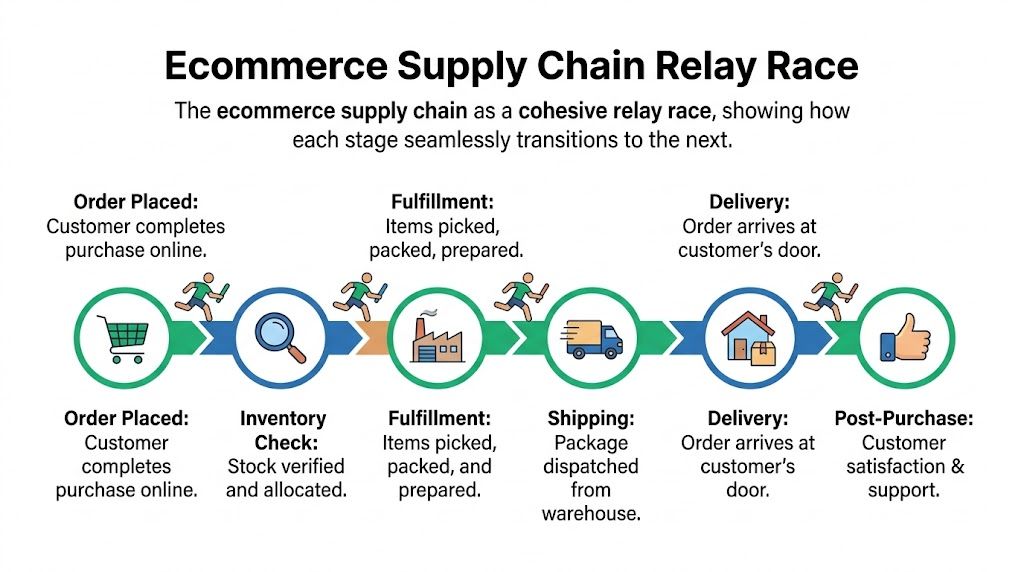
The simplest way to understand ecommerce and supply chain operations is to treat the order like a relay baton. Every stage passes it to the next. If one handoff is sloppy, the runner behind has to slow down, compensate, or stop entirely.
The first handoff starts before fulfillment
The baton enters the race when a customer clicks buy. That sounds obvious, but a surprising number of downstream problems start right there. The storefront collects shipping data, payment is authorized, fraud checks may run, and the order is admitted into your system. If those early controls are weak, the rest of the chain inherits bad inputs.
A clean first handoff includes:
- Order capture: Shopify records the order and customer details.
- Payment and review: Payment gateway logic and fraud rules decide whether the order can proceed.
- Inventory allocation: The system reserves stock and assigns a fulfillment location if you have more than one.
- Routing logic: The order is sent to the correct warehouse, 3PL, or internal team.
This is also where order orchestration matters. If your store can’t reliably decide where an order should go, everything later becomes manual cleanup. Merchants evaluating outsourced fulfillment models should understand how that decision layer interacts with partner capabilities. A practical place to start is this guide to 3rd-party fulfillment companies.
The warehouse leg is where promises become physical
Once the order reaches the warehouse, the baton moves from software into labor and physical execution. Picking, packing, label generation, and manifesting all happen here. This stage often gets framed as a speed problem, but it’s really an accuracy problem first.
A fast warehouse that ships the wrong item creates more work than a slower warehouse that ships correctly. The same goes for packaging. If the box size, label, customs documentation, or packing slip is wrong, the order may still leave the building, but the error hasn’t disappeared. It’s just moved downstream.
The warehouse shouldn’t be the place where missing information gets guessed. It should be the place where clean information gets executed.
Carrier movement and last mile are separate jobs
Many merchants lump shipping into one category. Operationally, that’s too broad. There’s a handoff to the carrier network, a movement through line haul and sortation, and then a last-mile delivery event. Different failures happen in each leg.
Line haul issues often look like delayed scans, trailer congestion, or routing inefficiency. Last-mile issues usually show up as address exceptions, missed delivery attempts, access problems, or unclear ETA communication. Customers don’t care which leg failed, but your team should.
A useful operating map looks like this:
| Stage | What happens | Common failure point |
|---|---|---|
| Checkout and capture | Order details enter Shopify | Incomplete or incorrect customer data |
| Review and allocation | Payment, fraud, and routing decisions | Wrong location assignment |
| Fulfillment | Pick, pack, label, manifest | Item or label errors |
| Carrier handoff | Package enters parcel network | Scan delays or missed pickup |
| Last mile | Final delivery attempt | Address or access issues |
| Post-purchase and returns | Tracking, changes, support, reverse flow | Too much manual intervention |
Reverse logistics is part of the same race
Returns aren’t a separate universe. They’re the return leg of the same journey. If your forward flow is sloppy, your reverse flow gets heavier. Wrong item, late shipment, damaged packaging, or an unfixable address issue can all end as returns or replacements.
That’s why experienced operators look at the order path end to end. The click matters. The pick matters. The handoff matters. But the post-purchase experience is where the customer decides whether your supply chain feels reliable.
Common Hurdles for High-Volume Shopify Merchants
High-volume stores don’t usually fail because they don’t know the basics. They fail because small weaknesses become expensive at scale. What worked when the team shipped a manageable daily volume stops working once promotions, subscriptions, channel expansion, and international orders add variability.
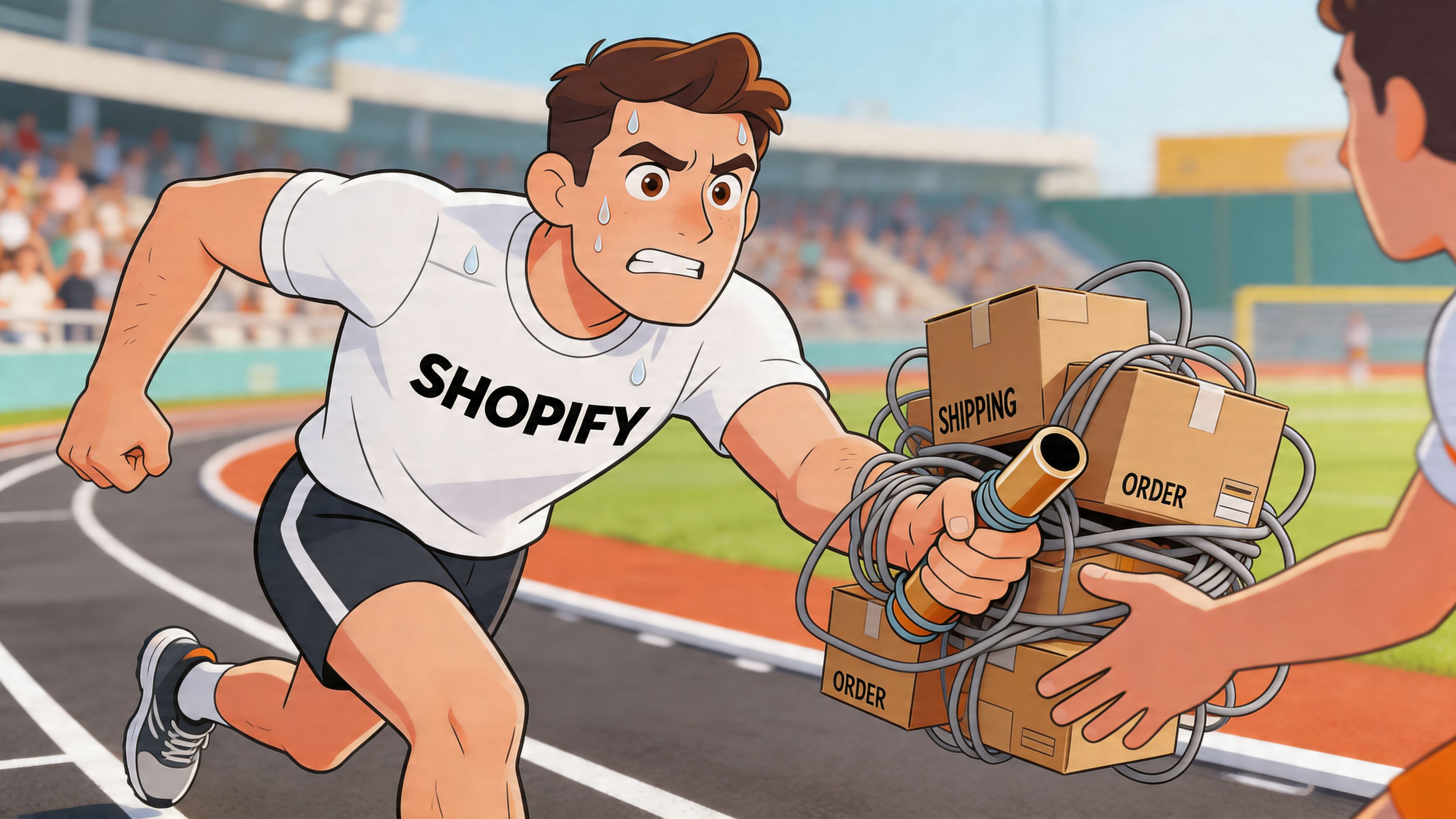
Inventory issues don’t stay in inventory
When stock data is late, duplicated, or fragmented across systems, the damage spreads quickly. Merchants see oversells during launches, false stockouts on fast movers, or stranded inventory in the wrong node. The customer notices only one outcome. The item they wanted isn’t available or the order gets delayed after purchase.
This gets harder in a resilience-focused environment. A 2025 supply chain resilience analysis notes that a 2023 Boston Consulting Group report found over 90% of North American manufacturing companies relocated parts of their supply chains in the last five years, with more planning to do so. That matters for ecommerce brands because suppliers, production locations, and routing assumptions are all less stable than they used to be.
If your replenishment and order routing logic depend on static assumptions, volatility shows up as customer-facing failure.
Fulfillment bottlenecks usually hide in handoffs
Warehouse teams can look productive on paper while still creating churn. Orders get printed in batches that no longer reflect priority. Special handling instructions live in one system but not another. Customer support approves a change after the order is already in a pick wave. No one is technically doing the wrong thing. The workflow is wrong.
The common warehouse bottlenecks for Shopify merchants tend to be:
- Wave timing problems: Orders release too early, before change windows or review steps are done.
- Exception blindness: Staff can’t easily see which orders need holds, approvals, or edits.
- Label dependency: Shipping labels generate before address quality is confirmed.
- Partner lag: The 3PL receives updates later than the storefront and support team.
Merchants that want a practical grounding in warehouse-side execution can use this walkthrough on how to fulfill orders on Shopify to pressure-test where handoffs are likely to fail.
Shipping failures hit trust first and margin second
Last-mile problems carry a special kind of frustration because the order already feels owned by the customer. At that point, a bad address, a carrier delay, or a failed attempt creates emotional friction fast.
Some teams react by adding more support labor. That helps for a while, but it doesn’t solve the root issue. If a customer has to contact you for a preventable correction, the process is already broken. The better fix is earlier intervention. Validate addresses before fulfillment. Hold orders briefly where edits are common. Make status updates clear enough that customers don’t need an agent to interpret them.
A support ticket about a shipment is often an operations signal in disguise.
Post-purchase chaos is where brands feel slow
This is the hurdle most upstream supply chain guides skip. After checkout, customers still need things. They mistype addresses, want to add products, need to change contact details, or realize the gift should go elsewhere. If your only answer is “email us quickly,” you’ve created a race between the customer and your fulfillment queue.
That’s why high-volume merchants feel buried even when warehouse throughput looks decent. The store keeps selling, but the post-purchase layer has no structured way to absorb change. Support becomes an emergency valve, and emergency valves don’t scale cleanly.
The KPIs That Measure Your Supply Chain Health
Good operators don’t rely on vibes. They use a small set of metrics that expose whether the system is healthy, where friction is building, and which fixes matter most. In ecommerce and supply chain management, the best KPIs are the ones that connect warehouse execution to customer outcomes.
Start with perfect order quality
The most useful high-level metric for many brands is Perfect Order Percentage, or POP. It combines the core ingredients of execution into one score: (% on-time × % complete × % damage-free × % correct docs). According to DCL’s ecommerce supply chain formulas, elite ecommerce operations benchmark at 96%+ POP, and achieving that level directly correlates to 25% lower return rates.
That matters because POP forces teams to stop celebrating partial success. Shipping on time doesn’t count as a win if the order is incomplete. Accurate picking doesn’t count as a win if the documentation is wrong. The customer experiences the whole order, not your favorite metric.
If a KPI can improve while customers still feel friction, it’s a diagnostic metric, not a top-line operating metric.
Use a balanced scorecard, not one hero number
POP is powerful, but you still need supporting metrics that tell you where breakdowns begin. Here’s a practical KPI set for ecommerce operators.
| KPI | What It Measures | Industry Benchmark |
|---|---|---|
| Perfect Order Percentage | Orders delivered on time, complete, damage-free, with correct documentation | 96%+ for elite ecommerce operations |
| On-Time Shipping Rate | Share of orders shipped within promised internal SLA | >98% |
| Delivery Accuracy | Orders delivered on the promised date | >95% |
| Receive Accuracy | Match between received and stowed inventory | >98% |
| Line Item Fill Rate | Completeness of fulfilled order lines | >95% |
| Days Inventory Outstanding | How long finished goods sit relative to annual COGS | <60 days |
| Inventory Turnover | How efficiently inventory converts into cost of goods sold | >8x/year |
A few notes on how to use them:
- On-Time Shipping Rate tells you whether your own operation released orders when expected.
- Delivery Accuracy tells you whether the promise survived carrier movement and last mile.
- Receive Accuracy catches upstream inventory errors before they become oversells or short picks.
- Line Item Fill Rate is especially useful for bundles, subscriptions, and multi-line orders.
- Days Inventory Outstanding and Inventory Turnover reveal whether stock is healthy or just expensive.
Track customer-facing friction beside warehouse metrics
Not every important measure needs to be a formula. Some of the most revealing operational signals are customer-facing and qualitative at first glance. WISMO volume, order edit requests, manual holds, and address exceptions tell you where the process lacks self-service or automation.
If those categories keep rising, don’t treat them as support-only issues. They’re usually telling you that a system handoff is too rigid, too early, or too opaque.
The Modern Tech Stack for Seamless Operations
Most scaling problems in ecommerce and supply chain work aren’t caused by a lack of software. They’re caused by software that isn’t assigned a clear job. Teams buy overlapping tools, let data sync loosely, and then wonder why customers can’t make simple changes without human intervention.
Each system needs one clear responsibility
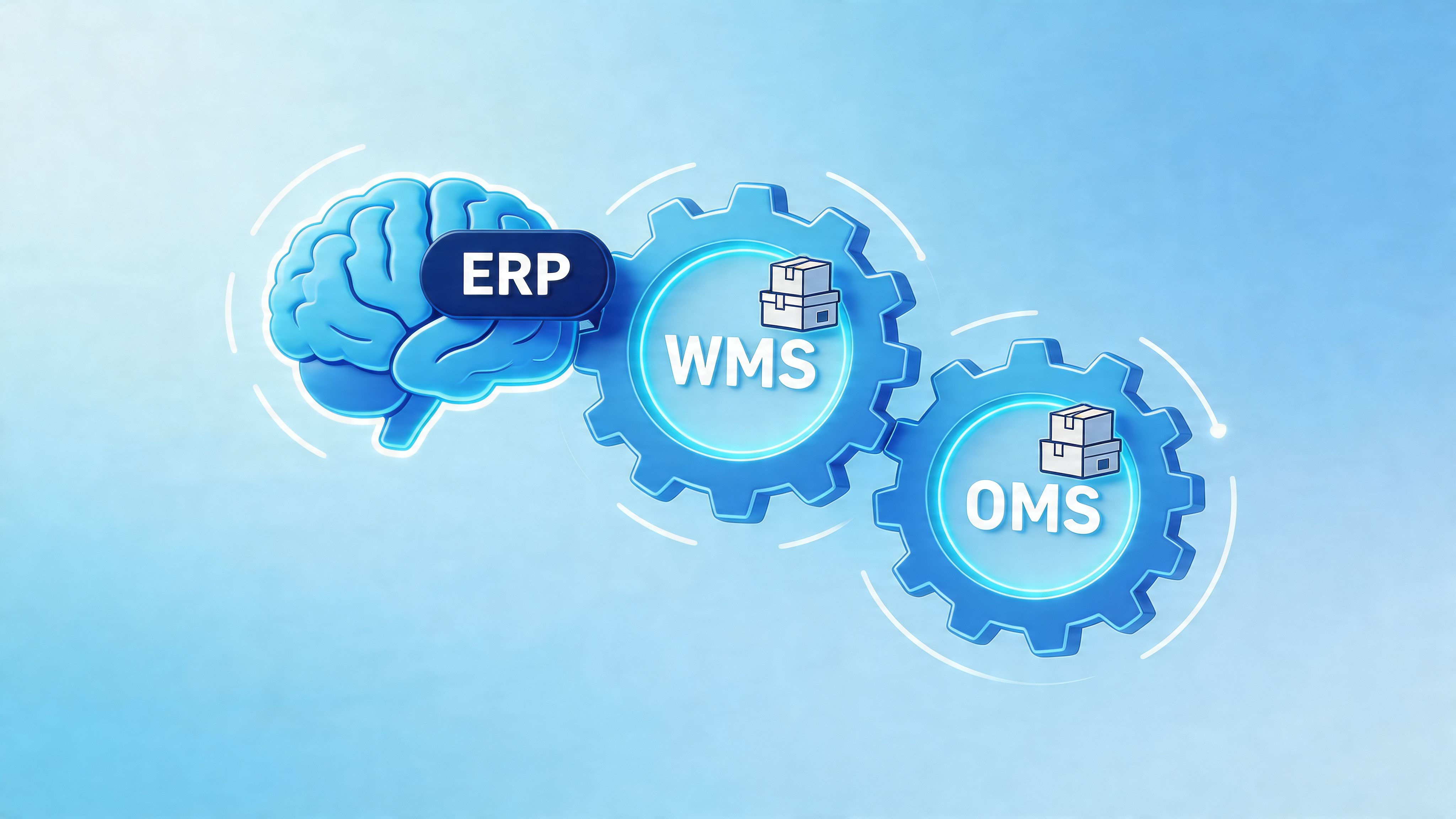
A healthy stack usually has three core operational systems.
ERP is the financial and planning brain. It tracks purchasing, cost structure, accounting controls, and often inventory valuation.
OMS is the order brain. It decides what should happen to an order, including routing, holds, splits, and status logic.
WMS is the warehouse execution brain. It manages receiving, bin logic, picking, packing, labor flow, and physical inventory control.
Problems start when merchants expect one of these systems to do all three jobs. That’s especially common in fast-growing Shopify environments where the storefront is simple to launch but downstream orchestration gets complex quickly. If you’re evaluating warehouse software choices, this comparison of best WMS systems is a useful way to frame what belongs in the warehouse layer versus the order layer.
The missing layer is usually post-purchase control
Here’s the gap many teams feel but can’t name. Even when ERP, OMS, and WMS are in place, the customer still has very little controlled access to the order after checkout. That creates a dead zone between storefront experience and back-end execution.
That dead zone matters. An analysis of ecommerce merchant operations found a major content gap around post-purchase order editing, and notes that allowing customers to self-serve address corrections or add upsells before fulfillment can reduce returns by up to 20-30% and cut support tickets by 40%, according to ShipBob’s analysis of ecommerce supply chain challenges.
The key phrase is before fulfillment. Once a warehouse wave starts or a label is created, optionality collapses. The best tech stacks preserve a controlled editing window and connect that window directly to order state.
APIs are the operating glue
A modern stack works when a customer action creates a valid system response all the way through the chain. If a shopper corrects an address, the OMS should know whether the order is editable. The warehouse or 3PL should pause or update the order if it hasn’t shipped. The tracking and support views should reflect the change. That requires APIs, event logic, and clean permissions.
Without that, merchants fall back to brittle workarounds:
- Email triage: Support manually forwards requests to ops.
- Spreadsheet exception queues: Teams track urgent changes outside the system of record.
- Late-stage edits: Staff try to patch labels or cancel picks after fulfillment has started.
- Data mismatch: The storefront says one thing while the 3PL portal says another.
The right architecture doesn’t eliminate exceptions. It decides where exceptions should live and who should handle them.
There’s also a bigger strategic shift underway. As order orchestration becomes more automated, merchants need to think beyond fixed workflows and toward systems that can respond dynamically to context, inventory, and customer intent. For operators tracking that direction, Zinc’s perspective on Agentic Commerce is useful because it frames how autonomous decision layers may shape purchasing and post-purchase flows.
The practical takeaway is simpler than the buzzword. Your stack should let the customer do what’s safe, let operations control what’s risky, and let systems keep both sides in sync.
Actionable Playbooks to Optimize Your Post-Purchase Flow
Many organizations know their weak spots. They don’t need another reminder that support is overloaded or that delivery issues hurt retention. What they need is an operating plan that changes behavior quickly without creating fresh complexity.
Playbook one, reduce support by moving simple fixes to self-service
The most impactful post-purchase win is usually not faster agent replies. It’s removing the need for the ticket in the first place. Most inbound order contacts fall into a few predictable categories: address edits, contact detail fixes, cancellation requests, and basic status questions.
Build around those first.
A practical version looks like this:
- Define an edit window: Give customers a clear time period when certain fields can still be changed.
- Set permission rules: Allow low-risk edits like address line fixes and phone number updates. Restrict higher-risk changes based on order state.
- Pause fulfillment only when necessary: Don’t stop all orders. Stop only the ones with validated changes that affect routing or delivery.
- Make status pages useful: If tracking, fulfillment state, and exceptions are visible, customers ask fewer clarifying questions.
This works because it respects both sides of the operation. Customers get control where it’s safe. Ops retains control where inventory, fraud, or physical workflow creates risk.
Playbook two, turn the order status experience into revenue
Most merchants treat the Thank You page and order status page as service screens. That’s too narrow. These pages are high-attention surfaces. The customer has already committed to the order, is still engaged, and is often open to small, relevant additions if the flow is simple.
The key is restraint. Post-purchase upsells only work when they feel like a continuation of the order, not a second checkout ambush.
Use this decision framework:
| Situation | Better offer | Avoid |
|---|---|---|
| Consumable product | Refill, accessory, or complementary item | Large unrelated catalog dump |
| Giftable order | Add-on wrap, card, or small companion item | Time-sensitive item likely to delay fulfillment |
| Routine replenishment | Low-friction bundle expansion | Complex cross-category recommendation |
| International shipment | Products that don’t complicate customs or restrictions | Items with separate compliance needs |
Keep the merchandising logic tight. Curated products beat broad collections. Operationally simple add-ons beat anything likely to trigger manual review.
A post-purchase upsell should fit inside the existing fulfillment logic. If it creates a warehouse exception every time, it isn’t profitable.
Playbook three, improve delivery reliability before the label prints
Teams often try to solve delivery failures after the package is already moving. That’s late. The most effective reliability work happens before a label is generated.
Focus on three controls.
- Address validation: Catch formatting and deliverability issues before the order enters fulfillment.
- Carrier logic: Match service level and destination to the right carrier rules, not just the cheapest visible rate.
- Exception-aware order release: Hold orders with risky address patterns, missing details, or edge-case delivery conditions for quick review.
This doesn’t need to become bureaucratic. The goal isn’t to slow all orders down. It’s to create a light layer of intelligence around the small subset most likely to fail.
The strongest post-purchase flows share one trait. They assume customers will need something after checkout and design for that reality upfront. That’s far cheaper than improvising after the warehouse and carrier have already committed to the wrong path.
Transforming Your Supply Chain into a Competitive Edge
The strongest ecommerce brands don’t win on marketing alone. They win because the experience after checkout feels dependable. The customer gets clear status, accurate delivery, and a path to fix simple issues without begging support for help. That isn’t a nice extra. It’s operations doing its job visibly.
That’s why ecommerce and supply chain strategy has to include the post-purchase window, not just sourcing, inventory, and shipping contracts. A brand can have solid procurement, a capable 3PL, and decent carrier rates, then still disappoint customers because edits are hard, tracking is vague, and exceptions are handled manually.
The practical shift is straightforward. Treat the order journey as one system. Measure execution with customer-relevant KPIs. Assign each system in the stack a clear role. Build controlled self-service where customers predictably need it. Protect the warehouse from chaotic exceptions by handling changes before fulfillment locks.
When teams do this well, logistics stops behaving like a hidden cost center. It becomes part of retention, margin protection, and brand trust. Support gets fewer repetitive tickets. Operations spends less time firefighting. Customers feel like the company is in control.
That’s the key advantage. Not just faster shipping, but a supply chain that makes the business feel easier to buy from.
If your team is trying to reduce order-change tickets, prevent avoidable delivery errors, and create a cleaner post-purchase experience on Shopify, SelfServe is built for that exact operational gap. It gives customers controlled self-service for order edits, supports multilingual experiences, and helps merchants add upsells after checkout without turning support into the middleman.