Selecting Cargo and Logistics Companies for Shopify in 2026
Your Shopify store can outgrow its fulfillment setup before the revenue dashboard makes that obvious. The first signs usually show up outside operations. Support is answering shipping-delay emails all day. Customers want address changes after checkout and your team handles them manually. Inventory looks fine in one system and wrong in another. Meanwhile, every new campaign adds pressure to a warehouse process that was built for a smaller business.
That's when choosing among cargo and logistics companies stops being a purchasing task and becomes an operating model decision. If you get it right, fulfillment becomes quieter, faster, and easier to scale. If you get it wrong, you'll feel it in margin, repeat purchase rate, support load, and team morale.
Why Your Logistics Partner Is Your Most Critical Hire
A growing brand usually hits the same wall in stages. First, packing slips pile up. Then same-day shipping becomes “we'll try.” After that, the customer experience starts to split. Marketing promises a premium brand. Fulfillment delivers something far less controlled.
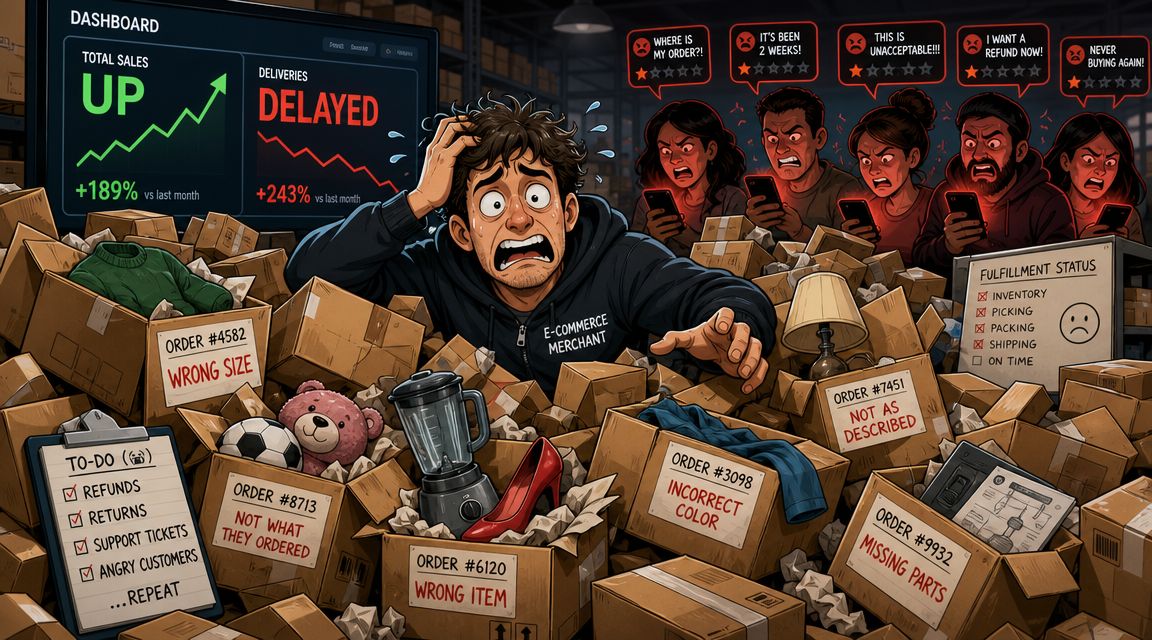
I've seen merchants treat this moment as a search for cheaper shipping or extra warehouse space. That's too narrow. Your logistics partner controls how orders leave your business, how quickly exceptions surface, how returns flow back in, and how much manual cleanup your team absorbs every day.
Fulfillment is the physical version of your brand
Customers rarely know which warehouse packed the order. They only know whether the package arrived on time, whether the address issue got fixed, whether the tracking made sense, and whether support had answers. That means your 3PL or freight partner is carrying part of your brand promise.
A weak partner creates familiar symptoms:
- Late exception handling: Orders get stuck, but nobody flags them until the customer asks.
- Messy inventory visibility: Shopify says one thing, the warehouse says another.
- Inflexible workflows: Small changes, such as redirects or order holds, turn into email chains.
- Support spillover: Operations problems become CX problems within hours.
The market is large, and so is the variation in quality
This isn't a niche decision. The logistics industry itself is vast. One estimate values the global logistics market at $11.23 trillion in 2025, up from $8.96 trillion in 2023, with a projection of $15.79 trillion by 2028, implying a projected 6.3% CAGR from 2023 to 2028 according to ClickPost's logistics market overview. That scale matters because it means you're not choosing from a small pool of interchangeable providers. You're choosing from a broad market with very different operating models, systems, and service standards.
Practical rule: Hire your logistics partner the way you'd hire a head of operations. Look past the pitch deck and test how they think, report, escalate, and recover.
Cost matters, but operating fit matters more
The cheapest quote often becomes the most expensive relationship. A low base pick-pack rate doesn't help if receiving is slow, inventory reconciliation takes days, or your support team has to manually process address fixes and “where is my order?” tickets.
What works is a partner that can absorb growth without forcing your team to babysit every shipment. That means clear warehouse processes, reliable integrations, usable reporting, and a service team that treats exceptions as operating events, not inbox items.
For a Shopify merchant, logistics isn't a back-office function anymore. It's part warehouse, part systems integration, part post-purchase experience. That's why this decision deserves the same care you'd give a key hire.
Defining Your Shipping Needs and Finding Potential Partners
Before you shortlist anyone, get your own house in order. Most bad 3PL searches fail because the merchant can't describe the business in operational terms. If you can't explain what you ship, where it goes, how it peaks, and where today's friction sits, every provider conversation stays vague.
The self-audit below is the starting point.
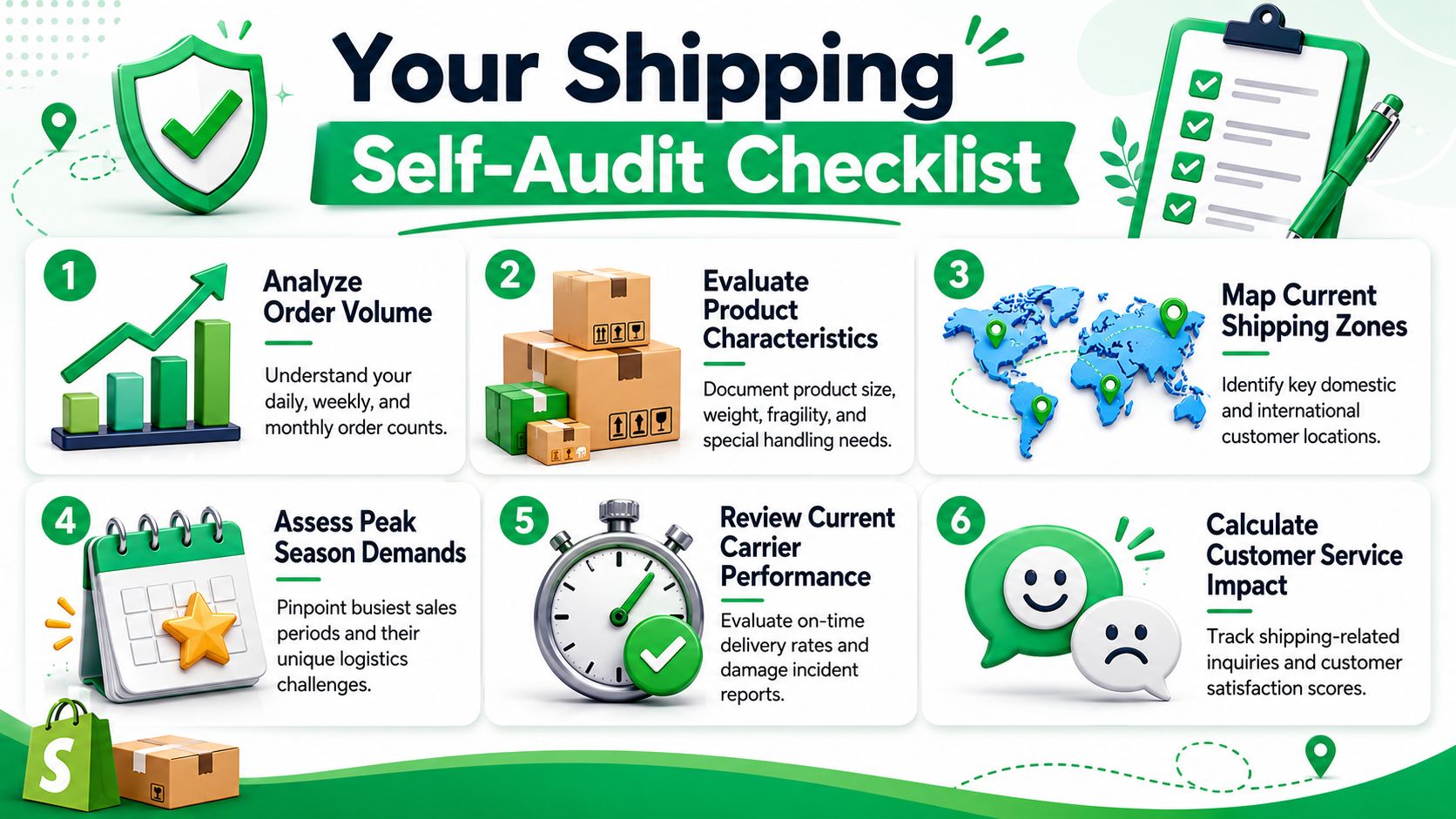
Build your operational profile first
Pull your last several months of order and fulfillment data and organize it into a simple working brief. It doesn't need to be fancy. It does need to be accurate.
Start with these categories:
Order pattern
Include average daily volume, weekly rhythm, and what peak periods look like. Don't smooth out the spikes. A partner needs to know your hard weeks, not just your average week.SKU behavior
Separate fast movers from slow movers. Flag bundles, kits, fragile items, oversized items, and anything with handling rules.Package reality
Document actual weights and dimensions, not what the product page says. Cartonization issues and carrier costs often show up here.Destination mix
Identify your core shipping zones. Domestic only is a different search from domestic plus cross-border. Urban-heavy and rural-heavy networks also behave differently.Service exceptions
Write down what creates work today. Address edits, partial shipments, preorder holds, lot tracking, gift messaging, branded inserts, and special packaging all matter.
A provider can only design around the problems you define. If your pain points stay fuzzy, their proposal will stay generic.
Later in the process, that profile helps you compare proposals on something more useful than sales language. It also helps you spot providers that are trying to fit your business into their warehouse rules instead of adapting workflows where needed.
Here's a useful walkthrough to review before outreach:
Define your visibility requirements early
A lot of merchants ask whether a provider has tracking. That's the wrong question. Tracking by itself doesn't solve much if the data arrives late, lives in separate systems, or doesn't support exception handling.
One logistics analysis found that nearly 45% of companies have little to no visibility beyond their immediate suppliers, according to Anaplan's review of logistics visibility challenges. For a Shopify brand, that gap shows up when support can't tell whether a delay is sitting with a carrier, in a warehouse queue, or upstream in replenishment.
Ask yourself:
- What must my team see in real time? Inventory by location, order status by stage, tracking milestones, carrier exceptions.
- Who needs the data? Operations, CX, finance, and planning often need different views.
- What action should each alert trigger? A visibility feed without an escalation path is just noise.
If your operation depends on fleet coordination, route execution, or field-level movement data, reviewing tools like Wistec fleet management can help you understand what mature transport visibility should look like before you evaluate a partner's stack.
Build a shortlist that's actually usable
Don't start with fifty names. Start with eight to twelve that fit your profile, then narrow to three to five.
Good places to source candidates include:
- Peer referrals: Ask brands with similar order profiles, not just similar revenue.
- Shopify ecosystem research: Read platform-specific breakdowns such as this guide to 3rd-party fulfillment companies.
- Trade groups and niche operators: Especially if your products need compliance, fragile handling, or specialized storage.
- Carrier and warehouse network overlap: Some partners look strong until you map where they operate and who they rely on.
A manageable shortlist beats a broad one. You want enough options to compare approaches, but not so many that every conversation becomes surface-level.
How to Evaluate Logistics Companies with a Smart RFP
A strong RFP does one thing well. It forces cargo and logistics companies to answer the same operational questions in the same format so you can compare them cleanly. Without that structure, you'll get polished sales calls, incomplete pricing, and a lot of “it depends.”
Ask for workflows, not promises
The best RFPs don't ask whether a provider can support your brand. They ask how the work will happen.
Your questions should cover:
Receiving
What is the intake process for inbound stock? How are discrepancies documented? When does inventory become available for sale?Order processing
How do orders flow from Shopify into the warehouse system? What happens when an order contains a hold, bundle, gift note, or edit request?Inventory controls
How do cycle counts work? How are variances reported and resolved? What fields are available in standard reporting?Exception handling
Who owns stuck shipments, damaged inventory, address issues, carrier disputes, and return anomalies?Customer-impact changes
Can the partner pause fulfillment on selected orders, support redirects, or accommodate post-purchase edits before pick begins?
Vet the data layer carefully
Many merchants frequently overlook a crucial risk. A provider can operate a decent warehouse and still create reporting chaos if their systems don't hold a clean source of truth.
Industry guidance on logistics data management recommends a workflow that starts with standardized data collection, then integrates TMS and EDI into a central repository, and only then moves into audits, validation, and KPI tracking, as explained in Sheer Logistics' logistics data management guidance. That sequence matters because analytics are only useful when shipment, rate, and performance records are consistent.
Ask direct questions such as:
- Which system is the system of record for order status?
- How often is inventory synchronized with Shopify?
- How do you validate inbound and outbound data?
- What audit process catches mismatched statuses or duplicate shipment events?
- Can you expose warehouse and carrier events in a usable format for our team?
If a provider can't explain how data is validated, don't assume the dashboard is trustworthy just because it looks polished.
Use a scoring matrix, not gut feel
Once proposals come in, score them. Don't rely on whichever team had the best demo.
| Criterion | Weight (Importance 1-5) | Partner A Score (1-5) | Partner B Score (1-5) | Notes / Red Flags |
|---|---|---|---|---|
| Shopify integration quality | 5 | |||
| Receiving workflow | 4 | |||
| Order cutoff and shipping process | 5 | |||
| Inventory accuracy controls | 5 | |||
| Exception management | 5 | |||
| Reporting and visibility | 5 | |||
| Returns handling | 4 | |||
| Pricing clarity | 4 | |||
| Support model | 4 | |||
| Contract flexibility | 3 |
A matrix won't make the decision for you. It will surface trade-offs. One partner may have a better warehouse process but weaker data visibility. Another may price well but require more internal cleanup.
Include scenario testing in the RFP process
I like to give finalists a few operating scenarios and ask them to respond in writing. For example:
- A customer changes the shipping address after ordering.
- A fast-moving SKU oversells during a campaign.
- An inbound shipment arrives short.
- A high-value package misses a carrier scan after pickup.
Their response tells you far more than a generic capability list. You'll see how they escalate, who owns the issue, and whether they think in terms of customer impact or warehouse convenience.
For a broader checklist of service categories and system considerations, this overview of e-commerce logistics services is a useful companion while you build the RFP.
Negotiating Your Contract and SLAs Like a Pro
The commercial proposal is where many merchants relax too early. Don't. A provider can look reasonable on the headline rate and still bury margin in accessorials, vague service definitions, and one-sided liability language.
Price the entire operating model
You're not buying a pick fee. You're buying a chain of activities.
Ask for every charge that can appear across the life of an order and the life of your inventory:
- Receiving-related fees: inbound appointments, pallet handling, carton receiving, discrepancy processing
- Storage charges: standard storage, long-term storage, oversize location surcharges
- Order-related costs: pick-pack, inserts, kitting, split shipments, order holds, relabeling
- Exception fees: returns inspection, disposal, address correction handling, manual intervention
- Packaging and dunnage: branded packaging, void fill, special packing requirements
When the provider says “that's uncommon,” ask when it applies and how often clients typically trigger it. You don't need averages from them. You need definitions tight enough that your finance team can model risk.
Turn service promises into enforceable SLAs
A lot of contracts use language that sounds reassuring and means very little in practice. Phrases like “commercially reasonable efforts” and “industry-standard service” won't help when holiday orders slip or receiving stalls.
Push for SLAs that define:
- The event that starts the clock
- The required action
- The reporting method
- The remedy if performance fails
Examples of useful SLA language include same-day processing cutoffs, receiving turnaround expectations, inventory discrepancy resolution workflows, and response-time commitments for urgent exceptions. The exact numbers should come from your commercial negotiation and your business model. The important part is precision.
A vague SLA protects the provider. A measurable SLA protects the relationship.
Use technology as negotiation leverage
Technology claims belong in the contract conversation, not just the demo. Benchmark examples in logistics show that AI-powered platforms can cut empty trips by 10% to 15%, and an LLM-based address rewriting system reported about a 43% reduction in parcel re-routing, as summarized in this logistics AI and big data analysis. Those figures shouldn't be treated as automatic outcomes for your brand, but they do provide an advantage.
Use them to ask sharper questions:
- If your routing tools improve asset utilization, where does that show up in my pricing or service reliability?
- If your address-quality workflow is strong, how do you handle customer-entered address errors before dispatch?
- What part of your stack prevents waste, and what part only reports it after the fact?
Good partners can answer in operational terms. Weak ones retreat into generic “AI-powered” language.
Protect the downside too
If the relationship doesn't work, your contract needs a controlled exit path. Review termination rights, transition assistance, insurance requirements, claims windows, and data access after termination. Also check whether you can retrieve historical order, inventory, and performance data in a usable format.
The best negotiation mindset is simple. Assume the partnership could work very well, and assume one day you may need to unwind it cleanly. A strong contract supports both outcomes.
Integrating Your Tech Stack for a Flawless Post-Purchase Experience
Once you've selected a partner, the hard work moves into systems and workflow design. In this phase, a promising 3PL relationship either becomes smooth and scalable, or turns into a daily stream of edge cases.
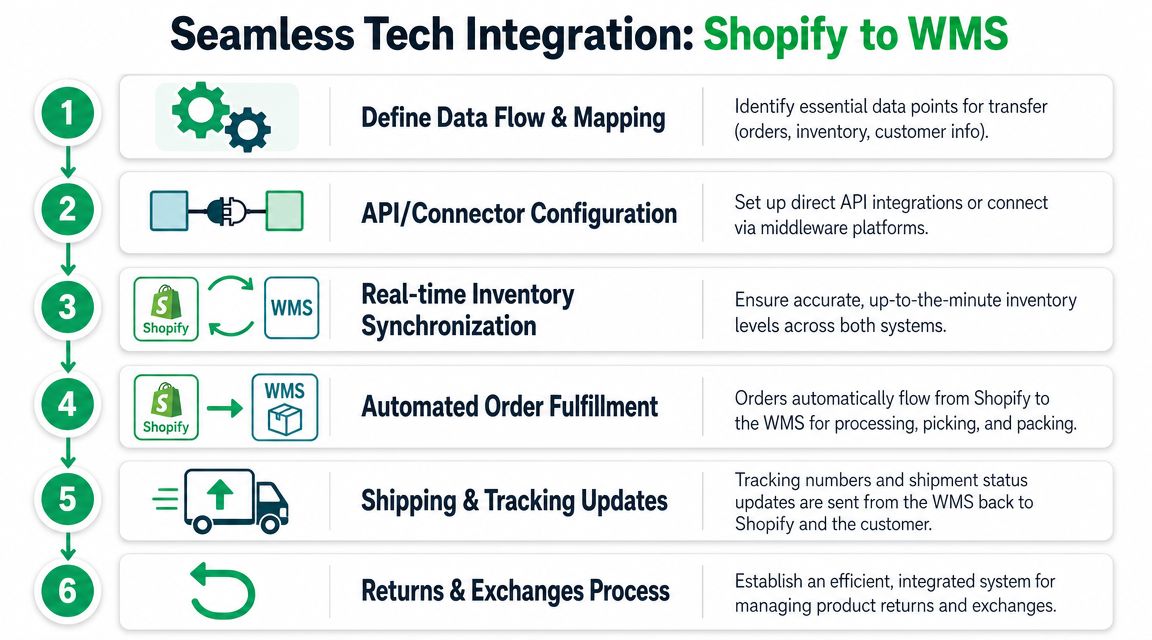
Map the full order lifecycle
Most integration projects focus too narrowly on one event: sending orders from Shopify to the warehouse. That's necessary, but it's not enough.
You need a clear map for:
- Order creation and release
- Inventory sync by SKU and location
- Holds, edits, and cancellation states
- Pick, pack, and ship milestones
- Tracking updates back to Shopify
- Returns and exchange triggers
If any of those handoffs is unclear, your team ends up managing exceptions by spreadsheet, Slack message, and support ticket.
Build around customer-change windows
Post-purchase experience becomes operationally important. Customers want to fix mistakes after checkout. They enter the wrong apartment number, use an old phone number, or realize they need delivery on a different day if the carrier supports it. If your systems can't absorb those changes before the order locks into fulfillment, support gets dragged into work that should be automated.
That's why your partner's stack needs to support flexible workflows. A recent logistics review notes that companies are increasingly using AI route planning, parcel lockers, and real-time rescheduling to prevent failed deliveries, highlighting how customer-driven flexibility is becoming part of modern delivery operations in Impressit's logistics challenges analysis.
For Shopify brands, the practical question is simple. Can your systems identify the window where an order is still editable, and can they apply approved changes without breaking the warehouse flow?
The post-purchase experience starts in ops, not in the helpdesk. If the fulfillment state is wrong or delayed, the customer-facing experience will be wrong too.
Connect warehouse data to self-service tools
A merchant can meaningfully reduce manual work. If order status, pick state, and address validation are flowing correctly, customers can resolve some issues themselves before they become failed deliveries or support escalations.
For example, third-party logistics software considerations become much more useful when paired with a customer-facing order management layer. One option is SelfServe, a Shopify app that lets customers edit eligible order details after purchase while merchants control what can change and when. In practice, that kind of setup only works when the logistics partner can expose clean order-state signals and respect edit cutoffs.
Don't ignore the physical environment around delivery
Not every fulfillment issue is purely digital. For some merchants, especially those serving gated communities, managed access sites, or properties with controlled entry, the handoff environment affects successful delivery just as much as the route plan. Reviewing tools like discover Nimbio for gates can help operations teams think more concretely about access control and handoff design where delivery friction happens at the property boundary.
Test edge cases before go-live
A clean launch plan includes ordinary flows and annoying ones.
Test these before switching volume:
- Address changes before pick
- Order cancellation after payment but before release
- Inventory oversell on a fast-moving SKU
- Split fulfillment across locations
- Tracking delay from carrier handoff
- Return created before final delivery scan posts
You're looking for timing issues, not just broken connections. Many integrations “work” in the happy path and fail when statuses overlap or update out of sequence.
A good integration is invisible to the customer. A bad one is visible in every “Where is my order?” ticket your team has to answer.
Beyond Launch Day for Long-Term Growth
The contract signature isn't the finish line. The first weeks after launch usually determine whether the provider becomes a real extension of your team or just another vendor you have to manage around.
Set a tight operating cadence early
During onboarding, run a short meeting rhythm and keep it focused. Review inbound receipts, open exceptions, inventory mismatches, carrier issues, and any customer-impacting failures. If something is recurring, assign an owner and a fix date.
A simple early checklist helps:
- Confirm data migration quality: Product master data, order states, and inventory fields should match across systems.
- Validate live inventory syncs: Don't rely on screenshots. Check real transactions and real SKU changes.
- Train internal teams: Support and operations need to know what the partner handles, what your team handles, and how to escalate.
- Review first-wave exceptions daily: The first operational misses often reveal process gaps faster than any implementation plan.
Manage the relationship like an operating function
After launch, move into a regular review cadence. Weekly operational check-ins are useful early. After the relationship stabilizes, formal business reviews can focus on SLA performance, recurring root causes, and network changes.
The best providers bring ideas, not just reports. They'll flag packaging issues, receiving bottlenecks, or carrier handoff patterns before those problems spread. That's especially valuable in periods of disruption, when merchants are trying to protect service continuity. If you're thinking about warehouse access, facility resilience, and continuity planning more broadly, this guide on products for supply chain stability is a useful operational reference.
What matters most is consistency. Hold the partner accountable to the standards you negotiated, but also give them clean forecasts, timely decisions, and one source of internal truth on your side. Strong logistics partnerships are mutual disciplines.
Frequently Asked Questions About Logistics Partnerships
Should a Shopify brand choose one provider for everything
Not always. A single partner can simplify accountability, system integration, and reporting. But if your business has very different needs across freight, warehousing, and last-mile delivery, a blended model can make sense. The cost is complexity. More handoffs usually mean more exception management, so only split providers when the operational gain is clear.
What's the biggest mistake merchants make when selecting cargo and logistics companies
They compare rate cards before they define workflows. Price matters, but bad-fit operations create hidden costs fast. If you haven't documented your SKU profile, service exceptions, edit windows, returns flow, and reporting needs, every quote will look more comparable than it really is.
How long should implementation take
It depends on system complexity, inventory condition, and how many custom workflows need to be supported. A straightforward setup with clean SKU data and standard Shopify flows moves much faster than a migration with kitting, multiple warehouses, lot tracking, and custom order logic. The practical rule is to launch only after live scenario testing passes, not when the calendar says you should.
What should customer support know before a new logistics partner goes live
Support should know the order-status vocabulary, the editable windows, the escalation path, and which exceptions can be resolved without warehouse intervention. They should also know what customers will see in Shopify notifications and tracking pages. A lot of avoidable ticket volume comes from support teams being trained too late or too lightly on the operational state model.
When should a merchant replace an existing logistics partner
Replace them when the pattern is stable and the root issue isn't improving. Occasional misses happen in every operation. Warning signs are repeated visibility gaps, unresolved inventory discrepancies, weak ownership of exceptions, and a support burden that keeps shifting back onto your internal team. If you're spending more time policing the relationship than improving the business, the partnership is probably no longer serving you.
If you're trying to reduce shipping-related support work while giving customers controlled post-purchase flexibility, SelfServe is built for that layer between checkout and fulfillment. It lets Shopify merchants offer customer-managed order changes within defined rules, including address edits and other approved updates, so operations teams can prevent avoidable issues before they turn into tickets or failed deliveries.