Proven Strategies to Increase Average Order Value on Shopify
Getting your Shopify store's Average Order Value (AOV) to climb isn't about guesswork; it's about strategically encouraging the customers you already have to add a little more to their carts. Think smart product bundles, tempting free shipping thresholds, and well-timed upsells. This approach is hands-down more cost-effective than pouring money into acquiring new customers, directly feeding your bottom line and fueling real growth.
Why Increasing Average Order Value Is a Game Changer
Chasing more traffic is the old way of thinking about e-commerce growth. It's expensive, and frankly, it's a grind. With customer acquisition costs (CAC) always seeming to be on the rise, the smartest move you can make is to get more value from the people already visiting your store. This is where AOV becomes your most powerful lever for building a sustainable business.
A higher AOV means healthier profit margins, plain and simple. Every order has fixed costs attached to it—payment processing fees, the box it ships in, the time it takes to pack. When a customer's cart bumps up from $50 to $75, those fixed costs shrink as a percentage of the revenue. That extra money goes straight to your profit.
Calculating Your Baseline AOV
Before you start making changes, you need to know where you stand. Figuring out your AOV is easy:
Total Revenue ÷ Number of Orders = Average Order Value
So, if you pulled in $50,000 from 1,000 orders last month, your AOV is $50. This number is your starting point. It's the benchmark that tells you exactly how your customers are behaving right now. From here, you can set a realistic goal, like a 15-20% increase, and build a strategy to get there.
The most profitable shift you can make is from a customer acquisition mindset to a customer value mindset. A small lift in AOV can have a massive financial impact without you having to spend another dime on marketing.
The True Impact of a Higher AOV
The ripple effects of a higher AOV touch every part of your business. It’s not just about the immediate cash injection; it creates a powerful cycle that strengthens your store from the ground up.
A healthier AOV lets you:
- Fund Free Shipping: You can finally offer that free shipping incentive customers love without it eating away at your margins.
- Improve Ad Campaign ROI: Every click that converts is suddenly worth more, making your ad spend far more efficient.
- Increase Customer Lifetime Value (CLV): When you successfully encourage a larger first purchase, you introduce customers to more of your product line, which is a great first step toward building long-term loyalty.
This focus is no longer optional. The global e-commerce conversion rate is hovering around a sobering 2.7%. That stat alone shows why you can't just rely on getting more bodies through the virtual door. Branded stores consistently see AOVs that are two to three times higher than their marketplace counterparts for one reason: they use smart AOV-boosting strategies. You can dive deeper into e-commerce conversion rate benchmarks and their effect on AOV. The data is clear—optimizing every single transaction is how you win.
Now, let's look at the core strategies you can deploy. While each tactic has its place, understanding where they fit into the customer journey is key to maximizing their impact.
Core AOV Growth Strategies at a Glance
This table breaks down the primary tactics we'll cover, clarifying their main goal and the best point in the customer journey to implement them.
Think of these as the essential tools in your AOV toolkit. The real magic happens when you start combining them to create a seamless, value-driven experience for your customers.
Crafting Irresistible Pre-Purchase Offers
The best time to increase the size of an order is before a customer even starts thinking about the checkout button. These pre-purchase strategies are so effective because you're tapping into a shopper's existing momentum. When the value is obvious, it's an easy "yes" to add just one more thing to the cart.
Ultimately, this is about solving a customer's problem more completely, saving them some money, or helping them hit a goal they already want—like free shipping.
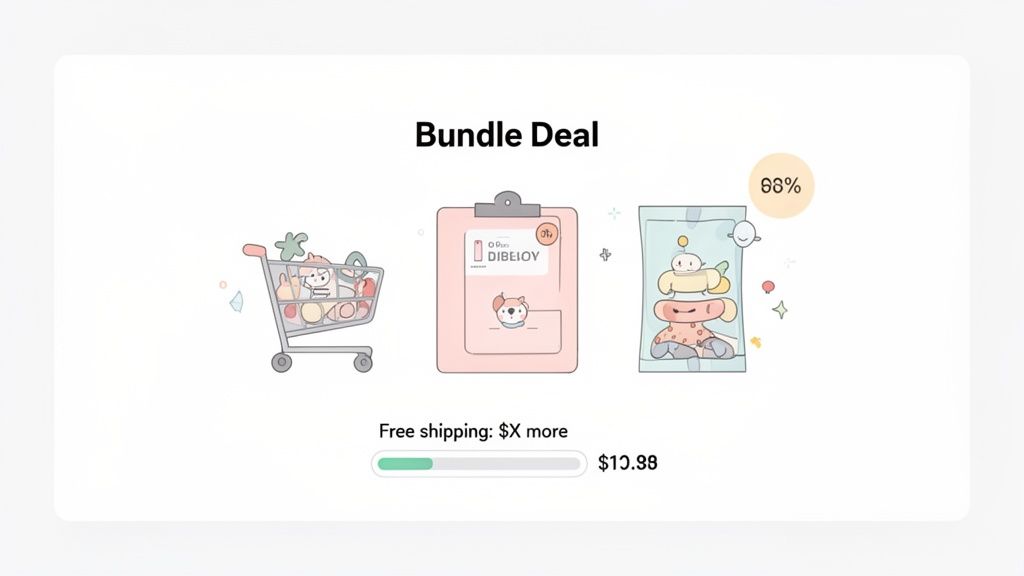
When you get this right, the customer feels like they're getting a smarter deal, and you see a direct, measurable lift in your AOV. It’s a classic win-win.
Create Product Bundles That Actually Solve a Problem
Let’s be honest: just grouping random products together and slapping a discount on them is lazy and rarely works. The bundles that fly off the digital shelves are the ones curated to solve a specific need, making the buying decision a no-brainer.
Put yourself in your customer’s shoes. What are they really trying to do?
- For a skincare brand: Don't just sell a cleanser. Offer a "Morning Routine Starter Kit" with the cleanser, a vitamin C serum, and a moisturizer. Price it so it's a better deal than buying each piece separately.
- For a coffee company: Build a "Perfect Pour-Over Bundle" with a bag of your best single-origin beans, a pack of filters, and a ceramic dripper. You’re no longer just selling coffee; you’re selling the entire premium coffee experience.
Curated collections like these immediately increase the perceived value and introduce shoppers to more of your catalog. When a bundle feels like a complete solution, people stop fixating on the individual item prices.
Use Volume Discounts and Tiered Pricing
Everyone loves to feel like they’re getting a good deal. Volume discounts are a fantastic psychological tool because they reward customers for buying more of what they already want.
The structure is simple but powerful: the more you buy, the more you save.
A well-structured tiered discount—something like "Buy 2, Get 10% Off; Buy 3, Get 15% Off"—is the perfect nudge. You'd be surprised how many people will add that one extra item just to unlock the next level of savings. That’s a direct win for your average order value.
This tactic is a goldmine for consumable products like supplements, beauty items, or household goods—things people know they’ll need more of eventually. It makes them feel smart for stocking up and saving money in the process.
For instance, if you sell protein powder, you could offer one tub for $50, two for $90 (a $10 savings), and three for $120 (a $30 savings). For any regular user, that three-tub option suddenly looks like the most compelling choice.
Set a Strategic Free Shipping Threshold
The words "free shipping" are pure magic in e-commerce. It's not a secret; research consistently shows that an overwhelming 90% of shoppers will buy more just to qualify for it. But here’s the catch: its success hinges entirely on setting the right threshold.
If you just pick a number out of thin air, you could either crush your margins or fail to motivate anyone. The goal is to find that sweet spot that encourages a slightly larger purchase without feeling out of reach.
Here’s a simple, data-driven way to find your magic number:
- Calculate Your AOV: First, you need to know your baseline. Let's say your current average order value is $62.
- Analyze Your Order Distribution: Dig into your analytics and see where most orders fall. You'll likely find a big cluster of orders in the $55-$65 range.
- Set the Threshold: Now, set your free shipping threshold about 15-20% above your current AOV. In our example, a $75 threshold would be perfect.
For a customer already spending $62, hitting that $75 mark feels completely doable. They are far more likely to add a $15 item to get the free shipping perk than they are to abandon their cart over a shipping fee.
This turns shipping from a cost center into a powerful tool to increase average order value. Just make sure you broadcast that threshold everywhere—in a site-wide banner and in the cart itself—to keep the incentive front and center.
Using Smart Upsells and Cross-Sells in the Cart
That moment a customer adds an item to their cart? It's gold. Their intent to buy is at its absolute peak, which makes it the perfect time to show them relevant offers that can seriously lift your average order value. This isn't about being pushy; it's about being genuinely helpful by anticipating what they might need next.
A well-timed offer feels less like a sales pitch and more like a great recommendation from a friend. When you get it right, in-cart upsells and cross-sells can dramatically boost your store's bottom line without getting in the way of the sale.
Upsells vs. Cross-Sells: Know the Difference
First things first, let's get clear on the two main types of in-cart offers. They each have a different job to do, and understanding the distinction is key to making offers that actually connect with your customers.
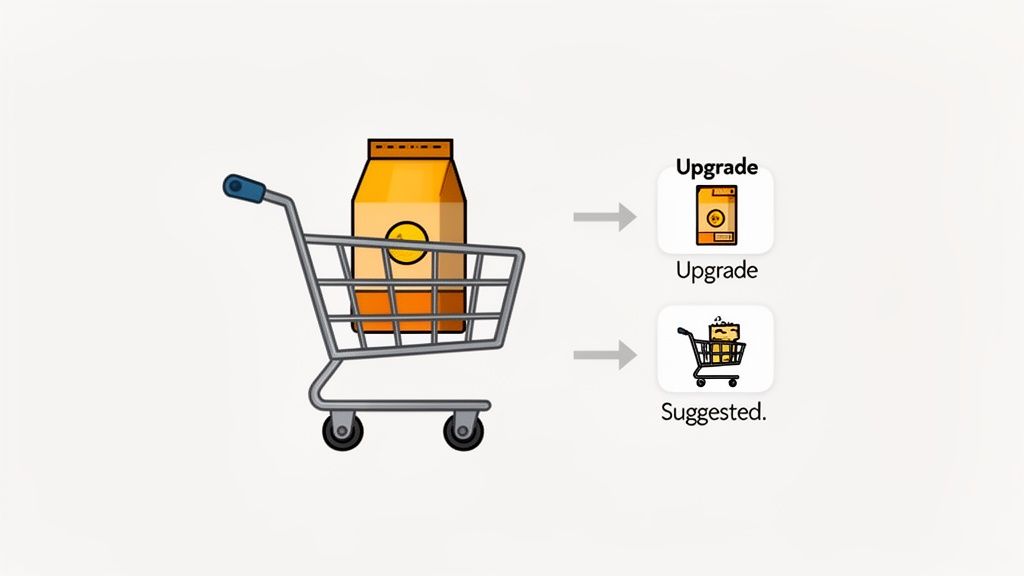
- An upsell is all about encouraging a customer to buy a better, more premium version of the product they're already looking at. Think of it as nudging them toward more value for just a little more money.
- A cross-sell is where you suggest a related, complementary item that makes their original purchase even better. It’s about completing the set or introducing them to something new they'll genuinely appreciate.
Let's say a customer adds a standard coffee grinder to their cart. An upsell would be showing them a pro-grade grinder with more settings for just $20 more. A cross-sell, on the other hand, would be suggesting a bag of single-origin coffee beans that you know pairs perfectly with that grinder.
The best in-cart offers are subtle, relevant, and feel like a helpful tip, not a hard sell. Aggressive, full-screen pop-ups are a surefire way to frustrate someone and send them running. Keep it gentle with suggestions inside the cart drawer or on the cart page itself.
Making Your Recommendations Feel Personal
The days of generic "you might also like" widgets are long gone. To actually move the needle on AOV, your recommendations need to feel like they were picked just for that customer. This means using your own store's data to make smart connections between products.
A great place to start is right inside your Shopify analytics. Look for items that people frequently buy together. This is the lowest-hanging fruit for building effective cross-sells. If you notice that 30% of customers who buy your best-selling running shoes also grab a specific type of performance sock, you've just found your first cross-sell to test.
Here are a few practical ways to frame these offers:
- "Complete the Look": This is a killer visual tactic for fashion or home decor brands. Someone adds a sofa to their cart? Show them a curated set of throw pillows and a blanket that matches the vibe.
- "Don't Forget the Essentials": This approach works wonders for products that need accessories. Selling a camera? Offer a memory card. A new phone? Suggest a protective case. You're framing the cross-sell as a helpful reminder, not just another product.
- "Upgrade and Save": A classic upsell strategy. If a customer adds a one-month supply of supplements, you can offer a three-month supply that brings the cost per unit down. It’s a win-win.
The broader e-commerce world backs this up. Global average order value has climbed by roughly 30% since 2019, hitting $144 worldwide in 2024. Part of that growth comes from merchants getting smarter about these exact kinds of upselling and cross-selling tactics. By refining your approach, you're tapping into a proven consumer trend.
Keep the Experience Seamless
The goal here is to increase the cart's value without adding any friction. Every extra click or new page is a potential reason for a customer to abandon their purchase.
The best in-cart selling apps let shoppers add recommended items to their order with a single click, right from the cart drawer. Avoid sending them back to a full product page—it completely breaks their momentum. The whole experience should feel smooth and integrated, keeping them on a clear path to checkout.
By making your offers relevant and incredibly easy to act on, you can turn your shopping cart into a powerful engine for growth. If you want to dive deeper, you might be interested in our guide on how to create a Shopify upsell and cross-sell strategy that works.
Finding Hidden Revenue in Your Post-Purchase Flow
Most merchants see the "Purchase Confirmed" screen as the finish line. In reality, it’s one of the most powerful—and overlooked—opportunities to increase your average order value. Think about it: the customer's trust is at an all-time high, and you already have their payment info. This post-purchase window is a golden, friction-free moment to present another compelling offer without ever risking the original sale.
A ton of effort goes into getting a customer through checkout, but the Thank You page and Order Status page are often an afterthought. This is a huge mistake. It’s the perfect place to deploy one-click upsells that feel less like a pushy sales tactic and more like a genuinely helpful suggestion. At this point, the customer has already committed. Their mindset has shifted from "Should I buy this?" to "What else might I need to go with this?"
You're capitalizing on existing momentum. Since the main transaction is already complete, there's zero chance of them abandoning their cart. Any offer made here is pure upside. If they take it, your AOV climbs. If they don't, you've still locked in the original sale.
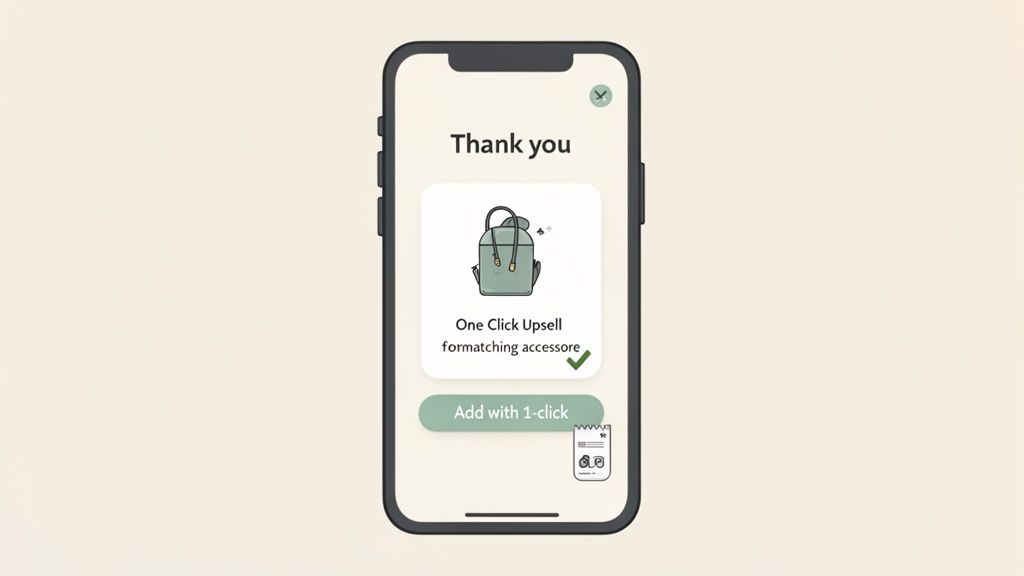
This is a perfect example of a well-timed, one-click offer. It's incredibly easy for an excited customer to add a complementary product. The visual is strong, the discount is clear, and it takes zero effort to say yes—the ideal recipe for a successful post-purchase upsell.
Presenting the Perfect Post-Purchase Offer
The secret to a great post-purchase offer isn't a massive discount; it's relevance. Throwing a random, heavily marked-down product at them just won't cut it. The offer has to feel like a natural next step, an intuitive extension of what they just bought.
So, what complements their purchase?
- Accessories: Someone just bought a new camera? Offer a discounted memory card or a camera bag.
- Refills or Consumables: They bought an electric toothbrush? Now’s the time to offer a subscription for brush heads.
- Care Products: Just sold a nice pair of leather shoes? A leather care kit or waterproofing spray is a no-brainer.
The offer should be a low-stakes decision. I've found the sweet spot is an item priced around 20-40% of the original order's value. This makes it feel like an easy impulse add-on, not another major purchase decision. Frame it as an exclusive, one-time offer to create a little urgency and make them feel like they’re getting a special deal.
As global online retail sales are projected to hit $6.42 trillion by 2025, every single customer touchpoint needs to be optimized. The post-purchase experience is a critical frontier for maximizing customer lifetime value and standing out in a crowded market.
Turning Customer Service Into a Revenue Stream
Here's another spot most stores completely miss for AOV growth: self-serve order editing. Typically, when a customer needs to change something—swap a size, fix a typo in their address—it creates a support ticket. That's a cost center. But what if you empower customers to manage these edits themselves? You can flip a potential headache into a profitable interaction.
Picture this common scenario: A customer realizes they ordered a medium t-shirt but really need a large. They log into their customer portal to make the swap. While they're there, a small prompt appears: "Customers who bought this shirt also loved these matching socks." With one click, they add the socks to their corrected order.
By transforming a routine customer service task into a self-serve shopping experience, you're not just reducing support tickets. You're creating a natural, context-aware moment to cross-sell that directly contributes to a higher average order value.
This isn't just theory. Modern Shopify apps let you build these upsell flows directly into the order status page. This gives customers the control they crave while opening up a brand-new, highly relevant sales channel for your business. For more practical ideas, you can dive deeper into our guide on leveraging Shopify post-purchase upsells effectively.
This approach really delivers a one-two punch:
- Reduced Operational Load: You slash the number of manual support requests your team has to handle for simple order changes.
- Increased Revenue: You introduce a perfectly timed opportunity to sell more to a customer who is already actively engaged with their order.
Your post-purchase flow is fertile ground for growth. Start treating the Thank You page as the starting point for the next sale and empower customers with self-serve tools. You’ll unlock hidden revenue, make customers happier, and sustainably lift your average order value.
Let's Get Personal: Boosting AOV with Smart Customer Segmentation
A one-size-fits-all strategy is the fastest way to leave money on the table. You simply can't treat a brand-new customer the same way you treat someone who's bought from you a dozen times. To really move the needle on your average order value, you have to stop shouting generic deals into the void and start having personal conversations.
That’s what smart customer segmentation is all about. It’s the process of slicing your customer data into meaningful groups so you can deliver campaigns that feel like they were made just for them. When you understand who your customers are and how they shop, you can craft offers that are not just tempting, but genuinely helpful. That's where you'll find sustainable AOV growth.
A Good Place to Start: Purchase History
One of the most powerful and straightforward ways to segment your audience is by their purchase history. It tells you a clear story. Think about it—a new customer has totally different needs and motivations than a loyal advocate. Treating them identically is a huge missed opportunity.
Let's break down the two most fundamental groups:
- New Customers: Their first purchase is everything. They’re testing the waters and getting to know your brand. Your goal is to make a killer first impression and show them what you're all about.
- Returning Customers: These folks already know and trust you. Your job is to deepen that relationship, reward their loyalty, and get them excited about more of your product catalog.
Just by splitting your audience this way, you can create targeted campaigns that speak directly to where each person is in their journey with you, naturally guiding them toward a higher AOV.
Practical Strategies for Your Key Segments
Okay, so you've split your customers into groups. Now what? This is where you can deploy specific, high-impact strategies that feel perfectly timed. Instead of just hoping for a larger order, you’re actively engineering it with offers that make sense.
For Your First-Time Buyers
With new customers, the name of the game is removing friction and showcasing value. They're often looking for an easy way to get started with your brand.
- Offer a 'Starter Kit' Bundle: Pull together a few of your most popular, complementary products into one easy-to-buy package. A coffee brand, for instance, could offer a "First Pour Kit" with a bag of their signature beans, a pack of filters, and a branded mug. It’s a brilliant way to introduce them to multiple products at once and immediately boosts their initial cart value.
- Use a Smart New Customer Discount: Instead of a generic "10% off," frame it as "Take 10% off your first order of $75 or more." This simple tweak encourages them to browse a little longer and add another item to their cart to unlock the savings.
For Your Loyal, Returning Customers
This is where you can get really specific. You have their data—what they like, how often they buy—so use it to your advantage.
Your returning customers are your most valuable asset. They're far more likely to try new products and spend more per transaction. Reward their loyalty with exclusive offers that make them feel like insiders, and they'll continue to invest in your brand.
- Roll Out the Red Carpet with VIP Upsells: Identify your top spenders and create a segment just for them. Offer these VIPs early access to new product drops or an exclusive, high-value upsell on their next purchase. Think about offering a premium version of a product they’ve already bought and loved.
- Serve Up Personalized Cross-Sells: Dive into their purchase history. If a customer consistently buys your vanilla protein powder, why not send them a targeted email offering a special deal on your new vanilla-flavored meal replacement bars? It's a natural, relevant cross-sell because it's based on a proven preference.
By tailoring your approach like this, every customer gets an offer that feels right for them. This personalized strategy doesn't just help increase average order value—it builds stronger, more profitable relationships that last.
How to Measure and Continuously Optimize Your AOV
Launching new bundles and upsells is the fun part. But the real, sustainable growth happens after the launch. This is where you shift from a one-off project to a continuous cycle of testing, measuring, and refining your approach to AOV. This feedback loop is what separates the pros from the amateurs, helping you discover what actually gets your customers to add more to their cart.
You can't just rely on gut feelings. You need a structured way to prove (or disprove) your ideas, and A/B testing is the gold standard for that. It’s all about putting your new strategy head-to-head with what you’re currently doing to see what really moves the needle.
Running Effective A/B Tests
The secret to a good A/B test is focusing on one thing at a time. If you test a new product bundle and change your shipping threshold simultaneously, you'll have no clue which change actually drove the results. It muddies the water completely.
Always start with a simple hypothesis. For example, you might hypothesize: "Offering a 'Complete Skincare Kit' bundle will lift AOV more than selling the three items separately." Then, you need to let the test run long enough to get clean, reliable data. I usually recommend at least two full business cycles to smooth out any random daily spikes or dips.
Here are a few high-impact areas I always suggest testing first:
- Shipping Thresholds: Does a $75 free shipping minimum perform better than a $100 one? Test it and find out.
- Bundle Makeup: Which combination of products is most appealing to your customers?
- Post-Purchase Offers: What happens if you offer a different product or a slightly different discount on the Thank You page?
I’ve seen so many merchants make this mistake: they kill a test after one or two days because they saw an initial spike. That could be a fluke. Let the test run its course so you can make decisions based on real data, not wishful thinking.
Key Metrics to Monitor Beyond AOV
While the end goal is to increase average order value, focusing on this single metric in a vacuum can be incredibly misleading. A higher AOV is only a real win if your business is healthier overall.
To get the full story, you have to track AOV alongside these other critical metrics:
- Profit Margin: Sure, your new bundle offer shot AOV through the roof. But did it eat up your profit margin in the process? You need to make sure your strategies are actually adding to your bottom line.
- Conversion Rate: Be careful with aggressive tactics. A super high free-shipping threshold might encourage big orders but scare away customers with smaller carts, tanking your overall conversion rate. It's all about finding that sweet spot.
- Customer Lifetime Value (CLV): Are the people snapping up your AOV-boosting offers coming back to buy again? This is the ultimate test—it tells you if you're building genuine loyalty or just creating one-time deal seekers.
This is where understanding your customer data becomes so powerful. The process looks something like this:
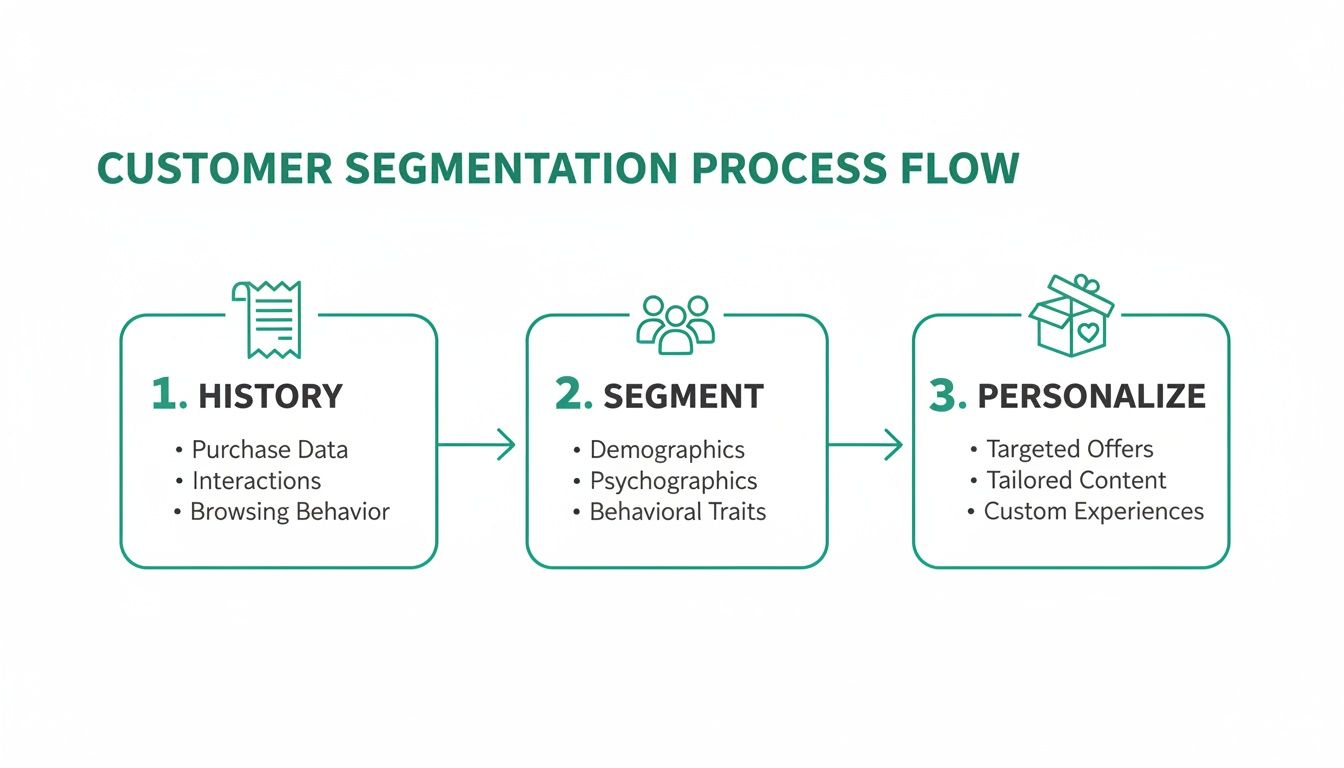
When you dig into purchase history, segment your customers, and personalize your offers, AOV optimization stops being a guessing game. It becomes a natural result of smart, data-driven marketing.
If you’re ready for a deeper dive into your store’s performance, a great next step is learning how to track and understand Shopify analytics for smarter decisions. This continuous loop of testing, learning, and improving is how you build a more profitable and resilient business.
Common Questions About Increasing AOV
Shopify store owners tend to grapple with the same set of challenges when working to increase their average order value. Let's tackle the most common questions we get with some straightforward, actionable advice.
Will Offering Free Shipping Hurt My Profit Margins?
This is a huge, and valid, concern. But if you're smart about it, free shipping can actually boost your bottom line.
The trick is to set a free shipping threshold that’s about 15-20% higher than your current AOV. This simple psychological nudge encourages shoppers to add one more thing to their cart to qualify. More often than not, that extra item’s profit margin more than covers the shipping cost you absorb. It's a win-win.
Of course, you'll want to test a few different thresholds to find the perfect sweet spot for your store.
What Is the Best Place to Offer an Upsell?
You've got a few great opportunities, but one definitely stands out. You can offer upsells on the product page (think a premium version of the product) or right in the cart (like a complementary accessory). Both can work well.
But the real magic happens post-purchase. An offer placed on the thank-you page after the customer has already paid is incredibly powerful. They can add to their order with a single click, which means there's zero risk of distracting them and losing the original sale.
How Do I Know Which Products to Bundle Together?
Don't just guess—let your data do the talking. The best place to start is right inside your Shopify analytics.
Look for "frequently bought together" reports. These pairings are your lowest-hanging fruit because customers are already telling you what they want. Another proven approach is to create bundles that solve a specific problem, like a "Beginner's Skincare Kit" or a "Complete Grilling Set."
SelfServe empowers your customers with self-serve order editing and creates new revenue opportunities with post-purchase upsells. Learn how SelfServe can help you reduce support tickets and increase AOV.