How to Start a Subscription Business on Shopify

Jumping into the subscription world is more than just flipping a switch on your Shopify store. It's about methodically building a new revenue stream, which starts with confirming your idea, picking the right model and price point, getting your tech sorted, and having a game plan for keeping subscribers happy. The whole point is to swap out guesswork for solid, data-driven decisions before you sink a ton of time and money into it.
Is Your Subscription Idea Built to Last?

Before you even think about landing page designs or which Shopify app to install, you have to answer the most important question: will people actually pay for this every month? A cool idea is one thing, but proven demand is everything. This is the step that separates the successful launches from the expensive flops.
The subscription economy is absolutely exploding. The global market is expected to rocket from USD 3,088.71 billion in 2026 to a mind-boggling USD 9,051.84 billion by 2034. That growth is a massive green flag for opportunity, but it also means the space is crowded. To win, your subscription needs to solve a real, recurring problem for a very specific group of people. You can dig into the numbers in this subscription e-commerce market report.
Pinpoint Your Target Audience
Your first move is to get crystal clear on who your ideal subscriber is. Are you selling convenience to busy professionals? Or are you curating unique discoveries for passionate hobbyists? The more specific you get, the easier it is to test your idea.
For instance, a DTC coffee brand isn't just selling to "coffee drinkers." A much better target might be customers who obsess over ethically sourced, single-origin beans and will gladly pay a premium for peak freshness delivered right to their door. That level of detail makes your messaging and your validation tests so much sharper.
Practical Validation Methods
Forget about hiring a pricey market research firm for now. You can get real-world validation with some lean, simple tactics. The goal here is to see what people do, not just what they say.
Here are a few ways to get tangible data:
- Survey Your Existing Customers: If you've got an email list or a social following, just ask them. Use a simple tool like Typeform or Google Forms to float the idea of a subscription. Ask about interest, how often they'd want deliveries, and what they'd be willing to pay.
- Analyze Repeat Purchase Data: Dive into your Shopify analytics. Do you see the same people buying the same product every 30 or 60 days? Boom. Those are your prime candidates for a replenishment subscription and a massive signal that you're onto something.
- Run a Small A/B Test: This is a classic. Add a "Subscribe & Save" option to a product page for a short time. Send a small slice of your traffic there and see how many people click it. Even if it doesn't actually work yet, this "painted door" test is a fantastic way to measure real purchase intent.
A huge mistake I see brands make is asking friends and family for feedback. They mean well, but their opinions are almost always biased. True validation comes from the clicks and actions of potential customers who don't know you personally.
Competitor Analysis as a Validation Tool
Take a hard look at what your competitors are doing—and, just as importantly, what they're not doing. What are their subscription perks? What are customers complaining about in their reviews? The gaps in their service can be a golden opportunity for you.
Maybe their program is super rigid and doesn't let subscribers swap products. If you can offer a more flexible subscription, that could become your key advantage. This kind of analysis not only validates demand but also helps you carve out your unique spot in the market. By doing this homework upfront, you’re building your subscription on a rock-solid foundation of proven customer need.
Designing a Profitable Subscription Offer
Alright, you’ve done your homework and validated your idea. Now comes the fun part: crafting a subscription offer that’s not just profitable for you, but absolutely irresistible to your customers. This is where the real strategy begins.
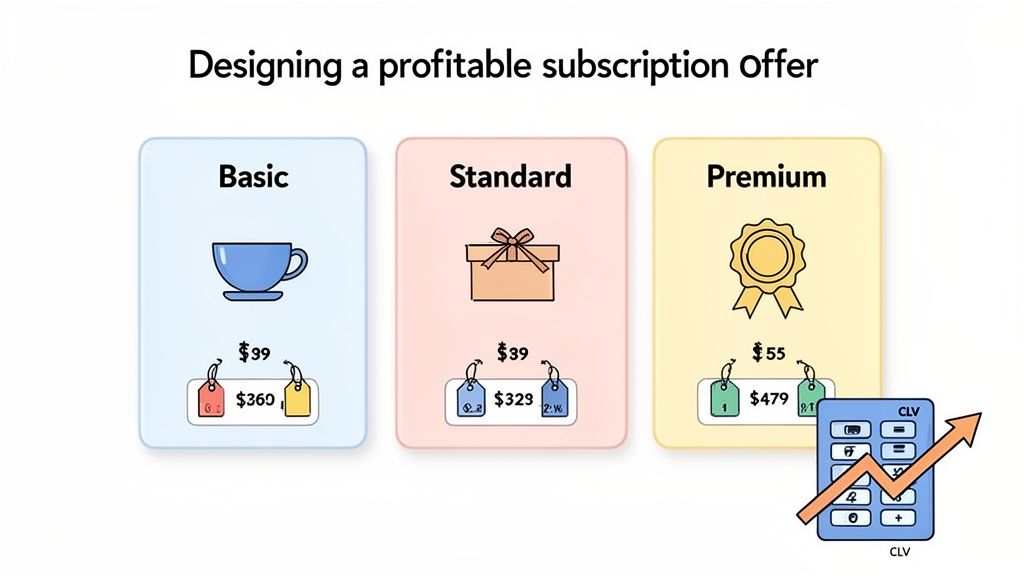
This isn’t about just adding a "Subscribe & Save" option to a product page and calling it a day. A truly successful subscription is a win-win. It needs to make the decision to subscribe feel like a no-brainer for the customer while building a sustainable, predictable revenue stream for your business.
When a customer lands on your offer, they're asking one simple question: "What's in it for me?" Your answer has to be more compelling than a tiny discount. Think bigger—are you offering unparalleled convenience, real savings, delightful discovery, or exclusive access they can't get anywhere else?
Choosing Your Subscription Structure
The model you choose will shape the entire subscriber experience, so it’s a critical decision. While you can get creative, most successful subscriptions fall into one of three buckets. Each one solves a different problem for the customer.
Here’s how they usually break down:
Replenishment (Subscribe & Save): This is the workhorse model for any consumable product—think coffee, skincare, vitamins, or pet food. It’s all about convenience. Customers set it and forget it, and you automate their repurchases. The key is to make the discount substantial enough to justify the commitment, usually in the 10-20% off range.
Curation (The Subscription Box): If your brand is all about discovery, this is your model. It’s perfect for industries like beauty, craft foods, or apparel where customers love trying new things. They pay a recurring fee, and you send them a thoughtfully selected box of goodies. The value here is in the surprise and the expert curation—you're their personal shopper.
Access (Membership): This model is less about the product and more about the perks. You're selling entry into an exclusive club. Members might get free shipping on all orders, early access to new product drops, members-only content, or a direct line to your team. It’s a powerful way to build a loyal community around your brand.
Don't feel boxed in by just one model. A skincare brand, for example, could run a classic replenishment subscription for their best-selling face wash while also offering a quarterly curated "Discovery Kit" with new serums and masks. This hybrid approach lets you serve different types of customers under one roof.
Setting Your Subscription Pricing
Pricing your subscription is equal parts art and science. It’s a delicate balance. Price it too low, and you’ll kill your margins and devalue your brand. Price it too high, and you’ll scare everyone away.
Before you even think about numbers, you need to understand your own. What’s your break-even point? What are your COGS? Most importantly, what’s your target Customer Lifetime Value (CLV)? Your pricing has to be built on a solid financial foundation.
A rock-solid rule of thumb I always use is the 3:1 CLV to CAC ratio. If it costs you $50 to acquire a new subscriber, their total lifetime value needs to be at least $150 for the business model to be healthy and scalable.
With your financial guardrails in place, you can start exploring different pricing tactics to see what fits your brand.
Tiered Memberships: This is a classic for a reason. Offer a few different levels (e.g., Basic, Standard, Premium) with escalating benefits. This lets you capture customers at different price points and gives them a clear path to upgrade as they become bigger fans of your brand.
Usage-Based Billing: While more common in software, this can be cleverly applied to physical goods. Think of a "pay-as-you-go" model for coffee pods, where a customer's plan is tied to how much they actually consume.
Fixed Pricing with Add-Ons: This is one of my favorite tactics for boosting AOV. You offer a base subscription for a flat fee and then give subscribers the ability to toss extra one-time products into their next shipment, often at a small discount. It’s an easy win for both of you.
In the end, your offer—the structure, the price, the perks—is the embodiment of the value you're promising. Get that right, and you won’t just be selling products; you’ll be building relationships and a recurring revenue engine for your store.
Building Your Subscription Tech Stack
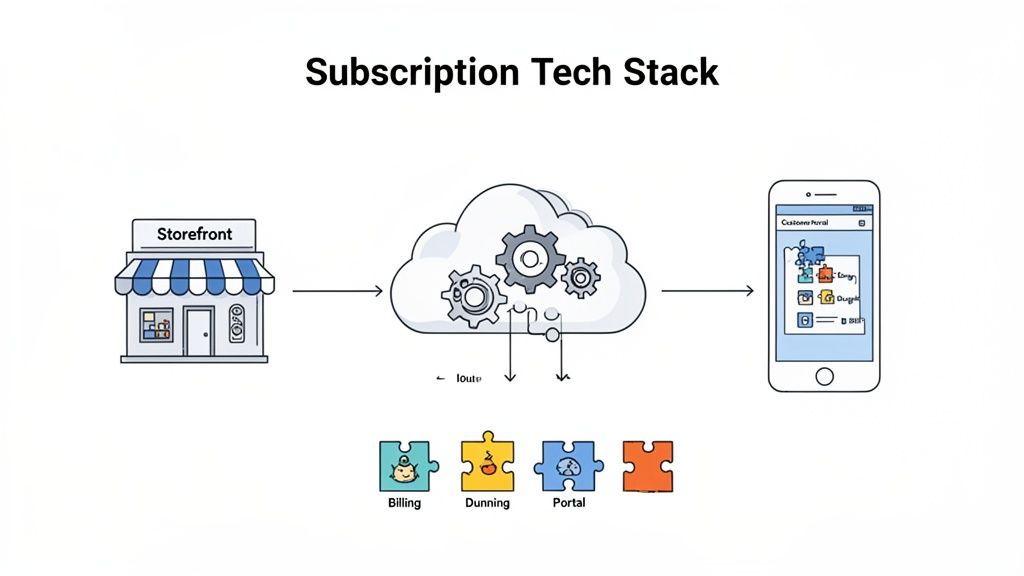
A fantastic subscription offer is only half the battle. The other, less glamorous half is making sure the entire backend experience is rock-solid. This is where your tech stack comes in—the specific collection of tools you'll use to automate billing, manage orders, and empower your customers.
For anyone on Shopify, the app ecosystem is packed with powerful subscription tools. Piecing together the right ones will do more than just save you from manual work; it will directly impact your churn rate and keep customers happy. The goal is to build a system that runs so smoothly you can focus on growth, not putting out fires.
Choosing Your Core Subscription App
Think of your subscription app as the engine of your entire program. It's the piece of software that handles recurring billing, talks to payment gateways, and dutifully creates new orders in Shopify every cycle. This is probably the most critical tech decision you'll make, so it pays to be thorough.
When you're browsing the Shopify App Store, don't let price be the only factor. You need to dig into the features that will actually make a difference as you start to scale.
Here are the absolute must-haves I look for:
- Reliable Billing Automation: This is table stakes. The app has to charge customers on their scheduled date without fail. Also, check for flexibility. Can you easily offer weekly, monthly, and quarterly options? You'll want that versatility later.
- Dunning Management: What happens when a credit card inevitably expires or gets declined? A solid app will have built-in dunning management that automatically retries the payment and sends friendly reminders to customers to update their info. This single feature is a lifesaver for fighting involuntary churn.
- Customer Portal Customization: A generic, clunky portal is a fast track to a support ticket or, worse, a cancellation. You need an app that lets you brand the portal to match your store and gives customers intuitive self-service options.
The ability for a subscriber to easily skip a shipment, swap a product, or update their address without contacting support is not a "nice-to-have"—it's a core retention feature. Every hurdle you remove makes it more likely they'll stick around.
Empowering Customers with a Self-Service Portal
The post-purchase experience is where your subscription business will either thrive or fall apart. Today’s customers expect to be in the driver’s seat. They have zero patience for emailing support and waiting 24 hours just to change a shipping address or add a one-time product to their next box.
This is exactly why a robust customer portal is so non-negotiable. It's your digital customer service agent, working 24/7. When subscribers can manage their own accounts, you achieve two massive wins:
- You slash support tickets: Every action a customer can take on their own is one less email your team has to answer. This frees up your support staff to handle the complex issues that actually need a human touch.
- You boost customer loyalty: Giving customers control builds trust. A smooth, intuitive portal experience reinforces their decision to subscribe to your brand in the first place.
For high-volume merchants, this becomes even more crucial. Investing in tools that enhance the native Shopify customer accounts can make a huge difference. For a deeper dive into this, check out our guide on getting the most out of your Shopify customer accounts.
Streamlining Your Backend Operations
Once the orders start rolling in, your operational efficiency becomes everything. A messy backend leads to shipping errors, inventory headaches, and unhappy subscribers—fast. Getting your ops dialed in from day one is the key to scaling without chaos.
Start by setting up automated workflows. A simple but effective trick is to use your subscription app to automatically tag orders in Shopify (e.g., Subscription - First Order or Subscription - Recurring). This makes it incredibly easy for your warehouse team to create custom fulfillment flows and for you to segment customers for marketing.
Next, think through your cancellation process. Of course, you never want a subscriber to leave, but making it difficult will only create brand-damaging frustration. A much smarter approach is to build a cancellation flow that gathers feedback. Ask a simple one-question survey: "Why are you leaving?" This data is absolute gold for improving your service. You can also offer an alternative, like pausing their subscription for a few months, to try and save the relationship.
By setting up this tech stack thoughtfully from the beginning, you're not just buying software—you're building the foundation for a profitable and sustainable subscription business.
Keeping Your Subscribers Happy and Engaged
Getting a new subscriber is a great feeling, but keeping them is how you actually build a business. That first sale? It’s just the starting line. The real money and stability come from nurturing that relationship so they’re happy to stick with you, month after month.
This is where you have to get serious about retention. A huge part of that means tackling churn head-on. Churn comes in two flavors: voluntary churn, where a customer actively decides to cancel, and involuntary churn, which happens when a payment fails because of something like an expired card. You need a solid game plan for both.
Let Customers Help Themselves with Self-Service
One of the fastest ways to lose a subscriber is through friction. When customers can't easily manage their own subscriptions, small frustrations can quickly snowball into cancellations. Forcing someone to email your support team just to skip a single shipment is a perfect example of a bad experience.
Giving customers a flexible, intuitive portal to manage their own account is one of the most powerful retention plays you can make. They expect to be in control.
At a bare minimum, here’s what a subscriber should be able to do on their own, no questions asked:
- Skip a shipment: Life gets busy. Letting them pause for a month removes the all-or-nothing pressure to cancel.
- Swap a product: Maybe they want to try a different coffee blend or a new candle scent. Easy swaps keep the experience fresh and prevent boredom.
- Update billing and shipping info: This is basic but absolutely critical. A customer should never have to contact you to update their credit card.
- Change their delivery date: Offering flexibility around when their order shows up adds a massive layer of convenience that people love.
Putting this kind of control in your customers' hands drastically cuts down on support tickets while giving them the autonomy they crave. The smoother you make the entire journey after they buy, the more likely they are to stay.
Churn can be brutal. Research shows 52% of consumers ditched at least one subscription in the past year simply because they weren't using it enough. The good news? That same analysis of 76 million subscribers found that former customers account for nearly 25% of new sign-ups, making them a prime audience for win-back campaigns. Check out more insights on the state of subscriptions from Recurly.
Tackling Failed Payments with Dunning Management
Involuntary churn is the silent killer of subscription revenue. A customer might absolutely love your product, but if their payment fails and you don’t have a system to catch it, they could disappear without ever meaning to. This is where dunning management becomes your best friend.
A smart dunning process is all about automatically recovering those failed payments. Instead of just giving up after the first decline, the system will:
- Automatically retry the payment: It will try charging the card again at strategic intervals over a few days.
- Send automated email reminders: If the retries don't work, it sends a series of polite, branded emails asking the customer to update their payment info.
This automated flow can recover a huge percentage of failed payments, directly protecting your monthly recurring revenue (MRR) without your team having to lift a finger.
Here’s a great example of how a self-service portal, like the one from SelfServe, can be set up to give customers this kind of control.
This clean interface shows exactly how you can let customers edit their own shipping details within a set timeframe, which prevents mis-shipments and headaches for everyone.
Boost Value and Build a Community
Beyond just preventing cancellations, the best way to keep subscribers is to constantly add value and make them feel like they're part of something. A transaction is forgettable; a real relationship is sticky.
Start thinking about ways to elevate the experience beyond just the box they get each month.
- Member-Only Perks: Give them exclusive access to sales, early drops of new products, or limited-edition items. This reinforces the value of being a subscriber.
- Exclusive Content: Create how-to guides, tutorials, or behind-the-scenes videos that are only available to your members.
- Personalized Communication: Use the data you have to send relevant offers. Don't just blast your whole list with the same generic email; make them feel like you know who they are.
By focusing on a seamless experience after the sale and continuously delivering more value, you turn a simple subscription into a loyal community. You can dive deeper into building a superior post-purchase customer experience to really strengthen those relationships.
Your Go-Live Launch Checklist
The moment you flip the switch on your subscription program is exciting, but a smooth launch doesn't happen by accident. It's the direct result of obsessing over the details and double-checking everything before your first subscriber signs up.
This isn’t just a checklist; think of it as your final dress rehearsal. You want to find any potential snags now, while the stakes are low, rather than when real customer orders are on the line.
Final Technical and UX Checks
Before you even think about sending a launch email, you need to put your entire subscription flow through its paces. The goal is simple: experience the whole process exactly as a new subscriber would, from discovering the offer to checkout and their first peek at the customer portal.
These are the non-negotiable tests you have to run:
- Walk Through the Checkout: Place several test orders using a real credit card (you can refund it right away). Is the subscription option obvious? Does the discount apply correctly? Are the delivery frequency options crystal clear?
- Pressure-Test the Customer Portal: After subscribing, log into the test customer account. Can you easily find where to manage your subscription? Don't just look—click. Test every single function: skip a shipment, swap a product, update your address, and change your payment method.
- Review Every Automated Email: Trigger all the key emails, like the order confirmation and the subscription activation notice. Read them for clarity, check for brand consistency, and click every single link to make sure nothing is broken.
The smallest bit of friction can kill a conversion. A confusing checkout or a clunky customer portal sends a signal to customers that this whole thing might be more trouble than it's worth. A smooth, intuitive flow builds immediate trust and makes them feel good about their decision to subscribe.
Preparing Your Team and Marketing
With the tech side locked down, it's time to get your team and your launch-day marketing ready to roll. A successful launch means everyone is on the same page and knows their role.
First, arm your customer support team. They're about to get a whole new set of questions. Prepare scripts and a detailed FAQ document that covers the common stuff: billing cycles, shipping schedules, and how to manage subscriptions. Your team needs to be the experts from day one.
At the same time, get your marketing announcements scheduled. Queue up your email campaigns, social media posts, and any on-site banners. Having everything pre-scheduled ensures a coordinated and impactful launch. For more ideas on improving this experience, check out our guide on how to modify the Shopify checkout page.
Key Metrics to Track from Day One
Once you're live, your focus shifts from preparation to performance. Success in the subscription world is measured by a very specific set of KPIs that go way beyond a single sale.
This diagram breaks down the core pillars of subscriber retention, which directly fuel your most important metrics.
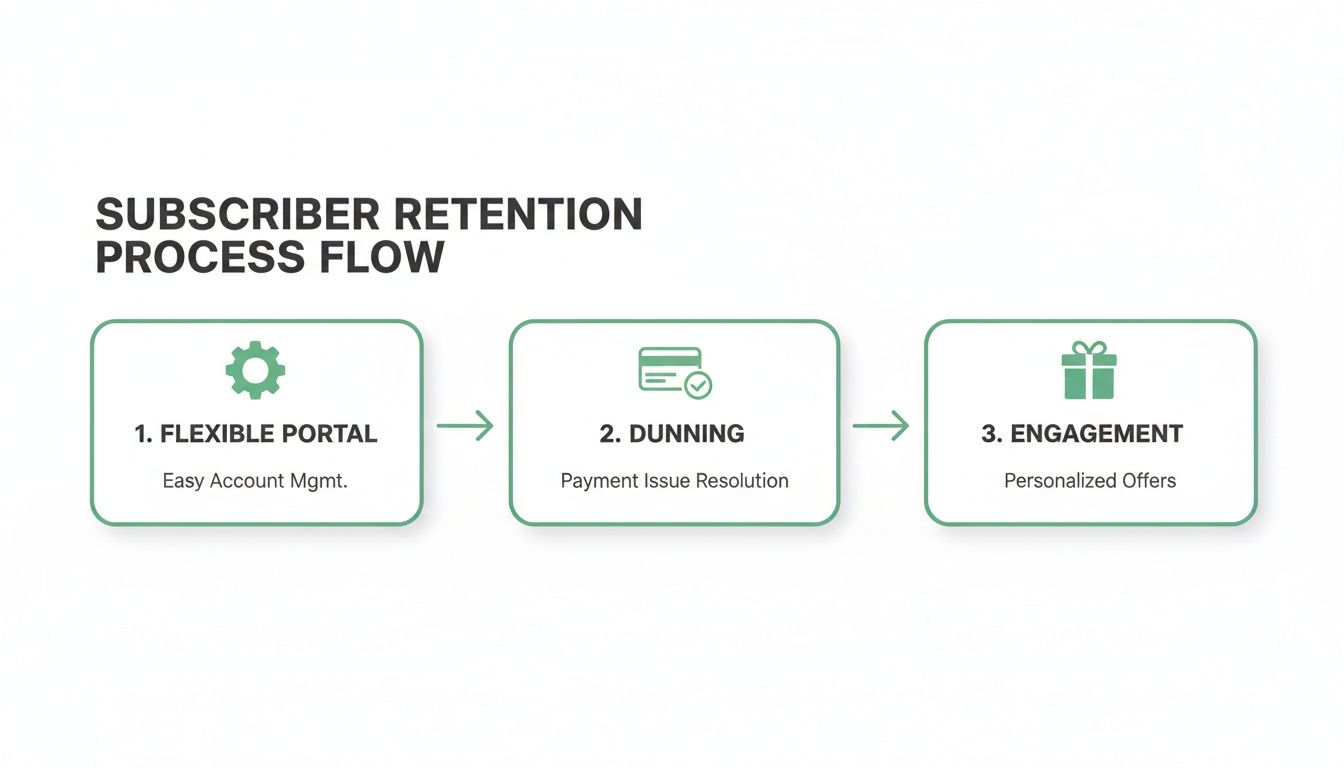
As the visual shows, a flexible portal, smart dunning, and genuine engagement all work together to keep subscribers happy and active.
Here are the numbers you need to watch like a hawk:
- Monthly Recurring Revenue (MRR): This is your north star. It's the predictable revenue you generate from all active subscriptions each month.
- Churn Rate: The percentage of subscribers who cancel in a given period. Your most important retention goal is to get this number as low as humanly possible.
- Customer Lifetime Value (CLV): The total revenue you can expect from a single subscriber over their entire relationship with your brand. A rising CLV is proof that you're building something that lasts.
- Average Revenue Per User (ARPU): This tracks the average revenue generated per subscriber, making it a great way to measure the impact of upsells and upgrades.
Tracking these KPIs from the very beginning gives you the critical feedback loop you need to make smart, data-driven decisions as you start to grow.
Scaling Your Subscription Program for Growth
Once you've got your subscription program humming along and bringing in predictable revenue, it's easy to get comfortable. But the real long-term win comes from thinking about what's next. For a lot of growing brands, that next step is looking beyond your home turf and taking your program international.
Scaling a subscription business globally is so much more than just ticking an "international shipping" box. You have to be deliberate about localization—making the entire experience feel native to every new market you enter.
Embracing International Expansion
Taking your subscription program global can unlock incredible revenue streams, but it also brings a new layer of complexity. The goal is to make the experience for a customer in Berlin feel just as seamless as it is for someone in Brooklyn.
Here's where you'll want to focus your energy:
- Multilingual Support: This is non-negotiable. Your storefront, self-service portal, and all those automated emails need to speak the local language.
- Local Payment Methods: Don't assume everyone uses a Visa. In many parts of Europe and Asia, local payment options are king. Offering them can make or break your conversion rates.
- Transparent Shipping and Duties: No one likes a surprise bill. Be crystal clear about international shipping costs, delivery estimates, and any customs duties they might face.
So many brands stumble when they go global because they treat every market the same. Localization is all about building trust. When a shopper in Germany sees prices in Euros and can check out with a familiar payment gateway, their confidence in your brand goes through the roof.
Adopting Flexible Subscription Models
As you grow, you’ll quickly realize that the old-school, rigid subscription models just don't cut it anymore. Today's customers crave control and flexibility. Bending your offers to meet that demand is a fantastic way to keep subscribers happy and attract new ones who were previously on the fence.
This move toward flexibility isn't just a hunch; it's a major trend. We're seeing usage-based and hybrid models taking over, where a base subscription might be paired with optional add-ons. It's a smart way to boost both profitability and loyalty, as detailed in this report on Shopify subscription trends for 2026.
Think about rolling out more dynamic options:
- Build-a-Box: Let your customers hand-pick the items in their subscription box each month. It gives them total control and makes every delivery feel special.
- Multi-Tier Memberships: Create 3-4 levels of membership with increasing perks. Think VIP access to new products, free shipping, or exclusive content to encourage upgrades.
- Usage-Based Plans: For consumables, why not tie the cost to how much they actually use? It's a fairer pricing model that really resonates with customers.
Offering these kinds of options shows you get that your customers aren't all the same. It turns a simple recurring payment into a genuine, long-lasting relationship.
Common Questions We Get About Subscriptions
Diving into subscriptions can bring up a lot of questions. It's a big move, after all. We've helped countless brands make the leap, and we've noticed the same key questions pop up time and again. Let's tackle them head-on.
What's the Right Subscription Model for Me?
Honestly, there’s no one-size-fits-all answer here. The best model really comes down to what you sell and how your customers use it.
If you’re selling something that runs out, like coffee, vitamins, or skincare, the replenishment model (often called "Subscribe & Save") is a no-brainer. It’s all about convenience.
But what if your brand is more about discovery? For products like unique snacks, craft beer, or even stylish socks, a curated box model is a fantastic way to introduce customers to new things they’ll love. And if you’ve built a strong community, an access model that offers exclusive perks—think members-only content or early access to new launches—can create incredibly loyal fans.
How Big of a Discount Should I Offer?
Most brands start with a 10-15% discount off the one-time purchase price. It’s usually just enough to nudge a customer to commit without completely eating away at your margins.
But don't just pick a number out of thin air. You need to look at your customer lifetime value (CLV) and customer acquisition cost (CAC). The real goal is to make sure that even with a discount, your subscribers are profitable in the long run.
A huge mistake we see is brands offering a discount so deep it cheapens the product. Your subscription's value should be a blend of savings, convenience, and a better experience—not just a race to the bottom on price.
Can I Mix Subscriptions for Physical and Digital Products?
Yes, and you absolutely should if it makes sense for your brand! The Shopify ecosystem handles this beautifully.
For example, you could offer a replenishment subscription for your best-selling face cream while also selling a membership that unlocks exclusive video tutorials and a private community forum. Bundling physical and digital perks together can create a seriously powerful offer that turns casual buyers into true brand advocates.
Ready to reduce support tickets and increase AOV from your subscribers? SelfServe gives your customers the power to manage their own orders with a flexible, multilingual portal. Install our Shopify app with a 30-day free trial.