
Mastering International Address Validation for Shopify In

A customer in Paris checks out, types in a perfectly normal-looking address, and one small formatting mistake sends the parcel to the wrong city. Your team doesn't see the problem until support starts asking where the package is, the carrier can't fix the label, and the buyer decides the store feels unreliable. International address validation exists to catch that kind of failure before it spreads into shipping, billing, and CRM records.
For Shopify merchants, the issue gets bigger after purchase too. A wrong address, a missing apartment number, or a country-specific format that never fit a rigid form can still create work after the order is placed. The good news is that modern validation tools can standardize addresses in real time and help merchants keep delivery promises intact.
Introduction to International Address Validation
A single bad address can create a chain reaction that looks small at first and then eats up time across the whole order lifecycle. A label prints, a carrier scans it, the package bounces, and your support team ends up translating a messy form entry into a fix no one wanted to make.
That's why international address validation is now a basic part of global ecommerce operations. Major vendors support it at scale, with Experian covering over 245 countries, Service Objects covering 250+ countries, and Google's Address Validation API validating, standardizing, and geocoding addresses in real time to improve delivery predictability and customer experience (Experian's international address verification overview).
The practical shift matters just as much as the geography. Address quality is no longer just a back-office cleanup task, it's a frontline control point that protects shipping accuracy, customer trust, and downstream systems. For Shopify merchants selling across borders, that means the address field isn't just a form, it's part of the revenue path.
Practical rule: treat every address as operational data, not just checkout text. If it's wrong at entry, it usually costs more to fix later.
Understanding International Address Validation
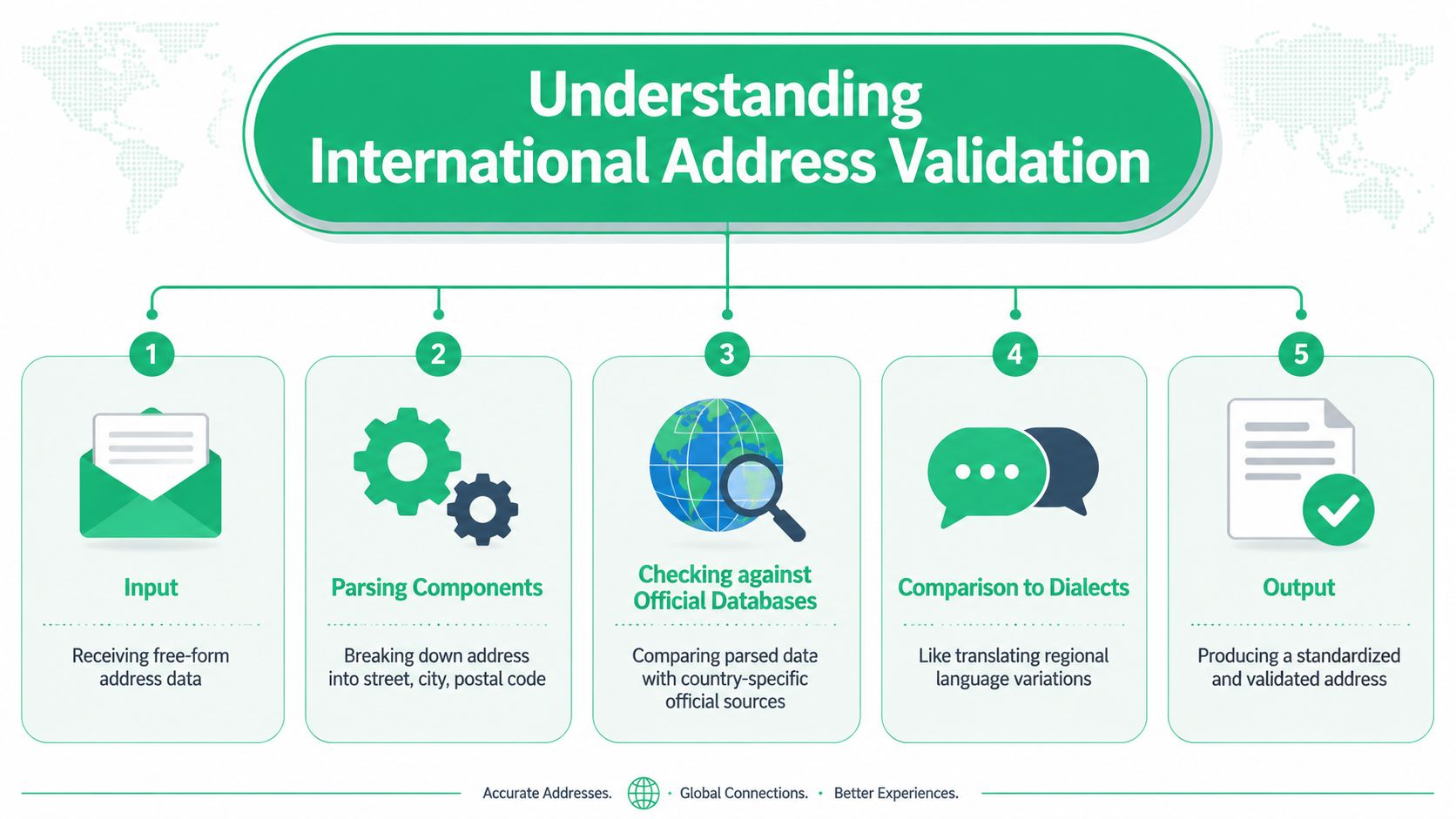
Think of an address as a sentence written in a local dialect. You can still understand the meaning, but only if you know the grammar rules for that country. International address validation takes free-form input, breaks it into components, checks those components against country-specific authoritative postal data, and then returns a standardized result that local delivery systems can use.
What the process actually does
The strongest systems don't just compare strings. They parse the address, correct typos, fill missing pieces, and standardize the result at the point of entry so bad data doesn't travel into shipping, billing, or CRM systems. EDQ says this is strongest when the entered address is matched against an authoritative, country-specific postal database and then normalized to local postal formatting rules (EDQ international address verification).
That real-time model is now the norm for modern tools. Loqate describes address verification as a process that can run in real time, and Experian says its global address verification software uses APIs to validate addresses at entry so accuracy starts from the beginning (Loqate address verification).
Why validation is more than formatting
Formatting alone can be misleading. Google's Address Validation API doesn't just match text to coordinates, it returns validated and standardized results plus delivery guidance, which is what operations teams need when a label, route, or customer record depends on the address being usable. Service Objects and Melissa both frame the same shift, point-of-entry validation helps keep bad data out before it turns into shipping or service problems (Google Address Validation API, Service Objects international address service, Melissa address verification guidance).
For Shopify stores, that distinction matters because an address can look complete and still be structurally wrong for the destination country. A postal code in the wrong position, a locality name placed where a region name should go, or a field order that only makes sense in one market can all create a bad match. The validator's job is to translate that local logic into something your fulfillment stack can trust.
Why scale changed the category
This isn't a niche utility anymore. International validation has become a standard global data-quality function because the tools now cover most major markets and support multilingual character sets, transliteration, and country-specific rules. In other words, the system has matured enough to handle the messy reality of global commerce rather than forcing every address into one template.
Country Address Variations
A rigid form assumes every country writes addresses the same way, and that's where problems start. ISO points out that countries need their own address-assignment standards, data standards, metadata, quality management, and aliases, which makes a one-size-fits-all parser structurally insufficient for many markets (ISO addressing conclusions).
Different countries, different logic
In some places, the house number leads. In others, the street component is secondary, and in some markets the neighborhood, block, or administrative area matters more than the familiar street-city-postal-code pattern. That's why a merchant can't safely assume a U.S.-style address form will work for every buyer.
Germany is a good example of why format awareness matters. If you want a plain-language walk-through of how German addresses are built, Translate AI's guide to German addresses is a useful reference because it shows how local conventions can differ from what English-speaking teams expect.
Why “valid” can still mean “wrongly entered”
The same problem shows up in other markets too. A valid address can be entered in a way that's technically recognizable but still not aligned with local postal conventions, which leads to failed matching or poor normalization. That's why operations teams need tools that accept variation without flattening it into one template.
A good validator respects local structure first, then standardizes the result for the systems that need it.
For ecommerce managers, the lesson is simple. The more international your customer base becomes, the less useful it is to think of an address as a fixed form and the more useful it becomes to think of it as structured local data. If your validation logic can't adapt to country-specific rules, it will reject good orders and accept bad ones.
Data Sources and Normalization Rules
Validation works only when the system compares a customer's entry to trusted source data. The strongest approach is to match the address against an authoritative, country-specific postal database, then normalize the result to the destination country's formatting rules so your records stay consistent and deliverable (EDQ international address verification).
The workflow merchants should expect
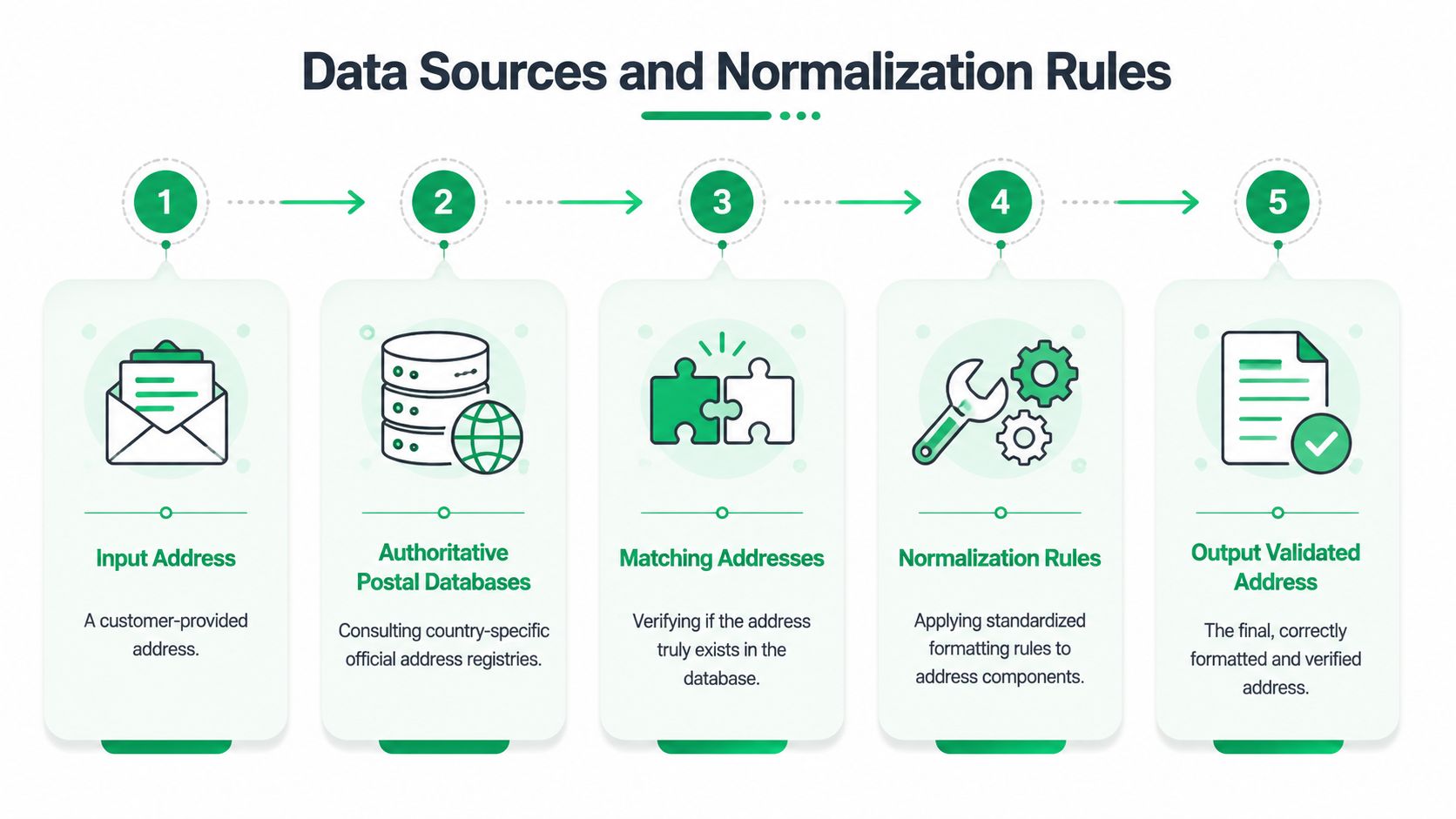
A clean workflow usually looks like this:
- Input address, the buyer types a free-form address.
- Component parsing, the system breaks it into street, city, postal code, and other parts.
- Database matching, the system checks those parts against official local data.
- Normalization, the system rewrites the result to the country's preferred format.
- Validated output, the system stores or passes along the standardized address.
That's the core logic behind good international validation, and it's why many modern APIs focus on parsing plus normalization instead of simple string matching. For teams evaluating tools, the question isn't whether a vendor can “find” an address. It's whether the vendor can return a standardized version that fits the destination country's rules and your operational stack.
Why flexible forms matter
The form itself has to cooperate. W3C recommends generic labels, multiple address lines, support for non-Latin characters, optional postal codes where relevant, and country-aware field ordering rather than rigid U.S.-style templates (W3C address form guidance via Loqate). That means your validation layer should parse flexible input, not punish a buyer because their country doesn't look like yours.
For Shopify operations, implementation choices hold particular significance. If your forms capture cleaner data, your fulfillment app, ERP, and support tools all benefit from fewer correction loops. If you're comparing ways to add that layer, SelfServe's post-purchase setup is one option because it can validate and standardize shipping details inside the customer's order-management flow, while other teams may prefer a standalone address verification tool such as the one outlined in this address validation tool guide.
Operational takeaway: normalization is not decoration. It's how a customer's input becomes data your carriers, warehouse, and support tools can actually use.
Business Impacts of Invalid Addresses
Invalid addresses don't stay isolated in checkout. They show up later as missed deliveries, avoidable support work, and manual corrections that slow down the order pipeline. Once the label is wrong, every team downstream has to decide whether to fix, resend, refund, or explain.
How bad addresses affect the business
A failed address can hit shipping first, then customer trust, then internal efficiency. Buyers who don't get their packages on time often contact support, and those tickets have to be investigated one by one. Merchants also lose the chance to treat a smooth post-purchase experience as a revenue touchpoint.
That's where post-purchase editing and upsell flows become interesting. If a shopper can review or correct a shipping detail after checkout, the merchant gets a second chance to keep the order healthy. If the same post-purchase surface also supports add-ons or curated offers, the page can do more than prevent problems, it can contribute to order value while the customer is still engaged.
Why Shopify merchants should care now
Global selling makes these costs harder to ignore because regional rules and mailing conventions don't line up neatly. The new EU single company form discussion from The EU Inc. by renn is a useful reminder that cross-border commerce is becoming more structured, not less, and merchants need cleaner operational data to keep up.
For Shopify teams, the right question isn't whether invalid addresses are annoying. They are. The critical question is how much operational effort you want to spend cleaning up problems that validation could have prevented.
If a customer can fix an address before fulfillment, you usually save more work than if your team tries to recover it after the parcel leaves the warehouse.
A Shopify-native workflow helps here because post-purchase address correction can happen in the same environment where customers already manage their order. If you're comparing implementation paths, the address validation guide for Shopify is a practical place to start because it shows how validation fits into a merchant-facing flow instead of sitting off to the side.
Common Validation Failure Modes
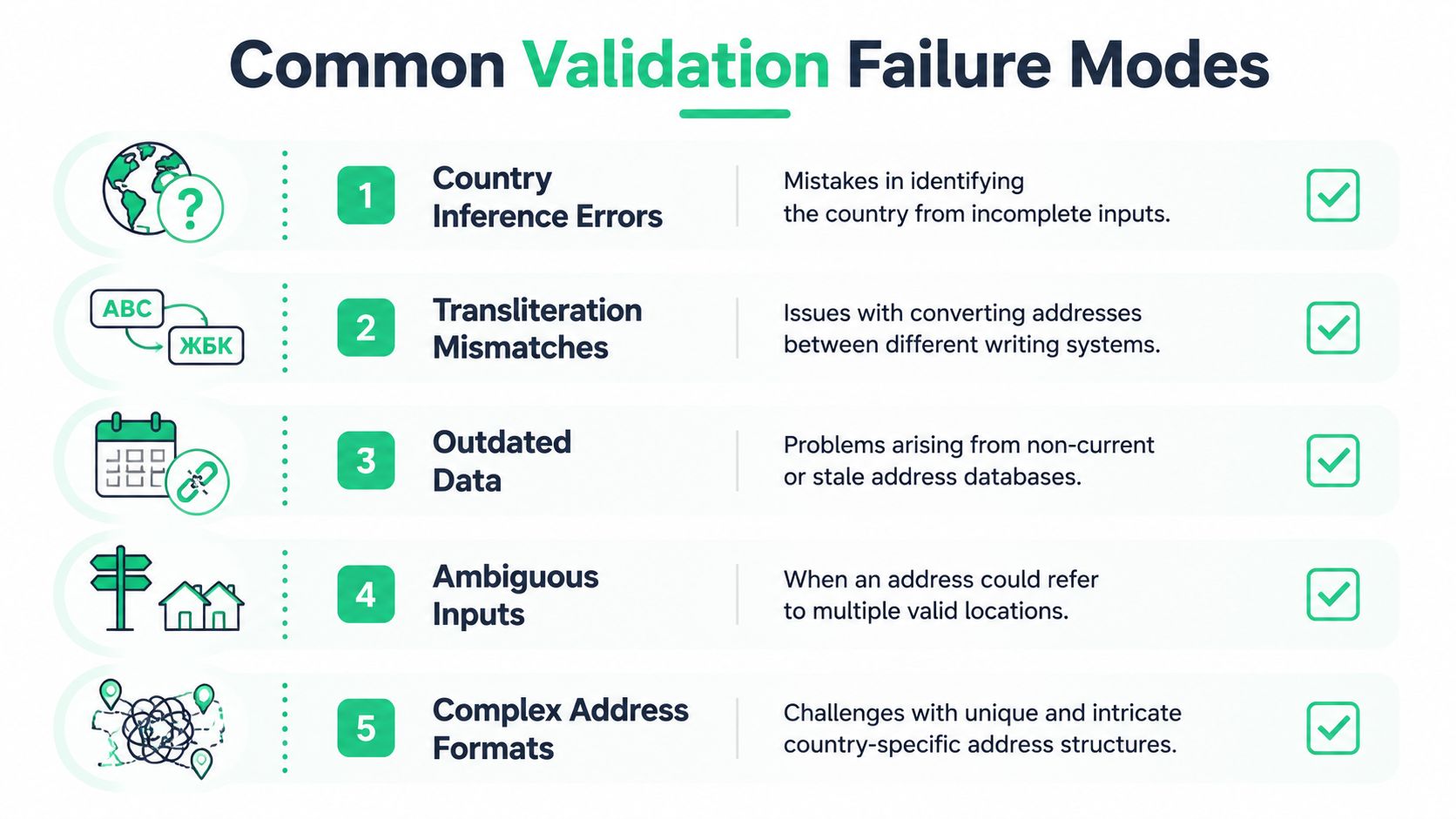
Good validation systems still fail when the input is messy enough or the rules are too blunt. The biggest mistake merchants make is assuming every failure means the address itself is invalid, when the actual problem may be country detection, script conversion, or an overly strict form design.
Where systems get tripped up
Country inference is a common weak point. Experian notes that cues like country names, ISO codes, and locality names can create false positives, because strings such as “DENMARK STREET” or a town name repeated across countries can be misread (Experian on global address identification problems).
Transliteration adds another layer of complexity. A buyer may enter an address in a non-Latin script, then the system has to map it carefully rather than guessing at character equivalents. If the parser is rigid, it may reject an address that would have been valid after normalization.
Why flexible logic wins
Optional postal codes also confuse systems that expect every country to behave like the U.S. or UK. Some markets don't use them the same way, and others make them optional in certain contexts. That means validation needs market-aware rules, not one global rejection rule.
A practical setup usually combines calibrated pre-filters, country-aware parsing, and fallback logic for incomplete entries. Machine learning can help when it's trained on local patterns, but only if the model is allowed to respect market differences instead of flattening them.
Good rule of thumb: if a validator rejects a lot of international orders for formatting reasons, the form may be too strict, not the customer too careless.
Implementing Validation in Shopify Post Purchase Flows
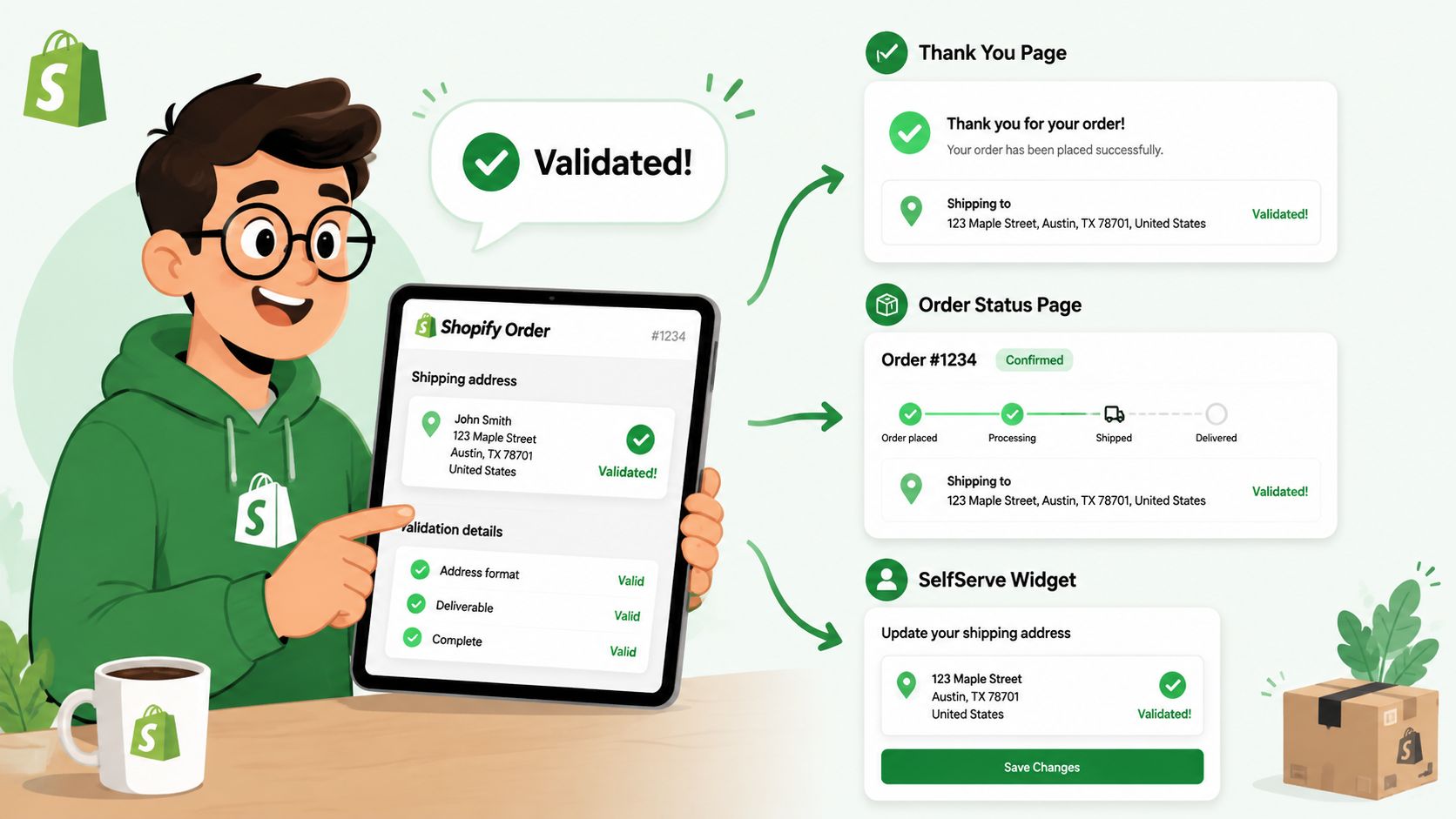
Shopify merchants get the most value when validation lives beyond checkout. If the customer can update shipping details on the Thank You page or Order Status page, the merchant can prevent a support case before it starts, and a post-purchase widget can become the place where accuracy and upsell work happen together.
What to configure first
Start with country-aware fields, not one locked template. W3C's guidance on generic labels, multiple lines, non-Latin characters, optional postal codes, and country-aware field ordering is the right baseline for global shoppers, especially if you're validating addresses after checkout rather than only at form entry (W3C address form guidance via Loqate).
Then connect the validation layer to the point where the customer can actually edit the order. SelfServe is one Shopify option in this space, and it lets merchants put address correction inside a post-purchase widget while keeping control over what shoppers can change and when. That matters because not every order should be editable forever, and not every field should be open to every customer.
How the flow should feel
The best experience is simple. A shopper opens the widget, sees the current shipping details, updates the address if needed, and gets a standardized result before fulfillment moves on. If you also enable autocomplete, the customer gets fewer keystrokes and fewer opportunities to introduce formatting errors.
Here's the operational payoff. The same post-purchase page can support address validation, shopper edits, and order add-ons without forcing the customer into a separate support channel. That's useful because the order is still fresh, the buyer is already engaged, and your team doesn't need to manually reconcile corrections later.
Where the workflow gains efficiency
A merchant can also add approval logic for sensitive changes, tag orders that were edited, or route exceptions into a manual queue. Those controls matter in higher-volume stores, where one loose setting can create downstream headaches in warehouse and support systems.
For a practical comparison of how validation tools fit into Shopify workflows, the Shopify address verification guide is worth reviewing because it connects real-time validation to actual store operations instead of treating it as a generic API checkbox.
The technical point is simple. Flexible parsing plus normalization beats rigid templates for international commerce, and Shopify merchants get the most benefit when that logic runs where the customer can still correct the record.
Conclusion and Next Steps
International address validation turns global checkout from a guess into a controlled process. Once you support country-aware parsing, authoritative matching, and post-purchase correction, you reduce delivery friction and give customers a cleaner experience.
Start by auditing your current forms for rigid field assumptions, then test a validation API or Shopify widget in a sandbox, and finally decide where post-purchase edits should be allowed. If your store serves multiple countries, the best next move is to make address accuracy part of the customer experience, not just the fulfillment back end.
A CTA for SelfServe.