Ecommerce Growth: Operational Cost Reduction for 2026
82% of businesses globally missed their annual operational cost reduction targets in 2023 according to MemberSplash's writeup on operational efficiency. That number should reset how ecommerce operators think about cost cutting.
Most brands don't fail because they lack ideas. They fail because they cut the visible line items first, not the structural ones. They freeze hiring, squeeze agencies, or trim ad tests, while support queues stay bloated, fulfillment teams keep correcting preventable errors, and finance still reconciles messy orders by hand.
The brands that get operational cost reduction right don't treat it as a finance exercise. They treat it as a workflow redesign project. Better yet, the smartest DTC operators don't stop at savings. They use those savings to fund revenue le-capturing moves inside the customer journey, especially after purchase, where margin leaks and margin gains often sit side by side.
That distinction matters. Cost reduction without reinvestment can make a brand leaner. Cost reduction that feeds revenue creates a flywheel.
First Diagnose Your True Operational Cost Drivers
Teams usually know their biggest bills. They often don't know their biggest leaks.
That's why the first move isn't renegotiating software or demanding lower pick-pack fees. It's building a baseline. According to a Harvard Business Review study cited by Starkmont Financial, organizations that conduct a thorough baseline analysis are 60% more successful in their cost-reduction efforts, which starts with recording current operating costs, revenue streams, and profit margins through a disciplined baseline review in Starkmont Financial's cost-reduction guidance.
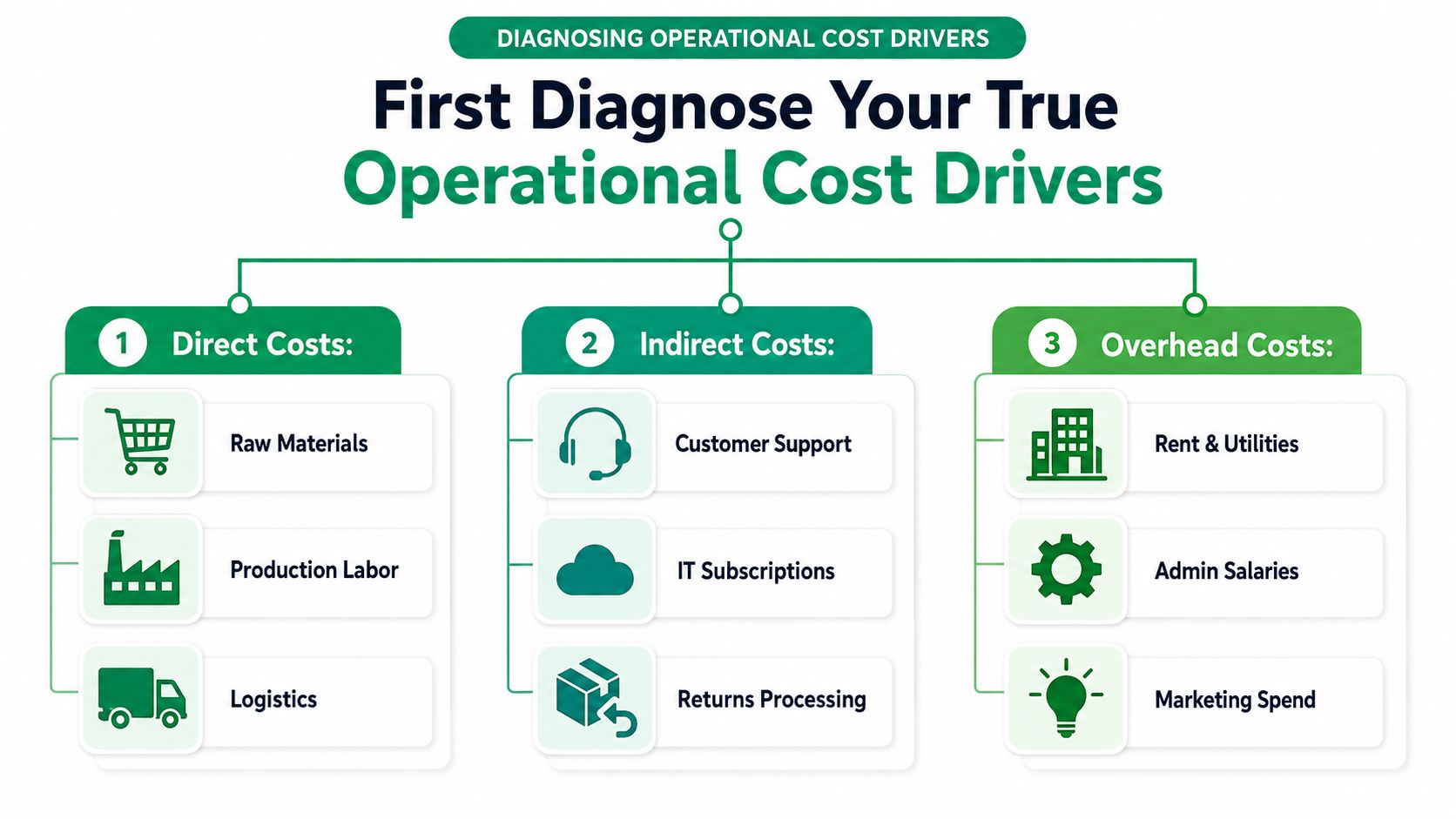
Map costs by workflow, not by department
Looking at a P&L alone won't tell you why costs keep climbing. A support salary line doesn't show how many tickets came from address edits. A shipping line doesn't show how many labels were reissued because warehouse data didn't sync cleanly. A returns line doesn't show whether exchanges are being lost because the process is clunky.
Start by grouping costs into operating flows:
- Pre-purchase and checkout costs that affect fraud review, order errors, and abandoned carts
- Post-purchase service costs such as order edits, status questions, cancellation handling, and WISMO tickets
- Fulfillment and shipping costs tied to pick errors, split shipments, relabeling, and manual exception handling
- Returns and reverse logistics costs including inspection, restocking, support contacts, and refund delays
- Back-office costs like reconciliation, invoicing, reporting, and approval bottlenecks
Operators uncover the underlying pattern. The expensive issue is rarely one giant line item. It's usually a chain of small process failures that force multiple teams to touch the same order.
Practical rule: If one customer request makes support, ops, warehouse, and finance all touch the same order, the process is underdesigned.
Build a baseline that exposes hidden friction
A useful baseline has to connect cost to behavior. For each operational flow, track what triggers the work, who handles it, where delays happen, and what downstream correction costs show up later.
A simple audit table works well:
| Cost area | Common trigger | Hidden downstream cost |
|---|---|---|
| Support | Order edits and status questions | Higher handle time, delayed queue response |
| Fulfillment | Manual exception handling | Mis-picks, relabeling, shipment delays |
| Returns | Poor policy flow or unclear portal | Extra tickets, lower exchange capture |
| Finance | Order changes after capture | Reconciliation errors and slower close |
For brands with meaningful order volume, this often reveals that operational cost reduction isn't mainly about cutting spend. It's about removing repeat touches. If your team changes addresses in one tool, updates tags in another, emails the warehouse, then later fixes the order in reporting, you're paying four times for one preventable event.
Teams that need a tighter handle on order-level accounting should also review this walkthrough on ecommerce financial reconciliation. It helps connect operational mess to the finance cleanup that happens later.
Prioritize the costs that repeat daily
Not every inefficiency deserves attention first. Focus on issues with three traits:
- High frequency. They happen every day.
- Cross-functional drag. They create work in more than one team.
- Customer impact. They slow delivery, create confusion, or erode trust.
That last point matters because some cost cuts backfire. Cutting a service layer that customers rely on can push costs elsewhere through chargebacks, cancellations, or repeat contacts.
For operators managing transportation, routing, or delivery coordination, there are useful insights from Logivo on overhead reduction that reinforce the same lesson. Overhead falls when teams remove coordination waste, not when they pressure headcount alone.
Slash Support Volume with Post-Purchase Self-Service
Support is where many DTC brands bleed margin. Not because agents are inefficient, but because the same preventable requests keep arriving. Address changes. Contact detail updates. Order cancellations within a short window. "Where is my order?" requests that should never need a human.
When those requests land in a shared inbox, the brand pays twice. First in labor. Then in delay. The customer waits, the agent triages, ops intervenes, and the order may already be moving through the warehouse by the time anyone acts.
Replace repetitive tickets with controlled customer actions
The fix isn't removing service. It's moving simple, rule-based actions into a controlled self-service layer.
The strongest post-purchase flows let customers handle low-risk changes themselves within clearly defined permissions. That usually includes editing a shipping address before fulfillment, updating contact information, or requesting a cancellation during an approved window. The merchant still controls what can be changed and when.
That design matters because it cuts volume without opening the door to chaos. You're not giving away operational control. You're codifying it.
A well-built self-service customer portal for ecommerce teams shifts the support team's role from data entry to exception management. That's where support becomes more valuable. Agents spend time on damaged orders, policy edge cases, and high-emotion interactions instead of copying and pasting address updates.
The real win is faster operations, not just fewer tickets
I've seen brands obsess over ticket count and miss the deeper benefit. Manual post-purchase support doesn't just cost money. It introduces lag into fulfillment.
An address change handled manually can miss the warehouse cutoff. A cancellation request answered too late can ship anyway. Then the business absorbs a return, refund, or reshipment that started as a simple request.
Here's the operational contrast:
Manual flow
- Customer emails support
- Agent verifies identity
- Agent edits order or messages ops
- Warehouse may or may not catch the update
- Finance later reconciles the final state
Self-service flow
- Customer makes an approved change directly
- Rules enforce timing and permissions
- Order data updates in the workflow
- Ops handles exceptions, not routine edits
The cheapest ticket is the one the customer never needs to open.
Turn a cost-saving moment into a revenue moment
Most cost-reduction plans stop at labor savings. That's incomplete.
Data from 2024 to 2025 shows that embedded upsell modules in post-purchase pages can increase Average Order Value by 12% to 18%, directly improving net operational margins, as noted in Cloudvara's discussion of cost reduction strategies. This is the blind spot in most operations conversations.
If a customer is already in a post-purchase flow, editing an order, checking status, or confirming details, that session can do more than deflect a ticket. It can recover margin. Accessories, replenishment items, bundles, and add-on protection are often more effective in this moment than in the original checkout because the buying decision has already been made.
That's why post-purchase self-service is more powerful than a support tactic. It combines labor avoidance with incremental revenue. For high-growth Shopify brands, that combination is far more durable than cutting service headcount and hoping the backlog doesn't come back.
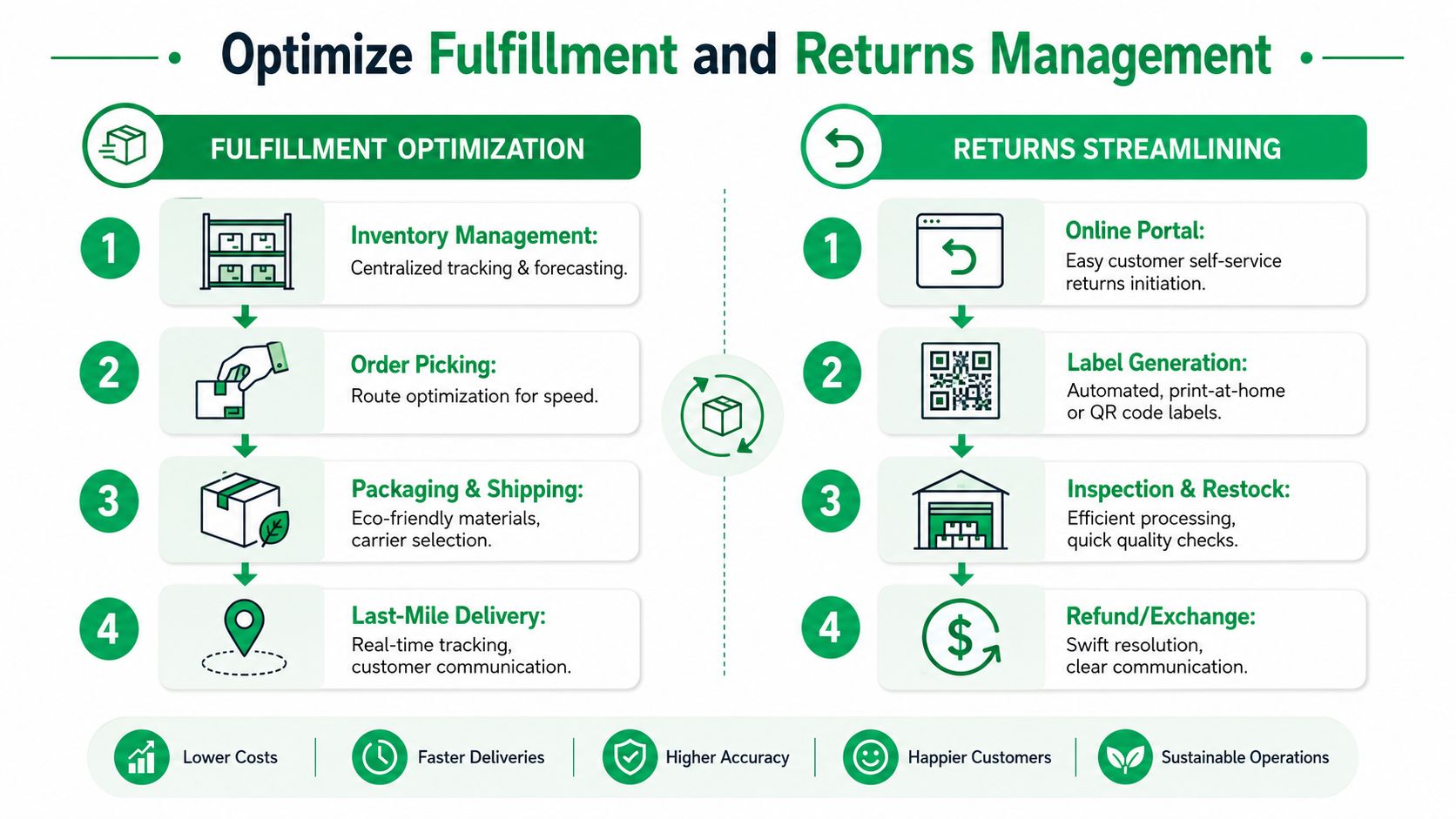
Optimize Fulfillment and Returns Management
A 1% to 2% fulfillment error rate sounds manageable until it hits scale. For a DTC brand shipping 10,000 orders a month, that can mean 100 to 200 problem orders that trigger reships, support tickets, return labels, refund work, and margin loss on inventory that may never sell at full price again.
Fulfillment and returns belong in the same operating model because the cost shows up across the P&L, not inside one team. A bad pick creates warehouse rework. A late scan creates a WISMO ticket. A weak return flow creates unnecessary refunds when an exchange would have kept revenue in the business.
Automate the handoffs that create avoidable labor
McKinsey notes that warehouse automation can improve operating costs, throughput, and accuracy when repetitive tasks and decision points are removed from manual workflows, as outlined in its analysis of next-generation warehousing. In practice, the biggest gains usually come from boring handoffs that teams tolerate for too long.
The repeat offenders are predictable:
- Order routing rules that send each order to the right node based on inventory position, margin, SLA, or geography
- Shipping label generation tied to carrier selection, service level, package constraints, and cutoff times
- Exception tagging for high-risk orders, address mismatches, or inventory conflicts before they hit the floor
- Customer notifications triggered automatically as status changes, so support is not acting as a tracking relay
I see this pattern often with high-growth Shopify brands that outgrow founder-led operations. They add volume faster than they tighten process. One address issue turns into a failed delivery, then a replacement shipment, then a chargeback threat, then a finance reconciliation problem. The original mistake might cost a few dollars in postage, but the fully loaded cost is much higher once labor and lost trust are included.
For operators evaluating warehouse partners, workflows, or network design, Market With Boost's expert advice is worth reading. It frames warehousing decisions in operational terms, not just rate-card terms.
Returns should protect margin before they process refunds
Returns policy is really margin policy.
Brands that treat every return as a ticket to close usually train customers to ask for cash back even when an exchange, store credit, or replacement would solve the problem better. That approach raises refund rates and creates more support work at the same time. Better operators build return logic around reason codes, product condition, and likely retention outcome.
That changes what the workflow is trying to do. If sizing is the issue, a guided exchange often beats a refund. If the item arrived late but the customer still wants it, partial credit may save the order. If return reasons show a specific SKU is driving disappointment, merchandising can fix the PDP, imagery, or fit guidance before the next thousand orders repeat the same mistake.
A digital returns management system for ecommerce operations matters because it standardizes these decisions. The right portal captures reason codes, applies policy rules, routes exceptions, issues labels only when needed, and presents exchange or credit options without asking an agent to mediate every case.
That is where cost reduction starts to connect directly to revenue generation. Every return prevented, redirected to exchange, or converted to store credit protects gross revenue while cutting labor. The strongest brands use those savings to fund growth levers with clear payback, such as post-purchase upsells, replenishment prompts, and higher-converting retention flows. That creates the flywheel. Lower operating cost frees cash. That cash gets reinvested into revenue-producing moments. Margin improves from both sides.
A practical implementation sequence looks like this:
- Standardize return reasons so teams can spot recurring product, packaging, or listing issues.
- Automate label and routing rules by item type, condition, and geography.
- Offer exchanges or credit first where the category and policy support better retention economics.
- Feed returns data back into merchandising, CX scripts, and PDP updates so the same issues stop repeating.
The video below shows the mechanics of a more efficient approach in action.
Watch the metrics between fulfillment and returns
Separate dashboards hide expensive cause and effect.
If one SKU generates address edits, replacement shipments, and a return spike, that is one operational problem showing up in three places. Teams that track warehouse accuracy, delivery exceptions, exchange rates, refund rates, and return reasons together usually find the root cause faster. It may be bad product data. It may be weak packaging. It may be a warehouse rule that routes orders to the wrong node.
A warehouse that ships fast but handles exceptions poorly is not efficient. It is pushing work downstream to support, finance, and the customer.
Substantial savings are achieved by preventing the second and third cost event. Faster picking helps. Cleaner order data helps more. Better return routing helps. Shipping the right item, to the right address, with the right policy path attached, is what protects both margin and future revenue.
Systematize Workflows to Reduce Fraud and Waste
Some of the most expensive operational problems don't look expensive at first. They show up as approval delays, duplicate tools, unclear ownership, weak controls, avoidable churn on the team, and policies that nobody revisits because "that's how we've always done it."
Mature operators separate themselves through their approach. They don't chase savings one department at a time. Rather, they install systems that force better decisions before spend happens.
Use budgeting to challenge inherited spend
Zero-based budgeting is one of the few finance disciplines that directly improves operational behavior. Instead of rolling last quarter's assumptions forward, it forces each expense to justify its existence.
According to PDF.ai's operational cost guide, implementing zero-based budgeting can reduce overhead by 15% to 20%, and the same source notes that hiring a new full-time employee costs $4,700 on average, which makes retention a practical cost lever, not just a people initiative.
That combination matters. If a brand keeps adding tools, approvals, and staff to patch over broken workflows, it eventually builds a cost structure around inefficiency. ZBB helps strip that back.
A practical review tends to uncover four categories of waste:
- Duplicate subscriptions that solve overlapping problems
- Manual review layers that exist because trust in the system is low
- Policy exceptions that became routine
- Temporary staffing patterns that never got revisited after peak periods
Pair automation with accountability
Back-office automation works best when ownership is clear. If nobody owns invoice matching, refund approvals, or exception queues, automation just makes the confusion faster.
The goal is to standardize repetitive tasks such as data entry, invoicing, and internal routing, then reserve human judgment for edge cases. Fraud controls fit this model well. Simple thresholds, review windows, and routing rules can catch obvious risk while keeping low-risk orders moving.
Retention belongs in the same conversation. Replacing people is expensive. Training new hires on messy workflows is worse. If your best operators keep leaving because every process depends on heroics, labor costs stay high even if base payroll looks stable.
Clean systems keep good people. Good people maintain clean systems.
Build one operating model, not scattered fixes
The common failure mode is isolated optimization. Finance introduces stricter approvals. CX adopts new macros. Ops adds another tracker. Fraud gets a separate review queue. Each fix makes local sense. Together they create drag.
A better model is simple:
| Area | System question |
|---|---|
| Budgeting | Does this spend still earn its place? |
| Automation | Should a person touch this at all? |
| Fraud control | What should route automatically and what needs review? |
| Retention | Are skilled people doing meaningful work or repetitive cleanup? |
When those answers align, operational cost reduction stops being reactive. It becomes the default way the business runs.
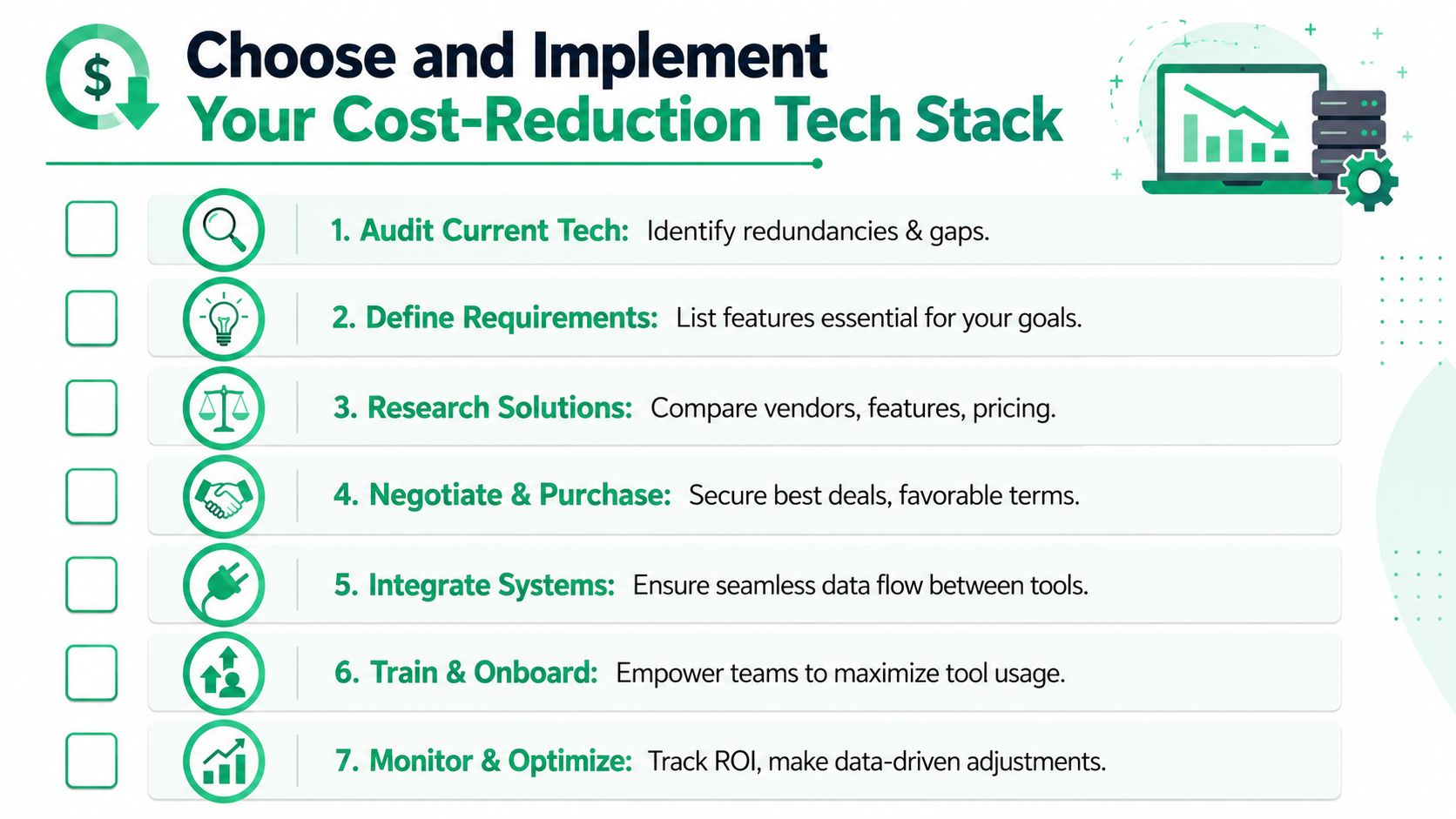
Choose and Implement Your Cost-Reduction Tech Stack
A surprising number of brands still treat operations software like a patchwork. One tool for support, another for returns, another for shipping, a spreadsheet for approvals, and a lot of manual glue in between. That stack feels manageable until order volume rises. Then every gap turns into labor.
The right tech stack doesn't just automate tasks. It removes handoffs, keeps data moving cleanly, and gives each team one source of truth about the order.
Compare old infrastructure with scalable operations tooling
The economics of modern infrastructure are no longer subtle. Integrate.io's analysis of ETL and cost savings says cloud infrastructure adoption delivers 51% lower operational cost than on-premise systems. The same source states that automation technologies can reduce labor costs by 25% to 80%, with organizations typically saving 30% to 40% on overall operational expenses.
For ecommerce brands, the takeaway isn't "move everything because cloud is trendy." It's that manual, brittle, on-premise or semi-manual environments create hidden operating costs that don't show up until the business scales.
Here's the practical comparison:
| Legacy approach | Modern approach |
|---|---|
| Manual exports between systems | Native integrations and real-time sync |
| Local or siloed infrastructure | Cloud-based tooling with flexible scale |
| People as the integration layer | Workflow automation and event-driven rules |
| Training by tribal knowledge | Documented, repeatable process adoption |
Buy for workflow fit, not feature count
The wrong way to select tools is to shop by category. The right way is to start with the workflow that's costing the most time or creating the most error correction.
Evaluate each candidate against a short list:
- Integration reality. Does it connect cleanly with Shopify, your 3PL, ERP, WMS, and support stack?
- Permission design. Can you control who changes what, and when?
- Exception handling. Does it only work in the happy path, or can it manage the messy edge cases?
- Operational visibility. Can finance, support, and ops see the same order state?
- Adoption burden. Will your team use it without building side processes?
This is also where many merchants undervalue AI outside the obvious operational buckets. Media efficiency affects operational efficiency when ad spend is a major cost center. For teams exploring that side, Applying AI for cost-effective ads gives a useful lens on using automation where spend discipline and growth overlap.
Implementation is where ROI is won or lost
Buying software is the easy part. Adoption is harder.
The strongest rollouts usually follow this pattern:
- Start with one painful workflow instead of trying to transform the whole operation at once.
- Define success operationally. Faster resolution, fewer touches, cleaner data, fewer exceptions.
- Train teams by scenario. Show support what happens when an order is edited. Show ops what happens when a cancellation request comes through.
- Review exception logs weekly during rollout so process gaps surface quickly.
- Remove old side processes once the new system proves itself.
If your team still relies on Slack messages and spreadsheets to override the system, the implementation isn't finished.
A cost-reduction tech stack should make the business simpler to run. If it adds more dashboards than clarity, it's not reducing costs. It's moving them.
Build Your Operational Flywheel for Sustainable Growth
Margin usually leaks faster in the handoff between savings and reinvestment than in the original workflow itself. A brand removes support tickets or warehouse exceptions, sees costs improve for a quarter, then lets the benefit vanish into general overhead. The brands that scale cleanly treat those savings as budget with a job.
A better operating model is disciplined reinvestment. If automation removes repetitive service work, the next question is not whether costs went down. Instead, the question is where that newly available time and margin should go to produce more gross profit.
One pattern works especially well in DTC. Reduce post-purchase labor first, then put part of that savings into revenue moments that happen after checkout, where customer intent is still high and acquisition cost is already paid.
What this looks like in practice
A high-growth beauty brand I worked with had a familiar problem set. Support was buried in order edits, address fixes, and "where is my order" tickets. Ops was spending time correcting avoidable fulfillment mistakes. The brand did improve its cost profile after shifting common post-purchase requests into self-service, but the bigger win came from what happened next.
Leadership did not treat the labor savings as a vague margin improvement. They reassigned support capacity toward save-the-sale conversations, VIP issue handling, and subscription retention. They also added post-purchase upsell offers in the order management flow, focused on replenishment add-ons and low-friction accessories that shipped with the existing order.
That changed the economics of the project.
The initial win was lower ticket volume and fewer manual touches per order. The second win was higher average profit per customer interaction, because the same post-purchase moment that used to generate cost now generated incremental revenue. Returns pressure also improved because customers got cleaner order data, faster corrections, and fewer fulfillment errors to begin with.
Reinvestment works best when it is specific
Operators should assign savings to named uses, not broad intentions. In practice, the strongest reinvestment buckets tend to be:
- Post-purchase upsells that increase contribution margin without adding meaningful acquisition cost
- Retention work such as subscription rescue, proactive service recovery, and higher-value support coverage
- Operational visibility so finance, CX, and ops can catch exception patterns before they become expensive habits
- Process hardening in fraud review, returns routing, and order edit controls, where a small mistake can erase a month of software savings
The trade-off is real. If every dollar saved goes straight to headcount reduction, the P&L may look better for a quarter, but the business often misses the compounding effect. If every dollar gets pushed into growth experiments without control, complexity returns and costs climb again. Strong operators split the gain. They protect part of the savings. They reinvest part where the payback is close to the transaction.
That is how cost reduction stops being a cleanup project and starts acting like a profit engine.
If your Shopify team wants to reduce support workload while opening up post-purchase revenue opportunities, SelfServe is built for exactly that. It lets customers manage approved order changes on their own, helps merchants stay in control of edit windows and permissions, and adds upsell opportunities directly into the post-purchase flow. For high-volume brands, it's a practical way to turn operational friction into a better customer experience and a more efficient margin profile.