Reverse Logistics Companies - reverse logistics companies: A Guide to Returns
Think of a reverse logistics company as the specialist that handles everything after the sale. When a customer sends a product back, these partners manage its entire journey—from the moment it leaves the customer's hands until it's back in your inventory, ready for its next life.
Instead of letting returns become a chaotic cost center, they help you turn the process into a strategic advantage.
Why Reverse Logistics Is No Longer Optional
For a long time, returns were just a messy, unprofitable part of doing business—an afterthought for most companies. Today, that's completely changed. How you handle returns directly impacts customer loyalty and your bottom line. Reverse logistics companies professionalize this entire backward flow of goods, moving products from the customer back through the supply chain to either recapture value or dispose of them responsibly.
For any ecommerce brand, especially those on a platform like Shopify, a great post-purchase experience is table stakes. Customers now expect returns to be just as easy and convenient as the original purchase. A clunky or confusing returns process doesn't just lose you that one sale; it can cost you a customer for good. This is where a dedicated partner becomes the hidden engine that keeps your business moving forward.
The Scale of the Returns Challenge
The explosion of online shopping has completely rewired customer behavior and, with it, the flow of products. The reverse logistics market has grown into a massive global industry, valued at an incredible USD 823.2 billion and on track to hit USD 3.18 trillion by 2033.
What's driving this? Online shoppers return roughly 30% of their purchases, a huge jump from the 8-10% return rate seen in traditional brick-and-mortar retail. This creates a massive logistical puzzle for direct-to-consumer brands. You can dig into more data on this trend and its market impact.
A strong reverse logistics strategy does more than just handle returns; it transforms a potential loss into an opportunity for improved customer satisfaction, value recovery, and sustainable operations. It's about playing offense, not just defense.
These specialized partners bring the infrastructure and expertise that most brands simply can't afford to build in-house. They offer a whole suite of services designed to manage this backward flow as efficiently as possible. This typically includes:
- Making returns easy for customers: Creating a simple, user-friendly process for initiating and sending back an item.
- Processing items quickly: Once a return arrives, they inspect, sort, and decide where it should go next.
- Recapturing maximum value: They're experts at identifying which items can be resold, refurbished, or recycled.
- Providing crucial data: You get insights into why products are being returned, which helps you fix underlying issues.
Ultimately, working with a reverse logistics company frees you up to focus on what you do best—growing your brand—while they handle the complex and resource-heavy process of managing everything that comes back.
How Reverse Logistics Providers Turn Returns Into Revenue
Let's be honest, returns can feel like a punch to the gut for any business. But what if you could flip that script? That's exactly what an expert reverse logistics company does. They transform the headache of returns into a well-oiled machine that actually generates value.
This isn't just about accepting a package at the warehouse door. It’s a complete system designed to squeeze every last drop of value out of a returned item, turning a potential loss into a recoverable asset.
The whole process kicks off the second a customer decides to send something back. Instead of a messy back-and-forth over email, a professional system takes over. This makes the experience smooth for the customer and, just as importantly, sets up your team for efficient processing on the back end.
This flowchart gives you a bird's-eye view of how a smart returns process funnels products back into the system to recapture value and slash waste.
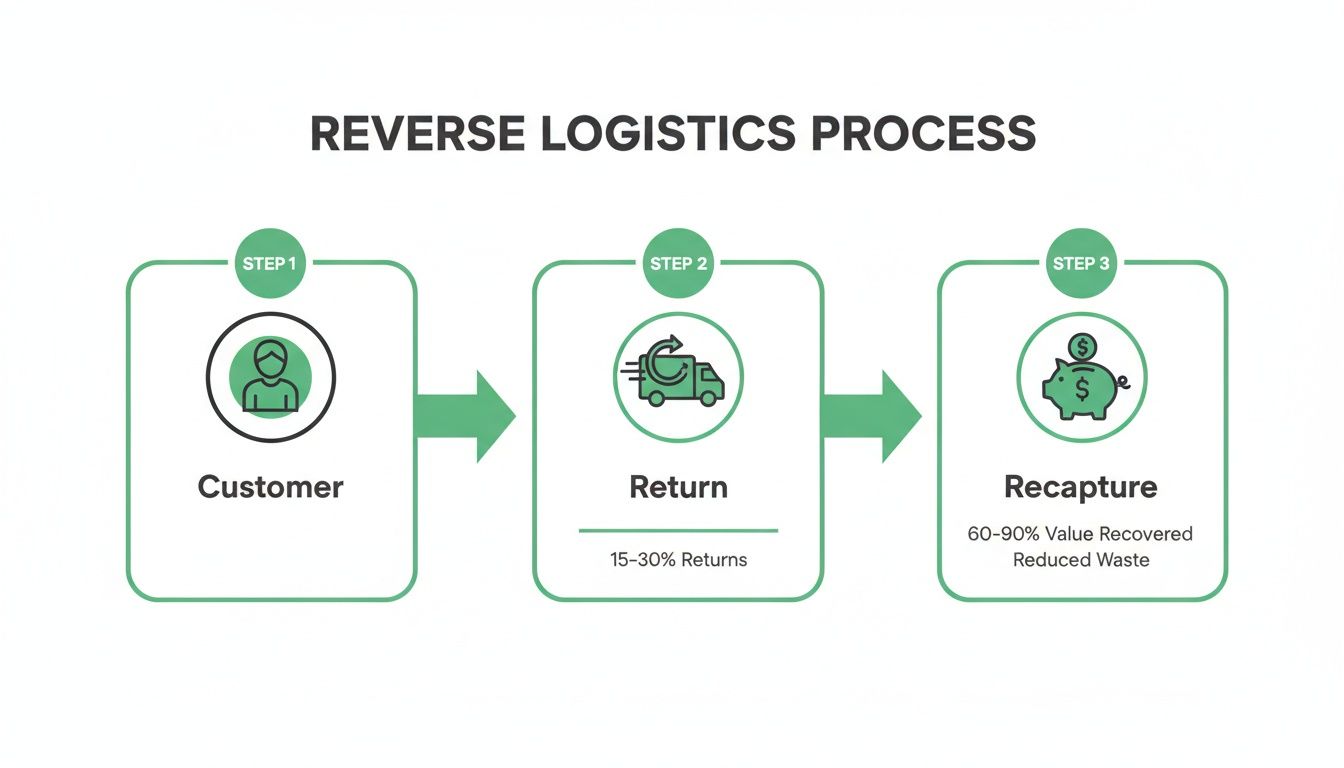
As you can see, a huge chunk of those returned goods can be recovered. This isn't just about damage control; it's about turning a negative into a real financial positive.
The Journey From Return to Recovery
It all starts with the Return Merchandise Authorization (RMA). Think of this as the official digital handshake that gets the ball rolling. A good RMA system, often plugged directly into your Shopify store, gives customers a simple way to start their own return, print a label, and see where it is in the process. No support ticket needed.
Once the item lands back at the warehouse, the real work begins with inspection and grading. Is the box still sealed? Is it like-new but opened? Or does it have a few scuffs? This initial sorting is crucial because it decides where the product goes next.
From there, the item is sent down one of several paths:
- Refurbishment and Repair: If a product has a minor flaw, it gets sent to the "hospital." Technicians can clean it up, fix a small issue, or just repackage it to look brand new again.
- Remarketing and Resale: A great partner knows exactly how to sell these refurbished or open-box items. They have established secondary channels—think B-stock marketplaces or their own direct-to-consumer outlets—to find the right buyer at the best price.
A world-class reverse logistics operation isn’t just about processing returns; it’s about making intelligent, data-driven decisions at every step to maximize recovery and protect your brand’s integrity.
Closing the Loop Responsibly
Of course, not every product can be saved. For items that are broken beyond repair or simply at the end of their useful life, the focus pivots to sustainability.
A responsible partner will handle recycling and proper disposal, breaking down items to salvage raw materials and making sure any hazardous parts are dealt with correctly. This keeps your products out of landfills and reinforces your brand's commitment to being environmentally conscious.
This level of efficiency is becoming non-negotiable, especially in North America, where the reverse logistics market is set to hit a staggering USD 560.8 billion by 2033. This boom is fueled by the fact that e-commerce returns already cost U.S. businesses over $100 billion each year. This puts incredible strain on Shopify brands, whose support teams can spend up to 20% of their time just on manual order issues. You can dive deeper into the U.S. market's scale and challenges to see the full picture.
One of the best ways to ease this burden is by empowering customers. Giving them a self-service customer portal can dramatically cut down on the manual work your team has to handle.
Measuring What Matters in Your Returns Process
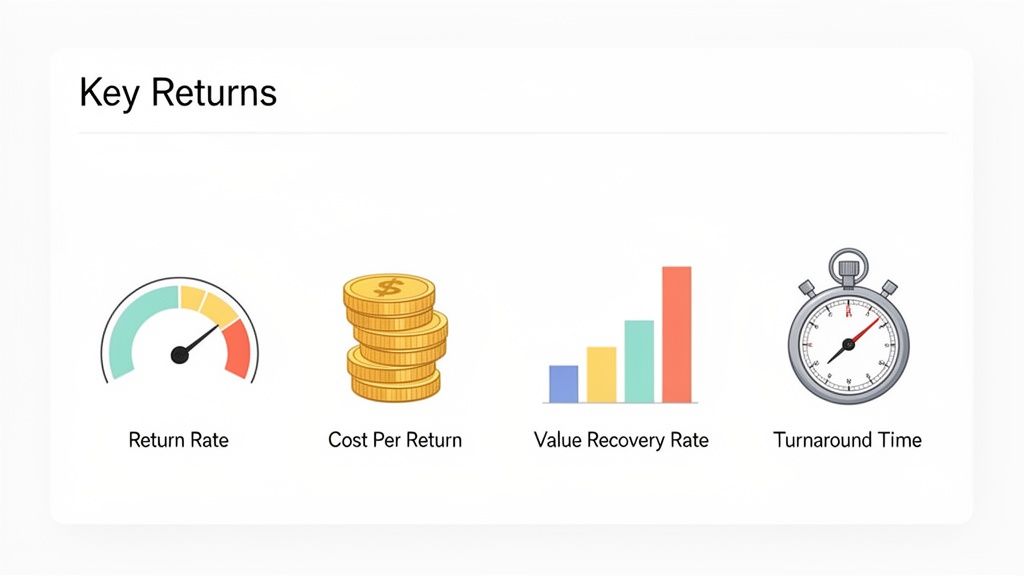
You can't fix what you can't see. Running a returns process without clear metrics is like flying blind—you're spending money, but you have no idea if you're making smart decisions or just burning cash. To get a real grip on your returns operation, you have to track the right Key Performance Indicators (KPIs).
These aren't just numbers for a spreadsheet; they're the vital signs of your entire post-purchase experience. They reveal the true cost of each return, shine a light on operational bottlenecks, and help you build a solid business case for partnering with a specialized reverse logistics company.
The KPIs That Actually Matter
To get the full picture, you need to zero in on a handful of metrics that show how efficient, costly, and valuable your returns process really is. Each one tells a unique part of the story, from why customers send things back to how fast your warehouse team is moving.
Here are the essential KPIs every ecommerce merchant should have on their dashboard:
- Return Rate: This is the big one—the percentage of items sold that come back. If this number is creeping up, it could be a red flag for everything from misleading product photos to quality control issues.
- Cost Per Return (CPR): This is the all-in expense to process a single return. It bundles together the cost of the shipping label, the payroll for your team to inspect and handle the item, and even the time your customer support team spends on it.
- Turnaround Time (TAT): This measures how long it takes to make a customer happy again, from the moment they request a return to when their refund is issued or their exchange is shipped. Faster TAT almost always equals a happier customer.
Value Recovery Rate is arguably the most powerful metric of all. It calculates how much of a product's original retail value you claw back through resale, refurbishment, or recycling. This is the KPI that reframes returns from a pure cost center into a potential revenue stream.
Digging Into the True Cost of Returns
While KPIs give you a great 30,000-foot view, the real magic happens when you understand the specific costs that drive them. Your Cost Per Return isn't a single line item; it's a mix of several expenses that can balloon if you're not paying attention.
The primary cost drivers you need to watch are:
- Transportation and Shipping: The price of getting that product from the customer's front porch back to your facility.
- Labor and Processing: The wages you pay your team to physically receive, inspect, sort, and process every item that comes back.
- Warehousing and Storage: The cost of the physical shelf space needed to hold returned inventory before it’s resold, refurbished, or recycled.
- Technology and Platform Fees: The recurring software costs for your returns management portal and any associated tools.
- Value Depreciation: The silent killer. This is the value a product loses for every day it sits in a box instead of being processed and put back into sellable inventory.
When you break down these costs, you can scrutinize a provider’s pricing with a much sharper eye and spot any hidden fees. A transparent partner will give you clear data on these drivers, helping you fine-tune your entire returns workflow to squeeze out every bit of efficiency and value.
Integrating Your Reverse Logistics Partner with Shopify
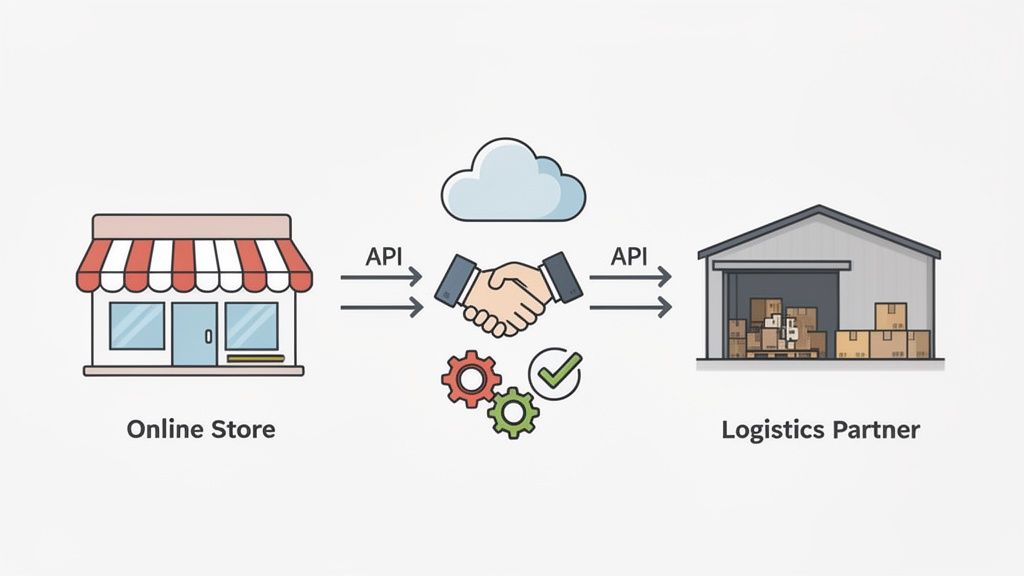
If you're running a Shopify store, your reverse logistics partner isn't just another vendor—they're an extension of your operations. For this relationship to work, your systems need to talk to each other flawlessly. This isn't just a technical nicety; it's the very foundation of an automated returns process that keeps customers happy and your team sane.
This connection is made possible by an API (Application Programming Interface). Think of an API as a dedicated translator between your Shopify store and your partner’s software. It allows them to share data back and forth instantly. When a customer starts a return, this digital handshake ensures every step is tracked and updated automatically, all without manual intervention from your team.
From Manual Headaches to Automated Workflows
Without a proper integration, your customer support team is buried in manual work. They're stuck creating RMAs, emailing shipping labels, checking tracking numbers, and then trying to remember to update inventory spreadsheets. It’s a tedious, error-prone process.
But when your systems are connected, that entire workflow clicks into place automatically.
This creates a positive chain reaction:
- Instant RMAs: The moment a customer submits a return request, the system generates the Return Merchandise Authorization number. No delays.
- Live Status Updates: Everyone stays in the loop. You and the customer can see the return's journey in real-time, from the moment it ships to when it's inspected at the warehouse.
- Automatic Inventory Sync: As soon as an item passes inspection, your Shopify inventory is updated. Good-as-new products are immediately put back into stock, ready to be sold again.
This kind of automation is a game-changer. When you consider that support teams can spend up to 20% of their time fixing manual order errors, this integration frees them up to focus on what really matters: helping customers.
Getting Ahead of Returns Before They Happen
A smooth returns process is great, but what’s even better? Preventing returns in the first place. Surprisingly, many returns don't stem from product issues but from simple, fixable mistakes, like a typo in the shipping address. This is where modern post-purchase tools can make a huge difference.
Giving customers a bit of control with self-service options can solve these problems before they even start.
A proactive post-purchase strategy empowers customers to fix their own mistakes. This not only cuts down on preventable returns but turns a potential headache into a positive brand experience.
For example, allowing a customer to edit their shipping address for a short time after they place an order can nearly eliminate those frustrating—and costly—"return to sender" packages. We dive deeper into these tactics in our guide on how to manage returns smoothly on Shopify.
Turning Cancellations Into Upsells
Here’s another smart move: use the post-purchase window to tackle "buyer's remorse." Instead of letting a customer cancel an order outright, you can present them with a compelling alternative right on their order status page.
Let's say a customer wants to cancel because they picked the wrong size. A timely offer could let them swap for the correct size or even add a complementary item to their order. Suddenly, you haven't just saved a sale—you've potentially increased its value.
By pairing the right reverse logistics companies with smart post-purchase tools, you create a system that doesn't just manage returns, but actively works to reduce them.
How to Choose the Right Reverse Logistics Partner
Choosing a reverse logistics partner is a lot like hiring a key employee. The right fit can be a massive boost to your growth, but the wrong one will cause endless headaches. To get it right, you need to go way beyond a simple price sheet and dig into the details with a structured evaluation. This is about finding a partner who can truly handle your operational needs now and support you as you grow.
First things first, let's talk tech. For any Shopify merchant, this is non-negotiable. You have to ask about their integration capabilities right out of the gate. Do they have a pre-built Shopify connector? How deep does it go? A good integration should automate RMA creation, push real-time status updates back to your system, and adjust inventory levels automatically. This isn't a "nice to have"—it's the bedrock of an efficient returns process.
Evaluate Core Operational Capabilities
Once you’ve confirmed the tech is solid, it's time to look at their physical operations. Slick software means nothing without the warehouse muscle to back it up. You need to ask some pointed questions about their capacity, typical turnaround times, and—critically—how they manage seasonal spikes in volume. The last thing you want is a partner who crumbles under the pressure of your Black Friday returns wave.
Here's a quick checklist to guide your vetting:
- Service Level Agreements (SLAs): Get specific. What are their guaranteed processing times for inspecting, grading, and issuing credit? Don't accept vague answers.
- Processing Capacity: How many returns can they actually handle per day or week? Make sure this number aligns with your current volume and, more importantly, your growth projections.
- Grading and Disposition Accuracy: What's their process for deciding if an item is good enough to resell, needs a little TLC, or has to be recycled? Consistency here is key to maximizing your recovery value.
Assess Reporting and Scalability
A great partner doesn't just move boxes; they provide data. Take a hard look at their reporting and analytics. Can their dashboards give you clear, actionable insights into why customers are returning products? Do they track value recovery rates and per-unit processing costs? This kind of data is gold for making smarter decisions about your products and marketing.
Beyond the data, think about their footprint. If you have ambitions to expand internationally, you need a partner who can manage cross-border returns without creating a nightmare for your customers. This is a bigger deal than ever. The Asia Pacific region, for example, now accounts for over 53% of global reverse logistics revenues, fueled by an e-commerce explosion that has seen returns jump 25% year-over-year. Global brands need partners who can navigate different languages and complex logistics. You can learn more about these regional logistics trends to see just how important this is.
A partner's value isn't just in processing returns today, but in providing the scalable infrastructure and actionable data you need to grow tomorrow.
Finally, break down their pricing. Insist on total transparency. A straightforward model that aligns with your business goals is what you're after—not a confusing contract riddled with hidden fees. By carefully evaluating these key areas, you can find one of the best reverse logistics companies that will feel like a true extension of your own team.
For a deeper look at the technology that makes all of this possible, check out our guide on third-party logistics software.
Common Questions About Reverse Logistics for Shopify Stores
Diving into the world of returns management can feel a bit overwhelming, especially when you're busy scaling your Shopify store. You know it's important, but figuring out the when and how of partnering with a reverse logistics company can be tricky. Let's break down some of the most common questions we hear from merchants.
When Should My Shopify Store Hire a Partner?
There’s no magic number that works for everyone, but there are definitely some clear signs that it’s time to call in an expert. A big one is team bandwidth. If your crew is spending more than 15% of their time just dealing with returns, you're paying for labor that could be driving growth instead.
Other red flags? You're physically running out of space to handle returned inventory, or you're consistently processing over 50-100 returns per month. If you can't get a returned product inspected, processed, and back into your system within 48 hours, you're losing money. A specialist brings in systems and efficiencies that are almost impossible to build when returns are just a side task.
What Is the Difference Between a 3PL and a Reverse Logistics Company?
This is a really important distinction. A traditional 3PL (Third-Party Logistics) is a master of "forward" logistics—their entire world revolves around getting your products out the door and to your customers as quickly and cheaply as possible. Their warehouses, software, and workflows are all built for one-way traffic.
A reverse logistics company, on the other hand, specializes in the messy, unpredictable journey of products coming back. They live and breathe the complexities of inbound returns.
A 3PL’s job is to get products out. A reverse logistics partner’s job is to bring them back intelligently, focusing on inspection, grading, refurbishment, and recovering value—things most 3PLs just aren't set up to do well.
Sure, some of the big 3PLs have started offering reverse services, but a dedicated partner will almost always have deeper expertise. They’re focused on turning your returns into assets, not just writing them off as a loss.
How Can I Lower My Return Rate in the First Place?
The best return is the one that never happens. Getting ahead of the problem is your most powerful tool.
- Beef Up Your Product Pages: Don't just list specs. Use high-resolution photos from every angle, videos of the product in action, and ridiculously detailed size guides. The more you manage customer expectations upfront, the fewer surprises they'll have when the box arrives.
- Let Customers Fix Their Own Mistakes: Think about how many returns are caused by simple errors. By using a tool that lets a customer fix a shipping address typo or update their contact info right after they order, you can wipe out a whole category of "return to sender" headaches.
- Offer Smart Upsells: We've all had that moment of "buyer's remorse." Instead of letting a customer stew on it and hit cancel, you can offer a compelling upsell on the order status page. This can turn their indecision into a bigger, more satisfying purchase, stopping a return before it even starts.
Can a Reverse Logistics Partner Improve Sustainability?
Absolutely. A good reverse logistics program is the engine of a circular commerce model, which is something more and more shoppers care about. Instead of tossing returned items into a landfill, your partner finds a home for everything.
Products in good shape can be refurbished and prepped for resale. For those that are truly at the end of their life, a good partner will handle responsible recycling or harvest usable parts. This isn't just about reducing waste; it’s a powerful story you can share with your customers, building your brand's reputation with shoppers who vote with their wallets.
Ready to stop returns before they happen? SelfServe empowers your Shopify customers to fix their own order mistakes, from address typos to contact info updates, all while offering revenue-boosting upsells on the order status page. Reduce support tickets and increase AOV with a free 30-day trial of SelfServe.