Shipping and Returns: Profit Driver for Shopify Plus in 2026
If you’re a high-volume merchant, you know that shipping and returns aren't just logistical hurdles. They're a fundamental part of your customer experience that can either forge lasting loyalty or quietly bleed your business dry. Get it wrong, and you create friction that sends customers running. But get it right, and you turn the post-purchase journey into your most powerful growth engine.
Why Your Shipping and Returns Strategy Might Be Costing You Sales
Let's be real for a moment. Your approach to shipping and returns isn't just a line item on a spreadsheet—it's a critical touchpoint that might be actively costing you sales. For stores moving serious volume, even the smallest snags can snowball into massive losses, turning a would-be brand advocate into a frustrated, one-time buyer.
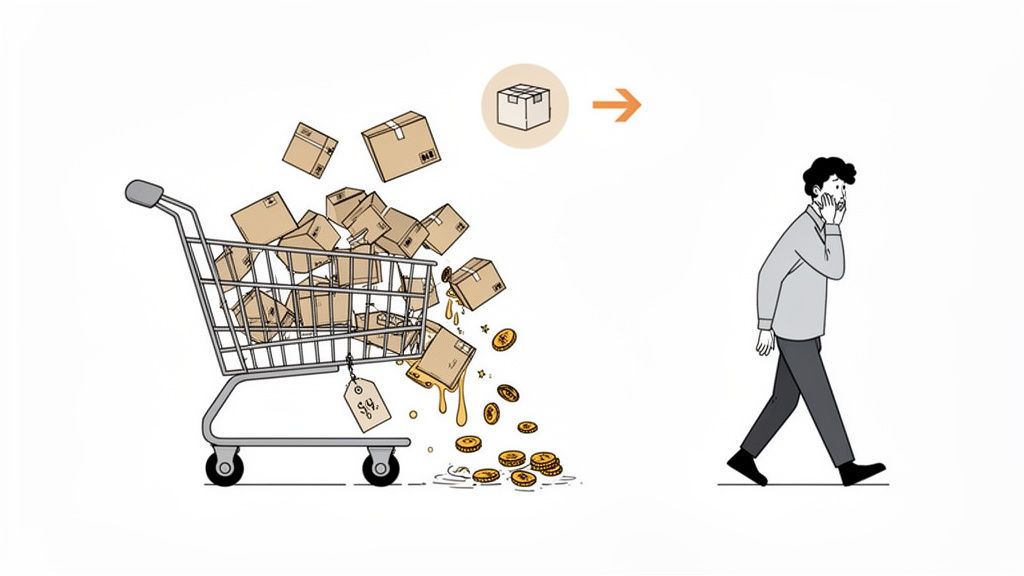
The trouble often begins with the most predictable, yet painful, issue: shipping costs. In our global ecommerce reality, unexpected delivery fees are the number one reason people abandon their carts.
In fact, a staggering 58% of consumers pointed to high shipping costs as their top frustration in 2025. This isn't a minor hiccup; it's a major roadblock that can lead to cart abandonment rates as high as 81% when shoppers don’t find the delivery options they expect.
This reactive, problem-solving mindset—where shipping and returns are treated as an afterthought—is incredibly expensive. It's time to stop thinking of this as a cost center and start seeing it for what it truly is: your single biggest opportunity for growth and retention.
From Reactive Damage Control to Proactive Growth
A proactive strategy is all about anticipating your customers' needs before they turn into support tickets. Think of the post-purchase window as the new frontier for building brand loyalty. Instead of just reacting to problems like a wrong address or a damaged item, you can empower customers to solve these issues themselves, instantly. For scaling brands, this shift isn't just nice—it's necessary.
Before we dive into the specific policies and workflows, let's zoom out and look at the common pain points that trip up customers and what that means for your business.
| Customer Friction Point | Impact on Your Business | High-Level Solution |
|---|---|---|
| High, unexpected shipping costs at checkout | The leading cause of cart abandonment, directly hitting your conversion rate. | Offer transparent, tiered shipping options (including free shipping thresholds). |
| Complicated or unclear return policies | Damages brand trust and deters future purchases. Customers fear being "stuck" with an item. | Create a clear, customer-friendly policy and a self-service returns portal. |
| Inability to edit an order post-purchase | A simple typo leads to failed deliveries, returned packages, and manual support work. | Enable post-purchase order editing for addresses, items, and shipping methods. |
| Lack of proactive delivery updates | Customers are left in the dark, leading to "Where is my order?" (WISMO) support tickets. | Implement automated, branded tracking pages and proactive notifications. |
Each of these friction points represents a moment where a customer can either become frustrated or delighted.
By treating the post-purchase journey with the same strategic care you give your marketing funnel, you can transform these potential liabilities into loyalty-building assets. We cover many of the foundational elements in our guide to shipping and fulfillment best practices.
The goal is to move away from simply doing damage control and toward creating a truly seamless experience that delights customers at every step. This is how you drive higher lifetime value and build a brand that people love to buy from again and again.
Crafting Your High-Conversion Policy
A world-class shipping and returns policy isn't just fine print—it's one of your most powerful sales tools. For high-volume merchants, it’s a non-stop engine for building trust. Forget about grabbing a generic template; your policy needs to be a clear, reassuring guide that turns hesitant browsers into confident buyers.
It all starts by tackling the biggest customer fears head-on. Shoppers in 2026 have sky-high expectations, and falling short is a surefire way to bleed revenue. High shipping costs and confusing return processes aren’t just minor inconveniences anymore. They’re deal-breakers.
The numbers don't lie. Free shipping and returns are table stakes now, with 1 in 2 global shoppers saying they primarily buy from stores offering both for free. What's more, 7 in 10 customers will bounce from a site if they don't trust its delivery promise, and a staggering 79% will ditch their cart if their preferred returns option is missing. You can get a better handle on these expectations by reviewing the full 2025 delivery and returns trends.
This data paints a very clear picture: your policy's number one job is to eliminate friction and build immediate confidence.
Setting Clear Expectations and Building Trust
The bedrock of a policy that converts is clarity. Vague language breeds uncertainty, and uncertainty kills sales. Every detail, from the return window to the condition of returned items, must be spelled out in simple, human terms.
Define Your Return Window: While 30 days is a common standard, think about offering a longer window (like 60 days) for store credit. This shows you're confident in your products and helps you keep that revenue in-house by encouraging customers to find something else they love.
Specify Item Conditions Clearly: Be direct. Instead of corporate-speak like "must be in original condition," try something like "items must be unworn, unwashed, with all original tags attached." There's absolutely no room for misinterpretation there.
Structure Refund Options Strategically: Give customers options. A full refund to the original payment method is a must, but you can gently nudge them toward store credit by offering a small bonus. For example, "Get a full refund, or choose store credit and we'll add an extra $10." It's a simple move that can seriously help your cash flow.
Your policy is more than just a list of rules; it's a promise to your customer. When you're transparent and flexible, you're showing them you stand behind your products and value their business. While a clear shipping and returns policy is a fantastic start, it's just one piece of the puzzle; you can also dig into other proven tactics to improve ecommerce conversion rates and strengthen your entire sales funnel.
Navigating International Shipping and Compliance
For high-volume brands, selling globally adds a whole new layer of complexity. An international customer should feel just as secure buying from you as someone domestically. That means you need to be upfront about duties, taxes, and regional laws.
You have two main ways to handle customs duties and taxes:
Delivery Duty Paid (DDP): This is the gold standard. The customer pays all duties and taxes right at checkout. No surprise bills show up at their door, which creates a smooth, trustworthy experience that builds loyalty.
Delivery Duty Unpaid (DDU): With this method, the customer is on the hook for any import fees when the package lands in their country. It might seem simpler on your end, but it can easily lead to unhappy customers ambushed by unexpected costs.
On top of that, you have to play by the local rules. For instance, the European Union has a mandatory 14-day "cooling-off period" where customers can return any online purchase, no questions asked. Your policy must reflect and honor laws like these to avoid legal trouble and earn trust in those markets. Being transparent about these international details in your shipping and returns policy isn't optional—it's essential.
Optimizing Your Reverse Logistics Workflow
Having a clear policy is a great first step, but it's only theory. Now it's time to put that policy into practice by building a modern, efficient operational workflow for your shipping and returns.
It helps to think of your returns process less like a customer service headache and more like a "reverse factory." Every item that comes back needs to be inspected, sorted, and sent to its next best destination—whether that’s back on the shelf, off to a liquidator, or sent for recycling.
This reverse factory mindset immediately helps you spot where you're losing money and where you can improve. An un-optimized workflow bleeds cash at every step, from bloated labor costs to lost product value. For high-volume brands, even tiny improvements can add up to massive savings. The goal is to re-engineer this entire process for speed, accuracy, and customer happiness, starting from the second a customer decides to make a return.
Building a Modern, Tech-Enabled Returns Process
The old way of handling returns—endless email chains, manually creating labels, and random packages showing up at your warehouse—simply won’t work for a growing business. A modern workflow starts by giving customers control through a self-service portal and finishes with a slick backend process your team can easily manage.
This process breaks down into a few key stages, each with its own costs and opportunities to get smarter. The infographic below lays out the core elements of a high-conversion policy that your operations need to support.
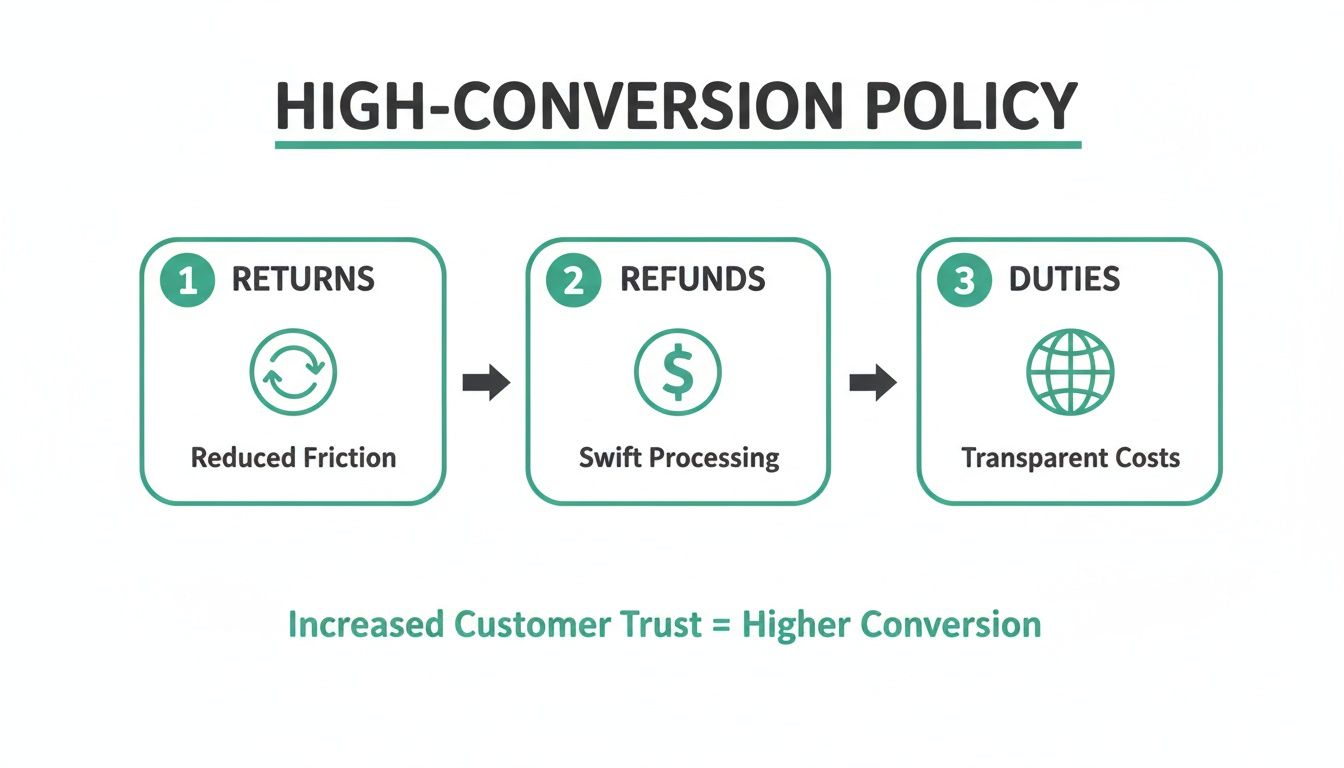
As you can see, things like easy returns and fast refunds build trust that helps drive sales. But those front-end promises are only as good as your back-end operations. If you can’t deliver, you’ll just create frustrated customers.
And the financial stakes here are staggering. E-commerce returns have become a huge problem for merchants, with global online return volumes expected to jump by 18% in 2025 alone. The entire reverse logistics market is projected to hit an incredible $936 billion by 2026.
The costs go far beyond the refund itself. Processing a single return can cost $8-12 in shipping, another $5-8 in handling, and $2-4 for restocking. On top of that, 10-25% of returned goods are often too damaged to be resold at all.
Key Decision Points in Your Workflow
To build a system that doesn't sink your profits, you have to make smart decisions at a few critical points along the returns journey. The aim should be to automate as much as you can while still keeping control.
Here are the core stages to nail down:
Return Initiation: This is where it all begins. Ditch the generic "contact us" form and implement a branded, self-service returns portal. This portal should walk customers through the process, let them select their reason for return, and show them different ways to resolve the issue.
Label Generation: Manually creating shipping labels is a huge time-waster and a recipe for errors. A good returns management system (RMS) will automatically generate a prepaid return label or QR code based on the rules you set.
Resolution Options: Don't just default to a refund. A smart portal will offer alternatives that help you keep the revenue. You can offer things like "instant exchanges," where the new item ships out as soon as the carrier scans the return package. This wows the customer and helps you save the sale.
Receiving and Inspection: When a package arrives back at your warehouse, your team needs a crystal-clear, standardized process. Is the item in perfect condition? Does it need minor repairs? Or is it headed for donation or recycling? To truly optimize your reverse logistics workflow, you can explore effective reverse logistics solutions to streamline returns and manage excess inventory.
Key Insight: The most expensive part of a return isn't always the refund—it's the operational drag. Automating tasks with a returns management system (RMS) can slash your cost-per-return by cutting down on manual labor, preventing costly errors, and getting products back into stock faster.
By tackling each of these stages one by one, you can turn your returns process from a chaotic cost center into a powerful tool for customer retention. For more help, you can also explore our guide on some of the top reverse logistics companies that can manage this for you. Your investment in an efficient reverse workflow will pay you back over and over in both cost savings and customer loyalty.
Reducing Returns Before They Happen
The best way to handle a return? Prevent it from ever happening. While a slick returns process is essential, the real win is stopping those returns at the source. It’s a shift from playing defense to having a strong offense.
Sure, great product pages with detailed photos and honest reviews are table stakes. But the biggest, often overlooked, opportunity to slash your return rate happens in the moments right after a customer clicks "Buy." Most preventable returns aren't because someone hated the product; they're the result of a simple, fixable mistake made during checkout.
Think about the classic, frustrating reasons for a return. A customer mistypes their apartment number. They accidentally order a size Medium instead of a Large. Or they realize they meant to add one more item to their cart. Traditionally, fixing this meant a frantic email to your support team, leading to a poor customer experience and more manual work for you.
The most effective way to cut down on these returns—and the support tickets they create—is to give customers the power to fix these small mistakes themselves.
Giving Customers Control Post-Purchase
The secret is post-purchase order editing. This doesn't mean a free-for-all where customers can change anything at any time. It's about giving them a specific, time-sensitive window to make crucial adjustments on their own through a self-service portal.
Imagine a customer places an order and immediately spots a typo in their street address. Instead of panicking and firing off an email, they can log into their order, fix it instantly, and go on with their day. That single action just prevented a misdelivery, a returned package, and a support ticket.
Here’s a look at what the customer sees. It’s not complicated; it’s just a clean, simple interface giving them direct control to edit their shipping details.
This is what self-service should look like: straightforward and empowering.
This level of customer control nips common logistical nightmares in the bud, saving you a fortune in unnecessary shipping and returns costs. You simply set a time-locked editing window—say, for two hours after the order is placed—that gives customers just enough time to catch their own errors before the order hits your fulfillment center.
How Self-Service Lightens Your Workload
A good self-service solution does more than just make customers happy; it dramatically reduces your team's manual work and operational overhead. Your customers feel trusted and in control, and your support team is freed up from repetitive, low-impact tasks.
Here’s how it works in the real world:
- Address Correction: A customer can fix a typo in their address, which is then validated in real-time to make sure it’s a real, deliverable location. This one feature alone can nearly wipe out returns from address errors.
- Variant Swapping: Someone who accidentally ordered the wrong size or color can quickly swap it for the correct one. No more size-related returns and exchanges.
- Contact Info Updates: They can fix a typo in their email or phone number, ensuring they actually get your order confirmation and shipping updates.
Don't mistake customer self-service for a loss of control. It's the opposite—it’s a massive gain in efficiency. Modern tools like SelfServe let you define exactly what can be edited and for how long. The system then automatically tags any edited orders, so your fulfillment team knows what’s up. It creates a predictable, automated workflow that solves problems before they even start.
This simple change turns the post-purchase experience from a passive waiting game into an interactive and reassuring part of their journey. It builds trust, and in return, you get fewer returns, happier customers, and significant savings in both time and money.
Turning the Post-Purchase Window Into Revenue
What if your order confirmation page was secretly your most profitable marketing channel? Most brands treat the moments after a customer hits "buy" as the end of the line—a simple transactional receipt. But that’s a huge missed opportunity. This post-purchase window is your final, high-converting chance to boost order value from a customer who is already fully bought in.
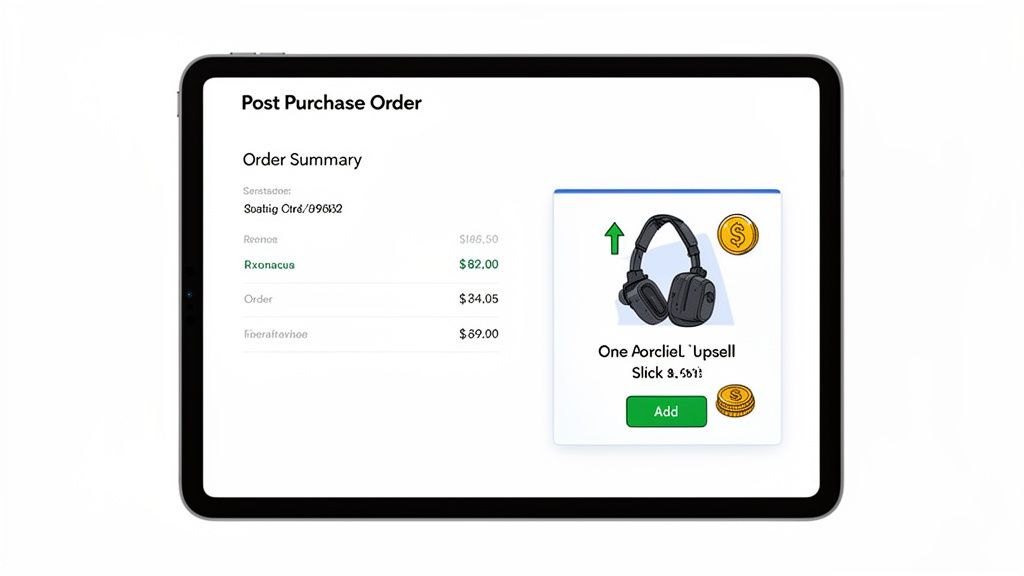
The strategy is all about using your Thank You and Order Status pages for one-click upsells. By showing a relevant, can’t-miss offer right after the initial sale, you can capture a surprising amount of extra revenue without spending a single dollar on new marketing. It’s the digital version of a cashier asking, "Would you like batteries with that?"
The Strategy Behind Post-Purchase Upsells
The logic here is pretty straightforward. The customer has already trusted you with their money, which means their purchase intent is at its absolute peak. Presenting a smart add-on at this exact moment doesn't feel like a disruptive ad; it feels like a genuinely helpful suggestion.
Think of it this way: a customer who just bought a new dress might be thrilled to see a matching handbag or the perfect pair of earrings. Someone buying a coffee machine could be offered a subscription for your best-selling beans. These aren’t random products pushed for a quick buck—they’re logical additions that make the original purchase even better.
For this to really work, the experience has to be seamless. A one-click upsell is non-negotiable. The customer simply taps "Add to Order," and the item is automatically added to their existing order without them having to re-enter any payment or shipping details. This frictionless flow is what drives high conversion rates.
Key Insight: Post-purchase upsells connect with customers at their moment of peak excitement. By offering relevant add-ons on the order status page, you can increase your Average Order Value (AOV) by 5-15% from customers who are already sold on your brand.
How to Implement Upsells Without Disrupting Fulfillment
A common worry we hear is that adding items to an existing order will throw the warehouse into chaos. That's a fair concern, but modern tools are designed to slot right into your fulfillment workflow, keeping everything organized and error-free.
Here’s how you can set up a controlled and effective upsell strategy that won't give your ops team a headache:
Curate Upsell Collections: Don’t offer your entire catalog. Instead, create specific collections of products that are natural add-ons. You could build a "Goes Well With" collection for your bestsellers or an "Under $20" collection for easy impulse buys.
Set Product Restrictions: You need the ability to exclude certain items from being offered. This is perfect for oversized products that have unique shipping rules or items that are constantly at risk of selling out.
Automate Order Tagging: Any order that has an upsell added should be automatically tagged in Shopify (for example, with an "Upsell Added" tag). This simple tag instantly flags the modified order for your fulfillment team, so they know to pack the extra item.
This systematic approach makes it easy for your team to spot and process modified orders, which means there’s no negative impact on your shipping and returns operations. To see exactly how these mechanics work behind the scenes, you can check out our detailed guide on the Shopify post-purchase upsell.
By turning your transactional pages into revenue drivers, you’re transforming a standard part of the e-commerce journey into a powerful engine for growth. It’s a simple, smart way to get more value out of every single customer you bring in.
4. Key Metrics for Post-Purchase Success
If you're flying blind on your post-purchase data, you're leaving money on the table. It’s easy to get lost in vanity metrics, but to really dial in your operations and see a tangible return, you need to track the numbers that actually matter to your bottom line and your customers' happiness.
Think of this as your operational dashboard. These are the key performance indicators (KPIs) that give you a clear, honest look at what’s working, what’s broken, and where you can make changes that will have a real impact.
Your High-Level Health Check
Let's start with the big-picture numbers. These are the core metrics every high-volume merchant needs to watch. They act as your early-warning system, telling you when something might be going wrong in your fulfillment or with your products.
Overall Return Rate: This one’s straightforward—it’s the percentage of items sold that come back to you. While it's a vital baseline, its real value is as a trend indicator. A sudden jump is often the first sign of a mismatch between your marketing and the product, or a potential quality control issue.
On-Time Delivery Rate: What percentage of your orders actually get to the customer by the promised date? A dip here is a direct cause of a flood of "Where Is My Order?" (WISMO) tickets and can quickly erode the trust you've worked so hard to build.
Order Accuracy Rate: This metric tracks the percentage of orders shipped perfectly—no wrong items, no incorrect quantities, no missing pieces. Every mistake here costs you double: you pay to ship the wrong order, and then you pay again to fix it.
These three metrics are your canary in the coal mine. If one starts trending in the wrong direction, it’s a clear signal to dig deeper and find the root cause.
Digging Deeper with Granular KPIs
To move from just identifying problems to actually solving them, you have to get more specific. The high-level numbers tell you that you have a fever, but the granular KPIs are what help you diagnose the illness.
Think of it this way: Knowing your overall return rate is 8% is interesting. But knowing that 60% of those returns are for a single SKU because customers say the color is different in person? That’s an actionable insight you can take straight to your marketing and product teams.
This is where the real magic happens. By breaking down the data, you can pinpoint the exact source of friction in your post-purchase journey.
Here’s a quick-reference table of the essential KPIs that provide this deeper level of insight. Tracking these numbers allows you to move beyond simply managing returns and start actively reducing them.
Essential Shipping and Returns KPIs
| Metric | What It Measures | Industry Benchmark |
|---|---|---|
| Return Rate by SKU | The percentage of returns for a specific product. | Varies by product, but anything significantly higher than your average is a red flag. |
| Return Rate by Reason | The breakdown of returns by reason code (e.g., "wrong size," "damaged," "not as expected"). | A healthy mix is fine, but if one reason dominates, it points to a specific issue. |
| Cost Per Return | The total operational cost to process a single return, including shipping, labor, and restocking. | Aim to keep this as low as possible, often between $15-$25 depending on the industry. |
By keeping a close eye on metrics like Return Rate by Reason, you can spot a sizing issue before it torpedoes your profits or realize a product description needs a quick update. Similarly, understanding your Cost Per Return shows you the true financial drain of your reverse logistics, pushing you to find new efficiencies.
These are the numbers that empower you to build a smarter, more profitable, and customer-friendly operation.
Frequently Asked Questions
When you're managing high order volumes, the same practical questions about shipping and returns tend to surface again and again. Let's break down the common concerns we see from top Shopify merchants and give you some clear, experience-backed answers.
How Long Should My Return Window Be?
While 30 days is the classic answer, many of the fastest-growing brands I work with now view their return window as a powerful marketing tool. Stretching it to 60 or even 90 days can give customers a huge confidence boost, often leading to better conversion without a major spike in actual returns.
For a high-volume store, it’s all about balancing that customer appeal with your inventory management. A great middle ground is a hybrid policy. For instance:
- Offer a 30-day window for a full refund to the original payment method.
- Provide a longer 60-day window for exchanges or store credit.
This approach keeps your customers happy and gives them flexibility, all while helping you hold onto that revenue.
Will Letting Customers Edit Orders Cause Fulfillment Chaos?
This is probably the biggest myth I have to bust. The short answer is no—not with a modern system that puts you firmly in the driver's seat. The fear of post-purchase edits creating a warehouse nightmare is completely understandable, but today’s tools are designed specifically to prevent that.
Think of it as a controlled workflow, not a free-for-all. You set the rules. By giving customers a specific time window (say, 2 hours after purchase) to make changes and automatically tagging those edited orders, you stop problems before they ever hit the fulfillment floor.
This isn't about losing control; it's about giving customers a little flexibility that saves your support team a ton of manual work.
What Is the Best Way to Handle International Returns?
The goal here is to make the experience feel as simple and local as possible for your international customers. The gold standard is partnering with a 3PL that has international return hubs, allowing shoppers to send items back to an address in their own country or region. It completely removes the friction of cross-border shipping for them.
If that's not feasible yet, the absolute minimum is a returns portal that can generate prepaid shipping labels for your key markets. And above all, be radically transparent on your policy page. Clearly state who covers return shipping and any potential duties. No one likes surprises, and being upfront is one of the easiest ways to build trust with a global audience.
Ready to reduce returns, cut support tickets, and increase your average order value? SelfServe empowers your customers with self-service order editing and one-click upsells, giving you more control and more revenue. Start your free trial at https://getselfserve.com.