Shipping E Commerce: Your 2026 Operations Guide
Sales are up. Orders are flowing. The team should be celebrating.
Instead, support is buried in “where is my order?” messages, warehouse staff are catching address typos after labels print, and finance is trying to understand why shipping costs climbed faster than revenue. That's a common stage in shipping e commerce. Growth exposes every weak process at once.
Most brands don't get stuck because they can't buy boxes or connect a carrier account. They get stuck because shipping touches everything at the same time: checkout, fulfillment, customer support, inventory placement, carrier performance, and post-purchase communication. A shipping workflow that works at low volume can break fast once order volume becomes less forgiving.
That pressure isn't unique to one store. Global parcel volume is massive. One industry estimate says the world ships about 217 billion packages annually, or nearly 5,900 parcels every second, up from 185 billion in 2023, according to global shipping and e-commerce statistics. When that many packages move through carrier networks, small merchant-side mistakes become expensive very quickly.
When Good Products Meet Bad Shipping
A lot of DTC brands hit the same wall.
They build a strong product, acquisition works, conversion improves, and order volume rises. Then shipping starts to drag the business back down. The problem usually doesn't show up as one dramatic failure. It shows up as a pile of smaller operational misses: the wrong box size, a missing apartment number, a delayed handoff to the carrier, a customer who emailed support ten minutes after checkout asking to correct their address.
None of those issues sound strategic on their own. Together, they become strategic very fast.
What growth exposes first
The first cracks usually appear in support and fulfillment at the same time:
- Support gets flooded: Customers ask about tracking, delivery timing, address changes, and order edits.
- Ops starts firefighting: Staff manually review holds, fix labels, and message carriers instead of improving process.
- Margin gets squeezed: Replacements, reships, and exception handling turn routine orders into expensive ones.
A brand can have excellent product-market fit and still create a poor customer memory if the shipping experience feels unreliable. Customers rarely separate the carrier's mistake from the merchant's responsibility. If the package arrives late, goes to the wrong address, or gets returned, they blame the store.
Bad shipping doesn't just add cost. It changes how customers talk about the brand.
Why this is bigger than fulfillment
Shipping e commerce is often discussed like a warehouse problem. It isn't. It's an operating model problem.
The warehouse feels the issue first, but the root causes often sit upstream:
- Checkout captured weak data
- The order moved too quickly into fulfillment
- The customer had no clean way to fix a mistake
- The team relied on manual intervention instead of rules
That's why scalable shipping starts with process design, not just carrier discounts. If the inputs are messy, faster fulfillment only accelerates the wrong outcomes.
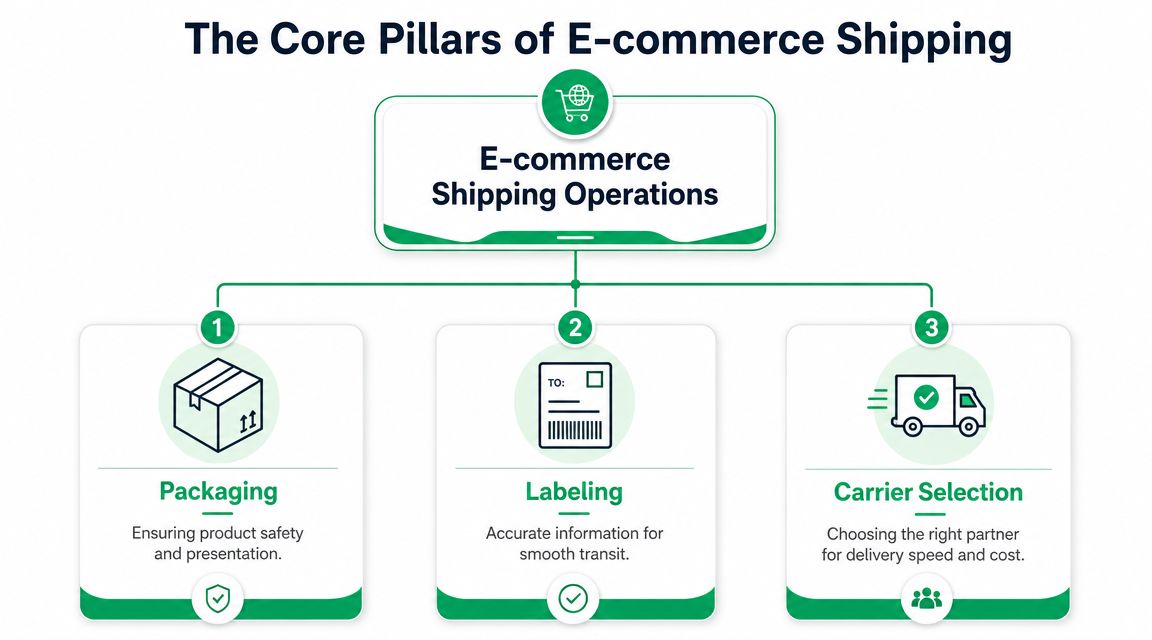
The Core Pillars of Ecommerce Shipping
Treat shipping like a house foundation. If the base is weak, every improvement on top of it becomes unstable.
For most merchants, the essential elements are packaging, labeling, and carrier selection. Tracking matters too, but it works best when those three are already disciplined. If packaging is inconsistent, labels are error-prone, and carrier rules are vague, tracking only gives you better visibility into problems you created earlier.
Packaging
Packaging controls cost, damage risk, and labor time.
A common mistake is treating the box as an afterthought. Teams use whatever carton is nearby, add excess void fill, and wonder why certain lanes are consistently expensive. The goal isn't to minimize packaging at all costs. The goal is to standardize the smallest set of packaging options that protect the product without creating unnecessary shipping cost or pick-pack complexity.
Practical packaging discipline usually includes:
- Box rationalization: Reduce the number of carton sizes so packers make fewer judgment calls.
- Product-to-package mapping: Define which SKUs or SKU combinations belong in which mailer or box.
- Exception rules: Flag fragile, liquid, or irregular items that need a different path.
Dimensional weight matters in real operations because oversized packaging can make a light order behave like a costly one. Merchants don't fix that with guesswork. They fix it by measuring actual shipment patterns and tightening packaging standards.
Labeling
Labeling is where data quality becomes physical.
A shipping label needs the destination information to be complete, formatted correctly, and attached to the right parcel. That sounds basic, but a lot of avoidable shipping failures start here. If warehouse teams are retyping, copy-pasting, or manually correcting address details, the process is already too fragile.
Good labeling operations depend on:
- Automated label generation: Pull order data directly from the commerce system into the shipping workflow.
- Scan-based verification: Match item, parcel, and label before handoff.
- Clear exception handling: Route holds, risky addresses, and special instructions into a visible queue.
Practical rule: If staff must “double-check everything by eye,” the workflow isn't controlled. It's dependent on attention.
Tracking
Tracking isn't just for the customer. It's an internal control system.
Customers want visibility after purchase, but operations teams need tracking for a different reason. Tracking exposes handoff gaps, delayed scans, repeated delivery exceptions, and lanes where a promised service level doesn't match actual performance. It also shapes support behavior. When customers can see clear order status, support doesn't need to answer routine “did it ship yet?” questions by hand.
The best tracking setups do three things well:
- Publish clean status updates: Not just carrier jargon, but understandable milestones.
- Trigger proactive communication: Let customers know when a shipment is moving, delayed, or delivered.
- Feed performance review: Use tracking outcomes to evaluate carriers and service levels over time.
Choosing Your Shipping Pricing and Carrier Strategy
Most shipping strategies fail because they're built around one question: what's the cheapest rate today?
That question is too narrow. Good carrier strategy balances margin, delivery promise, operational simplicity, and customer expectation. The right answer for a subscription brand shipping lightweight items is different from the right answer for a furniture brand or a cosmetics brand with regional demand clusters.
Pricing model choices
The checkout shipping offer changes both conversion and back-end execution. There isn't one perfect model.
Flat-rate shipping works best when your product mix is predictable. It simplifies the customer decision and keeps checkout clean. The trade-off is that some orders will be more profitable than others, and you need enough consistency in package profile to make the math work.
Real-time carrier rates are useful when order profiles vary widely. Customers see more accurate shipping costs, and you reduce the risk of undercharging on expensive shipments. The trade-off is that checkout becomes less controlled, and some customers react badly to high live rates.
Free shipping can be effective when margins, pricing structure, and average order economics support it. The operational trap is obvious. Shipping doesn't become free just because the customer doesn't see a line item for it. You still have to recover that cost somewhere in the model.
For merchants with heavy or oversized products, standard parcel logic often breaks down. If you're evaluating packaging and transport economics for bulkier orders, this guide to cost-effective heavy item shipping is a useful operational reference.
Carrier mix is a portfolio decision
Relying on one carrier feels simpler. It rarely stays optimal.
National carriers offer broad coverage and mature systems. Postal services can be useful for lightweight residential delivery. Regional carriers can improve economics and service in dense areas where they have strong networks. The point isn't to chase novelty. It's to match carrier strengths to shipment profiles.
| Carrier Type | Best For | Key Strength | Primary Trade-off |
|---|---|---|---|
| National carriers | Broad domestic coverage and mixed service levels | Wide network and operational consistency | Can be expensive on certain zones or parcel types |
| Postal services | Lightweight residential shipments | Often well suited to lower-cost small parcel delivery | Less flexibility for some premium service expectations |
| Regional carriers | Dense regional demand clusters | Strong local performance and lane-specific savings | Limited geographic reach |
What to measure before you renegotiate
A practical benchmark is to target roughly 8 to 12% shipping cost as a share of revenue for many categories and 95%+ on-time delivery, while also tracking cost per zone to spot packaging or routing inefficiencies, according to GoBolt's ecommerce shipping guidance.
Those benchmarks are useful because they force better questions:
- Are you over-promising speed?
- Are high-zone shipments eating margin?
- Are you paying premium rates for customers who don't need premium service?
- Would inventory placement reduce costly lanes?
Carrier decisions should come from service performance by lane, parcel profile, and promise window. If you're comparing major providers for international and premium parcel use, a side-by-side review of DHL vs FedEx for e-commerce shipping can help frame that decision.
Carrier selection gets better when you stop asking “Who is cheapest?” and start asking “Who performs best for this order profile?”
Navigating International Ecommerce Shipping
International expansion usually looks intimidating until you break it into operating decisions.
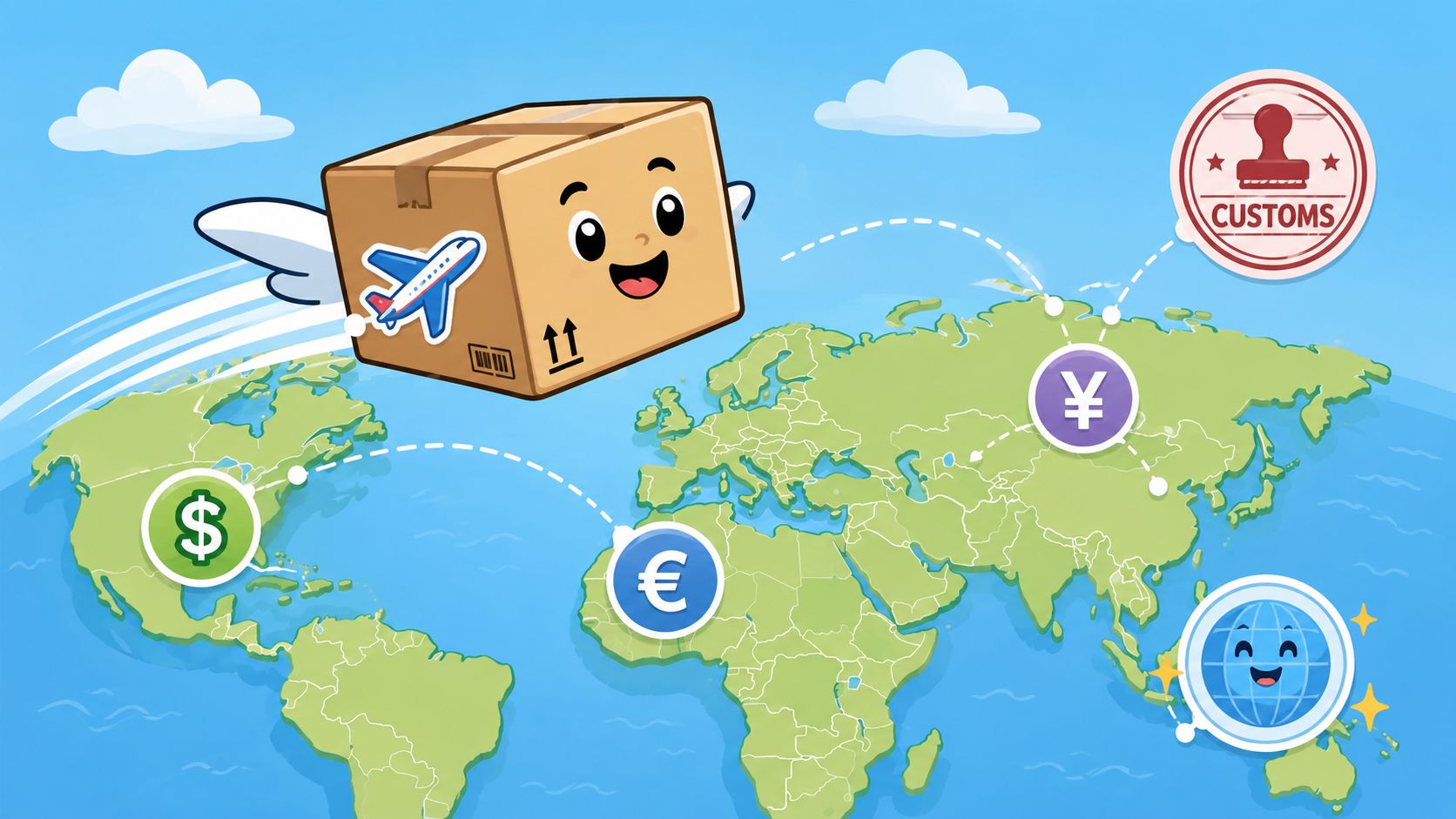
The biggest mistakes happen when merchants treat cross-border shipping like domestic shipping with longer transit times. It isn't. International shipping adds customs documentation, country-specific delivery expectations, duty handling, and more ways for the customer experience to become confusing.
Start with the customer-facing choices
Customers don't think in terms of customs entries or brokerage workflows. They think in terms of three practical questions:
- What will delivery cost me?
- How long will it take?
- Will I get hit with extra charges later?
That's why duty handling matters so much. If you ship with duties unpaid, the customer may face extra fees at delivery. That can create confusion, refusal, or support escalation. If you structure orders with duties paid, the experience is cleaner for the shopper, but your operation takes on more coordination and cost planning upfront.
The choice should match your market strategy. Premium customer experience often justifies more control. Early-stage market testing may justify a lighter operational setup, as long as the customer sees the terms clearly.
Customs needs clean product data
International shipping breaks when product information is vague.
Teams need a repeatable process for customs declarations, product descriptions, values, and HS code management. You don't need to overcomplicate this at the start, but you do need discipline. Sloppy product metadata leads to delays, holds, and preventable support tickets.
A workable cross-border setup usually includes:
- Standardized product descriptions that make sense to customs reviewers
- Consistent HS code assignment by SKU or product family
- Document generation rules tied to destination country and carrier workflow
- Clear ownership for compliance updates when catalog or markets change
For smaller merchants building that capability, this practical resource on International shipping in sugar land offers a grounded overview of the moving parts.
Cross-border carrier selection also changes once paperwork, last-mile handoff, and destination-country experience enter the picture. If you're evaluating partners, this overview of cross-border logistics companies is a helpful starting point.
A short visual explainer can also help align internal teams around the process:
International shipping becomes manageable when rules are explicit
The brands that scale internationally don't rely on heroic manual effort. They define rules by market.
That means knowing which countries you'll serve first, which service levels you'll offer, how duties will be presented, and what documentation must be correct before the order leaves the building. Once those rules are written down and embedded in tools, international shipping becomes much more predictable.
Streamlining Fulfillment and Returns Workflows
Fulfillment decisions shape shipping performance long before a label prints.
The central question is simple. Should you run fulfillment in-house or outsource to a 3PL? The right answer depends less on ideology and more on order profile, product complexity, capital constraints, and how much operational control you need.
In-house versus 3PL
In-house fulfillment works well when the brand needs tight control over packaging presentation, custom kitting, fragile handling, or rapid process changes. It gives operators direct visibility into labor, inventory accuracy, and exception handling. The downside is that every peak period, layout flaw, and staffing issue lands directly on your team.
A 3PL can help when order volume has outgrown your internal operation or when geographic reach matters more than warehouse-level customization. The trap is assuming outsourced means hands-off. It doesn't. A poorly governed 3PL relationship just moves your problems outside the building.
Use a simple decision lens:
- Choose in-house when product handling is nuanced and workflow flexibility matters more than network scale.
- Choose a 3PL when order density, broader reach, or faster deployment matters more than bespoke process control.
- Reevaluate regularly when the operation starts accumulating manual exceptions that neither model handles cleanly.
Data has to be normalized first
Shipping optimization isn't really possible if your reporting lives in separate tools with mismatched definitions.
Effective ecommerce shipping optimization requires merchants to consolidate and normalize data on costs, delivery times, and carrier performance into a single analytic layer so they can make valid comparisons and forecast future needs, according to eShipper's guidance on shipping analytics.
That matters whether you ship from your own warehouse or through a 3PL. If one system defines delivery date one way and another defines it differently, your benchmarking is already compromised. Teams need one source of truth for:
- Carrier performance by service level
- Transit behavior by lane
- Claims and exception patterns
- Cost components including surcharges and accessorials
- Returns reasons linked back to order and shipment data
Clean data beats loud opinions in shipping meetings.
Returns are part of the shipping operation
Returns often get treated as a separate service problem. They're part of shipping operations and should be managed that way.
A good returns workflow protects both customer trust and warehouse throughput. Customers need clear instructions and predictable status updates. Operations teams need returns to arrive with enough context to inspect, restock, refurbish, or quarantine efficiently.
If you're redesigning physical workflows, this piece with expert advice on fulfillment center layout is useful because layout decisions directly affect pick speed, accuracy, and returns handling.
The strongest returns processes usually share three traits:
- They classify return paths clearly
- They avoid manual triage wherever possible
- They connect returns data back to product, packaging, and carrier decisions
How Post-Purchase Edits Reduce Shipping Errors
Most shipping content focuses on rates, packaging, and fulfillment efficiency. Those matter. They're not the whole problem.
A major gap in e-commerce shipping advice is post-purchase support. Address quality is a known cost driver, and enabling customers to self-correct shipping details within controlled windows helps prevent failed deliveries and reduce manual support work, as noted in Jet Worldwide's discussion of post-purchase shipping challenges.
That's where a lot of avoidable cost hides.
The mistake usually happens after checkout
Customers place an order and then notice something wrong. Maybe autofill inserted an old apartment number. Maybe they forgot a gate code. Maybe they used a work address and meant to ship home. Maybe they want to correct a typo before the order moves to the warehouse.
Most stores still handle this with support tickets.
That creates a bad loop:
- The customer emails support
- Support checks whether fulfillment has started
- Ops pauses or edits the order manually
- The warehouse works off mixed signals
- The customer waits without certainty
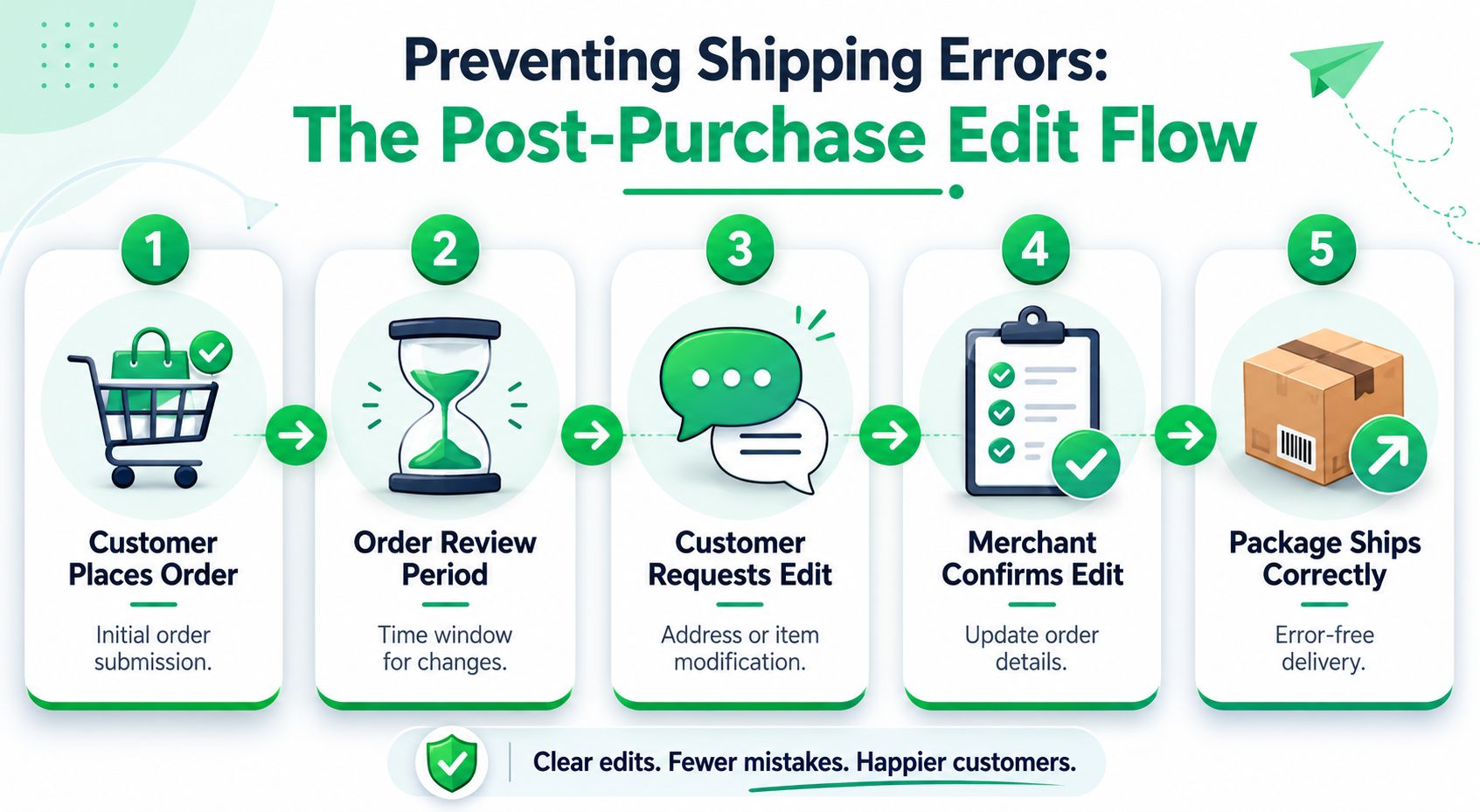
This is operationally expensive because it converts a simple customer correction into a cross-functional exception. At scale, those exceptions crowd out more valuable work.
Controlled self-service works better than manual triage
The answer isn't unlimited order editing. That creates its own chaos. The answer is controlled post-purchase editing.
That means the merchant defines what can be changed, for how long, and under what conditions. Address changes, contact detail fixes, and selected order edits can happen within a limited window before fulfillment locks the shipment. The customer gets speed. The merchant keeps control.
Google Maps address validation and autocomplete are especially useful here because they help standardize and correct addresses at entry, reducing the chance that a bad address flows downstream into label creation and carrier handoff. That's much more effective than discovering address issues after the parcel is already in motion.
What a good post-purchase workflow looks like
A durable workflow usually includes these controls:
Short review window
Give customers a defined period to correct mistakes before the order is released.Address validation at the point of change
Don't just accept free-text edits. Validate and standardize them.Permission-based edit rules
Allow low-risk changes automatically. Route higher-risk changes for review.Fulfillment lock timing
Once an order hits a commit point, editing stops and the customer sees that clearly.Clear audit trail
Every change should be visible to support and operations.
For Shopify teams trying to reduce address-related support work, this guide on how to change a shipping address on Shopify is a useful reference for structuring the workflow.
The cheapest shipping error to fix is the one the customer corrects before the order leaves your system.
Why this matters more in global commerce
Post-purchase editing becomes even more valuable when stores sell across markets.
Address formats vary. Language expectations vary. Customers may discover a formatting issue only after checkout. If the workflow is rigid, support becomes the translation layer between customer intent and warehouse execution. That's a poor use of team time.
A multilingual, rules-based editing experience is much more scalable than asking support to mediate every address correction by hand.
Building a Resilient and Customer-Centric Shipping Operation
Strong shipping e commerce operations aren't built from one clever rate strategy. They come from a set of disciplined choices that work together.
The fundamentals still matter. Packaging has to be standardized. Labels have to be accurate. Carrier selection has to match the order profile, not just the cheapest visible rate. International workflows need explicit rules. Fulfillment and returns need clean measurement, not assumptions.
But the part many teams miss is what happens after checkout and before shipment. That's where a surprising amount of cost, friction, and customer frustration begins. If customers can't fix small mistakes cleanly, the business absorbs those mistakes in support workload, fulfillment disruption, and failed delivery risk.
The most resilient operations design shipping as a customer experience system, not just a warehouse task. They reduce avoidable exceptions before the parcel moves. They give teams better data. They create fewer manual handoffs. And they make the customer feel informed, not trapped.
That's what turns shipping from a recurring operational headache into an advantage.
If your Shopify team is spending too much time on address changes, order edits, and post-purchase support, SelfServe helps customers make approved changes themselves within merchant-defined rules. It's a practical way to cut support workload, improve address accuracy, and keep fulfillment moving without losing control.