Your Guide to USPS Priority Mail Boxes and Rates in 2026
USPS Priority Mail is one of the most reliable and cost-effective shipping services out there, but figuring out which option to use can be tricky. For any e-commerce brand, this decision isn't just about logistics—it directly hits your bottom line.
The choice really boils down to two main paths: using a Flat Rate box with a set price, or using your own box and paying based on weight and distance.
Your Quick Guide to USPS Priority Mail
Let's be honest, shipping can feel overwhelming. But for direct-to-consumer brands, Priority Mail is the workhorse that perfectly balances speed with cost. The real secret is knowing which specific Priority Mail service to use for each package you send out the door.
It's a lot like packing for a trip. You have to decide between a small carry-on bag—where the airline has one fixed price—or a larger checked bag where the cost depends entirely on how much it weighs. That’s the core difference between Priority Mail Flat Rate and traditional, weight-based Priority Mail.
The Main Priority Mail Services
Each Priority Mail service is built for a different kind of shipment. Picking the right one is the first, and most important, step to keeping your shipping costs in check.
Priority Mail Flat Rate: This is the classic "if it fits, it ships" option. You grab a free, branded Flat Rate box from USPS, and as long as your shipment is under 70 lbs, you pay one single price. It doesn't matter how heavy the item is or how far it's going. This makes it a fantastic choice for shipping small, heavy products across the country.
Priority Mail (Weight-Based): This is the standard service where you use your own packaging. The price is calculated based on your package's weight and how many shipping zones it has to cross. This is often the cheaper route for lightweight items or for brands that want to use their own custom-branded boxes.
Priority Mail Regional Rate (Discontinued): You might still see this mentioned online, but this service is no longer available. It was designed for short-distance shipping but has since been replaced by newer, more efficient services like USPS Ground Advantage.
To help you visualize which service to use and when, here’s a simple table breaking down the options.
USPS Priority Mail Options at a Glance
This table compares the primary USPS Priority Mail services to help you quickly decide which is best for your shipment.
| Service Type | Best For | Pricing Model | Key Benefit |
|---|---|---|---|
| Priority Mail Flat Rate | Heavy, small items traveling far distances. | Fixed price based on box size. | Predictable shipping costs, no weighing needed. |
| Priority Mail (Weight-Based) | Lightweight or large items traveling short distances. | Variable, based on weight and zone. | Cost-effective for light packages; allows custom branding. |
Getting a handle on these fundamental differences is the key to making smarter shipping choices. The decision between grabbing a Flat Rate box or using your own packaging for a weight-based rate is often where merchants can find the most significant savings.
Choosing the Right USPS Priority Mail Box
When you're running a direct-to-consumer brand, your choice of shipping box is a lot more than just a container—it's a critical business decision. Picking the right one directly impacts your shipping costs, and getting it wrong can quietly eat away at your profit margins. Think of the free, USPS-branded Priority Mail boxes as your essential toolkit; knowing how to use them is key.
To get a handle on your USPS Priority Mail boxes and rates, it helps to know that the service really breaks down into a few main options: the super-popular Flat Rate service, the traditional weight-based method (using standard Priority Mail boxes or your own), and the now-discontinued Regional Rate program.
This chart lays out the basic decision you'll face.
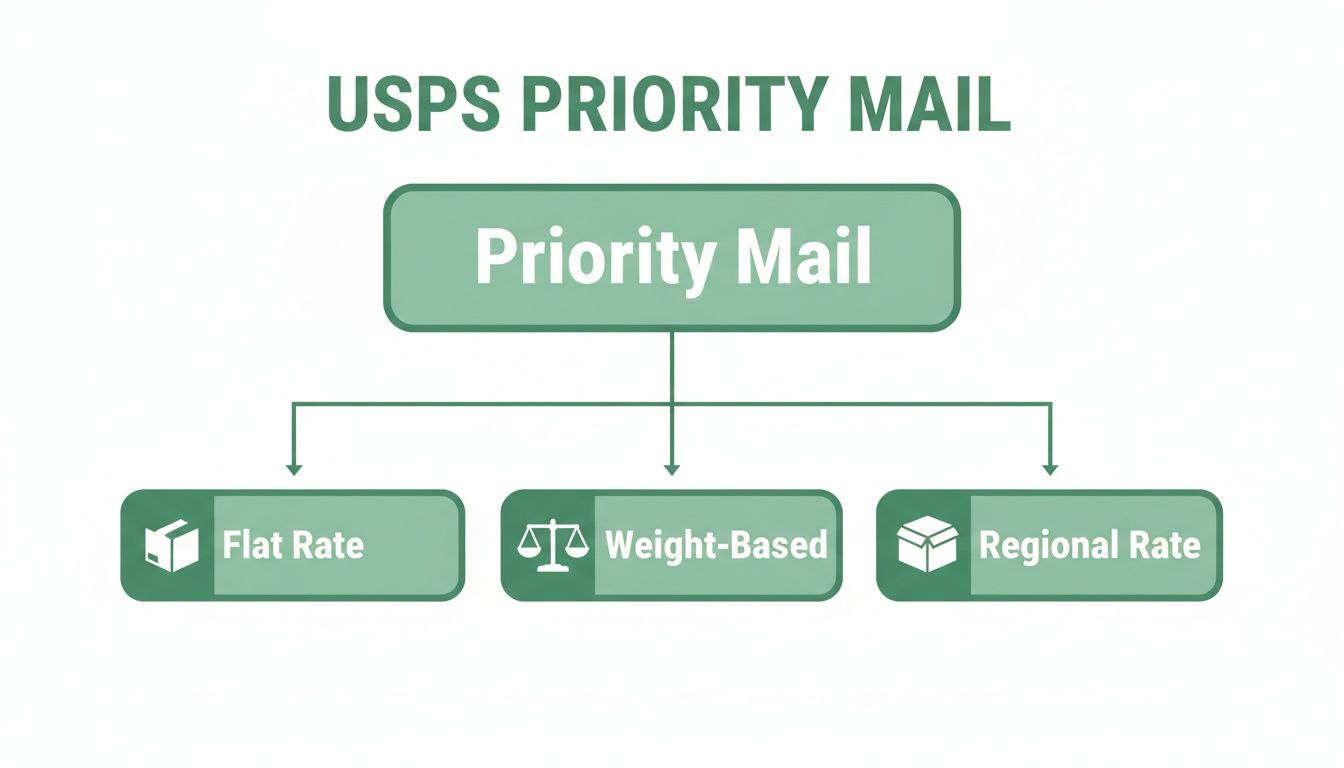
Ultimately, you're choosing between a predictable, fixed cost with Flat Rate or a variable cost that depends on weight and distance. Let's dig into the actual boxes and envelopes to see what makes the most sense for the products you sell.
The Flat Rate Box and Envelope Lineup
By far, the most well-known options are the Flat Rate boxes. The promise is simple and powerful: "if it fits, it ships" for one price, as long as it's under 70 pounds. For anyone trying to manage a budget, that kind of predictability is a huge win.
Key Insight: The real magic of Flat Rate is that it makes weight and distance irrelevant. A dense, 5-pound product costs the exact same to ship to a customer one state over as it does to one on the other side of the country. This makes it a no-brainer for heavy-for-their-size items.
Here’s a rundown of the most common Flat Rate options and what they’re good for:
- Padded Flat Rate Envelope: With dimensions of 12 ½" x 9 ½", this is your best friend for soft goods. It's perfect for things like t-shirts, leggings, or other apparel that needs a little more cushioning than a plain envelope can offer.
- Small Flat Rate Box: Measuring 8 ⅝" x 5 ⅜" x 1 ⅝", this little box is a workhorse for small but dense items. Think jewelry, cosmetics, small electronics, or a hefty hardcover book.
- Medium Flat Rate Boxes: These come in two very useful shapes—a top-loading box (11" x 8 ½" x 5 ½") and a side-loading box (13 ⅝" x 11 ⅞" x 3 ⅜"). They’re incredibly versatile and are great for shipping shoes, gift sets with multiple clothing items, or small home goods.
- Large Flat Rate Box: At 12" x 12" x 5 ½", this is what you'll grab for your bigger products. It can comfortably hold a laptop, several pieces of clothing, or even a board game.
Standard Weight-Based Priority Mail Boxes
So what happens when your product is light but too bulky to squeeze into a Flat Rate box? That’s where standard, weight-based Priority Mail comes into play. While you can always use your own branded packaging, USPS also provides a whole line of free standard Priority Mail boxes to use.
These boxes are not Flat Rate. Their cost is calculated based on the package's weight and the shipping zone it's headed to.
Crucial Distinction: You can only use Priority Mail branded boxes for Priority Mail services. Don't ever try to ship a USPS Ground Advantage package in a Priority Mail box. As of late 2025, USPS may start returning these packages or even hitting you with a penalty fee, so always match the box to the service. You can learn more by checking out these shipping and fulfillment best practices for Shopify merchants.
Here are a few of the most useful standard Priority Mail box sizes:
- Box #4: This cube-shaped box measures 7" x 7" x 6" and is fantastic for items like mugs, candles, or jars.
- Box #7: At 12" x 3" x 17 ½", this long, flat box is perfectly suited for things like picture frames, binders, or unfolded clothing.
- Shoebox: Designed specifically for footwear, these boxes typically measure around 7 ⅜" x 5 ¼" x 14 ¾" and are a go-to for any apparel or shoe brand.
The right choice always starts with your product's specific weight and dimensions. For heavy items going a long distance, a Flat Rate box is almost always the winner. But for lightweight products or shipments to nearby zones, a standard weight-based box will save you money nearly every time.
How USPS Calculates Priority Mail Rates
Trying to get a handle on your shipping costs can sometimes feel like you're chasing a moving target. The good news is that the logic behind USPS Priority Mail boxes and rates isn't as mysterious as it seems. Once you understand the key ingredients that go into the final price, you can make smarter decisions that protect your profit margins.
Let's pull back the curtain on how the USPS figures out your bill, moving from the simple stuff to the details that can save you real money.
Of course, with a Flat Rate box, there’s no math to do. If your product fits and the package weighs less than 70 pounds, you pay one predictable price. But what happens when you use your own packaging or a standard Priority Mail box? That's when things get more dynamic.
The Key Factors: Weight and Zone
When you're not shipping with a Flat Rate box, the price is determined by two main factors: how much the package weighs and how far it has to travel.
Package Weight: This one’s straightforward. A heavier package costs more to ship than a lighter one going to the same place. A 4 lb. shipment will always have a higher rate than a 1 lb. shipment.
Shipping Zones: The USPS divides the country into nine zones (numbered 1 through 9) that radiate out from your shipping location. Think of your warehouse as the center of a map. Sending a package to Zone 2 (just a few towns over) will be much cheaper than sending that exact same package to Zone 8 on the other side of the country.
Basically, the package's weight and its destination zone are the foundational pieces of your shipping cost puzzle.
Understanding Dimensional Weight
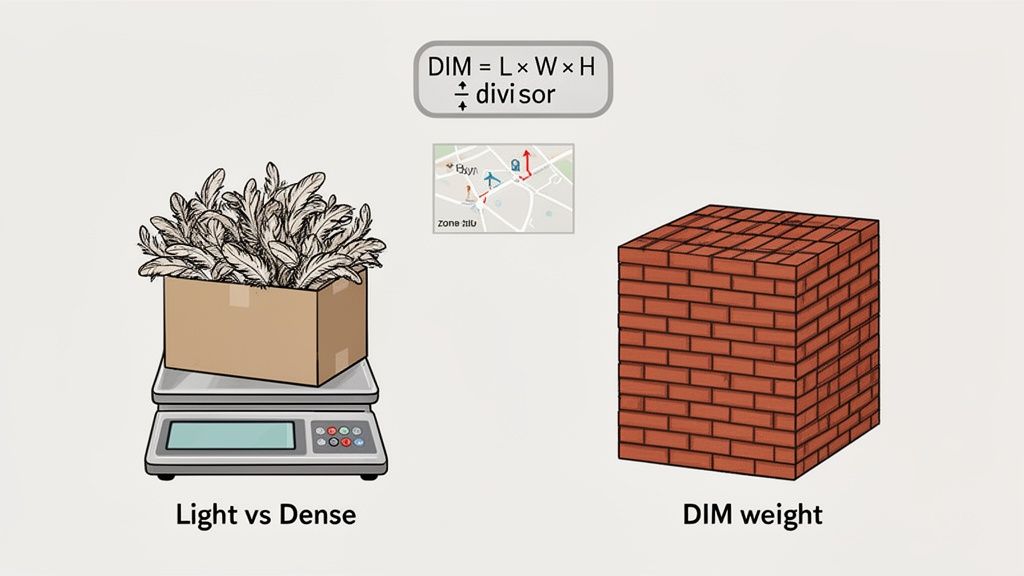
Now, here’s where a lot of merchants get tripped up. Imagine you're shipping a big, fluffy dog bed. It barely weighs anything, but it takes up a massive amount of space in a delivery truck. On the flip side, a small box of hand weights is heavy but compact. This is precisely why dimensional (DIM) weight exists.
Key Concept: Dimensional weight is a pricing model that accounts for a package's density. If a package is large but light, the carrier may charge based on its size instead of its actual weight.
To find the DIM weight, the USPS multiplies the package's length, width, and height, then divides the total by a specific number called a divisor (which is currently 166 for those getting Commercial Pricing). If this calculated DIM weight is higher than the package's actual weight, you get billed for the higher number.
This rule is a game-changer for anyone selling bulky but lightweight items, like apparel, home decor, or bedding. Ignoring DIM weight can lead to some painful and unexpected shipping bills.
Commercial vs. Retail Pricing: The Secret to Savings
Of all the factors that influence your USPS Priority Mail rates, this one might be the most critical for your bottom line. There are two main pricing tiers, and the one you use makes a huge difference.
Retail Pricing: This is the standard, full-price rate you pay if you walk into a Post Office and buy postage at the counter.
Commercial Pricing: These are discounted rates offered to businesses that use online shipping software. If you're using a platform like Shopify to print your labels, you are getting these rates.
The difference isn't small. Commercial Pricing can save you 15-30% or even more compared to paying retail. For any e-commerce business, getting access to these rates isn't just a perk—it's an absolute necessity for staying competitive.
This pricing advantage has become even more important as postage costs have steadily climbed. To cover its own rising expenses, the USPS has consistently increased rates. For context, the price of a first-class stamp has shot up from 39 cents in 2006 to a projected 78 cents by mid-2025—a 100% increase in less than 20 years. This trend directly impacts your shipping budget, making the savings from Commercial Pricing a crucial buffer against shrinking profits. You can review a detailed history of these postage adjustments to get a better sense of where things are heading.
Comparing 2026 Priority Mail Rates in Practice
Alright, we've covered the different types of Priority Mail boxes and how the rates work. But the real question is, how does this all play out when you’re actually packing an order and trying to save a few bucks on shipping? Let's run through a common scenario that online store owners face every day.
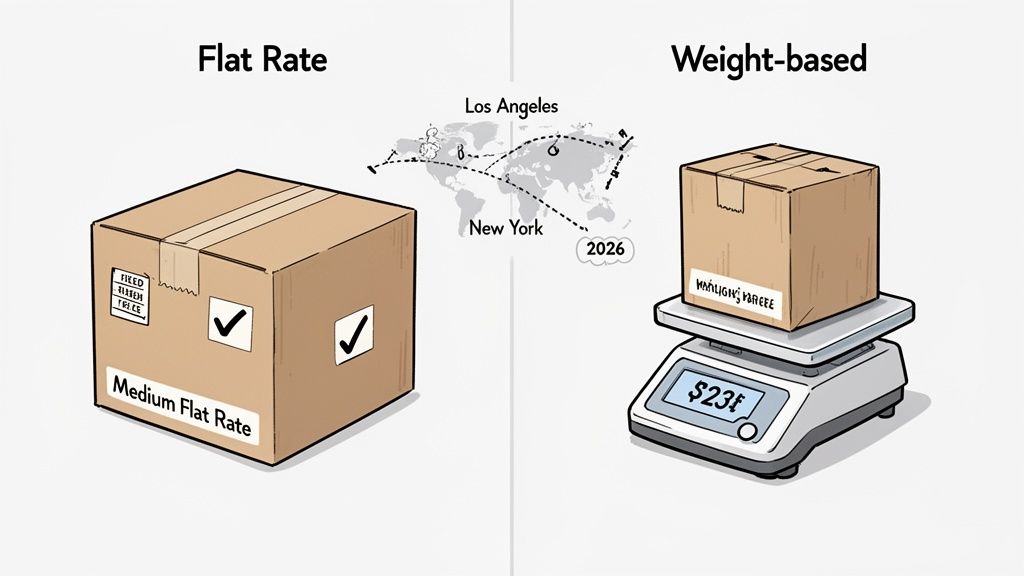
Seeing these options side-by-side with real numbers is where you can truly start to see the savings. It’s time to move past the theory and make some smart decisions for your fulfillment process.
The Hoodie Test: A Real-World Scenario
Picture this: your brand sells apparel, and you just got an order for a popular hoodie. The customer is in New York City (Zone 8), and you're shipping from your warehouse in Los Angeles (Zone 1).
The hoodie itself weighs 2.5 lbs. Once you put it in your nice, custom-branded box, the total package weight hits 3 lbs. Now you have a decision to make. Do you use a free USPS box or your own?
- Grab a free USPS Medium Flat Rate Box.
- Stick with your own branded box and pay the weight-based Priority Mail rate.
So, which one is actually cheaper? Let's dig into the projected 2026 Commercial Pricing for this exact shipment.
The Tipping Point: As you’ll see, a 3 lb package going cross-country is right on the edge where the price difference between Flat Rate and weight-based shipping gets really tight. This is exactly why you can't just guess—you have to know the numbers.
2026 USPS Priority Mail Rate Comparison for a 3 lb Package
To make this crystal clear, here’s a table that breaks down the projected commercial costs for shipping that 3 lb hoodie. We'll compare a regional shipment (Zone 4) to a cross-country one (Zone 8).
| Shipping Method | Cost to Zone 4 (e.g., Regional) | Cost to Zone 8 (e.g., Cross-Country) | Best Use Case |
|---|---|---|---|
| Medium Flat Rate Box | $15.50 | $15.50 | Shipping heavy items (over 3-4 lbs) any distance. |
| Weight-Based Priority Mail | $11.85 | $17.10 | Shipping lighter items, especially to closer zones. |
Look at that. For a shorter trip to Zone 4, using your own box is a no-brainer—it saves you over $3.60. But for that long haul to Zone 8, the Medium Flat Rate Box is the better deal, saving you $1.60. A buck or two might not sound like much, but those small savings can add up to thousands of dollars over a year.
And if you’re weighing all your options, our guide on the differences between UPS and USPS can give you an even broader perspective.
When You Need It There Yesterday
Of course, sometimes the standard 1-3 day delivery window just isn't fast enough. For those "I need it now" orders, there's Priority Mail Express—the USPS's guaranteed overnight service. It's incredibly fast, but that speed definitely comes at a premium.
Just like standard Priority Mail, its rates have been climbing steadily. Looking back, we can see that prices jumped significantly between 2018 and 2025. For 2026, a simple Flat Rate Envelope is projected to cost $33.25. This makes it a tough sell when customers are conditioned to expect fast, free shipping, so you have to manage your margins carefully. You can always check the official rate schedules published by USPS for the most current numbers.
This service is best saved for situations where the speed is worth the cost.
- For last-minute gift shoppers who are willing to pay for speed.
- When shipping time-sensitive documents or high-value items that require a delivery guarantee.
- As a premium upgrade at checkout for customers who want their order right away.
By getting comfortable with these cost comparisons, you can finally stop guessing. You'll know exactly when to grab a Flat Rate box for a heavy cross-country shipment or when to use your own packaging for a lightweight local delivery. Mastering these little details is how you build a truly optimized shipping strategy and protect your bottom line.
Optimizing Your Shopify Shipping Settings
Alright, so you’ve got a handle on the different USPS Priority Mail boxes and rates. But knowing the options is only half the battle. The real magic happens inside your Shopify dashboard, where you can turn all that theory into actual, tangible savings for your business.
Getting your shipping settings dialed in isn't just about finding the cheapest rate for a single package. It's about building a smart, automated process that works for you. When it's done right, your customers see accurate shipping costs at checkout—which is huge for preventing abandoned carts. It also saves your team from the headache of fixing shipping errors, freeing them up to focus on growing the business.
Activating Discounted USPS Rates
Let’s start with the most important thing you can do right now: make sure you’re using Shopify Shipping to get discounted USPS Commercial Pricing. If you’re still trekking to the Post Office to buy postage over the counter, you're paying retail rates and leaving a lot of money on the table—often 15-30% more on every single shipment.
The good news is that Shopify gives you access to these lower rates automatically. As long as you purchase and print your USPS labels directly from your Shopify admin, you're already getting the better price. There's no special switch to flip; you just have to use the built-in system.
Key Takeaway: Never go to the Post Office to buy postage for your orders. Always print your USPS Priority Mail labels directly through Shopify to guarantee you get the lower Commercial Pricing on every package you send.
Creating Smart Shipping Profiles
Your store probably doesn't sell just one type of product. You might have a mix of light t-shirts, heavy coffee table books, and bulky-but-light home decor. A one-size-fits-all shipping rule simply won't work and will end up costing you. This is exactly where shipping profiles become your new best friend.
Shipping profiles let you create specific shipping rules for different groups of products. It’s a game-changer.
For instance, you could create separate profiles for:
- Lightweight Apparel: Group your t-shirts and accessories here, setting up rules that lean on weight-based Priority Mail.
- Heavy Goods: Create another profile for dense products like candles or jars, which are often cheaper to ship in Flat Rate boxes.
- Bulky Items: Isolate those large-but-light products (think pillows or lampshades) that can trigger dimensional weight pricing, and give them their own set of rules.
By segmenting your products this way, Shopify can automatically apply the most accurate and cost-effective shipping rates at checkout. You'll stop overcharging customers for small items and, more importantly, stop losing money by undercharging on heavy or bulky ones.
Printing Labels and Managing Fulfillment
Once your profiles are set up, your day-to-day fulfillment becomes so much simpler. You can run the entire process right from your Shopify Orders page.
- Select an Order: Head over to your unfulfilled orders.
- Create Shipping Label: Just click the "Create shipping label" button to get started.
- Verify Details: Shopify pulls in the customer's address and the items in the order. Always give the package weight and dimensions a quick double-check for accuracy.
- Choose the Service: This is the moment of truth. Shopify will display a list of shipping options and their costs, including Priority Mail Flat Rate and weight-based Priority Mail. You can see the actual price difference and pick the one that makes the most sense.
- Buy and Print: Purchase the label and print it on your thermal or desktop printer. You're all set.
This integrated workflow doesn't just save you money with commercial rates; it also cuts down on manual data entry, which is where costly mistakes happen. As your business grows, you might even consider a multi-carrier shipping solution to automatically compare rates across different carriers in real time, squeezing out even more savings.
By taking a little time to fine-tune these settings in Shopify, you’re building a fulfillment engine that’s both resilient and cost-effective. It’s a strategic move that keeps your USPS Priority Mail rates as low as they can be, protecting your profit margins while giving your customers a great experience.
Common Questions About USPS Priority Mail
Alright, we've covered the basics of Priority Mail, but let's get into the nitty-gritty. It's often the small, specific questions that can trip up even seasoned ecommerce sellers, leading to shipping snafus and surprise costs.
Let's clear the air on the most common questions we hear from merchants. Getting these details right is the key to a smooth, cost-effective fulfillment process.
Can You Use Your Own Packaging For Priority Mail?
Yes, you absolutely can. In fact, for many sellers, using your own branded box is the way to go for standard, weight-based Priority Mail shipments. It's a fantastic opportunity to create a memorable unboxing experience for your customers.
Just keep the golden rule in mind: when you use your own box, the shipping cost is based on the package's weight, its dimensions, and how far it’s going (its shipping zone). For lighter items heading to nearby zones, this is almost always your cheapest option.
Important Distinction: You can use your own packaging for standard Priority Mail, but you can never use a Priority Mail branded box for another service, like USPS Ground Advantage. If you try, you'll likely get the package returned or even face penalties. The USPS is strict about this.
Are The Free USPS Boxes Really Free?
They are! You can hop on the USPS website and order packs of Flat Rate boxes, regular Priority Mail boxes, and envelopes, and they'll deliver them right to your door without charging you a dime. You can also swing by your local Post Office to grab some.
So, what's the catch? It's simple: you have to use the box for its intended service. A Priority Mail Flat Rate box must be used to ship with Priority Mail Flat Rate postage. You can't just grab a free box and use it for a standard, weight-based shipment.
How To Order Free USPS Boxes
Getting these free supplies is incredibly easy and saves you a trip to the Post Office. The best way is to order them directly from the USPS website.
Here's how it works:
- Head over to the official USPS website and find "The Postal Store."
- Click on the "Free Shipping Supplies" section.
- You can browse all the options or filter by the service you need, like Priority Mail or Priority Mail Express.
- Add the boxes and envelopes you need to your cart, and check out. They're shipped to you for free.
Delivery usually takes about 7-10 business days, so it’s a good idea to plan ahead and order your next batch before you're down to your last box.
Priority Mail Versus USPS Ground Advantage
This is where I see a lot of merchants get confused. While both are great services from USPS, they’re built for different situations.
The choice really boils down to two things: speed and cost.
- Speed: Priority Mail is the faster option, delivering in about 1-3 business days. USPS Ground Advantage, which travels by truck, takes longer, with a typical delivery window of 2-5 business days.
- Cost: Since it's a slower service, USPS Ground Advantage will almost always be cheaper than Priority Mail. The savings can be significant, especially for packages that aren't traveling across the country.
- Packaging: For Priority Mail, you must use their branded boxes or your own. For Ground Advantage, you can only use your own plain packaging, not Priority Mail boxes.
Think of it this way: Priority Mail is your go-to for a great balance of speed and price. Ground Advantage is your best friend for non-urgent shipments where saving every dollar is the main goal.
Does Priority Mail Include Insurance?
Yes, and this is a huge built-in benefit. Most Priority Mail shipments automatically come with a good amount of insurance coverage at no extra cost, giving you a valuable safety net.
When you use Commercial Pricing (the discounted rates you get through platforms like Shopify), your Priority Mail shipments typically include $100 of insurance. If you were to walk into a Post Office and pay the higher Retail rate, you'd only get $50 of coverage. This protects you against lost, damaged, or pilfered packages.
If your products are worth more than that, you can (and should) purchase additional insurance when you create your shipping label. For high-value items, it’s a small price to pay for total peace of mind.
With SelfServe, you can empower your customers to handle their own post-purchase needs, like editing a shipping address or adding an item to their order. This drastically cuts down on support tickets while giving your customers the control they want. See how SelfServe works and start your free trial.