Discover what is fulfillment service for Your 2026 Brand

Orders start as a simple win. A customer clicks Buy Now, Shopify confirms payment, and your team grabs a box. For a while, that feels manageable.
Then the business grows. Shelves spill into hallways, someone is reprinting labels at night, and support keeps getting the same message: “I entered the wrong address, can you fix it?” At that point, the question isn’t just what is fulfillment service. It’s whether your current operation can still protect margin, delivery speed, and customer trust.
A fulfillment service handles the operational work that starts after checkout and ends when the order arrives, or comes back through a return. That includes receiving inventory, storing it, picking items, packing orders, shipping them, and often processing returns. For scaling DTC brands, it’s less about outsourcing cardboard boxes and more about building a system that can keep up with customer expectations and your own growth goals.
That’s one reason this category has expanded so quickly. The global e-commerce fulfillment services market was valued at USD 123.68 billion in 2024 and is projected to reach USD 272.14 billion by 2030, growing at a CAGR of 14.2% according to Local Express fulfillment market analysis. Brands aren’t moving to professional fulfillment because it sounds impressive. They’re doing it because manual operations eventually become expensive in ways that don’t always show up clearly on the P&L until customer experience starts slipping.
From Garage to Growth The Need for a Fulfillment Service
A pattern shows up in almost every growing brand. The founder starts by packing orders from a garage, spare room, or tiny warehouse corner. That phase can work well because the team is close to the product, the packaging, and the customer.
Then volume changes the math. What used to be a straightforward routine turns into picking errors, late dispatches, and stock that lives in three different places with no clean system behind it. The business hasn’t failed. It’s outgrown the setup that got it started.

What changes when growth arrives
At small scale, founders can compensate for weak process with hustle. They remember where the bestsellers are stacked. They can catch a wrong label by eye. They can answer a shipping email quickly because they were the one who packed the order.
That breaks once orders pile up across multiple channels, team members, and daily carrier pickups. A fulfillment service becomes the operational layer that makes growth sustainable.
A practical definition is simple:
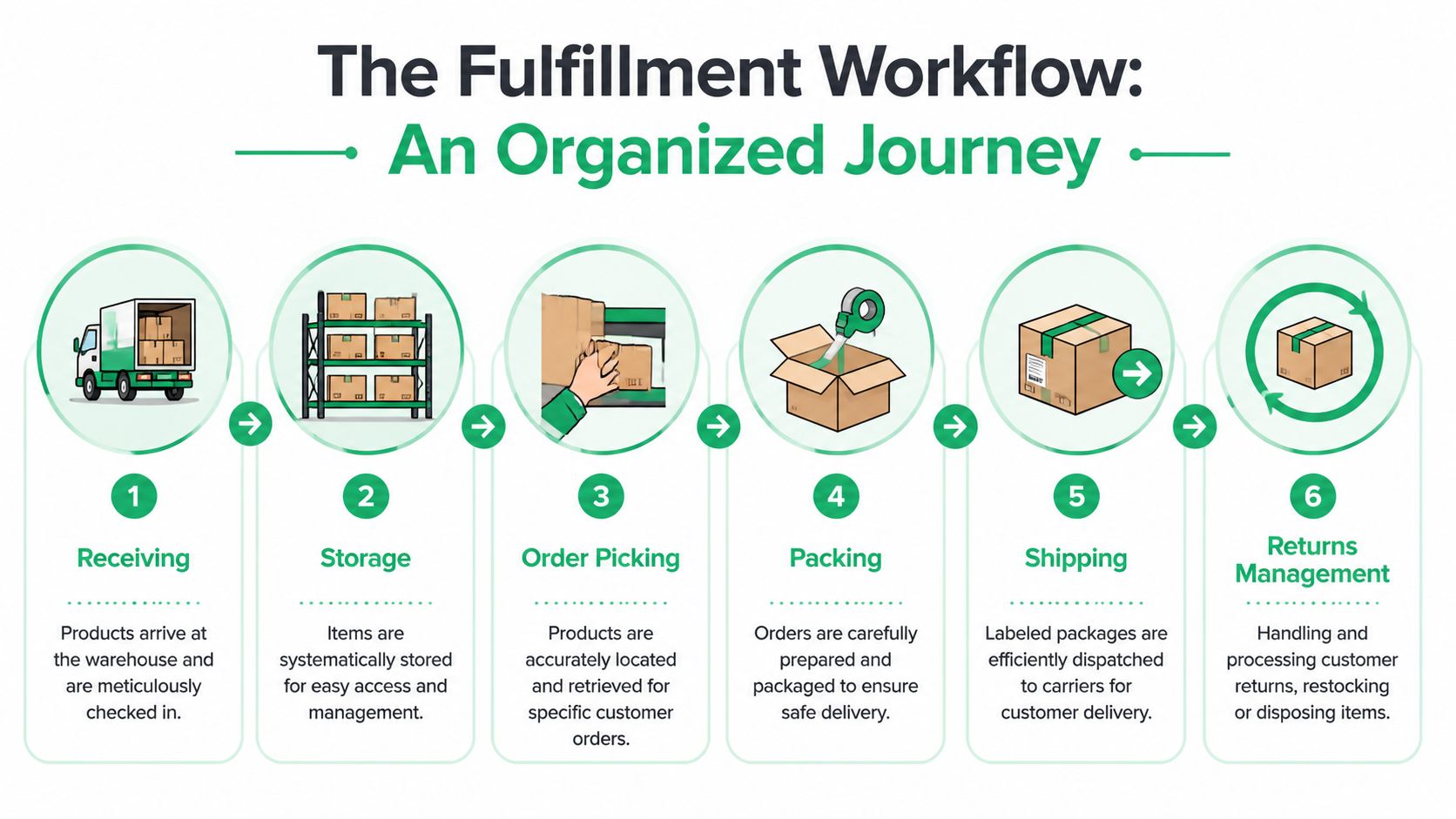
- Receiving inventory means products arrive from your manufacturer or supplier and get checked into a system.
- Storage means those products are organized so warehouse staff can find them quickly and accurately.
- Pick, pack, and ship means customer orders are turned into outbound parcels with the right items, packaging, and labels.
- Returns handling means the reverse flow is managed without turning refunds and exchanges into chaos.
Why this matters to a modern brand
The shift isn’t just physical. It’s strategic. Once customers expect fast and reliable delivery, fulfillment moves from back-office task to customer experience function.
Practical rule: If your team spends more energy chasing order exceptions than improving merchandising, retention, or forecasting, fulfillment has become a growth constraint.
A good fulfillment setup gives the brand room to focus on product, marketing, and operations strategy. A weak setup traps senior people inside daily shipping cleanup. That’s why mature operators stop treating fulfillment as “someone packing boxes” and start treating it as core infrastructure.
The Four Models of Ecommerce Fulfillment
There isn’t one right fulfillment model. There’s only the model that fits your product, margins, order profile, and growth stage. The wrong choice usually shows up in one of two ways: either you lose control, or you lose scalability.
The pressure is real. 64% of e-commerce parcels now arrive within two days, and 69% of customers report abandoning retailers permanently after just one late delivery, according to OpenSend order fulfillment time statistics. That makes fulfillment model selection a retention decision, not just an ops decision.
Fulfillment model comparison
| Model | Best For | Upfront Cost | Control Level | Scalability |
|---|---|---|---|---|
| In-house fulfillment | Early-stage brands, fragile products, tightly controlled packaging | Higher | High | Limited |
| Third-party logistics (3PL) | Scaling DTC brands, multichannel sellers, teams that need operational leverage | Moderate | Medium | High |
| Dropshipping | Product testing, low-inventory-risk launches, catalog expansion | Low | Low | Moderate |
| Hybrid | Brands with mixed SKU behavior, seasonal spikes, or special handling needs | Mixed | Medium to High | High |
In-house fulfillment
In-house works when control matters more than speed of expansion. If you sell premium bundles, highly customized packaging, or products that require special inspection before shipment, keeping fulfillment internal can make sense.
The trade-off is that you also own labor scheduling, warehouse layout, packing quality, carrier coordination, and every operational fire. In-house can be efficient for a time. It often becomes brittle under rapid growth.
Third-party logistics
A 3PL takes over warehousing and order execution. This is the model many growing Shopify brands move into once shipping volume becomes too distracting or too complex for an internal team.
What works well with a good 3PL is scale. You gain warehouse infrastructure, trained staff, and established processes. What doesn’t work is assuming every 3PL is interchangeable. Some are operationally strong but weak on integration, visibility, or exception handling.
A 3PL should reduce operational drag. If your team has to manually fix inventory syncs, shipment holds, and address issues every day, you haven’t outsourced complexity. You’ve redistributed it.
Dropshipping
Dropshipping lowers inventory risk because the supplier ships directly to the customer. For testing products or extending catalog breadth, it can be useful.
But it comes with obvious limits. You usually give up packaging control, quality oversight, and some delivery predictability. For a brand trying to build loyalty on experience, dropshipping often creates more customer service uncertainty than operators expect.
Hybrid fulfillment
Hybrid is what experienced operators often choose when the catalog isn’t uniform. Fast movers might sit in a 3PL. High-margin bundles may stay in-house. Slow-moving accessories might be dropshipped.
This model can be highly effective, but only if your systems are clean. The moment channel routing, inventory visibility, and order logic get messy, hybrid turns into confusion. It’s powerful because it’s flexible. It’s dangerous for the same reason.
The Core Functions Inside a Fulfillment Center
Envision a professional kitchen to easily understand how a fulfillment center operates. Ingredients arrive, get checked, stored in the right place, pulled in the right sequence, assembled correctly, and sent out fast. The customer only sees the final plate. The quality depends on everything that happened behind the line.
That’s how fulfillment works. The parcel on a doorstep is the result of several tightly connected warehouse functions.
Receiving and storage
Receiving is where inventory enters the operation. Boxes arrive from a manufacturer or distributor, and warehouse staff count, inspect, and scan them into the system. If receiving is sloppy, every downstream report becomes less trustworthy.
Storage sounds basic, but it’s where a lot of operational quality is decided. Products need to be placed in locations that support fast retrieval, accurate counts, and sensible replenishment. A warehouse that stores well is easier to pick from. A warehouse that stores badly creates extra walking, extra touches, and more picking mistakes.
A practical operator looks for questions like these:
- How are SKUs labeled: Clear bin logic matters more than fancy software demos.
- How are damaged units handled: Good providers separate saleable from non-saleable inventory quickly.
- How are replenishment moves managed: Pick faces need to stay stocked so teams aren’t constantly stopping to hunt product.
Picking and packing
Picking is the act of retrieving items for a live order. For effective picking, warehouse layout, SKU naming discipline, and system logic all matter. Products that look similar but have different variants are common sources of mistakes.
Packing is more than placing items in a box. It includes packaging choice, protective materials, inserts, label application, and final verification. Good packing protects both the product and the brand.
In practice, many “shipping issues” start as picking or packing issues. A delayed delivery is visible to the customer. A mis-picked variant is visible to support, returns, and margin.
Shipping, kitting, and returns
Shipping is where the order leaves the warehouse and enters the carrier network. That includes label creation, route selection, cutoff management, and handoff discipline. Fast warehouses still fail customers if carrier execution is inconsistent.
Kitting is the prep-cook function. Separate components are assembled into one ready-to-ship unit before the order hits the line. Subscription boxes, gift sets, starter bundles, and promotional packs all depend on this being managed well.
Returns management is the reverse path. Returned goods need to be inspected, restocked, quarantined, or disposed of according to clear rules. Brands that ignore returns as a warehouse afterthought usually pay for it twice, once in support burden and again in inventory distortion.
Understanding Fulfillment Pricing and Performance KPIs
Most merchants look at a fulfillment quote and jump straight to the pick-pack fee. That’s understandable, but it’s incomplete. The complete cost of fulfillment sits in the relationship between fees, error rates, and support burden.
A low headline rate can become expensive if orders ship late, returns are processed slowly, or your team spends hours each week cleaning up preventable exceptions. That’s why finance and operations need to evaluate fulfillment together, not separately.

What you’re usually paying for
Most fulfillment providers price around a bundle of operational activities rather than one flat warehouse fee. Common charges include:
- Receiving fees for checking inbound inventory into the warehouse
- Storage fees based on how much space your products occupy
- Pick and pack fees tied to order handling complexity
- Shipping charges passed through or negotiated through the provider’s carrier setup
- Special project fees for kitting, relabeling, inserts, or exception work
- Returns processing fees when items come back and need inspection or restocking
For operators trying to understand how those charges affect margin across channels, Jumpstart Partners ecommerce financial advice is a useful resource because it frames ecommerce accounting in a way that reflects real multichannel complexity, not just simple top-line reporting.
If you’re reviewing different logistics setups, it also helps to compare provider types and service models against a broader operational framework like this guide to ecommerce logistics services.
The KPIs that actually matter
Don’t manage a fulfillment partner by invoice line alone. Manage them by operational output.
A practical scorecard includes:
- Order accuracy rate so you can see whether customers are getting the right items
- On-time shipping rate because a correctly packed order that misses dispatch still harms the experience
- Dock-to-stock time which affects how quickly inbound inventory becomes sellable
- Inventory adjustment frequency because recurring mismatches usually point to process weakness
- Return processing speed which influences both customer satisfaction and stock visibility
Cost without performance is false economy
A cheaper provider can still cost more if they create extra support contacts, replacement shipments, or refund friction. Good operators ask one question repeatedly: what does this save on paper, and what does it create in downstream cleanup?
That’s the right lens for fulfillment. Warehouse fees hit the P&L directly. Service failures hit retention, reviews, and team capacity.
How to Choose the Right Fulfillment Partner
The best partner for one brand can be the wrong fit for another. A cosmetics brand with bundle-heavy promotions, a supplements company with lot tracking, and an apparel business with broad SKU variation won’t evaluate providers the same way.
Start with your own operational reality before you start vendor demos. If you skip that step, you’ll be comparing polished sales narratives instead of actual fit.
Start with your operating requirements
Write down what the partner must handle well, not what sounds nice in a presentation.
Focus on questions like these:
- What does your order profile look like: Single-item orders behave differently from multi-line bundles.
- What handling requirements exist: Fragile products, expiration-sensitive goods, and gift packaging all change execution.
- Where are your customers located: Geographic spread influences warehouse placement and shipping strategy.
- How often do customers make changes after checkout: Address edits, cancellation requests, and order merges matter operationally.
- Which systems need to connect: Shopify, ERP tools, returns platforms, and support workflows all affect day-to-day execution.
If your category deals with regulated or restricted shipping scenarios, it’s worth reviewing how teams automate third-party fulfillment compliance before you sign with a provider that treats compliance as an afterthought.
Questions that reveal the truth
A serious 3PL evaluation should get specific quickly. Ask direct questions and listen for operational clarity.
- How does your WMS integrate with Shopify: You want details, not “we connect with all major platforms.”
- What happens when inventory counts don’t match: Good partners have escalation paths and reconciliation discipline.
- How do you handle order holds and customer edits: This matters more than most sales teams admit.
- What are your SLAs for receiving, shipping, and returns: If expectations are vague, accountability will be too.
- Who owns issue resolution: You need to know whether support, ops, or an account manager is responsible.
- Can you support a phased migration: This is especially important if some SKUs remain internal during transition.
The quality of a fulfillment partner often shows up in how they describe exceptions, not how they describe normal flow.
For a broader view of provider categories and selection criteria, this overview of third-party fulfillment companies is a helpful reference point.
Watch for operational red flags
Some warning signs appear early:
- Overpromising on setup simplicity usually means implementation risk is being glossed over
- Weak answers on returns often signal that reverse logistics is underbuilt
- No clear ownership structure creates delays when something breaks
- Generic dashboards without process depth can hide warehouse instability
The right partner doesn’t need perfect marketing. They need clear process, realistic implementation expectations, and a technology stack that won’t collapse under exceptions.
Integrating Fulfillment with Your Shopify Store
Most merchants hear the same promise from fulfillment vendors: “It’s plug and play.” In reality, the integration is where strong operations are built or undermined.
A fulfillment partner isn’t just receiving orders from Shopify. It’s participating in a live system where order data, inventory status, address quality, routing logic, and exception handling all need to move cleanly between platforms. If that doesn’t happen, the warehouse becomes the visible symptom of a data problem that started upstream.

What the system is actually doing
The Warehouse Management System, or WMS, is the operational core. It receives real-time order data from storefronts like Shopify, automatically generates pick lists, verifies addresses, and removes manual data entry from the process. When integrated properly, that setup can ensure 99%+ delivery accuracy, according to Medallion Enterprises on fulfillment service technology.
That sounds technical, but the business impact is simple. Fewer manual touches usually means fewer preventable mistakes. For a high-volume Shopify Plus merchant, even a small breakdown in order data quality can create a large support queue very quickly.
If you’re comparing systems on the warehouse side, this overview of best WMS systems helps frame what to look for beyond surface-level feature lists.
Where integrations usually fail
The weak point usually isn’t the basic sync. It’s what happens when real customers do real things.
Common failure patterns include:
- Inventory sync lag that allows overselling
- Order transmission delays that create fulfillment bottlenecks
- Address errors that weren’t caught early enough
- Status mismatches between Shopify and the warehouse system
- Exception workflows that still rely on email and spreadsheets
Most guides skip this part, but these are the problems that create friction inside the first months of a new 3PL relationship. The integration matters because it determines whether exceptions are controlled inside systems or dumped onto your support and operations teams.
A useful walkthrough of fulfillment technology is below.
Why post-purchase control belongs in the workflow
The biggest misunderstanding in ecommerce logistics is that checkout locks the order. Operationally, that isn’t true. Customers still request address edits, contact updates, cancellations, and item changes after payment.
If your stack can’t manage those requests before the warehouse acts, your team ends up doing manual intervention against a moving target. That’s expensive, slow, and error-prone. The better approach is to design the integration so order changes are controlled, visible, and passed downstream before they become pick-pack-ship problems.
Optimizing Post-Purchase Operations and Driving Revenue
The post-purchase window is where fulfillment and customer experience collide. Most brands put huge effort into acquisition and checkout, then leave the period after payment under-managed. That’s where support tickets pile up and preventable warehouse errors start.
Many resources still gloss over this. Most guides on fulfillment services fail to address the operational friction from integration failures, such as what happens during transition periods, how inventory sync failures create customer-facing issues, or the support burden merchants face in the first 30-90 days, as noted by eWorld Fulfillment on fulfillment service implementation gaps.
Reduce mistakes before the warehouse touches the order
The cleanest fix for many fulfillment problems is to stop bad data from reaching the warehouse in the first place.
That means building a post-purchase workflow that can handle:
- Address corrections before labels are locked
- Contact detail fixes before carrier notifications fail
- Controlled cancellation requests before pickers touch inventory
- Order edits within defined windows so changes are operationally safe
This is one of the most overlooked levers in ecommerce operations. Merchants often try to solve downstream warehouse symptoms when the actual issue is that customer-requested changes aren’t managed upstream.
Good post-purchase operations don’t just reduce tickets. They protect warehouse flow from customer-side volatility.
Turn the order status experience into an operational asset
A strong post-purchase layer also creates commercial upside. If a customer is already in the order status flow, that moment can support curated add-ons, bundle extensions, or accessory offers, as long as the workflow is tied cleanly to fulfillment timing.
That requires discipline. Offers have to respect order cutoffs, inventory rules, and operational constraints. Done badly, it creates more exceptions. Done well, it improves revenue without creating extra acquisition cost.
Returns belong in the same conversation. Brands that want a more deliberate approach to reverse logistics can learn from this guide to ecommerce returns strategy, especially if returns are currently handled as a customer service task rather than an operations system.
What works in practice
The most effective setups create a communication layer between the shopper, Shopify, and the fulfillment partner. That layer should decide what can still change, when it can change, and how those changes flow into the systems that execute the order.
What doesn’t work is relying on inboxes, Slack threads, and warehouse favors. That approach might save a few orders when volume is low. At scale, it turns every exception into labor.
A fulfillment service becomes much more valuable when post-purchase operations are designed as part of the system, not treated as cleanup after the fact.
If your Shopify team wants to reduce support workload, let customers make controlled post-purchase changes, and capture more value from the order status experience, SelfServe is worth a close look. It gives merchants a practical layer between checkout and fulfillment so address fixes, contact edits, and upsell opportunities happen before they become expensive operational problems.