Mastering Shipping to Mexico from US in 2026

You launch international shipping, wake up the next morning, and see a cluster of orders from Mexico. Revenue looks promising. Operations does not.
The first instinct is usually tactical. Which carrier should we use? What paperwork do we need? Who pays duties? Those are valid questions, but they’re not the whole job. For a high-growth DTC brand, shipping to Mexico from US succeeds or fails in the operational details that happen before the parcel reaches customs. Address quality, order edit windows, product classification, and customer communication matter just as much as the label on the box.
Businesses don’t struggle because Mexico is impossible. They struggle because they try to run cross-border shipping with a domestic workflow. That’s where support tickets pile up, orders miss clearance windows, and customers lose confidence fast.
The Growing Opportunity in Mexican Ecommerce
A lot of brands hit the same moment. Orders from Mexico start as a trickle, then turn into a weekly pattern, then into a channel you can’t ignore. Marketing sees demand. Finance sees incremental revenue. Operations sees exposure.

That demand is backed by real freight movement, not wishful thinking. Freight between the U.S. and Mexico reached $73.8 billion in August 2024, up 4.2% year-on-year, with Mexico consistently outpacing Canada in freight dollar value over the preceding 18 months. Trucks moved $94.2 billion in March 2025 alone according to the U.S. Bureau of Transportation Statistics trade data.
For ecommerce operators, that matters because it changes the default assumption. Mexico isn’t a side market anymore. It’s a serious cross-border lane with sustained volume and infrastructure built around it.
What this looks like inside a Shopify operation
The first wave of Mexico orders usually exposes three weak spots:
- Checkout data quality: Customers enter addresses in formats your domestic workflows weren’t built to validate.
- Post-purchase changes: Support gets requests to fix apartment details, colonia names, phone numbers, or recipient notes after payment.
- Expectation gaps: Customers assume a parcel is moving in one continuous domestic-style handoff, when cross-border fulfillment has more checkpoints.
Practical rule: If your team treats Mexico orders as “international, but basically the same,” you’ll create avoidable exceptions.
That’s why the better way to think about expansion is operational design, not carrier shopping alone. The brands that do this well build processes around the actual friction points before volume makes those problems expensive.
One useful strategic read is Reddog Consulting Group’s perspective on scaling CPG with international ecommerce. It’s helpful because it frames cross-border growth as a system decision, not just a shipping add-on.
The opportunity is real, but so is the complexity
You don’t need a massive enterprise network to start shipping to Mexico from US. You do need discipline. The market rewards brands that document products properly, lock down clean customer data, and communicate clearly when a shipment enters customs review.
That’s the playbook that keeps growth from turning into support chaos.
Understanding the US-Mexico Shipping Rulebook
The rulebook gets easier when you stop treating it like legal theory and start treating it like order data. Every shipment to Mexico carries a story customs has to understand. What is it? Where did it come from? What is it worth? Who is receiving it?
If those answers aren’t consistent across your order, product catalog, and export documents, clearance gets harder.
Start with product identity, not paperwork
Most merchants begin with forms. I’d start with the catalog.
If your SKU data is vague, your shipping workflow will be vague too. “Accessory,” “kit,” or “sample bundle” might make sense for merchandising. It doesn’t help when a shipment needs proper classification. The customs process expects each product to be clearly described and consistently mapped.
That’s why HS codes should be handled as product infrastructure, not as a last-minute shipping task.
Customs doesn’t reject shipments because a team forgot a form in the abstract. It rejects shipments because the product data underneath the form is incomplete, inconsistent, or wrong.
The de minimis change raised the bar
A major shift made that even more important. As of August 29, 2025, the U.S. de minimis exemption for Mexico-bound shipments ends, requiring HS codes for every parcel crossing the border. Incorrect HS codes can trigger customs rejections, adding 2-5 days to transit times, as outlined in this guide to shipping from the U.S. to Mexico.
That changes the operating model for DTC brands in a practical way. Small orders, add-ons, and low-value shipments no longer sit in a simpler bucket. Every parcel needs disciplined classification.
Here’s what that means in day-to-day ecommerce terms:
Every SKU needs a classification owner
Don’t leave HS coding scattered across merchandising, finance, and ops. One function should own the master record.Bundles need explicit treatment
If your store sells curated sets, gift packs, or build-your-own combinations, someone must define how those products are documented before orders flow.Order edits can’t break compliance
When support swaps an item, adds a replacement, or approves a customer request, that change can affect export documentation.
Think of compliance as a data chain
A clean Mexico shipping workflow usually follows this sequence:
| Workflow area | What needs to be right |
|---|---|
| Product setup | Clear descriptions, correct classification, consistent SKU metadata |
| Checkout | Accurate customer name, address, and contact details |
| Order review | Any edits captured before export documents are finalized |
| Shipment creation | Invoice and customs details matching the actual order contents |
Teams get into trouble when they focus only on the last row.
For brands entering Mexico for the first time, the simplest mental model is this: your shipping documents are only as good as the storefront data feeding them. If that upstream data is sloppy, no broker or carrier can fully rescue the downstream workflow.
How to Prepare Your Shipment for the Border
Preparation is where profitable cross-border shipping gets decided. By the time a box is physically moving toward the border, your room to fix errors is already shrinking.
For most brands, the critical mistake isn’t forgetting that paperwork exists. It’s assuming paperwork can be corrected whenever needed. That’s not how the Mexico workflow behaves.
The border process has a real cutoff point
The Mexican customs process requires a licensed broker to prepare a Pedimento, which then generates a QR-coded DODA. After that filing, changes become much harder. Post-purchase address changes are only feasible before this filing. Afterward, modifications require a new Pedimento, doubling processing time and costs, as explained in Cargado’s breakdown of the U.S.-Mexico documentation workflow.
That’s the operational point many merchants miss. They think of address edits as a customer service issue. In Mexico shipping, address edits can become a customs issue.
What needs to be ready before filing
The practical pre-border checklist looks like this:
- Commercial invoice accuracy: Product descriptions, values, and receiver details must align with the actual order.
- Customer contact details: Phone number quality matters because cross-border handoffs and last-mile delivery often depend on reachable recipients.
- Address structure: Street, neighborhood references, municipality, state, postal code, and recipient name need to be internally consistent.
- Product classification readiness: Each item should already be mapped in your catalog so the export workflow isn’t improvising under time pressure.
The right operational window for edits
Most brands should define a clear pre-export edit window. During that window, support can approve address fixes, customer changes, or limited order corrections. After that window closes, the order should become operationally locked.
That policy protects the shipping team from a common trap. A customer asks for “one small change” after the parcel has already entered border documentation. The change sounds harmless. Operationally, it isn’t.
Field advice: The customer does not see the customs clock. Your team has to.
Packaging and labeling discipline matters too
Mexico-bound shipments should be packed for a longer, more segmented journey than a domestic parcel. The goal isn’t fancy packaging. It’s reducing ambiguity and handling risk.
A practical standard looks like this:
| Area | Good practice |
|---|---|
| Outer label | Clear recipient details, readable barcode, no competing old labels |
| Inner contents | Packing information that matches the order and invoice |
| Carton choice | Appropriate strength for transfer points and carrier handoffs |
| SKU identification | Easy verification if customs or warehouse teams need to inspect contents |
What works and what doesn’t
What works is front-loading accuracy. Validate addresses early. Make product data usable. Give support a hard cutoff for edits. Make sure the shipping team knows when an order can still change and when it cannot.
What doesn’t work is letting customer support, warehouse ops, and customs documentation run on separate timelines. That creates rework, broker friction, and preventable delays right before the border.
For a fast-growing Shopify brand, the best Mexico shipping preparation process isn’t the one with the most forms. It’s the one that prevents bad data from reaching the forms in the first place.
Choosing Your Mexico Shipping Carrier
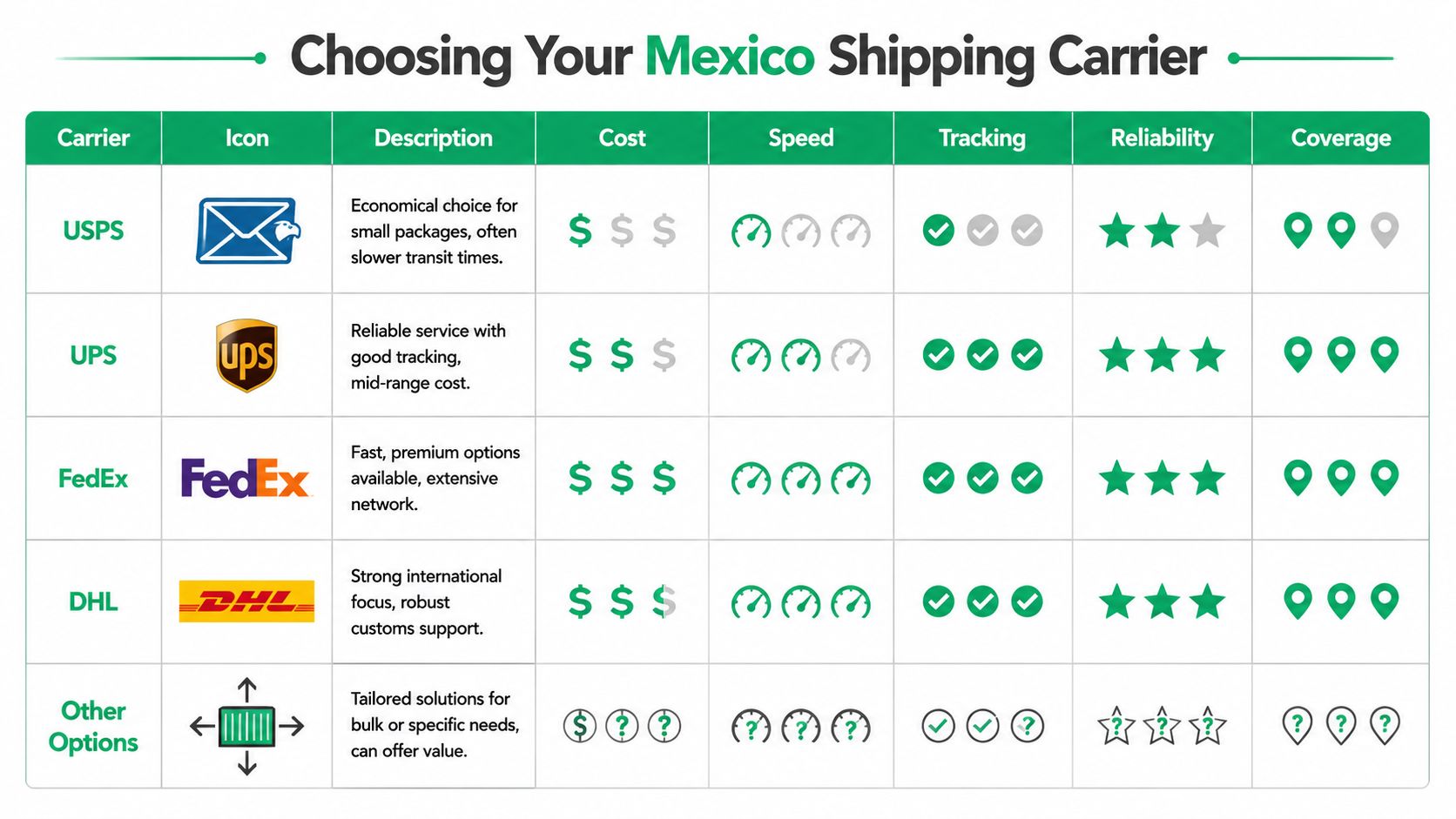
Carrier selection for Mexico isn’t just a rate decision. It’s a customer experience decision, a tracking decision, and often a support burden decision.
A lot of teams compare carriers the way they compare domestic parcel options. That’s too shallow. For shipping to Mexico from US, you need to know how a carrier handles brokerage coordination, service consistency, and handoffs when the shipment crosses the border.
The hidden issue is the handoff model
One of the least understood realities in cross-border logistics is this. Mexican law requires U.S. carriers' tractors to travel only 26 km into Mexico, necessitating three separate carriers on almost every cross-border load. This creates tracking visibility gaps and affects delivery windows, according to CH Robinson’s explanation of cross-border shipping options.
Even if you’re shipping parcels rather than full truckloads, the broader lesson still matters. Cross-border movement often involves more parties and more status transitions than domestic shipping. That’s why customers sometimes see long stretches with no visible tracking movement, then a burst of updates.
A practical comparison of common carrier choices
| Carrier | Best fit | Main strength | Main trade-off |
|---|---|---|---|
| USPS | Lower-cost small parcels where speed is less critical | Budget-friendly entry point | Less robust visibility and less control over customer experience |
| UPS | Brands that want reliable tracking and a structured service model | Strong operational consistency | Usually not the cheapest option |
| FedEx | Higher-service shipments or faster delivery expectations | Premium network and good visibility | Higher cost pressure on margins |
| DHL | International-first operations | Strong customs orientation and cross-border experience | Pricing can be less forgiving for some catalogs |
| Freight forwarder or 3PL model | Complex, high-volume, or mixed-mode shipping | Better orchestration across brokers and carriers | More setup work and process dependency |
How I’d choose by business model
If you’re shipping lightweight, lower-risk parcels and testing demand, USPS can be a reasonable starting lane. You’ll save money, but you should be honest internally that support may need to absorb more ambiguity.
If the brand promise depends on cleaner tracking and fewer exception headaches, UPS or FedEx is usually easier to operationalize. DHL can be especially useful when your team values international process maturity over domestic familiarity.
For brands shipping larger order volumes, regulated products, or more complex catalogs, I’d stop thinking “parcel carrier” and start thinking “cross-border operating model.” That’s where a broker-supported 3PL or a specialist from a list of cross-border logistics companies often makes more sense than forcing a parcel-first setup to do a freight job.
Pick the carrier that fits your exception-handling ability, not just your target shipping cost.
What customers actually feel
Customers don’t care whether a tracking gap came from a handoff yard, customs sequencing, or a carrier transition. They experience one thing. Uncertainty.
That’s why the best carrier choice is often the one your team can explain clearly. If your support team can set expectations around milestone updates, carrier transitions, and realistic delivery windows, you can live with more operational complexity. If not, pay more for a cleaner service model.
What works and what fails
What works:
- Aligning carrier choice to product value and customer promise
- Testing one or two lanes before broad rollout
- Using carriers with support teams your ops staff can reach
- Writing customer-facing shipping language that matches the carrier reality
What fails:
- Choosing the lowest rate with no plan for handoff visibility
- Promising domestic-style delivery certainty
- Letting marketing write shipping claims without ops review
The cheapest carrier can become the most expensive one if it drives confusion, escalations, and repeat contacts.
Demystifying Mexican Duties Taxes and Fees
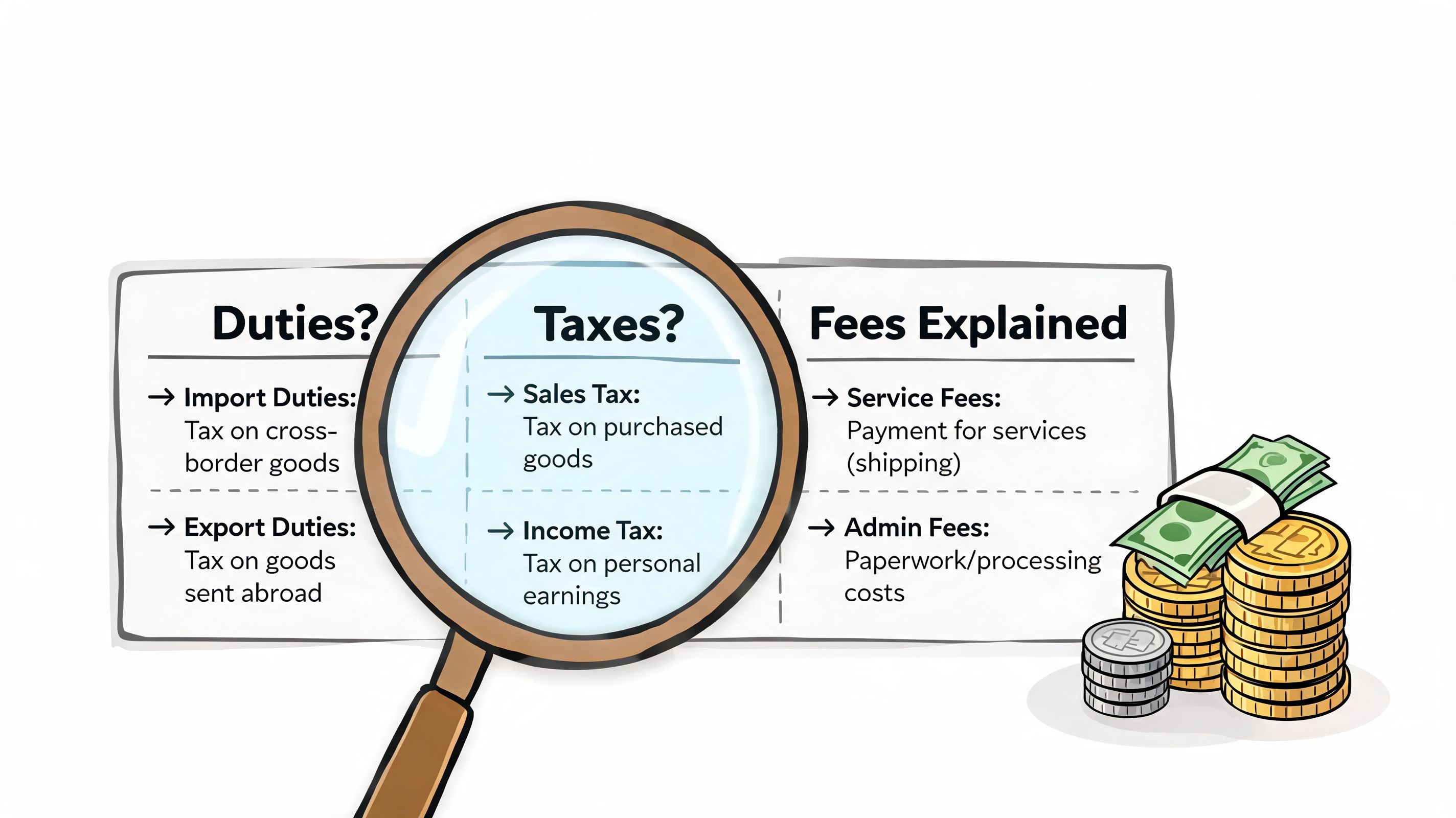
Unexpected charges are one of the fastest ways to damage trust in a new market. Customers may forgive a slower delivery. They’re much less forgiving when they feel surprised at the door or confused during checkout.
That’s why duties and taxes need to be treated as a merchandising and CX decision, not just a finance calculation.
Customers don’t separate fees the way operators do
Internally, teams may distinguish among customs duties, taxes, brokerage-related charges, and carrier fees. Shoppers usually collapse all of that into one simple reaction. “Why am I being asked to pay extra?”
That’s why your pricing and checkout presentation matter so much. If landed cost isn’t visible early enough, support inherits the problem later.
DDP versus DDU is a brand decision
The core choice is usually between DDP (Delivered Duty Paid) and DDU or equivalent unpaid-duty models.
Here’s the practical comparison:
| Model | What the customer sees | Merchant upside | Merchant risk |
|---|---|---|---|
| DDP | More all-in pricing clarity before delivery | Better control of the experience | More operational setup and margin planning |
| DDU | Lower upfront merchant complexity | Simpler to launch in some cases | More delivery friction and customer confusion |
If you’re positioning the brand as premium, gifting-friendly, or low-friction, DDP is usually easier to defend. If you’re testing a market and want to limit early complexity, DDU can work, but only if your checkout language is explicit and your post-purchase messages are clear.
Operational reality: Customers judge the total experience, not whether your accounting treatment was convenient.
The financial workflow has to match the shipping workflow
A lot of brands make a documentation mistake here. They decide on DDP or DDU in theory, but the carrier setup, checkout messaging, and customer emails don’t all reflect the same choice.
That creates three problems:
- Checkout ambiguity: The shopper can’t tell whether extra payment may be required later.
- Support inconsistency: Agents answer the same fee question differently.
- Carrier friction: The delivery partner reaches the customer with terms the brand didn’t explain well.
For growing brands, it’s smart to document one fee policy for Mexico and train support around it. Don’t let every agent improvise.
Get tax advice where your business model needs it
There’s a difference between operational shipping guidance and tax structuring guidance. If your expansion raises importer-of-record questions, accounting treatment issues, or broader compliance concerns, it helps to involve specialists such as Tax Accountants who can review the financial side of cross-border decisions in context.
That’s especially important if Mexico is moving from a test market to a repeatable channel with formal forecasting and inventory planning behind it.
What actually works in market
The brands that handle duties and fees well do a few simple things consistently:
- They decide early whether they want a friction-reduction strategy or a low-complexity launch strategy
- They mirror that decision in checkout, shipping policy, and support scripts
- They review fee-related complaints as a CX signal, not just a cost issue
What doesn’t work is punting the decision downstream and hoping the carrier or broker smooths it out. They can process the shipment. They can’t protect your brand promise for you.
Mastering Customs Clearance and Last-Mile Delivery
A parcel isn’t successful when it leaves your warehouse. It’s successful when the customer receives it, understands what happened along the way, and doesn’t need to open a support ticket to decode the journey.
That final stretch is where a lot of Mexico programs start to wobble.

Clearance doesn’t only depend on speed
Many guides say customs clearance usually takes 1-2 days, but they don’t explain what causes exceptions or how merchants should communicate them. That gap matters because unclear timelines drive support contacts. ARCB’s overview of shipping to Mexico from the USA highlights this communication problem directly.
The missing operational lesson is simple. A shipment delay is manageable. A silent shipment delay is what creates anxiety.
What customers need to hear before they ask
For Mexico orders, the best customer messaging is milestone-based, not promise-based.
That means your notifications should acknowledge stages such as:
- Order received and preparing for export
- In cross-border processing
- Under customs review
- Transferred to local delivery network
- Out for delivery
Customers interpret a pause very differently when you’ve already explained that border review and local handoff are normal parts of the process.
A useful companion read is this guide to last-mile carrier tracking, especially if your current order status page doesn’t do a good job of translating logistics events into customer-friendly updates.
Last-mile success depends on clean intake
Once a shipment clears customs, local delivery issues take over. Bad phone numbers, ambiguous delivery notes, incomplete recipient names, and hard-to-find addresses all become more expensive to fix at this stage.
That’s why last-mile performance is partly won before checkout ever closes.
If a customer’s address data is weak at order creation, the problem doesn’t disappear after customs. It simply changes owners.
Returns need a plan before launch
Many brands treat returns as a phase-two problem. That’s a mistake. If a customer in Mexico can buy easily but can’t understand how a return would work, trust stays shallow.
Your returns policy for Mexico should answer three practical questions:
- Can the customer initiate the return through a familiar channel?
- Will the return route differ from the original delivery route?
- Who communicates status when the parcel is moving back across borders or into a local returns process?
Even if your return program is narrow at launch, define it clearly. Ambiguity creates more frustration than a restrictive but understandable policy.
A short walkthrough can help teams visualize how the final delivery phase affects the full order experience:
What strong operators do differently
Strong cross-border teams don’t just track shipments. They translate shipment movement into customer language.
They build order status pages and support macros around expected handoffs, customs review, and last-mile variability. They tell customers what stage the shipment is in and what to expect next. That reduces unnecessary “Where is my order?” contacts and gives support agents a clearer script when real exceptions happen.
The payoff isn’t only fewer tickets. It’s confidence. When customers feel your brand understands the route, they’re more willing to order again.
Building a Resilient Mexico Shipping Operation
The brands that win in Mexico don’t win because they memorized a checklist. They win because they built a system that can absorb exceptions without falling apart.
That system starts with one principle. Cross-border shipping is a workflow design problem. If your team relies on manual fixes, inbox heroics, and late-stage corrections, the process will break as volume grows.
The core operating model
A resilient setup usually has four traits:
Address accuracy early
Validate customer data before fulfillment teams and brokers have to work around it.A controlled edit window
Let customers or support make legitimate changes only while the shipment can still absorb them operationally.Clear shipment state changes
Everyone should know when an order is editable, documentation-ready, in customs flow, or handed off for local delivery.Multi-carrier visibility
If your program involves more than one partner, you need one operational view of the shipment lifecycle. Consequently, a multi-carrier shipping solution becomes less of a convenience and more of a control mechanism.
What leadership should focus on
For an operations leader, the true KPI isn’t just successful delivery. It’s whether the process can scale without multiplying support load and manual intervention.
That’s also why Mexico expansion often connects to a broader operating strategy. If your business is evaluating customer support coverage, fulfillment coordination, and regional service design, resources on CallZent's nearshore strategy can be useful for thinking through how cross-border demand affects staffing and service structure.
The strongest Mexico shipping operation is the one that prevents avoidable exceptions before the parcel starts moving.
Shipping to Mexico from US can absolutely become a durable growth channel. But it won’t stay healthy if every order depends on someone catching errors by hand. Build the workflow around clean data, controlled changes, and proactive communication. That’s what turns cross-border complexity into a repeatable capability instead of a recurring fire drill.
If your team wants tighter control over post-purchase changes before orders hit critical fulfillment and customs workflows, SelfServe is built for that job. It gives Shopify brands a way to let customers update shipping details within defined windows, supports real-time address validation, and helps reduce support volume before small edits become expensive cross-border exceptions.