USPS vs FedEx: The 2026 Guide for Shopify Merchants
Orders are coming in. Revenue looks healthy. Then shipping starts eating the margin you thought you had.
A customer emails because tracking has not updated. Another realizes they entered an apartment number incorrectly. Your finance team sees a carrier invoice that is higher than the rates shown at label creation. Support spends the afternoon answering delivery questions that have nothing to do with the product. Operations has to decide whether to reship, refund, intercept, or wait.
The usps vs fedex decision for a Shopify brand centers on this point. It is not just a rate comparison. It is a choice about support load, claim friction, fulfillment speed, PO box coverage, address error exposure, and how much control your team has after checkout.
For high-volume stores, the right answer is rarely “pick one carrier and stick with it.” The better answer is to understand what each carrier was built to do, where each one creates hidden cost, and how your post-purchase workflow either absorbs those problems or prevents them.
The Shipping Decision Every Shopify Store Faces
A familiar pattern shows up when a Shopify store scales. The first few hundred orders are manageable. Your team can manually fix addresses, answer “where is my order” emails, and make judgment calls on rush shipments.
Then volume goes up, and the cracks stop being small.
One brand ships low-cost apparel and defaults to USPS because the base rate looks good. That works until support starts handling missed scans, delayed updates, and address issues that could have been corrected if the customer had a short edit window after purchase. Another brand moves too aggressively toward FedEx for everything, then gets hit with surcharge-heavy invoices on residential orders that were never margin-rich enough to justify premium service.
The problem is not choosing the “wrong” carrier once. The problem is using the wrong carrier for the wrong shipment profile, then forcing your support and ops teams to absorb the consequences.
A practical shipping strategy has to answer questions like these:
- What happens when a customer uses a PO box?
- Which orders need premium tracking visibility?
- When does a cheaper label create more cost in support or reshipment?
- How hard is it to file a claim when something goes wrong?
- Can customers fix mistakes before the warehouse locks the order?
The cheapest label is not always the lowest-cost shipment. Support tickets, rework, failed delivery attempts, and claim delays all count.
For Shopify merchants, especially on Shopify Plus, usps vs fedex is really an operations design choice. Carrier selection shapes your queue volume, your cancellation workflow, your exception handling, and the post-purchase experience customers remember.
Understanding the Carrier DNA
A 10-ounce skincare order, a replacement shipment for a VIP customer, and a wholesale carton headed to an office park should not move through the same carrier logic.
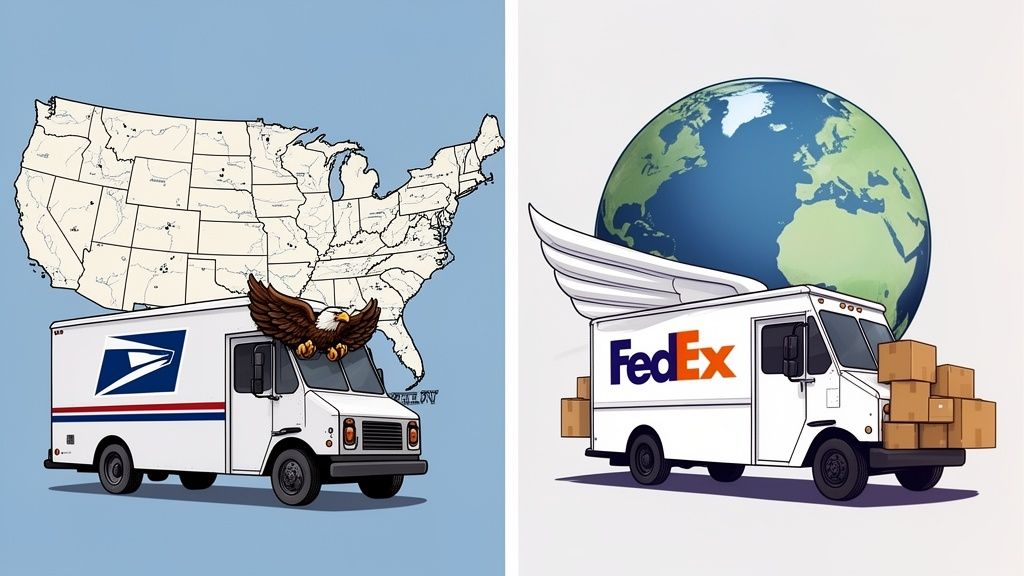
Carrier selection starts with what each network was built to do. USPS was built for universal domestic access. FedEx was built around time-definite delivery, tighter scan visibility, and premium parcel control. For Shopify operators, that difference shows up in support volume, exception handling, and how many orders need manual intervention after checkout.
USPS is built for reach and lightweight residential volume
USPS has one structural advantage no private carrier can fully replicate. It serves every U.S. address, including PO boxes, military addresses, and rural destinations that often create extra complexity elsewhere.
That matters operationally. Stores with a high mix of lightweight residential orders usually get cleaner economics with USPS, especially when the product itself does not justify premium shipping spend. Apparel, beauty, supplements, accessories, and replenishment orders often fit this model well.
USPS also tends to be easier on the front end of rate presentation. Merchants usually see fewer consumer-facing surcharge surprises than they do with private carriers, which helps when finance is trying to protect contribution margin by zone and order weight.
The trade-off is visibility. Tracking can be good enough for standard consumer orders, but it is not always detailed enough to calm an anxious customer or help support resolve a “where is my package?” ticket quickly. If your team regularly fields questions about scan gaps or delivery timing, it helps to set delivery expectations clearly and offer a post-purchase edit window before fulfillment locks. Brands that rely heavily on Priority Mail should also understand how fast USPS Priority shipping typically runs in practice, because customer assumptions about “priority” often create avoidable tickets.
FedEx is built for speed, tighter tracking, and higher-control shipments
FedEx came out of the express market, and that heritage still shapes how the network performs. FedEx’s own company history highlights its early focus on overnight delivery and time-definite transportation, which helps explain why merchants often choose it for urgent, high-value, and more operationally sensitive shipments, according to FedEx corporate history.
That usually makes FedEx a better fit for orders where failure is expensive. Replacement shipments, launch-day orders, premium expedited upgrades, signature-sensitive packages, and many B2B deliveries fall into that category. The label costs more, but the shipment may create fewer downstream issues if better tracking and tighter service reduce reships, credits, and support time.
FedEx can also be easier to justify when warehouse teams need more precise scan events to manage exceptions. Better visibility helps ops teams separate true delays from customer perception issues.
The trade-off is invoice complexity. Residential delivery fees, dimensional weight exposure, delivery area surcharges, and premium service pricing can turn a workable shipping program into a margin leak if rules are not set carefully.
Why carrier DNA matters more than generic carrier advice
The practical question is not which carrier is “better.” The useful question is which network creates the lowest total operating cost for a specific order profile.
| Carrier | Core strength | Best fit for Shopify ops | Main operational trade-off |
|---|---|---|---|
| USPS | Universal domestic reach | Lightweight residential ecommerce, PO boxes, broad consumer coverage | Less detailed tracking, more ambiguity during delivery exceptions |
| FedEx | Speed, scan visibility, service control | Urgent, high-value, B2B, replacement, and structured international shipping | Higher surcharge exposure and more invoice management work |
For growing Shopify brands, that distinction affects more than transit time. It affects how many address issues reach the warehouse, how often support has to explain delayed scans, how returns and replacements are prioritized, and whether a premium shipment protects customer lifetime value.
Post-purchase tooling matters here too. A system like SelfServe can reduce carrier-specific friction by letting customers correct address mistakes, request changes before pick-and-pack, and resolve simple issues without creating another support ticket. That does not replace carrier strategy. It makes the strategy easier to operate at scale.
A Detailed Comparison for DTC Merchants
A carrier choice looks cheap or expensive long after the label is bought. It shows up in replacement orders, WISMO tickets, claim follow-up, and how often the warehouse has to stop normal flow to handle exceptions.
This side-by-side view focuses on the criteria that directly impact DTC margins and customer experience.
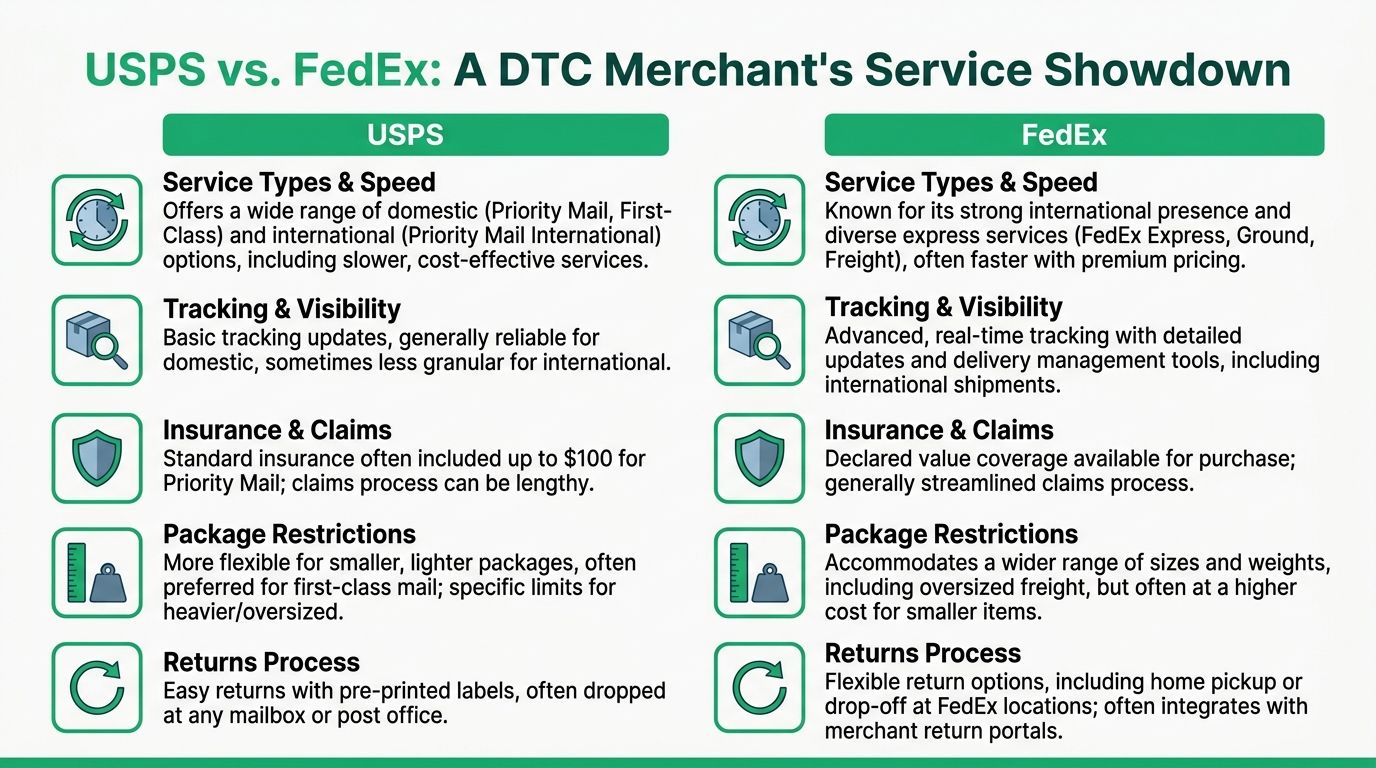
| Criteria | USPS | FedEx |
|---|---|---|
| Best use case | Lightweight domestic residential orders | Time-sensitive, high-value, B2B, international |
| Delivery access | Reaches PO boxes and all U.S. addresses | Strong broad coverage, but not PO boxes |
| Small parcel cost profile | Usually stronger | Usually weaker |
| Tracking detail | Basic | More granular and real-time |
| Express performance | Available, but less competitive for premium time-definite use | Strongest category |
| Claims experience | Slower and more manual | Generally easier for merchants to manage |
| Surcharge exposure | Lower for common consumer shipments | Higher, especially on residential and heavier orders |
Services and pricing in real store terms
USPS usually has the advantage on lightweight residential parcels. That matters most for brands selling low-cube items where shipping can erase contribution margin fast.
USPS Ground Advantage prices by weight and zone and is built for everyday domestic parcels, while FedEx Ground and Home Delivery tend to make more sense as weight, dimensions, urgency, and service expectations rise, based on each carrier's published service structure and rate logic from USPS Ground Advantage and FedEx rate and service details.
For a Shopify operator, the mistake is comparing only the first label quote. A complete comparison includes address correction fees, residential surcharges, reship risk, and how often support has to explain a vague delivery story to a customer who paid for a premium experience.
A few operating rules hold up well:
- Use USPS for low-urgency, lightweight residential orders where cost control matters more than tracking detail.
- Use FedEx for urgent shipments, replacement orders, higher-value packages, and shipments tied to stricter service expectations.
- Review invoice behavior, not just checkout rates or label estimates.
Comparing base postage without exception cost is how brands end up with a cheap shipping program that is expensive to run.
Speed and reliability
Speed matters differently depending on the order type. A routine replenishment order can absorb a little uncertainty. A replacement shipment, launch order, or wholesale delivery usually cannot.
FedEx still offers money-back-guarantee language on many U.S. express services, subject to service conditions, through its FedEx money-back guarantee policy. USPS Priority Mail Express is the Postal Service's fastest domestic option and includes an overnight to 2-day delivery target with a money-back guarantee to many ZIP Codes, as described on the USPS Priority Mail Express service page.
That difference affects merchandising decisions. If checkout offers an upgraded promise, operations needs a carrier that supports that promise consistently enough to avoid apology emails and manual refunds.
If your team is calibrating those promises, this breakdown of how fast priority shipping really feels to customers is useful.
Tracking visibility and support burden
Tracking quality changes support cost. It also changes refund timing, replacement logic, and how much confidence your agents have when responding to a delivery complaint.
USPS tracking covers the basics for many domestic shipments, but scan gaps can leave the team waiting longer before deciding whether an order is delayed or at risk. FedEx gives merchants more event-level visibility through its tracking tools and delivery manager workflows, which can reduce back-and-forth on exception cases, according to FedEx Tracking service documentation.
For a growing Shopify brand, this is not a cosmetic difference. Better scan detail shortens ticket handling time and reduces avoidable replacements.
It also creates a practical opening for post-purchase automation. If a customer can correct an address, request a change early, or resolve a simple issue through SelfServe before the parcel enters a messy exception cycle, the carrier matters less because the avoidable problem never reaches support.
International shipping
International orders expose the trade-off more clearly.
USPS is often the lower-cost option for brands shipping lighter, lower-urgency cross-border orders. FedEx usually offers tighter operational control through its customs tools, transit visibility, and broader portfolio of international service levels, as outlined in FedEx international shipping services and USPS international mail services.
The operational question is simple. Do you want the cheaper label, or the lower chance that support spends twenty minutes explaining a package stalled in customs with limited visibility?
For low-value international orders, USPS can be a rational choice. For high-value orders, replacements, or shipments where the customer experience needs to feel premium end to end, FedEx often justifies the extra spend.
Insurance and claims
Claims separate a usable shipping setup from one that drains operator time.
USPS includes insurance on qualifying Priority Mail and Priority Mail Express shipments, with filing and indemnity rules handled through its domestic claims process at USPS claims and insurance. FedEx also provides declared value and claims workflows through its FedEx claims support page, and many merchants find the process easier to manage because tracking detail and shipment records are clearer from the start.
That does not mean FedEx is always cheaper after a loss. It means the admin burden is often lower, which matters if your team is filing claims while also trying to keep SLAs intact.
| Claims factor | USPS | FedEx |
|---|---|---|
| Included coverage on common qualifying services | Available | Available |
| Filing experience | More manual | More efficient |
| Resolution speed | Often slower | Often faster |
| Best fit | Lower-risk shipments where occasional friction is acceptable | Higher-value shipments where ops needs faster closure |
What usually works best
A strong DTC setup usually splits volume by order type instead of forcing every shipment through one carrier.
- Route lightweight residential orders to USPS.
- Move urgent, high-value, replacement, or B2B orders to FedEx.
- Review support tickets and reshipments by carrier, not just total label spend.
- Use post-purchase tools like SelfServe to catch address errors and change requests before they turn into carrier exceptions.
That routing logic protects more than freight spend. It reduces avoidable tickets, keeps fulfillment flow cleaner, and helps the brand spend premium shipping dollars only where they protect revenue and retention.
Impact on Fulfillment Workflows and Customer Experience
Carrier choice shows up everywhere after the label is printed.
A warehouse team feels it in pickup routines and exception queues. Support feels it in ticket quality. Customers feel it in whether tracking looks trustworthy and whether returns are easy to complete.
Pickup, handoff, and warehouse flow
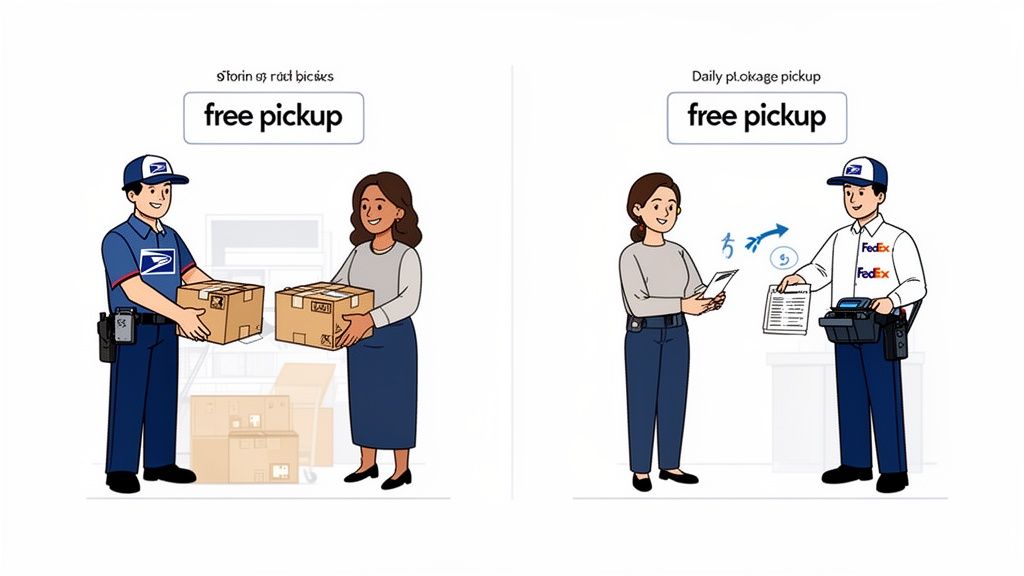
USPS is usually simpler for brands that ship a large number of lightweight packages from one primary location. Its pickup model is easier on smaller ops teams, and the network is familiar to customers and warehouse staff.
FedEx tends to fit better when your operation already runs around service-level commitments and planned dispatch discipline. The workflow is more structured, but that structure also demands more from the team. If pickups are missed, labels are created late, or cutoff discipline slips, the premium service advantage can disappear.
That is why the internal workflow matters as much as the rate card. A fast carrier does not help if your process is loose.
Tracking changes the support queue
This is one of the clearest operational differences between USPS and FedEx.
FedEx provides superior performance for time-critical shipments with advanced metrics like on-time rates and hub handoff delays, outperforming USPS’s moderate reliability. Its advanced tracking is ideal for reducing support tickets from customers needing precise delivery windows for high-value orders or curated upsells, according to OrderCup’s comparison of FedEx and USPS for ecommerce shipping.
For support leaders, the key lesson is simple. Better visibility leads to better triage.
A team with more detailed scans can:
- Delay fewer replacements unnecessarily
- Give customers clearer ETA guidance
- Escalate true exceptions faster
- Reduce back-and-forth on “is this lost?” questions
USPS can still be the right operational choice for low-cost orders. But if your average order value is high, your buyer is impatient, or your CX team is already overloaded, limited tracking clarity can become a cost center.
Use premium visibility where ambiguity is expensive. Not every order needs it, but the wrong orders definitely do.
Returns and post-delivery friction
Returns are another area where the carrier choice affects labor more than merchants expect.
USPS returns tend to be easy for customers because the network is familiar and convenient. That matters for broad consumer brands with a high residential mix. FedEx returns can be strong in a more managed workflow, especially when the merchant wants tighter control or integrated commercial processes.
The more important issue is what happens before the return starts.
A lot of returns are not product problems. They are shipping workflow problems:
- Wrong apartment number
- Old saved address
- Missing unit details
- Customer notices a mistake after checkout but before fulfillment
- Support cannot update the order fast enough
Those failures create avoidable reships, customer frustration, and finance reconciliation headaches. They also force teams into manual approvals, label voids, and warehouse interruptions.
What operators should watch
If you are reviewing usps vs fedex at the operational level, track these factors by carrier:
| Workflow area | What to watch |
|---|---|
| Support | WISMO volume, handling time, escalation rate |
| Fulfillment | Pickup reliability, cutoff adherence, hold queue volume |
| Returns | Address-related returns, reship frequency, label reissue volume |
| Finance | Claim aging, surcharge disputes, invoice variance |
| CX | Delivery confidence, complaint quality, post-delivery satisfaction |
That view is more useful than headline transit times alone. It tells you which carrier creates extra work inside your business, not just how the package moves outside it.
Reducing Shipping Headaches with Post-Purchase Automation
Most shipping problems do not begin with the carrier. They begin with bad order data, inflexible workflows, and a support team forced to act as a manual repair layer after checkout.
It changes how often carrier-specific weaknesses prove expensive.
Address quality matters more than often recognized
A bad address can turn any shipment into a problem. The difference is how expensive that problem becomes with each carrier.
DTC brands see 15% to 25% return rates from bad addresses, and post-purchase tools with address validation and defined edit windows can drastically reduce that issue. FedEx’s advanced tracking suits time-sensitive orders but carries residential and fuel surcharges that can run 20% to 30% higher for shipments over 5 lbs, making errors especially costly, according to JoinPortal’s shipping comparison for ecommerce teams.
When merchants ignore this, they usually create one of two failure modes:
- USPS failure mode: Lower-cost shipment, but the package goes to an incomplete or outdated residential address and becomes a slow support problem.
- FedEx failure mode: Premium shipment to a bad address, which creates a more expensive correction, reshipment, or failed delivery event.
Defined edit windows reduce manual fire drills
A mature post-purchase setup gives customers a controlled way to fix mistakes before the order passes the point of no return.
That matters operationally because it reduces:
- Manual support tickets for address changes
- Slack messages to the warehouse to stop fulfillment
- Cancellation-and-reorder workarounds
- Carrier correction fees and failed attempts
- Reshipments caused by preventable data errors
The best systems do not allow unlimited changes. They allow the right changes, within a defined window, with merchant rules in place. That is the difference between flexibility and chaos.
Good automation supports both carrier strategies
Post-purchase tooling should not be thought of as “USPS support” or “FedEx support.” It should work across both.
For USPS-heavy brands, automation reduces the number of low-margin domestic shipments that fail because of editable mistakes that nobody caught in time.
For FedEx-heavy brands, automation protects premium shipments from avoidable errors that turn a high-service option into a high-cost mistake.
A strong setup usually includes:
- Real-time address validation: Catch bad data before the order moves downstream.
- Customer self-service editing: Let customers fix the obvious mistakes themselves.
- Permission-based controls: Allow edits only for the fields and timing your ops team can support.
- Exception routing: Push risky changes into approval queues instead of letting them bypass controls.
- Order status visibility: Reduce ticket creation by giving customers a better post-purchase experience.
For operators thinking about customer communication and visibility together, this guide to track package software for ecommerce teams is a helpful companion to carrier selection.
The goal is not to react faster to shipping mistakes. The goal is to stop creating so many preventable ones.
A Clear Framework for Choosing Your Shipping Carrier
A customer upgrades to expedited shipping at 2:14 p.m. At 2:26 p.m., another customer notices the apartment number is missing. By 3:00 p.m., your warehouse is batching both orders. Carrier choice stops being a pricing exercise at that point. It becomes an operations decision that affects pick accuracy, support volume, reships, and whether your team spends the afternoon clearing exceptions or shipping on time.
The useful framework is simple. Match the carrier to the order’s risk, service promise, and downstream support cost.
FedEx built its reputation around time-definite delivery and tighter shipment visibility. USPS is built for broad domestic reach and cost-efficient residential delivery. For Shopify brands, that usually means USPS fits the bulk of lightweight domestic orders, while FedEx fits shipments where delay, ambiguity, or loss would create outsized operational cost.
Choose USPS when cost control matters more than precision
USPS usually earns the default slot for routine ecommerce orders with low downside risk.
That often includes:
- Lightweight domestic parcels
- Residential deliveries
- PO box destinations
- Standard shipping promises
- Orders where a tracking update gap is unlikely to trigger a refund request or reship
This is a common fit for apparel, beauty, accessories, and repeat-purchase products with stable parcel profiles.
The key trade-off is not hard to understand. USPS can keep label spend in line, but if your team regularly deals with address corrections, “where is my order” tickets, or replacement requests tied to weaker scan visibility, the cheap label can create expensive follow-up work.
Choose FedEx when the cost of a problem is higher than the label premium
FedEx makes sense when failure is expensive.
Typical examples include:
- Premium or expedited shipping selections
- Higher-value orders
- Replacement shipments
- Wholesale and retail partner orders
- International shipments
- Orders tied to a launch, event, or strict delivery window
In these cases, better tracking visibility and more predictable service can reduce customer anxiety and give your support team clearer answers before a ticket turns into a refund demand.
FedEx does come with its own cost discipline. If your package dimensions drift, if surcharges are not monitored, or if your team routes low-risk orders into premium services by habit, margin erodes fast.
Build carrier rules your warehouse and support team can follow
Growing brands run into trouble when carrier selection lives in someone’s head. The warehouse asks shipping. Shipping asks support. Support asks the customer. None of that scales.
Set routing logic around order attributes your systems already know:
| Order condition | Better fit |
|---|---|
| Lightweight domestic residential shipment | USPS |
| PO box destination | USPS |
| Standard shipping on a low-risk order | USPS |
| Time-sensitive shipment | FedEx |
| Higher-value order | FedEx |
| International order with higher support risk | FedEx |
Good rules reduce hesitation at the packing station and cut down on avoidable exceptions. They also make post-purchase edits easier to control. If a customer changes an address after checkout, your team can decide based on rule logic instead of starting a case-by-case debate. Brands that need that structure across multiple services usually benefit from a multi-carrier shipping solution for Shopify brands.
Use a blended strategy, then protect it with post-purchase controls
For most Shopify merchants, the practical answer is a split model. Use USPS for routine domestic volume. Use FedEx for orders where speed, visibility, or service reliability protects revenue and reduces support fallout.
Then protect that model after checkout.
If USPS is handling high-volume domestic orders, customer self-service tools can catch address mistakes before they turn into return-to-sender issues or low-margin reships. If FedEx is handling premium or high-stakes orders, edit controls and approval rules help prevent expensive last-minute changes from slipping into fulfillment unchecked.
The right carrier decision lowers label waste. The right post-purchase setup lowers the hidden costs around it.
Frequently Asked Questions for Ecommerce Operators
How should bulky but lightweight products affect my usps vs fedex strategy
Use caution with both carriers. Bulky parcels can distort the economics fast, even when the item itself is light. USPS can still work if the shipment stays within the kind of parcel profile that favors its network, but operators should test the full landed shipping cost and not assume a lightweight item is automatically a USPS win. If the package shape creates repeated handling issues, FedEx may be operationally cleaner even when the label is pricier.
Which carrier is better for subscription box fulfillment
That depends on the box profile and customer promise. If your subscription shipments are mostly lightweight, domestic, and predictable, USPS is often easier to scale. If the boxes vary enough that support visibility becomes important, or if premium subscribers expect tighter delivery confidence, FedEx can be worth introducing for selected segments rather than the entire program.
What is the biggest recent operational shift merchants should pay attention to
The bigger change is not a single service update. It is the widening gap between carrier label cost and total operational cost. Merchants now need to think about tracking quality, surcharge exposure, claims friction, and address error handling as one system. A carrier decision that looks right in a rate table can still create extra support work, more reships, and slower exception handling.
Is one carrier always better for customer experience
No. Customer experience depends on match quality. USPS often gives customers a perfectly good experience when expectations are realistic and the shipment is a clean fit. FedEx gives a better experience when the order needs urgency, tighter visibility, or a more premium delivery promise. The mistake is overusing either one outside its strength.
If your team is drowning in address changes, cancellation requests, and avoidable shipping tickets, SelfServe gives Shopify merchants a cleaner post-purchase workflow. Customers can update order details within defined windows, address validation helps prevent bad deliveries, and built-in upsells turn the order status experience into a revenue opportunity instead of a support burden.