How Fast Is Priority Shipping Really? A 2026 Guide

For most of us, "priority shipping" means getting our stuff fast. In the United States, that usually translates to a delivery window of 1-3 business days. It's a solid upgrade from standard ground shipping, but the real speed depends on which carrier is handling the box and a few other key factors.
How Fast Is Priority Shipping in 2026?
When a customer pays extra for a priority upgrade, they're buying a promise of speed. But what does that promise actually mean? Is it one day? Three days? The truth is, it varies. The "priority" services from USPS, FedEx, and UPS all operate on slightly different timelines and have their own unique strengths.
Getting this right is more important than ever. By 2026, global e-commerce sales are expected to reach a mind-boggling $6.86 trillion. To make that happen, an estimated 217 billion parcels will be shipped worldwide—that’s nearly 5,900 packages flying out the door every second.
Fast, reliable shipping isn't a luxury anymore; it's the standard. In fact, 52% of direct-to-consumer brands now aim for a 2-3 day delivery window as their baseline.
2026 Domestic Priority Shipping Comparison
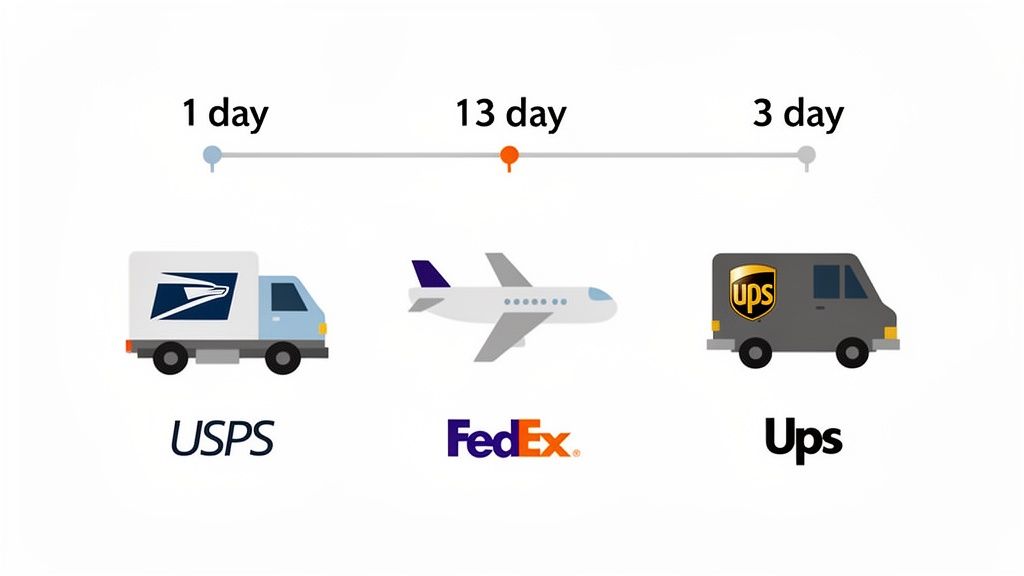
So, when you need to get a package delivered quickly within the US, who do you turn to? Let's take a closer look at the flagship priority services from the three major carriers. This table breaks down what you can realistically expect from each one.
| Carrier | Service Name | Advertised Delivery Speed | Best For |
|---|---|---|---|
| USPS | Priority Mail | 1–3 Business Days | Cost-effective shipping for packages up to 70 lbs, especially to residential and rural addresses. |
| FedEx | FedEx 2Day | 2 Business Days | Time-sensitive business documents and packages that need reliable, day-definite delivery. |
| UPS | UPS 2nd Day Air | 2 Business Days | Businesses that need guaranteed second-day delivery with robust tracking and service options. |
As you can see, the term "priority" can mean slightly different things. Both FedEx and UPS offer a day-definite 2-day service, while USPS provides a more flexible 1-3 day window that often comes at a lower price point.
It's also easy to get USPS Priority Mail confused with its Flat Rate options. While they often work together, they aren't the same thing. To get a better handle on the nuances, it's worth checking out our detailed comparison of flat rate vs priority mail shipping. Knowing these distinctions is the first step toward picking the right service and keeping your customers happy.
What Does Priority Shipping Actually Mean
When a customer clicks "priority shipping" at checkout, they're expecting their order to arrive sooner. But what are they actually paying for? It’s not just about a faster truck.
Think of it as buying a fast pass at an amusement park or getting TSA PreCheck at the airport. You aren't making the roller coaster or the airplane move any quicker; you're just getting to skip the long lines.
That's exactly what priority shipping does for a package. It's a ticket to the front of the line, ensuring it gets special treatment from the moment it leaves your facility.
The Journey of a Priority Package
So, what does this "special treatment" look like in practice? It all comes down to cutting down on idle time.
Imagine a truck overflowing with packages pulling into a massive sorting hub. As soon as it's unloaded, carrier staff are trained to spot and separate the priority parcels from the sea of standard ground shipments. These packages get whisked away to be sorted first.
This "first on, first off" approach is the secret sauce. Instead of sitting on a pallet for hours waiting its turn, your package is immediately processed and sent to the next outbound truck or plane.
Priority shipping is less about the truck driving faster and more about your package spending less time waiting. It’s a pass to the front of every logistical line it encounters.
By minimizing dwell time at every hub, the package can leapfrog standard mail and keep moving, shaving precious hours or even days off its total journey.
More Than Just Speed
But the premium you pay for priority shipping often buys more than just a speed advantage. Carriers bundle in other valuable features that enhance the entire delivery experience and help justify the higher price tag.
These perks are a big reason why offering priority options can actually reduce your support headaches.
Key benefits often bundled with priority services include:
- Enhanced Tracking: Priority packages almost always get more detailed and frequent tracking scans. This gives you and your customers a much clearer picture of the shipment's progress, which is a lifesaver for cutting down on those "Where is my order?" calls.
- Included Insurance: Most priority services, like USPS Priority Mail, come with a baseline level of insurance (usually up to $100). It’s a built-in safety net that protects against loss or damage without you having to purchase it separately.
- Broader Service Area: Many carriers will deliver priority packages six days a week, including Saturdays, for no extra charge. This can easily knock a full day off the delivery window, especially for orders placed on a Thursday or Friday.
At the end of the day, "priority" is a promise of efficiency. It's an assurance that a package will be treated with urgency at every step, creating a more reliable and transparent experience for everyone involved.
What Actually Affects Priority Delivery Times
So, you see that “1-3 day” delivery window for priority shipping and think it’s a guarantee. It’s not. In reality, that estimate is more of a best-case scenario, a well-educated guess from the carrier. A whole host of real-world factors can shift that delivery day, making the actual arrival time a moving target.
For anyone managing operations or customer support, knowing what these variables are is the key to setting realistic expectations and figuring out what went wrong when a package gets delayed.
The Two Clocks of Shipping Speed
First, we need to talk about the two different timelines that are always running: fulfillment time and shipping time. Customers tend to lump these together, but for any merchant, they are two completely separate stages of the journey.
- Fulfillment Time: This is everything that happens inside your four walls. It’s the time it takes your team to get an order, walk the warehouse aisles to pick the items, pack them securely in a box, and print that shipping label.
- Shipping Time: This clock doesn't start until the carrier—be it USPS, FedEx, or UPS—physically picks up the package and scans it. This is the part that corresponds to the “1-3 business days” promise.
A slow fulfillment process is a common culprit for missed delivery windows. If your warehouse takes 48 hours just to get an order out the door, a 2-day priority shipment instantly becomes a 4-day wait for your customer. The carrier hasn't even seen the package yet, but you're already two days behind.
Geographic and Carrier Constraints
Once a package is finally in the carrier’s hands, its journey is still subject to plenty of variables. The efficiency of a carrier's route optimization logistics is a massive factor in how quickly that priority package gets from point A to point B.
This is how carriers are supposed to handle these expedited packages.
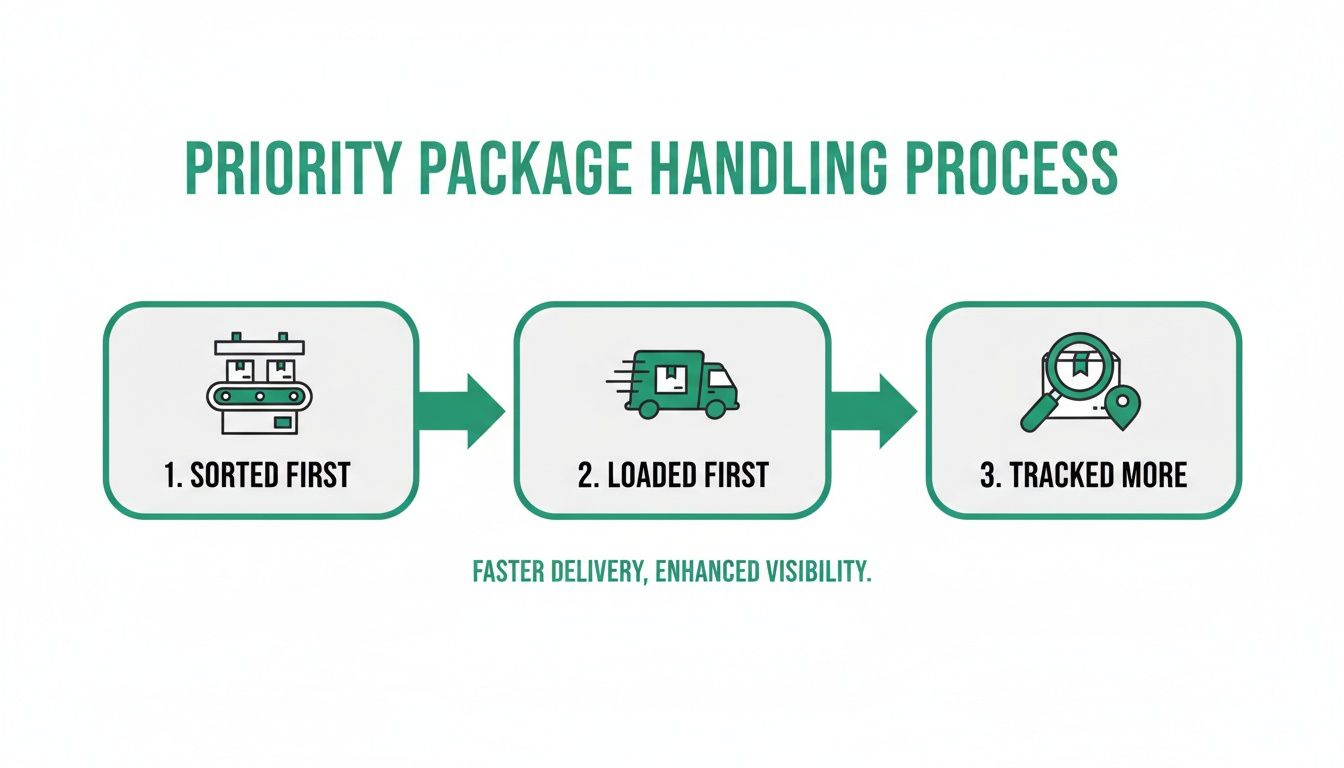
As you can see, priority packages get the VIP treatment—they’re sorted first, loaded onto trucks and planes first, and tracked more diligently. This system is designed to shave off as much time as possible, but it can’t account for everything.
Several other logistical hurdles can still add delays:
- Origin and Destination: A package going from a major hub like Chicago to another like Atlanta will almost always be faster than one traveling from rural Wyoming to a small town in Florida. More ground to cover and fewer direct transit routes mean more handoffs and more chances for a delay.
- Carrier Cutoff Times: Every single carrier facility has a strict cutoff time for daily pickups. If your package gets dropped off at 5:01 PM and their cutoff was 5:00 PM, it’s not going anywhere until the next business day. That one minute can cost you a full day.
- Weekends and Holidays: Remember, carriers count in “business days.” An order placed on a Friday with 2-day shipping isn't going to show up on Sunday. It will likely arrive the following Tuesday or even Wednesday, since Saturday and Sunday typically don't count as transit days.
A priority shipping promise is a delicate dance between your own internal fulfillment speed and the carrier's vast, complex logistics network. A hiccup in one area can completely erase any speed gained in the other.
Getting a handle on these moving parts helps you give customers more accurate estimates and quickly troubleshoot issues before they turn into frustrated support tickets. If you want to really tighten up your end of the bargain, take a look at our guide on https://www.getselfserve.com/post/delivery-route-optimization. Nailing down your internal processes is the first step to truly delivering on the promise of speed.
Understanding Priority Speeds for International Orders
When an order crosses a border, the word "priority" changes its meaning entirely. If you're used to domestic priority shipping arriving in just a few days, you'll need to adjust your expectations. A realistic timeline for most international priority shipments is 6-10 business days, and that's often on the optimistic side.
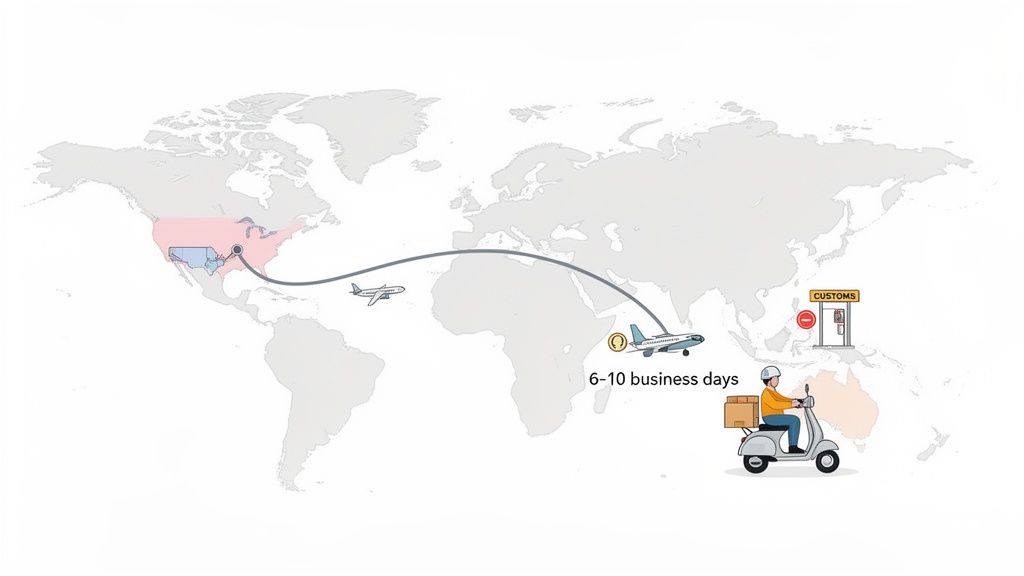
It helps to think of an international shipment like a long-distance relay race. The first leg is a sprint—getting the package from your warehouse to the departure airport. But after that, the baton is passed through a series of complex handoffs, and each one is a new opportunity for delay.
The Customs Clearance Bottleneck
The biggest and most unpredictable hurdle is always customs clearance. This is where government agents in the destination country inspect the package, check the paperwork, and figure out if any taxes or duties are owed. A priority label gets your package to the front of the line, but it absolutely does not let you skip it.
Even a tiny mistake on the customs declaration can be a disaster. A vague product description or a slightly off valuation might flag the package for a secondary inspection, which can easily add days or even weeks to the delivery time. This is the single biggest reason international priority shipments get stuck.
For international orders, “priority” is less about guaranteed speed and more about being first in line for each step of a very long journey. It prioritizes the package for customs review and handoff to local carriers, but it can’t eliminate those steps.
The good news is that technology is starting to chip away at these delays. We know that 73% of shoppers will bail on a purchase if they don't see a fast, trusted shipping option, but they're also sensitive to cost. Carriers like DHL are using AI-powered logistics to bring their average international priority transit times down to 6-8 days, a big improvement from the 10+ days that were common just a few years ago. You can learn more about these developments from these shipping trends that are shaping 2026 on dclcorp.com.
Last-Mile Delivery and Final Handoffs
Even after a package finally clears customs, it isn't home free. It still has to make it through the "last mile" of its journey, which means being handed off to a local postal service or a regional courier.
The quality of these local partners varies wildly from country to country. In Germany, your package might be handed to the incredibly efficient Deutsche Post. In a more remote region, it could go to a less predictable service. These final handoffs can tack on significant and often frustrating delays to the total delivery time. For a closer look at how one of the major players handles this, check out our guide to FedEx International First.
Meeting Customer Expectations for Priority Orders
The real secret isn’t just getting the box out the door quickly. It's about building transparency and control into the entire experience, from the moment they click "confirm order" to the second it lands on their doorstep. This is your chance to prove that the upgrade was worth every penny.
Give Customers the Tools to Help Themselves
Think about the number one cause of frantic "where's my order?" support tickets: anxiety. A customer is watching the clock, and a simple typo in their shipping address could derail the whole thing. Instead of waiting for them to panic and contact you, what if you let them fix it themselves?
By giving customers a short window after purchase to correct their own address, you can head off one of the biggest reasons for delivery delays before the label is even printed. It’s a simple feature that can have a massive impact on your support queue.
You can easily add a self-service widget to your order status page. This lets customers quickly fix a typo, update their phone number, or even cancel the order within a time limit you define. Giving them this small bit of control goes a long way in reducing their stress and reinforcing the high-end feel of their purchase.
Turn Potential Problems into Positive Experiences
With global parcel volume expected to hit a staggering 236 billion packages by 2026, mistakes are bound to happen. That’s a $538 billion market with over 647 million packages flying around every single day. For businesses expanding overseas, where 30% of brands are now selling, the risk of an address error is even higher. You can dig into more of this data in the full State of the Industry Report on globaltranz.com.
Smart tools that include multilingual support and automatic Google Maps validation are no longer a luxury; they're essential for ensuring your priority orders arrive without a hitch.
But a great post-purchase experience can do more than just prevent problems—it can also boost your bottom line. The order confirmation page is prime real estate. The customer is already in a buying mood, so why not let them add a related item to their order with one click?
Here are a few actionable ways to nail the post-purchase experience:
- Set a Clear Edit Window: Give customers a set amount of time, like one hour, to make changes before the order is locked for fulfillment.
- Validate Addresses Instantly: Use an address verification tool to catch typos as they happen, guiding the customer to a correct format.
- Offer Smart Upsells: Let customers add a complementary product to their order before it ships, increasing the average order value without extra shipping costs.
Putting these ideas into practice helps you get ahead of issues, exceed the high expectations tied to priority shipping, and create a genuinely better customer experience.
Common Questions About Priority Shipping Speed
Even after you get the basics down, the world of priority shipping can still be tricky. There are little nuances that often trip up both customers and the merchants serving them. Questions about guarantees, the difference between service levels, and what to do when a package is late are practically universal. Let's tackle some of the most common ones head-on.
Getting ahead of these questions on your website can save your support team a mountain of work and help your customers choose the right shipping option from the start.
What Is the Difference Between Priority and Express Shipping?
This is a classic. The simplest way to look at it is the difference between "fast" and "fastest." They’re two totally different service tiers built for different levels of urgency.
Priority Shipping is your go-to for faster-than-normal delivery. It’s the workhorse of expedited shipping, promising arrival in about 1-3 business days for most domestic packages. It’s a solid step up from standard ground shipping and strikes a great balance between speed and cost.
Express Shipping is the top-tier, time-guaranteed service. This is what you choose when a package absolutely, positively has to be there overnight or by a specific time the next business morning. Carriers like FedEx and UPS save their strongest money-back guarantees for these premium Express services.
So, if you have a critical document that must land on a desk by 10 AM tomorrow, Express is your only real choice. But if you just need something to get there quickly without the absolute urgency, Priority is almost always the more practical and affordable route.
Is Priority Shipping Guaranteed to Arrive in the Stated Time Frame?
This is where a lot of confusion comes from. The short answer is generally, no.
For most carriers, that 1-3 day window for services like USPS Priority Mail is a delivery estimate, not a firm promise backed by a money-back guarantee. While these packages are definitely given preferential treatment over standard mail and are highly reliable, they aren't bulletproof.
A priority shipping timeline is a target, not a contract. Things like severe weather, a massive holiday rush, or even just a final destination in a remote area can all push the delivery date back without it being considered a service failure.
Services like FedEx 2Day or UPS 2nd Day Air do have a clearer day-definite commitment, but even then, the most ironclad guarantees are saved for their top-of-the-line Express options. It's so important for merchants to set this expectation clearly. Frame "priority" as an expedited service that is expected to arrive on time, but not promised.
How Can I Reduce Support Tickets About Priority Shipping?
When it comes to cutting down on those "Where Is My Order?" (WISMO) tickets, transparency and self-service tools are your best friends. A proactive strategy can stop the vast majority of these questions before a customer even thinks to hit "contact us."
First, be painfully clear on your shipping policy and FAQ pages. Spell out your internal processing time and the carrier's estimated shipping time. For example: "Our team ships all orders in 1-2 business days. Priority shipping is an estimated 1-3 business days after your order leaves our warehouse."
Second, put the power back in your customers' hands. A good post-purchase solution allows them to manage their own order without needing to ask for help.
Look for key self-service features like:
- Order Tracking: Give them one clear, easy-to-find link to track their package right from their order status page.
- Address Correction: Let customers fix their own address typos within a short window (say, the first hour after purchase). Since a bad address is a leading cause of delays, this nips the problem in the bud.
- Order Cancellation: Provide a simple "cancel" button for orders that haven't been fulfilled yet. This avoids a lot of unnecessary back-and-forth emails.
This kind of proactive setup not only empowers your customers but also takes a huge load off your support team, freeing them up to focus on more complex issues that actually require a human touch.
What Should I Do if My Priority Shipment Is Late?
If a priority package blows past its expected delivery date, don't panic. Your first move should always be to check the official tracking page for the latest updates. More often than not, the package is just delayed by a day and you'll see a new estimated delivery date already posted.
If you don't see any tracking updates for several days, or if the status shows an alert, it’s time to contact the carrier directly with your tracking number. They can launch a package search or give you more specific details on what's going on.
For merchants, it's a fantastic practice to keep an eye on these higher-value shipments yourself. If you notice a significant delay, reaching out to the customer before they even know there's a problem can turn a potentially bad experience into a great one. A quick email that says, "Hey, we noticed a delay with your priority order and are looking into it for you," shows you're on top of it and that you really care.
By giving customers more control and total transparency, SelfServe helps Shopify merchants dramatically cut down on support tickets related to shipping. Let your customers fix their own address mistakes and track their orders with ease, all while you boost your average order value with built-in upsells. Start your 30-day free trial of SelfServe today and perfect your post-purchase experience.